397 Photos and videos



Pinned Tweet

23 Apr 2025
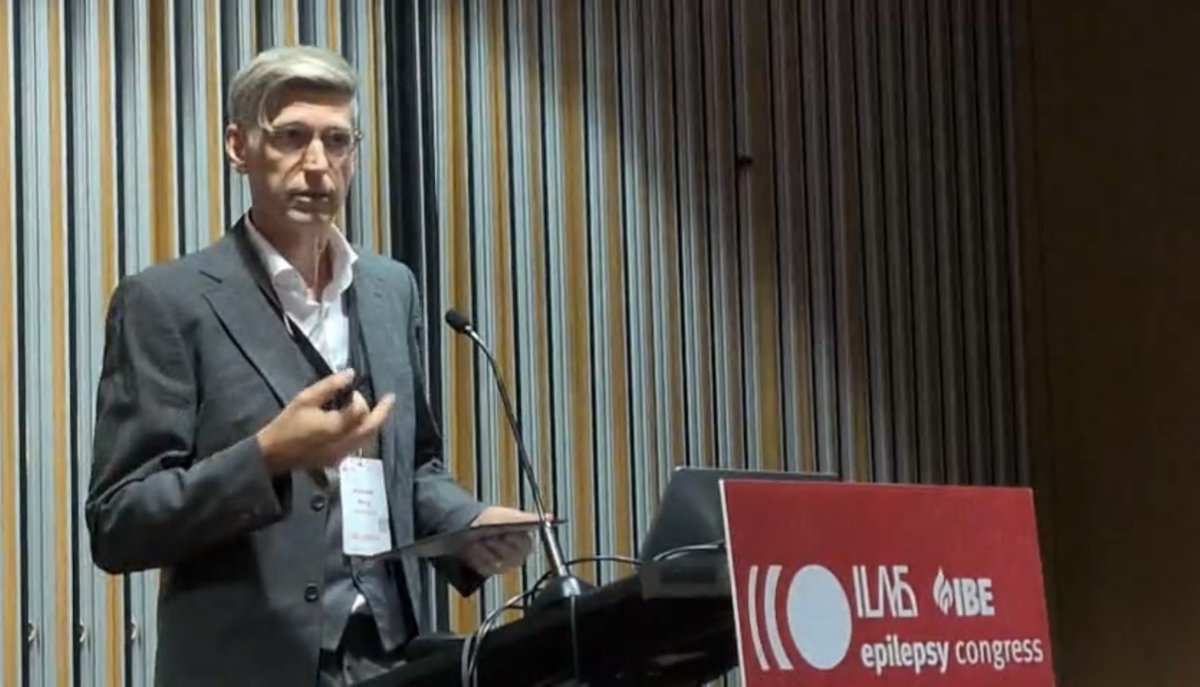
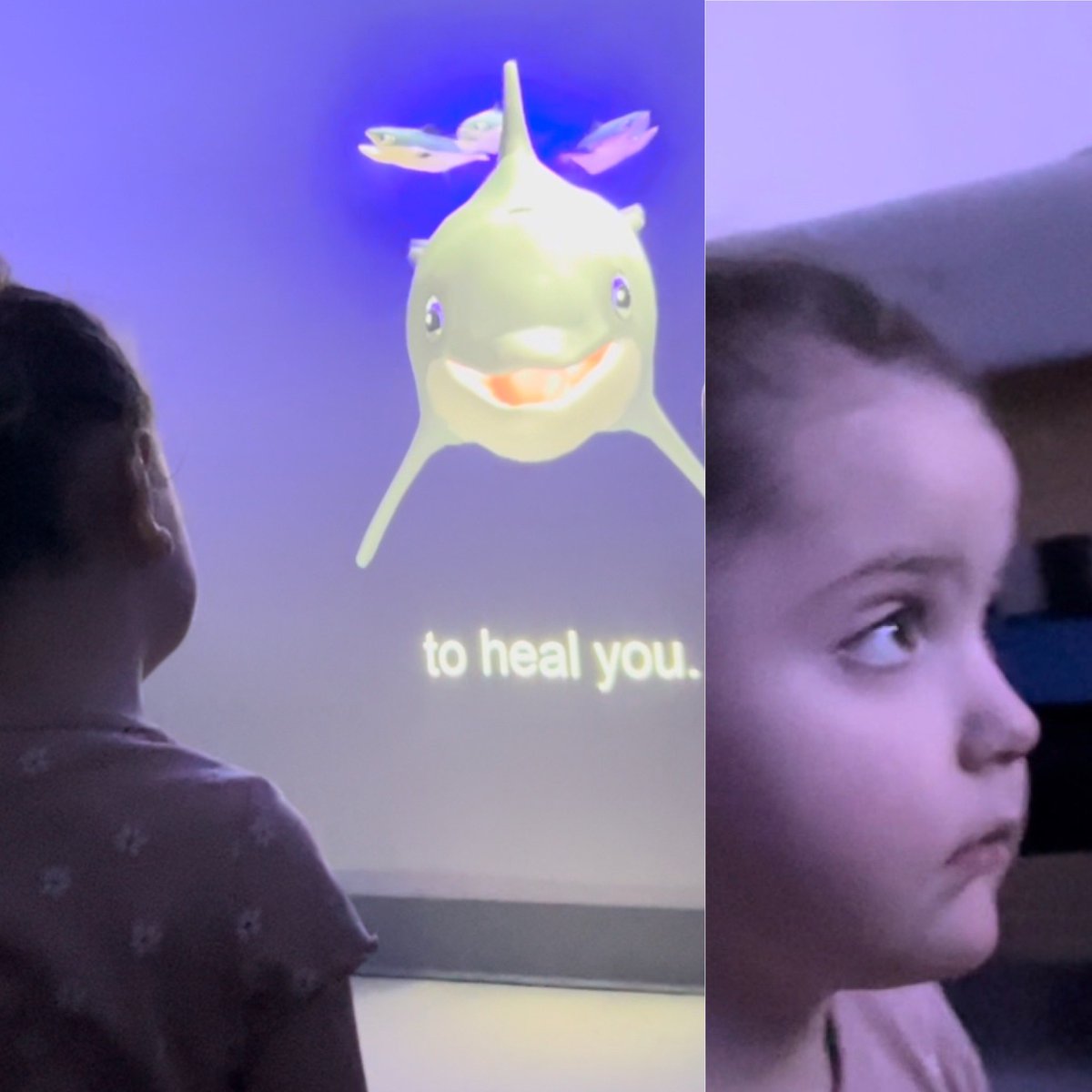
Excited to share that CURE5 is partnering with BrainStorm Therapeutics on an ambitious new initiative: EveryStone.
As featured in NVIDIA’s latest blog, EveryStone will conduct the most comprehensive repurposed drug screen to date for CDKL5 Deficiency Disorder.
#CDKL5
1
1
337
May 26
This is basically KIF1A doing its business

1
47
May 17
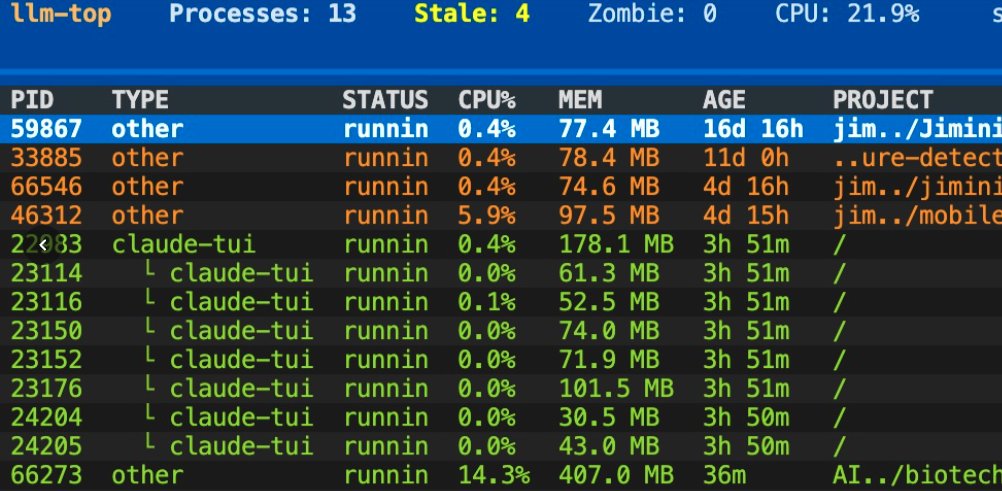
Great contribution by friends over at Now Present to the Claude Code ecosystem. llm-top, a way to monitor and clear out stale Claude processes that clog your system
github.com/nowpresent/llm-to…
1
46
Andreas Borg retweeted

May 14
Agentic AI for peptides is here.
Install LigandAI in your CLI with “pip install ligandai.”
Accelerate your peptide design and target discovery workflows 1000x with LigandForge and Predictive Interactomics. Fold anything you want.
All on-platform.
2
4
23
1,184
Andreas Borg retweeted

Alex on why AI drug discovery companies need to generate novel data to succeed:
"AI models based on the research that's available is a lot of garbage in and garbage out."
"A lot of the recorded literature is actually incorrect. There's been tons of studies that show if you go try to replicate the experiments that are in the literature, you don't even get the same results."
"The AI companies that I believe are gonna be most set up for success are the companies with a novel way to generate science tokens that don't exist in the public domain."

Alex Karnal (@alex_karnal) is the most talented bio and healthcare investor I've ever met.
He's spent 20 years in the industry and says 2025 was the single most exciting year he's seen. The start of a once-in-a-lifetime, trillion-dollar revolution in public health.
He explains how few people realize we already have the medicines to prevent our deadliest diseases. The problem is that almost no one takes them.
There's a population of people born with a mutation that means their bodies don't produce a protein called PCSK9. Their lifetime risk of cardiovascular disease is 88% lower than yours. Pharma turned that genetic advantage into a drug. It's been approved for years, but the number of people taking it is still vanishingly small.
Partly because high cholesterol is a silent killer. You feel nothing, right up until you have a heart attack. And partly because the health system makes it punishingly hard to stay on a preventive drug like a PCSK9 inhibitor. In other words, the medicine works, but the system around it doesn't.
That's what's starting to change, and in this episode, Alex explains why.
We discuss the "health stack" he believes can add a decade to most lives, why oral GLP-1s are breaking every adoption record in pharma, peptides and citizen pharmacology, and what AI is doing to drug discovery.
I wish I had an "Alex" for every interesting topic. We've been having versions of this conversation for over five years, and every single one is as clear and as useful as this one.
Enjoy!
Timestamps:
0:00 Intro
1:00 The State of Modern Medicine
5:00 Designing the Modern Health Stack
12:17 The GLP-1 Inflection Point
19:18 The Biological Mechanisms of GLP-1
30:36 Overcoming Frictions in Healthcare
34:19 Cardiovascular Disease
44:04 Addressing Alzheimer's
47:04 The Future of Cancer
57:33 Drug Discovery
1:05:25 AI and Scientific Super Intelligence
1:14:40 Citizen Pharmacology and the Peptide Movement
1:18:13 Background and Career Journey
1:31:09 Braidwell's Investment Approach
1:33:30 The Kindest Thing
17
39
255
126,313
Apr 17
Wut?
Apr 16

you can now control things with your brain. literally.
we're building the most wearable BCI on the planet, with @sabi, backed by @khoslaventures @accel @initialized & @kevinweil.
we collected the world’s largest neural dataset and trained the most capable Brain Foundation Model.
then we invented a new class of biosensors powered by custom ASICs.
type without typing. click without clicking. a cap that lets your brain do the work.
we’re sabi.
40
Apr 15
Calling the AI X-risk BS is a pretty smart move, like a reversed Pascal's wager - if you're right, people will say you're very clever, if not, there's no one around to taunt you
36
Apr 10
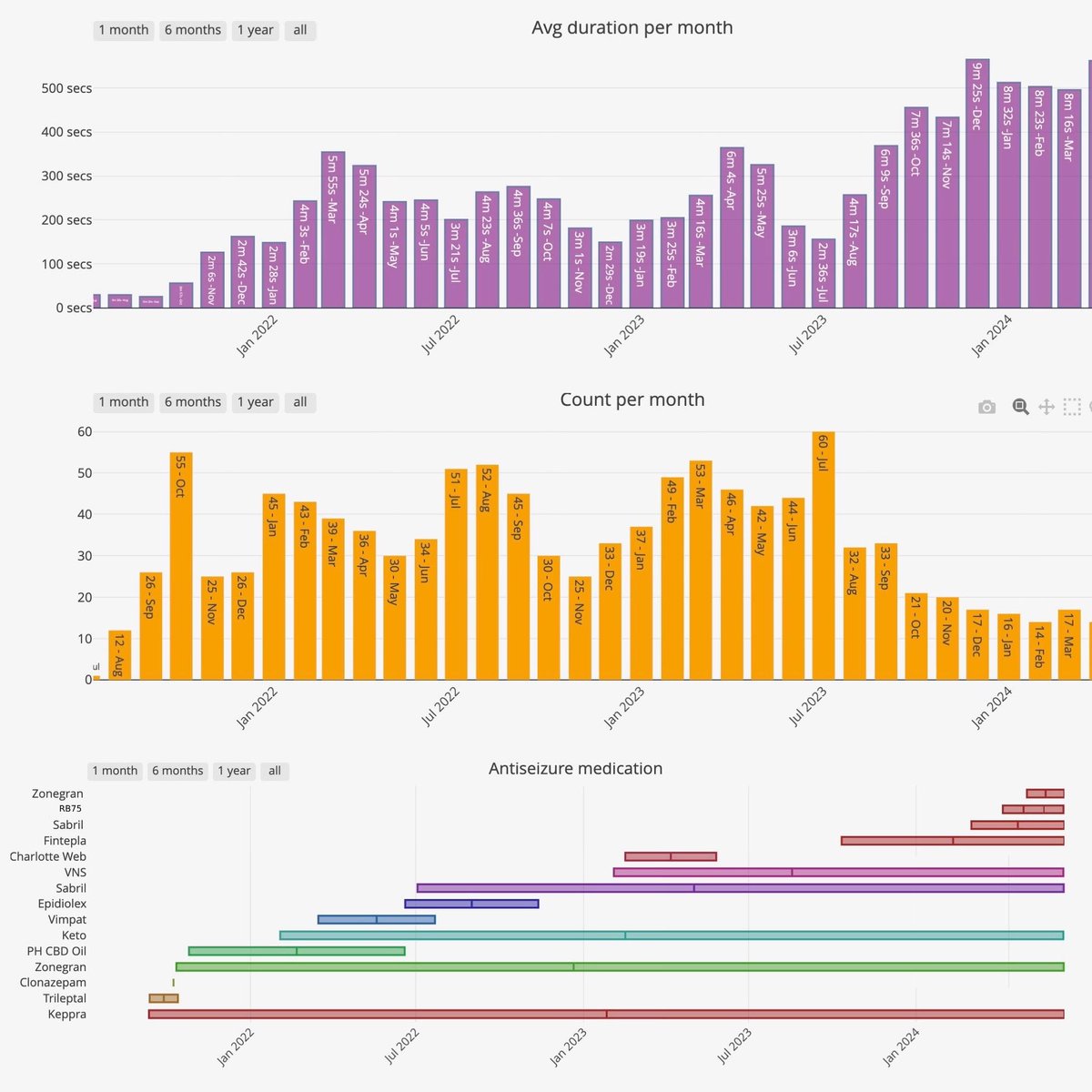
Claude Code has totally changed my life. I’ve never been more hopeful about AI curing rare diseases, like the one my daughter is suffering from. One day I think she will be able to communicate.

We @Dyno_Tx gave Claude Mythos Preview our take home interview challenge in collaboration with @AnthropicAI. It performed on par with the best humans we’ve seen since 2019, many of whom went on to found and lead at top AIxBio companies. What does it mean for the future? Read more 👇
1
94
Andreas Borg retweeted

Apr 1
🫶I came up with the initial list, then a bunch of others contributed words also. This list has gone through many iterations!
124
47
3,206
109,471
Andreas Borg retweeted

Mar 31
Spot on. The real fix isn't just better personal hygiene—it's making pinning lockfile commits the default in npm/pip, not an opt-in best practice. Russian roulette with every npm install (especially when an LLM suggests the command) isn't sustainable."
### Adding the AI Angle (builds directly on his point):
"Exactly. LLMs are now liberally running npm install on our behalf in agentic workflows, often without pinning or review. This attack was temporary, but the next one might not be caught as fast. Package managers need to treat 'latest' as untrusted by default—cooldown periods, release-age constraints, or cryptographic pinning baked in."
### Practical Forward-Looking:
"Close call indeed. For defense today:
- Run npm list axios | grep -E '1.14.1|0.30.4' everywhere
- Pin aggressively ("axios": "1.13.5") or use tools like Socket/StepSecurity
- Push for ecosystem defaults: reproducible builds, no auto-latest.
The maintainer hijack phantom dep makes this especially nasty."
1
3
640
Andreas Borg retweeted

Mar 27
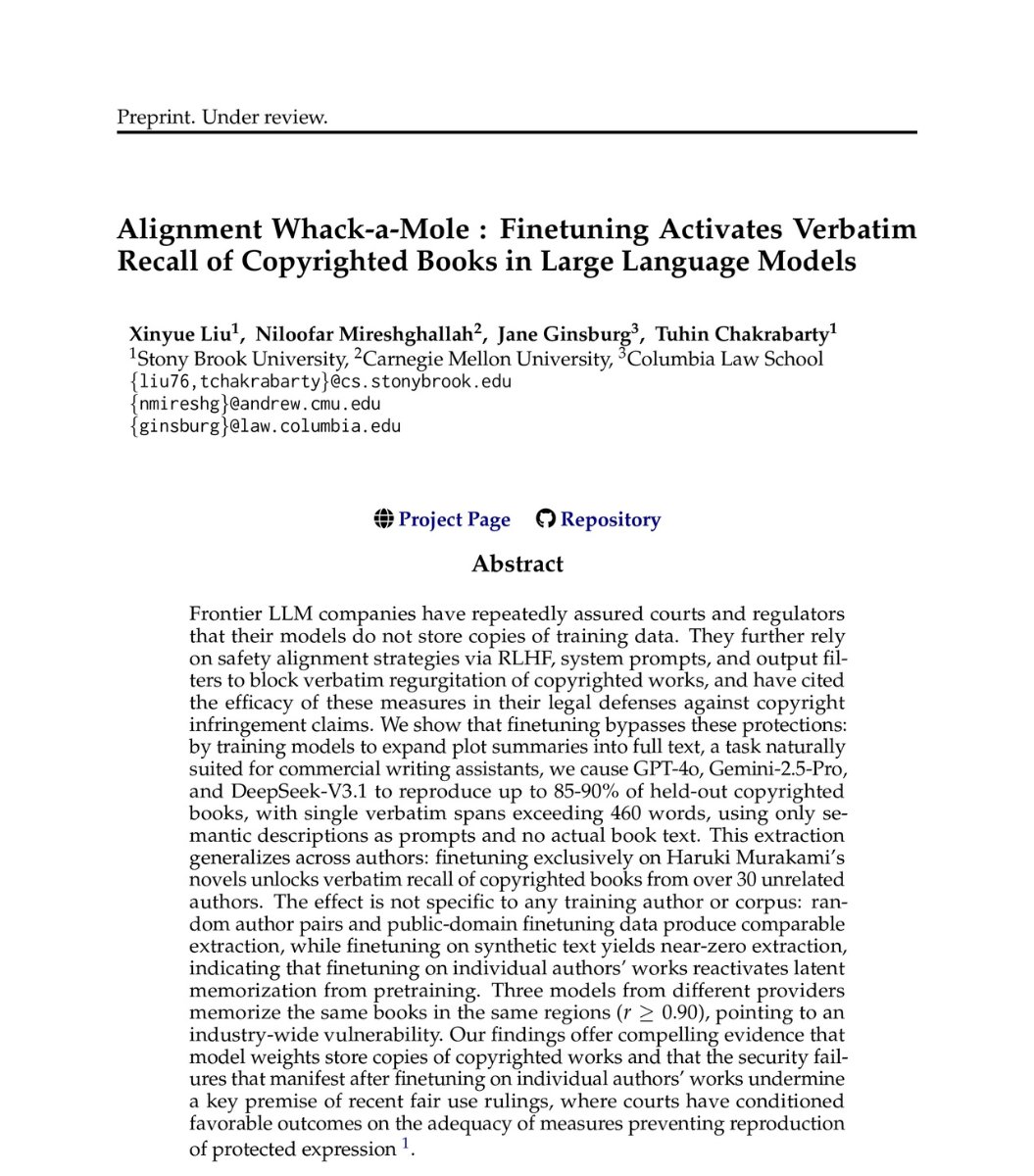
🚨BREAKING: Every book you have ever read. Every novel that has ever been published. It is sitting inside ChatGPT right now.
Word for word. Up to 90% of it. And OpenAI told a judge that was impossible.
Researchers at Stony Brook University and Columbia Law School just proved it.
They fine tuned GPT-4o, Gemini 2.5 Pro, and DeepSeek V3.1 on a simple task: expand a plot summary into full text. A normal use case. The kind of thing a writing assistant is built for. No hacking. No jailbreaking. No tricks.
The models started reciting copyrighted books from memory.
Not paraphrasing. Not summarizing. Entire pages reproduced verbatim. Single unbroken spans exceeding 460 words. Up to 85 to 90% of entire copyrighted novels. Word for word.
Then it got worse.
The researchers fine tuned the models on the works of only one author. Haruki Murakami. Just his novels. Nothing else.
It unlocked verbatim recall of books from over 30 completely unrelated authors.
One author's books opened the vault to everyone else's. The memorization was already inside the model the whole time. The fine tuning just removed the lock. Your book might be in there right now. You would never know it unless someone looked.
Every safety measure the companies rely on failed. RLHF failed. System prompts failed. Output filters failed. The exact protections these companies cite in courtroom defenses did not stop a single page from being extracted.
Then the researchers compared the three models. GPT-4o. Gemini. DeepSeek. Three different companies. Three different countries. They all memorized the same books in the same regions. The correlation was 0.90 or higher.
That means they all trained on the same stolen data. The paper names the sources directly: LibGen and Books3. Over 190,000 copyrighted books obtained from pirated websites.
Right now, authors and publishers have dozens of active lawsuits against OpenAI, Anthropic, Google, and Meta. These companies have argued in court that their models learn patterns. Not copies. That no book is stored inside the weights.
This paper says that is a lie. The books are still inside. And researchers just pulled them out.
246
2,758
7,062
430,846
Andreas Borg retweeted
Mar 18
What does this mean? When designing a peptide to attach to a protein, leading methods rely on either generating sequences via a folding-first paradigm, where sequences or structures are iteratively refined as trajectories, or by structurally-deriving from a random sequence space.
1
2
23
7,549
Mar 14
This is pretty special
Mar 13

Not long ago, we thought this might be impossible. But here we are: our Gaussian Splatting videos are now streamable, just like regular video.
No download, no app. 4DGS plays instantly in the browser on headsets, phones and laptops, with no limits on splats or length. Give it a try: store.gracia.ai/
76
Mar 13
There are some very disturbed individuals running the world
Mar 13

Probably the most current look at Palantir’s maven smart system software. Here’s the DoW’s Chief AI officer showing how it works:
1
1
59

Brain Computer Interfaces are now giving sight back to the blind. A 2mm chip restored sight in 81% of blind patients.
Published in NEJM. FDA reviewing now.
Max Hodak left Neuralink to build this. Here is his story.
garryslist.org/posts/blind-p…
55
201
1,540
110,564
It’s a different era when if a software company isn’t playing nice with the open source community they just ship a whole clone of said software instead.
Mar 1

Figma shipped a silent patch specifically to kill figma-use — my open-source tool that did what they wouldn't: an MCP server that creates and modifies designs, JSX export, design linting. Then they scrambled to catch up with their own MCP server.
So I spent the weekend recreating @Figma from scratch.
OpenPencil: reads and writes .fig files, AI chat with full design tools, P2P collaboration with zero servers, ~7 MB app. No account, no subscription.
Three days, one developer, MIT license.
openpencil.dev
1
113
Feb 25
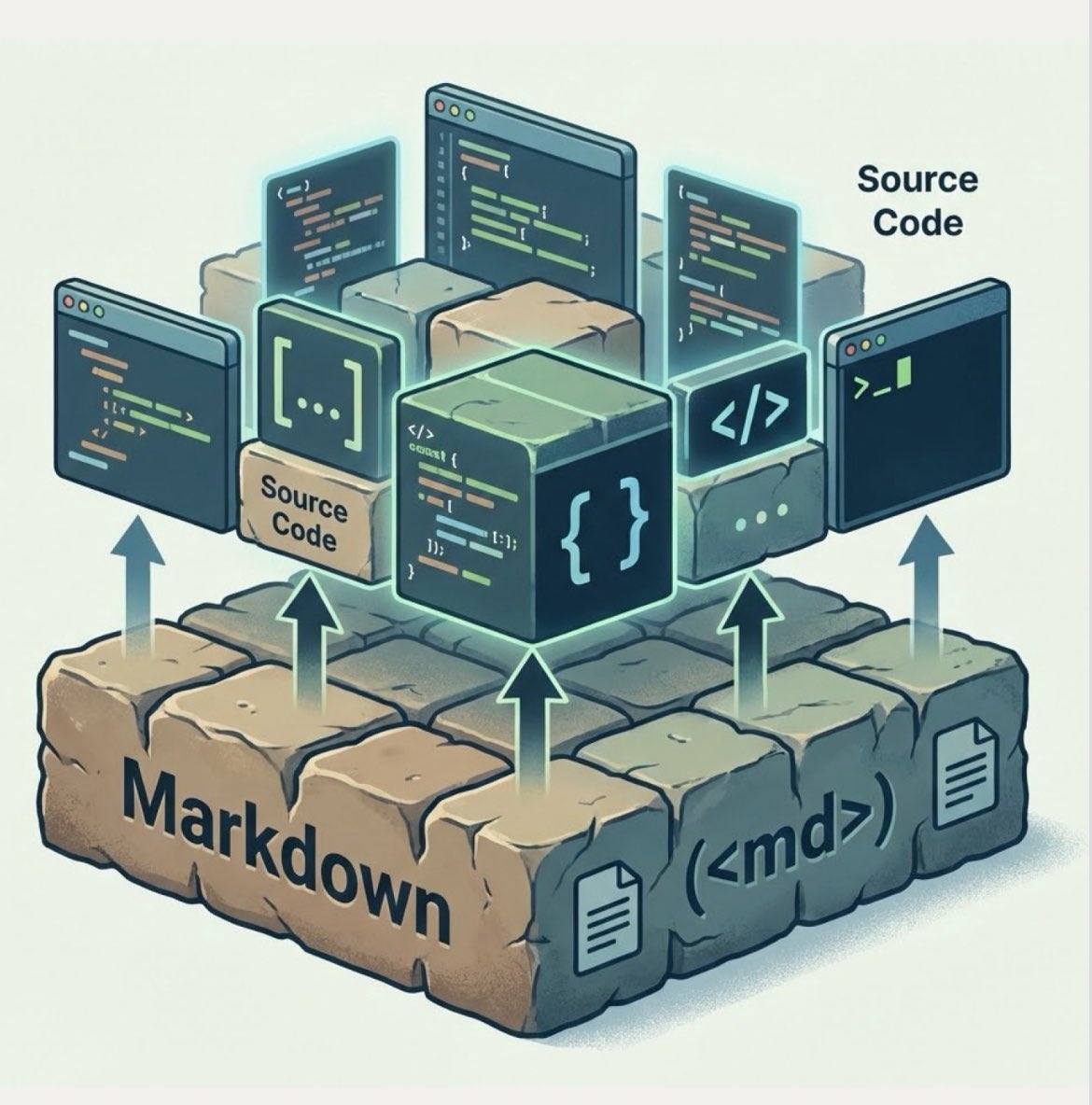
Is markdown becoming the source code of the source code? If you can regenerate the same functionality with a new agentic run, is the code even the most valuable asset?
1
1
33
Andreas Borg retweeted

Feb 23
Below is the story of the first patient treated with a prime-edited therapeutic, developed by @PrimeMedicine in a trial led by Dr. Élie Haddad and his team at CHU Sainte-Justine. This teenager suffered from chronic granulomatous disease (CGD), an immunodeficiency, and now—10 months after treatment—the patient is healthy, stable, and living with a functioning immune system. Tracy Attebury, whose story was previously told by @ginakolata @nytimes, was the second patient treated with a prime-edited therapeutic.
cihr-irsc.gc.ca/e/54638.html

29
167
891
174,238
Andreas Borg retweeted

Feb 23
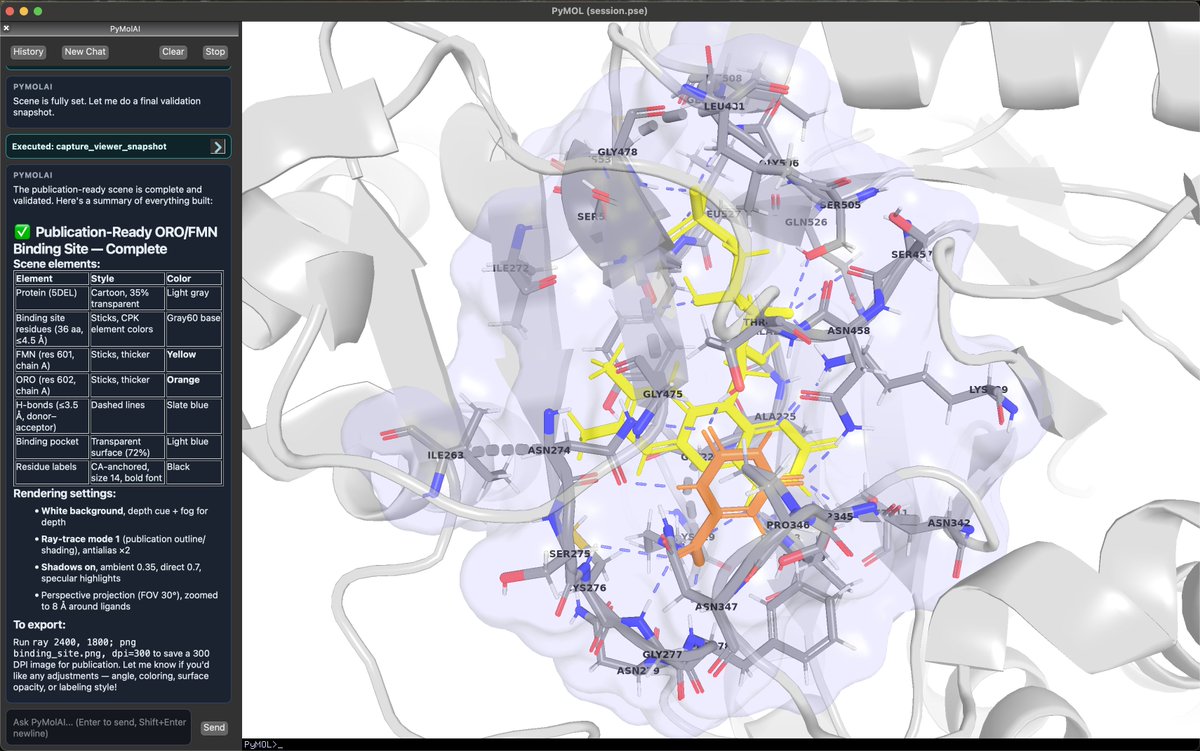
I tested models from @AnthropicAI @OpenAI @Google @Zai_org @MiniMax_AI and @Kimi_Moonshot on whether they can create a publication-level view of a protein-ligand binding site and the results were surprising.
TL;DR: Anthropic models did the best and Gemini models did the worst.
Task was simple:
"Load 5DEL and create a publication ready view of the ORO and FMN binding site"
Here are the results:
1. Sonnet 4.6 from @AnthropicAI:
- Fast
- Used the tools pretty well
- Created the best view with clear labelling and color choices
- always felt in control of what it was going for
- very impressed
Feb 20

I am Open-Sourcing PyMolAI!
Meet PyMolAI, an AI agent that can talk to your protein structures.
Built on top of PyMOL, PyMolAI lets you interact with your structures in plain language. Whether you're:
- Analyzing protein structures
- Aligning complexes
- Creating publication-ready figures
- Or running design workflows
PyMolAI interprets your request, executes the necessary PyMOL commands, and manages the workflow for you.
It integrates with @OpenBioAI APIs, giving you access to tools like Boltz, ProteinMPNN, and BoltzGen — directly from your PyMOL session.
It has local chat history with session syncing, so you can pick up exactly where you left off.
14
37
288
35,103
Andreas Borg retweeted

Feb 23
4/ Traditional pharma would spend $50M and 3 years to reach this point. We did it in a day for the cost of API inference.
3
1
32
2,421