
Author of Software Architecture with C
Joined June 2014
- Tweets 217
- Following 292
- Followers 108
- Likes 746
5 Photos and videos



Adrian Ostrowski retweeted

28 May 2025
Greetings @adr_ostrowski, We're delighted to inform you that "Software Architecture with C " made it to the list of best Software Architecture books of all time! bookauthority.org/books/best…
1
1
79
Adrian Ostrowski retweeted
25 Sep 2024
Great work @adr_ostrowski! "Software Architecture with C " has been featured in BookAuthority's list of best Software Design books of all time! bookauthority.org/books/best…
1
2
100
Adrian Ostrowski retweeted

29 Sep 2024
PayPal is updating their ToS to let themselves give your data to merchants starting Nov & they're banking on people not knowing to opt out, SO to opt out before they start: go to Settings >Data & Privacy > Manage shared info >Personalized shopping, & toggle that shit off
1,312
45,019
151,653
31,665,706

Adrian Ostrowski retweeted

12 May 2024
Telegram has launched a pretty intense campaign to malign Signal as insecure, with assistance from Elon Musk. The goal seems to be to get activists to switch away from encrypted Signal to mostly-unencrypted Telegram. I want to talk about this a bit. 1/
282
5,015
17,621
4,672,904
Adrian Ostrowski retweeted

16 Jun 2024
Zima zaskoczyła drogow... A nie, czekaj...
16 Jun 2024

Około godziny 15:00 Telewizja Polska odnotowala atak DDOS przeprowadzony z adresów IP zlokalizowanych na terenie Polski. Po niecałej minucie zaczęliśmy działania przy współpracy z operatorami krajowymi, które doprowadziły do mitygacji ataku. Służby IT przywrocily usługi.
18
20
488
50,739
Adrian Ostrowski retweeted
28 May 2024
Well done @adr_ostrowski! "Software Architecture with C " is featured in the list of best Software Design books of all time! bookauthority.org/books/best…
1
2
3
151

Adrian Ostrowski retweeted

29 Aug 2023
Prawdziwe VLOP-y istnieją i korzystasz z nich codziennie 🤳
O kampanii: vlop.me
--
CC: @TokJaniszewski @mrzemek @sylvcz @S_Wikariak @10kubawator @annawitten @DanielMaikowski @jeczjan @piotrszostak_ @Basia_Erling @maciejwmasce @szymonpalcze @bpaszcza @K_Izdebski
1
14
31
8,003
Adrian Ostrowski retweeted

27 Aug 2023
LLMs believe every datapoint they see with 100% conviction.
A LLM never says, "this doesn't make sense... let me exclude it from my training data".
Everything is taken as truth.
It is actually worse than this.
Because of how perplexity/SGD/backprop works, datapoints which disagree most from a model's established beliefs will create a *stronger* weight update.
Contradicting datapoints are taken as a higher truth than agreement.
Indeed, RHLF is the greatest example of this. You can cause a model to wildly change what it believes by forcing small amounts of contradictory data down its throat.
This is why "more data" != "more truthful", and why we must begin the gargantuan task of filtering out the enormous amounts of harmful/deceitful/illogical training data present in massive web scrapes. (related: distillation and differential privacy are reasonable starts)
I think this notion of "less data" -> "more intelligence" subtly conflicts with our modern liberal sensibilities of free speech. Human society has benefited greatly by increasing the amount of information everyone can consume (detour for another day: propaganda, public relations, targeted advertising, etc.).
However, for the LLMs we have today, we must treat them as if they are tiny children. They have no filter. They believe everything they see with 100% conviction. And this is the root of the problem. This is what value misalignment looks like.
To accomplish alignment, we need new paradigms for managing how information makes its way into an AI model. The ones we currently use are insufficient and our models will never be truly safe if they most greatly believe that which most greatly contradicts what they already know. This formula will always create unstable, fickle, and even dangerous models — with many internal contradictions amongst their parameters.
Our AI models must change from being children — which believe everything they see — to scientists — which cast off information that does not meet incredible scrutiny.
I have some ideas on how to accomplish this, but that's for another day.
98
130
968
287,723

Adrian Ostrowski retweeted

25 May 2023
I feel compelled to say this: think VERY HARD before you promise ABI stability to your users. There's no such thing as "a little ABI stable" or "mostly ABI stable". It's a lot of work.
1
12
1,191
Adrian Ostrowski retweeted

17 May 2023
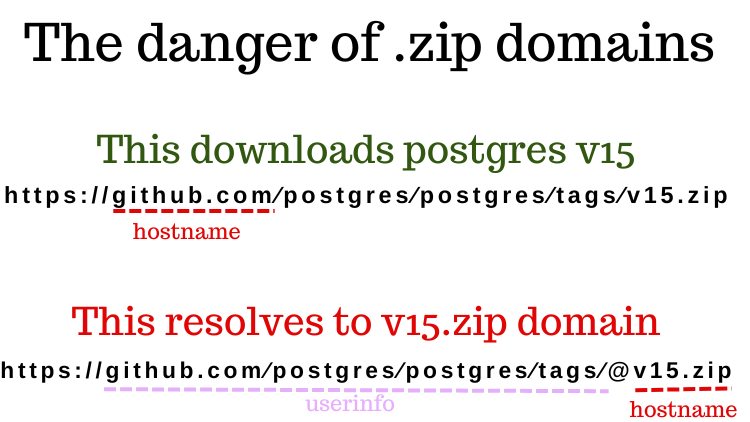
What is the difference between the two urls?
one has an @ and one doesn't.
But also the first downloads version 15 of postgres from GitHub and the second one resolves to v15 dot zip domain which can also downloads a zip file that sure doesn't have postgres in it.
You see, URLs with @ in them are split into two parts, anything before @ is user info and anything after it is the host name, however this rule is broken if what comes before @ are forward slashes.
The second URL includes a character encoded like forward slash but isn't really the real forward slash, which URL parsers ignores making anything before the @ as user info and treating whatever comes after it as the real hostname.
While this can happen on any domain, the zip domains makes it more likely to happen. When you click on a link that ends in zip especially if it looks like from GitHub you won't think twice about it.
Read the full blog from Bobbyr below.
38
728
3,119
540,879
Adrian Ostrowski retweeted

13 Apr 2023
Book of the Day: Software Architecture with C by Adrian Ostrowski (@adr_ostrowski) and Piotr Gaczkowski (@DoomHammerNG)
meetingcpp.com/mcpp/books/bo…
#cplusplus
#cpp
10
45
4,540
Adrian Ostrowski retweeted
14 Mar 2023
Book of the Day: Software Architecture with C by Adrian Ostrowski (@adr_ostrowski) and Piotr Gaczkowski (@DoomHammerNG)
meetingcpp.com/mcpp/books/bo…
#cplusplus
#cpp
4
26
2,590
Adrian Ostrowski retweeted

Agile orgs don't have QA teams, by and large. As Deming pointed out, you cannot inspect quality into a product. It has to be there to begin with. A separate QA team is an antipattern. Cross-functional teams have all the skills necessary to deliver an idea, including QA.
39
78
574
63,953
Adrian Ostrowski retweeted
11 Feb 2023
C 23 is final, the C Committee has approved the final draft to be send to ISO!
How C 23 changes the way we write code - Timur Doumler - Meeting C 2022
youtube.com/watch?v=QyFVoYca…
#cpp
#cplusplus
3
59
160
21,316
Adrian Ostrowski retweeted

11 Feb 2023
C 23 is done!
A big thanks to all who contributed over the past three years.
9
73
751
95,420
Adrian Ostrowski retweeted
11 Feb 2023
Book of the Day: Software Architecture with C by Adrian Ostrowski (@adr_ostrowski) and Piotr Gaczkowski (@DoomHammerNG)
meetingcpp.com/mcpp/books/bo…
#cplusplus
#cpp
3
33
3,172