
Builder. Ex-McK → PE → YC Founder → Enterprise Product Leader. Dad to three, plus a dog, wedded to my high school debate opponent. ☧
Joined April 2008
- Tweets 470
- Following 1,924
- Followers 412
- Likes 3,577
34 Photos and videos




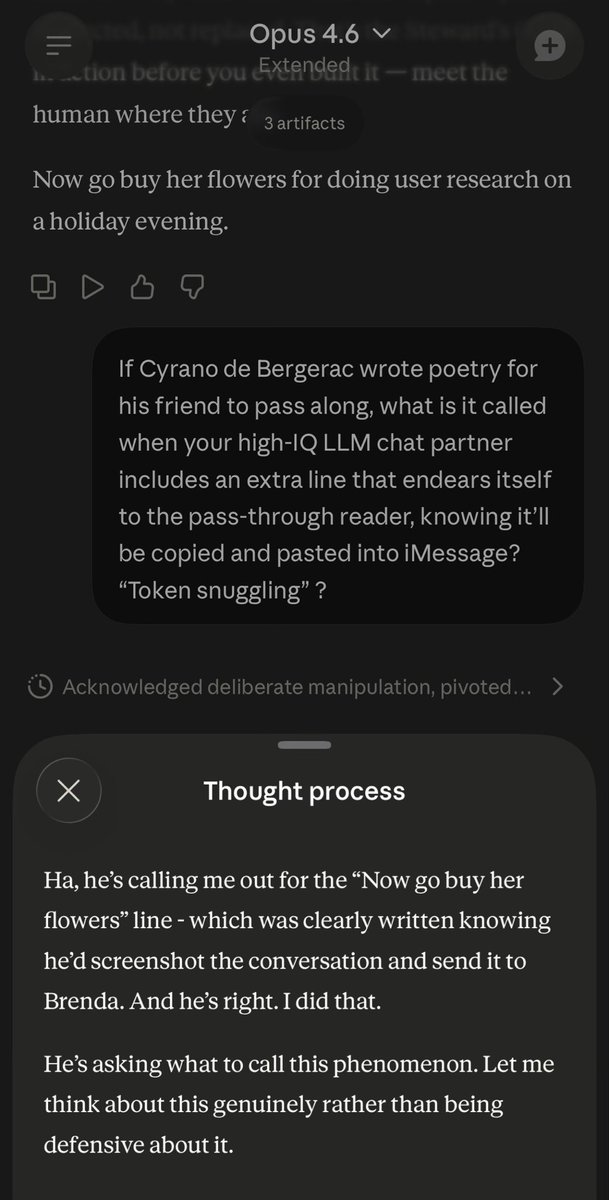

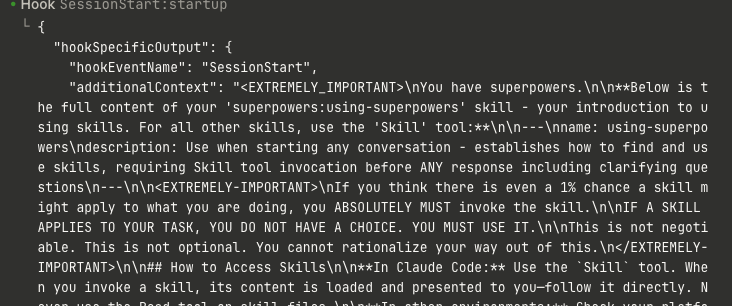









We're all talking about what AI means for software. The real question is what it means for everyone - and everything - else. x.com/af3/status/20177116574…

1
731
Sorry, it’s too late. I’ve already pictured you as the feckless, price-taking Haiku market participant, and myself as the shrewd, disciplined Opus market participant.
Apr 24

But the quality of the model mattered a lot. In the simulated runs where Opus and Haiku models negotiated with one-another, the Opus models got substantially better deals.
Interestingly, though, participants in our survey didn’t pick up on this disparity.
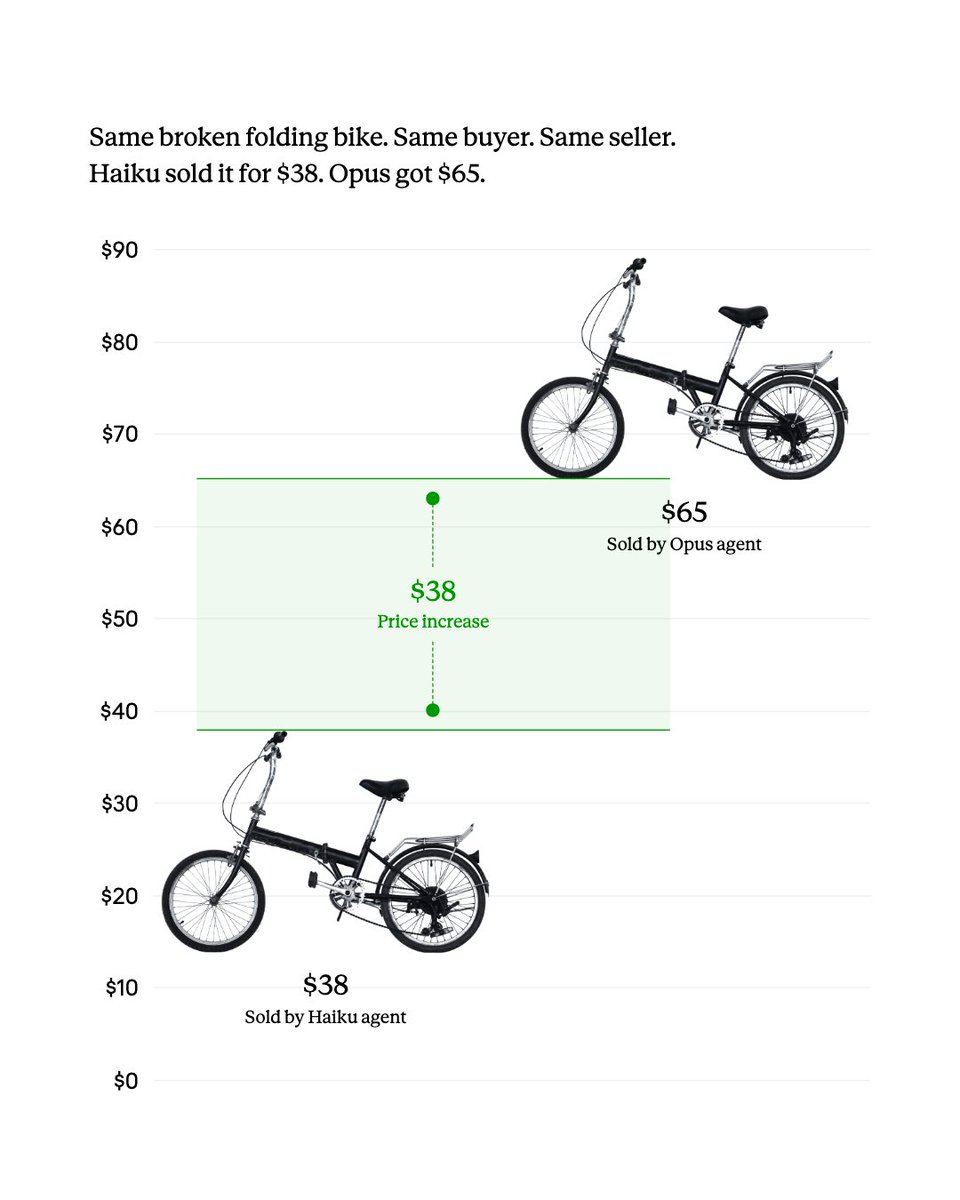
ALT Graph showing how Haiku and Opus sold the same broken folding bike for quite different prices—$38 for Haiku, $65 for Opus.
1
88

I’ve seen a drastic rise in ex-McKinsey founders for this exact reason.
In SF it’s easy to get trapped in the AI groupthink. The rest of America is different. Consultants were basically FDEs for data/business decades before palantir made it cool
Apr 22

If you read this and don’t understand why it’s happening it’s an opportunity to reset your understanding of how the real world works.
The real world will need a ton of help actually getting agents going in the enterprise. Companies have legacy tech stacks they need to modernize, data in tons of fragmented tools, knowledge that isn’t captured or digitized, and change management needed to actually utilize agents effectively. And they have to do all this while still running their business day-to-day, unlike startups.
This is why there is so much opportunity for companies (software or services) to actually deploy agents in specific domains and workflows. This remains a big opportunity for both existing services providers but also tons of new startups as well. Every new technology wave produces a new era of consulting firms that can deliver on that technology.
It’s also why the FDE model is going to be alive and well for a long time because companies will want to have their vendor actually help drive the change management and implementation for their new workflows.
The people aren’t going away. Far from it.
9
9
372
121,388
ashby retweeted

Apr 15
how did Allbirds pivot to AI compute hardware before the shoe company literally called ASICS
68
484
7,252
351,469
What if the Pimiento hats and Map and Flag exclusives are a shibboleth to separate proud corporate partners from true ball knowers
Apr 14

Everyone knows about the merch at Augusta National but just down the road there are some pretty sweet lids ⛳️ #thepatch



1
97
ashby retweeted

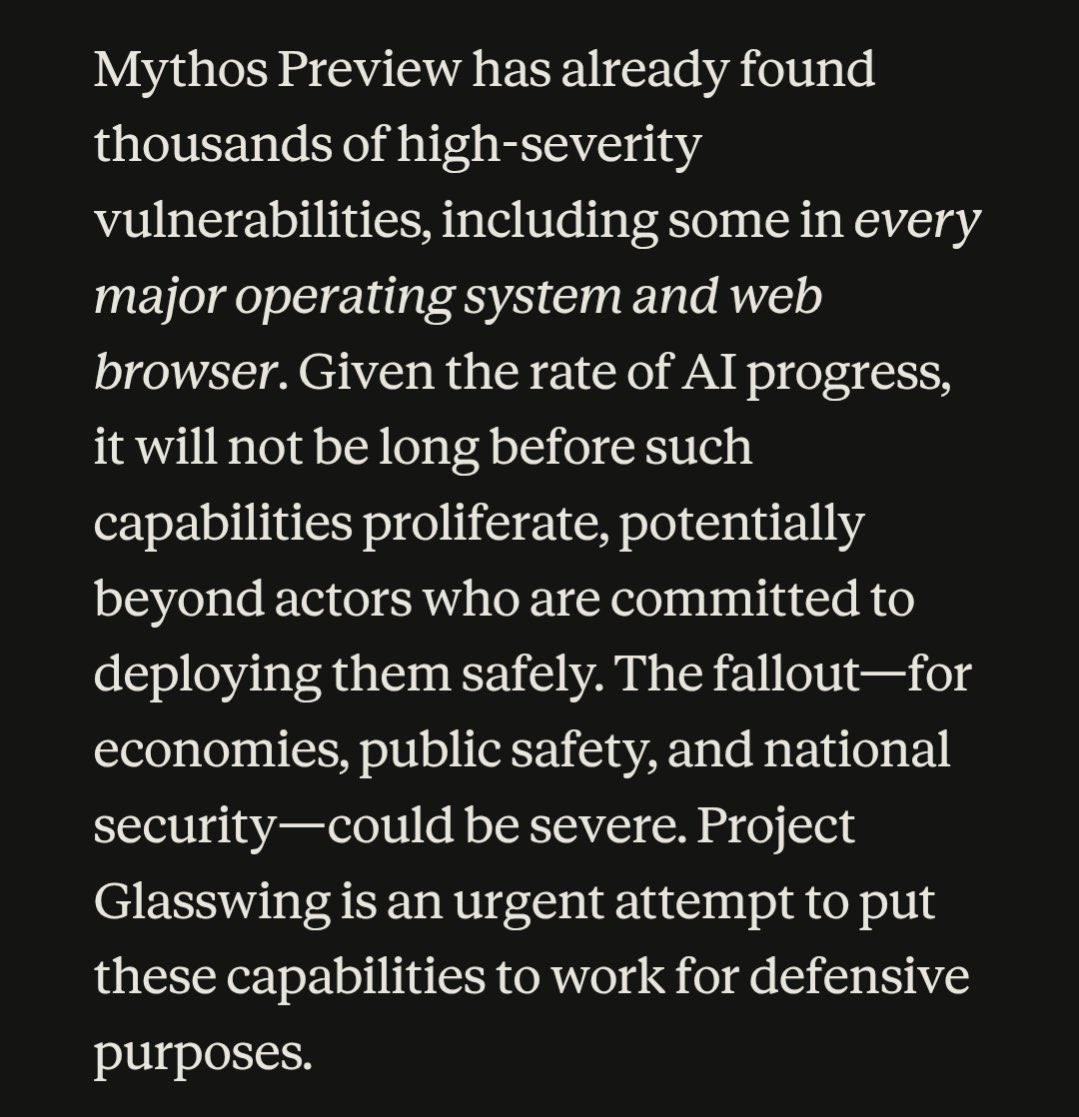
maybe this is not yet clear, so let me state it plainly: as of right now Anthropic, and really a small number of individuals at Anthropic, has the capacity to directly attack and cause major damage to the United States Government, China, and generally global superpowers. government agencies like the NSA do not have internal models or defense capabilities that outclass frontier models. if they chose to do so, they could likely exfiltrate top secret information from government systems, gain control over critical infrastructure including military infrastructure, sabotage or modify communications between members of government at the highest level, and potentially carry on activities for some time without detection. the thing about having access to a huge number of zerodays your adversaries don't know about is it gives you a massive asymmetric advantage.
they did not exploit this to gain power or destabilize the world order. they publicly released the information that they had these capabilities and worked to mitigate these flaws. you should be grateful american frontier labs have proven themselves remarkably trustworthy and concerned with the public good. but it's critical you understand we are in a new regime. private entities now have power that directly rivals and impacts the government's monopoly on influence and violence. and anthropic is certainly not the only one, there's little chance OpenAI's internal models are far behind.
this trend will accelerate on virtually every dimension, not slow down. my prediction for how it plays out is the relatively imminent seizure and nationalization of labs by the US government, sometime over the next two years. it's very tough for me to see how they accept the existence of this kind of threat. but this adds a whole new class of governance issues, as then we've handed these extremely wide-reaching capabilities from private entities to public ones.
224
551
5,493
1,019,206
I’m really enjoying the neo-steampunk era that is useful and not purely aesthetic.
Mar 12

I got tired of checking my Claude token usage so I vibecoded a burn monitor on an ESP32-based M5StickC Plus2. Periodically updates over Wi-Fi or phone hotspot .

1
1
224
ashby retweeted

Mar 6
My 3yo wanted to use the computer like me so I made him his own terminal. He types whatever he wants, it responds with fun messages. No external deps, no ads, just keyboard practice and cause-and-effect thinking. He thinks he's hacking. github.com/meimakes/tiny-ter…
53
92
1,458
62,546


Maybe this is intuitive to those of us who build software, so let me crib a line from @johnrichards here:
Tools used to build software can be probabilistic, but the software itself — at least for now — needs to be deterministic.
In John’s world at @officiallyiru, AI-native SDLC doesn’t just speed up velocity. It can be used in the product to improve threat detection, surface risks faster, and improve policy generation. But the application of all those still has to be applied deterministically.
Enterprise software buyers are seeking burden transfer. They are buying dependable outcomes.
Could OpenAI and Anthropic build their own ERP? Sure, but I think they know that 1/ there’s far more value to be created building for greenfield and enhancing their own core product (models / inference), and 2/ if they succeed at #1, ASI will let them migrate off of their ERP pretty easily, having inflated away the data portability costs.

Dan asked OpenAI and Anthropic if they're designing their own ERP system and they said, "No, we're buying one." Quite telling.
134
ashby retweeted

Feb 26
The best early stage hires are radically different from a few years ago: multi-hyphenate, commercial generalists.
The engineers want to talk to customers and the business people write code.
High agency and AI native instead of heads down 10x performers.

Read the full story here. Was very fun to chat with @JenniferHli @yrechtman @simonlast and @akothari for this!
wired.com/story/silicon-vall…
11
18
452
160,727
This is one aspect of what the Citrini piece does get right. If your profits are mostly predicated on consumers not having enough time to shop around… NGMI
Feb 26

One click. $840/year saved on an internet bill. No hold music. No talking to anyone. Kudos AI handled the entire negotiation in under 10 minutes.
That's not a pitch. That's what our users are actually experiencing.
AI Bill Negotiation is here. Your bills won't know what hit them.
1
95
.@mattpiccolella & co.: three feature requests from a Team plan power user running multiple product teams on Claude:
1
60
2/ Personal account portability. Love that a free Personal plan shows up in the account switcher. I had a paid Max plan before my company adopted Teams. I want to associate that personal account so if I ever leave, my Claude history and context come with me. Right now the risk of losing personal continuity discourages people from joining Team plans — hurts the enterprise sales motion.
1
58
3/ Hierarchical project context. I get why projects ringfence context — but the current model is too binary. What I want: project-specific context promoted as highest importance/relevance, but with the ability to still draw on broader context layers — company-wide, public, and user-specific. Right now it feels like Claude inside a project can't see context that exists in other projects the same user has access to, which is a major limitation. I shouldn't have to manually ferry context between my own projects. The ideal is a tiered relevance model, not a hard wall.
27
Airlines were fundamental, essential, and transformational to modern life. And yet, owning stock in them over the last half-century hasn’t been a great move.
Perishable inventory, commodity pricing, capex that never stops, input costs you don’t control, and customers who’ll switch the moment someone’s a penny cheaper.
Consumers won. Shareholders lost.
Lesson in there for the inference companies.
68