
PM @Google | Tech Space Geek | Fitness Enthusiast | Adventurer 🇺🇲🇧🇼🇬🇭🇬🇧
Joined November 2010
- Tweets 529
- Following 845
- Followers 830
- Likes 23,751
18 Photos and videos






Ander Dobo retweeted

8 Oct 2025
Meet the Flutter Extension for Gemini CLI 👋
This extension combines the Dart and Flutter MCP Server with additional context and commands, making it easier and more productive to build Flutter apps with Gemini CLI.
Get started → goo.gle/46SMYMg

ALT A light blue puzzle piece featuring the white Flutter logo is shown on the left, connecting to a dark gray rounded square icon on the right. The icon displays a prominent blue-to-pink gradient "greater than" symbol, representing a code editor or development environment, symbolizing the integration between Flutter and such tools.
10
102
675
99,585
Ander Dobo retweeted
14 Aug 2025
Coming in hot... it's Flutter 3.35 ⚡
We have updates to hot reload, a new Dart and Flutter MCP server, and more. See what's new → goo.gle/47uveso
26
160
924
92,290
Ander Dobo retweeted

10 Aug 2025
📣 #FCAIC #10 is live Monday, Aug 11 @ 9AM PDT / 4PM UTC
🧠 With Googlers @KhanhNwin & @anderdobo 💙
🎥 Prompt, Code, Think: Flutter x Firebase AI Logic
🔗 youtu.be/watch?v=K8R_0P_jI4I
#FlutterDev #Dart #AgenticApps
1
6
18
13,907

1/ We're excited to share that we're decoupling the Material and Cupertino design libraries from the core Flutter SDK. This will make the framework lighter, more flexible, and allow for faster iteration on Material and Cupertino. More in the thread 👇
17
68
403
24,973
Ander Dobo retweeted
21 May 2025
We're launching an early access program for building plugins with codegen (FFIgen & JNIgen) to boost native API access. 🔑
Learn what we hope to achieve with direct native interoperability and how you can apply for early access ↓
goo.gle/4mwGEkE
2
27
242
18,267
Ander Dobo retweeted
20 May 2025
Gemini in Android Studio now speaks fluent Flutter 💬✨ This means that you can leverage the power of Gemini directly within Android Studio to build beautiful, high-performance Flutter apps.
Read the blog → goo.gle/4mwBWU3
2
66
466
21,018
Ander Dobo retweeted
20 May 2025
Drum roll, please 🥁🥁🥁 Flutter 3.32 is here!
🌐 Hot reload on web (Experimental)
📚 Widget library updates (Cupertino fidelity & Material migration)
✏ NEW Property editor
🔥 Firebase AI Logic
Get the details in the blog → goo.gle/3Sb5rgf
12
115
683
40,431
Ander Dobo retweeted
11 Dec 2024
Flutter 3.27 is here 🌟
We’ve got updates across the framework, engine, and ecosystem, all to refine your development experience and boost your app’s performance.
Dive into the details → goo.gle/3VAJedw

ALT Text reads, "Flutter 3.27" next to the Flutter logo.
42
250
1,001
154,351
Ander Dobo retweeted

3 Jul 2024
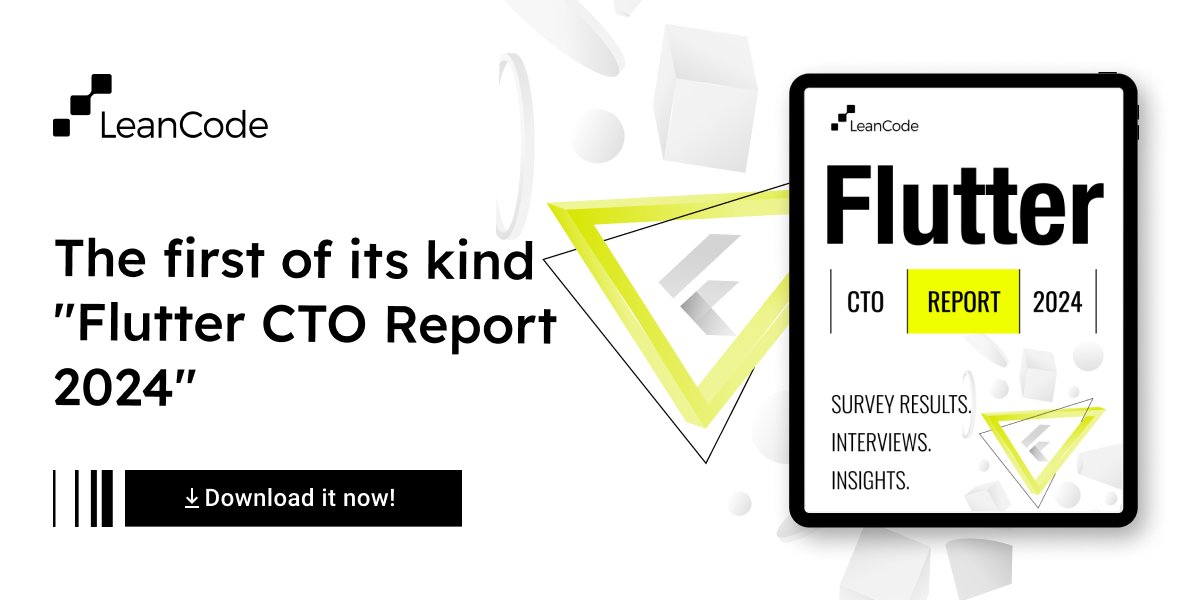
✨Flutter CTO Report 2024 is here!
✨Download it today! leancode.co/flutter-report
Inside:
👀 How much faster is #Flutter?
👀 What is the biggest obstacle when starting with Flutter?
👀 How popular is Flutter for Web and other platforms?
👀 and much more!
1
10
46
6,069
Ander Dobo retweeted

27 Jun 2024
It's time for I/O Berlin 🇩🇪!
If you are around, please come on over and meet @marihasnany @ZoeyFan723 @anderdobo @jryanio and myself at the IO crossword --powered by Flutter -- booth.

3
8
57
2,910

10 Jun 2024
If you're Tech Leader responsible for adoption and use of Flutter and Dart in your organization, please take #FlutterCTOSurvey from the LeanCode team. Your feedback is important!
10 Jun 2024

➡️Flutter CTO Survey➡️bit.ly/4bSYyZ9
@anderdobo says, "I think the important thing is to gather feedback and understand what questions you have, what your experiences are, what the needs are, that this survey will help to gather.” Let’s make a difference together!💡Fill out this #Flutter Survey!
1
8
571
Ander Dobo retweeted

14 Apr 2024
Planning is a key agentic AI design pattern in which we use a large language model (LLM) to autonomously decide on what sequence of steps to execute to accomplish a larger task. For example, if we ask an agent to do online research on a given topic, we might use an LLM to break down the objective into smaller subtasks, such as researching specific subtopics, synthesizing findings, and compiling a report.
Many people had a “ChatGPT moment” shortly after ChatGPT was released, when they played with it and were surprised that it significantly exceeded their expectation of what AI can do. If you have not yet had a similar “AI Agentic moment,” I hope you will soon. I had one several months ago, when I presented a live demo of a research agent I had implemented that had access to various online search tools.
I had tested this agent multiple times privately, during which it consistently used a web search tool to gather information and wrote up a summary. During the live demo, though, the web search API unexpectedly returned with a rate limiting error. I thought my demo was about to fail publicly, and I dreaded what was to come next. To my surprise, the agent pivoted deftly to a Wikipedia search tool — which I had forgotten I’d given it — and completed the task using Wikipedia instead of web search.
This was an AI Agentic moment of surprise for me. I think many people who haven’t experienced such a moment yet will do so in the coming months. It’s a beautiful thing when you see an agent autonomously decide to do things in ways that you had not anticipated, and succeed as a result!
Many tasks can’t be done in a single step or with a single tool invocation, but an agent can decide what steps to take. For example, to simplify an example from the HuggingGPT paper (cited below), if you want an agent to consider a picture of a boy and draw a picture of a girl in the same pose, the task might be decomposed into two distinct steps: (i) detect the pose in the picture of the boy and (ii) render a picture of a girl in the detected pose. An LLM might be fine-tuned or prompted (with few-shot prompting) to specify a plan by outputting a string like "{tool: pose-detection, input: image.jpg, output: temp1 } {tool: pose-to-image, input: temp1, output: final.jpg}".
This structured output, which specifies two steps to take, then triggers software to invoke a pose detection tool followed by a pose-to-image tool to complete the task. (This example is for illustrative purposes only; HuggingGPT uses a different format.)
Admittedly, many agentic workflows do not need planning. For example, you might have an agent reflect on, and improve, its output a fixed number of times. In this case, the sequence of steps the agent takes is fixed and deterministic. But for complex tasks in which you aren’t able to specify a decomposition of the task into a set of steps ahead of time, Planning allows the agent to decide dynamically what steps to take.
On one hand, Planning is a very powerful capability; on the other, it leads to less predictable results. In my experience, while I can get the agentic design patterns of Reflection and Tool use to work reliably and improve my applications’ performance, Planning is a less mature technology, and I find it hard to predict in advance what it will do. But the field continues to evolve rapidly, and I'm confident that Planning abilities will improve quickly.
If you’re interested in learning more about Planning with LLMs, I recommend:
- Chain-of-Thought Prompting Elicits Reasoning in Large Language Models, Wei et al. (2022)
- HuggingGPT: Solving AI Tasks with ChatGPT and its Friends in Hugging Face, Shen et al. (2023)
- Understanding the planning of LLM agents: A survey, by Huang et al. (2024)
[Original text: deeplearning.ai/the-batch/is… ]
80
439
2,401
390,641
Ander Dobo retweeted

9 Apr 2024
✨ Today, we're making Gemini 1.5 Pro available via the Gemini API in a public preview, along with native audio (speech) understanding. And we're also addressing many developer asks.
#BuildWithGemini → goo.gle/3xxaUH1
See what's being launched 🧵⬇️

ALT Image reads "Gemini 1.5 Pro" set against a black background.
29
179
863
121,809
23 Feb 2024
Fantastic @ashitaprasad!
22 Feb 2024

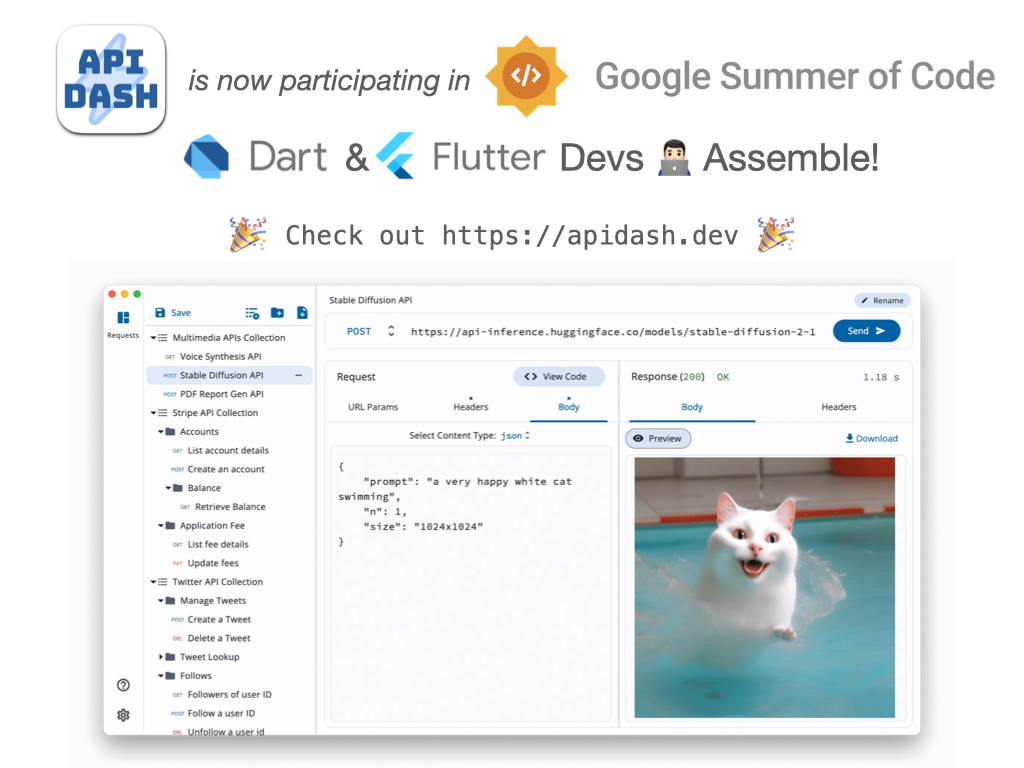
Some exciting news 🥳 API Dash (@apidashdev) has been selected as a mentor organization in the Google Summer of Code 2024.
I am eagerly looking forward to mentor awesome #Dart & #Flutter devs. 💙
Project Link - github.com/foss42/apidash
@dart_lang @FlutterDev @GoogleOSS #gsoc
1
6
470
21 Feb 2024
Another way to build, now with open models from Google, underpinned by the research and technology used to create the Gemini models.

Gemma is a new family of open models that help developers and researchers build AI. Along with the lightweight models, we’re launching tooling that encourages collaboration and a guide to responsible use of these models. Learn more → goo.gle/49IOArw
ALT Against a black background there's "Gemma" written in blue text.
4
403
21 Feb 2024
#BuildWithGemini and Flutter
20 Feb 2024

In this video, @khanhnwin shows you how to use the new google_generative_ai package to integrate Gemini into your Dart and Flutter projects.
Learn more → goo.gle/3SNeh3n
1
6
562
15 Feb 2024
Aaand it's @FlutterDev and @dart_lang SDK stable release day!🚀
15 Feb 2024
💝 A special gift for you... Flutter 3.19 and Dart 3.3 are here!
We’re excited to share SDK releases for Flutter and @dart_lang, along with some exciting announcements involving AI and a brief look at our roadmap for 2024.
Read the blog → goo.gle/3I4eJWd
1
14
575
15 Feb 2024
You can now more easily #BuildWithGemini in your Dart and Flutter apps with the Google AI Dart SDK!
Folks are already building some really cool things and I'm looking forward to more.
15 Feb 2024
Introducing the Google AI Dart SDK ✨💙
The new pub.dev package helps Dart and Flutter developers more easily build apps that use generative AI.
Get started with #GeminiAI → goo.gle/3SHFSD3
ALT Text reads, "Build with Gemini" with a sparkle above the text.
3
7
1,044
15 Feb 2024
Happening right now! Tune in!
14 Feb 2024
👀 Tune in for a special announcement on #ObservableFlutter this week!
@craig_labenz and fellow Flutter Developer Relations Engineer @khanhnwin discuss something new.
Set a reminder for tomorrow at 9am PT → goo.gle/49Clpq3
ALT YouTube thumbnail with the title "Surprise announcement!"
11
466
Ander Dobo retweeted

5 Feb 2024
An idea I can't stop thinking about...
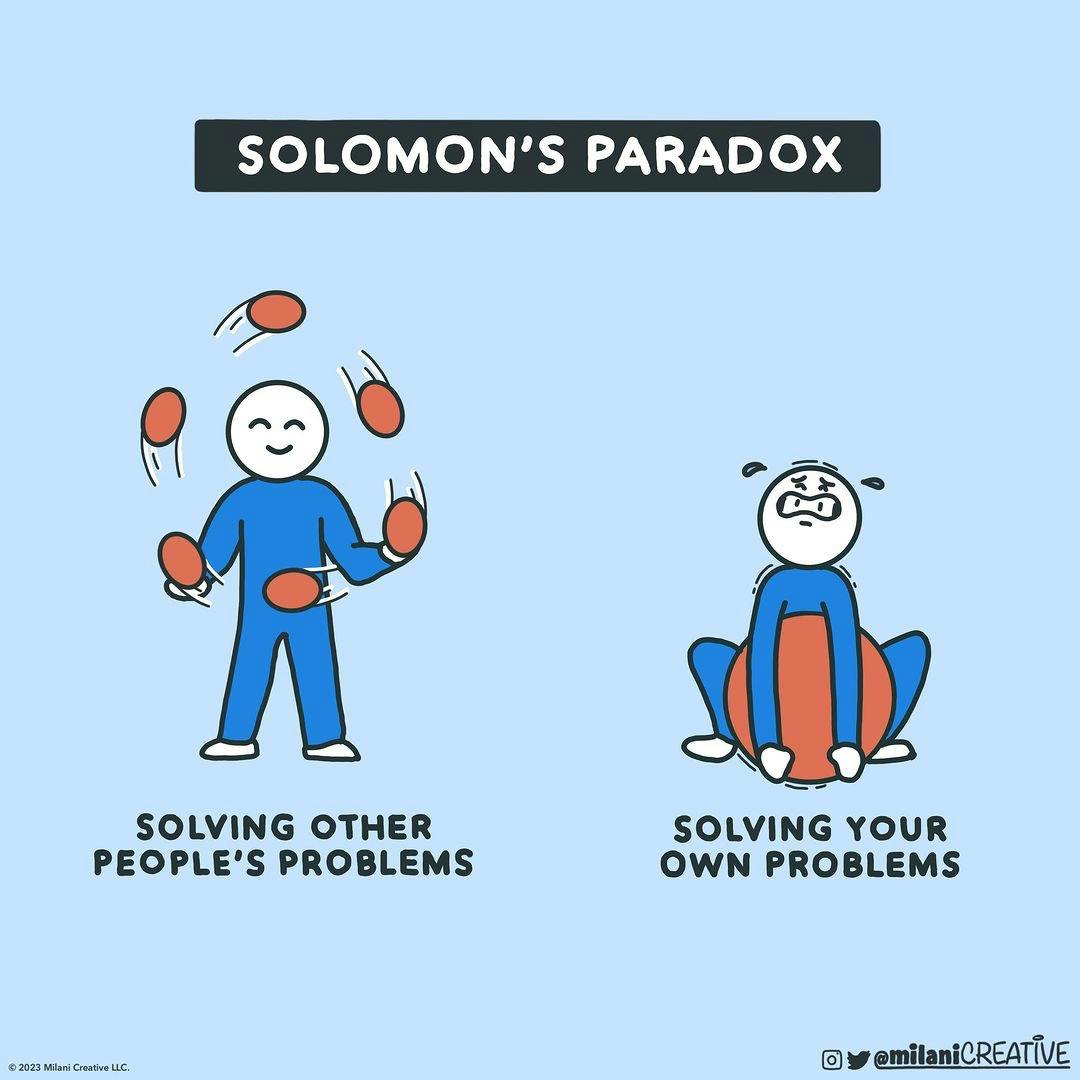
Solomon's Paradox (and how to escape it):
In the Old Testament, King Solomon was known for his incredible wisdom. He was considered one of the wisest men who ever lived.
But King Solomon's life was quite a mess:
• Hundreds of wives and partners
• Obsession with money and wealth
• Absent relationship with son and children
In short, King Solomon was great at giving advice, but terrible at taking that same advice into account in his own life.
This story gave a name to a common psychological phenomenon:
When we provide clear, rational perspectives and advice to others, but are unable to provide those same quality perspectives to ourselves, we are falling victim to Solomon's Paradox.
We've all been stuck in Solomon's Paradox at one point or another.
Why? Well, it's quite simple, really:
When you're considering someone else's problems, you are objective, rational, and balanced.
When you're considering your own problems, you are emotional, irrational, and volatile.
It's not your fault—you're human, after all!
Two core strategies to escape:
Strategy 1: Create Space
Viktor Frankl, the Austrian philosopher and Holocaust survivor renowned for his contributions to existential psychology, has a brilliant framing for the power of space:
"Between stimulus and response, there is a space. In that space is our power to choose our response."
Pause: Our immediate reactions are almost always emotional, and we make bad decisions in the heat of emotion. Force a pause (whether it's seconds, minutes, hours, or days) before reacting.
Reset: Allow yourself to feel the emotional response, but remind yourself that you are in control of what comes next. Give yourself that power.
Engage: With a more balanced perspective, engage with the situation.
Strategy 2: Zoom Out
A rule for life: When in doubt, zoom out.
You live your entire life zoomed in. This can create challenges, as struggle feels bigger than it really is and growth feels smaller than it really is.
Forced zoom outs provide perspective, on the true nature of your struggles and the impressive nature of your growth.
Mental Time Travel is a useful tool for zooming out:
Imagine yourself in the past and consider yourself in the present.
Imagine yourself in the future and consider yourself in the present.
This zoom out forces perspective that breathes new life into a situation.
***
To fight back against Solomon's Paradox:
Create space and force new perspective.
The right questions (and answers) will come to you.
111
1,046
5,404
870,308