
A new kind of AI R&D lab which creates practical end-user products based on foundational research breakthroughs
Joined March 2024
- Tweets 51
- Following 89
- Followers 6,760
- Likes 2
1 Photos and videos
Answer.AI retweeted

Apr 18
Going thru the lesson 9a notebook (by @johnowhitaker) of the fastai course, and created a little tool to play around and visualize the latents produced by an autoencoder
Crafted with SolveIt and FastHTML (both by @answerdotai)
1
2
4
1,617
Answer.AI retweeted

Apr 10
This is a great discussion.
We've spent 2 years building a solution that's working well for us -- co-writing software side by side the AI in an notebook-ish environment. We call it the "solveit method". (We've created a course and platform for it: solve.it.com/ )
Apr 9

My colleague @istoica05 and I have been debating the role of specification in AI. I have argued that a key advantage of AI is that we can leave large parts of the specification unwritten. @istoica05 argued we need to focus on more specification. We converged on iterative disambiguation as the driving mechanism for specification.
@vsreekanti and I have a new blog exploring this challenge more deeply and why maybe that interative process is still so important and still the bottleneck.
4
13
139
30,641

I am sharing this pi-notebooks extension for those using @badlogicgames Pi w/ notebooks.
Notebooks have a lot of json-boilerplate and they are finicky to edit w/ regular text tools. However, their actual structure makes them easier for AI to edit if given the proper tools (ie they have cells ids, you can get a cells' summary, overview etc...)
I have just ported the SolveIT / notebook editing tools from @answerdotai dialoghelper repo. It keeps context shorter and edit much better.
GH repo: github.com/kafkasl/pi-notebo…
1
4
827
Answer.AI retweeted

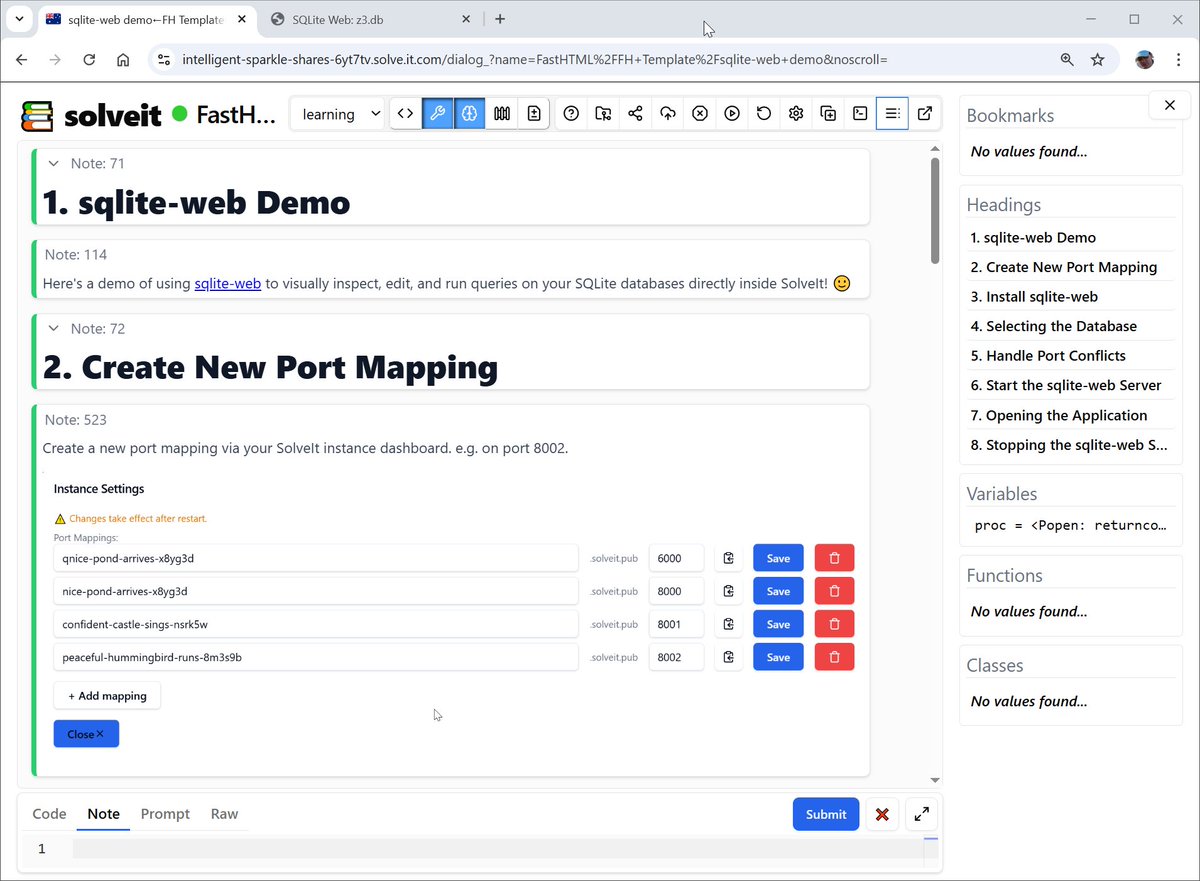
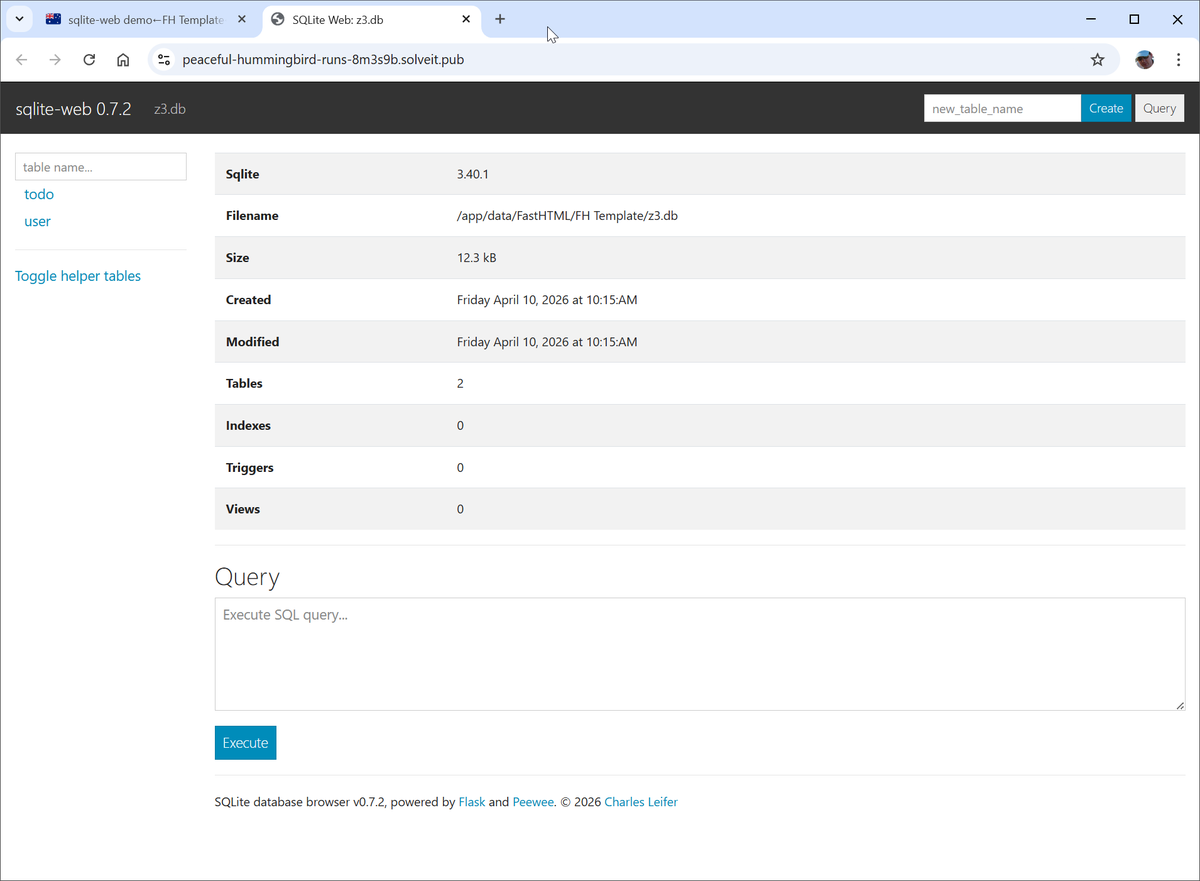
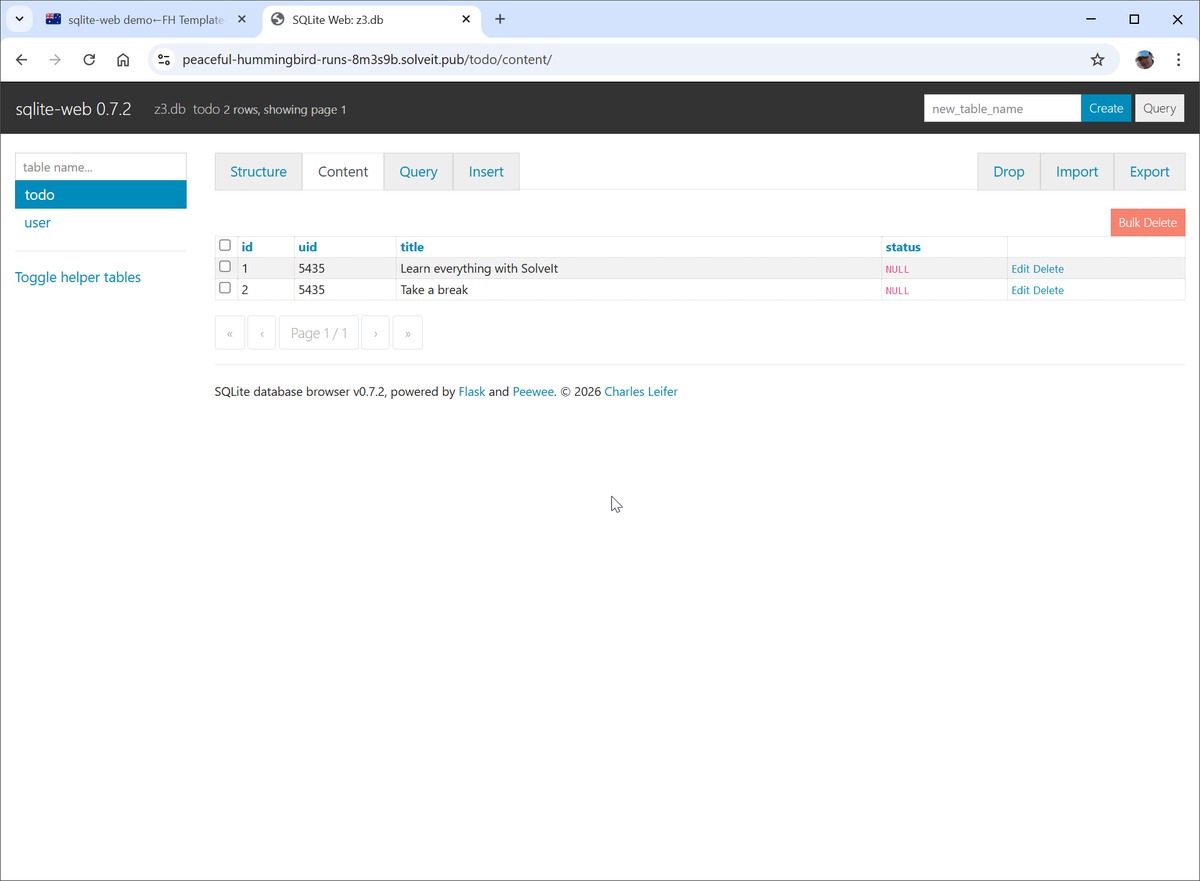
Running an SQLite Database Browser in SolveIt! 🔍🚀
Now that SolveIt supports multiple port mappings for each instance we can do some cool things like spin up a web-based SQLite database browser such as sqlite-web.
This gives us a nice way to visually browse, inspect, edit, and run queries on any SQLite database directly from within SolveIt.
Super useful for database work and explorations, debugging and so on!
See the SolveIt dialog here: share.solve.it.com/d/d34a3fc…

2
3
6
793
Answer.AI retweeted
1
2
919

Mojo in Jupyter is here 🙌
@jeremyphoward released a new Jupyter kernel that lets you run Mojo directly in notebooks.
It works great on macOS, supports recent Linux versions, and is easy to install via pip or uv.
Give it a try and let us know what you build!
github.com/AnswerDotAI/mojok…
#MojoLang #OpenSource #DeveloperTools
4
32
193
17,333
Answer.AI retweeted

Jan 24
You are a victim of the same delusion as numerous folks who have believed in past decades that superhuman performance by computers in one task was a harbinger of human-level AI.
It happened with code generation, math, chatbots, go players, robot acrobats, Jeopardy-playing systems, cars driving themselves in the desert, chess players, inference engines, checker players, compilers, equation solvers....
94
131
2,113
288,745
Answer.AI retweeted

Jan 24
hey, asking for a friend
can we stop using lines of code for a measurement in productivity? at one point we all agreed on this
361
116
3,735
374,342
Today I finished learning my first 1500 Chinese characters! (actually it was on November, but didn't get around writing about it until now).
I took the chance to write a far too long review on my learning journey so far. I don't think anyone should read it unless you have a lot of free time or really want to learn a new language (for those who won't heed the warning, the link is below)
It is titled: Excuses, Friction & FastHTML: My journey learning 1500 chinese characters because it reflects the most useful lessons learned for me.
For context, I'm learning Chinese for family reasons. It's going to be a lifelong project but I only have (or want) to invest 5-30min a day tops. So it is a marathon for me, not a sprint.
With this in mind, I set out to find an easy way to learn w/o too much effort.
I tried a variety of approaches, like straight our learning the Dao De Jing, immersion in Taiwan, brute-force anki, and audio lessons. Success was mixed, learning happened, but not sustainably which leads me to the first word "Excuses"
If you find yourself making excuses not to do it, it's probably because it's not a good method for you. I felt "lazy" because I didn't want to put in the effort, instead I procrastinated by reading how others learned Chinese. Or I kept trying new approaches w/o completing any.
However, by being lazy and using that as a guiding light, I kept exploring alternatives until I found a talk by Jeremy Howard that lead me to the wonderful book "Remembering Traditional Hanzi Characters" by James. W. Heisig. ( @jeremyphoward thank you so much for that!)
This book is a perfect match for my learning approach because it teaches you characters in a very approachable way, it decomposes them into smaller chunks, gives them visual stories and weaves them into a network that makes learning much easier.
If I had "powered through" the other approaches I'd never have found this blessing.
I had a math teacher that used to tell us that lazy ones are the clever, because they find better methods to work less by making things easier. Amen.
Which leads me to the second word "friction".
The method was right, now I needed to just do it every day. The only important lesson here is to minimize the friction as much as possible so it becomes a habit. For example, I got the ebook version so I could review anywhere, I got the anki app for review, I got anki cards for the book so I could just add them easily. If I could write them with pen & paper great, otherwise just use your finger.
Setting a very low bar, contrary to some opinions is great. I committed to every **just** review the pending cards. If I had time and energy, I would learn some new ones, maybe 1, 2 or 5, rarely more than that.
Thanks to compounding this eventually led me to cross 500, and then 1000 chars. At this point the habit was so deeply ingrained that I found myself doing up to 25 chars/day w/o any extra effort.
Once I finished the book, I started trying to read simple stories, or talk to my wife. Looking up words in the book index is super annoying, but it was manageable during the learning. With the book finished, that became a source of friction which led to me... FastHTML.
I ended up creating my own lookup page with all the book characters. That way I could look up by char, meaning, or number in the book. Moreover, each char had hyperlinkg to its constituents making review and lookup a pleasure, instead of having to browse through the book (best case) or navigate the ebook (even worse!) when I didn't have the physical copy.
Eventually I wanted to learn words with multiple chars, so I added the feature to lookup multiple chars, and then have Gemini explain me how those chars with the meanings attributed to them by the book, gave rise to the final meaning. Absolutely perfect.
Sometimes it seems a "waste of time" or "procrastination" to work on the tools or methods, but the opposite is true. The better the tools the easier the process.
At the time of writing, I'm connecting the FastHTML app, so any compound word can be added directly to my anki decks, I've transcribed Pimsleur audio lessons so I can review them using the books characters or pop them into ChatGPT Voice mode to practice with the right context.
Happy learning, I'll report back when I finish the next 1500.

2
1
10
1,159
SolveIT by @answerdotai is by far the best reading experience I've had. Their dialogue approach means you can split the text at any point and just ask questions. You can also run code if you need it, and show/hide selectively stuff to the AI (so it does not get distracted with your rabbit holes).
Here's a very basic example: gist.github.com/kafkasl/d76e…
People are lately reading full form books in a number of different personal approaches
2
11
1,264
Answer.AI retweeted
Jan 7
Great to see @threejs supporting llms.txt. 😀
I have noticed that the majority of libs/services I work with nowadays seem to have an llms.txt nowadays. Makes me happy!
(I've been really enjoying the very comprehensive @GeminiApp llms.txt recently for writing Gemini code.)

5
13
84
16,836
Answer.AI retweeted

24 Feb 2025
Agency > Intelligence
I had this intuitively wrong for decades, I think due to a pervasive cultural veneration of intelligence, various entertainment/media, obsession with IQ etc. Agency is significantly more powerful and significantly more scarce. Are you hiring for agency? Are we educating for agency? Are you acting as if you had 10X agency?
Grok explanation is ~close:
“Agency, as a personality trait, refers to an individual's capacity to take initiative, make decisions, and exert control over their actions and environment. It’s about being proactive rather than reactive—someone with high agency doesn’t just let life happen to them; they shape it. Think of it as a blend of self-efficacy, determination, and a sense of ownership over one’s path.
People with strong agency tend to set goals and pursue them with confidence, even in the face of obstacles. They’re the type to say, “I’ll figure it out,” and then actually do it. On the flip side, someone low in agency might feel more like a passenger in their own life, waiting for external forces—like luck, other people, or circumstances—to dictate what happens next.
It’s not quite the same as assertiveness or ambition, though it can overlap. Agency is quieter, more internal—it’s the belief that you *can* act, paired with the will to follow through. Psychologists often tie it to concepts like locus of control: high-agency folks lean toward an internal locus, feeling they steer their fate, while low-agency folks might lean external, seeing life as something that happens *to* them.”

1,948
9,301
49,754
11,260,160
Answer.AI retweeted

30 Oct 2025
With the risk of this looking like a marketing post, worth checking out solve.it.com
Built by Jeremy Howard and team at @answerdotai. Geared at effective learning using AI. Lateral opposite of vibe coding. This AI won’t even tell you the answer, but help arrive at it.
1
2
1,533
Answer.AI retweeted

6 Nov 2025
The Solve.it.com course from @jeremyphoward & @answerdotai is so good I'm telling friends not to use my 15% discount code.
Pay the full $500. They've earned it.
Week 1 awesome, and they extended registration till next week. Don't miss this. #programming #education
1
2
1,056

Starting Nov 3, my @answerdotai co-founder @jeremyphoward and I are teaching this hands-on approach in our live Solve It With Code course.
Join our free early access list to preview the method (and get a discount).
👉 solve-it-with-code.beehiiv.c…
2
7
2,969
Answer.AI retweeted

8 Oct 2025
Most AI tools give the illusion of rapid progress but results that don't surive first contact with testing. The @answerdotai team have done an incredible job designing solveit in a way that makes it genuinely hard to fall into the traps and dead ends of most "vibe coding" tools.
1
1
3
1,328
Answer.AI retweeted
2 Oct 2025
It's a strange time to be a programmer—easier than ever to get started, but easier to let AI steer you into frustration. We've got an antidote that we've been using ourselves with 1000 preview users for the last year: "solveit"
Now you can join us.🧵
answer.ai/posts/2025-10-01-s…
47
114
878
160,676
Answer.AI retweeted
16 Oct 2025
18 months ago, @karpathy set a challenge: "Can you take my 2h13m tokenizer video and translate [into] a book chapter".
We've done it! It includes prose, code & key images. It's a great way to learn this key piece of how LLMs work.
fast.ai/posts/2025-10-16-kar…
32
336
3,087
160,099
Answer.AI retweeted
8 Oct 2025
99% of AI "guidance" online is of the (fantasy) genre "10x your productivity by running parallel Claude Codes that orchestrate sub-Claude-Codes that dynamically spin up sub-sub-Claude-Codes". @jeremyphoward's solveit is the opposite and I can't recommend his course highly enough.
2 Oct 2025

It's a strange time to be a programmer—easier than ever to get started, but easier to let AI steer you into frustration. We've got an antidote that we've been using ourselves with 1000 preview users for the last year: "solveit"
Now you can join us.🧵
answer.ai/posts/2025-10-01-s…
1
1
7
1,657