
@Kayrros; @ColumbiaUEnergy. Ex @IEA, @EIAgov, Newedge, etc.
Joined January 2016
- Tweets 1,443
- Following 662
- Followers 3,078
- Likes 505
164 Photos and videos






May 5
Thanks for the shout-out

A tweet that deserved far more attention than it got. From nearly 3 weeks ago. Bravo
2
2
443
Apr 17
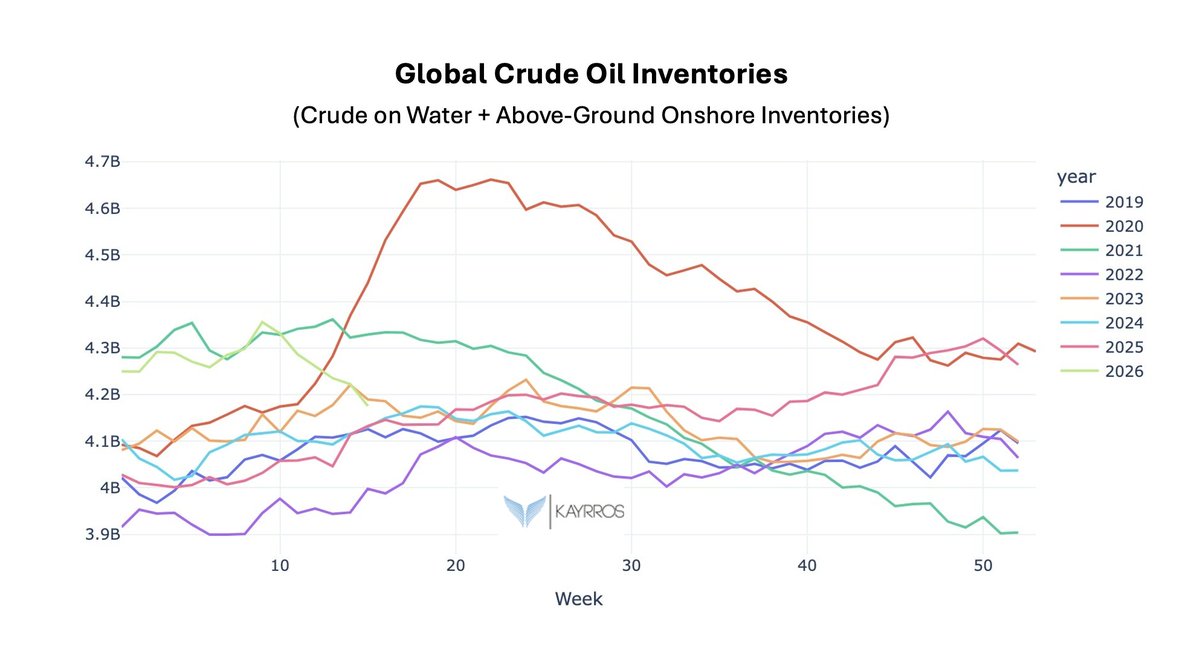
Global crude supply plunged by ~13 MMb/d since the war but less than half of that is reflected in crude inventories.
Observable crude stocks have only dropped by 5MMb/d on average since end-February, almost entirely "on the water."
Where is the rest? Demand destruction and product stock draws.
Plus a little bit of strategic crude released from caverns.
Compared to crude, product stocks and demand are difficult to directly and independently measure. Nevertheless, it is already clear that high prices are rapidly slashing oil use.
Despite lower consumption, product stocks are also drawing fast.
6
10
81
8,709
Apr 14
The more I think about it, the more it seems to me that the effect of the US blockade of tankers going in and out of Iran — even if perfectly executed — may not rise up to expectations.
The effect of the US blockade on Iran (at one end of the trade) and China (at the other end) seems unlikely to be as severe as that of the Iranian blockade on Arab Gulf producers and other consumers , and that for two storage-related reasons:
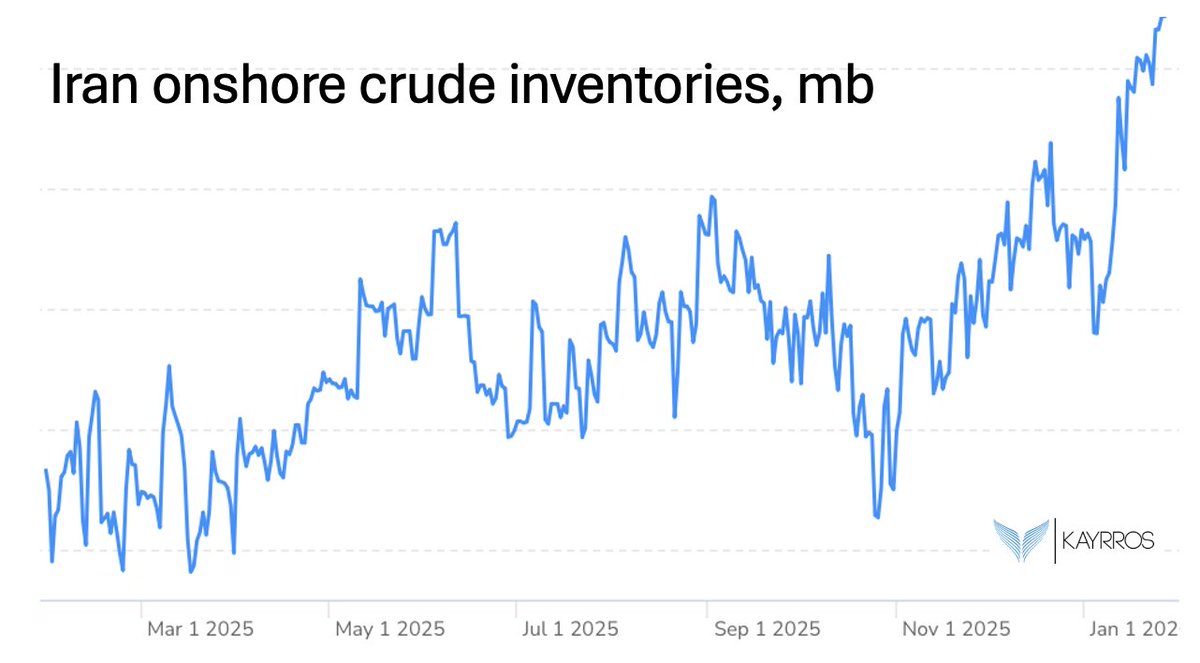
- Iran is structurally long crude storage capacity. It has a lot more runway (capacity to keep producing at normal levels without exporting) , even after the bombing campaigns, than Arab producers had at the beginning of the war.
- assuming that all Iran crude exports go to China, the loss of Iran’s deeply discounted crude supplies for China would amount to a 40 mln bbl shortfall over one month (at March export levels, as per IEA estimates in today’s OMR). Huge for any country, but peanuts for China, given the massive scale of its pre-war stockpiling
After about 26 days, Iran would have to start cutting production… sure it would be deprived of crude export revenue but the operational effect would be limited. That seems like a very long time to wait.
14
29
122
25,084
Apr 8
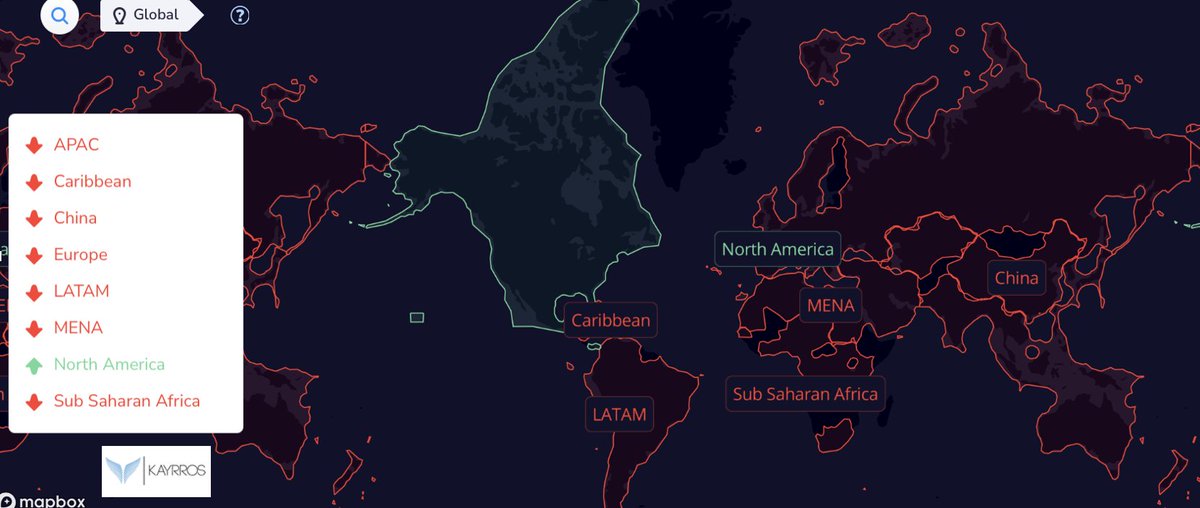
The world is red today as far as crude oil is concerned, meaning onshore crude stocks are falling (week-on-week) everywhere, in every major region, except in North America.
Cease-fire or no cease-fire, this will continue for some time
4
501
Apr 7
As the last tankers that loaded in the Gulf before the war reach their destination, onshore crude stocks are plummeting.
First it was crude on the water that plunged by ~175MMb since March 1 (or 4.55MMb/d over an extended period of 36 days).
Now onshore crude stocks are retracing their earlier gains, dropping by >50MMb worldwide from their end-March peak.
Predictably, China and the rest of Asia-Pacific, the main outlets for Gulf crude oil, are driving the draws.
Chinese stocks alone plunged by an estimated 30 MMb in the six days to April 6 (5 MMb/d).
Other Asia-Pacific is following suit, down ~12 MMb (2MMb/d) over that same period.
MENA dipped by ~5 MMb (830kb/d).
This is just the beginning.
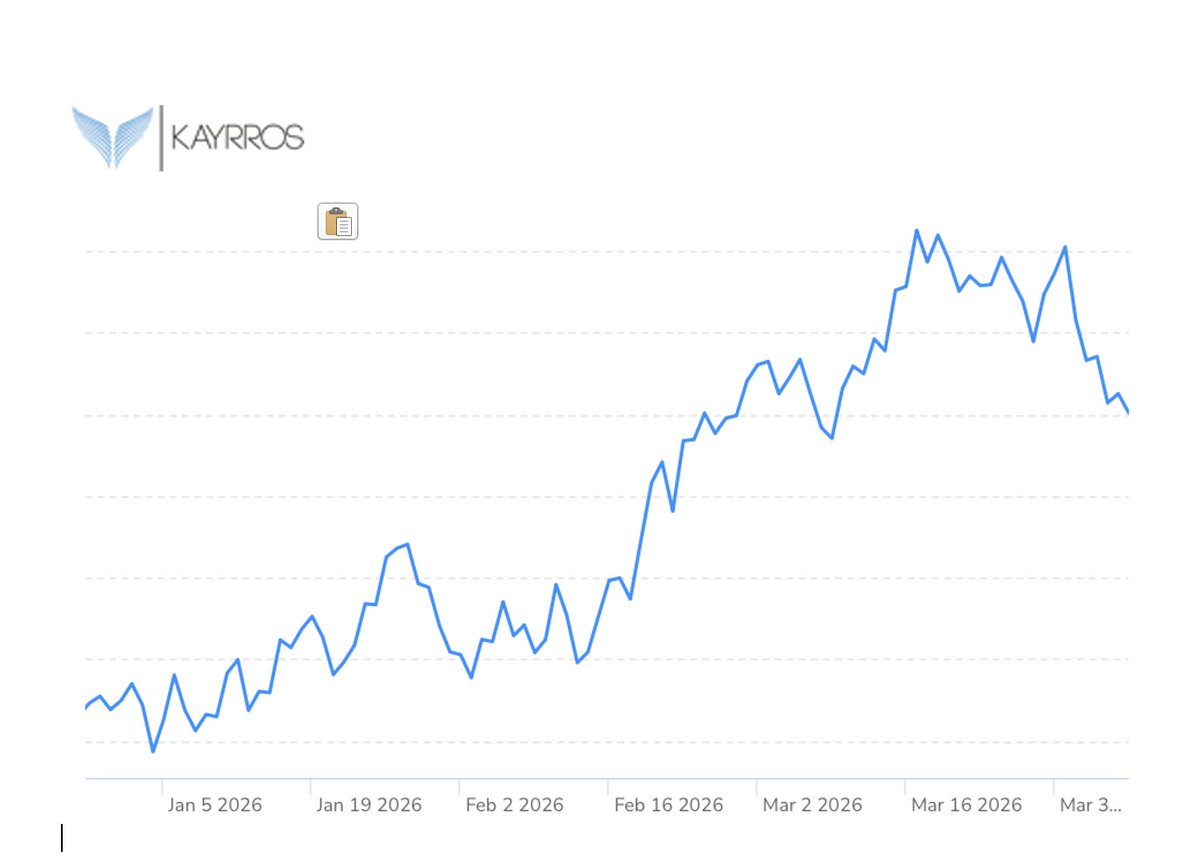
ALT Global crude oil inventories held in above-ground storage, year-to-date
5
22
81
16,636
Apr 1
A month into the Iran war, the effect of crude supply disruptions from the Gulf is starting to land.
Until now, the shortfall had been mostly felt "on the water," as reduced Gulf loadings led to a steep plunge in oil in transit but failed to show up onshore. Precautionary steps by Saudi Aramco and others to pre-position stocks in Egypt and elsewhere outside the Gulf helped cushion the blow.
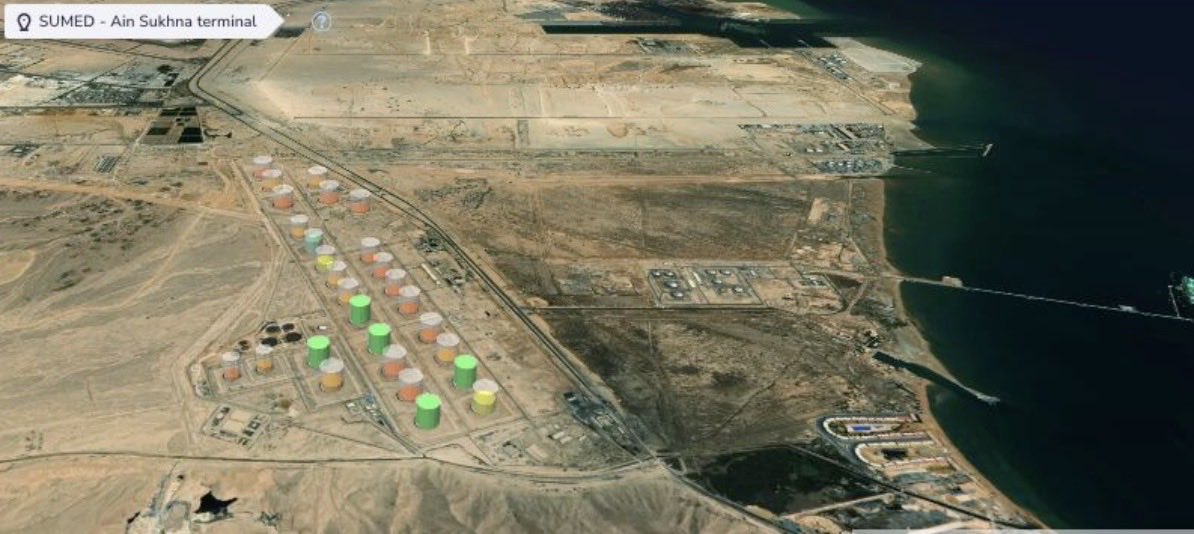
That cushion is wearing thin. Egyptian stocks alone dropped by nearly 15 million barrels in the last two weeks (~1 million barrels per day) -- more or less equally split between both ends of the Sumed pipeline, Ain Sukhna on the Red Sea and Sidi Kerir on the Med.
1
3
635
Apr 1
Asia is the #1 outlet for Gulf oil so no wonder it has led global draws, with Asia-Pacific stocks plunging by more than 26 MMb from March 19 (a recent high) to March 3, roughly 2.2 MMb/d, Kayrros data show. (The March 19 date is no accident: it takes about 20 days for tankers to sail from the Gulf to China or Japan.)
Current crude stocks in Asia are the lowest ever recorded for this time of year since the start of satellite measurements in 2016, but still higher than March 11, 2025 lows. It should be noted that the decline follows -- and exacerbates -- cyclical patterns: Asian stocks have been hitting a seasonal low around end-March / early April in recent years.
Globally, above-ground onshore crude stocks (that is, excluding underground caverns) have dropped by ~850,000 b/d in the two weeks from March 15 to March 31.
Things will get worse before they get better.
1
308
Antoine Halff retweeted

A brief summary of last night’s events:
A. Iran emerged with the upper hand. It demonstrated once again that it will not hesitate to raise the level of escalation to defend its strategic assets — without any retreat on the issue of the Strait of Hormuz. This was entirely predictable.
B. Yet another indication that this war lacks a coherent, pre-planned strategy. Once the regime did not collapse early on, it is no longer clear what the overarching strategy actually is.
C. Trump was aware of the strike, but chose to look the other way once tensions escalated. This reflects an ongoing gap between Washington which may still be interested in preserving a future-facing Iran and Israel, whose approach appears aimed at systematically degrading the country’s entire infrastructure.
D. The strike itself seems to have been driven by frustration: Iran is not yielding, and there is a desire to force outcomes (such as opening the Strait of Hormuz) without committing ground forces — and before external pressure brings the campaign to a halt.
E. The strategic failure so far leaves Trump facing a difficult choice: escalate dramatically, potentially including boots on the ground, or move to stop the campaign now.
F. At this stage, the fundamental questions remain unanswered: What is the ultimate objective? What are the exit ramps? What does success even look like?
G. Instead, the conflict is drifting into a war of attrition — with no clear signs of regime collapse in Iran. Meanwhile, the president, having committed to the idea that Iran has effectively capitulated, may find it difficult to disengage while facing a visible disadvantage in the maritime arena and no resolution to the nuclear issue.
Bottom line, last night’s events underscored just how unstructured this campaign has become — lacking strategic clarity, long-term planning, and a defined end state. At the same time, they exposed growing gaps between Israel and the United States, gaps that may widen further if similar outcomes repeat.
And as always..just because something is operationally feasible does not mean it is strategically wise.
One more point that must be stated clearly — Iran is not close to capitulating.
#IranWar
Mar 19

🚨After the first Iranian missile strike, Qatari officials contacted White House envoy Steve Witkoff, CENTCOM commanders and other senior Trump administration officials and demanded to know whether the U.S. had prior knowledge of the Israeli strike, per source with knowledge
55
569
1,959
684,355
Mar 19
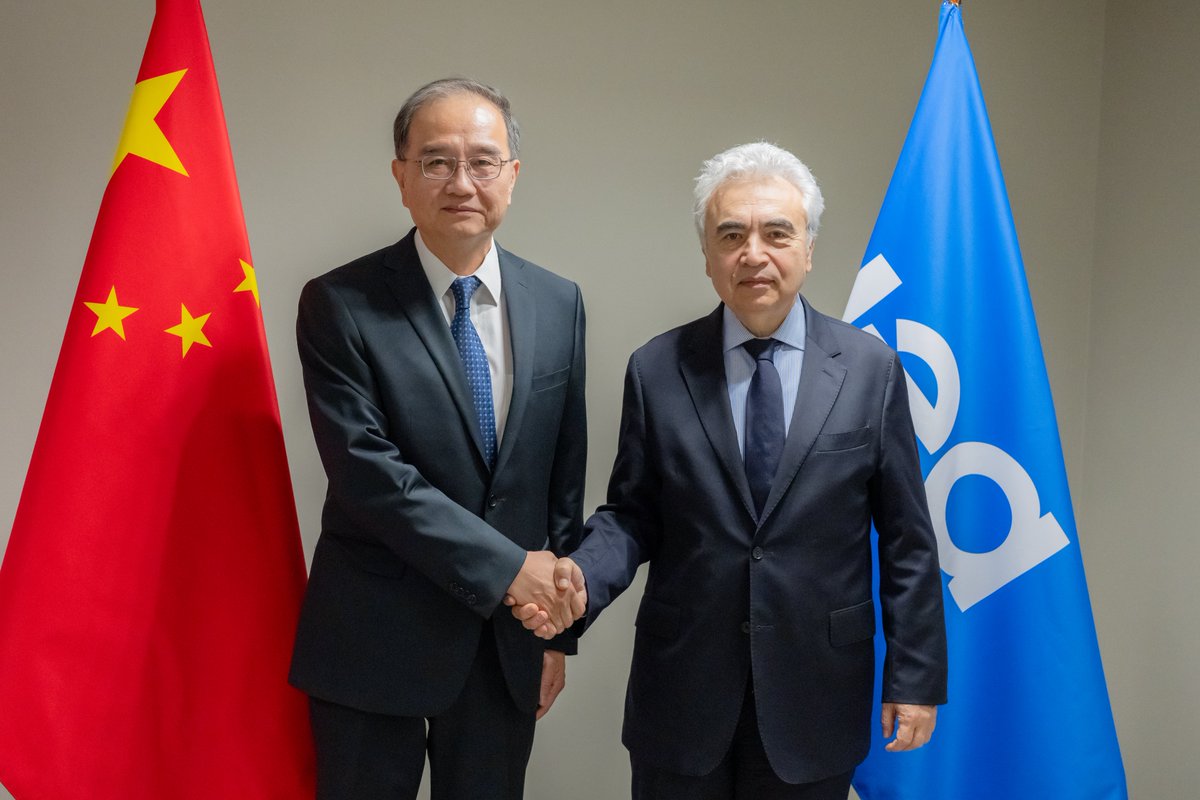
China’s share of the global Oil & Gas markets and its energy imports are so huge that a collective response to the current energy crisis that didn’t include it would be problematically limited.
A meeting is just a meeting but this meeting of @fbirol and Amb. Deng Li is a great start. Its announcement sends the right message .
Mar 19

Pleased to meet with Ambassador of China to France Deng Li at the @IEA headquarters in Paris today
We discussed the importance of international cooperation to stabilise global oil markets for the benefit of all countries
413
Mar 17
It was good talking to Armelle Bohineust at @Le_Figaro
about the blockage of the Strait of Hormuz and what it means for energy markets and oil prices
lefigaro.fr/conjoncture/guer…
296
Mar 12
Kudos to the Oil team at the International Energy Agency @IEA for producing and releasing today an excellent report under great pressure.
I’ve been in that job and I know what it takes. Very impressive!
Oil Market Report - March 2026 – Analysis - IEAf iea.org/reports/oil-market-r…
4
260

Saudi Arabia has told Tehran that while it favors a diplomatic settlement to Iran's conflict with the United States, continued attacks on the kingdom and its energy sector could push Riyadh to respond in kind, four sources familiar with the matter told Reuters reut.rs/4bw2UaA
80
444
1,678
1,278,245
Mar 7
I keep seeing reports that unlike other Gulf producers, Saudi Arabia has 2-4 weeks before it must cut supply.
In fact, geospatial data suggests that it was one of the first to cut — not because it was more exposed, but because it was better prepared.
linkedin.com/posts/antoine-h…
3
443
Mar 3
Why Iraqi crude production looks like the first domino to fall in the face of marine traffic blockage in the Strait of Hormuz
linkedin.com/posts/antoine-h…
1
1
4,151
Mar 3
The problem for Iraq is that is has limited storage capacity at Basrah compared to export flows.
On paper, as of yesterday, storage capacity utilisation at Basrah was only 53.6%. Due to the low nameplate capacity, however , that leaves only 6 mb of effective spare storage capacity (assuming maximum utilisation of 80%).
According to the International Energy Agency’s latest Oil Market Report, seaborne crude exports from Basrah were recently 3.5 mb/d.
That means as of yesterday, Basrah had less than two days of coverage capacity — hence the talk of closure today.
This insufficient storage capacity compared to flows is a real structural vulnerability for Iraq.
Mar 3

🚨 IRAQ WILL BE FORCED TO CUT ITS PRODUCTION BY MORE THAN 3 MLN BPD IN A FEW DAYS IF OIL TANKERS CANNOT MOVE FREELY AND REACH LOADING PORTS - TWO IRAQI OIL OFFICIALS
7
15
5,129
Antoine Halff retweeted

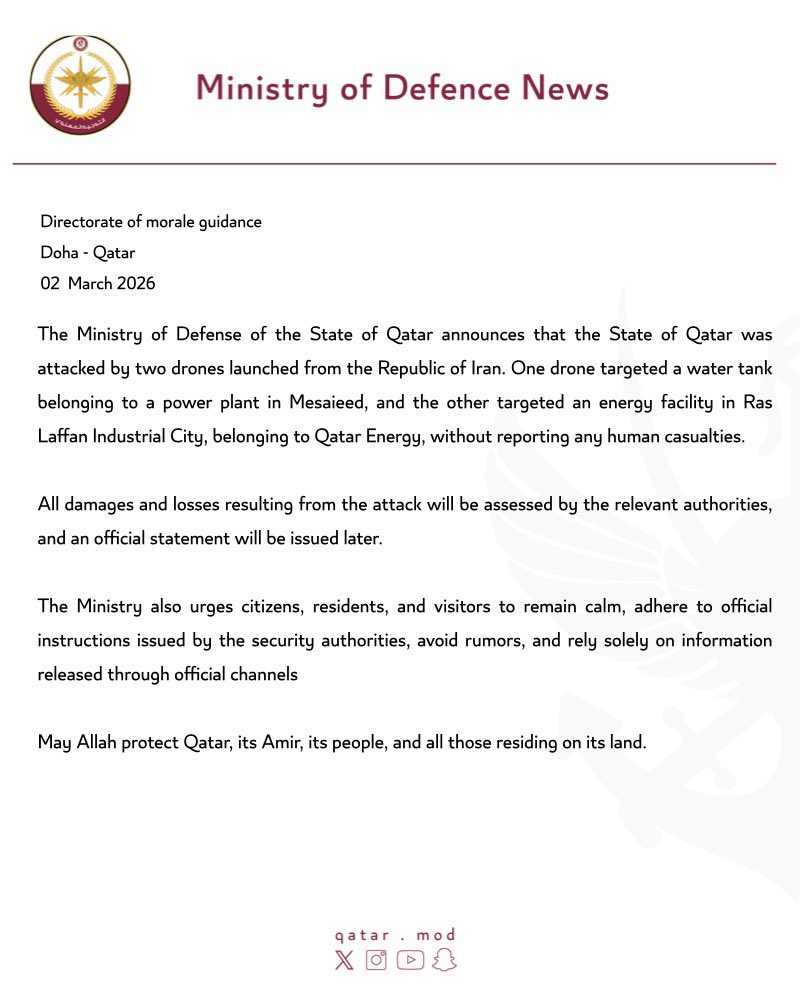
🚨BREAKING: #Qatar’s Ministry of Defense says the country was attacked by two drones launched from #Iran.
• One drone targeted a water tank at a power plant in Mesaieed.
• The second targeted an energy facility in Ras Laffan Industrial City belonging to QatarEnergy.
No human casualties reported so far.
Iran is now directly targeting critical energy infrastructure in the Gulf. This is a major. #oott
@MOD_Qatar
2
11
6
6,257
Mar 2
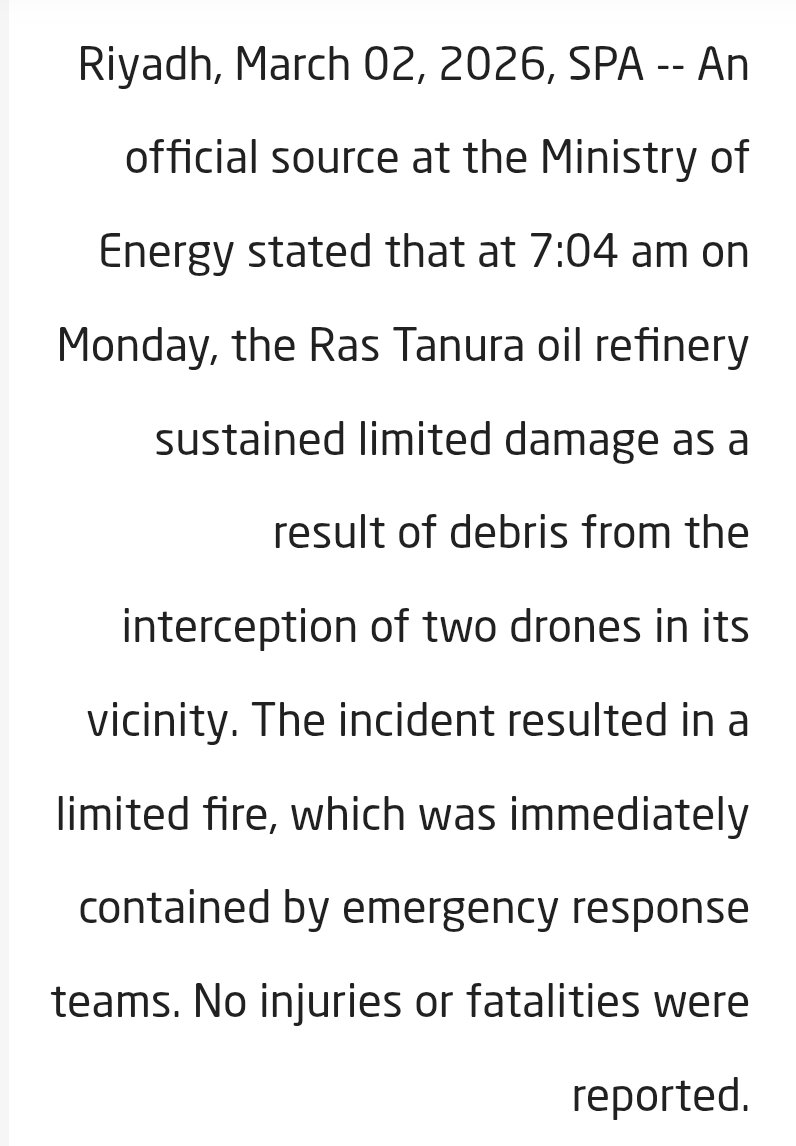
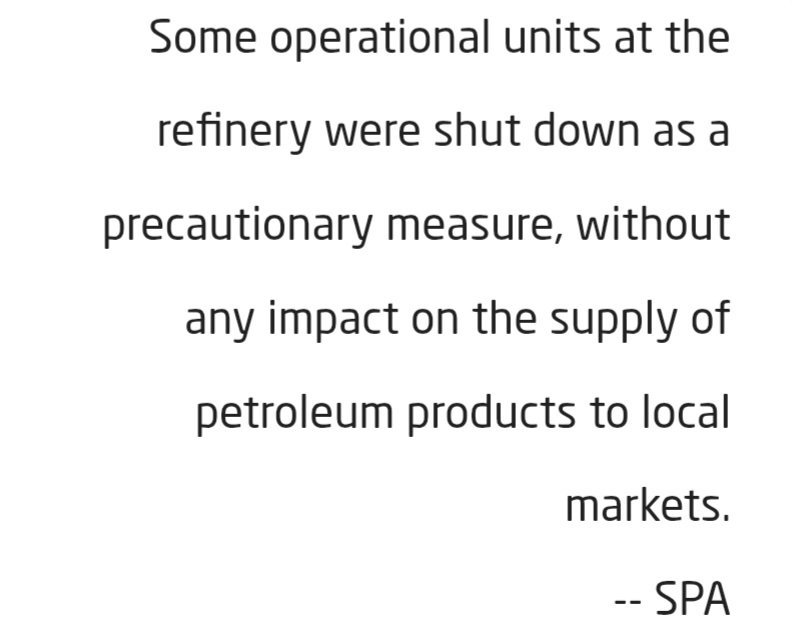
Although Ras Tanura took a hit, damage to energy infrastructure so far appears to be collateral rather than intentional.

The 550k b/d Ras Tanura refinery fire caused by *debris from 2 intercepted drones*, Saudi energy ministry says.
Key distinction, and much different to if it was struck directly as that would open up a whole new dimension to the conflict.
Ras Tanura is Saudi's biggest refinery.
5
537
Feb 28
The #energy impact of the attack on #Iran will primarily stem from any retaliatory strikes on its neighbors’ energy facilities, as well as disruption in tanker traffic through Hormuz
Iran oil itself not a real concern as it only goes to China where it feeds into the massive stock build — huge reserves effectively sterilised from the broader market — and China has ample safety reserves to draw from
Although Tehran first reputedly assured its neighbors it would only target US military assets on their territories, there are already reports on hits on Saudi Eastern Provinces, the heart of the Kingdom’s oil industry
Thanks @juliaradio for the chat, great to be in good company with @raadie66
npr.org/2026/02/28/nx-s1-567…
9
17
7,463