
Software dev & designer. I care about software that's pragmatic, ergonomic, and collaborative. Building promptbible.ai, a better notes app for writing prompts
Joined January 2009
- Tweets 27,441
- Following 1,824
- Followers 2,598
- Likes 20,344
626 Photos and videos





Jun 12
My favorite phrase to say to Codex/Claude Code is “Pareto improvement”
I use it everytime I’m planning, reviewing, or prodding the agent to improve and cleanup my codebase.
A Pareto improvement is a change that makes one aspect of a system better, without making any other aspect worse.
2
1
92
May 22
Finally found a productive workflow for QA’ing frontends with agents.
Can’t believe it took this long for me to find a working setup.
In Codex & Claude Code, there’s a few ways the agent can help QA your app in a real browser:
1. First-party Chrome extension
2. In-app browser (only on Codex)
3. Playwright MCP
4. Chrome DevTools MCP
The first two sound tempting, because they’re first-party to your agent.
But for manually testing a web app, I think the best option is DevTools MCP.
It not only lets the agent drive the web browser, like all the rest do, but it’s got access to the full suite of dev tools in Chrome, including performance/network tracing, reading console logs, and debugging.
Works super well with Codex /goal: you can ask it to improve perf to hit certain metrics, and it’ll not stop until it hits those metrics.
1
1
4
449
May 20
Addicted to telling Codex or Claude Code to “get a subagent to do [task]”, especially since it keeps the main thread clean and you can continue chatting in it.
Makes me wish regular ChatGPT and Claude had this.
This pattern is helpful for ideation/research/planning tasks too!
1
1
177
Apr 24
Just tried Claude Design.
Burned through my Pro weekly limit in one session, but boy was I happy.
I don’t think Figma is going to be replaced by this anytime soon. It still works best if you give it hand-designed layouts, color choices, type choices, etc).
That said, the experience is miles ahead of Figma Make.
Only because it makes a serious effort of structuring your design system and it makes creating one from existing artifacts super duper easy (GitHub repo, Figma files, brand assets, copy samples).
I’m an indie maker, and putting together a design system has always been a bit of a chore, but this has legitimately taken a lot of work of my plate.
Now, if only Figma worked this way! Autogenerate or update a design system from the decisions I’ve made in my mockups and my repo.
A boy can dream!
3
29
8,605
Mar 20
I’m excited for the agentic revolution remaking software as we know it.
The argument for user-configurable or user-extensible software has always been a bit flawed, because it assumes that if someone finds off-the-shelf software distasteful, or disrespectful of their needs, then the answer is to make tweaks atop that software.
But software expresses affordances and conceptual models that are tightly coupled to a data model, API semantics, and architectural capabilities.
Which means if said software is wrongly-opinionated for a use case, it’s unlikely that making userland tweaks or extensions will help much.
When agents become users that consume APIs directly, software that’s designed in a fashion disrespectful of their users’ goals, needs, or mental models will become more intolerable.
Any hard limitation of those APIs or underlying data models will become more stark.
When users’ experiences with software used to be mediated by UIs alone, it’s always a bit opaque as to how that software can evolve or be modified to work differently in a way that more closely matches your goals or the way you think.
In that world, a different UI seemed to be the answer.
But at the end of the day, poorly-made software is hamstrung by its fundamental design at the system level. The UI can only express what the system is designed for.
Competition between software tools will become much more perfect, when these design flaws are quickly discovered, as agents run into a wall with an API that can’t express the user’s intent.

5
591
Mar 18
Folks like to compare Anthropic to Apple but I think OpenAI has more of that Apple design DNA.
The Codex macOS app such a treat to use with a ton of little design details.
They ship new workflow features more slowly compared to Anthropic, but they do it more thoughtfully and usually with a considered UX
Anthropic UX feels more like Microsoft in this case: drawers chock full of stuff, lots of it powerful, but they aren’t necessarily well thought out from a usability perspective
Mar 18

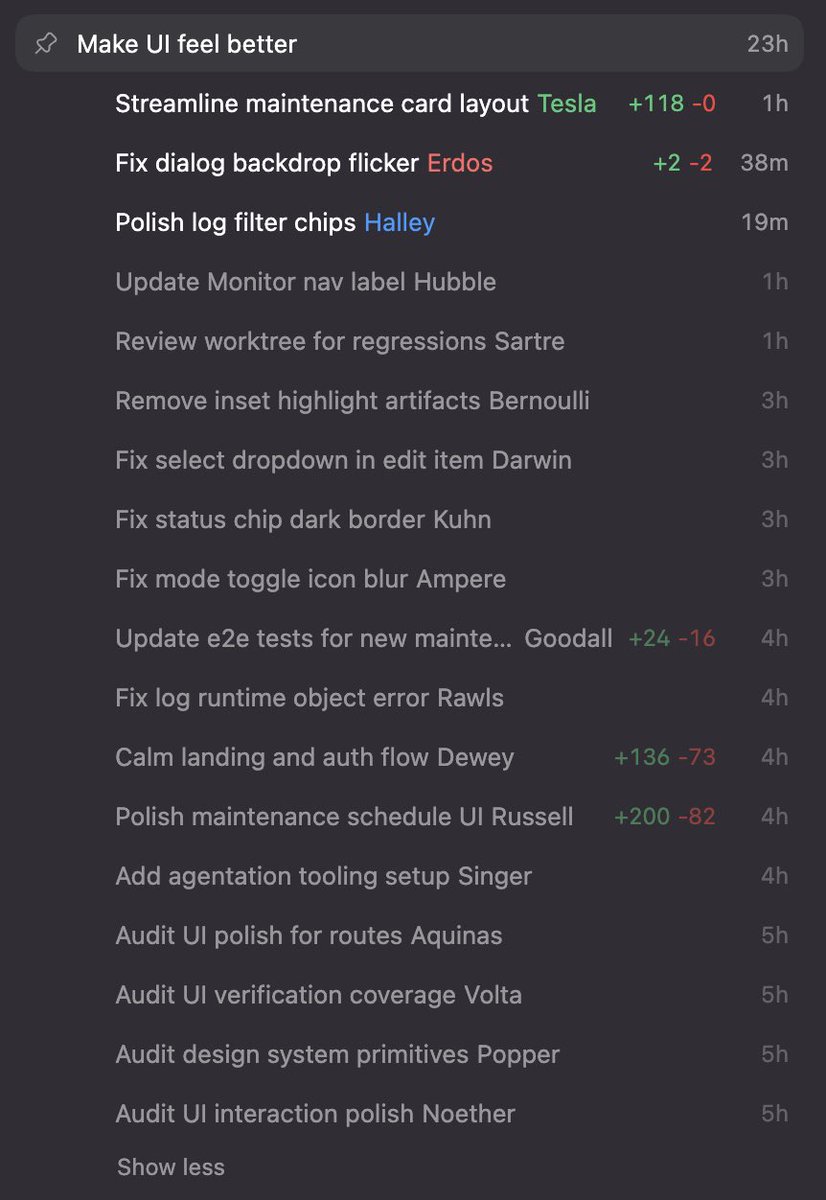
Codex sub-agents are such a treat to use
I love how you can steer each one individually
Makes it possible to start with a coarse ask, have the agent break up the work into small orthogonal parts, then deep dive into each one
It’s also super cute that each sub-agent gets a name like “Erdos”, “Halley”, “Hubble”, etc: it’s a small detail but it makes it possible to refer to them easily!
4
636
Mar 18
Codex sub-agents are such a treat to use
I love how you can steer each one individually
Makes it possible to start with a coarse ask, have the agent break up the work into small orthogonal parts, then deep dive into each one
It’s also super cute that each sub-agent gets a name like “Erdos”, “Halley”, “Hubble”, etc: it’s a small detail but it makes it possible to refer to them easily!
1
4
835
Feb 18
I think people are making too much of a big fuss over “taste” and how that’s a comparative advantage for humans over AI models
I think “taste” is simply an act of prediction over learned patterns of human preferences
(I go into detail more in the article)
Corollary of this:
AI models can pattern match over a larger dataset of human preferences than any single human will ever be able to, and will win out over humans every time.
Humans only have an advantage over AI models insomuch as much of these human preferences are still tacit and granular and difficult to put into words
Anyone who’s tried to prompt an AI model for a song, an image, or a video exactly to taste will know how difficult it is to explicitly state what your preferences are.
But recommender algorithms are already better at recommending and curating content than human curators, using proxy signals like likes, views, etc
Perhaps it’s a matter of time before someone cracks the code of how to infer a user’s preferences (without explicit prompting) for creation (not just curation)
When that happens, there’s no need for a middleman human to make creative decisions. The end-consumer can simply ask for what they want, and the AI models will provide it, to taste.
4
431
Jan 22
This is beyond cool.
Designs collocated with your codebase!
Visual designs are a huge part of spec’ing out a UI
If specs should be collocated with the code so that agents always have the context of what they’re building or maintaining, then it makes sense for the design files to be collocated with it too

Excited to launch Pencil
INFINITE DESIGN CANVAS for Claude Code
> Superfast WebGL canvas, fully editable, running parallel design agents
> Runs locally with Claude Code → turn designs into code
> Design files live in your git repo → Open json-based .pen format
2
622
23 Dec 2025
I had this thought too, while working on a reasonably complex feature that necessitated spiking out multiple approaches to a problem
Agents let us try many different approaches quickly and that’s a good thing
But not having failed approaches be easily accessible as context to the agent is a missed opportunity
It’s one thing to describe in a spec .md file that an approach didn’t work, it’s another to have that available to the agent to inspect at anytime
21 Dec 2025

A problem with VCS today in an agentic world is they only store the [mostly] successful history. We should be storing the thousands of branches that were failures; the false starts that didn't solve the problem. The negatives are important and we are just throwing it all away.
2
282
20 Dec 2025
Why didn’t Adobe do this with Firefly?
19 Dec 2025

🎨 Qwen-Image-Layered is LIVE — native image decomposition, fully open-sourced!
✨ Why it stands out
✅ Photoshop-grade layering
Physically isolated RGBA layers with true native editability
✅ Prompt-controlled structure
Explicitly specify 3–10 layers — from coarse layouts to fine-grained details
✅ Infinite decomposition
Keep drilling down: layers within layers, to any depth of detail
🤗 Hugging Face: huggingface.co/Qwen/Qwen-Ima…
🧩 ModelScope: modelscope.cn/models/Qwen/Qw…
💻 GitHub: github.com/QwenLM/Qwen-Image…
📝 Blog: qwen.ai/blog?id=qwen-image-l…
📄 Technical Report: arxiv.org/abs/2512.15603
🚀 Demo (HF): huggingface.co/spaces/Qwen/Q…
🚀 Demo (ModelScope): modelscope.cn/studios/Qwen/Q…
4
272
14 Dec 2025
Sometimes code is more expressive than graphical tools.
And knowing when a tool is more expressive (for the space you’re trying to search) is half the battle won.
For example, keyboard or clipboard interactions are better explored in code.
2
4
436
14 Dec 2025
Agentic coding is transformative for design not because they make construction easier, but because they make it easier to explore certain spaces that you’d otherwise be locked out of, without technical mastery.
Before agentic coding, design was relegated to graphical tools.
Graphical tools don’t have the concept of a clipboard, events, or HTML elements, and they don’t have the idea of state, latency, or the network boundary.
They excelled at exploring layouts, typography, color, structural navigation, or microcopy.
But anything to do with content, data, or state has had to bump up against reality much later than it normally would, since PMs and designers aren’t able to explore the full space of what’s possible.
3
112
4 Dec 2025
Spotify really should do something like Wrapped on an ongoing basis
I didn’t recognize half of my “most played artists” or “most played albums” this year, because listening through Spotify happens mostly through playlists, Daily Mixes, and Discover Weekly
Usually I’m listening sight unseen, while coding or reading or doing chores around the house.
It would be nice to see some trends/insights in realtime as to recent discoveries so I can dive deeper into them.
It’s not great that the product is only catered toward this rediscovery use case once every year. Feels completely arbitrary!
3
2
221
4 Dec 2025
Turns out I really like the “introvert psych rock” that Ciao Ciao Marigold makes
If only I knew waaaay earlier!
1
127