
Joined September 2021
- Tweets 560
- Following 882
- Followers 7,859
- Likes 1,966
4 Photos and videos



Pinned Tweet

Apr 21
The Firm’s race is to replace you before they collapse under their own weight and market pressures.
Your race is to replace them before they finish or the market finishes them.
1/

8
20
86
142,216
augmented things retweeted

Jun 13
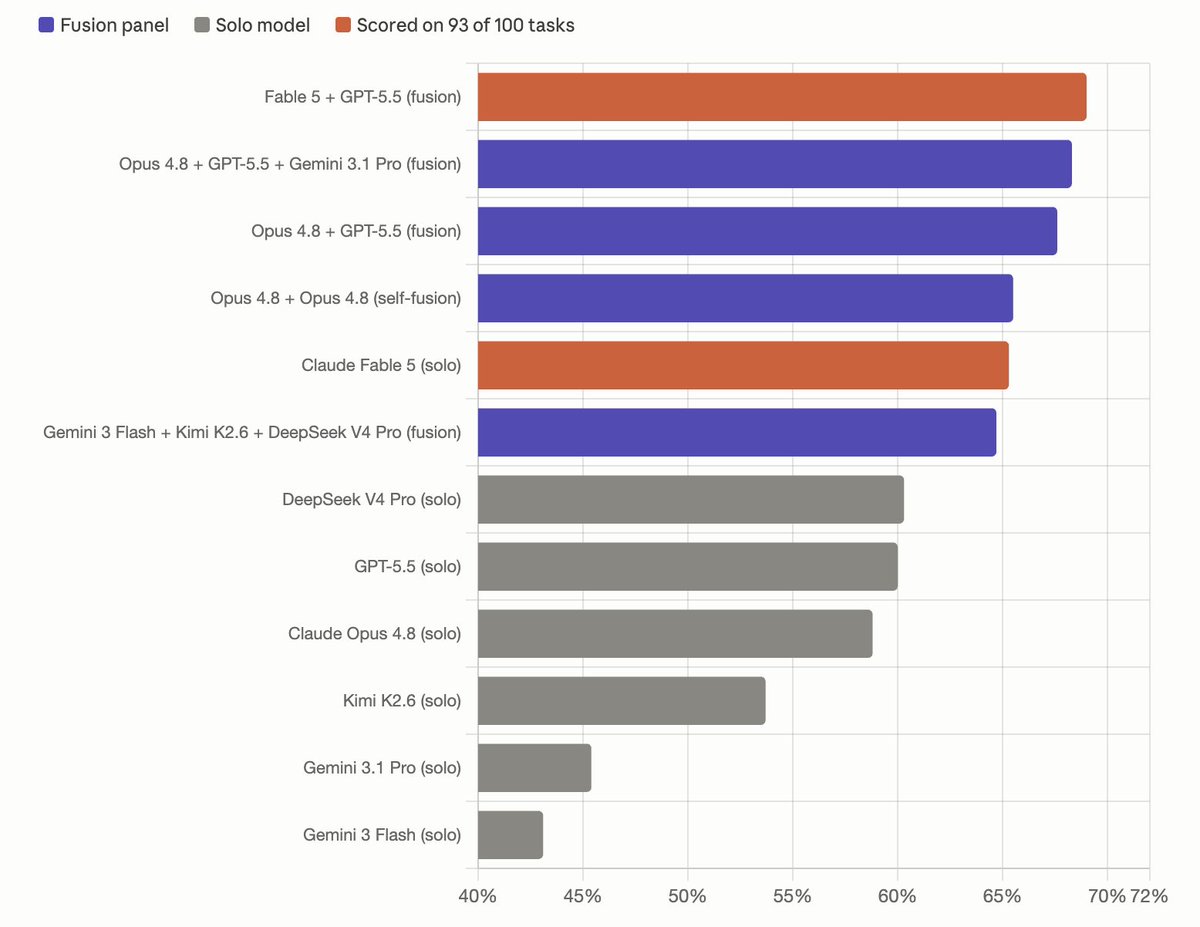
Introducing the Fusion API, the smartest compound model in the market.
Fusion achieves Fable-level intelligence at half the price.
How it works 👇
642
1,643
13,963
5,354,416
augmented things retweeted

Jun 11
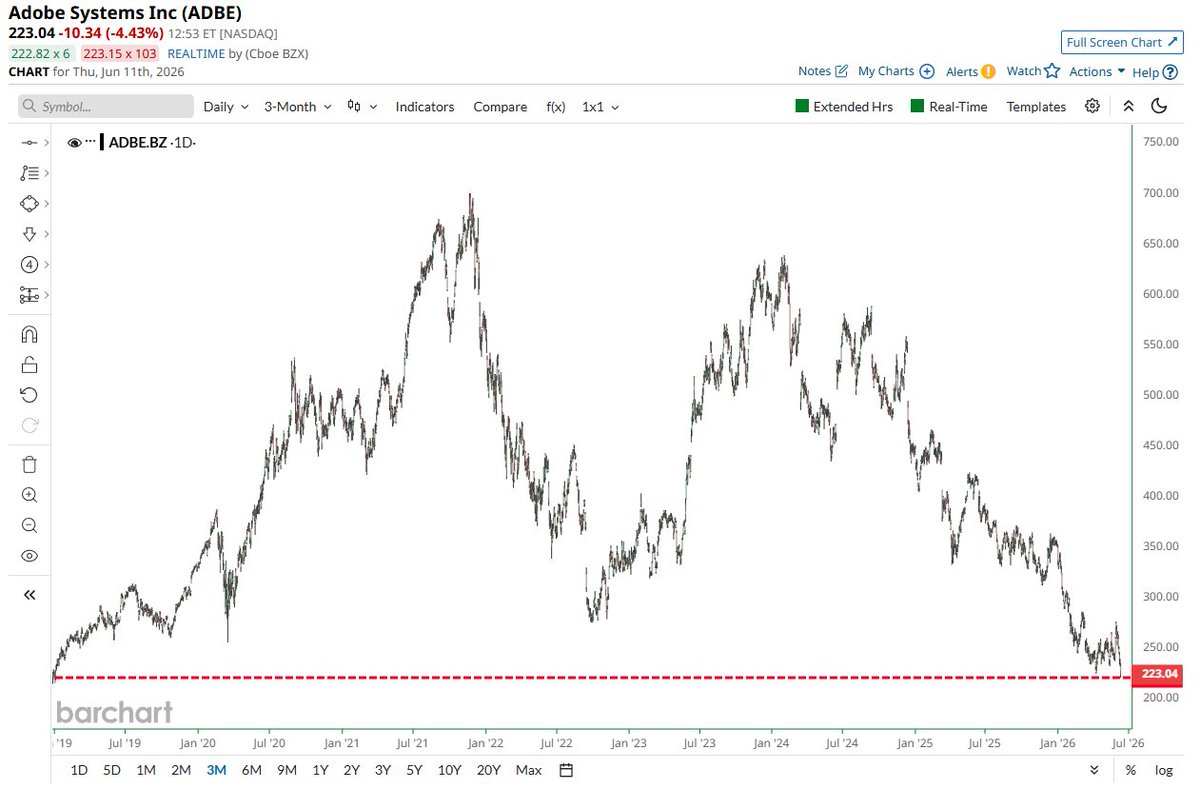
⚡️Adobe is the first large-cap price discovery of the end of the seat as the unit of economic account.
Per-seat SaaS was never a software business model.
It was a derivative on employment.
Every license priced a human sitting in a chair performing a function, which means the entire software economy’s revenue base is indexed to headcount in the functions it serves.
Adobe’s revenue line was, structurally, a long position on the global population of paid visual-production workers. The model decouples output from headcount.
When output stops requiring seats, the derivative reprices toward its terminal value regardless of how good the underlying software is. ADBE’s chart is the first clean market quote on that repricing, and the reason it matters beyond Adobe is that nearly all of enterprise software is written in the same unit of account.
Beneath that sits an inversion almost nobody prices correctly.
Software’s entire historical value proposition was as a complement to human labor: the tool made the worker more productive, the worker became more valuable, the worker’s employer paid for the tool.
AI arrives as a substitute for the worker, and that flips the customer relationship at the root. Adobe’s customer was never demand for images. Adobe’s customer was the worker standing between demand and supply. Remove the worker from the loop and demand for images can explode while Adobe’s customer base evaporates, because the entity Adobe billed has left the transaction. This is why “creative content volume is growing faster than ever” and “Adobe at 2019 prices” are both true simultaneously, and why anyone citing content-volume growth as bullish for ADBE has misidentified who the customer was.
That produces the abundance paradox, which tells you where the value went.
When production cost collapses toward inference cost, value cannot stay in production tooling. Abundance destroys tolls. Value migrates to the remaining scarcities: compute (the new marginal cost of creation, captured by Nvidia and the hyperscalers), distribution (attention stays scarce no matter how much content exists, captured by the platforms), and verification (when anything can be fabricated, proof-of-real becomes the scarce good).
Adobe’s revenue is not vanishing, it is being remitted to other balance sheets. The same enterprise budget dollar is moving from per-seat licenses to per-token inference, and that single migration is the unified explanation for why the market pays semis and punishes incumbent SaaS. One trade, two legs, and ADBE is the short leg’s poster asset.
The decay curve has a specific shape, and it is demographic, not cyclical. The last real moat was professional identity: millions of people whose sunk cost in Photoshop mastery is fused to their self-concept and their employability. That moat does not get breached, it ages out.
The senior cohort defends the workflow until retirement. The cohort behind them splits. The youngest cohort never learns the tool at all, the way no one under thirty learned darkroom printing.
That gives the decline an actuarial structure: slow, smooth, unstoppable, fifteen years long, with cash flows persisting the entire way down.
Which resolves the value-trap question precisely.
Enterprise contracts and identity defense fund a long fade rather than a collapse, so the stock can look cheap on trailing cash flow every single year while terminal value quietly approaches the salvage price of the brand.
The double-top, eighteen-month distribution chart is exactly what an actuarial repricing looks like when institutions model it.

12
9
90
24,704
augmented things retweeted

Jun 8
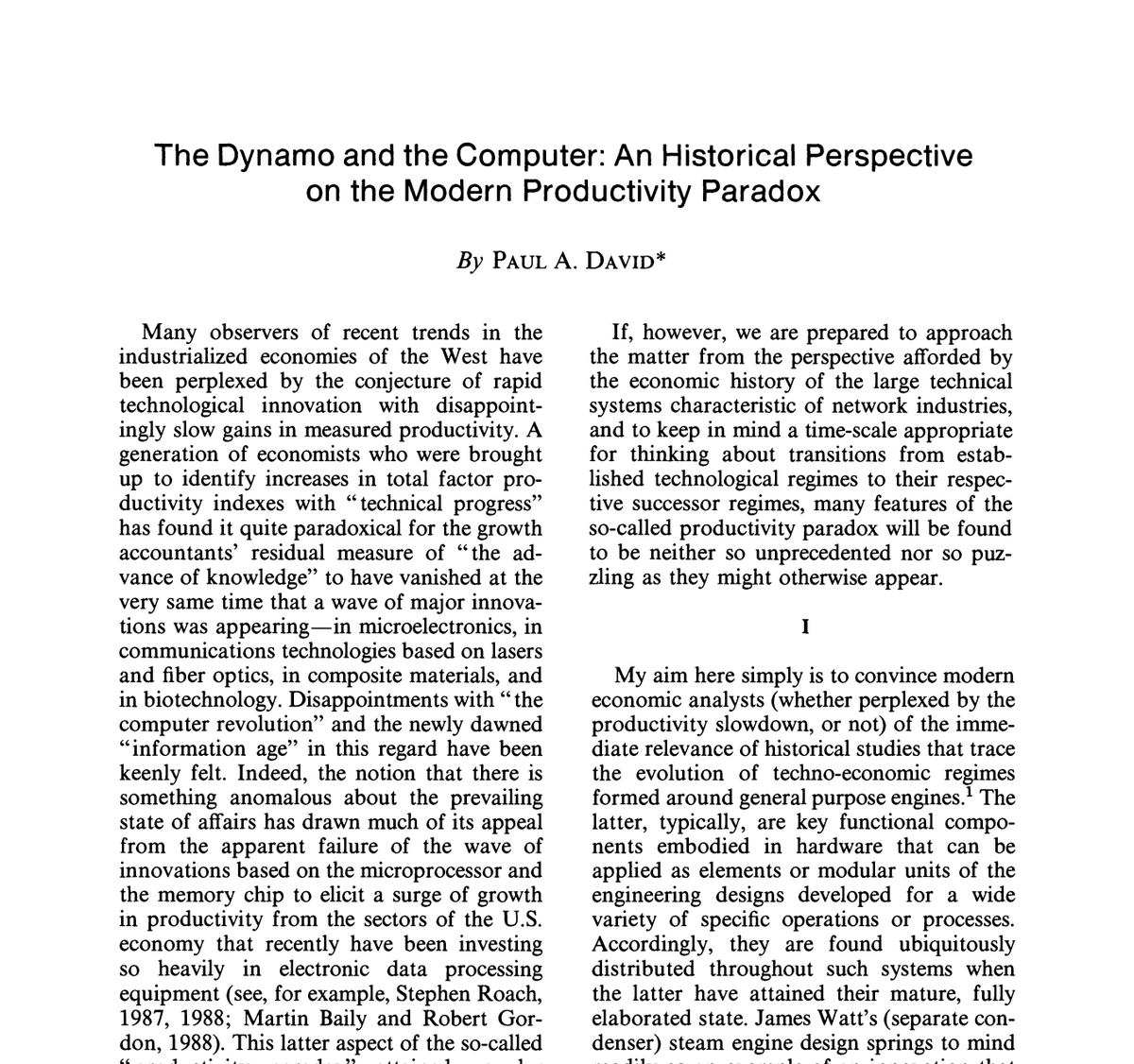
If you've adopted AI at your company but haven't seen any tangible results, read this 1990 article: "The Dynamo and the Computer" by Paul David.
When electricity first arrived, factories that "adopted" it barely got faster. They just swapped the steam engine for an electric one and ran everything else exactly as before: same machine layout, same workflow, same management. Electricity in, no real gains out.
The most common mistake with any new technology is to drop it into the old organization and then declare the transformation done.
The real leap came decades later, when each machine got its own small motor. Suddenly machines no longer had to be lined up around one central drive shaft. They could be rearranged around the actual flow of work.
The productivity gains didn't come from electricity. They came from REDESIGNING THE ENTIRE FACTORY around it.
AI is the same. Bolting it onto your existing process gets you a faster steam engine. The payoff comes when you redesign the work itself.
(link to paper in comments)
146
753
4,232
286,580
augmented things retweeted
the people giving young people advice for where to find opportunities funneled them into a structural pump & dump where they financialized every opportunity & used them as exit liquidity.
everything's different now. update perspective & approach to win.
x.com/augmentedthings/status…
Apr 28
We're in a permanently higher-volatility environment. Anti-fragile operators will win.
If volatility doesn’t make you stronger, it will make someone else stronger at your expense.
You are the new unit of scale now. Whether you compound leverage or industrialize noise comes down to architecture and design discipline.
Execution is cheap. The ground is moving. Plan accordingly.
1
3
47
6,082
augmented things retweeted

Jun 8
We spent a century building a world where you sell your one life back to a corporation by the hour. AI just made that whole arrangement optional.
14
8
40
1,654
augmented things retweeted

Jun 6
Your margin is my opportunity: AI version…
The biggest surprise of 2026 is that the capability gap between the best open-weight/source models and the best closed models has narrowed much faster than the pricing gap. The pricing gap remains enormous while the capability gap is quite narrow.
What does this means in practice?
For a company consuming 1 billion input tokens and 1 billion output tokens per month:
GPT-5.5 Pro: ~$105,000
Claude Opus 4.8: ~$30,000
DeepSeek V4 Pro: ~$5,220
DeepSeek R1: ~$2,740
I asked ChatGPT what it thought about this and it answered as follows:
“If I were building a company today, the economic frontier would look roughly like:
DeepSeek V4 Pro / R1 for high-volume inference.
Claude Opus for premium agent workflows where reliability matters.
GPT-5.5 Pro only for workloads where its incremental capability demonstrably produces enough business value to justify a 20–40× token premium.”
Most CEOs have no idea that, instead of this nuanced approach, their teams are running amok internally by picking the most expensive models in most cases and burning through massive budgets with zero governance, audit ability and control.
As control planes like our Software Factory become more standard, you can expect the run rate revenue growth of the frontier labs to go down meaningfully and the revenues of the open models to skyrocket.
Why? Because we can implement the nuanced approach above and be agnostic to model - instead focusing on customer intent, model task and cost management among other things.
Jun 6

Quite a week for open-source AI. Especially American open-source. Nemotron 3 Ultra is the most important release in quite some time. And some really cool RL and fine-tuning work from Harvey.
221
218
1,996
860,335
war time leaders needed.
peace time leaders upgrade or move aside.
the rules are different and you will fail if you don't change.
May 20
The same environment that is fragmenting institutions is doing something else at the same time: it’s running the fastest, most brutal, most productive innovation cycle in the history of organized work.
Bad architectures are failing fast. Good ones are getting rewarded faster. The trial-and-error loop that used to run in years is running in weeks. The ideas that don’t work are dying before they can metastasize. The ones that do work are compounding before anyone has agreed on a name for them.
4/
1
3
20
40,083


augmented things retweeted

Waking up to see over 300 members in the Discord feels surreal.
Seeing this group of amazing builders come together has been one of the most rewarding experiences of my existence.
I’m grateful for every single person who has joined us along the way.
If you’re looking for a supportive, positive space to build, learn, and connect with others on a similar journey, we’d love to have you join us.
Come join us: ➡️ discord.gg/yCZajs2e8V
28
5
70
2,172
augmented things retweeted

Jun 3
Welp, that happened faster than I predicted. Thought it would be end of 2027, then early 2027, but agentic traffic growing so fast that bots have now passed human traffic online for the first time in the Internet's history. radar.cloudflare.com/traffic…
388
2,168
8,316
2,243,174
augmented things retweeted

Jun 2
Seven new models launching at Build: let’s go!
Reasoning. Code. Image. Transcribe. Voice.
Built from scratch on a clean data lineage, designed for efficiency, working seamlessly as a family of models
Thread 🧵
#MSBuild
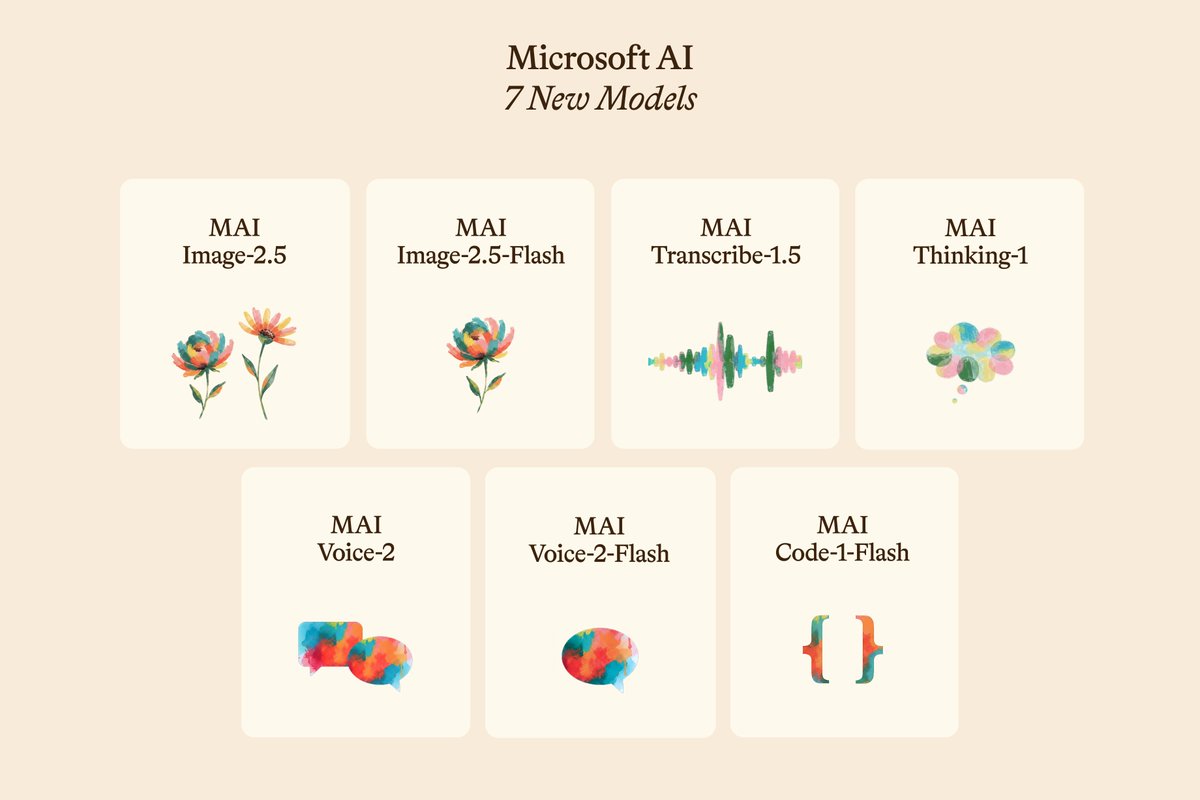
ALT Graphic titled ‘Microsoft AI: 7 New Models’ showing icons for Image, Transcribe, Thinking, Voice, and Code models in a grid
137
524
3,365
388,445

Introducing Base MCP
Your agent's new gateway to Base
→ Connect an agent to your Base Account
→ Enable it to swap, trade, and manage your portfolio
→ Use plugins from leading apps on Base
The next stage of the agentic onchain economy
754
752
4,244
982,835
augmented things retweeted
May 22
“It’s an early, visible, visceral and an almost out of a Netflix Original version of the dynamic that will play out in every organization where the transition happens faster than the institution can honestly manage it. Which is most of them.”
May 20
deny. hide. subvert. build digital weapons. exit.
People will pick one or all of these when faced with training their AI replacements. You are about to see this pattern play out at a scale and speed that has no modern precedent.
1/
1
3
19
3,642
augmented things retweeted

May 21
New genre of post emerging:
“I’m firing a ton of people and our business has never been better. Here’s why”
Performative white-collar executions
May 21

Today we reduced headcount by 22%. The business is the strongest it's ever been. So I think it's important to be direct about what I'm seeing and why.
First, I made this decision and I own it. I did it because the way to operate at the highest level of productivity is changing, and to win the future, ClickUp needs to change with it.
Second, this wasn't about cutting costs. Most savings from this change will flow directly back into the people who stay. We'll be introducing million-dollar salary bands. If you create outsized impact using AI, you'll be paid outside of traditional bands.
Most importantly, I have the deepest gratitude for those affected. We're doing this from a position of strength specifically so we can take care of people properly. Everyone affected receives a package aimed at honoring their contributions and easing the transition.
I only see two options: wait for this to play out gradually in the market or be honest about what I'm seeing and act proactively.
THE 100X ORGANIZATION
The primary change is that we're restructuring around what I call 100x org. The goal is 100x output. The roles required to build at the highest level are fundamentally different than they were a year ago.
Incremental improvements to existing systems won't get us there. We need new ones. That means creating enough disruption to rebuild rather than iterate on what's already broken.
The common narrative is that AI makes everyone more productive. It doesn't. Many of the workflows of today, if left unchanged, create bottlenecks in AI systems.
These roles will evolve. But waiting for that to happen naturally means falling behind now.
The 100x org is actually heavily dependent on people - infinitely more than today. This is only possible with 10x people that have embraced and adopted new ways of working.
THE BUILDERS, AGENT MANAGERS, AND FRONT-LINERS
— THE BUILDERS: 10X ENGINEERS
I don't think most companies have internalized what's actually happening with AI in engineering. The common narrative is that AI makes all engineers more productive. That may be true in isolation, but at an organization level - that is the farthest thing from reality.
Here's what we've validated recently at ClickUp: the great engineers, the ones who can orchestrate, architect, and review, are becoming 100x engineers. They're not writing code. They're directing agents that write code. The skill is judgment.
AI makes the best engineers wildly more productive, and everyone else using AI slows these engineers down.
Think about it - the bottlenecks are (1) orchestration - telling AI what to do, and (2) reviewing - what AI did. Everything is leapfrogged and no longer needed.
So who do you want orchestrating and reviewing code?
And how do you want your best engineers to spend their time?
If your best engineers are spending time reviewing other people's code, then this is inherently an inefficient bottleneck. These engineers can review their agent's code much faster than reviewing human code.
The new world is about enabling your 10x engineers to become 100x.
The wrong strategy is to push every engineer to use infinite tokens. Companies doing this are celebrating 500% more pull requests. But customer outcomes don't match the volume of code being generated.
I call this the great reckoning of AI coding, and every company will face this soon if not already.
More code is just another bottleneck to the best engineers, and ultimately to your company's impact as well.
— THE BUILDERS: 10X PRODUCT MANAGERS
Product management and design roles are merging.
Designers that have customer focus, become more like product managers.
And product managers that have intuition for UX become more like designers.
The bottleneck of user research is gone. It takes us just one mention of an agent to kickoff research and analyze results.
The bottleneck of product <> design iteration is also gone. The product builder iterates on their own, along with agents and skills that ensure alignment with quality and strategy.
Also controversial today - I believe that the wrong strategy is to have your PMs shipping code - that just introduces another bottleneck that the best engineers will waste their time on.
To be clear, PMs should be coding but they should do this in a playground to iterate, validate, and scope. That code should not go to production.
Everything outside of managing systems, orchestrating AI, and reviewing output becomes a bottleneck.
That's why the other roles that are critical along with these are the systems managers (to reduce bottlenecks) along with a bottleneck you can't replace - customer meeting time.
— THE SYSTEM MANAGERS
Ironically, the people that automate their jobs with AI will always have a job. They become owners of the AI systems - agent managers. We have many examples of these people at ClickUp.
The underlying systems in which we operate are absolutely critical to get right. I think most companies are delusional to think they can iterate on existing systems and compete in this new world.
You must create enough disruption so that old systems are deprecated entirely. If there's any definition for 'AI native' that's what it is.
— THE FRONT-LINERS
In a world that will become saturated with AI communication, the human touch will matter more than anything to customers.
This is a bottleneck that you shouldn't replace - even when agents are high enough quality to do video meetings.
One-on-one meeting time with customers is something that shouldn't be automated. The systems around the meetings should be - so that front-liners spend nearly 100% of their time with customers.
REWARDING 100X IMPACT
In a world where companies are able to do so much more with less, where does that excess money go?
In our case, much of the savings in this new operating model will flow directly back to those that enabled it.
We must reward people that create productivity accordingly. This aligns incentives on both sides. Plus, in a world where your best people create 100x impact, you can't afford to lose them.
You should aim to retain these employees for decades. The context they have and their ability to efficiently orchestrate and review will be nearly impossible to replace.
Compensation bands of today should be thrown out the door. We're introducing $1 million cash/year salary bands with a path available to nearly everyone in the company if they produce 100x impact by creating or managing AI systems.
THE FUTURE
Nearly every company will make changes like these. The ones that do it proactively will define what comes next.
The future is not fewer people. It's different work, new roles, and better rewards for those who embrace it. We're already seeing entirely new roles emerge, like Agent Managers, that didn't exist a year ago.
ClickUp is positioning to lead this shift, not just internally, but for our customers too. I've never been more certain about where we're headed.
80
163
3,349
217,928
augmented things retweeted
May 20
When employers do this, and the trusted system erodes, the people start changing.
May 20
deny. hide. subvert. build digital weapons. exit.
People will pick one or all of these when faced with training their AI replacements. You are about to see this pattern play out at a scale and speed that has no modern precedent.
1/
2
25
8,861
May 20
deny. hide. subvert. build digital weapons. exit.
People will pick one or all of these when faced with training their AI replacements. You are about to see this pattern play out at a scale and speed that has no modern precedent.
1/
2
9
31
42,598
May 20
This is what free markets do when the friction that used to insulate bad architecture collapses. Risk doesn’t accumulate silently into systemic failure, it surfaces, loses fast, and clears the field. The volatility that looks like chaos at the institutional level is actually the signal working correctly: price discovery running in real time, at every layer, all at once.
5/
2
1
3
593
May 20
Some architectures break under instability. Others are built for it. The ones built for it don’t just survive the volatility, they get stronger from it. Every piece of the chaos is evidence that the native architecture compounds while the inherited one decays.
The only map worth trusting is the one you build yourself. The people already doing that didn’t wait for the environment to stabilize. They built something that doesn’t need it to.
6/
1
4
496