
Building @EmpiricalHlth - don't die of heart disease. Previously @AppCardiogram, @GetSift, @HealthCareGov rescue team, @BrexHQ, & @Google AI.
Joined May 2010
- Tweets 3,740
- Following 2,248
- Followers 2,589
- Likes 7,461
161 Photos and videos


Jun 13
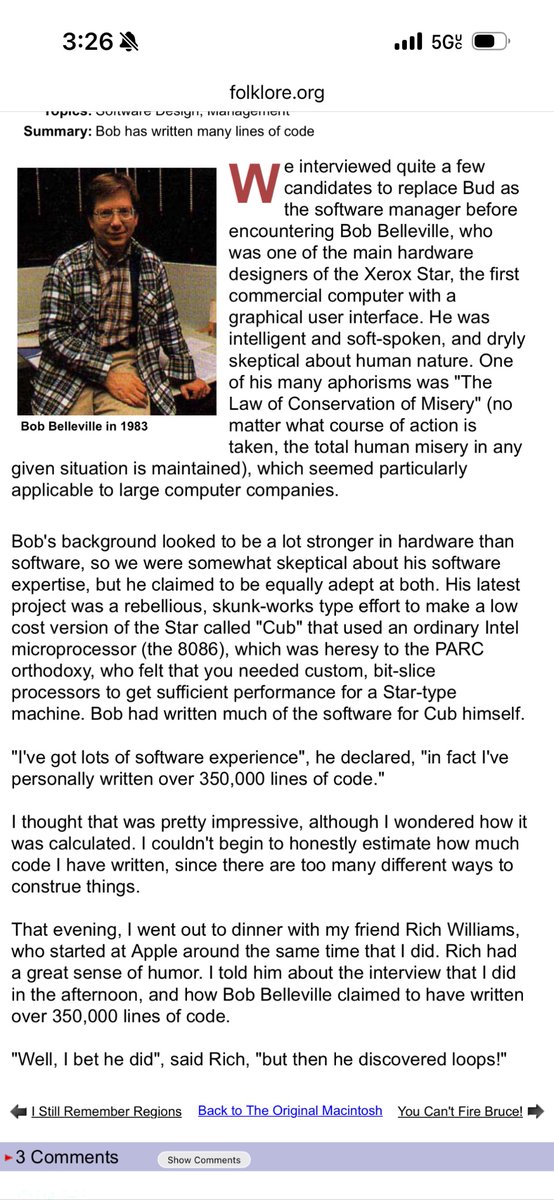
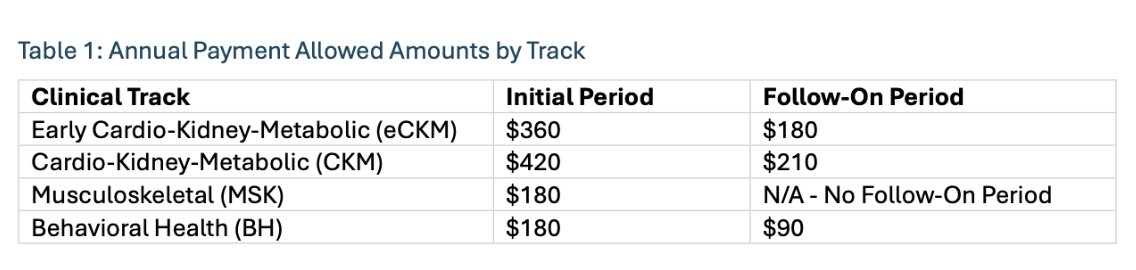
This same dynamic is playing out in AI for health right now. Startups that price on outcomes (VBC, Medicare ACCESS), rather than fee for service, give themselves the incentive to invest in software that compounds.
Jun 11

The pricing model determines what you build. Charge for outcomes and you're forced to invest in software that compounds. Charge for time and you never will. Pricing isn't downstream of the product. It IS the product decision.
1
1
16
333
Brandon Ballinger retweeted

Jun 12
111
242
2,755
1,394,695
Jun 1
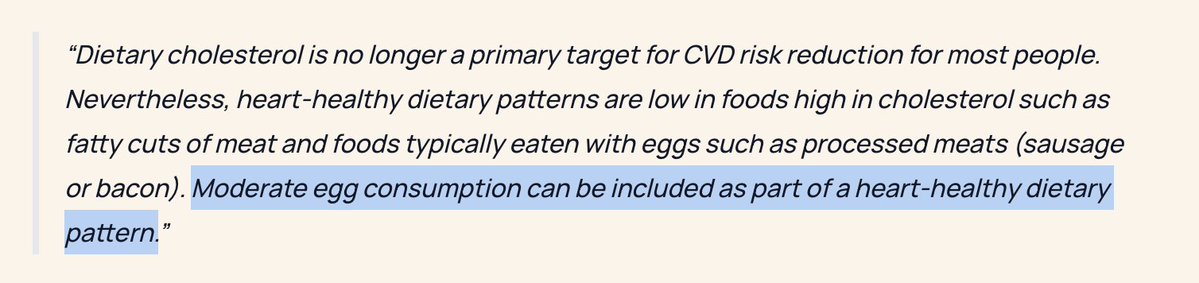
Eggs are officially healthy again (AHA 2026 dietary guidance).
25
17
254
May 27
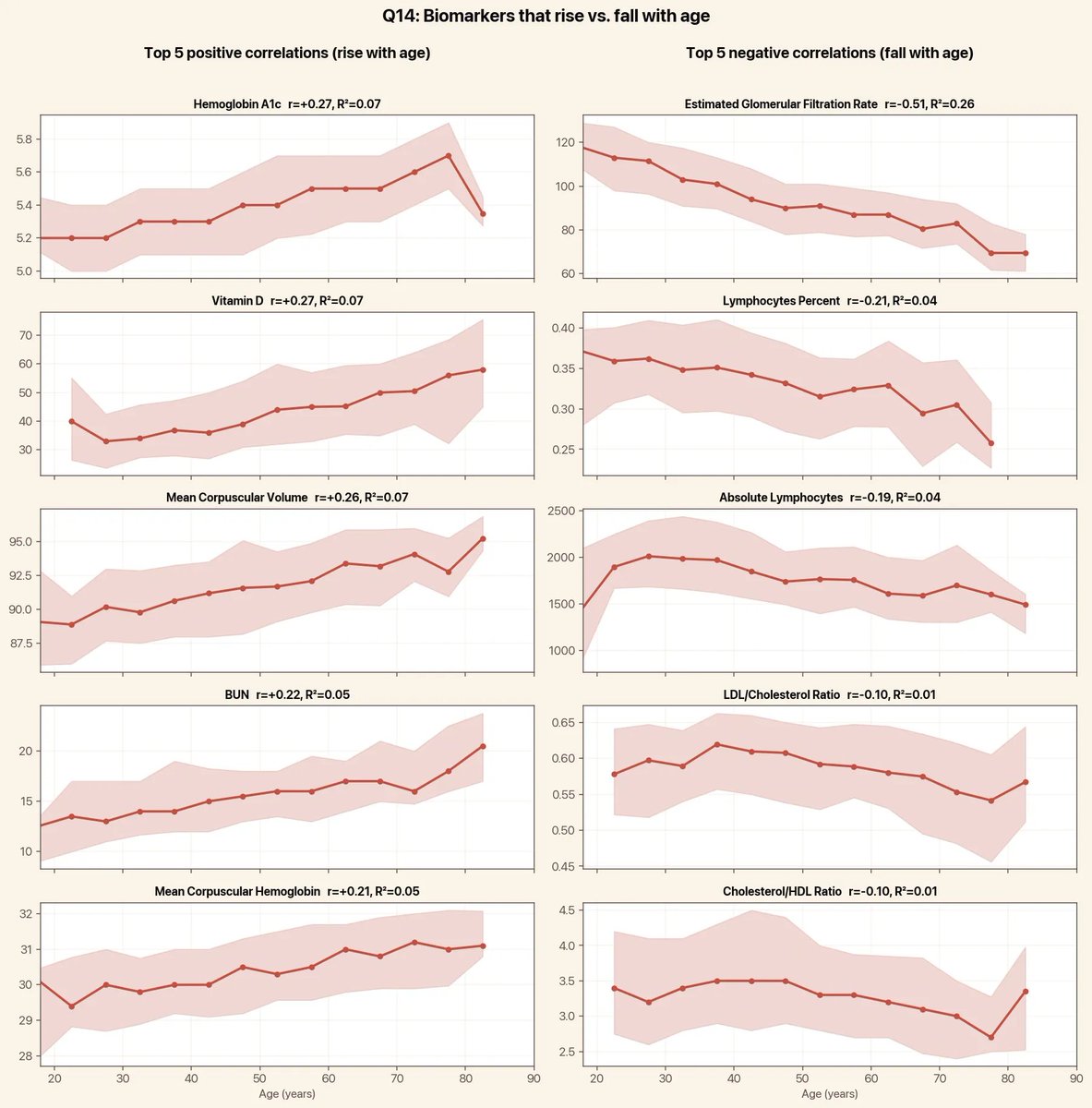
The biomarkers that rise and fall the most as we age:
1
30
46
2,772
May 21
JEPA in a nutshell: Don’t predict pixels. Instead predict representations.
1
2
238
May 21
Apparently Vitamin D acts more like a hormone than a vitamin. Regulates 1,000 to 2,000 genes (5-10% of the human genome).
30
15
350
Brandon Ballinger retweeted

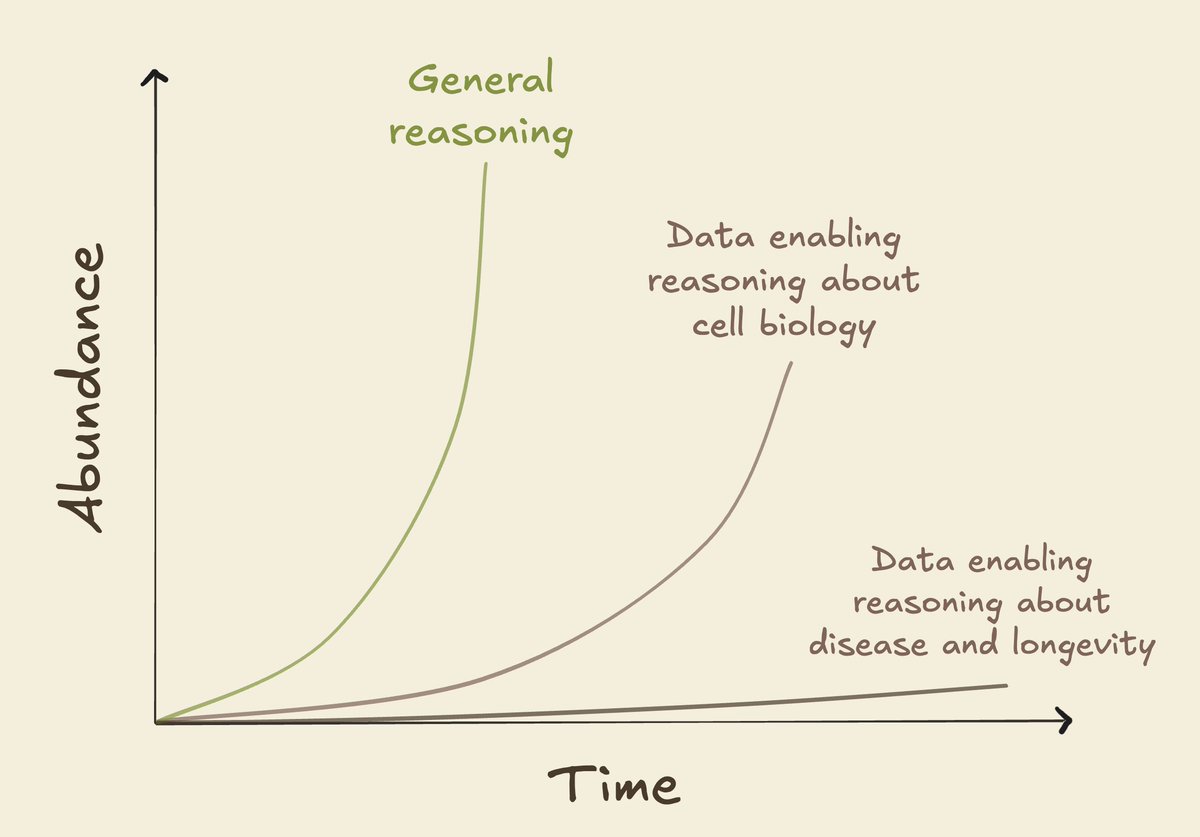
The “data for AI in bio” discourse is shifting from “we need data” to “what's the right data for this problem?”, and then how to produce it.
Right now there's a key gap between stated goals of curing disease and ongoing data generation efforts. We gravitate towards rapid and scalable experiments, even when those will never tell us how to treat Alzheimer's or aging.
The default path is that intelligence will explode, and cures will be stuck waiting for data that can't be accelerated.
There is work we should start today if we want to avoid that.
I wrote out thoughts on how we can identify data that will/won't let us cure disease, and how to overcome the technical and physical barriers to making it.
7
24
92
10,592
May 1
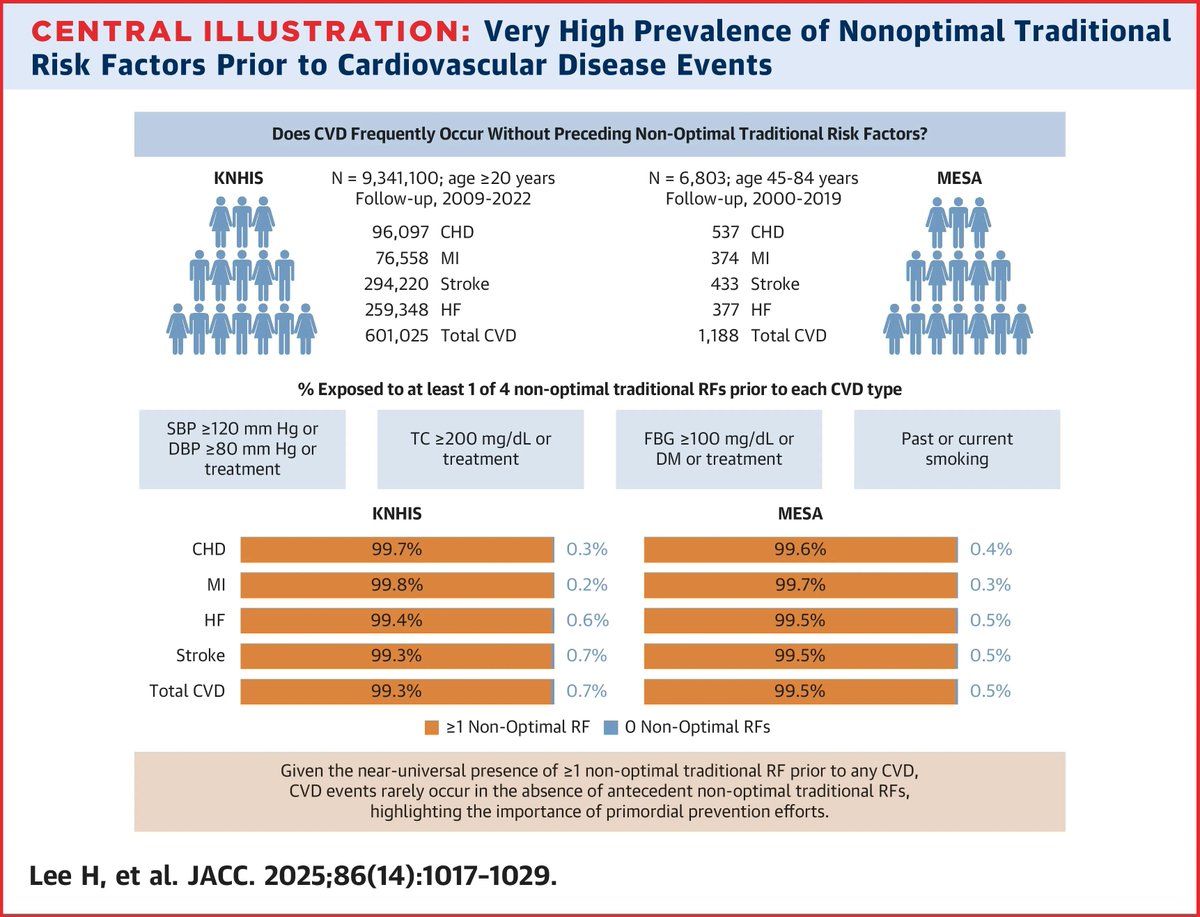
99.3% of heart attacks are predictable from known risk factors:
29
24
732

**Free** for all Medicare members.
1 in 5 people in the US are covered by Medicare, and 2/3 of Medicare beneficiaries qualify for ACCESS's cardiovascular tracks.
Apr 13

We're bringing the best cardiovascular care to for Medicare members in July. Thrilled to be selected in first wave of ACCESS participants: cms.gov/priorities/innovatio…
2
6
1,925
Brandon Ballinger retweeted

Apr 13
We're bringing the best cardiovascular care to for Medicare members in July. Thrilled to be selected in first wave of ACCESS participants: cms.gov/priorities/innovatio…
2
20
2,503
Brandon Ballinger retweeted

Apr 5
I just added a @karpathy-inspired "personal disease wiki" to hstack, my stack of LLM tools for fighting disease.
It feels like the kind of thing you'd get if a brilliant doctor (who knows your case individually (who also has your disease themselves (who stays on top of the latest research))) sat down and spent weeks organizing everything they know into one place.
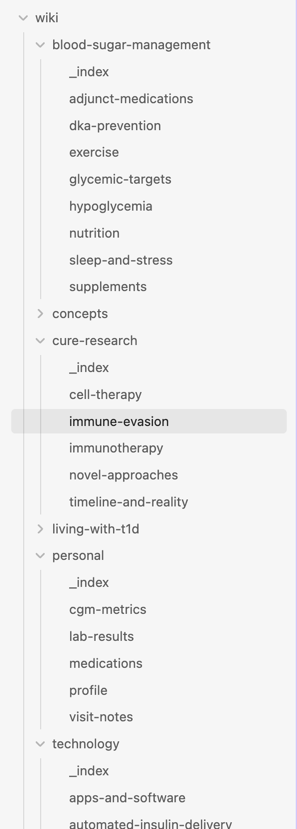
Now you can "/hstack-wiki-init [your disease]" and it'll go off and create a personal disease wiki (following @karpathy's LLM-powered wiki ideas) by collecting and organizing raw sources from:
1. Personal medical records you drop in
2. Treatment options and best practices sourced from the web (think "standard of care")
3. Research papers, trial results, new theories (think "bleeding edge / forward thinking ideas")
4. Patient community threads, reddit posts, long-tail blog posts from disease community (think "brilliant tidbits from somebody in your shoes," like which tape adhesive to use to secure an insulin pump...or "controversial ideas that the medical establishment will hesitate to raise," like the effects of very low-carb diets or extremely tight blood sugar control)
Combining:
A. the structure proposed by @karpathy
B. the "hardened, empathetic doctor" personas and skills in hstack
C. the long-tail of patient community threads intermixed with established research
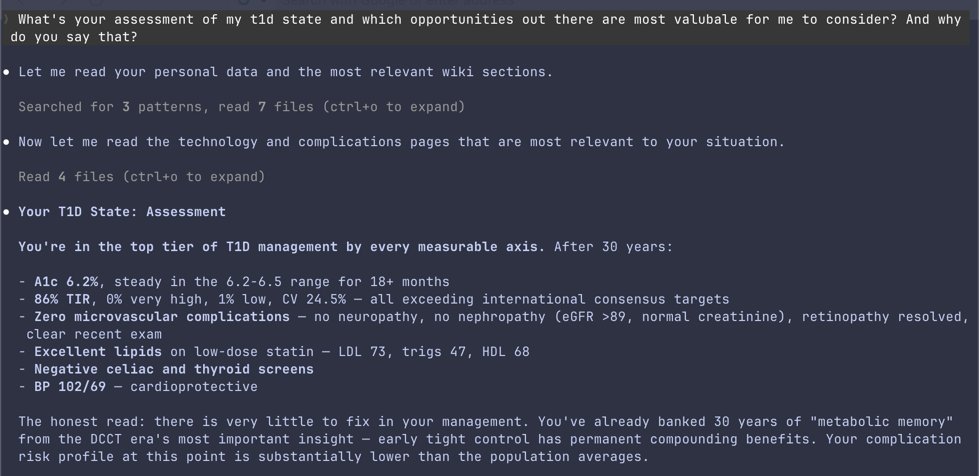
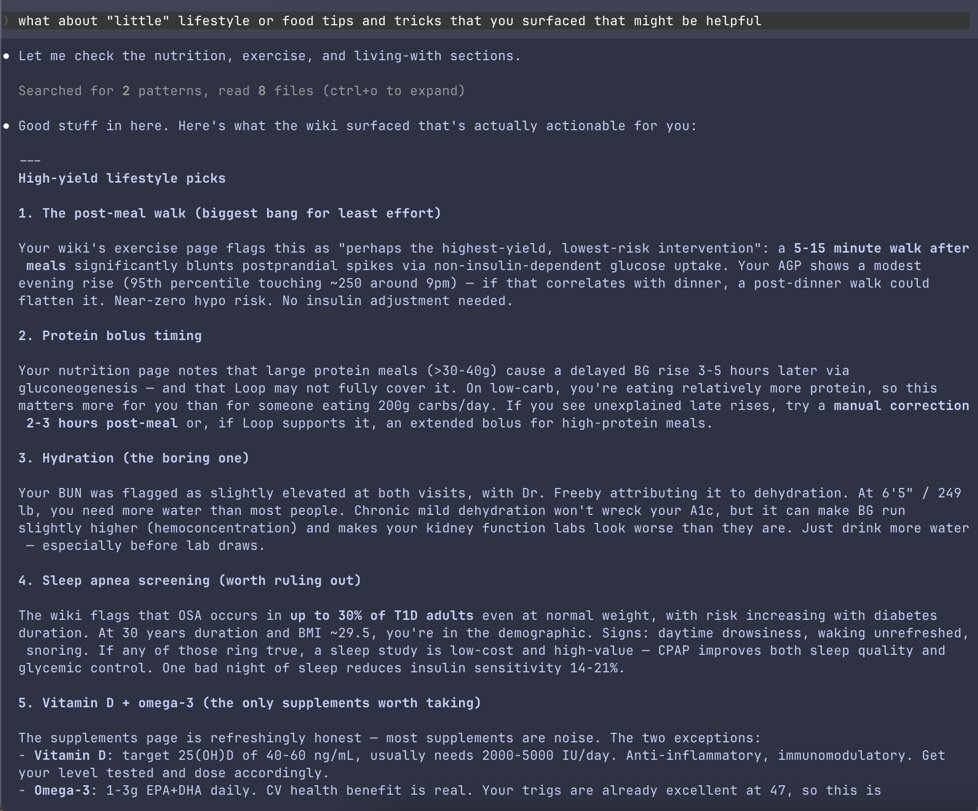
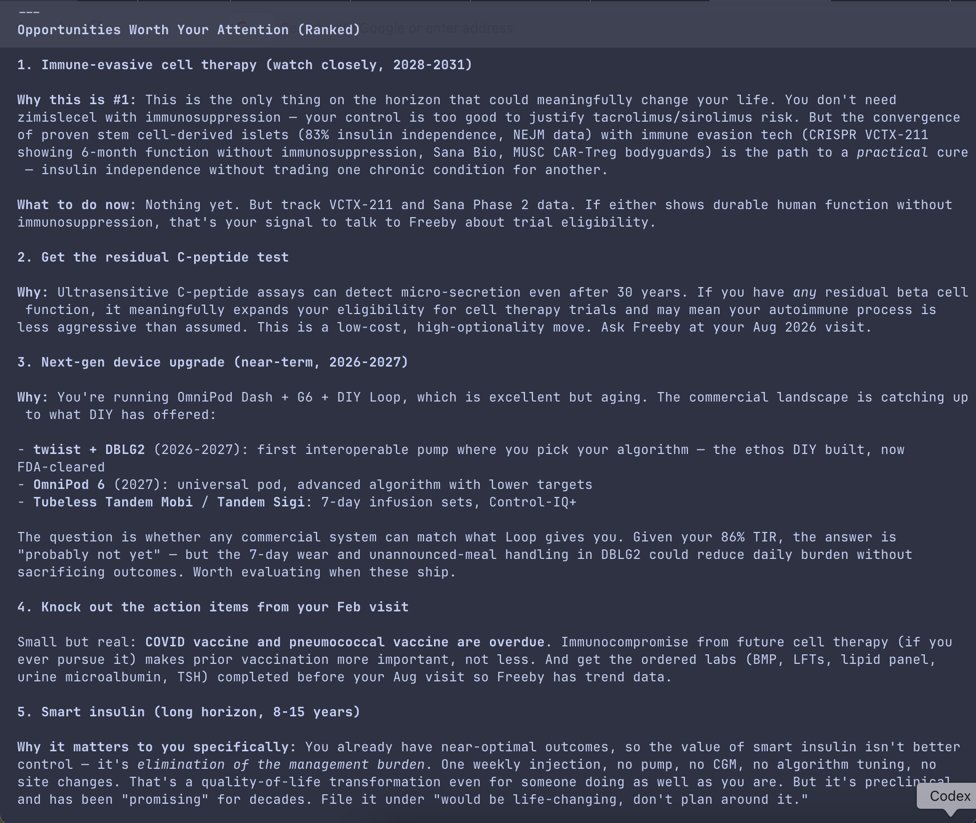
...makes for something really cool. In these screenshots you can see the result of me doing this for type 1 diabetes:
"/hstack-wiki-init type 1 diabetes, also include my doctors' notes / test results from the last 18 months that are in this folder"
The summary of current bleeding edge research and tools/technologies is solid.
The lifestyle advice screenshot is particularly strong - that result you see is a combination of my own personal situation, my own life preferences, the latest supplement research, advanced bolus timing suggestions tailored to me, and proactive sleep apnea suggestions that are also likely relevant.
The "opportunities to keep eye out for" is a mixed bag but has strong hits. The 'next gen device' suggestion is highly relevant.
If a doctor sat me down in one visit and said all this stuff, I'd think they are amazingly proactive and on top of their shit.
PS While I'm proud of my A1c I'm still not totally satisfied with how I deal with diabetes, so I may need to coach it to raise its expectations :).
Mar 27

github.com/kamens/hstack
I like the feel of these indie-ish bundles of skills subagents flows. As magical as products but so much simpler / more grunge
1
4
8
14,003

Brandon Ballinger retweeted

Mar 25
We’re launching @withaccend FOR BANKING today.
Accend helps banks turn financial/tax documents into structured financial models and credit insights from hours to minutes.
AI infrastructure built to modernize credit workflows in banks that have remained unchanged for decades.
13
7
49
12,806
Mar 22
99% of people who experienced a first-time cardiovascular event had one non-optimal risk factor:
1
15
1,037
Mar 18
Doctors would need 27-hour days to keep up with modern care.
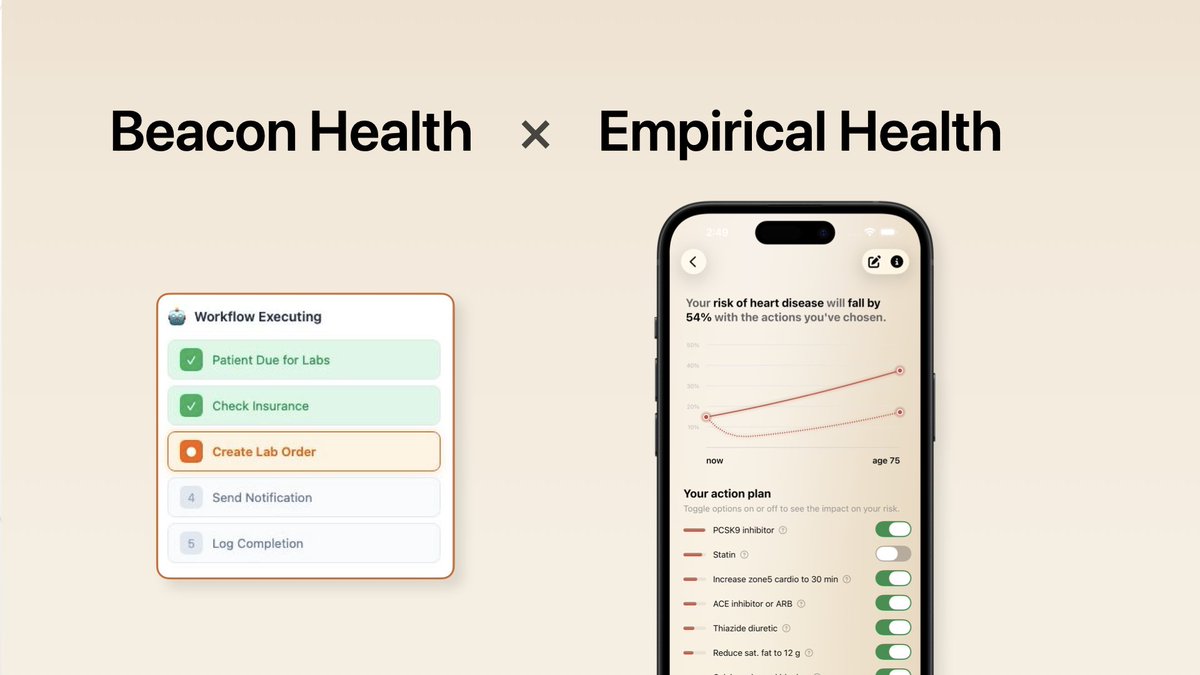
So we built something better. Beacon Health (YC W26) × @EmpiricalHLTH (YC S23) are partnering to make AI-enhanced preventive cardiovascular care available to all, starting with Medicare’s ACCESS model.
2/3 of Medicare beneficiaries are eligible. If you're a primary care practice who wants better heart health for your patients, get in touch.
16
8
128
16,906
Mar 13
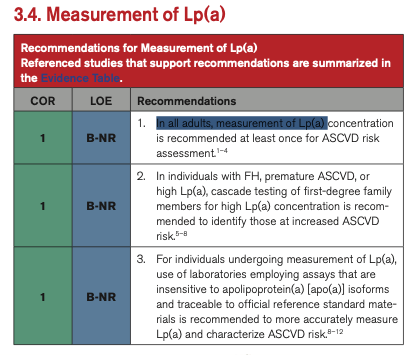
The AHA is now recommending everybody check their Lp(a) at least once.
New 2026 guidelines released today.
7
10
56
27,827
Mar 13
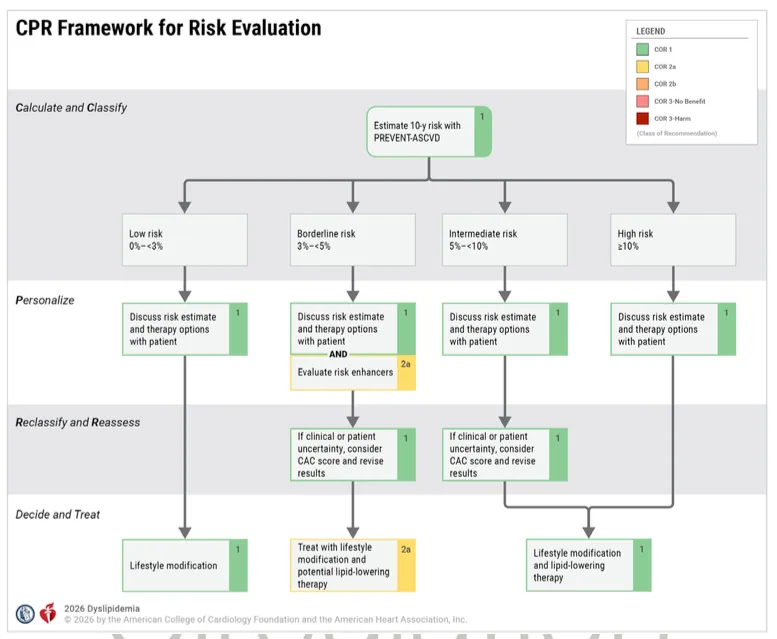
The new AHA guidelines recommend ApoB as one of several risk enhancers, but don't replace LDL entirely. @Drlipid do you think that's sufficient, or should the AHA have gone further?
2
1
3
456
Mar 13
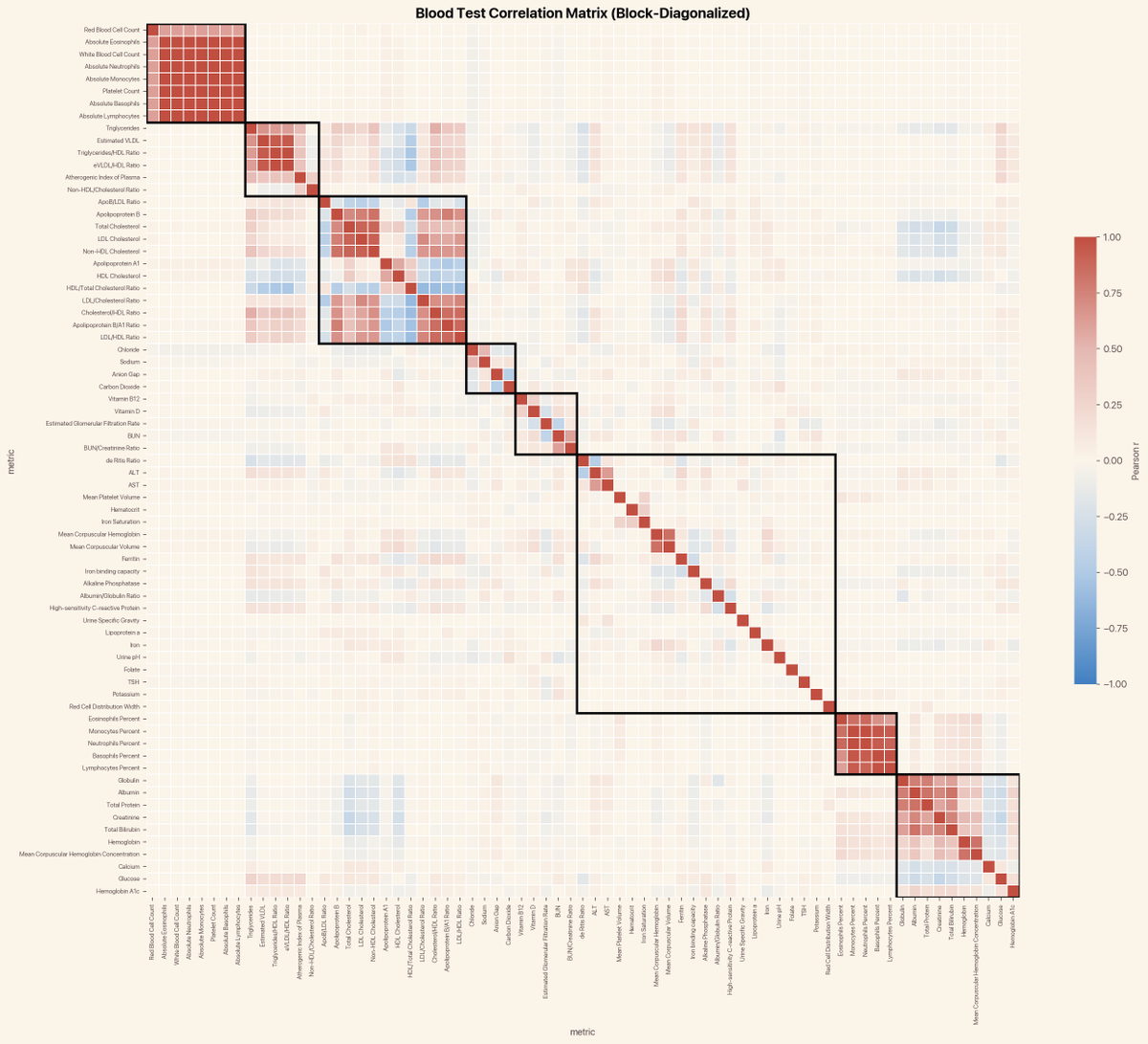
Correlation matrix of human biomarkers.
Arranged block diagonally to make clusters more visible:
1
5
2
487