
Just curious about a lot of different things.
Joined June 2020
- Tweets 3,608
- Following 703
- Followers 51
- Likes 5,549
57 Photos and videos














7 Aug 2025
5 Aug 2025

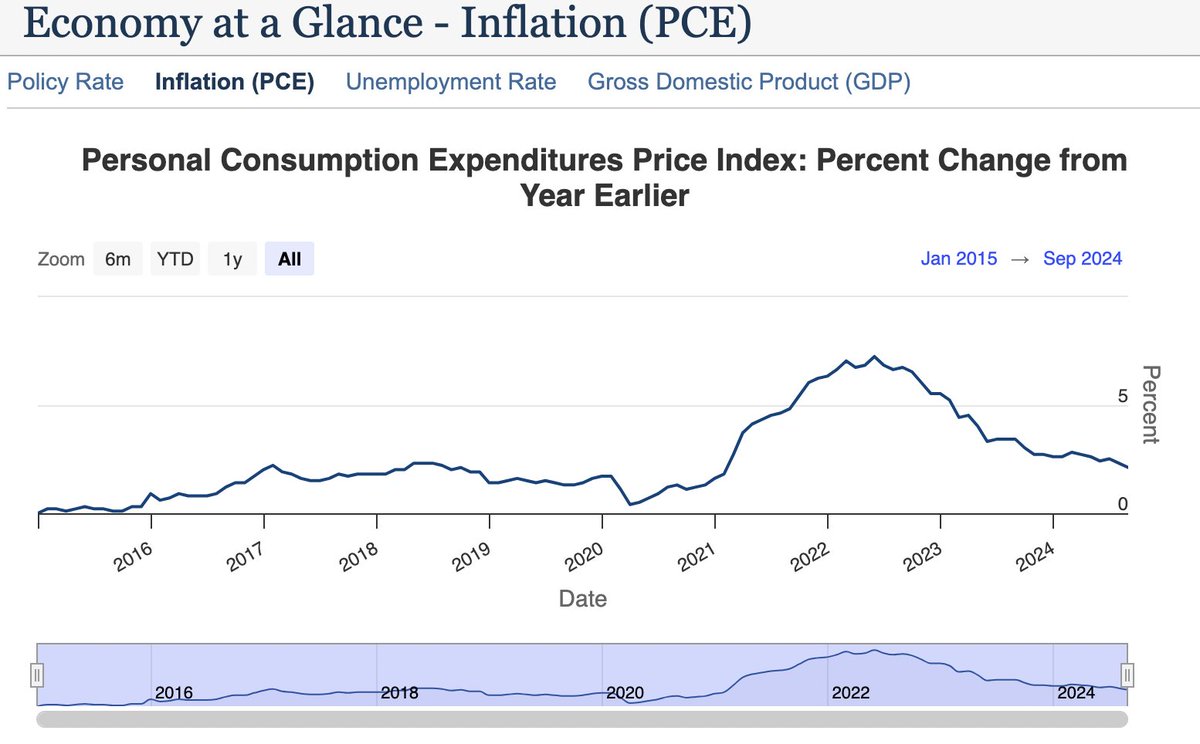
Can anyone pin-point the exact moment where everything in society just got substantially worse?
42
curiouscat retweeted

26 Jul 2025
.@GavinNewsom: "I'm sick of it... This party needs to wake up. These guys aren't screwing around. And I say this not in a literal sense, but they're assassins when it comes to the way they weaponize grievance and the way they play politics. Enough. I mean, what more goddamn evidence do we need? They have rolled back the last half century in real time. That's just six months, right? Can you imagine this guy having an additional 42 months with no system of checks and balances? No oversight? I mean, seriously, the hell else more evidence do you need?"
2,155
7,601
28,953
1,443,997
curiouscat retweeted

25 Jul 2025
Here’s my plan for energy dominance:
- punch solar, batteries, and electric motors while China dominates us
- larp as pro nuclear but do little to nothing
- classify coal as a critical mineral
- claim we’ll help O&G even though production was already at absolute record levels
21
51
523
48,443
curiouscat retweeted

25 Jul 2025
Kamara Birthday Contest 🚨
RT for a chance to win an AK autographed #Saints mini helmet 👀
#SaintsContest | Rules: neworlns.co/TWcontest
58
1,878
1,246
85,951
curiouscat retweeted

23 Jul 2025
In most of the world day-to-day weather variations are still much larger than long-term global warming.
As a result, both daily record highs and daily record lows remain common.
However as the world warms, new daily record highs consistently far outnumber new daily record lows.
68
297
865
110,252
curiouscat retweeted

4 Jul 2025
Another truth bomb 💣 from Scott Galloway. It needs no commentary from me. Apologies for the sound quality, but I couldn’t find the clip of the original broadcast.
🎥 TikTok - vm.tiktok.com/ZNdPRDrTE/
55
1,379
3,403
188,818
curiouscat retweeted
3 Jul 2025
I truly hope this puts a definitive end to the perpetual insistence by Democrats that they can compromise with Republicans. You can't. These people are extreme, depraved, and shameless. They just stripped healthcare from 17 million people to give themselves a tax cut. You gain nothing by playing nice. They will not compromise. And the only thing worse than their extremism is our inability to recognize it. We need fighters who understand the moment we're in. If you can't or won't fight, you should not be in office.
582
2,015
8,571
234,639
curiouscat retweeted

2 Jul 2025
“If solar and wind are the most affordable and fastest to build resources, why do they need tax credits?” A reporter asked me this fair question yesterday. Here's the steelman case, in my view:
1) Market failure correction: Social value of solar and wind (e.g. reduced fuel price volatility, CO2 emissions, air pollution) exceeds private market value; tax credits help internalize these public benefits
2) Offsetting non-price barriers: Solar and wind face significant non-price barriers (e.g. permitting delays, interconnection challenges, transmission constraints) that favor incumbent resources; tax credits help counterbalance
3) Energy security: Solar and wind don’t rely on globally traded fuels, providing insulation from potential actions of adversarial governments while enabling lower-cost fuel export to allies
4) Supporting rapid load growth: With electricity demand rising quickly, tax credits help scale up new generation faster and mitigate backsliding into higher-emission resources
5) Accelerating deployment: Even in regions where solar and wind are cost-competitive, the pace of market-driven adoption may not align with public objectives; tax incentives help close the gap
6) Offsetting tariff impacts: Tariffs have raised costs of a variety of input materials and grid equipment; tax credits help offset these added burdens and keep projects economically viable
7) Addressing uneven economics: While solar and wind are the most affordable new energy sources in many markets, this isn’t universally true, especially in regions with weaker RE resources
8) Consistent w/ historical precedent: Nearly all major energy sources in US history have received federal subsidies; supporting renewables continues that tradition in service of modern priorities
61
146
586
59,697
curiouscat retweeted

25 Jun 2025
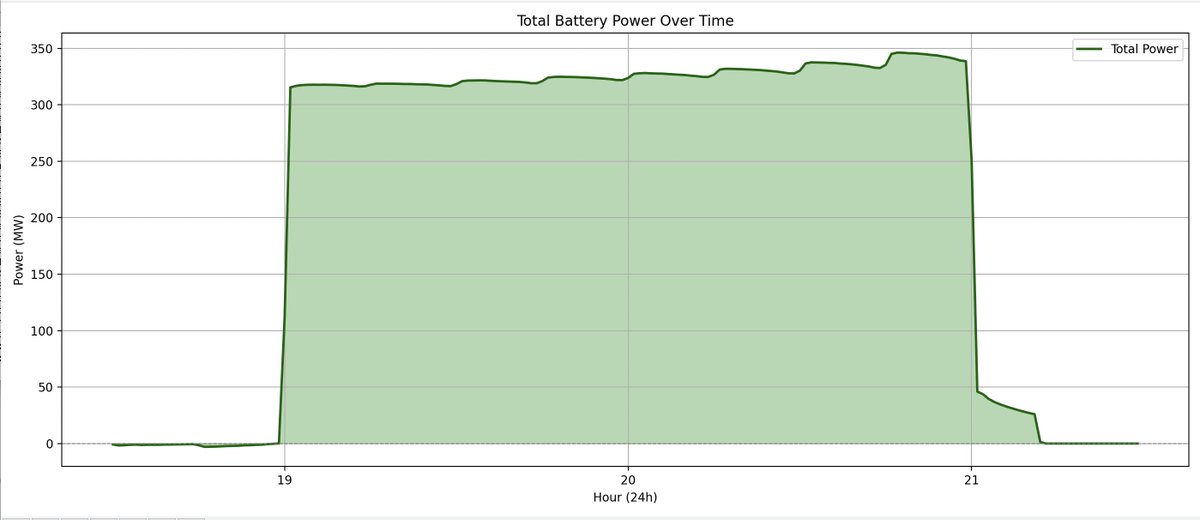
Sorry - I already reposted this once. But, it's been sitting with me... I'm just starting to realize how absolutely incredible this graph is. We've been talking about virtual power plants for 20 years. And, it's now happening at a meaningful scale. And it's not just Tesla - @Sunrun, leap.energy, @basepowerco and many others are doing the same thing. Tesla is just so much better than others at telling the story.
I'm going to guess this event leveraged 50,000-100,000 homes with Powerwalls, all providing a portion of their stored capacity, discharging in unison, providing the power equivalent to a large gas power plant or a third of a nuclear power plant. On command. For 2 hours. Highly controllable (those stair steps look like someone flexing the system). Charged with mostly solar - either the homeowner's own solar, or grid solar during peak sun hours when electricity is cheap and CAISO has excess solar it often curtails. Extremely cost effective.
People power.
The potential for this technology to transform the grid is enormous. There are 80 million single family homes that could be doing this, and getting backup power when they need it. 80 million x 5kW is 400GW of power. That's 5 states of Texas worth of peak power. 11.5kW per home (which every Powerwall is capable of), and we can power nearly the whole US friggin' grid. For 2-4 hours. Every day. We are literally still at the starting line of a marathon.
Today - battery systems for US homeowners are very expensive. But, they don't have to be. The underlying LFP battery cells in those Powerwalls are *dirt *cheap. And unfortunately, as with residential solar, we've layered all kinds of soft cost crap on top of it to make it unaffordable to the average homeowner. Many companies working on fixing this... @signaturesolar_ @stormentum and many more.
More of this, please!
25 Jun 2025

Tonight, the Powerwall fleet in California dispatched 345MW to the grid during a Virtual Power Plant event, reducing the need for fossil-fueled peaking plants
49
213
1,966
191,948
curiouscat retweeted

22 Jun 2025
“If we elect Trump, we will be at war within 6 months.” - Kamala Harris

2,113
21,851
210,337
8,976,314
curiouscat retweeted

13 May 2025
Chip manufacturing is the rate limiting step by far.
A terawatt is a massive amount of power (2x the average electricity demand of the United Sates), but it could be brought online by 2030 using solar PV and lithium ion batteries.
Most of the necessary supply chain already exists, and the lagging areas could be built well within that timeframe.
This would be ~28% of today's global electricity demand. China is the only country on Earth that uses more electricity, and just barely at ~1.1 TW.
Solar is the only energy source that can grow to this scale this quickly. In fact, at last year's growth rates (28.6%), solar will generate an entire China worth of electricity in 2030.
(although China's demand will be higher by then)
Napkin math on energy:
1. Natural gas
Total U.S. nat gas production is ~11,500 TWh/year on a chemical energy basis. With high efficiency combined cycle gas turbines you'd get 60% of that as electricity (~0.8 TW of power).
If we redirected 100% of our national gas production to this cluster, it still wouldn't be enough.
We would need to increase gas production by ~2.5x as much as we have in the past 20 years.
The gas turbine capacity is an even bigger issue. Total installed gas generating capacity in the U.S. is 500 GW.
(and only 293 GW of that is combined cycle, much of which is older and lower efficiency)
We're backlogged for years with a few 10's of GW of orders. 1,000 GW of gas turbines is not going to happen quickly.
2. Nuclear Fission
Nuclear fission has the potential to supply well over 1 TW of power, but it's not going to be fast. The U.S. has a total of 97 GW of nuclear capacity. The entire world has 399 GW.
At our peak, the U.S. built 9 GW in a year.
We would have to build our entire nuclear fleet every single year for a decade.
This would also be a 3.5x increase in global nuclear fuel consumption and we would have to build out new enrichment and fuel fabrication to meet that.
Our most recent nuclear plants, Vogtle 3 & 4, took 15 years to build. If we could build new plants in 5 years, we'd have to start construction on an entire U.S. fleet every 6 months to have 1 TW of capacity ready within 10 years.
It is possible that we could scale up to that level of construction in the future, but it's not feasible in the near term.
3. Solar Batteries
5 TW (DC) of PV using single axis tracking in West Texas with 16 TWh of storage would give us 1 TW of power at a 92% capacity factor (equivalent to U.S. nuclear).
600 GW (DC) of solar was installed globally in 2024 (35% more than in 2023). At that rate (linearly), 5 TW could be built in just over 8 years.
Realistically, we couldn't use the entire global supply of solar panels, but 600 GW is not the entire global supply.
Global manufacturing capacity was 1 TW/year in 2024 and is expected to reach 1.8 TW/year by the end of 2025.
We could build 5 TW by 2030, and still have enough manufacturing capacity to supply the rest of global projected solar demand.
(although projections have been low for decades now)
Global battery cell manufacturing capacity was 3 TWh/year in 2024, and 7.9 TWh/year is announced for the end of 2025.
Analysts are saying that battery cell capacity is massively oversupplied (relative to 1.6 TWh/year of projected demand), but it works out quite nicely if you're trying to build a 1 TW compute cluster by 2030.
16 TWh over 5 years is 3.2 TWh/year, not even enough demand to account for the oversupply in current projections.
We would need to build new pack and module capacity to integrate all those cells, but that's very doable.
With 24% efficient solar modules and a 0.5 ground coverage ratio, 5 GW DC would require ~42,000 square kilometers of land, less than 0.5% of U.S. land area.
It would be a gargantuan effort, but a 1 TW solar-powered compute cluster could feasibly be brought online by 2030.
(from an energy perspective at least)

Been thinking about the fastest way to bring a terawatt of compute online.
That is roughly equivalent to all electrical power produced in America today.
76
116
989
313,645
curiouscat retweeted
11 May 2025
1/5th of the solar already installed in California could power desalination at a scale that would transform the American Southwest.
Arizona, Nevada, and New Mexico could double their water use.
Abundant water means we can grow cities, power industry, and even engineer microclimates.
3 May 2025

We could have water abundance in the American Southwest via desalination without even needing to build pipelines.
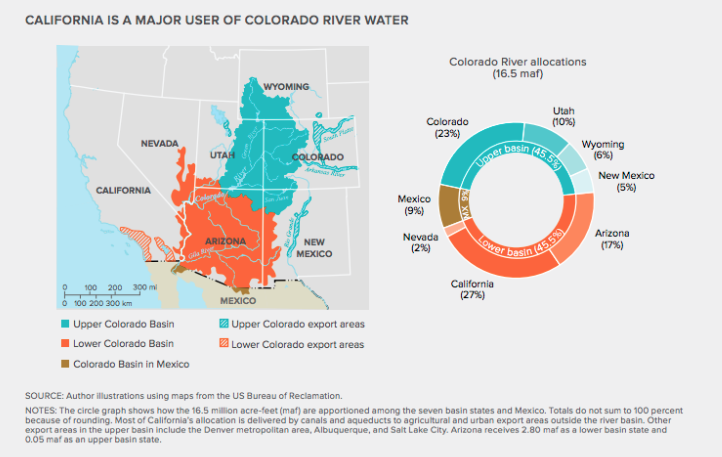
California uses more water from the Colorado River than New Mexico, Arizona, and Nevada combined.
California's share of the Colorado River is about 5.5 billion cubic meters per year.
At 3 kWh/m^3, it would take about 16 TWh/year to replace California's share with desalination - 6% of California's current electricity consumption.
You could power that desalination with just 2 GW-scale nuclear power plants, or 1/5th of California's existing solar generation.
The American Southwest could have plenty of water for population growth, evaporative cooling, agriculture, etc.
The water is already there. We just need to send less of it to California.
14
31
212
17,462
curiouscat retweeted
18 Dec 2024
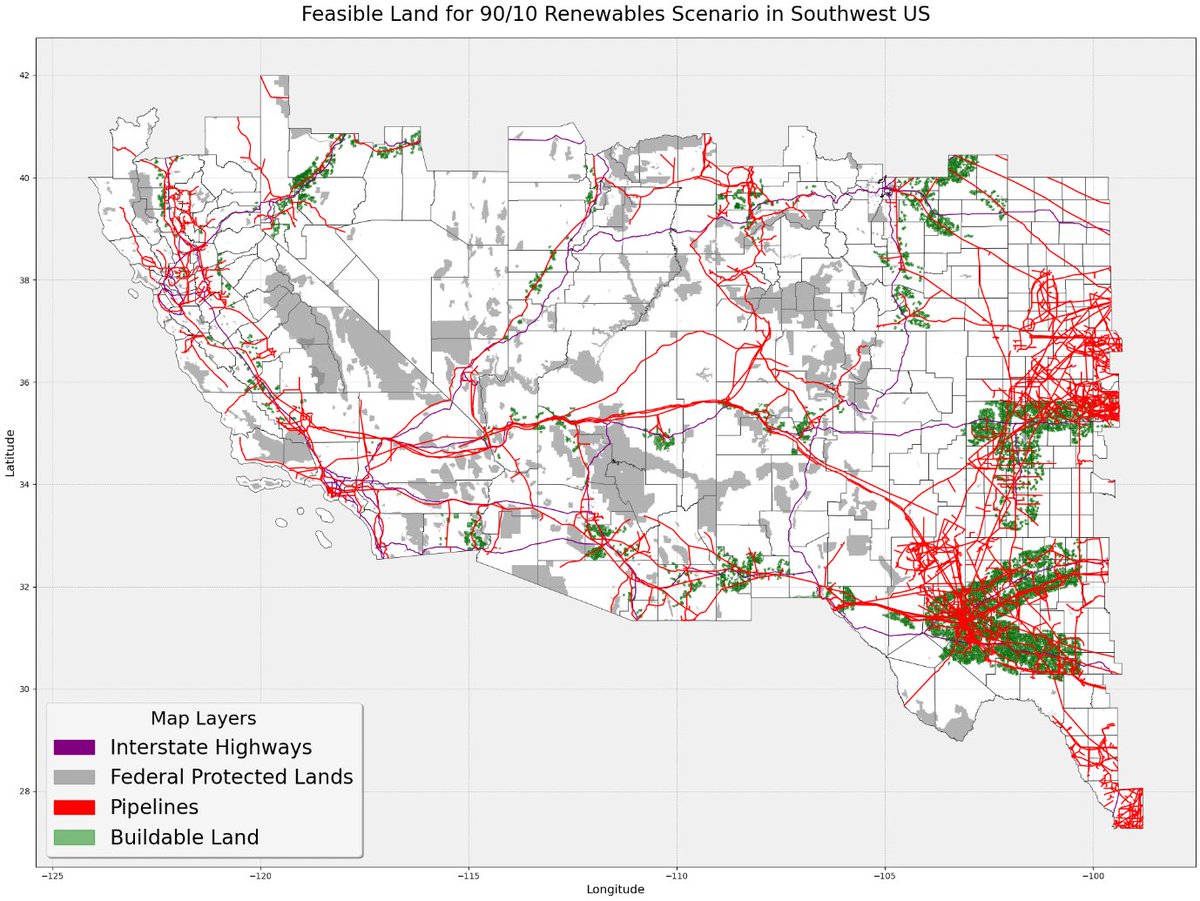
3) Off-grid solar microgrids powered by 90% solar are enormously scalable, with >1,200 GW of datacenter potential in the US southwest alone.
This is enough suitable land (filtering for lots of things) to cover 4-40X all of the datacenter growth projected in the US through 2030.
2
15
68
4,550
curiouscat retweeted
10 May 2025
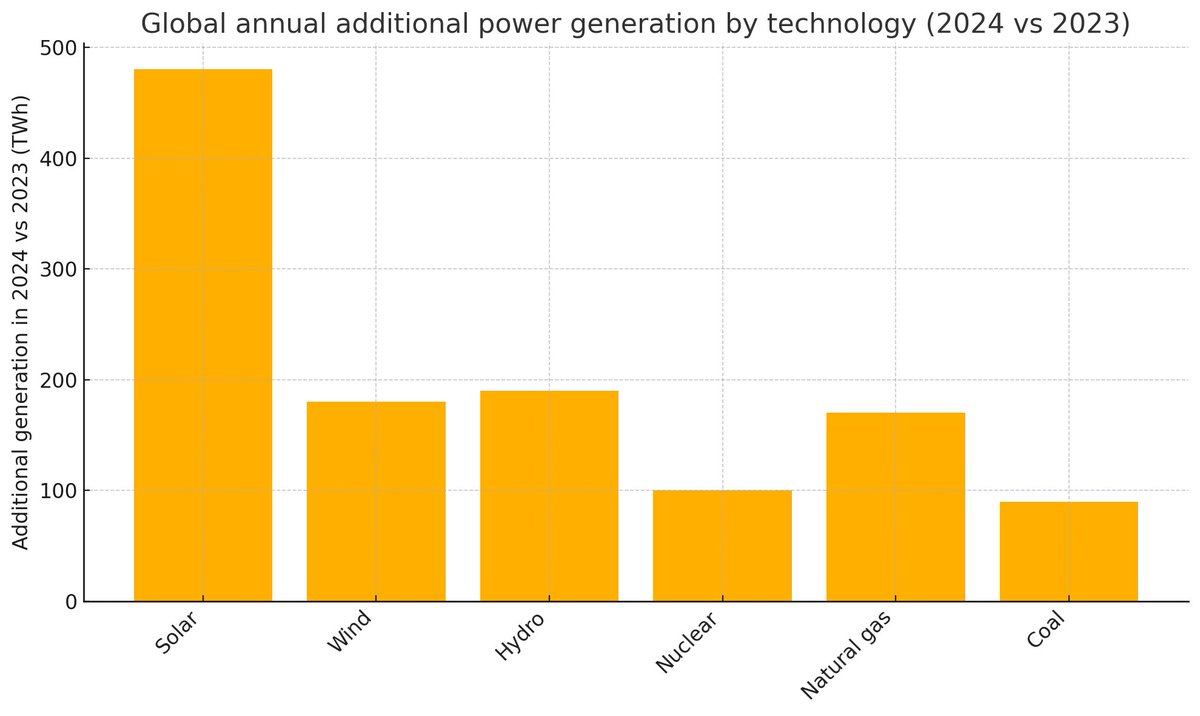
Last year, solar grew 2x faster than nuclear fission ever has.
Not in “nameplate capacity” - in actual generation.
Not in percentage growth - in absolute growth.
Solar is the fastest growing source of nuclear power the world has ever seen.
Ignore it at your own peril.
9 May 2025

I don’t think people realize solar is absolutely dominating everything else right now.
118
71
602
65,497
curiouscat retweeted
11 Oct 2024
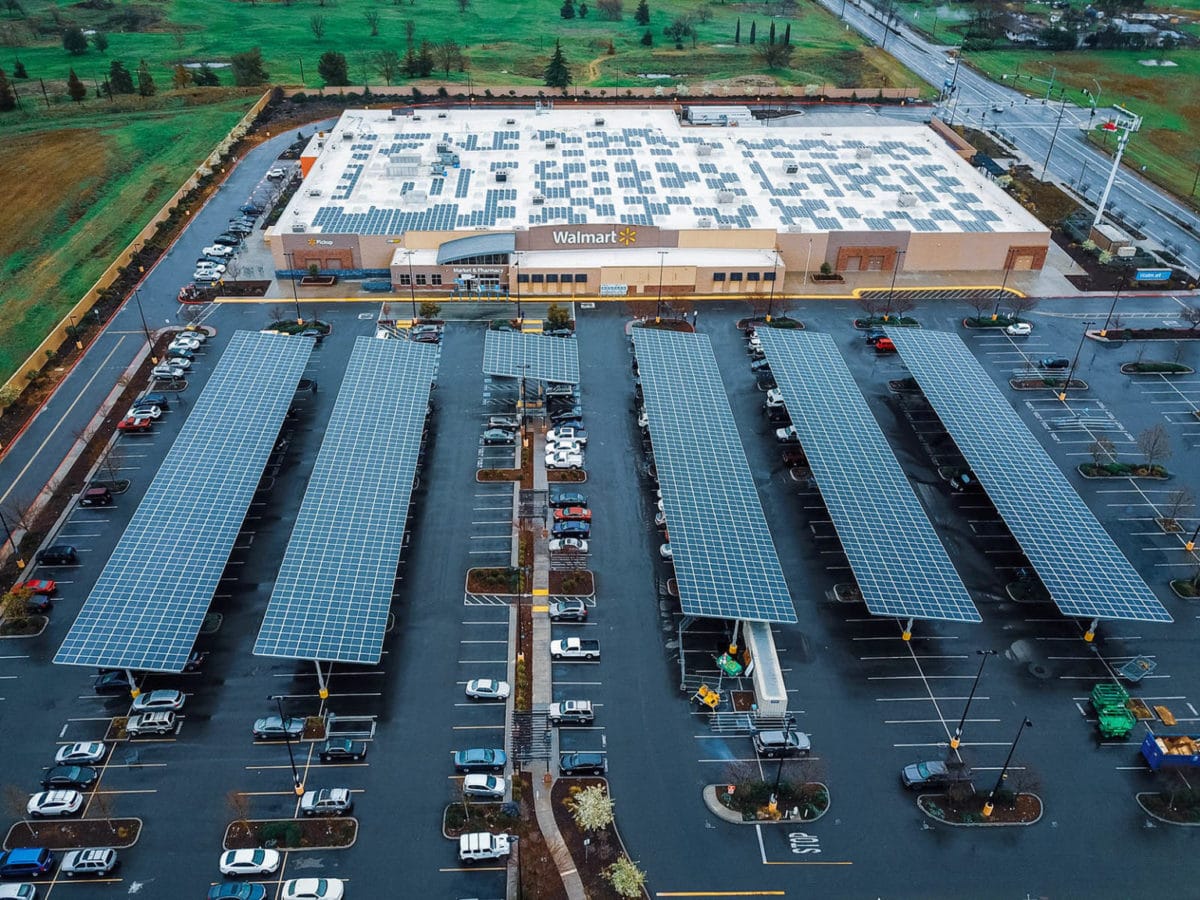
Solar covered parking could generate as much electricity as all existing sources combined in the U.S.
(~4,400 TWh/year)
- U.S. has an estimated 1-2 billion parking spaces
- 1 billion standard sized parking spaces = 14 billion square meters (3.4 TW @ 24% efficiency)
- 4,400 TWh/year (17% CF, 14% system losses)
- U.S. electricity generation 4,178 TWh (2023)
U.S. electricity generation:
eia.gov/tools/faqs/faq.php?i…
Capacity factor and loss assumptions:
nrel.gov/docs/fy16osti/65298…
11 Oct 2024

Huasun's Himalaya G12-132 HJT module sets a new benchmark with 768.938 W output & 24.75% efficiency! ⚡🌍 Discover how this breakthrough is advancing solar technology.
Read more ow.ly/Hbn650TJs2A
#SolarEnergy #RenewableEnergy #solarmodules #MESIAMember #Photovoltaics

257
273
1,224
3,878,374
curiouscat retweeted

8 May 2025
Saints fans, here's some high praise for QB Tyler Shough from a Super Bowl Champ & SB MVP. #whodat
listen to Deion Branch:
28
161
1,123
222,700
curiouscat retweeted

8 May 2025
Never deleting this app 🤣

2,673
37,810
363,367
25,185,411
curiouscat retweeted

6 May 2025
Check out our latest pod with @JessePeltan, which is just 3 hrs straight of him dropping bangers like the one below
306
622
3,604
21,727,356
6 Apr 2025
I have never heard @DivesTech, who I admire, sound incredibly bearish.
4 Apr 2025

Wedbush analyst Dan Ives just joined my Spaces with a warning:
"Hope for something over the weekend in terms of a delay in tariffs or some cooler heads because If there's nothing over the weekend we go into next week and it's a scary prospect kinda"
51
curiouscat retweeted

6 Mar 2025
The flippening... via - BBG
• US business optimism drops: 59% of respondents cite tariffs as a negative impact.
• US executive confidence dropped to 47% from 67% in December.


9
6
13
4,526