
Joined May 2009
- Tweets 5,161
- Following 2,684
- Followers 15,878
- Likes 6,851
868 Photos and videos






Morgan Beller retweeted

Apr 9
Still wild to me that Stoke's first Zenith engine was made by a team of less than 10 people in under one and a half years.
29
187
2,005
119,625
Morgan Beller retweeted

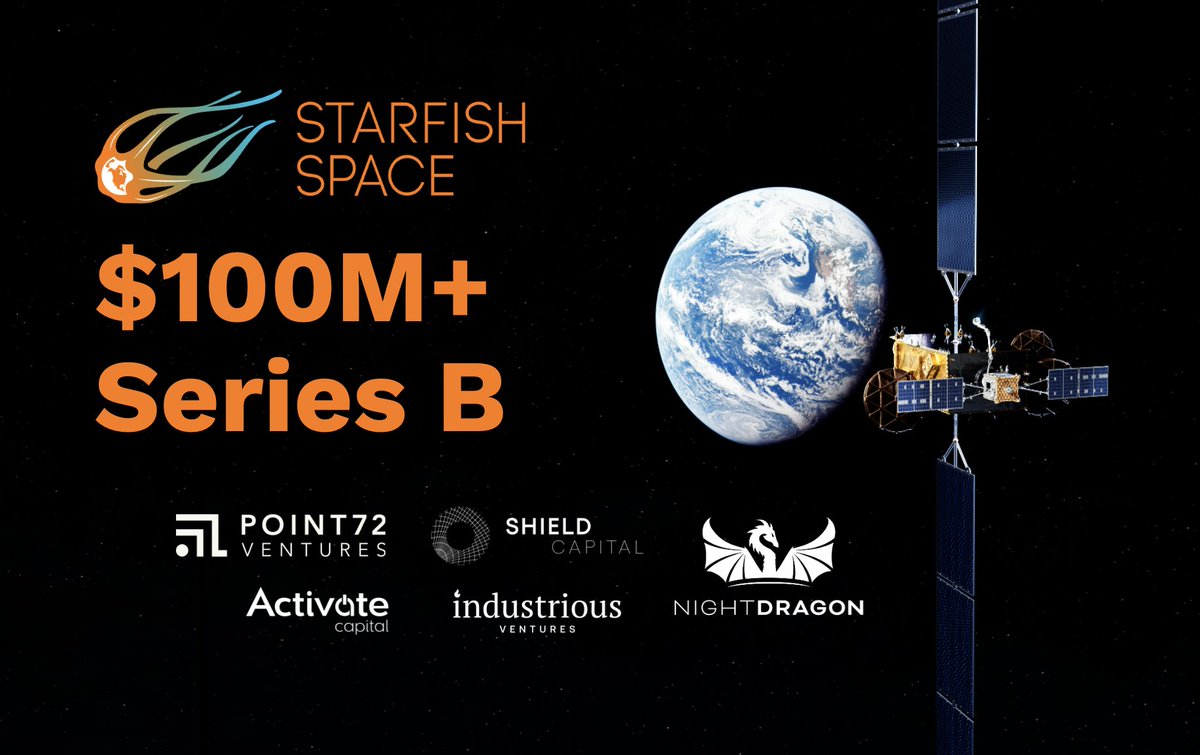
Big news: we just closed a $100M Series B.
This funding will go toward building and operating our Otter missions, scaling to meet growing customer demand, and expanding our team.
We've had a lot to celebrate lately, from missions like Remora and Otter Pup 2 to new contracts with great customers like SDA and the Space Force. And we're just getting started. Our first full Otter mission is on track to fly later this year.
Read our full press release: starfishspace.com/press-rele…
We’d like to thank our investors for helping us build the future of infrastructure in space.
@p72vc, @ShieldCapVC, @IndustriousVC, @nightdragon
6
23
117
27,370
Morgan Beller retweeted

Mar 30
I am super excited to share that @Starcloud_ has raised a $170M Series A at a $1.1bn valuation to fuel our development of data centers in space 🚀
The round comes after the successful deployment of our first satellite, Starcould-1, a few months ago, which had the first @NVIDIA H100 on board and was the first to train an LLM in space. The funds will be used to develop our third satellite, which aims to be cost-competitive with Earth-based data centers in terms of AI inference cost.
The round was led by @Benchmark and @EQT Ventures, and we are excited to welcome Benchmark GP, @Chetanp Puttagunta, to our board. We are also excited to welcome other new investors, including the world's largest infrastructure fund, @Macquarie Capital, @SevenSevenSix 7️⃣7️⃣6️⃣, Manhattan West, Adjacent, Carya, GSBackers, and Harpoon.
We are very grateful for the continued support of existing investors, including @NFX, @NebularVC, @YCombinator, @FUSE_VC, @Soma_Capital, 3Capital Partners, Wyld VC, Tiny VC, and Taurus Ventures.
Onwards!

222
164
1,776
472,479

Feb 19
History doesn’t fully repeat itself, but cost curves rhyme.
@_dmuus_ (brilliantly) calls out that what we’ve seen - time & time again - is that infrastructure comes first & imagination follows.

9
16
1,233
Feb 19
We are in the “containerization” era of space. Containers reshaped the world & rapidly reusable launch will do the same.
s/o to @stoke_space @StarfishSpace & @Starcloud_ for doing the hard work (we 🫶🏻 you)
3
12
1,091
Morgan Beller retweeted
Jan 31
For the last several months, we’ve been working on the design of our @Starcloud_-3 distributed constellation of 200kW inference nodes in dawn-dusk sun-synchronous orbit, providing many gigawatts of low-cost AI compute. It seems we’re not alone! 🙌
29
54
231
48,472
Jan 11
“The storyteller makes no choice / soon you will not hear his voice.” ❤️
Jan 11

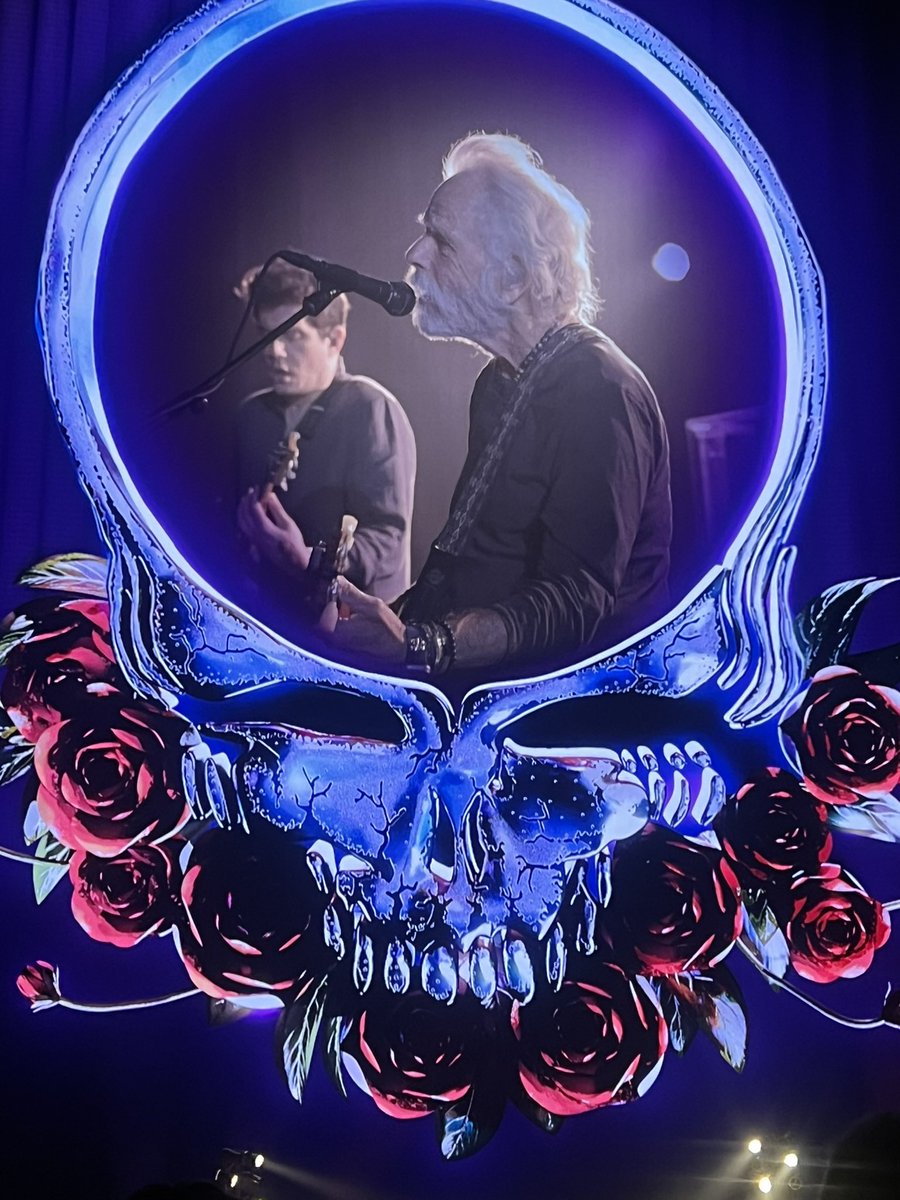
People die every day, but they won’t mint more Bob Weirs. He was the last of the best, the headlight on the northbound train, the rebellious teen who became the rambling man who became the keeper of the Grateful Dead flame. Weir helped birth the new world, watched its ruination, and spent the autumn of his life rebuilding it. Six full decades ensuring that the music never stopped. He withstood time with grit, soul, and a Boddhisattva’s Zen. And now, he's gone.
Bob, eternally sacred in the no-bullshit Stetson, straight out of a black and white Western, a dead-ringer for the last honorable sheriff in a depraved and sinister county – the last rampart protecting our society from pagan free fall. A cowboy prophet descending from Mt. Tamalpais declaiming outlaw epics about bloody shootouts in El Paso corrals, estimated prophets on burning shores, and lightning trains.
Projecting the Sinai authority of the Old Testament God, he helped birth a mythic scripture replete with winners and losers, wronged heroes and sinister villains, those haunted by death, but who remain determined to cheat the grave.
Goodbye Ace, may there be infinite Saturday nights in whatever dimension you've ascended to, one more big old party where rock and roll music meets the rising planet sun.
2
8
758
21 Dec 2025
.@rookisaacman saying @NASA will get by with a little help from it’s friends @SpaceX, @blueorigin, & @stoke_space
youtu.be/MfeIkUOfYps?si=ckmP…
3
8
1,206
21 Dec 2025
Deja vu / can’t believe how much more the team has done since the last video… Thank you for sharing the story so beautifully @Erdayastronaut
21 Dec 2025

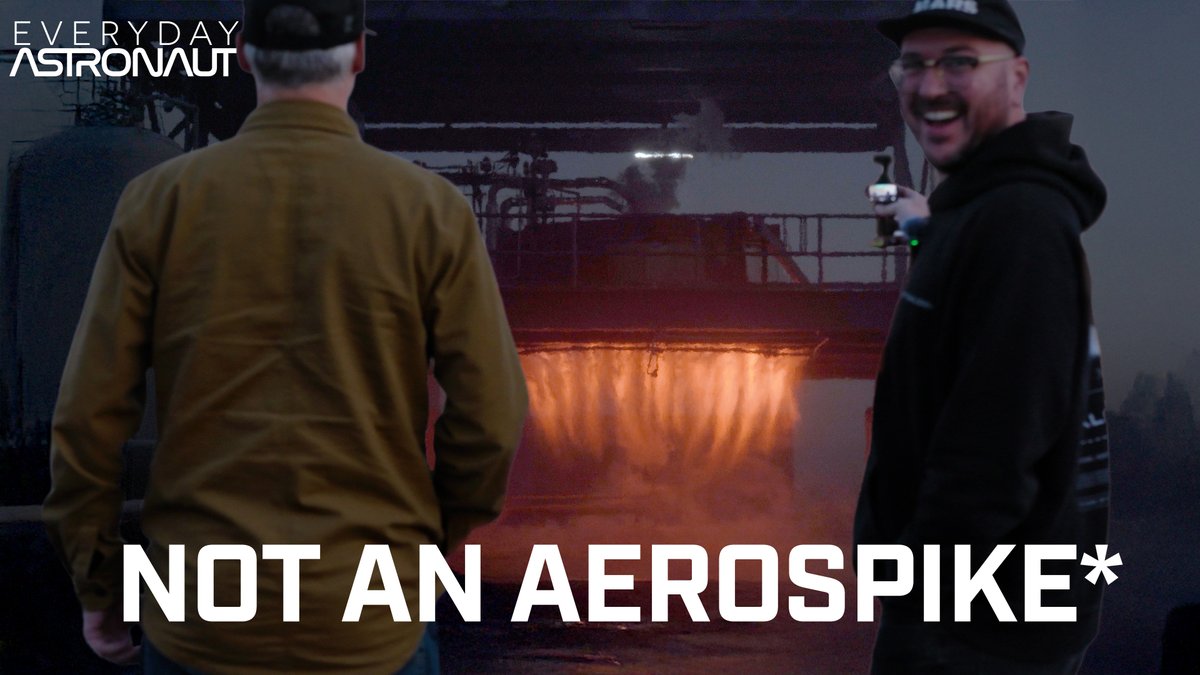
NEW VIDEO and a VERY requested video! Enjoy a new tour of @stoke_space w/ CEO @AndyLapsa!!! There's so many juicy details in this video and of course, we witness another incredible Andromeda test! Enjoy! - youtu.be/7OxNZ-N_3vE
3
1
10
1,465
Morgan Beller retweeted

21 Dec 2025
NEW VIDEO and a VERY requested video! Enjoy a new tour of @stoke_space w/ CEO @AndyLapsa!!! There's so many juicy details in this video and of course, we witness another incredible Andromeda test! Enjoy! - youtu.be/7OxNZ-N_3vE
49
125
1,663
137,644
Morgan Beller retweeted

10 Dec 2025
🚀💪🔥
10 Dec 2025

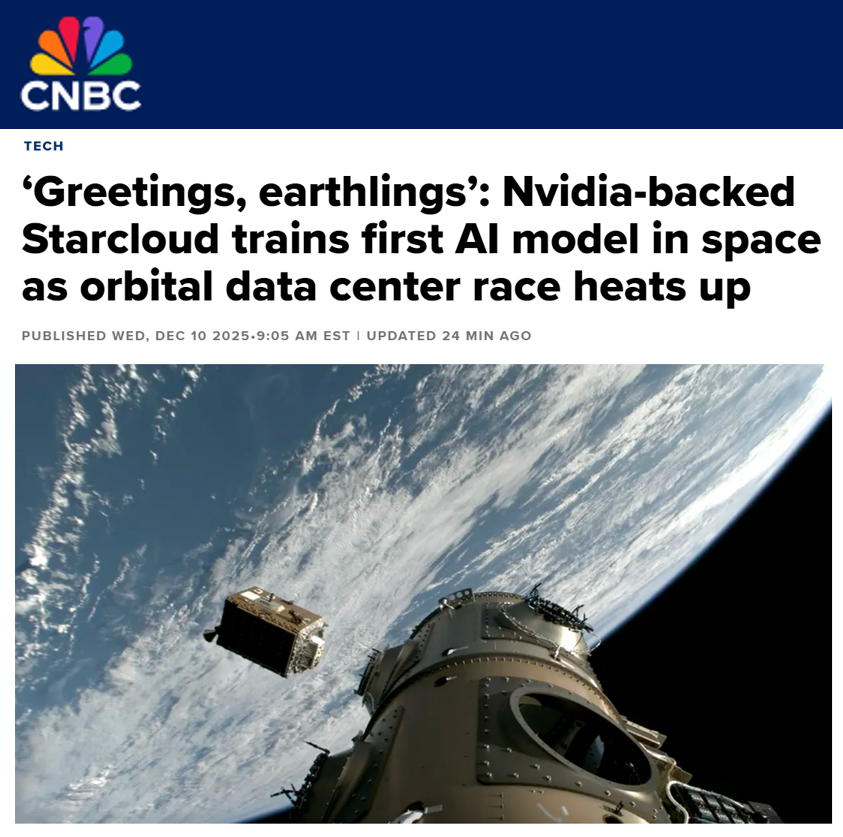
We just trained the first LLM in space using an @Nvidia H100 on Starcloud-1! 🚀
We are also the first to run a version of @Google's Gemini in space!
This is a significant step on the road to moving almost all compute to space, to stop draining the energy resources of Earth and to start utilizing the near limitless energy of our Sun!
Thanks @pia_singh_ and @CNBC, for highlighting our work!
@starcloud_, @AdiOltean, @ezrafeilden
4
13
82
9,695
Morgan Beller retweeted

6 Nov 2025
Very good analysis 👀
I'd like to add that by launching an @Nvidia H100 in space, @Starcloud_Inc1 started the new space computing industrial revolution now embraced by @SpaceX, @Google and others.
Datacenters in space are now the new frontier.
5 Nov 2025

100 GW of Compute Above Earth: The Hardware Leap Hidden in Elon’s Claim 🔥🧠⚙️
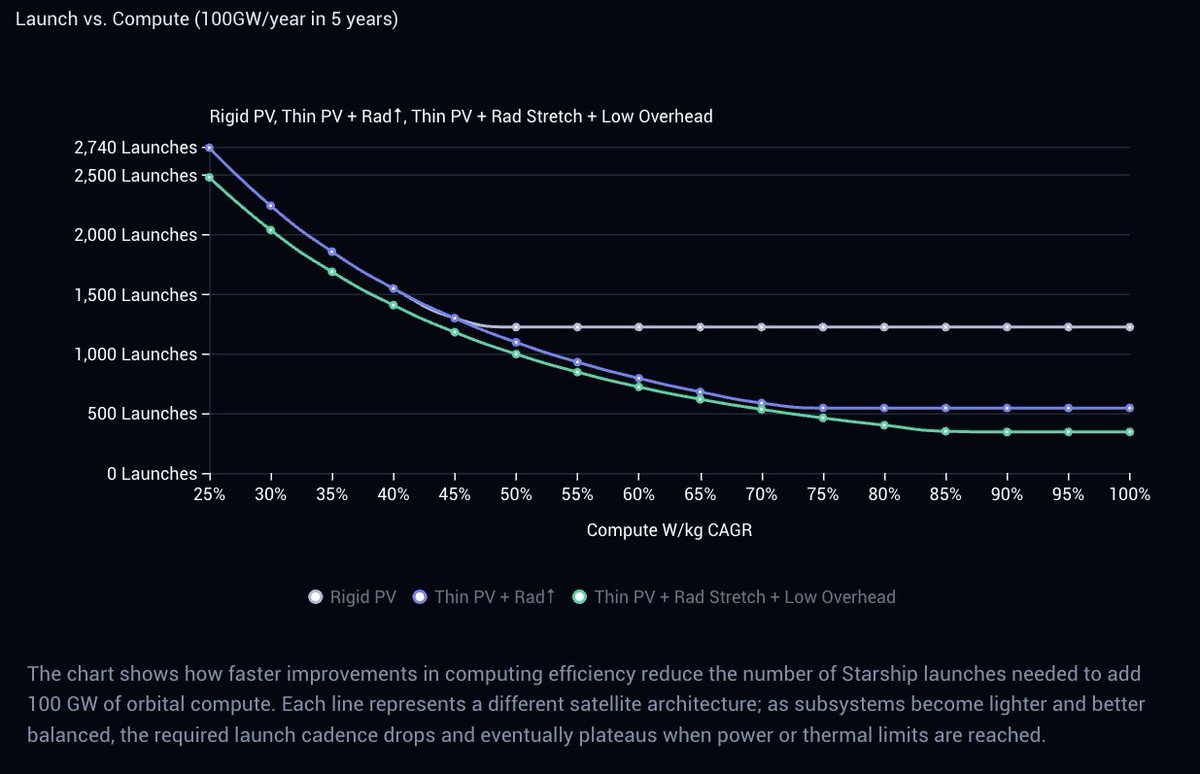
Elon says SpaceX could launch ~100 GW of energy, in the form of high-orbit compute, in ~five years. That implies very specific performance requirements for chips, radiators, and solar arrays if launch cadence is going to stay reasonable.
In space, compute is constrained by a triangular bottleneck:
1️⃣ Power generation (solar)
2️⃣ Heat rejection (radiators)
3️⃣ Compute density (processing power per kg)
All three must rise together. If one lags, the other two stop contributing, and the launch count to hit 100 GW explodes.
Today’s generally assumed baseline:
☀️ Solar ~0.8 kW/kg (rigid LEO-class PV)
🌡 Radiators ~1 kW/kg
🧠 Compute ~0.1 kW/kg (typical GPU rack)
At these levels, you’d need ≈ 3000 Starship launches to deploy 100 GW of space compute!
Compute is the dominant lever: every doubling of compute W/kg roughly halves required launches. Musk’s AI5 → AI8 roadmap points to ~50-100 % annual gains, far faster than the ~25 % GPU trend. Tesla’s AI ASICs are built for efficiency and power density, rather than flexibility; the exact silicon needed for mass-constrained data centers.
Crucially, those gains demand new satellite architectures. To sustain cadence, future SpaceX platforms would need to move beyond Starlink-style LEO buses toward larger, optimised HEO compute vehicles with thin-film arrays > 1.5 kW/kg and light, high-temperature radiators > 2 kW/kg: performance levels cited only in advanced NASA STMD and ISNPS studies.
Given the 100 GW / ~5 yr claim, Elon is effectively telling us he believes compute, solar, and thermal systems will all hit near-frontier performance, and that Tesla’s chips will deliver the compute-per-kilogram leap needed to make it physically and economically possible.
It’s ambitious but plausible: if those PV and radiator systems reach projected “advanced” specs, SpaceX could feasibly deploy ~100 GW of orbital compute per year with ~300 Starship launches.
100 GW matters: it’s roughly the entire terrestrial data-center load expected by 2030. If SpaceX hits that number in orbit, the next AI scaling curve won’t be built on Earth.
Link below for the full breakdown 🧐
5
7
51
6,480
Morgan Beller retweeted
6 Nov 2025
.@TBPN on data centers in space:
6 months ago: “There’s some @YCombinator co working on it.”
Now: “There’s $10Tr of market cap taking it seriously!”
@Starcloud_Inc1, @NVIDIA, @Google, @SpaceX
9
15
98
27,373
Morgan Beller retweeted

5 Nov 2025
🔥
5 Nov 2025

Wait for it... The difference a year makes at our SLC-14 launch site. 😍
9
17
422
28,240

2 Nov 2025
Proud mom
2 Nov 2025
I’ve never heard a more beautiful call out:
“𝗦𝘁𝗮𝗿𝗰𝗹𝗼𝘂𝗱-𝟭 𝘀𝗲𝗽𝗮𝗿𝗮𝘁𝗶𝗼𝗻 𝗰𝗼𝗻𝗳𝗶𝗿𝗺𝗲𝗱” !!!!!!
🚀🚀🚀🚀🚀🚀
@Starcloud_Inc1, @ezrafeilden, @adioltean
2
1
9
1,615
Morgan Beller retweeted
2 Nov 2025
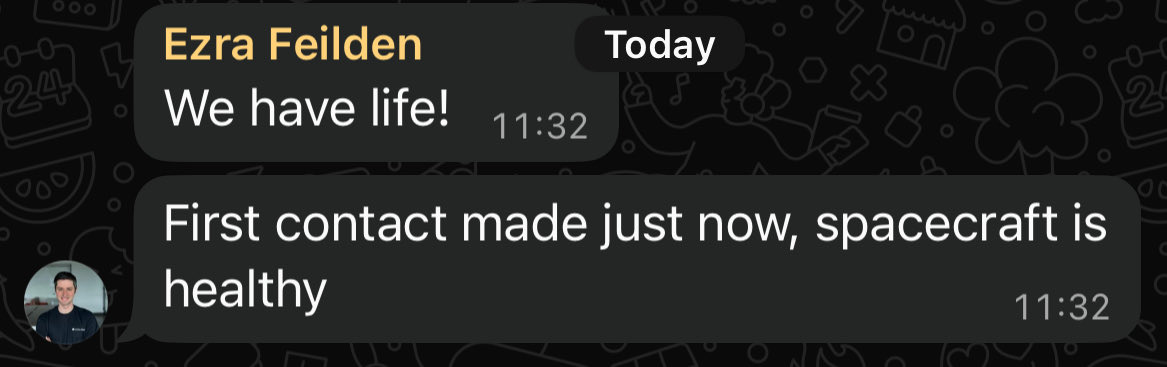
Starcloud-1 is alive! 😃
Starcloud was founded just 21 months and and this satellite hosts the first Nvidia H100 in space, which will provide high powered inference and fine tuning capabilities for other satellites.
It’s the first in a much larger ambition to build almost all new data centers in space, taking advantage of the abundant energy and cold temperatures in space. This will also reduce the strain on energy and water from data centers on Earth 🚀
@Starcloud_Inc1, @EzraFeilden, @adioltean
79
73
816
111,105
Morgan Beller retweeted
2 Nov 2025
I’ve never heard a more beautiful call out:
“𝗦𝘁𝗮𝗿𝗰𝗹𝗼𝘂𝗱-𝟭 𝘀𝗲𝗽𝗮𝗿𝗮𝘁𝗶𝗼𝗻 𝗰𝗼𝗻𝗳𝗶𝗿𝗺𝗲𝗱” !!!!!!
🚀🚀🚀🚀🚀🚀
@Starcloud_Inc1, @ezrafeilden, @adioltean
108
108
925
185,631

Space isn’t just for stars anymore. 🌠
Starcloud’s H100-powered satellite brings sustainable, high-performance computing beyond Earth.
Learn more: nvda.ws/47eYZvC
885
1,538
12,672
5,380,631
17 Oct 2025
👀

5
1
12
1,735