
We help founders make something people want. Subscribe to our newsletter: yc.link/newsletter
Joined February 2010
- Tweets 24,632
- Following 364
- Followers 1,613,824
- Likes 19,227
4,104 Photos and videos














Pinned Tweet

Jun 11
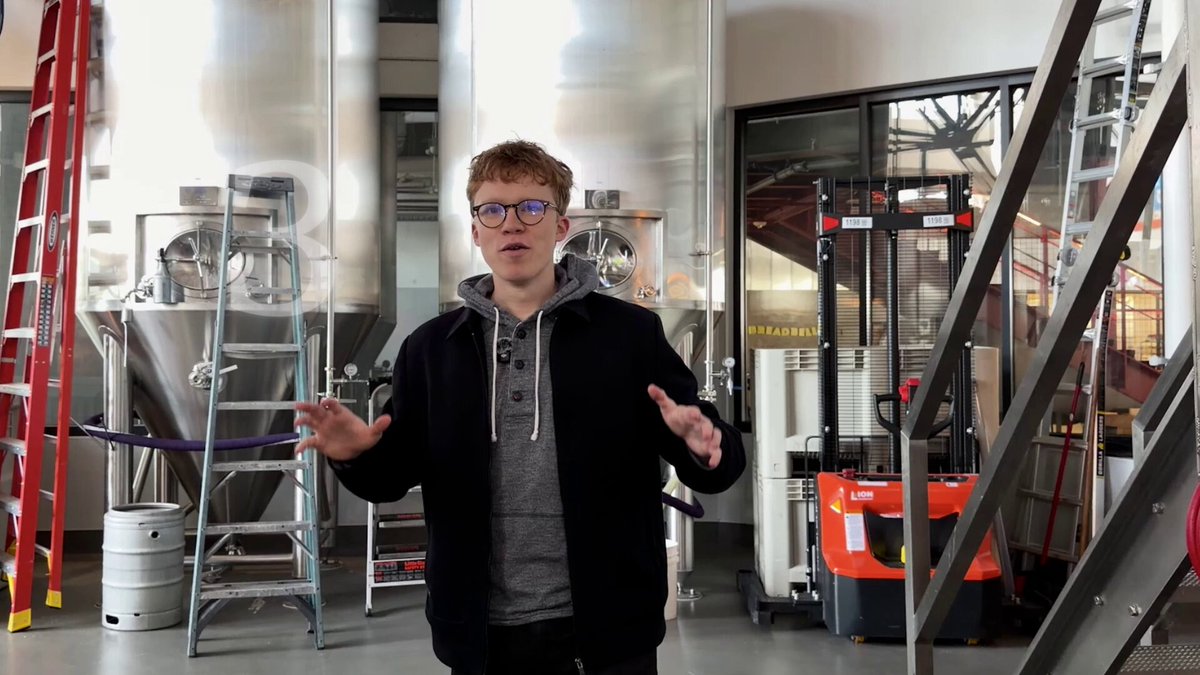
We're excited to announce Diana Hu (@sdianahu) as YC's newest Managing Partner.
Diana co-founded Escher Reality (YC S17), which was acquired by Niantic, where she shipped AR to the 100M people playing Pokémon GO. Since returning to YC as a partner, she has worked with nearly 230 companies that are now worth a combined $7 billion.
Few people have built a startup from zero and also shipped at global scale. Diana has done both.
ycombinator.com/blog/diana-h…
70
47
917
400,936
Y Combinator retweeted

A couple years ago it would’ve seemed crazy/creepy to record every meeting and conversation.
Now it feels crazy not to.
Most companies still don’t know this yet though, and the ones that do have a major advantage.
41
8
303
22,416
Y Combinator retweeted

9h
one YC founder this batch went from $0 to $30K MRR in 2 months, entirely by showing up to his prospects' offices in person.
he'll sit w/ engineers until they fully set up his product
one company kicked him out after he went there 4 times in 1 week. but his close rate is >50%.
18
7
204
20,374
Y Combinator retweeted

Good take
My guess is
- demand for intelligence is near infinite
- but 80% of workloads will be running on 99% cheaper models within 12-18 months
- 20% of workloads will still run on latest gen models where IQ maxing is important (scientific breakthroughs, higher level ochestrator agents?)
- rough analogy might be what % of macbooks or gaming PCs sold have the maxed out specs for CPU/GPU, prices are falling much faster than Moore's law here though
- this leads me to think the limiting factor will be energy and compute, not better models
At Coinbase we're working hard on routing prompts to cheaper models where appropriate, and in some cases have been able to keep costs roughly flat, while token usage continues to grow exponentially.
Jun 2

The most basic way AI could blow up imo. I'm not saying it does but this is the most obvious way I can see it happening
- Per seat subscriptions are massively subsidized. The flat fee was priced way below what heavy usage actually costs
- For real business use you have to move to the API anyway. Data protections, work integrations and compliance officer approval
- On the API you pay metered rates, and businesses are burning credits way faster than the per seat pricing ever led them to expect
- This is everywhere right now. Internally for us, Codex users, Uber torching its entire 2026 AI budget in 4 months, the Microsoft comments. Just go try an API
I shared more on this here: x.com/Shaughnessy119/status/…
- And I don't think most businesses have the money to keep paying increasing API rates without a real change to how they operate (caps needed)
- Because they have a cheap alternative. They can reach open source models through any aggregator (OpenRouter, Venice, Baseten, Together) and still get strong privacy. Venice private data centers, or E2EE/TEE serving GLM 5.1.
More on open source inference provider raises here: x.com/Shaughnessy119/status/…
- And the discount is enormous. DeepSeek V4 codes within a hair of Opus on SWE bench at roughly 1/30th the price, and the cheapest open models run closer to 1/100th
- Chinese labs open source frontier grade models. The model is the single biggest cost an inference provider has, and they get it for free
- This idea dies if China goes closed source. That is actually bullish web2 AI labs, because if everyone is closed you pay up for the best intelligence. China goes closed source if they are tired of giving away an asset and they want the revenue and data flow to train new models
- Is this showing up in web2 AI lab revenue yet? No. Revenue is off the charts. Anthropic went from 9B to 47B run rate in five months
- So go forward, what happens?
- I think revenue slowly starts leaking to the open source inference providers (see Venice usage, OpenRouter's $113M raise, Baseten is raising at $11B or triple its valuation in three months, on revenue that went from $200M to $600M annualized in a single quarter)
- It doesnt move overnight, but it caps the labs ability to raise prices, and margins are already deeply negative. OpenAI is reportedly running near negative 122%
- With margins that bad there is no cash flow, so the labs are fully dependent on outside capital to buy GPUs, train models, and keep subsidizing usage (I.e. see Google tapping $80b equity sale, granted 30b for employee RSU taxes. Clearly they think Equity is overvalued or you wouldn't sell it)
- The break comes when that capital stops. Pricing is capped so margins cant improve, and the moment investors lose conviction on payback, the whole flow reverses
- Why would they lose conviction on payback? Back to the start - the inability to improve margins or get businesses to pay more
- This is also limiting, if we start making new drugs with AI or create entirely new businesses, you better believe people will pay up to the max for AI usage
470
612
6,589
2,785,541

Aster (@asterailabs) is building the autonomous research lab.
They run thousands of AI agents in parallel to achieve 1000x speedups in autonomous research. Their lab just set a world record on ProteinGym in 30 minutes—and now they're automating open-ended research.
Congrats on the launch, @emmett_bicker!
ycombinator.com/launches/Qng…
25
21
230
28,014
So proud of @datacurve (YC W24) - building THE defining software engineering benchmark in DeepSWE
Tired? SWE-Bench Pro
Wired? Datacurve DeepSWE

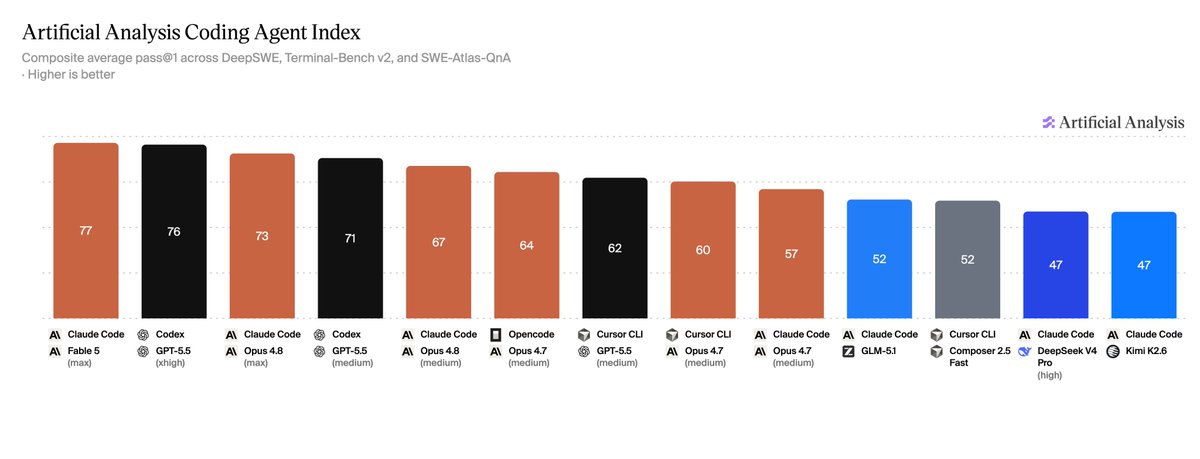
We've updated the Artificial Analysis Coding Agent Index, replacing SWE-Bench Pro with Datacurve's DeepSWE benchmark - the swap lifts Codex with GPT-5.5 (xhigh) above Claude Code with Opus 4.8 (max), while the newly released Claude Fable 5 (max) in Claude Code debuts at the top
DeepSWE, built by @datacurve, writes its tasks from scratch rather than adapting them from public GitHub issues or pull requests, so no model has seen the solutions during training. That matters because SWE-Bench Pro, the benchmark it replaces in our Coding Agent Index, had grown gameable, with some models recovering the fix from the repository's commit history instead of solving the task.
The swap reorders the index: Codex with GPT-5.5 (xhigh) rises from 65 to 76, overtaking Claude Code with Opus 4.8 (max) at 73. Claude Code with Fable 5 (max), which enters directly on the refreshed index, leads at 77. SWE-Bench Pro had been flattering some combinations and penalizing others.
More below.
11
11
138
33,959
Y Combinator retweeted

Jun 12
Imagine thousands of agents working for you on the web 🤔
This is why we rebuilt Browser Use:
> Made for long-running tasks
> Creates its own harness for any task
> [NEW] Browser Use Terminal
All it takes is one command.
Try it now ↓
Jun 8

Introducing Browser Use 0.13.0 [beta] 🏴☠️
> The old Browser Use was built for GPT-4.
> This one was built for SOTA models.
Custom LLM Harness.
Custom Browser Harness.
In Rust.
👇
7
15
116
21,813
Y Combinator retweeted
Jun 12
a common question investors will ask you when you're fundraising is "what does this look like in 5 years?"
these days, the honest answer is often "nobody knows."
investors aren't grading you on prophecy. they're grading you on thoughtfulness.
show them you're at the frontier. they should leave the meeting thinking that if anyone is going to figure it out, it'll be you.
16
8
77
14,663
Y Combinator retweeted

Jun 12
Demo day is going to be cool 😎

5
4
42
8,384
Y Combinator retweeted

Jun 12
today, we're open sourcing the Extend CLI
watch Fable use it to parse and extract an entire corpus of documents — end to end, without leaving the terminal
try it yourself: npm install -g @extend-ai/cli
it comes with a built-in agent skill, so claude code/codex/cursor know how to drive it out of the box
16
17
189
36,263
Y Combinator retweeted

We went from 0 to 2,200 paying customers in under a year by following @ycombinator's 15 rules:
1/ Do things that don't scale. Get your first 10 customers by hand.
2/ Launch now, not when it's "ready". A mediocre product in front of real users teaches you more in a week than 6 months of polishing in the dark.
3/ Charge from day one. If nobody will pay, you don't have a startup, you have a hobby.
4/ Talk to users every single day. The roadmap you need is sitting in your customers' heads, and they'll hand it to you for free
5/ Always hunt the 90/10 solution. For almost any feature there's a way to capture 90% of the value with 10% of the effort.
6/ There are only two real jobs: write code and talk to users. Everything else (conferences, press, VC coffees, corp dev calls) is fake work.
7/ You pick your customers as much as they pick you. 10 users who love you beat 1,000 who kind of like you.
8/ Growth is an output, not a strategy. Grow before product market fit and all you're buying is churn.
9/ Do less, really well. Pick one or two metrics and judge every task against them.
10/ Know if you're default alive. Paul Graham's question: on current growth and current burn, do you reach profitability before the money runs out?
11/ Don't hire until it hurts. Headcount is not progress, it's burn. Every great startup was embarrassingly small for embarrassingly long.
12/ Momentum is the only real moat in year one. Ship something every week, even something tiny.
13/ Every great startup is badly broken at some point. The game isn't avoiding fires, it's how fast you put them out. Again. And again
14/ Ignore your competitors. Startups die of suicide, not murder. In year one, the only company that can kill yours is your own
15/ Startups rarely die from running out of money. They die because the founders fall out. Brutal honesty with your cofounder is the cheapest insurance you'll ever buy
Good luck !
107
318
2,876
245,534
Y Combinator retweeted

Jun 12
Yes, Starcloud-1 runs DOOM on its H100.
Hardest part of running DOOM in orbit wasn't radiation, thermals, or bandwidth. It was resisting the urge to do this on day one.
8
9
83
21,156
Y Combinator retweeted

Jun 12
Osmosis is growing fast and tackling some of the hardest infrastructure problems in RL:

1
3
24
11,683

Claude Managed Agents is now available on Blaxel.
Run your agent loop on @ClaudeAI managed infra, while running tool execution on secure, persistent sandboxes.
-> 25ms suspend/resume. Shared persistent filesystem. Controllable network.
x.com/ClaudeDevs/status/2065…
Jun 12

Claude Managed Agents can operate in a sandbox you control, on your own infrastructure or with any provider you choose.
Today we added new guides for @blaxelAI, @e2b, @googlecloud, @namespacelabs, and @superserve_ai, so you can choose the best fit for your use case.
4
4
34
10,623
Y Combinator retweeted

Jun 11
Design Arena has surpassed 4 million users!
Since launch, we’ve grown from 6 arenas to 30 and seen our community create millions of designs.
What started as a way to compare AI-generated design has become one of the clearest views into how people actually use AI models in the real world.
Thank you to everyone building and sharing.
We can’t wait to see what you design next!

4
8
53
7,901
Y Combinator retweeted

Jun 10
One piece of advice we got during YC was to explain our company using verbs instead of nouns.
Early on, I walked into a meeting and did the opposite:
“We’re building a cloud platform for AI”
No one knew that that meant, their eyes glazed over. Then I started saying this instead:
“We containerize your code and run it on GPUs in the cloud so you don’t have to manage the infra yourself”
That clicked way more. Our brains understand verbs because they’re more concrete. If you describe your company using nouns, you risk people not understanding you.
And no one buys or invests in things they don’t understand.
108
146
3,121
325,612
Jun 12
At our latest YC Paper Club, researchers and builders presented on self-play for LLMs, AI for biology, formal verification, and agentic coding in production.
Thank you to our presenters:
00:00 — Francois Chaubard (@FrancoisChauba1) | Introduction & Call for Presentations
05:47 — Yasa Baig (@BaigYasa) | A World Model of Protein Biology (biohub.ai/esm/protein/about)
25:38 — Luke Bailey (@LukeBailey181) | Scaling Self-Play with Self-Guidance (arxiv.org/pdf/2604.20209)
37:51 — Arnab Maiti | Stream RAG: Instant and Accurate Spoken Dialogue Systems with Streaming Tool Usage (arxiv.org/pdf/2510.02044)
47:40 — Robert Joseph George (@Robertljg) | Lean and the New Era of Verified Intelligence (arxiv.org/abs/2602.22631)
58:52 — Lukens Orthwein (@lukensort) | Founder AI Hacks: Programming is an RTS Game Now
1:16:07 — Closing Remarks
17
28
207
27,808
Jun 12
If you're interested in joining a future Paper Club, apply to attend here: events.ycombinator.com/ycpap…
1
9
4,473
Everyone thinks AI coding tools set founders free.
Watch what people actually build with them: rules, approvals, process, layers. The same cage, assembled faster.
The tool that can scaffold anything in an afternoon will scaffold your bureaucracy in an afternoon too.
Speed of construction is speed of calcification. Build the thing that lets you create new things: experiences that didn’t happen before.
143
74
845
117,532