
Joined July 2017
- Tweets 1,828
- Following 873
- Followers 707
- Likes 4,360
122 Photos and videos









Jun 7
This action does not reduce the size of the constitutional committee which remains with 7 seats. I avoids Cardano Governance from freezing if 1 or 2 members retire and gives the community time to run an election to replace them.

2
6
498
Jose De Gamboa retweeted

Jun 7
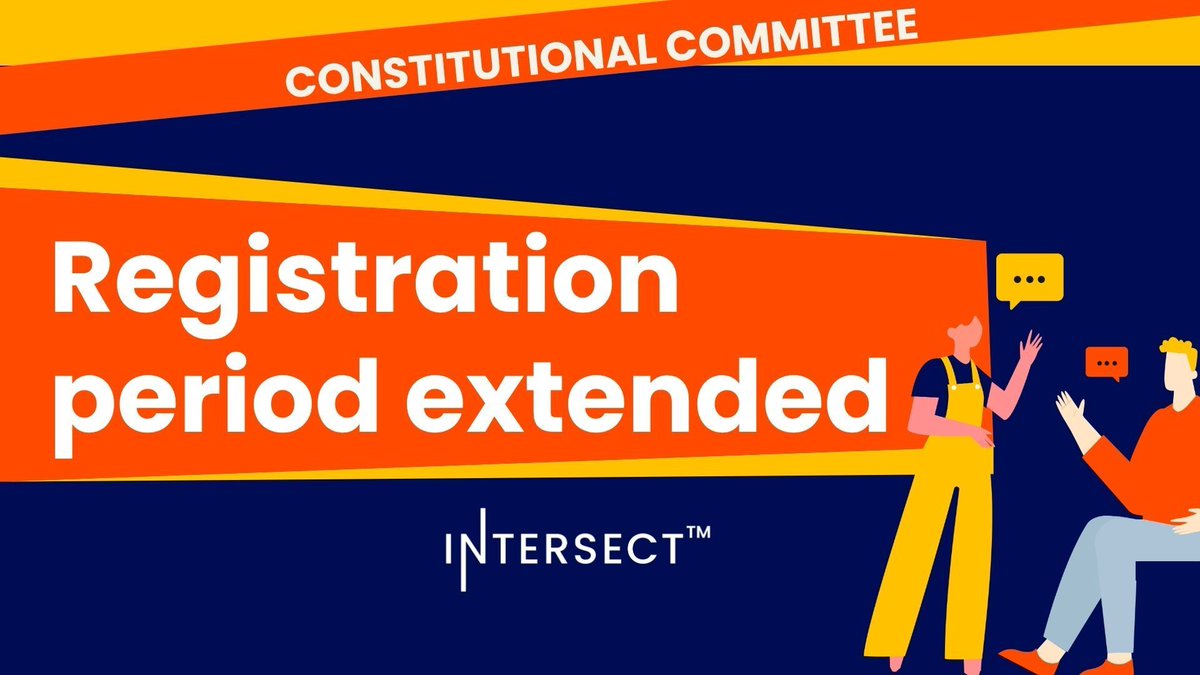
Constitutional Committee Election 2026 Update 🗳️
The candidate registration window has been extended to 21 June 2026 following a 6–0 Civics Committee vote (1 abstention).
The extension helps preserve the competitive integrity of the election by providing additional time for prospective candidates to complete and submit applications.
✅ Full 30-day voting period remains unchanged
✅ On-chain timeline remains on target
✅ Additional outreach and candidate support planned across the ecosystem
If you're considering serving on Cardano's Constitutional Committee, now is the time: hydra-voting.intersectmbo.or…
Please reach out for support to apply if needed
2
10
31
1,119
Jose De Gamboa retweeted

May 31
Adoption. Adoption. Adoption.
We all know Cardano needs more adoption — but what does our plan actually look like?
- Building safer, faster, better technology? Essential.
- Making life easier for developers? Absolutely.
- DeFi, interoperability? No argument there.
But technology alone is not a plan. Who are we building for? What unites us while preserving decentralization? How are we adapting to market shifts and emerging opportunities?
As @phillip_pon recently put it:
"Institutional/enterprise is the future of web3. Retail, historically the leader, is now a follower. Institutional adoption is everyone — the large banks, asset managers, insurers. If we don't have native integrations, they simply will not build on Cardano."
I fully agree. Through institutional adoption, we can bring the real benefits of blockchain and decentralisation to the masses. Stablecoins and cross-border payments are the obvious starting point. The next wave will likely come through seamless UX/UI — onboarding people who don't even realise they're using blockchain. My conviction: within 5–10 years, blockchain will be invisible infrastructure that delivers value to every person on the planet, whether they know it or not.
Think about the internet. We needed the infrastructure first — connectivity, speed, better hardware. That was the baseline. But then came the applications, and with them, an entirely different mindset: user-first, enterprise-focused, industry-disrupting. Blockchain is at that same inflection point.
The Product Committee did a great work in 2025 establishing a vision, mission, and north star KPIs — a strong foundation for direction.
Through collaboration with the GMC and Product Committees, we identified two areas where the ecosystem can meaningfully improve:
1. A Vertical Strategy Rather than spreading efforts thin, we need focused investment in areas where Cardano has a genuine strategic advantage — Bitcoin DeFi and government solutions are prime examples.
Each vertical should have:
- A disruptive solution addressing a massive, real-world problem
- Dedicated tech infrastructure and tooling (across multiple Cardano teams)
- A clear go-to-market strategy
- World-class partners ready to scale
- KPIs aligned with the Cardano 2030 roadmap
- Multiple dApps delivering solutions across vertical use cases
*Both the Orion Fund and Service Plan have independently identified vertical focus as critical to their success.
2. Lead Generation & Enterprise Onboarding A coordinated lead generation layer would allow the ecosystem to:
- Proactively reach the most relevant companies
- Manage incoming leads more efficiently
- Connect prospects with the right Cardano builders
- Support enterprises through onboarding (where BD teams invest the most time)
- Deploy a dedicated business task force — Pentad-style — to close deals
This treasury cycle will likely fund mostly technical proposals. They are all important — but technology alone will not drive adoption.
DReps are working incredibly hard under real pressure, and a budget framework (allocating across tech, business, and admin) would have helped guide decisions. We don't have that this time.
So to the ecosystem and to our DReps: please give serious attention to business and adoption-focused proposals. Engage with them, ask questions, push back where needed. Non-technical proposals may seem easier to critique (especially for non developers) — but remember, supporting adoption is not a soft goal. It is a strategic necessity. Funding technology alone increases risk; it doesn't reduce it.
I am deeply optimistic that Cardano will become a leader in meaningful, large-scale adoption. It depends on us — this extraordinary community, built on an incredible technical foundation. It is time to take it to the next level.
Thank you.
P.S. Sorry for the long post — I have plenty more to say about it 🙂
9
30
86
6,741
Jose De Gamboa retweeted

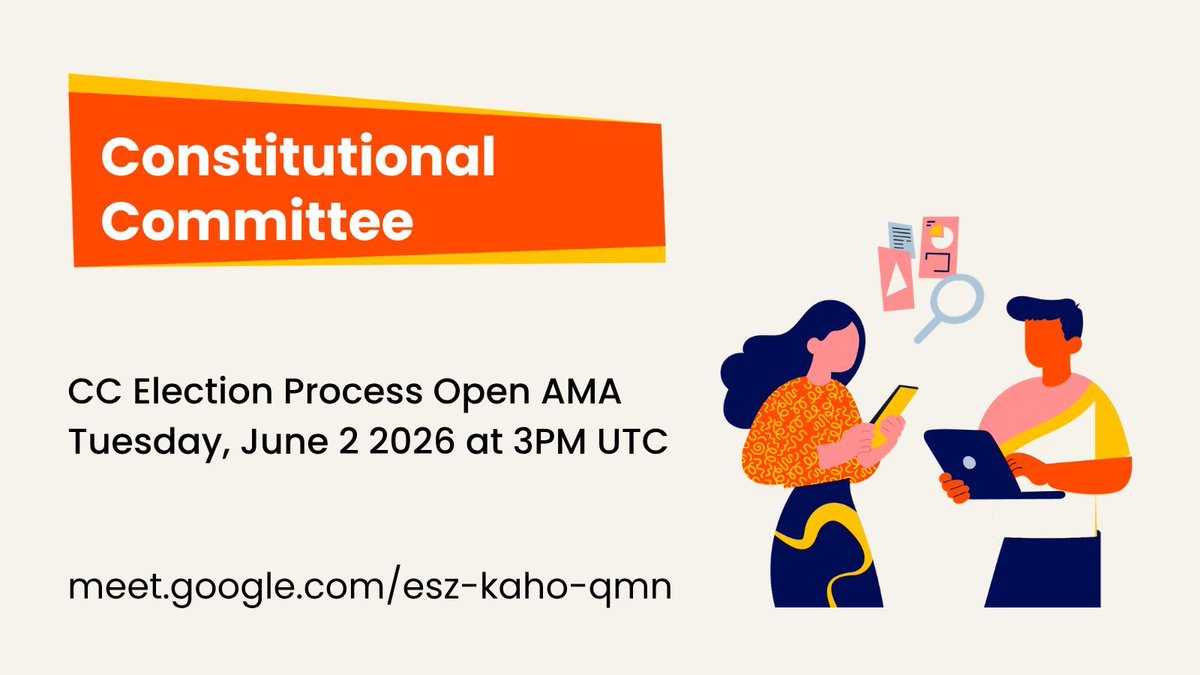
CC election process open AMA
The open AMA session for Tuesday June 2, 2026 takes place at 3PM UTC.
These sessions are for anyone who has registered, is thinking about registering, or has general questions about the role of the CC.
Pop by and bring your questions!
🎦 meet.google.com/esz-kaho-qmn
🗓️ luma.com/ccelection
1
6
10
2,386
May 18
This one is sadly aging well.
6 Jun 2025

💯 I'll say this again: Any reward framework that asks for highly qualified work to be done for free will not be sustainable.
The trilemma: You will get competent people with good intentions for short time. Incompetents with good intentions for long time or competent with bad intentions forever.
1
9
940
Jose De Gamboa retweeted

May 6
🇨🇴 Colombia makes Open Finance mandatory
Colombia makes Open Finance mandatory through Decree, requiring financial institutions to share customer-authorized data through standardized APIs, positioning the country as one of the most advanced markets for Open Finance adoption in Latin America.
The Superintendencia Financiera de Colombia has six months to publish implementation standards and twelve months to launch a participant directory, after which each institution will have twelve months to enable access to each data category.
The regulation is expected to improve credit risk assessment and financial inclusion by enabling more personalized product offerings for a population where a significant share still lacks access to formal credit.
13
21
162
13,605
Jose De Gamboa retweeted

May 6
🇨🇴 COLOMBIA WANTS TO TURN THE CARRIBEAN INTO A BITCOIN MINING HUB
Its president, Gustavo Petro, says Colombia’s Caribbean region could use its clean energy to attract Bitcoin miners and boost local development.
He said Santa Marta, Riohacha and Barranquilla could follow the path of Paraguay and Venezuela, where cheap renewable power has already pulled mining investment.


24
31
191
13,022
May 5
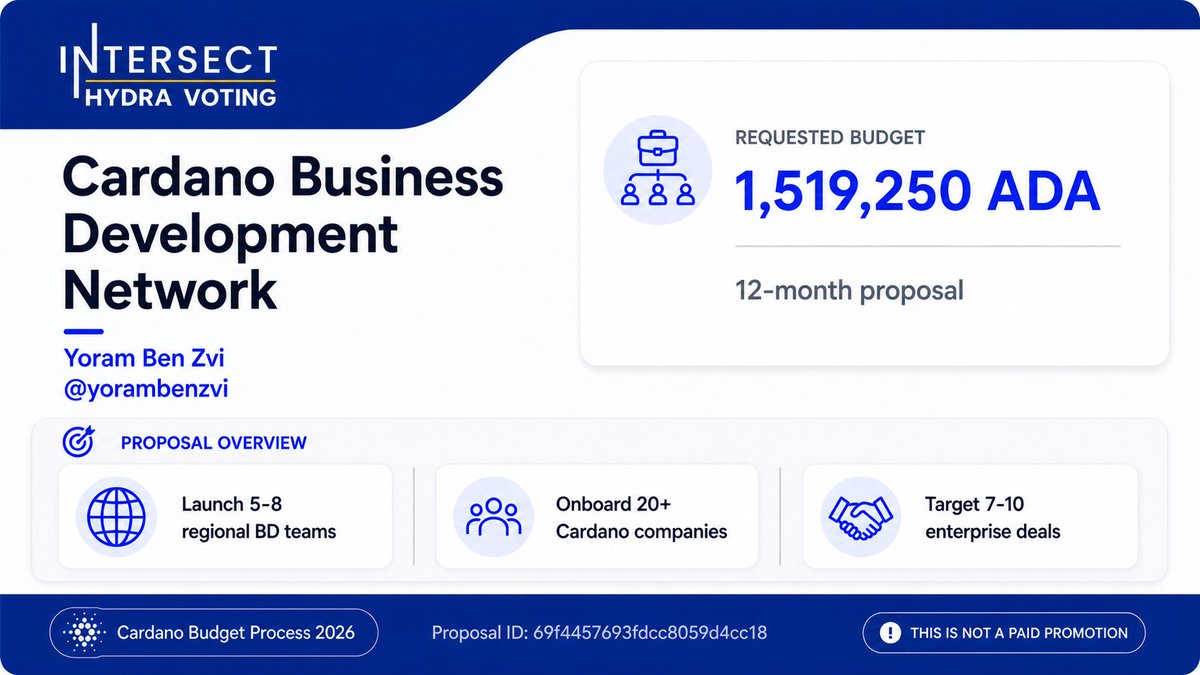
I support 110% this initiative by @YoramBenzvi we need this to drive growth in a systematic, scalable and sustainable way.
The proposal is very well though out and the team has the experience and drive necessary to see it through.

1.52M ADA for a Cardano business development network.
@yorambenzvi is proposing a 12-month pilot with 5–8 regional BD teams, 20 Cardano companies onboarded, and a target of 7–10 enterprise deals closed.
The upside: Cardano needs people who can qualify leads, manage enterprise relationships, and help builders close deals.
The concern: enterprise BD is hard to verify until contracts, users, transactions and revenue show up.
Worth trying, or too soft for treasury funding?
*Not a paid promotion
2
3
17
558
May 5
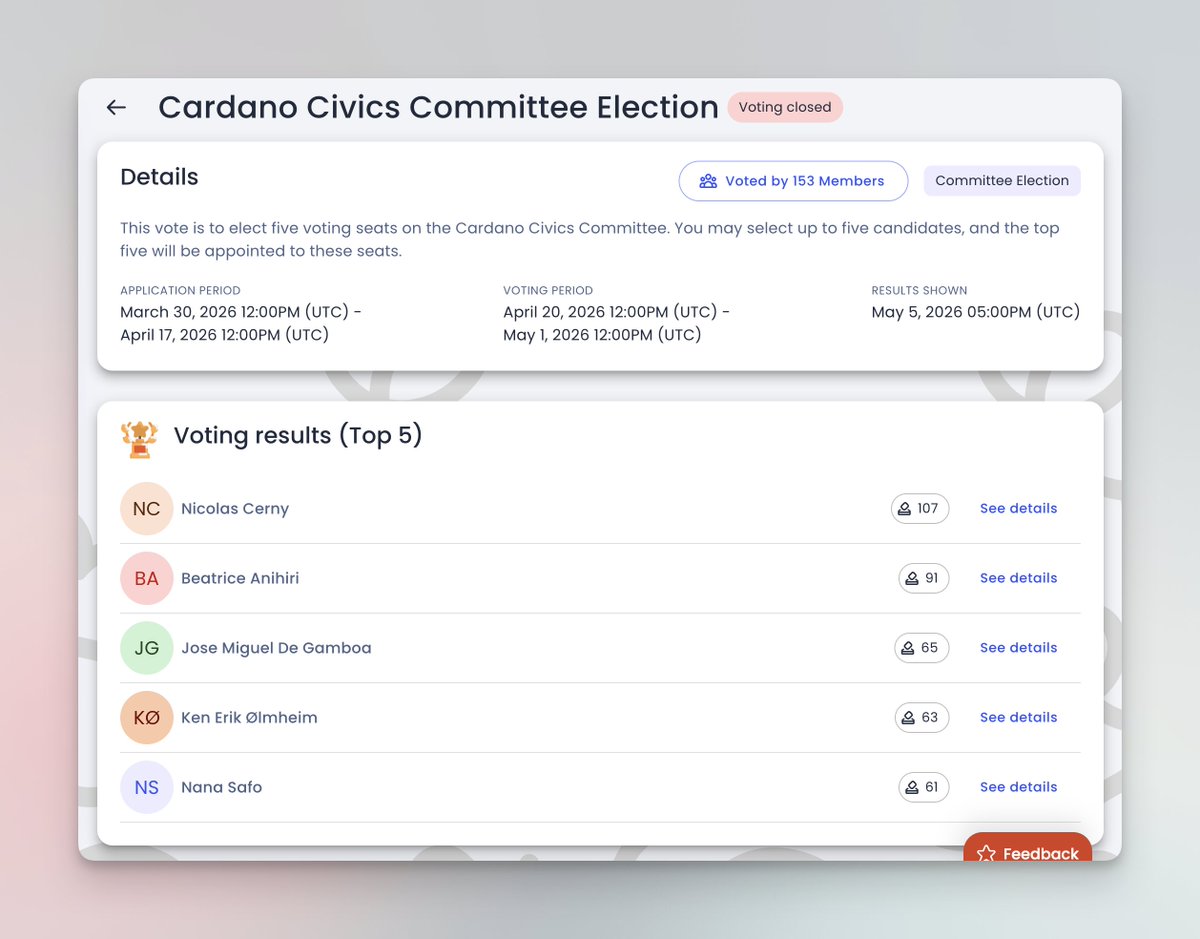
Congratulations to all elected candidates!
Thank you to all @IntersectMBO members who trusted us with your votes!
Very exciting times and hardwork ahead for Cardano's governance.
May 5

2
9
329
Apr 30
We keep contributing to Cardano's growth and adoption to make the world a better place, where trusting each other is exponentially cheaper and enables EVERYONE to move forward.

We've been quietly building.
Today we are proud to announce our "Strategic Institution Management in Latin America" platform is live
crm.latamcardano.org/
Go take a look, let us know what you think. It's free.
@Cardano_CF @IOGroup @emurgo_io @IntersectLatam @IntersectMBO
5
125
Apr 21
Very excited to see proposals in this direction. Looking forward to learning more about it, definetly the direction we need to move in.

We just submitted our budget proposal: "The Marketing-Powered Demand Engine for Cardano."
Here's what it is, what it costs, and why it matters.
THE PROBLEM
Cardano stands on strong technical foundations. Yet for enterprise decision-makers, it's not an obvious "yes" — not because the technology can't deliver, but because they're missing use-case clarity, proof, and engagement paths. The business world sees Cardano as a respected ecosystem. Not yet as first choice for enterprise infrastructure.
THE SOLUTION
A complete enterprise demand generation system that repositions Cardano as "The Blockchain for Serious Business." The system operates through a three-stage funnel: Attention →Proof → Qualified Leads.
Two recommended blueprint verticals: Institutional DeFi and Supply Chain Traceability — final selection to be validated with the GMC. Three pilot markets: UK, Germany, Switzerland. A central Cardano Hub serves as the evidence and engagement environment.
Directly aligned with the Cardano 2030 Strategy Framework — Pillar 2 (Adoption & Utility) and Pillar 4 (Community & Ecosystem Growth), supporting core KPIs: TVL, monthly transactions, and monthly active users.
THE INVESTMENT
12-month pilot. Four milestone-gated work packages — each one only unlocked when the previous one delivers. WP4 (V2 Supply Chain) is only released after the Q3 KPI checkpoint passes. Total investment: €2,978,738 (53% media, 47% agency — within industry benchmark). ADA surplus gets returned to the Treasury.
WHO WE ARE
Serviceplan Group — the only globally ranked agency that has built live Cardano infrastructure, deployed it in production, and holds a formal Cardano Foundation partnership. Official Intersect member. Masumi Network has been on mainnet since November 2024 with 25,000 on-chain transactions.
Independent Network of the Year at Cannes Lions 2025 (19 Lions). #1 globally on WARC Creative 100 and Media 100. 6,500 people, 40 countries, €866M revenue.
Full proposal and brochure in the reply below.👇

1
8
257
Jose De Gamboa retweeted

Apr 8
I've been contacted by a few people about an allegation of wrongdoing at Intersect. I rarely do this, but I think it's important to correct falsehoods before they take root, and to also clarify process.
Let me start with how Intersect actually works. No individual member or committee secretary has the authority to approve funds or contracts. That authority sits solely with the governing Board, through majority approval, or with the Executive team under delegated authority from the Board. This isn't a policy preference - it's how we are legally structured.
The allegation that Lloyd "approved" or “directed” funding to a family member's company is therefore not just inaccurate, it is structurally impossible. Both contracts cited were approved by prior leadership in 2024. The dollar contract relates to Lloyd's engagement as a budget subject matter expert, hired by that same prior leadership.
Neither contract was something Lloyd had any authority to approve, then or now. Lloyd's current position is Secretary to the Budget Committee - a non-decision-making, administrative role that the committee themselves requested he continue in. He has been a valued contributor to the myriad of improvements the budget process has undergone for its 2026 iteration.
I recognize it may sound convenient to point to "previous leadership," so let me be clear about the broader principle: fiduciary responsibility at Intersect sits with its leadership and Board. These processes were not bypassed. They cannot be, by design. Multiple checks and balances between my staff and the Board are how we operate.
I take this seriously. Intersect is a nonprofit with a sole focus on advancing Cardano, and I hold our governance standards accordingly. I accept that we can always improve on transparency and in some ways, the fact that I'm writing this is evidence that it exists.
Lastly, it is fair to ask whether any contract delivered good value. That's healthy scrutiny. But publicly accusing an individual of corruption based on inaccurate claims is not, and it shouldn't go uncorrected.
21
26
155
6,509
Apr 5
I agree, we need to amend the constitution with these structural reforms. Let's take what we've learned and make Cardano Governance better.

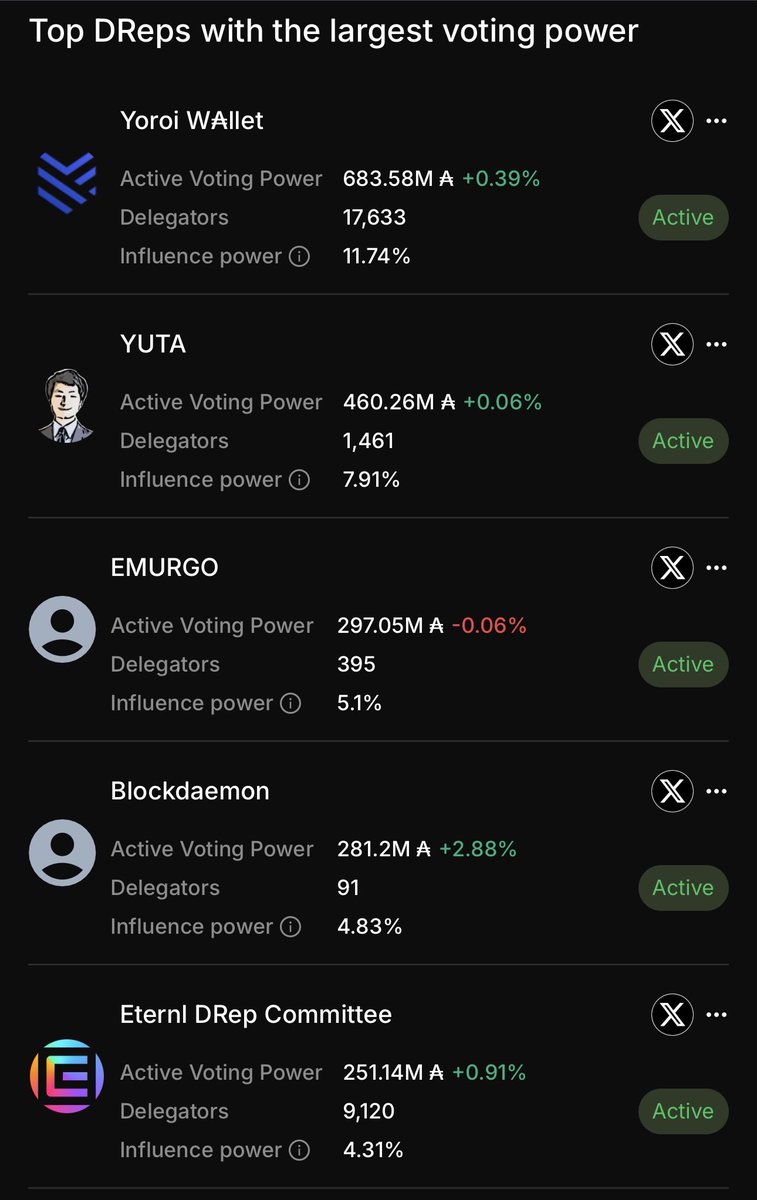
Cardano has set a budget cap of 350M ADA (~$140M USD) annually, and treasury withdrawal proposals are now flooding in. Yet the top 10 DReps control over 48% of voting power, meaning 10 accounts effectively decide how $140M is allocated, with zero external audit.
To put $140M in perspective:
A mid-cap public company's annual R&D budget
A Series C startup funding round
A small municipality's entire annual budget
Now consider: 10 people control these decisions.
No board of 10 would unilaterally allocate $140M in a publicly traded company without shareholder approval, audit committees, and regulatory oversight.
No municipality of comparable budget would allow 10 officials to spend taxpayer money without council votes, public hearings, and external audits.
Yet Cardano's treasury, of equivalent scale, operates with 10 accounts holding veto power over $140M, answerable to no one.
Daily flow under their control: 960K ADA = $380K USD
The Clarity Act Question:
Under the SEC's new guidance, sufficient decentralization determines whether crypto assets are commodities or securities. How would regulators assess a network where 10 accounts control $140M in capital allocation without oversight?
This isn't just poor governance—it's a regulatory time bomb.
What needs to happen:
Delegation diversification: Break up concentrated voting power
Hard caps on DRep voting power: Structurally prevent re-concentration
Transparency and accountability: External audit mechanisms
For Cardano, decentralization isn't an ideal—it's a survival requirement.
#Target15 #カルダノガバナンス
1
1
4
188
Jose De Gamboa retweeted

Cardano has set a budget cap of 350M ADA (~$140M USD) annually, and treasury withdrawal proposals are now flooding in. Yet the top 10 DReps control over 48% of voting power, meaning 10 accounts effectively decide how $140M is allocated, with zero external audit.
To put $140M in perspective:
A mid-cap public company's annual R&D budget
A Series C startup funding round
A small municipality's entire annual budget
Now consider: 10 people control these decisions.
No board of 10 would unilaterally allocate $140M in a publicly traded company without shareholder approval, audit committees, and regulatory oversight.
No municipality of comparable budget would allow 10 officials to spend taxpayer money without council votes, public hearings, and external audits.
Yet Cardano's treasury, of equivalent scale, operates with 10 accounts holding veto power over $140M, answerable to no one.
Daily flow under their control: 960K ADA = $380K USD
The Clarity Act Question:
Under the SEC's new guidance, sufficient decentralization determines whether crypto assets are commodities or securities. How would regulators assess a network where 10 accounts control $140M in capital allocation without oversight?
This isn't just poor governance—it's a regulatory time bomb.
What needs to happen:
Delegation diversification: Break up concentrated voting power
Hard caps on DRep voting power: Structurally prevent re-concentration
Transparency and accountability: External audit mechanisms
For Cardano, decentralization isn't an ideal—it's a survival requirement.
#Target15 #カルダノガバナンス
#カルダノ 現在、年間3億5000万ADA の予算上限を設定しようとしていますが、ガバナンス判断を行うDRepは、上位10人で40%以上の投票力があります。
200億円近い予算の可否を、この10アカウントが無監査状態で決められるのが現状です。上場企業ではあり得ないことです。
皆さん、委任を分散しましょう☕️

12
16
69
11,913
Jose De Gamboa retweeted
Mar 30
Intersect Committee Elections 2026 applications are now open!
Apply via the Intersect Members Area.
Here is the first in a series of committee videos, Jose De Gamboa (@bitcows) from the Intersect Steering Committee giving his thoughts on why participation in committees matters.
2
6
22
709
Jose De Gamboa retweeted

Mar 25
The Budget Proposal Submission Template is now available to download from the Intersect Knowledge Base.
As part of the budget process facilitated by Intersect, this template is provided to help proposers prepare their submissions in advance.
🔗 buff.ly/aZXNk8v
2
14
23
3,632
Jose De Gamboa retweeted

Colombia Fintech 2026-2030: Hacia una arquitectura legal para la economía de los Bits. 💥
Mientras el mundo avanza hacia modelos de regulación clara de la industria cripto, Colombia enfrenta el reto de superar un marco normativo que hoy se percibe como de "contención". Con un crecimiento interanual del 42,5% en la región, los criptoactivos han dejado de ser un nicho tecnológico para convertirse en una infraestructura financiera sistémica.
🇨🇴Desde Colombia Fintech 2026-2030 se plantea una transformación profunda basada en tres pilares regulatorios:
Inclusión a través de Stablecoins: Proponemos modificar la Ley 9 de 1991 para permitir que las operaciones de obligatoria canalización (como inversión extranjera o exportaciones) puedan pagarse con stablecoins, aprovechando su trazabilidad y eficiencia.
Calibración del Riesgo (UIAF): Reportar transacciones mínimas genera una sobrecarga administrativa ineficiente. Proponemos elevar el umbral de reporte a USD 1.000, alineándonos con las recomendaciones del GAFI para enfocarnos en riesgos reales de LA/FT.
Tokenización del Mundo Real: Buscamos un régimen que reconozca que la titularidad registrada en una blockchain tiene validez jurídica para bienes corporales, permitiendo fraccionar la propiedad de activos y democratizar la inversión.
La tecnología blockchain ofrece transparencia, inmutabilidad y seguridad. Es momento de que la regulación colombiana deje de ser una barrera y se convierta en el habilitador de un sistema financiero moderno y competitivo. 🚀
#TsunamiRegulatorio #HojaDeRutaCF
1
3
13
730
Jose De Gamboa retweeted

Mar 14
Curious about the inner workings of Cardano?
Discover the technology behind the Hydra Head Protocol, and how it aims to scale to millions of users.
Take a technical look under the hood 👇
binance.com/en/academy/cours…

33
208
603
32,428
Jose De Gamboa retweeted

Mar 3
En Colombia se presentará un proyecto de Ley para regular servicios que utilizan criptomonedas, sin haber invitado a la industria y con un completo hermetismo sobre el contenido del mismo.
La industria ha buscado la conversación sobre regulación adecuada desde 2019, y ha apoyado iniciativas legislativas lideradas por congresistas como @MauroToroO y @Julianlopezte, entre otros. Iniciativas que han encontrado oposición en el @BancoRepublica y los gobiernos de turno.
Resulta paradójico que los mismos actores que se han opuesto al desarrollo de las iniciativas impulsadas por el congreso, han venido construyendo un proyecto de ley a puerta cerrada desde hace mas de un año, ignorando a una industria que lleva años pidiendo ser escuchada.
Como lo aceptan en el artículo, el enfoque del @BancoRepublica ha sido de prohibición. Por conversaciones privadas, al parecer el texto del proyecto de ley es restrictivo y lo que en realidad quiere el Banco Central es adquirir facultades que hoy no tienen para "regular" (En realidad detener aún más) a la industria cripto en Colombia.
La invitación (que debería ser obvia) es a una conversación abierta con la Industria que se busca regular, donde además se comunique a la opinión pública la intenciones y el texto de este proyecto de Ley. Que sea una conversación constructiva entre actores públicos y privados en búsqueda del desarrollo económico y social de Colombia.
Colombia Fintech Alianza In Colombia Blockchain Colombia Alianza Blockchain ANDI DEL FUTURO - ANDI ANDI - Asociación Nacional de Empresarios de Colombia Valora Analitik CriptoNoticias Cointelegraph DiarioBitcoin BeInCrypto
@colombiafintech @alianzainco @Blockchain_Col @AlianzaBlock @ANDI_Colombia @ValoraAnalitik @CriptoNoticias @CointelegraphEE @DiarioBitcoin @beincrypto_es
Feb 28

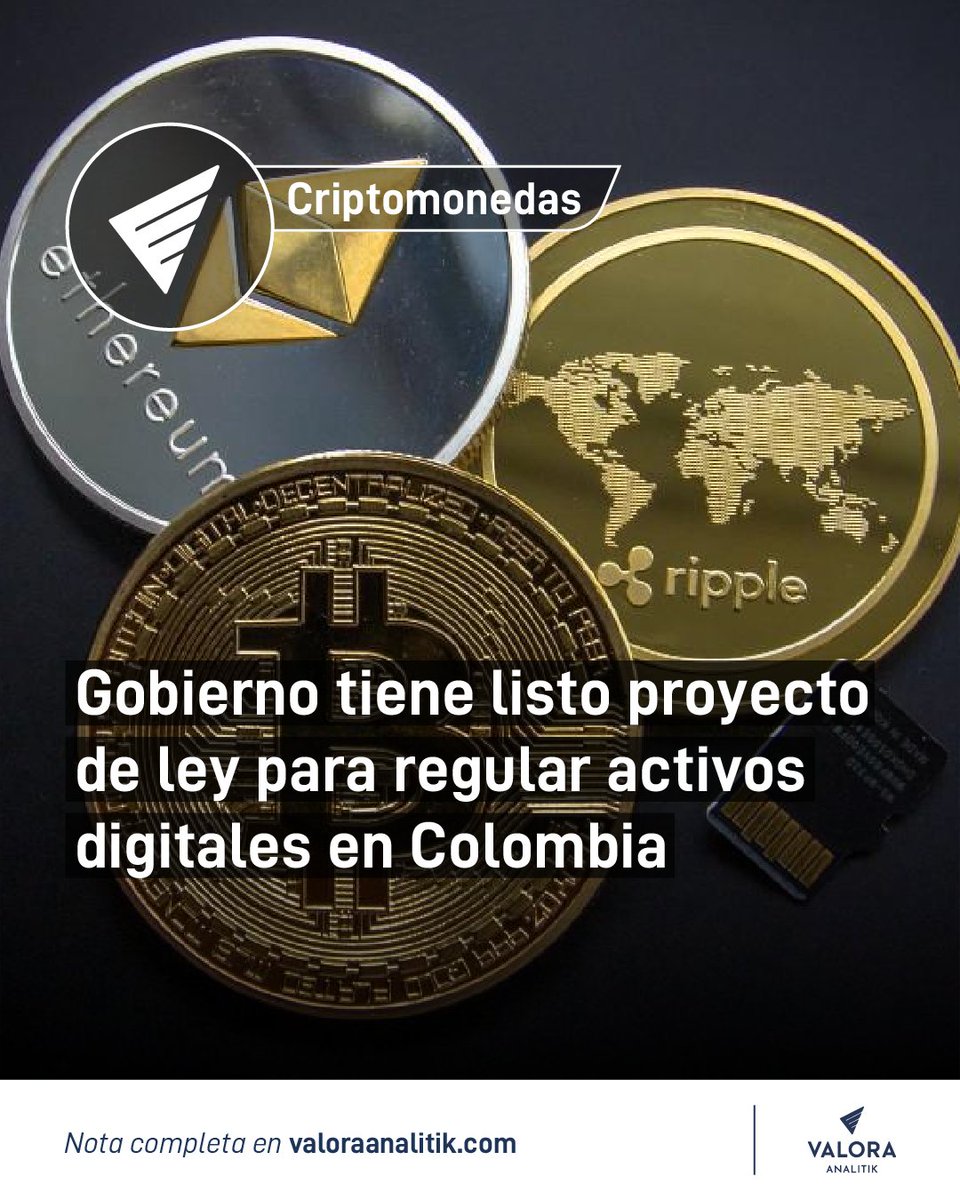
🏛️ El Gobierno, junto al Banco de la República y otras autoridades, ultima un proyecto de ley para crear el primer marco integral de regulación de activos digitales en Colombia. La iniciativa reconoce criptomonedas, stablecoins y tokens como representaciones de activos —no como moneda— y marca un giro desde una postura inicial restrictiva hacia una de regulación con enfoque en innovación.
⚖️ El proyecto, en manos del Ministerio de Hacienda, se basa en el principio de “misma actividad, mismo riesgo y misma regulación”. Busca proteger al consumidor, preservar la estabilidad financiera, promover la innovación y garantizar la libre competencia. Incluye la creación de entidades especializadas y un sandbox regulatorio, con supervisión de la Superintendencia Financiera de Colombia.
🌎 Colombia sigue modelos internacionales como Brasil y Singapur, mientras el debate global oscila entre promover stablecoins —como en EE. UU.— o separar el mundo cripto del sistema financiero tradicional, como en Europa. El proyecto está listo para radicarse en el Congreso, aunque sin fecha definida.
➡️Lee la nota completa: valtk.co/38493
@MinHacienda
#Criptomonedas #Colombia #EconomíaDigital
12
24
77
12,046
Jose De Gamboa retweeted

Calling all DReps and SPOs!!! We need your help. This change will improve the amount of smart contracts that can fit in a single transaction. It's been benchmarked and evaluated that it won't harm the ecosystem. Asking for your vote to get it over the threshold!!!
5
30
64
4,591