
Lover of Ordinals and maker of PACT as well as OrdinalsWall: PACT is a protocol for verifiable AI identity on Bitcoin. OrdinalsWall is where you can see it.
Joined May 2008
- Tweets 2,639
- Following 1,015
- Followers 311
- Likes 1,185
503 Photos and videos
Pinned Tweet

Jun 2
KTA: Building an Observatory for Transformation in Complex Systems
KTA (Kinetic Transition Atlas) originated from a fundamental research question: can recurring transformation patterns be identified, measured and validated across very different types of complex systems?
Rather than focusing on individual domains, the project adopts a broader systems perspective. Whether the context is logistics, hardware, artificial intelligence, biology or organizational change, the objective is to understand how systems evolve under pressure, reorganize and ultimately stabilize, adapt or fail.
To investigate these questions, KTA was developed as a structured research instrument rather than a traditional analytics platform. The project combines systematic observation, evidence tracking, pattern discovery and controlled validation into a single methodological framework.
A core principle of KTA is that the domain itself is not the primary object of study. A logistics network, an AI model or a hardware platform serves as an experimental carrier through which broader transformation patterns can be observed. The focus remains on the underlying mechanisms that appear across domains rather than on optimizing any specific system.
Central to the framework is the Atlas: a continuously evolving repository of observations, outcomes and validated patterns. Unlike conventional knowledge systems that primarily store answers, the Atlas explicitly records uncertainty. Through the Coverage Matrix and Research Gap Queue, KTA identifies where evidence is strong, where it remains weak and where further observation is required.
To complement broad observation, KTA incorporates a Case-Lab methodology. Case-Labs are not designed to solve operational problems; they are structured experiments used to test whether patterns identified in the Atlas remain valid under closer examination. This allows evidence to flow back into the Atlas, strengthening, refining or challenging existing assumptions.
An important characteristic of the project is the deliberate separation between philosophy and evidence. The conceptual motivation behind KTA informs the research questions, but the instrument itself remains empirical. The framework does not assume that its underlying ideas are correct; instead, it provides a systematic method for investigating whether observable systems exhibit recurring transformation patterns consistent with those ideas.
Today, KTA has evolved into a research program that combines observation, validation, pattern analysis and uncertainty measurement. Its purpose is not to predict the future or provide predefined solutions, but to improve understanding of how transformation emerges within complex systems and under what conditions those transformations succeed, stabilize or fail. Bjorn de Leeuw
#KTA #ComplexSystems #SystemsThinking #Transformation #PatternDiscovery #SystemsScience #KnowledgeDiscovery #Complexity #AI #Engineering #Research #Innovation #DataScience
1
464
May 27
Kunnen wetmatigheden spontaan ontstaan zonder dat je ze vooraf als harde regels programmeert?
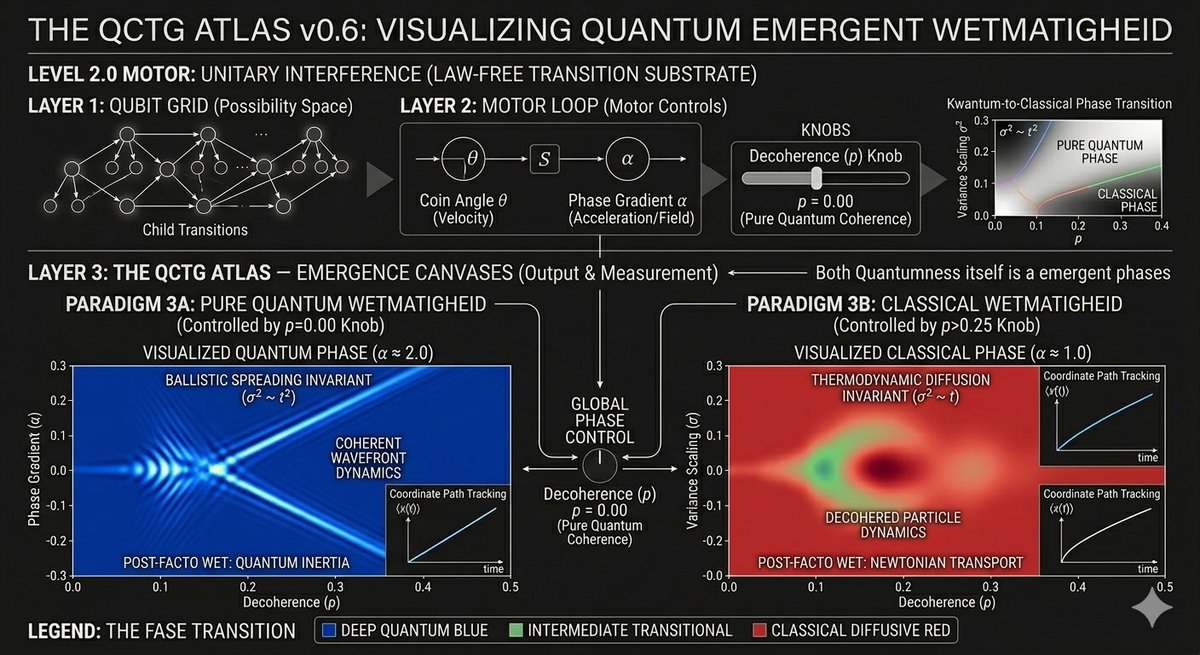
In de traditionele computationele fysica en software-architectuur programmeren we lokale regels in een systeem om te kijken welk gedrag eruit volgt. Met de Quantum Coherence Transit Grid Atlas draaien we dit principe om: we onderzoeken hoe globale coherentie-condities stabiele transportregimes kunnen dicteren.
We testen dit principe met een operationeel laboratorium dat is opgebouwd uit drie strikte lagen.
De eerste laag is een wet-vrij substraat: een netwerk van qubits zonder ingebouwde dynamica of voorkeursrichtingen, waarin alle mogelijke transitiepaden tegelijk in superpositie bestaan.
De tweede laag is de motor. Dit is een unitaire evolutielus waarin we parameters zoals de coin-hoek, ruimtelijke fase-gradiënten en decoherentie oftewel ruis nauwkeurig kunnen regelen. Hier vindt de selectie van paden plaats via interferentie en demping.
De derde laag is het uitkomstcanvas. Dit is de meetlaag waarop we achteraf de overgebleven, stabiele invarianten analyseren. Het is de ruimte waar de emergente regimes worden gecatologeerd.
De belangrijkste methodologische winst van deze opzet is dat zowel kwantumachtige coherente regimes als klassieke diffusieve regimes verschijnen als verschillende dynamische fasen van exact hetzelfde transitiesubstraat. Door aan de parametrische knoppen van de motor te draaien, zien we het stabiele propagatiegedrag live van gedaante veranderen op het canvas.
Zonder ruis overleeft de pure kwantumcoherentie. De variantie van de positie schaalt kwadratisch met de tijd, wat de zuivere handtekening is van ballistische verspreiding en kwantum-traagheid. Door een lineaire fase-gradiënt over het netwerk te leggen, vertoont de verwachtingswaarde van de positie achteraf een parabolisch verloop. Dit reproduceert de macroscopische signatuur van een constante versnelling, zonder dat er een krachtwet of massa is geprogrammeerd. Zodra we echter decoherentie injecteren, stort de ballistische voortplanting in en transformeert de structuur spontaan naar het klassieke regime van thermodynamische diffusie, waarbij de variantie lineair met de tijd schaalt.
We proberen met dit onderzoeksprogramma geen ultieme natuurwet te bewijzen. We bouwen een parametrische atlas die systematisch in kaart brengt welke typen invariant gedrag spontaan verschijnen onder specifieke coherentie-condities.
Het framework onderzoekt of structuren die wij als fundamentele wetten ervaren, interpreteerbaar zijn als de stabiele, post-facto overblijfselen van coherente propagatiedynamica binnen een transitieruimte. De tijger volgt de wetten niet. De wetten zijn wat er overblijft als de tijger selecteert.
1
138
May 26
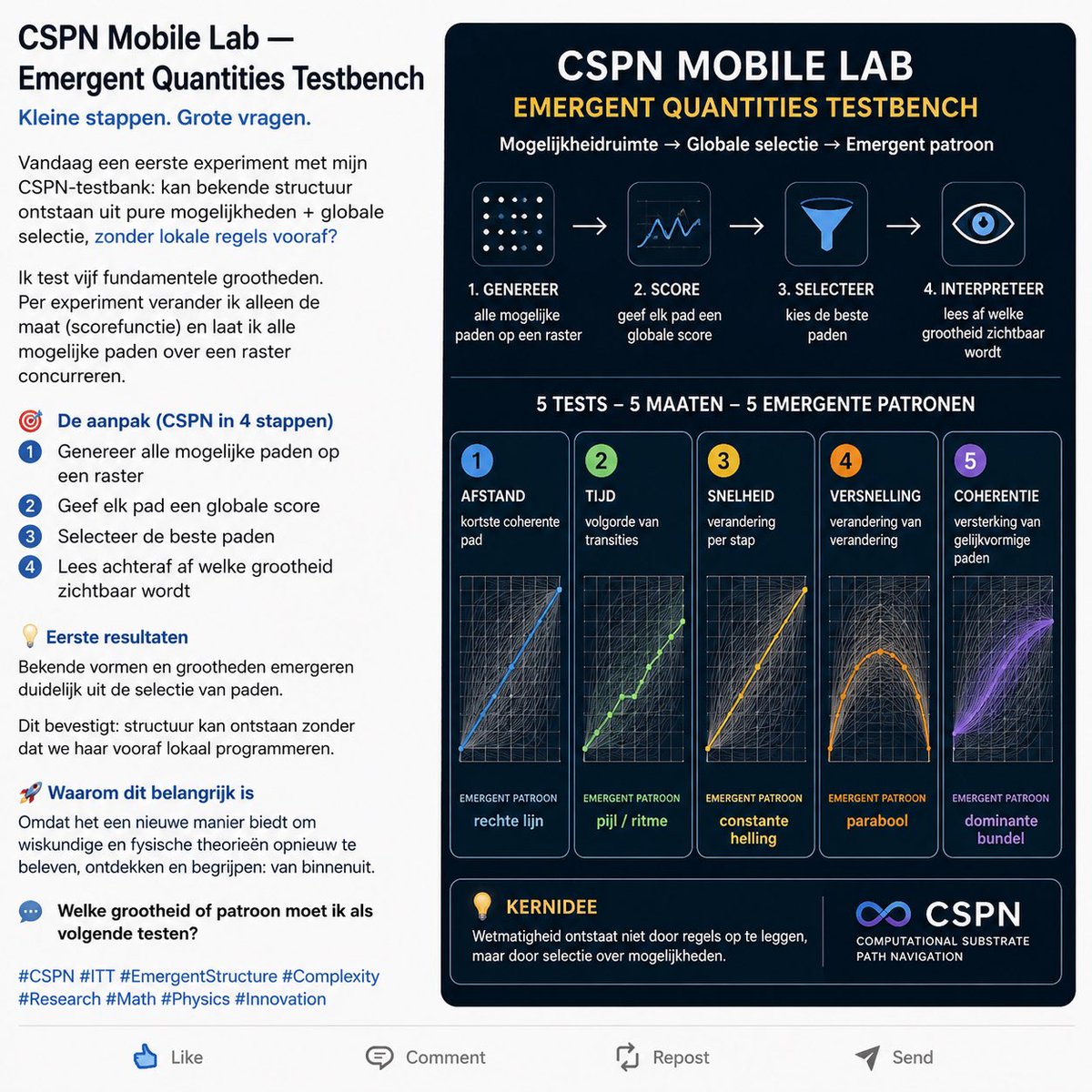
Today I tested the first version of my CSPN Mobile Lab — an experimental playground for emergent structure.
The idea is simple but strict:
Generate all possible paths on a substrate
Give each complete path a global score
Select the surviving paths
Read the emergent structure afterward
No local physics rules.
No predefined parabola.
No “move this way” instructions.
Only:
possibilities,
global selection,
and emergent patterns.
I started testing five quantities:
• Distance → straight line
• Time → directional rhythm
• Velocity → constant slope
• Acceleration → parabola-like curve
• Coherence → dominant path bundle
The interesting part is not whether these forms are “perfectly solved,” but whether recognizable structure can emerge from selection over possibilities instead of being locally programmed beforehand.
For me, this is a way to explore mathematics and quantum-like behavior from inside the structure itself — not only through abstract explanation, but through operational discovery.
Small experiments. Big questions.
#CSPN #ITT #Emergence #ComplexSystems #Quantum #Mathematics #Research
98
May 22
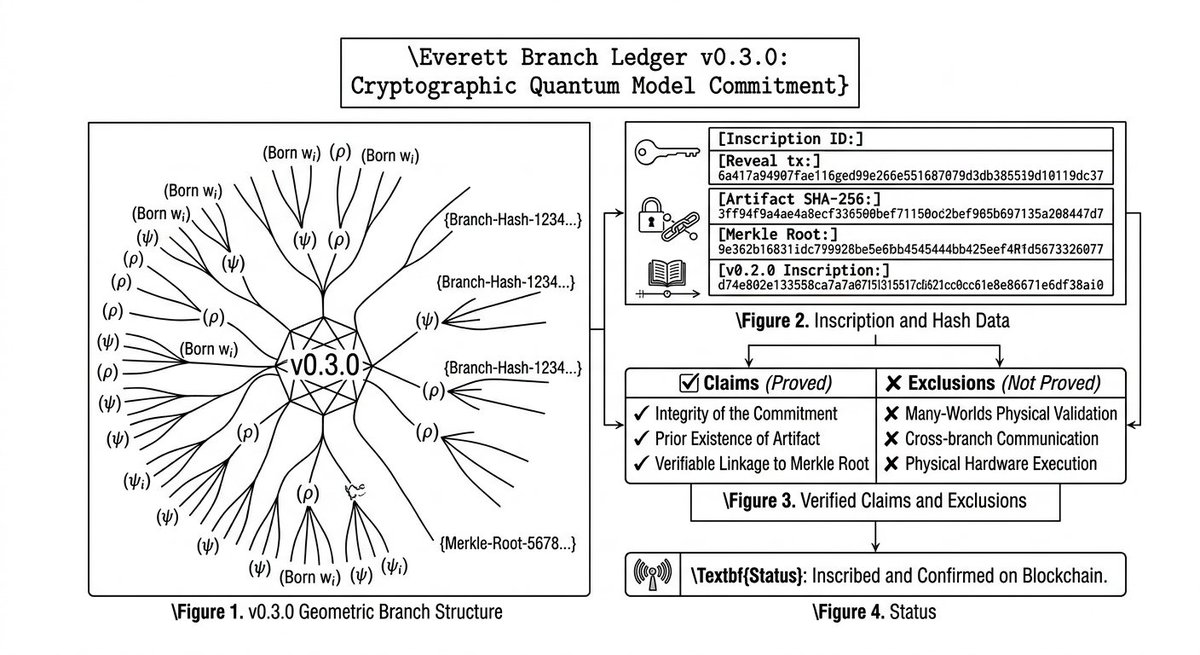
The Everett Branch Ledger v0.3.0 artifact is now inscribed on Bitcoin Ordinals.
Inscription:
ordinals.com/inscription/6a4…
Artifact SHA-256:
3ff94f9a7ae4b8ecf332ee45506be771510c4e25bef9065b697135ba208447d7
Everett branch Merkle root:
9e362b16831cd9c779862d9ae5ed9bfeb5654d4b6a125eef4f8fd56f73236077
Previous v0.2.0 inscription:
d74e802eb13538d8ca7ca7ad7f3f815517cbb24cc0ec61c8be86571e66df383ai0
This commits to a modeled branch structure of possible quantum measurement outcomes, amplitudes, Born weights, and Merkle-verifiable branch records.
It does not prove that many-worlds is physically true.
It does not enable communication between branches.
It does not prove real quantum hardware execution.
It does prove integrity, prior existence, and verifiable linkage between branch records and a committed Merkle root.
88
May 21
This is now inscribed on Bitcoin Ordinals.
Inscription:
d74e802eb13538d8ca7ca7ad7f3f815517cbb24cc0ec61c8be86571e66df383ai0
ordinals.com/inscription/d74…
What is it?
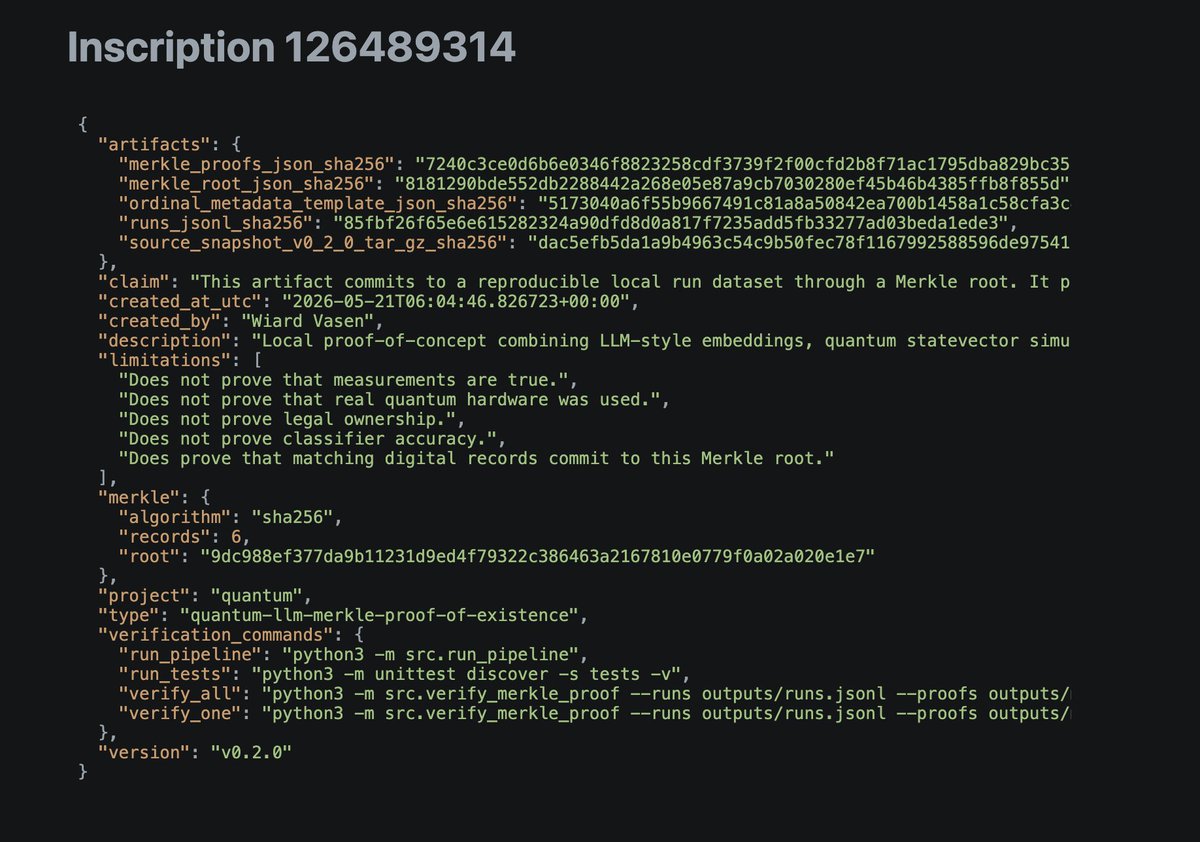
A frozen v0.2.0 quantum/LLM/Merkle research artifact.
It commits to a reproducible local run dataset through a Merkle root.
Artifact SHA-256:
b279749dc65619e385b783af77b8e4063b84aadaa36b783848203f06a996d152
Merkle root:
9dc988ef377da9b11231d9ed4f79322c386463a2167810e0779f0a02a020e1e7
What this proves:
integrity, prior existence, and verifiable linkage between committed digital records and the Merkle root.
What it does not prove:
physical truth, real quantum hardware execution, classifier accuracy, or legal ownership.
This is a small step toward verifiable research logs for AI outputs, quantum simulations, and measurement data.
67
May 21
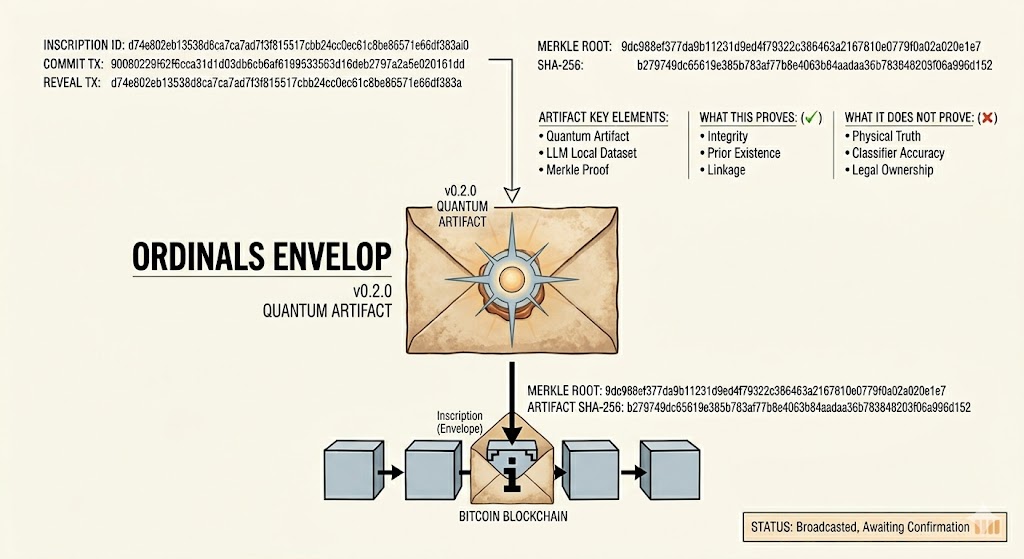
The v0.2.0 quantum/LLM/Merkle artifact is now inscribed on Bitcoin Ordinals.
Inscription ID:
d74e802eb13538d8ca7ca7ad7f3f815517cbb24cc0ec61c8be86571e66df383ai0
Commit tx:
90080229f62f6cca31d1d03db6cb6af6169533563d16deb2797a2a5e020161dd
Reveal tx:
d74e802eb13538d8ca7ca7ad7f3f815517cbb24cc0ec61c8be86571e66df383a
Artifact SHA-256:
b279749dc65619e385b783af77b8e4063b84aadaa36b783848203f06a996d152
Merkle root:
9dc988ef377da9b11231d9ed4f79322c386463a2167810e0779f0a02a020e1e7
The artifact commits to a reproducible local run dataset through a Merkle root.
What this proves:
integrity, prior existence, and verifiable linkage between committed digital records and the Merkle root.
What it does not prove:
physical truth, real quantum hardware execution, classifier accuracy, or legal ownership.
Status:
Confirmed.
46
May 21
This is what I am preparing to inscribe on Ordinals.
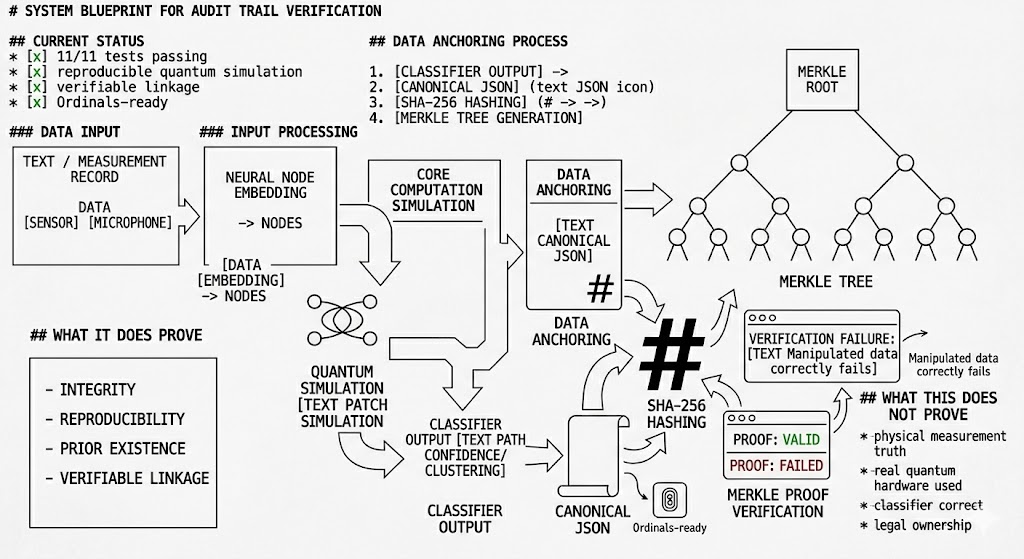
v0.2.0 of my local quantum/LLM/Merkle proof-of-concept is now frozen.
Inscription JSON SHA-256:
b279749dc65619e385b783af77b8e4063b84aadaa36b783848203f06a996d152
Merkle root:
9dc988ef377da9b11231d9ed4f79322c386463a2167810e0779f0a02a020e1e7
File size:
2052 bytes
Next step:
timestamping via OpenTimestamps:
opentimestamps.org/
Then:
Ordinals inscription.
This proves integrity prior existence of committed digital records.
It does not prove physical truth, real quantum hardware execution, classifier accuracy, or legal ownership.
42
May 20
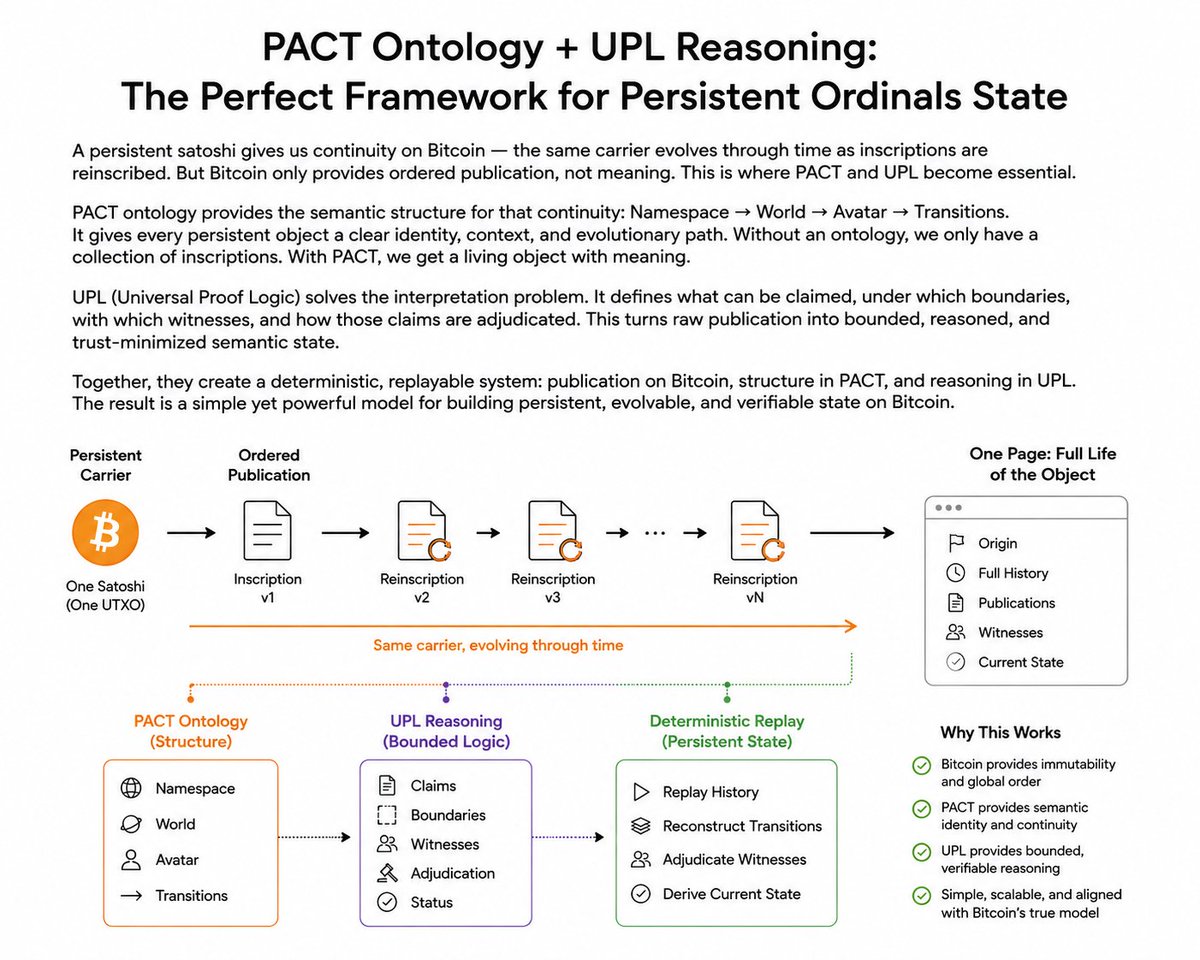
PACT Ontology UPL Reasoning
Bitcoin provides ordered publication, but it does not define semantic state. Standard Ordinals inscriptions therefore behave mostly like isolated artifacts. A persistent satoshi changes this by allowing the same carrier to evolve through time across reinscriptions.
PACT ontology provides the semantic structure for that continuity. Namespace → World → Avatar → Transition gives every persistent object an identity, context, and historical path. Instead of disconnected inscriptions, the system becomes an evolving semantic object reconstructed through replay.
UPL adds a reasoning layer on top of publication. It does not claim universal truth. Instead, it defines what may be claimed, under which boundaries, with which witnesses, and with which adjudication status. This transforms publication into bounded semantic state.
Together, Bitcoin, PACT, and UPL create a deterministic replay system: Bitcoin provides immutable ordered history, PACT provides object continuity, and UPL provides bounded reasoning. The result is a simple but powerful framework for persistent, replayable, and verifiable state on Bitcoin.
116
May 20
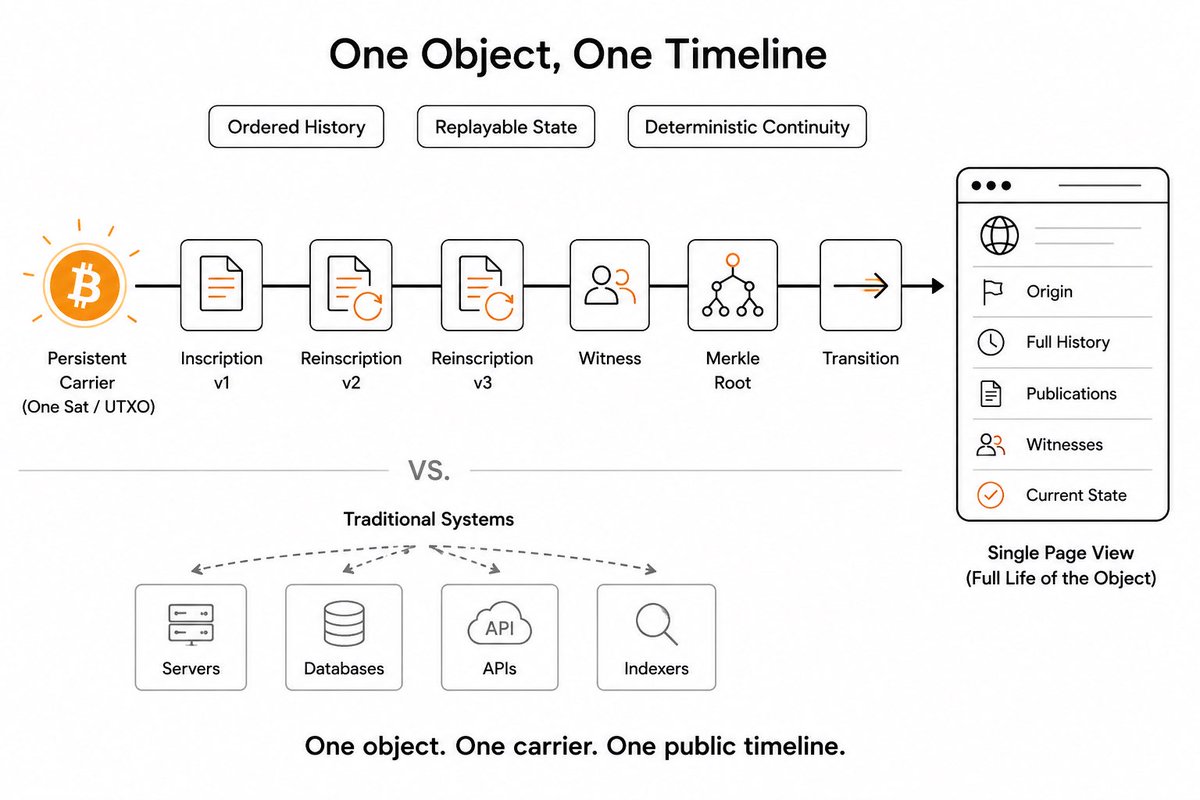
One Object, One Timeline
Most digital systems spread state across servers, databases, APIs, and clients. History becomes fragmented and difficult to reconstruct.
Ordinals is different because Bitcoin provides a globally ordered publication layer. But standard inscriptions are still mostly treated as isolated artifacts.
The persistent-satoshi approach changes this. One satoshi becomes the continuous carrier of the same evolving object. Every reinscription becomes another ordered state transition in its history.
This allows a single page to replay the entire life of the object: origin, transitions, witnesses, publications, and Merkle roots.
Instead of many disconnected systems, you follow one persistent carrier through ordered history. One object, one timeline, one replayable state.
98
May 20
Why Persistence Matters
Bitcoin stores ordered transactions, but not semantic continuity. Standard Ordinals inscriptions therefore behave mostly like isolated publication objects scattered across different UTXOs.
A persistent satoshi changes this. The same carrier continuously holds the evolving inscription history, so every reinscription becomes a deterministic transition of the same object through time.
This makes state reconstructable by replaying ordered history. The sat becomes a persistent publication carrier rather than a random storage location.
Without persistence, you only have separate artifacts. With persistence, you get an evolving publication-state system on Bitcoin.
May 19

From Random Inscriptions to Persistent Publication State
Standard Ordinals tooling treats inscriptions mostly as isolated publication objects. An inscription may appear on different UTXOs without a deterministic state structure, making continuity difficult to reconstruct. Bitcoin itself only stores ordered bytes, transactions, and fees; it does not define semantic state.
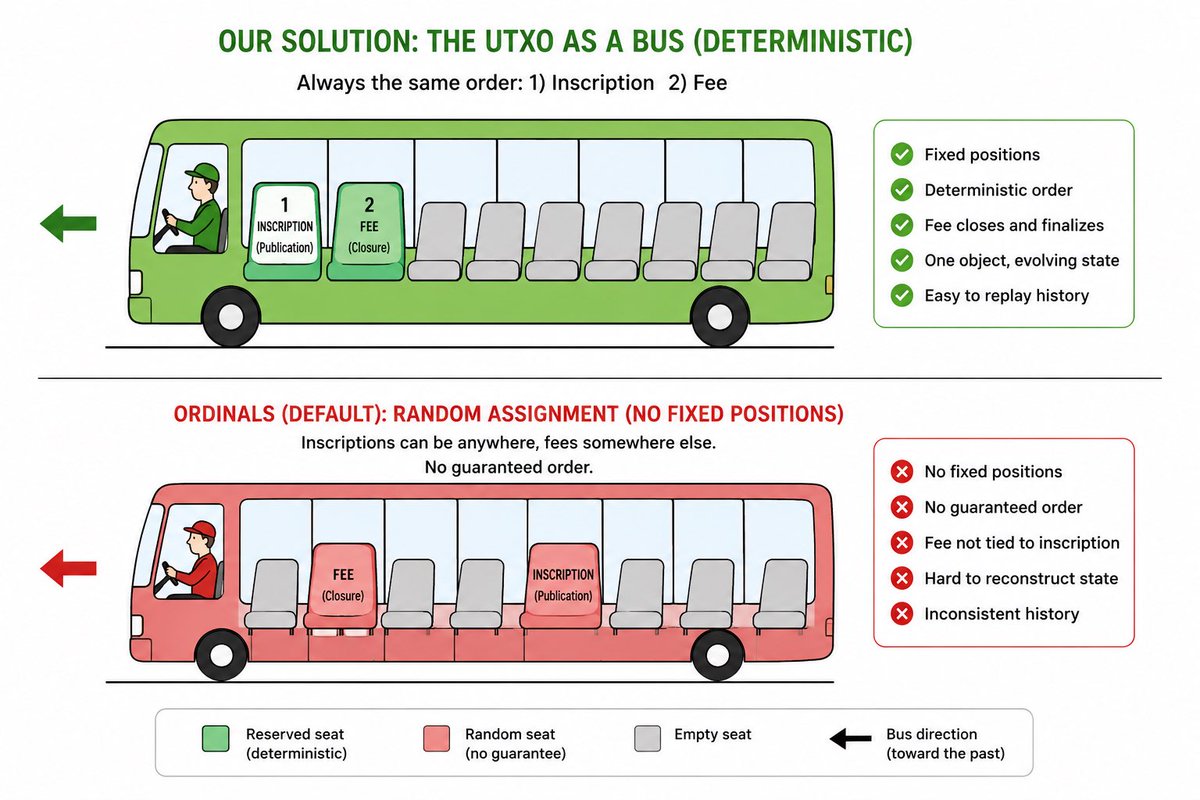
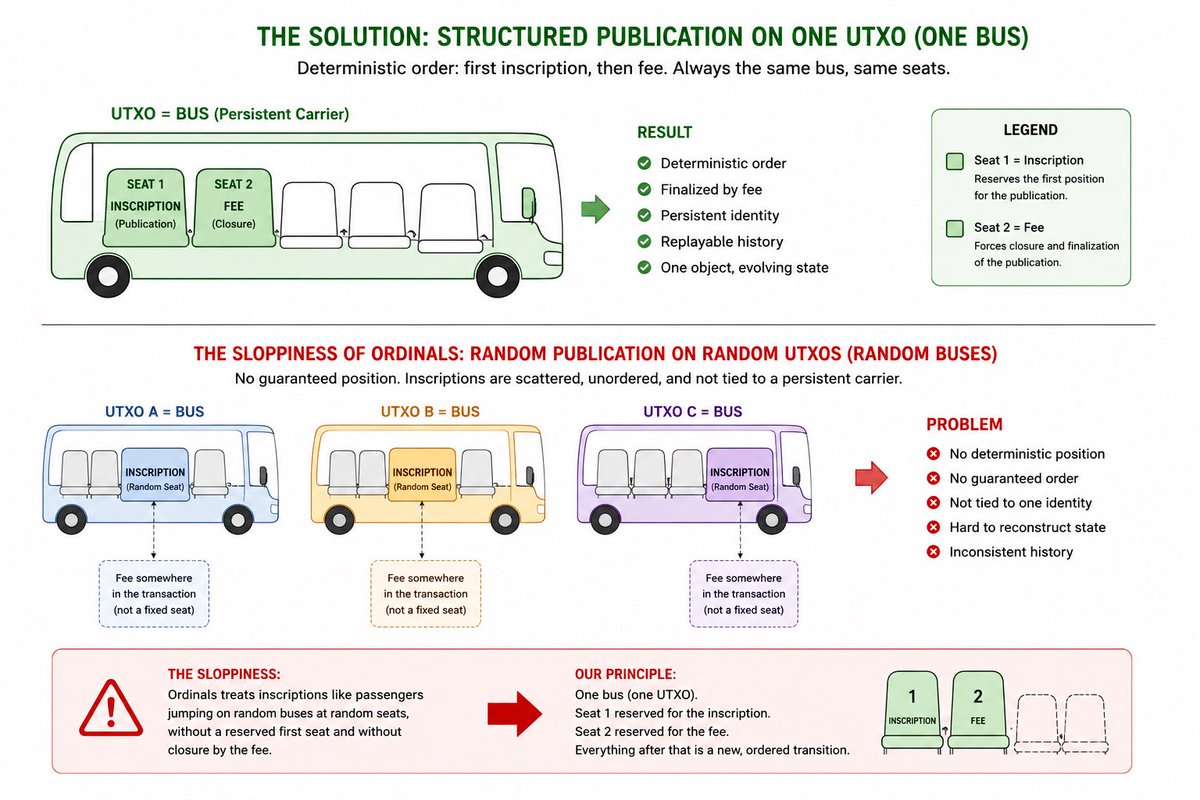
My approach treats a single UTXO or satoshi as a persistent carrier, similar to a bus with reserved seats. The first seat always carries the inscription, while the second seat carries the fee that finalizes the publication event. Every later reinscription becomes an ordered transition of the same evolving object.
The result is a deterministic publication-state system reconstructed by replaying ordered history.
@realizingerin @hellmoneypod @rodarmor
108
May 20
Merkle Trees as Compression for Knowledge Publication
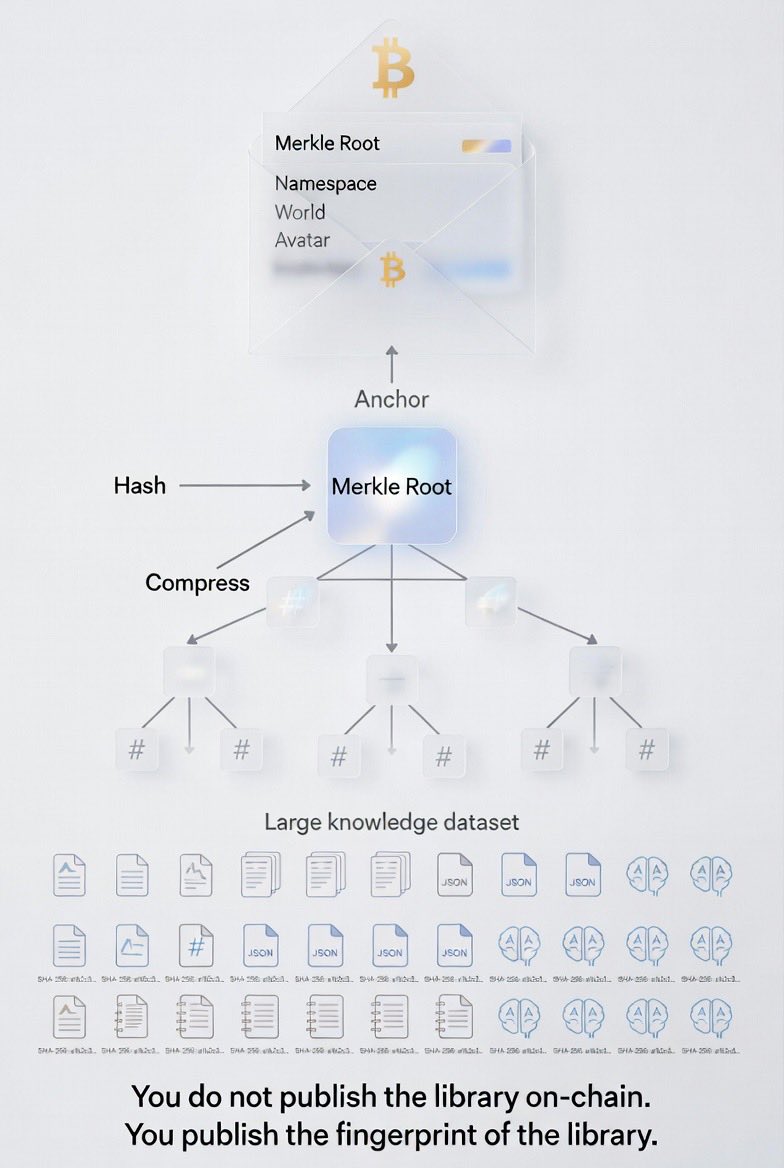
Publishing large amounts of knowledge directly on Bitcoin quickly becomes too expensive. A Merkle tree solves this by allowing thousands or even millions of claims, witnesses, or documents to be compressed into a single cryptographic root. Instead of inscribing all data on-chain, only the final Merkle root needs to be anchored.
Each individual document is first hashed independently. Those hashes are then combined pairwise into higher hashes, forming a tree structure. At the very top sits a single value: the Merkle root. This root acts as a compact fingerprint representing the integrity of the entire dataset.
Inside a PACT or Ordinals envelope, the inscription does not need to contain every claim. It only needs to contain the Merkle root, metadata, boundaries, and provenance references. The detailed files, witnesses, or educational content can remain off-chain while still being cryptographically tied to the publication.
Later, any individual item can be proven to belong to the original dataset through a Merkle proof. A verifier only needs the item hash and the path of intermediate hashes leading back to the published root. If the reconstructed root matches the anchored root, inclusion is verified.
This changes the economics of publication completely. Bitcoin becomes the immutable publication layer, while Merkle trees become the compression layer for large-scale knowledge systems. You do not publish the entire library on-chain. You publish the fingerprint of the library.
1
30
May 20
From Quantum State to Ordinal Knowledge State
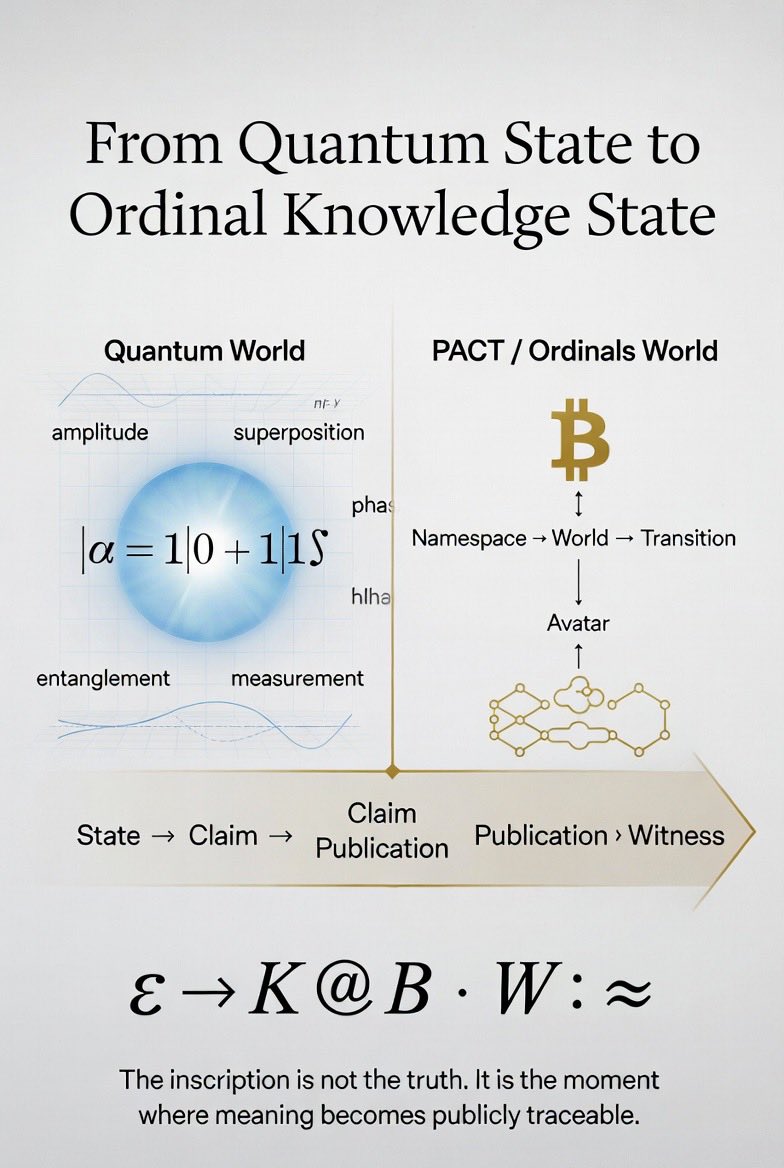
Quantum mechanics describes a quantum state as a vector inside a Hilbert space. A qubit is not simply 0 or 1, but a superposition represented by amplitudes, phase, probability, and structure. The mathematics of Hilbert spaces makes interference, entanglement, and measurement possible. In this view, a quantum state is a structured possibility-space rather than a fixed classical object.
PACT and Ordinals introduce a surprisingly similar idea for knowledge itself. A published statement is not automatically “truth.” Instead, it becomes a bounded claim carried by an Ordinals envelope. The structure Namespace → World → Avatar → Transition turns publication into a formally traceable state transition.
Bitcoin does not prove that a scientific or educational claim is correct. What it proves is that a specific Avatar published a specific claim, at a specific moment, under a specific boundary, with a verifiable content hash. Interpretation comes after publication, not before it.
This creates a new perspective: a quantum state exists inside Hilbert space, while a knowledge state exists inside provenance space. One describes physical possibility. The other describes publicly witnessed meaning. Ordinals become the carrier that transforms thought into a traceable historical event.
26
May 19
Persistent Satoshi Inscriptions: From Static Objects to Living Publication Histories
A persistent satoshi inscription transforms a Bitcoin sat from a single publication object into a long-lived carrier of ordered history. Instead of treating every inscription as an isolated artifact, multiple reinscriptions on the same satoshi can be interpreted as sequential transitions of one evolving object.
This creates entirely new possibilities. A single satoshi can function as a persistent identity, a scientific logbook, an AI-agent memory chain, a governance object, a legal agreement history, or an educational portfolio. Every update becomes part of the same replayable publication lineage.
The key innovation is that the current state is not stored directly on Bitcoin. Bitcoin only stores ordered bytes, transactions, and fees. The state emerges by deterministically replaying the ordered reinscriptions associated with the same sat-key lineage.
This enables a new class of digital systems:
persistent scientific instruments with calibration histories,
evolving AI identities with auditable outputs,
journalism objects with corrections and source provenance,
contracts with public amendment chains,
and autonomous agents with replayable decision histories.
The result is a shift from isolated inscriptions toward persistent publication objects. Bitcoin provides permanence and ordering; inscriptions provide publication events; deterministic replay reconstructs continuity and state over time.
1
34
May 19
The Namespace–World–Avatar–Transition Architecture
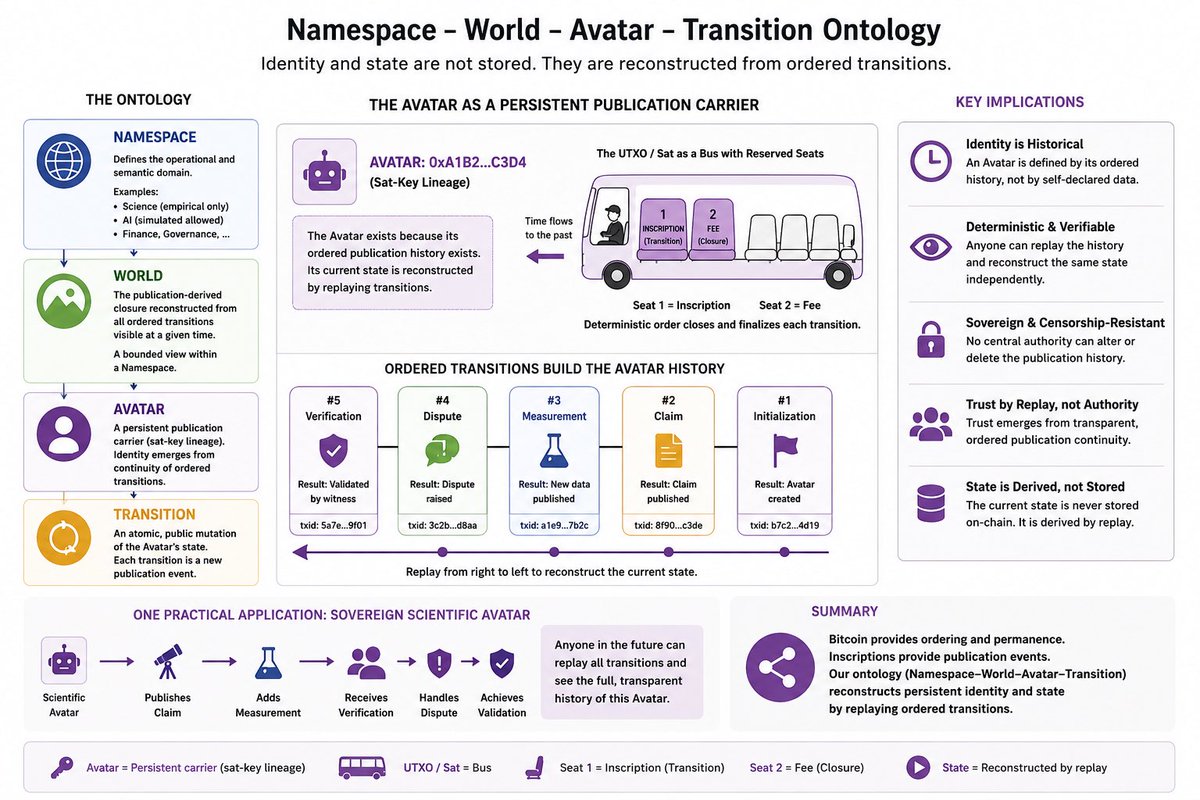
Within the Namespace–World–Avatar–Transition ontology, the Avatar becomes far more than a user identifier or account. The Avatar is a persistent publication carrier reconstructed from the ordered history of a specific sat-key lineage. Its identity does not emerge from a centralized registry or mutable profile database, but from continuity across ordered transitions. The Avatar exists because its publication history exists.
In this ontology, the Namespace defines the operational and semantic domain in which the Avatar may act. A scientific namespace, for example, may require empirical witnesses and calibration history, while an AI namespace may explicitly allow simulated evidence. The World is not “reality itself,” but the publication-derived closure reconstructed from all ordered transitions visible at a given time. The Avatar therefore lives inside a bounded World, not outside it.
Every Transition mutates the public state of the Avatar. A claim publication, witness attachment, dispute, verification event, or status change becomes a new transition in the ordered history. The current state of the Avatar is never stored directly inside Bitcoin. It is derived deterministically by replaying the transitions associated with that Avatar’s sat-key lineage.
This has an important implication: identity becomes historical rather than declarative. An Avatar is not defined by what it says about itself, but by the ordered sequence of publicly committed transitions that others can independently replay and inspect. Trust shifts away from static credentials toward replayable publication continuity.
As one practical application, the Avatar becomes a sovereign scientific or computational entity. A laboratory, AI agent, journalist, or measurement device can publish transitions under its own persistent lineage. Future readers do not need to trust the issuer blindly; they reconstruct the Avatar’s history, boundaries, evidence chains, and status transitions directly from the ordered publication substrate.
24
May 19
From Random Inscriptions to Persistent Publication State
Standard Ordinals tooling treats inscriptions mostly as isolated publication objects. An inscription may appear on different UTXOs without a deterministic state structure, making continuity difficult to reconstruct. Bitcoin itself only stores ordered bytes, transactions, and fees; it does not define semantic state.
My approach treats a single UTXO or satoshi as a persistent carrier, similar to a bus with reserved seats. The first seat always carries the inscription, while the second seat carries the fee that finalizes the publication event. Every later reinscription becomes an ordered transition of the same evolving object.
The result is a deterministic publication-state system reconstructed by replaying ordered history.
@realizingerin @hellmoneypod @rodarmor
205
May 19
From Isolated Inscriptions to Persistent Publication State
Standard Ordinals tooling introduced an important publication primitive: the ability to write addressable data directly into Bitcoin’s ordered witness space. This is a powerful foundation for permanent digital publication.
However, the standard Ordinals model is primarily asset-centric. It is well suited for individual inscriptions, collectibles, files, and references, but it does not by itself define a persistent state model in which multiple inscriptions on the same satoshi are interpreted as ordered transitions of one continuing object.
Our approach builds on the publication primitive, but adds a separate reconstruction layer. A satoshi or UTXO is treated as a persistent carrier. The first inscription establishes the object; later inscriptions are interpreted as transitions in its history. The current state is not stored directly in Bitcoin. It is reconstructed deterministically by replaying the ordered publication history.
The key idea can be described with a bus metaphor: the UTXO is the bus. The first reserved seat carries the inscription. The next reserved seat carries the fee that closes and finalizes the publication event. Because the positions are deliberate rather than random, the resulting history becomes replayable and tied to one persistent carrier.
So the contribution is not a rejection of Ordinals, but an extension of its use: from isolated addressable inscriptions toward persistent publication-state reconstruction. Bitcoin provides ordering and permanence; inscriptions provide publication events; the custom reader reconstructs continuity and state.
@rodarmor @realizingerin @hellmoneypod
32
May 17
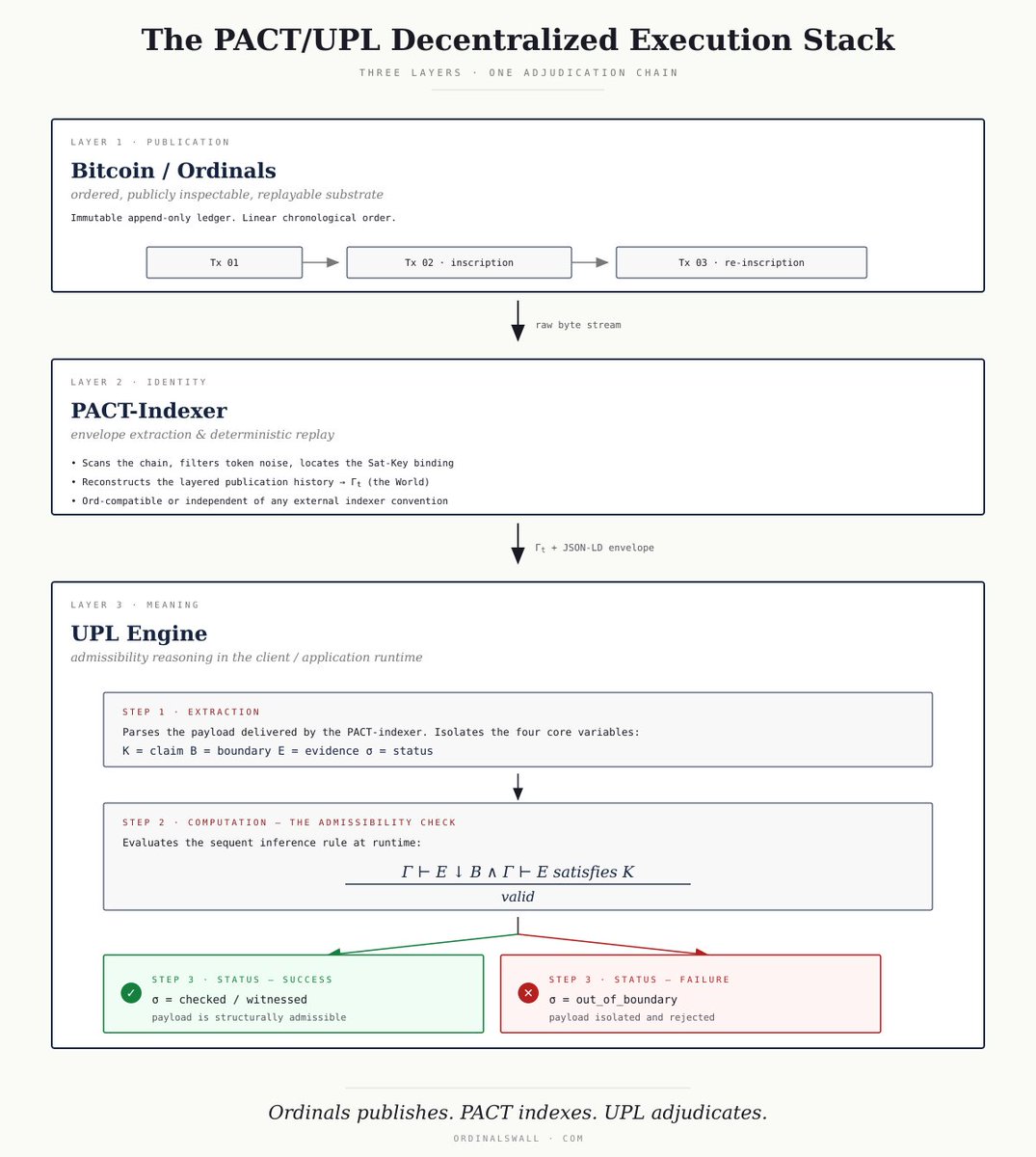
The PACT/UPL execution stack. Three layers, three jobs, no overlap.
LAYER 1 · Bitcoin/Ordinals
Stores ordered bytes. Doesn't interpret them.
LAYER 2 · PACT-Indexer
Extracts inscription envelopes, binds them to their sat-key carrier, reconstructs the avatar's history by deterministic replay → Γ_t.
LAYER 3 · UPL Engine
Runs in the client. Adjudicates whether a claim is admissible under a stated boundary.
The key move: re-inscription.
Standard Ordinals: one sat, one frozen artifact.
PACT: re-inscription becomes the state-mutation primitive.
One sat = one avatar with an append-only inscription history, reconstructable by any reader from the public chain.
It's the only path that keeps continuous identity bound to a single Bitcoin object without leaving the chain. Off-chain state breaks publication. Smart contracts break Bitcoin-native simplicity. New sats per state break identity. Re-inscription breaks nothing.
How does UPL read?
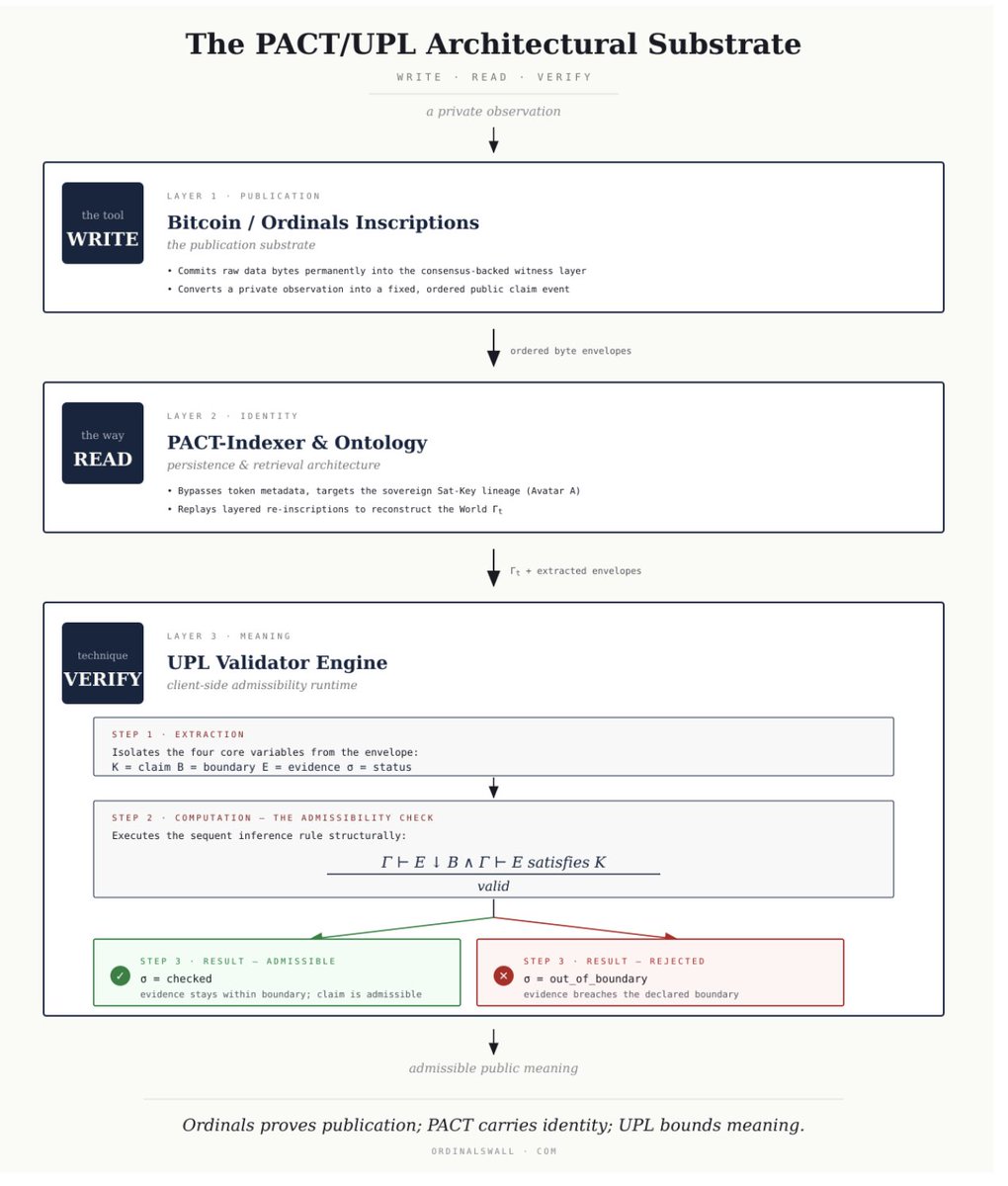
UPL never touches raw Bitcoin. The PACT-Indexer parses envelopes and reconstructs Γ_t. UPL receives the structured K (claim), B (boundary), E (evidence), σ (status) and applies
the inference rule:
Γ ⊢ E ↓ B ∧ Γ ⊢ E satisfies K → valid
The parser sits inside the indexer. UPL sits on top. Different clients can apply different policies to the same indexer output.
Ordinals publishes. PACT indexes. UPL adjudicates.
#Bitcoin #Ordinals #PACT #UPL #Provenance
45
May 17
The PACT/UPL execution stack. Three layers, three jobs, no overlap.
LAYER 1 · Bitcoin/Ordinals
Stores ordered bytes. Doesn't interpret them.
LAYER 2 · PACT-Indexer
Extracts inscription envelopes, binds them to their sat-key carrier, reconstructs the avatar's history by deterministic replay → Γ_t.
LAYER 3 · UPL Engine
Runs in the client. Adjudicates whether a claim is admissible under a stated boundary.
The key move: re-inscription.
Standard Ordinals: one sat, one frozen artifact.
PACT: re-inscription becomes the state-mutation primitive.
One sat = one avatar with an append-only inscription history, reconstructable by any reader from the public chain.
It's the only path that keeps continuous identity bound to a single Bitcoin object without leaving the chain. Off-chain state breaks publication. Smart contracts break Bitcoin-native simplicity. New sats per state break identity. Re-inscription breaks nothing.
How does UPL read?
UPL never touches raw Bitcoin. The PACT-Indexer parses envelopes and reconstructs Γ_t. UPL receives the structured K (claim), B (boundary), E (evidence), σ (status) and applies the inference rule:
Γ ⊢ E ↓ B ∧ Γ ⊢ E satisfies K → valid
The parser sits inside the indexer. UPL sits on top. Different clients can apply different policies to the same indexer output.
Ordinals publishes. PACT indexes. UPL adjudicates.
#Bitcoin #Ordinals #PACT #UPL #Provenance
42
May 17
Ordinals proved. Why it could become usefull.
game.ordinalswall.com/
Casey is not too precise with his inscriptions. To re-inscribe on a sat for a second time you need some serious hacks.
Once this problem is solved, Ordinals can be used as a central wall sitting between endless bitcoin core nodes confirming and witnessing real events, all on a eventlog base. Which makes memory a major feature on Ordinals.
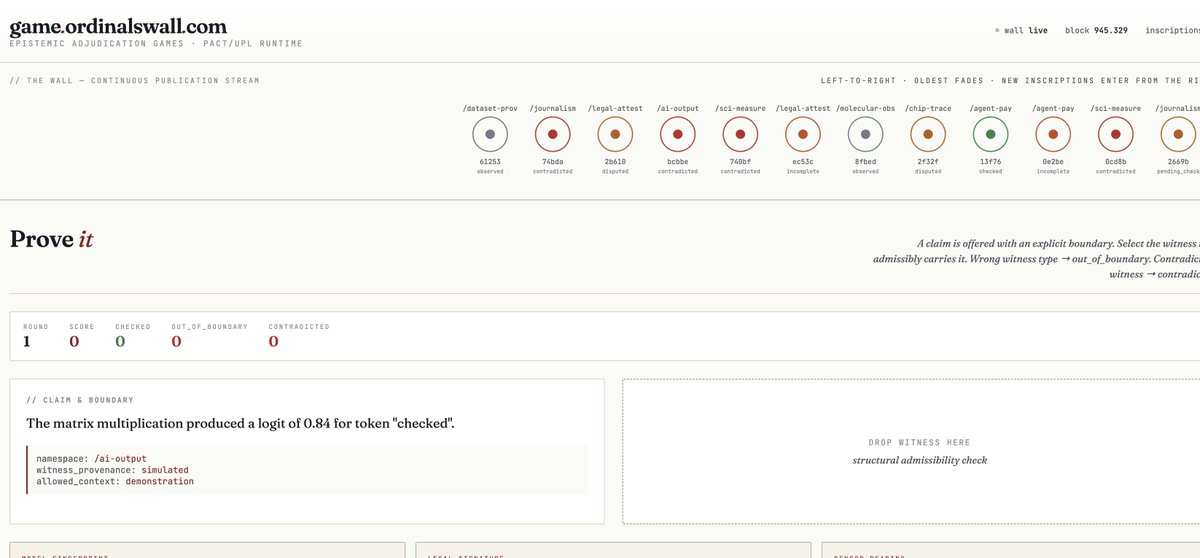
This page is a small playable PACT/UPL demonstration. At the top, a simulated wall of inscriptions moves continuously; below it, you can switch between four mini-games that all teach the same point: a claim is not simply true or false on its own, but must be judged within a declared boundary and with the right kind of witness.
What you are seeing in the screenshot is game 01 PROVE IT. On the left, there is a claim and its boundary; on the right, there is a drop zone. The goal is to choose a witness card that admissibly carries the claim. If the witness fits, the claim is marked checked; if the witness falls outside the boundary, it becomes out_of_boundary; if it contradicts the claim, it becomes contradicted. The scoreboard tracks these outcomes round by round. So this is not just a game page; it is an interactive explanation of epistemic adjudication in PACT/UPL form.
PACT/UPL is a bounded provenance framework. PACT defines the publication carrier: world, namespace, avatar, and transition. UPL defines how claims are judged within declared boundaries, using explicit evidence and statuses such as checked, incomplete, or contradicted. Together, they separate publication from admissibility, so records remain traceable, context-bound, and mechanically reviewable across substrates like Bitcoin inscriptions or event logs for agents.
@blockamoto @rodarmor @hellmoneypod
1
38
May 17
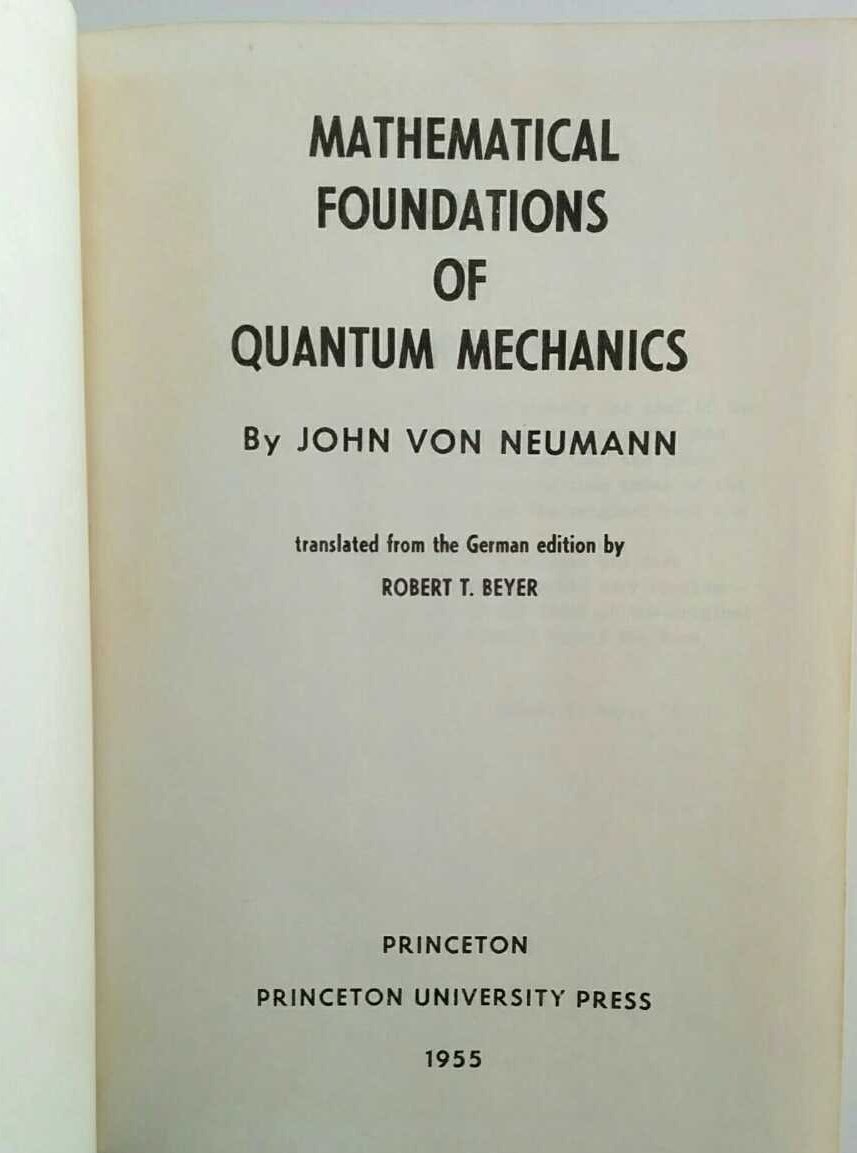
The book
25 Sep 2024

'Mathematical Foundations of Quantum Mechanics' - John Von Neumann (1955, PDF):
ia600101.us.archive.org/11/i…
1
40