
Professor of Finance, co-director of Ctr for Fin. Tech., Imperial Business School; visiting scholar, Harvard Uni; research director, CNRS; research fellow, CEPR
Joined March 2012
- Tweets 383
- Following 289
- Followers 140
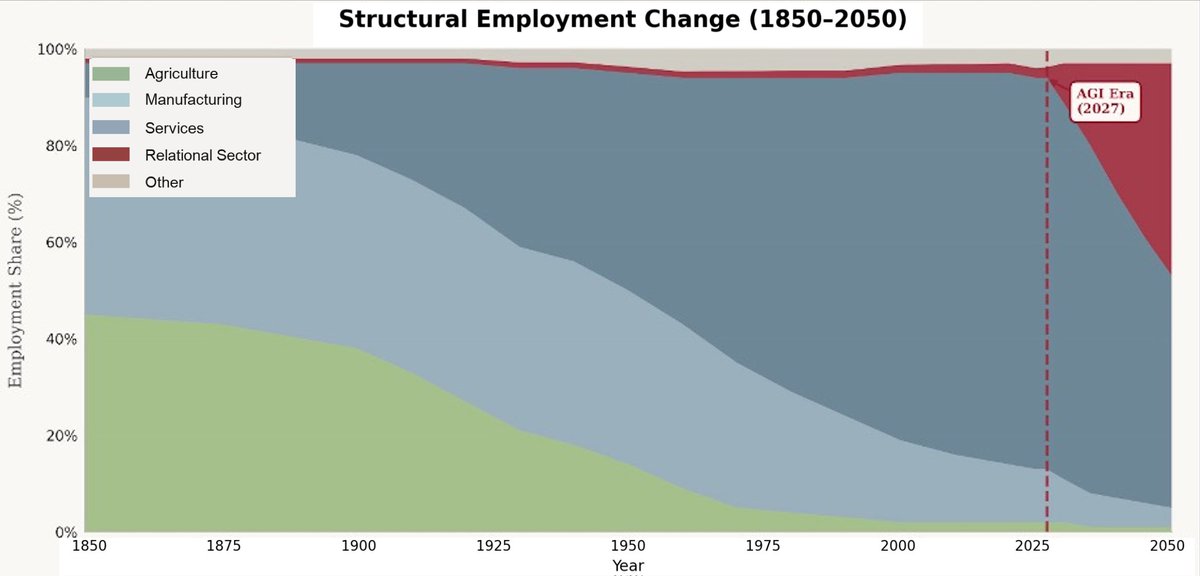
- Likes 171
13 Photos and videos







Prof Gilles Chemla retweeted

Quel que soit le parti pour lequel vous voterez en 2027, si vous voulez offrir un avenir aux entreprises tech en France et en Europe, écoutez le fondateur de Mistral ou Total Énergies et non des politiciens en seul quête de pouvoir.
Ne tuons pas l'UE, faisons-la accélérer ! 🇪🇺🚀
45
254
1,129
44,235

Apr 22
This book addresses all these questions in depth by combining academic and practitioner perspectives. 3/3
#privateequity #healthcare #healthcarefinance #corporatefinance #healthpolicy
amazon.com/Private-Equity-He…
51
Apr 22
Does PE create value? How? How do AI and tokenization transform PE? As public invstment dries out and large firms buy PE-backed innovation and sell poorly performing business lines to PE, what is the impact of PE on patients and other stakeholders? 2/3
amazon.com/Private-Equity-He…
38
Apr 22
Private equity already manages 5 to 10% of global corporate equity and keeps rising. Nearly all new large innovative firms are funded with PE. Healthcare is one of the most heavily impacted sectors. #privateequity #healthcare #healthcarefinance
1/2
amazon.com/Private-Equity-He…
36
Prof Gilles Chemla retweeted

Apr 15
This 2 hour Stanford lecture will teach you more about how LLMs like ChatGPT & Claude are built than most people working at top AI companies learn in their entire careers.
Bookmark this & give 2 hours today, no matter what. It'll be the most productive thing you do this week.
143
3,305
19,319
2,280,689
Prof Gilles Chemla retweeted

Apr 14
New essay on the economics of structural change and the post-commodity future of work.
1. Almost any question about the impact of advanced AI on the economy needs to start at the same place: what is still scarce? Answer that, and the analysis becomes pretty straightforward. This essay explores what becomes scarce if AI really can replicate most of what humans do in production, and what this mean for the future of jobs.
2. My conjecture, working through the economics: labor reallocates across sectors, and the sector it reallocates to has properties that keep labor a meaningful share of the economy. Ultimately this is about the structure of demand itself. For this, we have to go back to Girard, Augustine and Rousseau: once people's base needs are met, their preferences shift to comparative motives (e.g., status, exclusivity, social desirability). This motive is inherently non-satiated.
4. The key paper is Comin, Lashkari, and Mestieri (Econometrica 2021). As people get richer, they don't buy proportionally more of everything. They shift spending toward sectors with higher income elasticity. They estimate income effects account for 75% of observed structural change.
5. The ironic consequence: the sector that gets automated becomes a smaller share of the economy, not a larger one. Agriculture got massively more productive and its share of employment collapsed. Manufacturing too. The "stagnant" sectors absorb the spending and the jobs.
6. So the question is: which sectors have high income elasticity in a post-AGI world? I argue it's what I call the relational sector. Categories where the human isn't just an input into production, it is part of the value.
7. Why does the relational sector have high income elasticity? Because human desire has a mimetic, relational dimension. We don't just want things for their intrinsic properties. We want what others want, and we want it more when others can't have it. Girard, Rousseau, Augustine, and Hobbes all saw this.
8. In work with Kristóf Madarász, we showed this experimentally: WTP roughly doubles when a random subset of others is excluded from the good. And in new work with Graelin Mandel, AI involvement kills the premium. Human-made art gains 44% from exclusivity; AI-made art only 21%.
9. This all comes together for the core argument. The sector that absorbs spending as AI makes commodity production cheap is one where human provenance is part of the value, and demand for it grows faster than income. Exactly the profile that keeps labor meaningful.
10. To be clear about the claim: I'm NOT saying aggregate labor share must rise. It may fall. The claim is about sectoral composition, i.e., where expenditure and employment go once commodities get cheap, and the fact that the sector that will absorb reallocated labor maps to a substantial component of human preferences and desire.
11. If you're interested in the formal model, a linked companion technical note works out all the economics.
Read the essay here: aleximas.substack.com/p/what…
162
499
2,713
976,517
Prof Gilles Chemla retweeted

This looks like a must-read!
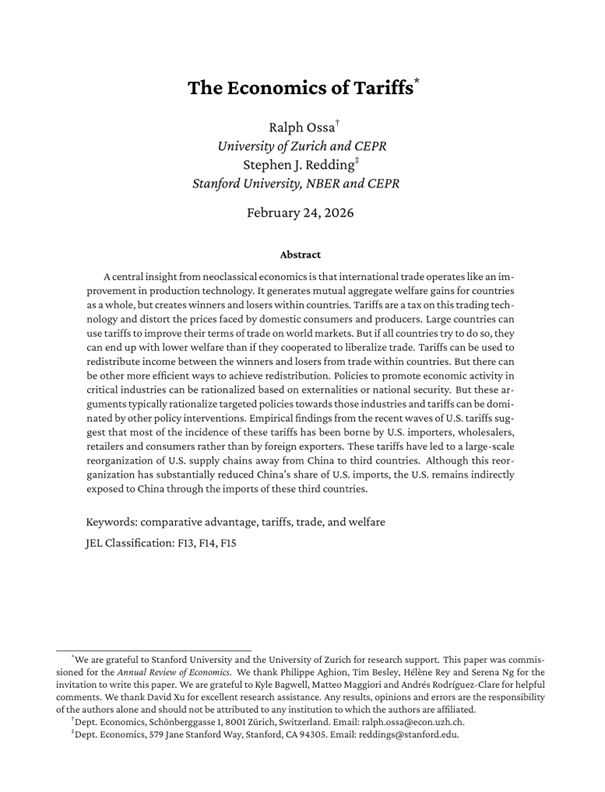
"The Economics of Tariffs" by Ralph Ossa and Stephen J. Redding.
"A central insight from neoclassical economics is that international trade operates like an improvement in production technology. It generates mutual aggregate welfare gains for countries as a whole, but creates winners and losers within countries. Tariffs are a tax on this trading technology and distort the prices faced by domestic consumers and producers. Large countries can use tariffs to improve their terms of trade on world markets. But if all countries try to do so, they can end up with lower welfare than if they cooperated to liberalize trade. ...Empirical findings from the recent waves of U.S. tariffs suggest that most of the incidence of these tariffs has been borne by U.S. importers, wholesalers, retailers and consumers rather than by foreign exporters. These tariffs have led to a large-scale reorganization of U.S. supply chains away from China to third countries. Although this reorganization has substantially reduced China’s share of U.S. imports, the U.S. remains indirectly exposed to China through the imports of these third countries."
econ.uzh.ch/dam/jcr:8e21c947…
5
77
380
28,917
Prof Gilles Chemla retweeted

Feb 14
Between 1974 and 2014, only 0.1% of publications in the top 50 economics journals were replication studies.
That's 40 years. Thousands of papers. Almost none replicated.
We've built careers on findings no one has verified.
When economists finally replicate studies, 40-67% fail depending on the study.
Federal Reserve (2015): Only 49% of 67 papers from top journals successfully replicated — even with the original authors' help.
Most papers? Never checked at all.
Here's the worst part: Papers that don't replicate get cited MORE than papers that do.
And after a failed replication is published, only 12% of subsequent citations mention it.
The profession rewards interesting findings, not true ones.
Remember Reinhart-Rogoff (2010)? "Debt above 90% GDP kills growth."
Herndon, Ash & Pollin found a spreadsheet error. Results didn't hold. But by then, it had shaped austerity policy across Europe and the US.
How many other canonical papers have Excel errors?
We replicate recent papers, but canonical findings from the 1970s-90s? Nobody touches them. Too famous. Too foundational.
The older the paper, the less scrutiny it gets. Yet these are the studies we cite most.
Maybe we should replicate backwards.
Start with the most-cited papers from 1975-2000. See what holds up.
federalreserve.gov/econres/f…
80
723
2,461
250,558
Jan 27
Donc ras le bol en plus tres peu de trains tres chers donc on prend la voiture vive les trajets responsables. Les tgv Paris-Lille sont plus confortables coutent souvent moins chers et durent 1h distance equivalente@udupc14 @train_nomad @SNCFVoyageurs #SNCF 3/3
83
Jan 27
A 56€ on est ballottes, sac entre vos jambes, des valises nous tombent dessus et peut etre un changement. Si Caen Cherbourg en car le trajet annonce 4h14 dure 6 heures. Pour remboursement il faut passer par la sncf pas de reponse. @udupc14 @train_nomad @SNCFVoyageurs #SNCF 2/3
1
63
Jan 27
Il y a 10 ans Paris-Cherbourg direct de 3h Prems: €20 a toute heure. On rangeait son sac au dessus du siege, de la place pour toutes les valises, bp de places handicap. Aujh meme quand le caen-cherbourg est en car (surprise)... 56€ @udupc14 @train_nomad @SNCFVoyageurs #SNCF
1
71

#AI Adoption, Incentives, and Firm Value in General Equilibrium
The authors study how AI adoption reshapes incentive contracts, employment relationships, and firm values.
Authors: Gilles Chemla, Vincent Tena
Read More: spkl.io/6012Am386
#AI

ALT A close up of a person using a cell phone with AI applications on the screen and a green plant in the background.
1
1
278
Prof Gilles Chemla retweeted

Over the years, I have actively participated in the economic policy debate in Spanish and written a fair amount on the topic (including many papers and several books!). Some of these issues go beyond purely local interest and are relevant, with only minor changes, for other countries in Western Europe and Latin America.
I have always wanted to translate some of this work into English (if only to reach a wider audience), but until recently the cost was prohibitive. Thanks to AI, that cost has now fallen by roughly two orders of magnitude.
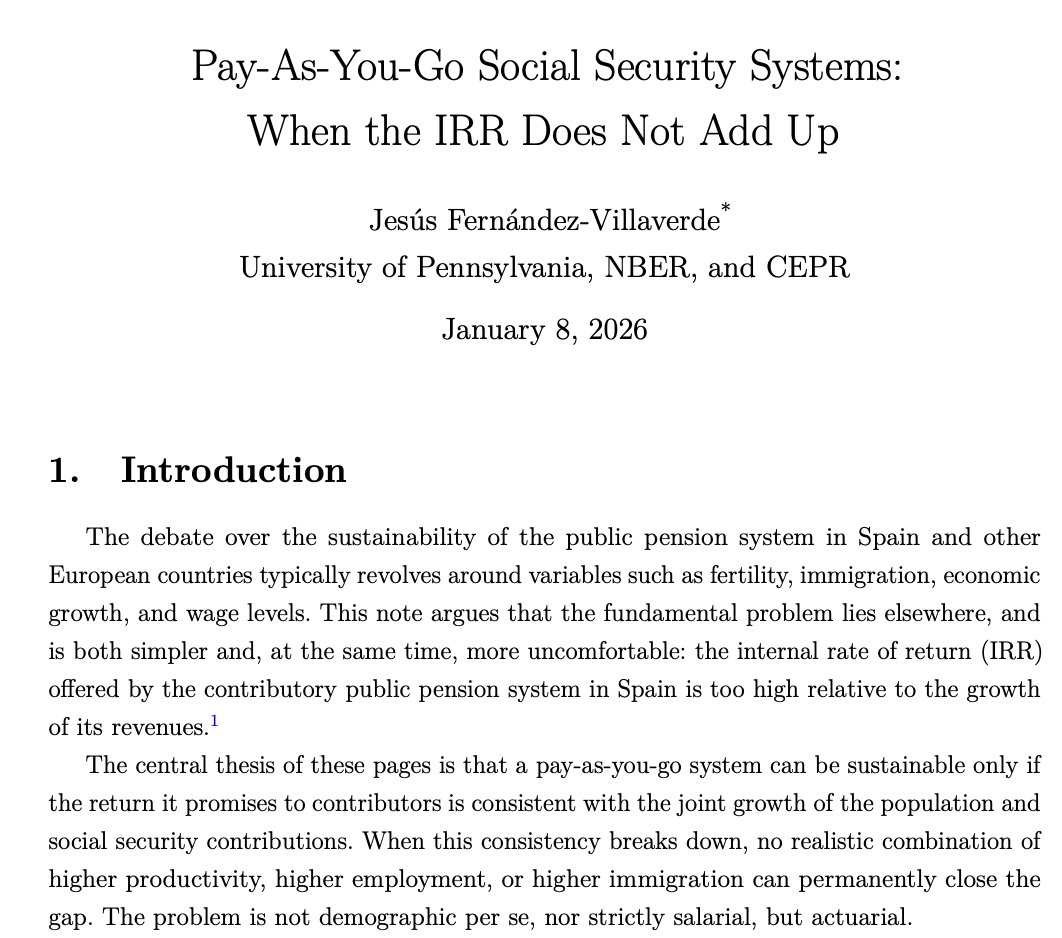
Yesterday, I circulated a short policy paper I wrote over the Winter Break in Spanish arguing that it is far more useful to think about the sustainability of pay-as-you-go social security systems in terms of their internal rate of return (IRR) than to focus on cash flows, as much of the debate tends to do.
The paper went viral, and several non-Spanish economists expressed interest.
This morning, I translated it into English with the help of AI and made some light adaptations. I did not spend a great deal of time polishing every detail, but I think it is still well worth reading:
sas.upenn.edu/~jesusfv/Pensi…
The punchline will not be new to anyone who has read Samuelson’s (1958) classic paper, but it bears repeating. The key to the sustainability of a pay-as-you-go social security system is that the IRR received by participants must equal the growth rate of the system’s revenues. Once you think in these terms, almost everything else becomes secondary. Lower fertility simply implies a lower growth rate of revenues.
Along the same lines, higher wages do not necessarily help the system if the IRR is already too high. In fact, they can make things worse, because an excessive IRR is then paid over a larger base. Somewhat surprisingly, when I explained this point to several excellent economists, many told me they had never thought about it this way.
What actually helps a pay-as-you-go system is faster wage growth, because it raises the growth rate of revenues. It is all about the derivative, not the level.
The effects of immigration are also much more nuanced than is often assumed. If the IRR is too high, bringing in additional immigrants may worsen the system’s present discounted balance, even if it improves the current cash-flow position.
As always, comments are welcome. I may write something longer in the future, and I would welcome any suggestions.
P.S. I write differently in Spanish than in English. Do not be surprised if the paper reads somewhat differently from my work originally written in English. Personally, I think I write much better in Spanish, but that style does not always translate cleanly.
10
53
310
84,583
Prof Gilles Chemla retweeted

Jan 1
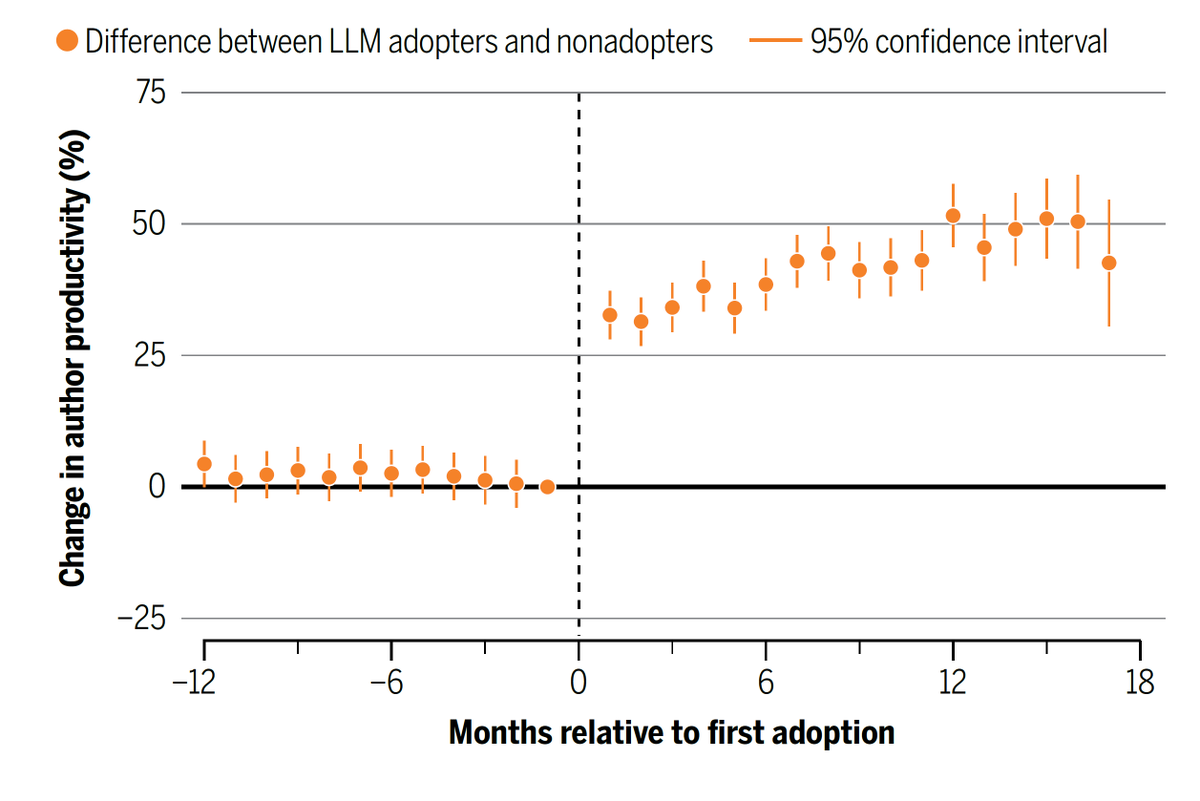
Scientists Who Use AI Become Stunningly More Productive
In a new paper that just appeared, the authors found that researchers who use large language models (LLMs) become stunningly more productive. An analysis of more than 2 million papers revealed that those who adopt AI increase their paper output on average by 40%. For non-native English speakers it’s even more, up to 80%.
The scary part is that this is data only until July 2024, when scientists used LLMs mostly for writing. It is foreseeable that in the next few years the AI-adoption rate will go to nearly 100% across all scientific disciplines, resulting in more papers than ever and putting significant strain on peer review.
Source: Kusumegi et al, Science 390, 6779, 1240 (2025)
346
352
1,876
398,886
2 Jul 2025
Billet flexible achete pour cet apres midi. J avais des rdv importants le matin. Cette nuit message sans bonjour ni excuses. Plus de flexibilite. Pas de remboursement alors que je "dois" changer pour un billet pas flexible contre mon gre..
.. #adurn @sncfvoyageurs @train_nomad
1
108
16 Nov 2024
#NeverGiveUp Huge congrats to BBC special correspondent @lucymanning for her two year long fight. We all need to fight for a cause dear to our heart and improve our society.
16 Nov 2024

So I’ve never written a story about myself. But I broke the rule to show how, despite warm words about change, police still fail women reporting sexually motivated crimes. Here’s my story of the 2 yr battle to get my offender convicted. TLDR: Don’t give up bbc.co.uk/news/articles/cvgw…
1
145
Prof Gilles Chemla retweeted

Our upcoming #CPD programme includes speakers from @Arup @JacobsConnects @HS2ltd @MottMacDonald @Laing_ORourke. Join us to learn from major programmes around the world and set the direction of future research.
Early bird registration closes 5 August: imperial.ac.uk/continuing-pr…

3
1
357
3 Aug 2024
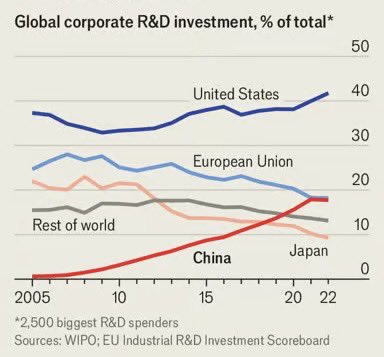
One could have hoped that #candidates in #EU #elections would have put their proposed policies to overturn the decline of the European Union in global #R&D #Investment at the core of their campaign...

1
369
18 Jul 2024
17 Jul 2024

🇮🇱🇵🇸 Le pire cauchemar des mouvements de boycott hier soir dans America’s Got Talent: Un chœur de jeunes composé d’Israéliens et de Palestiniens interprètent « Home » de Phillip Phillips qui a visiblement ému les quatre juges.
Se décrivant après leur représentation, l’un des membres palestiniens du Chœur des jeunes de Jérusalem dit qu’ils forment « un groupe de Palestiniens et d’Israéliens ». Nous croyons qu’à travers la musique, en travaillant ensemble et en nous parlant, nous faisons un pas en avant vers la construction de cet avenir incroyable où règnent la justice, la liberté, l’égalité et l’inclusion.
1
97
9 Jul 2024
Les manquements au pluralisme sont criants sur tous les medias Bollore et l aggressivite du pdg de Canal ("je ne sais pas ou vous etiez pendant les 30 dernieres minites") en dit long sur son sentiment d impunite. L #ARCOM finira t elle par sevir vraiment?
9 Jul 2024

Maxime Saada, Franck Appietto et Gérald Brice-Viret se font littéralement crucifier par l'ARCOM lors de l'audition de C8 concernant l'apparition subite et très opportune d'une mesure de différé pour #TPMP après des années de sanction
5
1
156