
CEO @abundanceinst. Meghan's husband. Henry, Danny, Caroline, Jude, Anna, Rose, and Grace’s dad.
Joined April 2009
- Tweets 5,031
- Following 937
- Followers 2,851
- Likes 2,550
Photos and videos
Pinned Tweet

6 Jan 2025
🧵 The NRC has been operating an illegal nuclear blockade for 50 years and a recent lawsuit might finally bring it to an end. Buckle up...
13
48
365
57,027
Christopher Koopman retweeted

Jun 12
We're gonna abundance so much, you may even get tired of abundance. And you'll say, please, please, it's too much abundance. We can't take it anymore. Mr. Musk, it's too much, and I will say no it isn't, we have to keep abundance, we have to abundance more, we're gonna abundance more!
Jun 12

odd I don’t see any of the “abundance democrats” posting about the combined spaceflight / satellite constellation and telecommunications / AI company today, which is experiencing the largest IPO in human history — I would have thought they’d be excited!
217
424
5,575
302,226
Christopher Koopman retweeted

From what I know right now, I think this Fable export control decision is the worst federal AI policy decision in history.
I hope it stays the worst.
7
17
193
15,375
Christopher Koopman retweeted

10 May 2025
If your thing is underestimating AI progress, pivot to not doing that
23
28
319
63,233
Christopher Koopman retweeted

Pope Leo XIV has sent the world a message with his new encyclical, “Magnifica Humanitas.” Unfortunately, it’s not the message the world needs to hear, @abundanceinst CEO @ckoopman writes in The Washington Star. What huge AI danger is he missing? Find out: twstar.com/p/pope-leos-ai-en…
4
2
863
Jun 8
RT @TaylorLorenz: It's incredible to see MTS doing better reporting on the major civil liberties issues related to "age verification" than…
21
Christopher Koopman retweeted

Solar is impressive. Mankind currently adds ~600GW per year (or about 120GW firm) by installing ~2.7m panels *every day*.
In order for Valar Atomics to exceed this rate, we only need to install 13 of our reactors per day to match.
And our goals are much more ambitious than 13.
30
29
547
24,935
Jun 6
“Do not be afraid of marriage and of forming a family” 🚀

📺 TV EN DIRECTO | El Papa bendice a las parejas a punto de casarse y llama al matrimonio: “Si antes dije no tengáis miedo en pensar en una vocación, el matrimonio también es una vocación. No tengáis miedo del matrimonio y de formar una familia” social.elpais.com/icvh4f
10
607
Jun 6
Take 90 seconds today to walk with Travis on the path toward energy enlightenment.
Jun 6

Yes, America’s power grid is awesome 💪🏼
But speed to power and customer preferences matter too
What if new customers would rather not deal with monopolies?
Here’s the policy paper @Edison_Electric doesn’t want you to read cato.org/briefing-paper/case…
Freedom is the American way 🇺🇸
1
19
1,023
Christopher Koopman retweeted

Jun 5
In the 1980s, the US produced 80% of global enriched uranium.
Today that number is zero -- and we rely on Russia instead!
@ScottNolan & @GeneralMatter are solving this crisis; he’s jumpstarting America's nuclear renaissance, and makes us all more bullish on its scale & speed.

EPISODE 157: Scott Nolan on the AI Energy Crisis & America's Nuclear Renaissance
@JTLonsdale sits down with @ScottNolan
Lessons from SpaceX early days; building @GeneralMatter; why we rely on Russia; how we fell behind China; nuclear power in space; and more!
(00:00) Episode intro
(01:20) Boeing vs SpaceX / lessons on speed & performance
(05:20) What made SpaceX unique?
(09:05) General Matter / how to make nuclear fuel
(16:45) Disarmament and relying on Russia
(19:50) The AI energy crisis / falling behind China
(24:30) Founders Fund & energy investing
(27:15) How to scale nuclear energy
(32:00) How to fund the nuclear buildout
(36:15) Nuclear in space & new possibilities
9
31
231
28,306
Christopher Koopman retweeted

Jun 5
✅Energy Milestone Achievement!
Next stop: powering the nation.
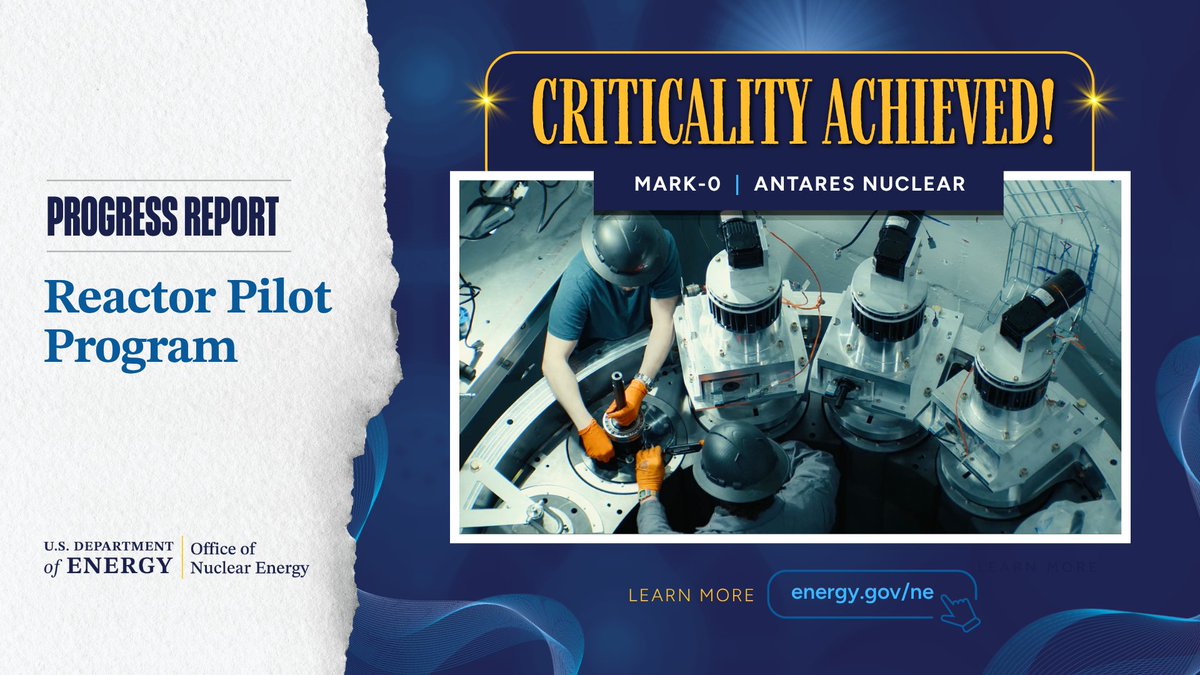
The @AntaresNuclear reactor at @INL achieved criticality, the first major hurdle in powering the United States with domestic nuclear energy. INL continues to lead the nation and the world in nuclear innovation and this breakthrough paves the way for the future of reliable baseload power.

🎉 WE HAVE CRITICALITY! 🎉
On June 4, 2026, at around 12:30 MDT, @AntaresNuclear’s Mark-0 microreactor achieved initial criticality at @INL.
It is the first nuclear test reactor to go critical under @ENERGY’s Reactor Pilot Program. Congratulations to Antares on reaching this historic milestone!
5
6
26
3,199

AI is facing the same policy choice that defined the internet era.
@AdamThierer, senior fellow at R Street Institute and a 30-year tech policy historian:
"When I was growing up in the '70s, it was a big deal when we got a telephone that was a different color and had a longer cord. That was innovation back in the '70s."
"Then the internet came along, we decided to have a firm firewall between that old era of regulated monopoly and the new world of digital technologies. We allowed them to be born free of government top-down control."
"And we saw this flowering of entrepreneurialism and creativity and culture because of that policy choice."
"Are we going to allow it to continue to be a technology of freedom? Or are we gonna bottle it all up and centralize?"
8
31
107
162,107
Christopher Koopman retweeted

Jun 5
I will be going live on @MTSlive at 1:45ET / 10:45PT to discuss the dangers of nationalizing AI. Here’s link to tune in:
x.com/MTSlive/status/2062931…
1
5
11
2,785
Jun 5
I still don’t know what to make of Brad. He starts by telling me he’s consulted “very experienced lawyers” and within minutes is repeatedly begging me to ask an LLM. Appeals to authority are always extremely strange when debating legislative text. But this is bonkers.
3
15
2,428
Christopher Koopman retweeted
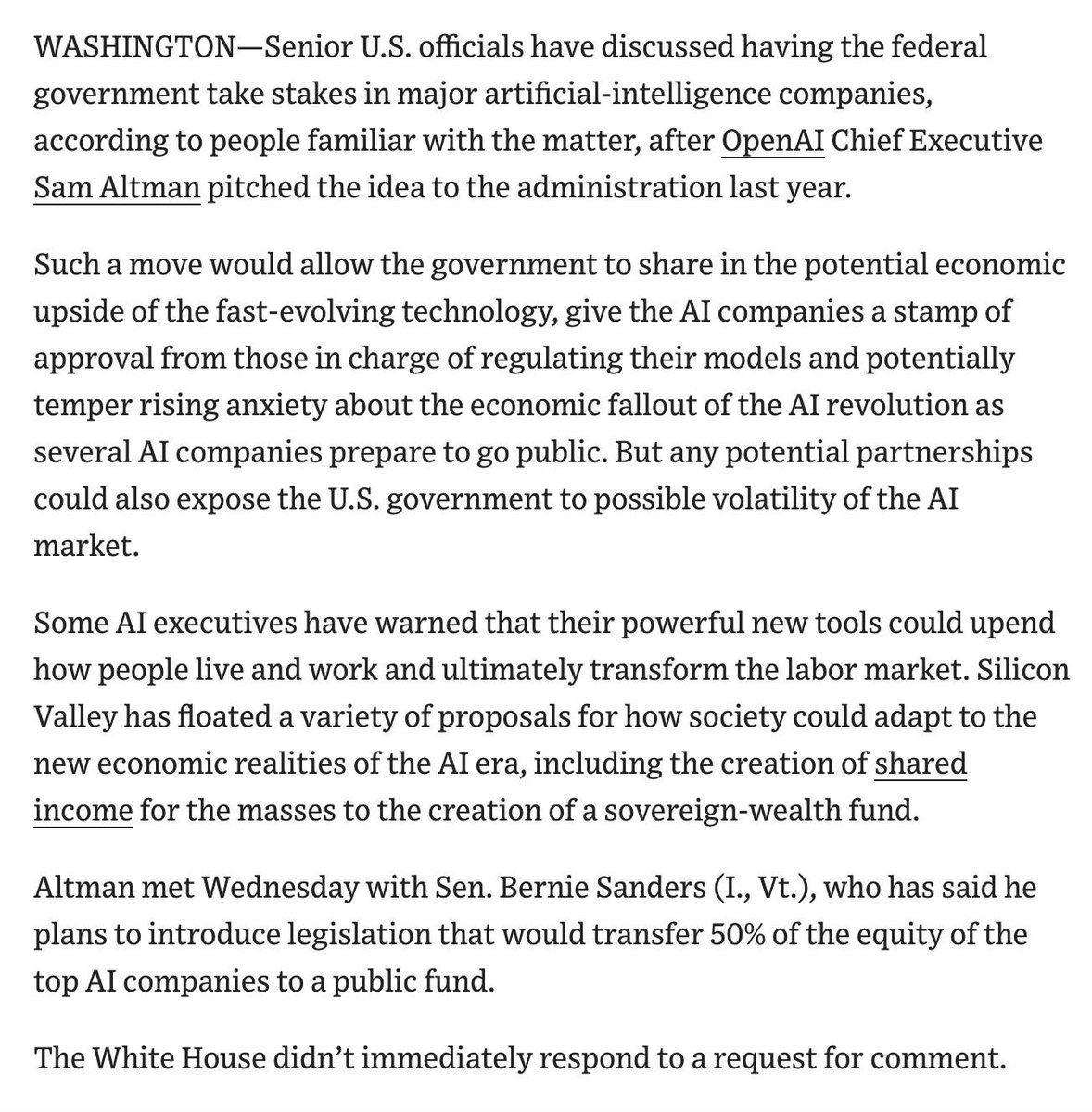
Partial government ownership of private companies is regulatory capture on steroids. BUT...... If the AI labs wanted to donate shares into every kid's Trump Account....
Jun 5

Wall Street Journal confirming our reporting today, with some new details that gov shares in OpenAi could go to Trump account-type program by @AmrithRamkumar & co
2
3
19
2,594
Christopher Koopman retweeted
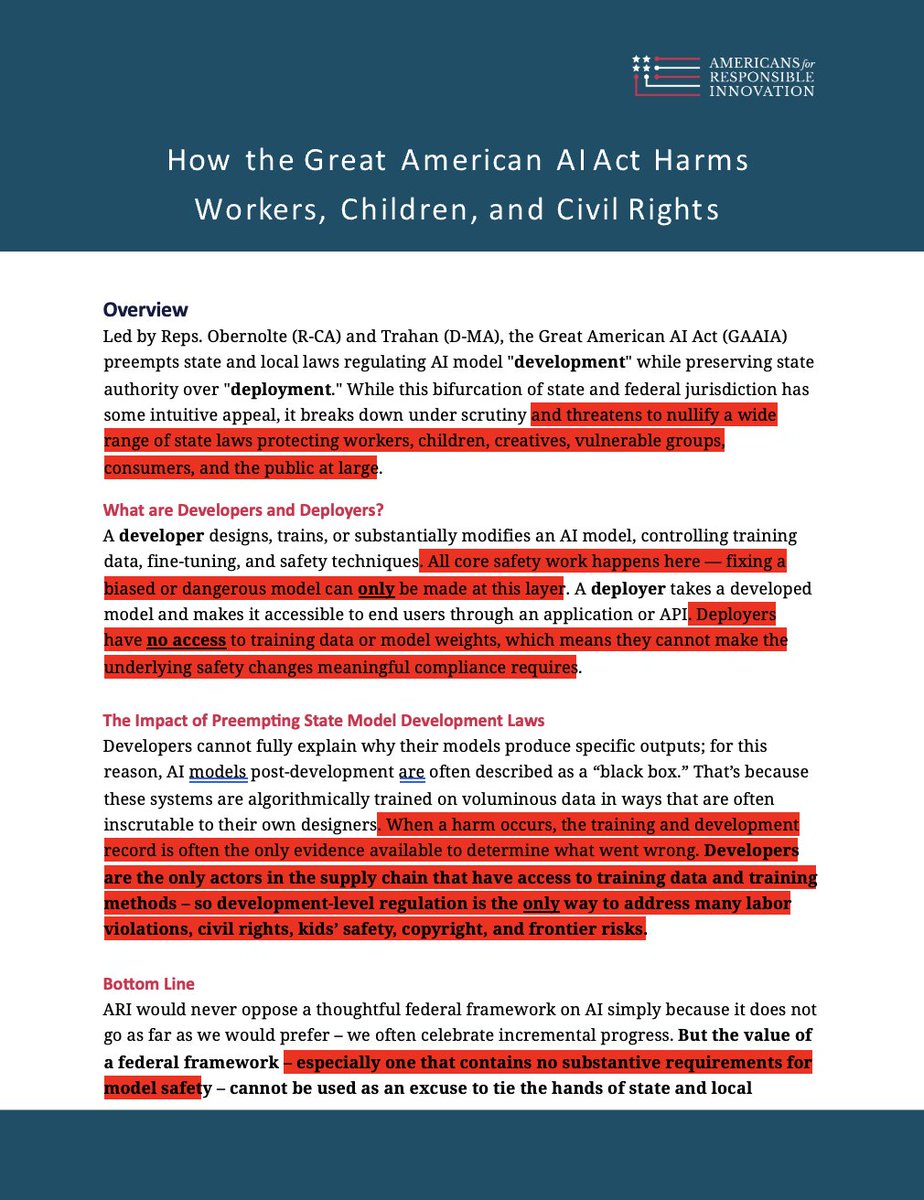
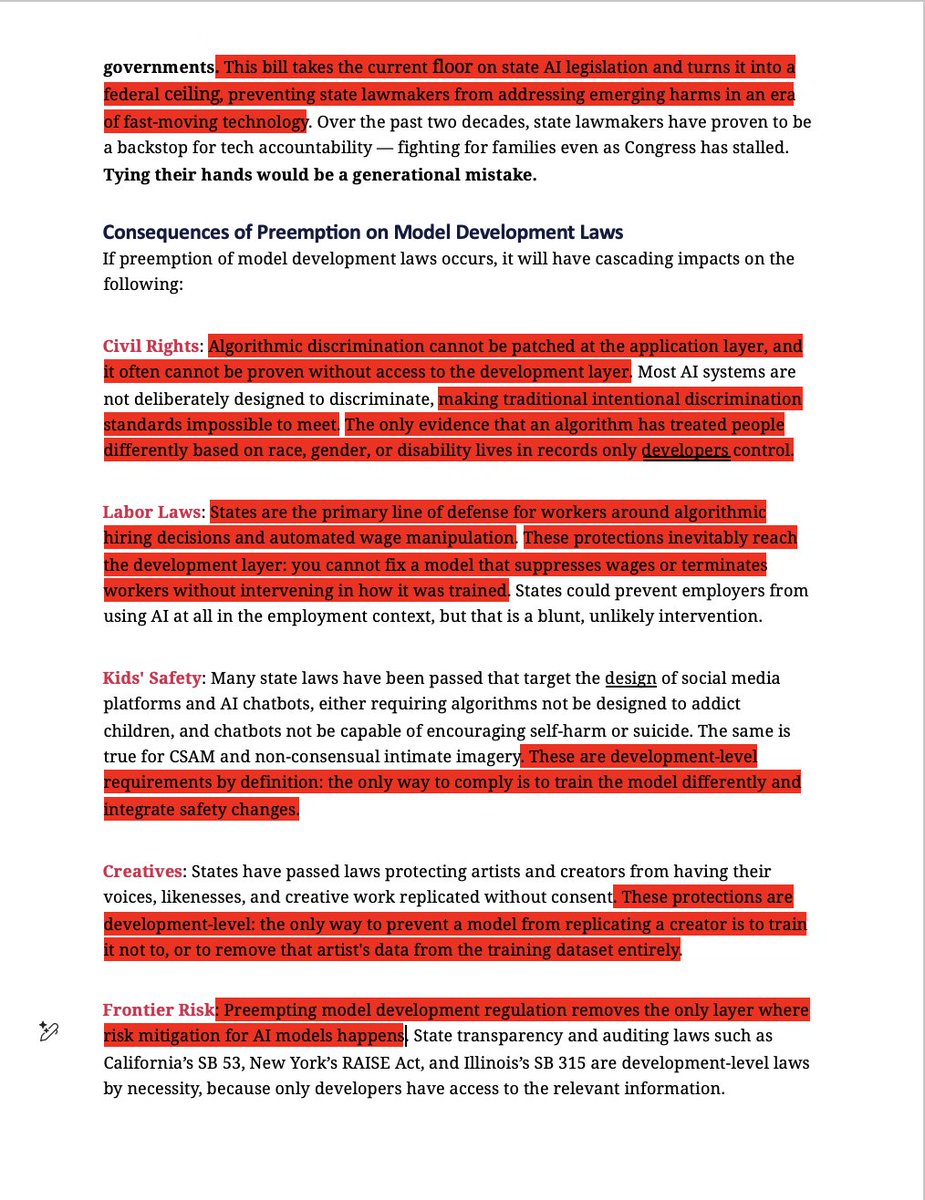
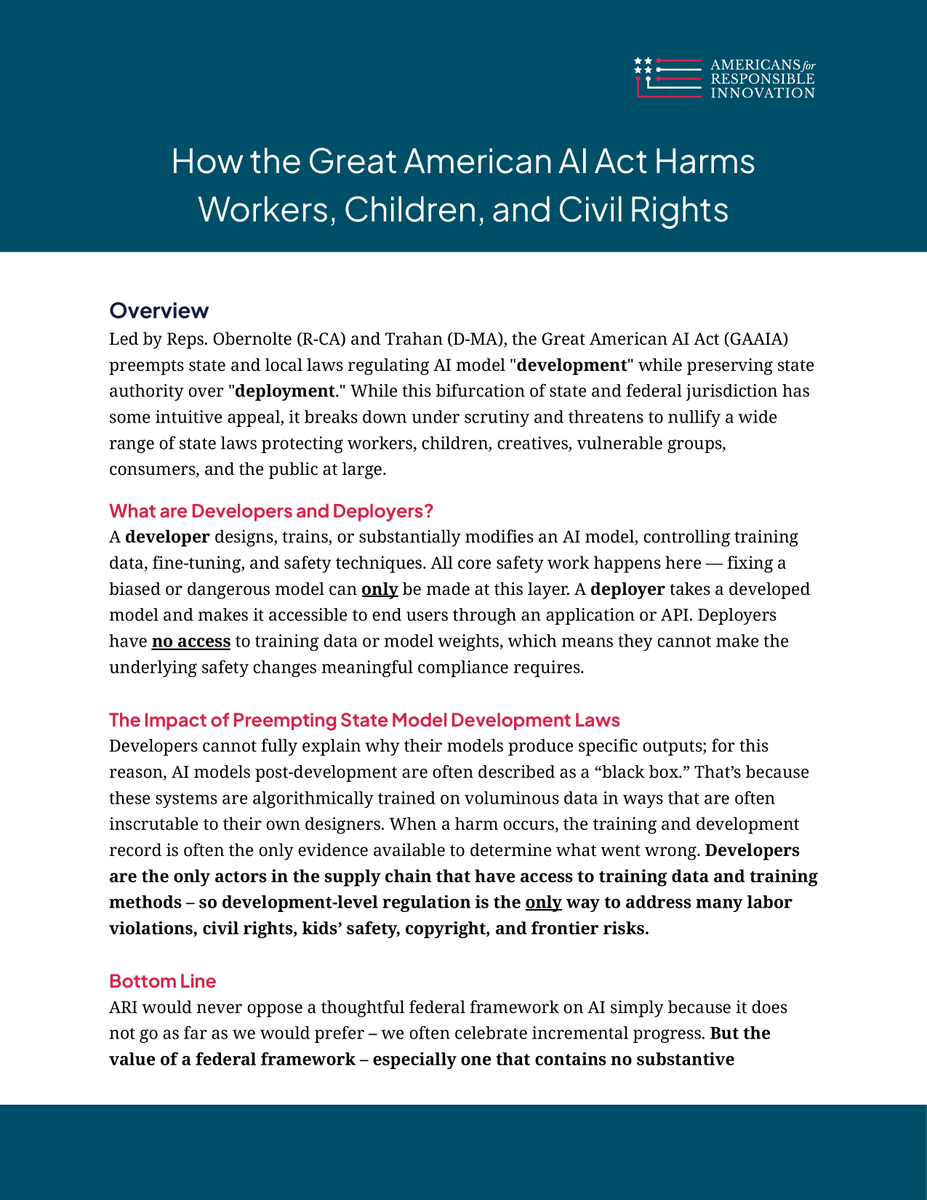
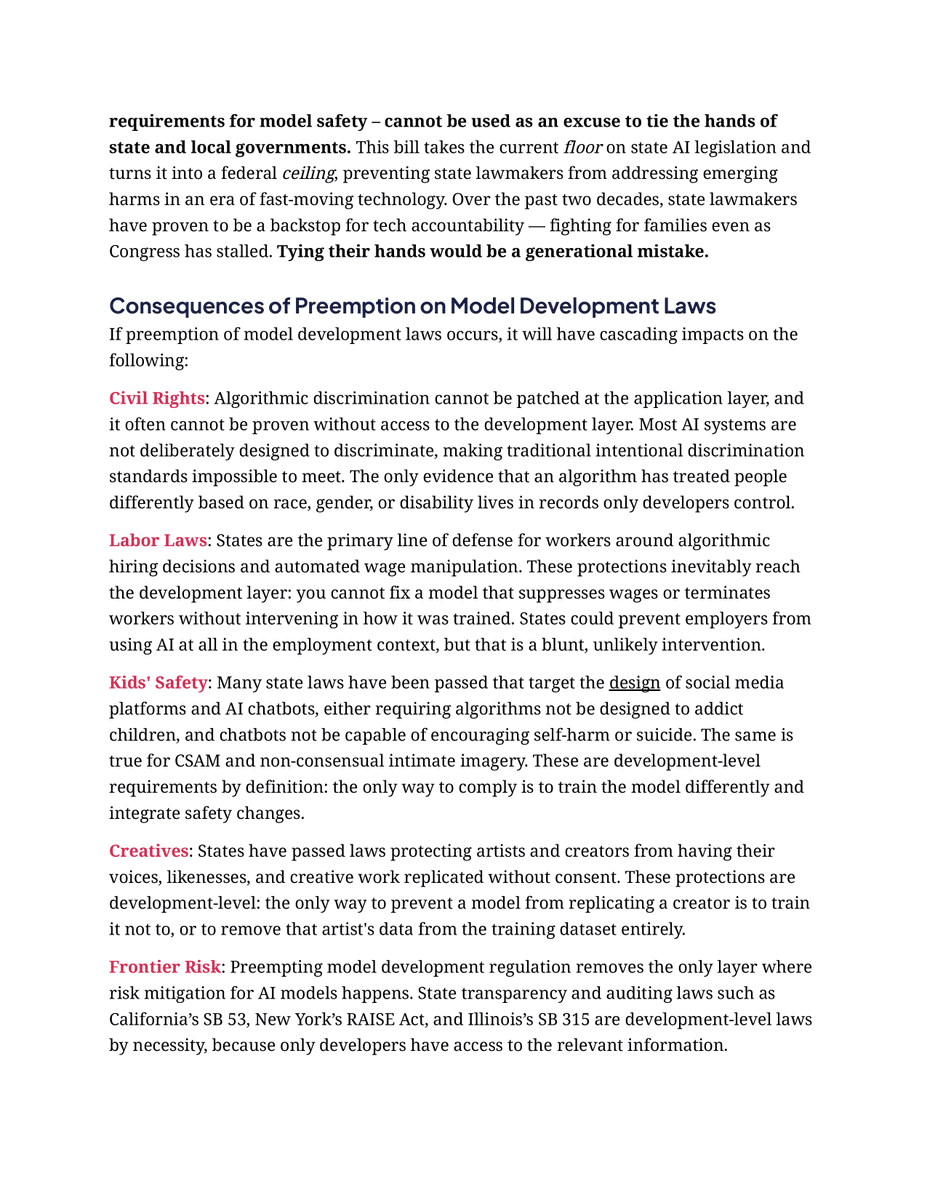
Every red-highlighted sentence in the below @americans4ri two-pager, which discusses @JayObernolte and @RepLoriTrahan's AI bill in red is either overbroad, misleading, partly false, or false. Full explanations in next post.
1
8
24
2,227
Jun 5
Brad is begging us to ask our LLMs. He asked his model whether federal law requires labs to scrub their data. That’s the procedural question, and it isn’t the one in dispute.
A request. Give your LLM the following prompt:
“Under U.S. federal law: (1) If child sexual abuse material is present in an AI lab’s training dataset, is the lab’s knowing possession of it already a crime under 18 U.S.C. § 2252A? (2) Can the willful blindness doctrine establish that knowledge for a lab that runs a web-scale scrape and chooses not to check? (3) Once a lab knows the material is in its dataset, is continued possession a crime? (4) Does that prohibition apply regardless of whether a state separately requires scrubbing?”
The honest answer is yes to all four. Possession is possession. A training corpus on a lab’s servers is possessed by that lab, and knowingly possessing CSAM is already a federal crime.
1
7
1,003
Jun 5
You and your organization have spent the entire day making stuff up. Don’t get mad at me for calling you out. Own it.
2
2
16
6,258
Jun 5
Brad is going around claiming that preemption is coming for local rules on data centers, with Monterey Park held up as the example.
This isn’t true, and the text is unambiguous.
Sec 121 preempts only a law “specifically regulating the development of any artificial intelligence model.” The findings say the same thing. The stated purpose is to preempt “State regulation specifically targeting artificial intelligence model development.” The bill defines “development” as the acts of a developer: determining training objectives, training, fine-tuning, modifying a model’s weights, and evaluating before deployment whether it clears safety or capability thresholds. Building, powering, or zoning a data center appears nowhere in that definition. A company operating a data center and leases out compute is not a developer under the bill, because the definition requires both setting the training objectives and directing the training.
On top of that, Sec 121(c)(1) expressly preserves “any State law or regulation of general applicability.” A data center moratorium is a land use rule. It applies to the building regardless of what runs inside, whether that is AI training, crypto mining, or ordinary cloud storage.
Now look at the measure Brad uses. The ballot language prohibits data centers citywide to protect air quality, water, and public health, and to prevent spikes in electricity and water rates. It doesn’t mention AI model development anywhere. It’s about as clean an example of a generally applicable local land use law as exists, and nothing in this bill preempts it. The voters who passed it would not being overridden by anything in here.
There’s one place a preemption argument might have footing. The word “specifically” is used but not defined. If a city wrote an ordinance that singled out data centers because they’re training AI, a developer would have an argument that the ordinance specifically regulates development. A neutral data center ban doesn’t get there. The general applicability carve-out and the developer definition both cut the other way. Monterey Park’s measure is neutral. It bans all data centers for environmental and infrastructure reasons. So this is the one example the argument cannot reach.
This is the second time today this account has steered the public toward a reading of this preemption that the text does not support.
The first was CSAM. Brad and ARI claim that scrubbing child sexual abuse material from training data a development-level mandate the bill would strip from states. But possessing that material is already a federal crime, which means no lab may lawfully hold it in a training set no matter what any state does or doesn’t require. A general criminal prohibition on that material is a law of general applicability, which is clearly left untouched. The protection they claim the bill removes is secured by federal criminal law that this bill does not touch.
Both arguments are built the same way. Each one stretches “specifically regulating the development of an AI model” to cover something that sits outside it, and each one only holds up if you leave out the general applicability carve-out written into the same section. The CSAM version leaves it out. The data center version leaves it out and then points at Monterey Park, which the carve-out squarely protects.
This is a pattern. This is an organization with lawyers. A general applicability carve-out is not buried, and it is not hard to understand. When a group steers the public toward reading a preemption clause to reach already-criminal conduct and a local land use vote, twice, while leaving out the one sentence in the text that answers both, the charitable explanation gets hard to hold. At that point the framing reads like an effort to be believed by people who have not opened the bill.
There are real questions about this bill. But the argument has to start with what the text says. Read Section 121, all of it, and then we can have the real fight.
3
2
16
4,058
Jun 4
Go read 49 U.S.C. § 30103(b) (which preempts state car-safety standards) and then 49 U.S.C. §§ 44701 and 44704 (only the FAA certifies aircraft). Y’all just cited the two best examples of federal pre-market preemption.
Thanks for the support, @americans4ri!

Countering AI harms happens at the pre-deployment level.
You test cars before they're on the road, and planes before they take off. Here's why broad preemption of pre-deployment state laws fails.
Two-pager:
ari.us/wp-content/uploads/20…
2
7
26
5,513