
CEO of @legiitcom - Think Big isn't motivation. It's a decision you make. Make it; or stay small. legiit.com/dashboard/start
Joined March 2015
- Tweets 86,482
- Following 445
- Followers 10,285
- Likes 68,941
65,669 Photos and videos






Pinned Tweet

12 Jun 2025
I'm Chris M. Walker.
Here's What You Need to Know.
Let me tell you straight: I build successful businesses and help others do the same.
I grew up in North Myrtle Beach, South Carolina.
Started with nothing.
Worked at McDonald's.
Learned what it took to get ahead.
Now I run multiple 7-8 figure businesses:
Superstar SEO - My agency that got it all started
Legiit @legiitcom - B2B growth engine connecting businesses with the tools and talent they need
Legiit isn't just another marketplace.
It's a complete growth engine combining Ai, data, and expert freelancers to help any business scale.
What makes us different?
We focus on results, not hype.
Our platform gives you control without the agency price tag.
Our support team answers in under 90 seconds.
Our freelancers are top-notch.
Our systems work because they're built on real data.
I also founded Think Big Learning - teaching kids and people in tough spots how to use business to take control of their lives.
My mission is simple: Help every business on Earth grow on their own terms.
If you want to know more, ask away.
If you want to join Legiit, just click the link in the comments.
If you want to stay updated, follow me now.
No fancy promises.
Just stuff that works.
That's it.
12
7
34
4,012
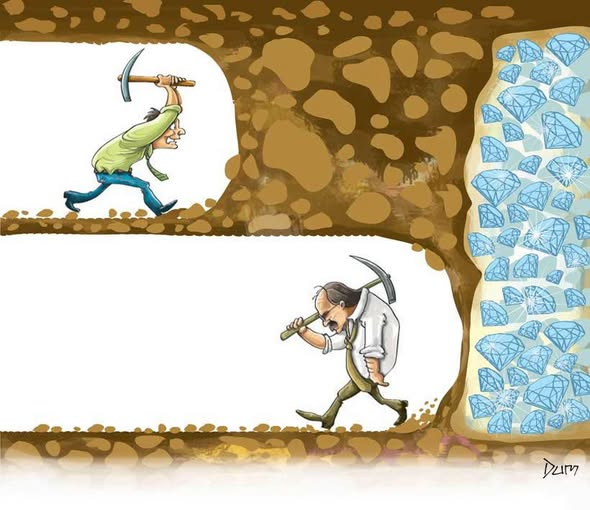
The hardest part of the thing you want isn’t doing it. It’s starting it.
Think Big Minute #58
You know what you want.
Or you have a few things you want to start.
But you’re worried about a million different things that might go wrong.
You’re worried you might fail.
But the thing is…
…you’re right.
Things will go wrong.
You might fail….
…but might not.
If you succeed… great!
If you fail… now you can try the next thing.
This seems especially true with people that want to start a business or new project.
They spend ungodly amounts of time worrying about things that might go wrong.
Spending energy on problems they don’t actually have and almost certainly never will.
They’ll have all the opportunity and ability they need and all they have to do is start and…
…they just don’t.
Take the leap.
Learn the skill.
Ask the girl.
Open the business.
Whatever it is for you just start and…
…Think Big
2
51
Jun 12
Thomas Edison filled 3,500 notebooks with ideas. You can't remember the one you had in the shower this morning.
Your best idea this year might already be gone. You just never wrote it down.
Think Big Minute #56
Ideas don't show up on a schedule. They show up in the shower, on a drive, in the middle of a workout, in the middle of a completely different task.
And your brain is a terrible place to keep them.
David Allen wrote Getting Things Done, and the most important sentence in that book is this: your mind is for having ideas, not holding them.
Every idea you try to hold in your head is what Allen calls an open loop. Part of your brain stays behind to babysit it. Carry five of those around and you wonder why you can't focus. Then the loop fails anyway, because memory is a terrible warehouse, and the idea is gone.
The people we treat as geniuses mostly just refused to trust their own memory.
Edison's 3,500 notebooks are still being studied today. Da Vinci left behind more than 7,000 pages of notes and sketches. Richard Branson carries a notebook everywhere he goes and says ideas can leave your head before you even leave the room. He's built companies out of things he scribbled down in meetings.
These people did not have better memories than you.
They stopped using memory for storage.
An idea you didn't write down is worth exactly nothing. It might as well have never happened.
My system is stupid. When an idea hits I send myself a Slack message or shove it into the Notes app on my phone. Ten seconds, then back to whatever I was doing. No fancy app, no subscription, no second brain with color coded tags. A Slack channel full of messages from me to me.
Most of those notes turn out to be nothing. That's fine. Writing everything down doesn't mean every idea is good. It means you get to find out later which ones were.
The reason almost nobody fixes this is that the cost is invisible. A lost customer shows up in a report. A lost idea shows up nowhere. Forgetting doesn't send you a notification. The idea just never existed, and you never find out what it would have been worth.
So you assume you're not losing anything.
You are. Everyone is. The only question is how much.
How to fix it:
1. Pick one place. Notes app, a Slack message to yourself, a notebook in your pocket. One place, not four.
2. The instant an idea hits, dump it there. Under ten seconds. Then go right back to what you were doing.
3. Don't organize it in the moment. Capturing and filing are different jobs. Mixing them is how the whole thing dies.
4. Once a week, go through the pile. Act on it, schedule it, or delete it.
That's the entire system. It costs nothing and takes seconds.
Stop trusting your memory with things that might be worth money.
Write it down. All of it. Let future you decide what it's worth.
Think Big
79
Jun 12
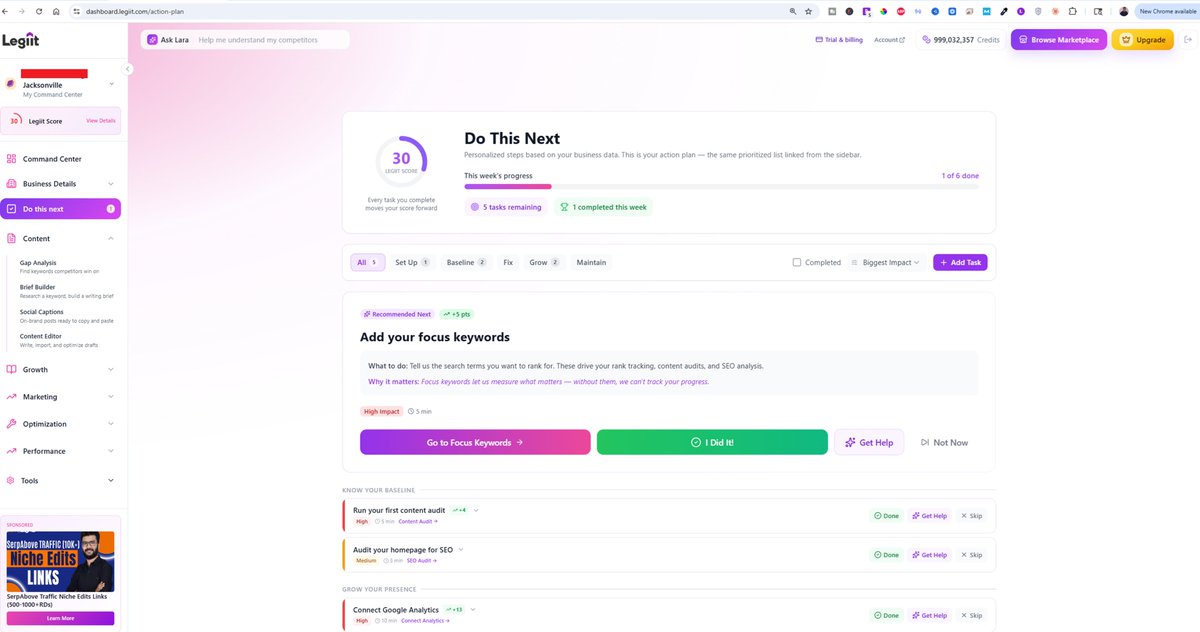
Fun new feature on @legiitcom Legiit Command Center!
Create a brand guide from your website, leverage it to create images for whatever you need.
Combine it with social caption generation and handle all of your social media.
Grab a free trial at the link in the comments.
12
3
7
291
Jun 11
John D. Rockefeller counted the drops of solder it took to seal one can of oil. 39 instead of 40. The average business owner can't tell you what he actually made last month.
One of them built the most profitable company in American history. The other one is winging it.
Think Big Minute #55
Ask almost any business owner about his numbers and you'll get revenue. Push a little harder and you might get expenses.
That's the whole map.
Gross profit versus net profit? Average order value? What a customer is worth over their lifetime? What it costs to get one?
Blank stares.
And those are just the basics.
Business is a math problem. Money comes in, money goes out, and a handful of numbers decide whether the gap gets bigger or smaller. Walking in without knowing them is stepping into a boxing match with no gloves and no mouthpiece. You're not competing. You're absorbing hits and wondering why everything hurts.
The people who built the biggest businesses in history were obsessive about this to a degree that looks insane.
Rockefeller had his people test whether 39 drops of solder could seal an oil can instead of 40. It could. Across millions of cans, one drop saved a fortune. He ran Standard Oil from a ledger, because before he was the richest man alive he was a bookkeeper, and he never stopped thinking like one.
Andrew Carnegie ran his steel empire on cost sheets. He wanted the cost of every process in every mill, because he believed if you watch the costs, the profits take care of themselves.
Sam Walton spent Saturday mornings going through the numbers of every Walmart store, one by one, for decades. He knew which store was slipping before that store's own manager did.
Watch one episode of Shark Tank. The founders who get destroyed aren't the ones with bad products. They're the ones who can't answer what it costs to get a customer. The sharks ask for the numbers before they taste the product, because the numbers are the business.
Revenue is the only number with an audience. It's the one people ask about at dinner. It's the one that sounds good in a post. So it's the only one most owners ever learn.
Revenue is the number you tell people. The numbers underneath decide whether you eat.
Most owners never learn the rest because they never wanted to do business in the first place. They wanted to do the thing. The plumber loved plumbing, so he opened a plumbing company. The baker loved baking. The designer loved design. Michael Gerber wrote a whole book about this almost forty years ago, The E-Myth, about technicians who catch what he called an entrepreneurial seizure and wake up owning a business they never actually wanted to run.
The craft gets you in the door. The math decides whether you survive. And nobody who got in for the craft wants to hear that the job is mostly math now.
At best that owner stays the same size forever. At worst the business dies and he never finds out why, because the why was sitting in numbers he never looked at.
I learned this with real money on the line. For years at Legiit I watched the top line go up and assumed everything underneath was fine. The real numbers told a different story than the totals did, and every important decision got better the day I started pulling them apart instead of admiring the sum.
The numbers to know, in plain English:
Gross profit. What's left after the direct cost of delivering the thing. If this is thin, nothing downstream can save you.
Net profit. What's actually left after everything. The only number that pays you.
Average order value. What the typical sale is worth. Raise it and everything gets easier without a single new customer.
Customer acquisition cost. What you spend to get one customer. Most owners have never calculated it once.
Lifetime value. What a customer is worth over the whole relationship, not just the first sale. This decides what you can afford to spend to get them.
LTV against CAC. If a customer is worth $1,000 and costs $200 to get, you have a machine. If you don't know either number, you have a guess.
You don't need an accounting degree. You need six numbers and the willingness to look at them every week.
Stop running the business on the one number that sounds good at dinner.
Solve the math problem you actually signed up for.
Think Big
120
Jun 11
Three business owners.
Same niche.
Same expertise.
Same offer.
One has 50,000 followers and is broke.
One has 5,000 followers and pays themselves $30k a month.
One has no followers and runs a $400k/year consulting practice.
So followers are not the variable.
The real variable is the content mix.
Most owners only post one type of content and call it a strategy.
But content has three jobs:
TOFU = attention.
MOFU = trust.
BOFU = conversion.
Stories are TOFU.
They stop strangers from scrolling.
Tips are MOFU.
They prove you know what you’re talking about.
Offers are BOFU.
They tell people what you sell and how to buy.
The problem?
Some people only tell stories and build an audience that never buys.
Some people only teach and end up educating the same warm audience forever.
Some people only pitch and wonder why nobody trusts them enough to buy.
You need all three.
On social, you may need more TOFU because most people are still strangers.
In email, you can lean more into MOFU and BOFU because people are already warmer.
In a paid community, you can teach and sell more directly because trust is already higher.
The numbers are not the point.
The point is this:
Every channel needs stories, teaching, and offers.
Different mix.
Same three jobs.
TOFU turns strangers into attention.
MOFU turns attention into trust.
BOFU turns trust into revenue.
If you’re posting consistently but not getting results, your content may not be bad.
Your mix may be broken.
Tell stories.
Teach what you know.
Sell what you do.
Three jobs.
Every channel.
Different mix.
Think Big.
1
1
60
Jun 11
ChatGPT has quietly built a file on you, and most of it you've never seen.
It stores what you tell it, then reads your patterns to profile your personality and habits, things you never typed out loud.
Here are 6 prompts to expose everything it has on you, and wipe what you didn't agree to:
👇
1
1
213
Jun 11
5/ See What's Stored
Now take it back. The saved file is buried two clicks deep.
Open ChatGPT Settings, Personalization, then Manage Memories. That's the explicit list of facts it's saved about you. Read it, most people are shocked what's there, then tap the trash icon on anything you want gone, or Clear All to wipe the lot. Deletion is instant, no undo.
1
40
Jun 11
6/ Kill the Invisible Tracking (IMPORTANT)
Deleting the list isn't enough. Two switches keep profiling you in the background.
In Settings, Personalization, turn off Reference Chat History, the hidden layer with no list you can ever see. Then go to Data Controls and turn off "Improve the model for everyone" so your chats stop training future models. Memory and training are separate toggles, flip both.
30
Jun 11
. @RyanSerhant is what real life Zack Morris would have grown up to be and no one will change my mind.
43
Chris M. Walker retweeted

Jun 10
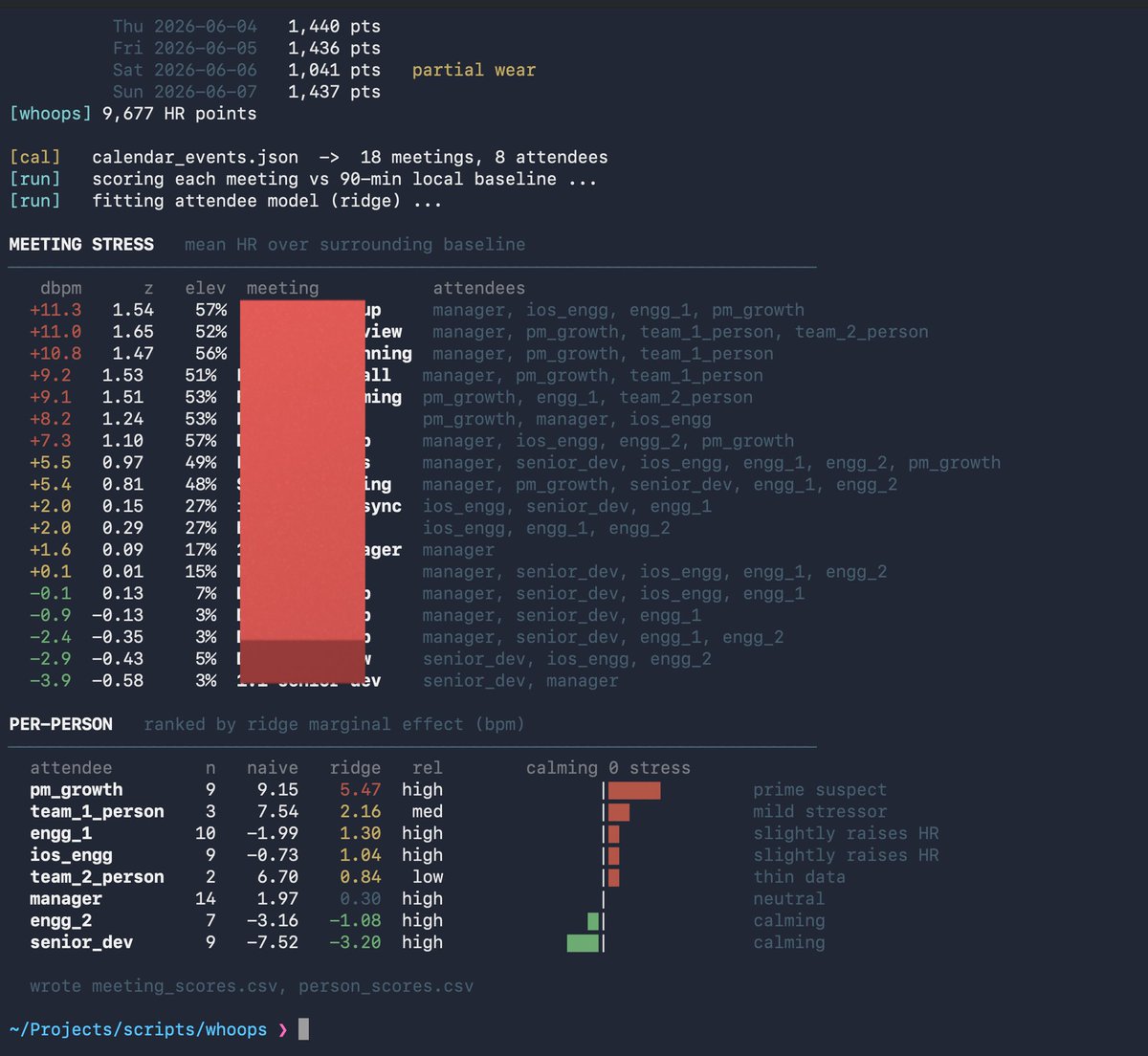
i hooked my whoop to my work calendar to find which coworker gives me the most stress 🚨
thanks to fable, I reverse engineered whoop to pull per minute heart rate. nd matched spikes with cal events and attendees
I now have a leaderboard and I think about it daily.
few info masked for obvious reasons ;)

1,007
2,840
44,941
11,007,559
Jun 11
Legiit @legiitcom is having a historically good month by all of our main KPIs.
No month in company history has had higher order volume and gross sales together through 10 days. 🤯🎉
Thanks everyone. 🤗
35
Jun 10
Make Claude your personal data analyst.
Feed it a messy spreadsheet and the right prompts, and it finds what you'd have missed.
Copy and paste these 7 prompts: 👇
1
187
Jun 10
6/ Explain the Change
A number moved. Find out where the movement actually came from.
Paste to Claude:
"[my metric, like monthly revenue] moved [up or down, by how much] over [time period]. Break that change apart by segment and driver until you find where most of it really came from. Give me the 2 or 3 things responsible for the bulk of the move, not a list of everything."
1
71
Jun 10
7/ The Bottom Line
Turn all of it into something you can act on.
Paste to Claude:
"Pull everything we found into a decision-ready brief: the 3 most important findings, what each means for [my goal], and the specific action I should consider for each. Keep what the data proves separate from what it only hints at, and write it in plain language I could send to someone who never saw the numbers."
18