
I write cool software (TypeScript, React Native). Senior software engineer @infinite_red. Maintainer @MSTjavascript. Prev: @WalterPicksApp @gitlab.
Joined March 2021
- Tweets 2,787
- Following 1,465
- Followers 744
- Likes 10,629
98 Photos and videos







Pinned Tweet

8 Jun 2024
Do you like phone games like this but hate when they're full of ads? Me too. That's why I made my own. Play once per day for free, or pay $0.99 and play unlimited forever. No ads. No consumables. Just flow. Link in thread.
8
1
35
7,814
Tyler Williams retweeted

9 Jun 2025
Apple today took a shot at React Native and other cross-platform frameworks.
I have thoughts.
First, the quote in question, from their keynote (around the 40 minute mark):
"Some other frameworks promise the ability to write code once for Android and iOS.
And that may sound good, but by the time you've written custom code to adapt each platform's conventions, connected to hardware with platform-specific APIs, implemented accessibility, and then filled in functionality gaps by adding additional logic and relying on a host of plugins, you've likely written a lot more code than you'd planned on.
And you are still left with an app that could be slower, look out of place, and can't directly take advantage of features like Live Activities and widgets.
Apple's native frameworks are uncompromisingly focused on helping you build the best apps."
78
166
2,642
574,613
Tyler Williams retweeted

31 Jan 2025
🖤❤️ RNR 320 ❤️🖤
This week, we dive into silky-smooth animations with @mironcatalin! 🚀
From Reanimated and layout animations to interpolation and motion accessibility—we're covering it all.
Listen now! 🎧
reactnativeradio.com/episode…
1
7
24
4,662
21 Jan 2025
So cool.
21 Jan 2025

This is honestly so inspiring. Jay fixes React Native list performance, and doesn't use a single line of native code to do it.
(...thus proving once again that top-notch React Native performance is rarely constrained by JavaScript performance, but rather by time, skill, creativity, and dedication!)
@jmeistrich
5
286
Tyler Williams retweeted

14 Jan 2025
I've been around the world, but this is my first time going to Durham, NC!
Who am I going to see?
allthingsopen.ai/
cc: @mazenchami @AllThingsOpen

ALT Gant Laborde speaking at All Things Open AI conf
1
8
20
1,568
13 Jan 2025
We love a little simplification every now and then!
13 Jan 2025
⭐️ New @ir_ignite release out, version 10.1.3, where we removed `eslint-plugin-n`, `eslint-config-standard`, and `eslint-plugin-promise` to simplify our standard eslint setup and fix some dependency conflicts.
Tested with yarn/npm -- report issues if you find any.
Thanks to @coolsoftware.dev for the PR, and @Stefan_Wallin for reporting!
github.com/infinitered/ignit…
1
2
1,060
9 Jan 2025
I read Daishi's amazing article about state management, and a few hours later, got multiple questions about MobX-State-Tree and the future of React.
So I wrote my own thoughts about where I see MST headed in the React Compiler Era:
coolsoftware.dev/blog/mobx-s…
7 Jan 2025

I just wrote a new blog post!
Thoughts on State Management Libraries in the React Compiler Era
RSC also matters
blog.axlight.com/posts/thoug…
1
3
263
20 Dec 2024
Guess what I’ll be listening to on my cross country road trip!
20 Dec 2024

🖤❤️ RNR 317 ❤️🖤
The final episode of 2024 is here!
Jamon, Robin, and Mazen wrap up the year with React Native’s biggest milestones and bold moments.
Plus: they make some 2025 predictions — Version 1.0, perhaps?? 👀
Listen now 👇
reactnativeradio.com/episode…
137
Tyler Williams retweeted

19 Dec 2024
We just published a small patch release to fix a regression in v7 of MobX-State-Tree: github.com/mobxjs/mobx-state…
1
7
289
19 Dec 2024
I love the RN Newsletter. Always short 'n sweet, good cadence, but helps keep the pulse on the community.
19 Dec 2024

📰 RNN 185 📰
Don't miss the latest issue of the #ReactNative Newsletter!
✅ Major announcements from Expo
✅ Accessibility & props for screenreaders in React Native
✅ The latest on React 19
✅ AND SO MUCH MORE!
Read now!
mailchi.mp/infinite.red/reac…
119
Tyler Williams retweeted

17 Dec 2024
⚛️ TOP REACT NATIVE POSTS OF 2024 ⚛️
Let's go!
👇
#BestofReactNative2024
2
46
268
51,901
Tyler Williams retweeted
17 Dec 2024
Did we miss anything?
There was so much this year that we may have missed a few, so please reply to the thread and we'll add it in!
And thank you to everyone helped make 2024 an AMAZING YEAR for React Native! 🎉
#BestofReactNative2024
3
1
2
253
Tyler Williams retweeted

19 Nov 2024
. @Partiful just won Google Play's 2024 Best App award. It's built with Expo.
5
10
392
81,460

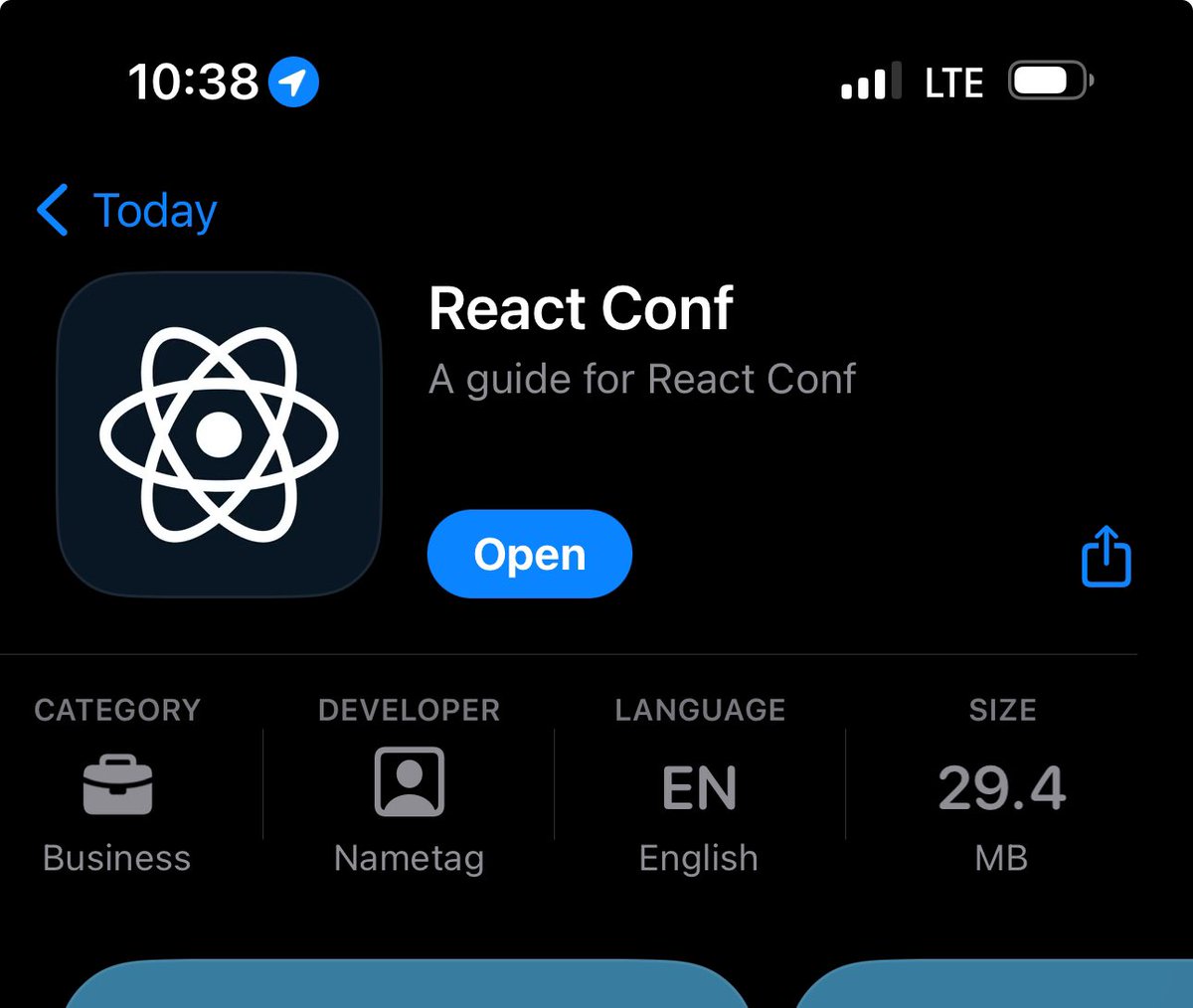
fun fact: React Compiler also optimized this app!
15 May 2024

Just installed the app, only 29mb? I thought React Native was super bloated tho?!
5
16
270
45,659
Tyler Williams retweeted
2 Mar 2024
This is actually a good question (quoted below), and I have a good answer for it.
I was an iOS native dev from 2012-2015 (Obj-C days) and really, really loved it. Xcode was annoying but I could get around that with various tooling (RubyMotion, cocoapods, etc) that made it so I could be in Xcode less. And I shipped native binaries. I had no intention of changing.
But I run a consultancy, and my clients increasingly started asking me for Android versions as well — their users were demanding it. So I started learning Android development in 2014-2015.
The problem was that my team was clearly going to have to go through a transformation:
1. I’d have to double the size of the mobile team
2. Half would be iOS, half Android
3. We were still doing web at the time, so I’d have a whole other separate team doing web
4. The costs would go up tremendously — good for me, but bad for my clients
In 2015 I was also preparing to merge my company with another company to become the new Infinite Red. As we were doing our due diligence, we realized both of our teams were facing this same potential issue. And with the doubled team size, it was now magnified.
Because of this, my cofounder @twerth started researching alternatives in September 2015. We had heard of React Native but our assumption at the time was that it wasn’t good enough to deliver the level of user experience that we were used to.
But his evaluation when he came back was “This is actually quite good.” (Remember, early days for RN! But he saw where it was going.)
The primary reason it made sense was from a business standpoint. We could use the same team for all three platforms and share code, devs, training, tooling, and more. We could ship apps for about 60% of the cost (half the time with iOS plus a bit to tweak for Android). This is by far the biggest reason.
But the second reason was technical. React Native is native, and the JS layer is just orchestrating UIViews and Android native views via React’s brilliant “UI as a function of state” paradigm. That meant views take up the same amount of memory as native (because they literally are native) and feel and look native to the user.
With that decision made, we converted two native projects that were just kicking off to React Native and have been focused on that from then on.
Now, what about personally? Truth be told, I still like iOS native dev the best. Swift is cool, and the SwiftUI declarative UI system (stolen shamelessly from React) is a good improvement over previous interface builder and xibs and programmatically / imperatively built UIs. If I was an individual dev, I’d probably lean that direction.
But I’m not, and there’s almost no business case for doing native mobile dev these days when React Native exists. It’s plenty good enough in most ways and even superior in a few ways — the third party ecosystem is vast, libraries like Reanimated and Vision Camera have no equal in native land, etc.
That’s why I use React Native. It is a native app in the end, just running Hermes with some bytecode to orchestrate the native UI. And I still enjoy it 8 years later!
7
20
214
43,937
Tyler Williams retweeted
17 Dec 2024
Shopify goes all in on React Native, announcing it as their default way to build mobile apps. @ShopifyEng @mustafa01ali
#BestofReactNative2024
x.com/mustafa01ali/status/17…
2 Feb 2024

It’s been a while since we’ve done an update on @shopifyeng mobile @reactnative, so let’s do it.
shopify.engineering/react-na…
A thread 🧵
1
1
10
1,492
Tyler Williams retweeted
17 Dec 2024
NativeWind v4 was announced along with gluestack-ui! @gluestack
#BestofReactNative2024
x.com/gluestack/status/17583…
16 Feb 2024

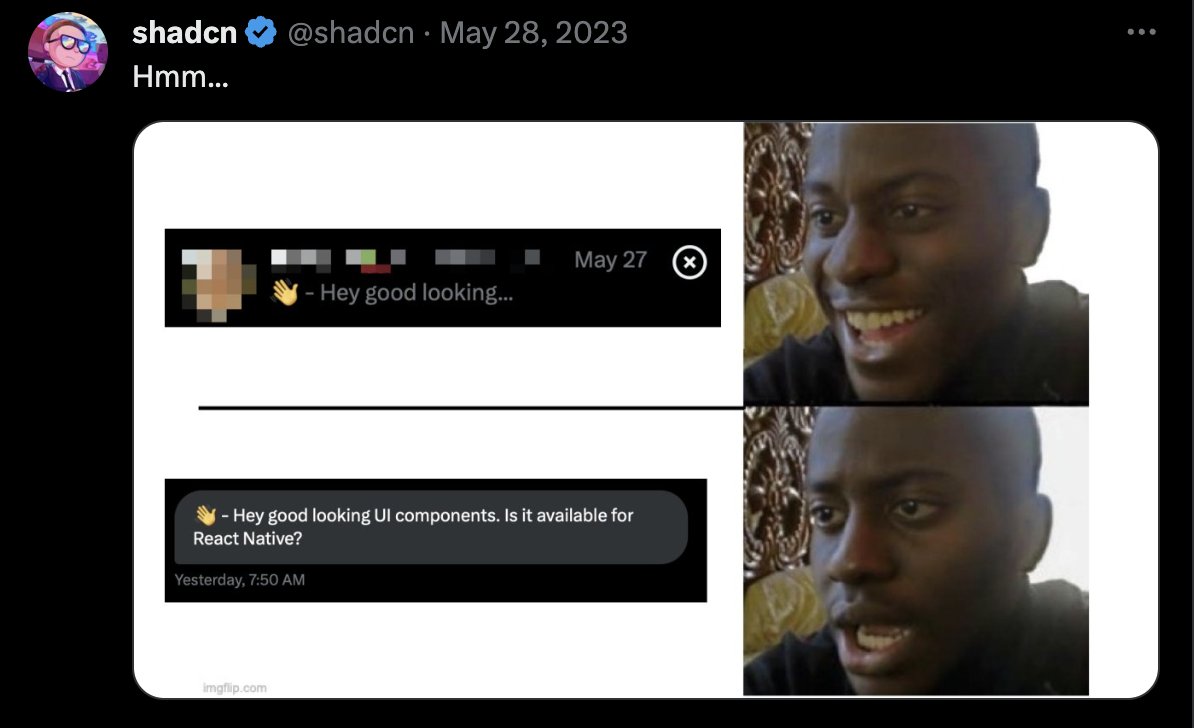
Looking for shadcn/ui for React Native? Well, we heard you. Introducing NativeWind(V4) gluestack-ui (Experimental).
Copy and paste accessible and customizable components into your apps.
2
5
14
2,672
Tyler Williams retweeted
17 Dec 2024
Kicking it off with @reactnativemsft releasing React Native Test App 3.0, an important testing component in the RN world!
RNTA provides test apps for all of the main platforms as a package.
#BestofReactNative2024
x.com/ReactNativeMSFT/status…
11 Jan 2024

Big news: React Native Test App (RNTA) 3.0 is here!
This release paves the way for future #ReactNative features, like bridgeless mode. It's all about innovation and staying ahead! 🚀

1
1
13
3,090
Tyler Williams retweeted
17 Dec 2024
The team at @margelo_io announced react-native-skottie, a library that runs Lottie animations using Skia’s GPU-accelerated engine.
#BestofReactNative2024
x.com/margelo_io/status/1748…
18 Jan 2024

Announcing react-native-skottie - a library to run Lottie animations using Skia's GPU-accelerated engine! 🥳
1.0.0 is out now! 🚀
github.com/margelo/react-nat…
1
4
35
2,924
17 Dec 2024
What a year it's been for React Native.

1
1
7
467

💝 This is a uniquely open-hearted conversation about the evolution of debugging in React Native. Kudos to @cedric_dev, @huntie, and @jamonholmgren for honestly discussing the history and future of debugging react native apps.
9 Dec 2024
🖤❤️ RNR 316 ❤️🖤
The Expo-vember series finale is here... with Meta! 🍂
This week: @jamonholmgren is joined by @cedric_dev (Expo) and Alex Hunt (Meta) to talk new DevTools, Chrome DevTools Protocol, and the future of debugging.
Listen now!
reactnativeradio.com/episode…
6
32
6,734