
As #Canada’s sole manufacturer of #dilutionrefrigerators, we make reliable and innovative fridges so our customers can focus on developing their research.
Joined September 2021
- Tweets 1,004
- Following 241
- Followers 305
- Likes 881
544 Photos and videos




Jun 12
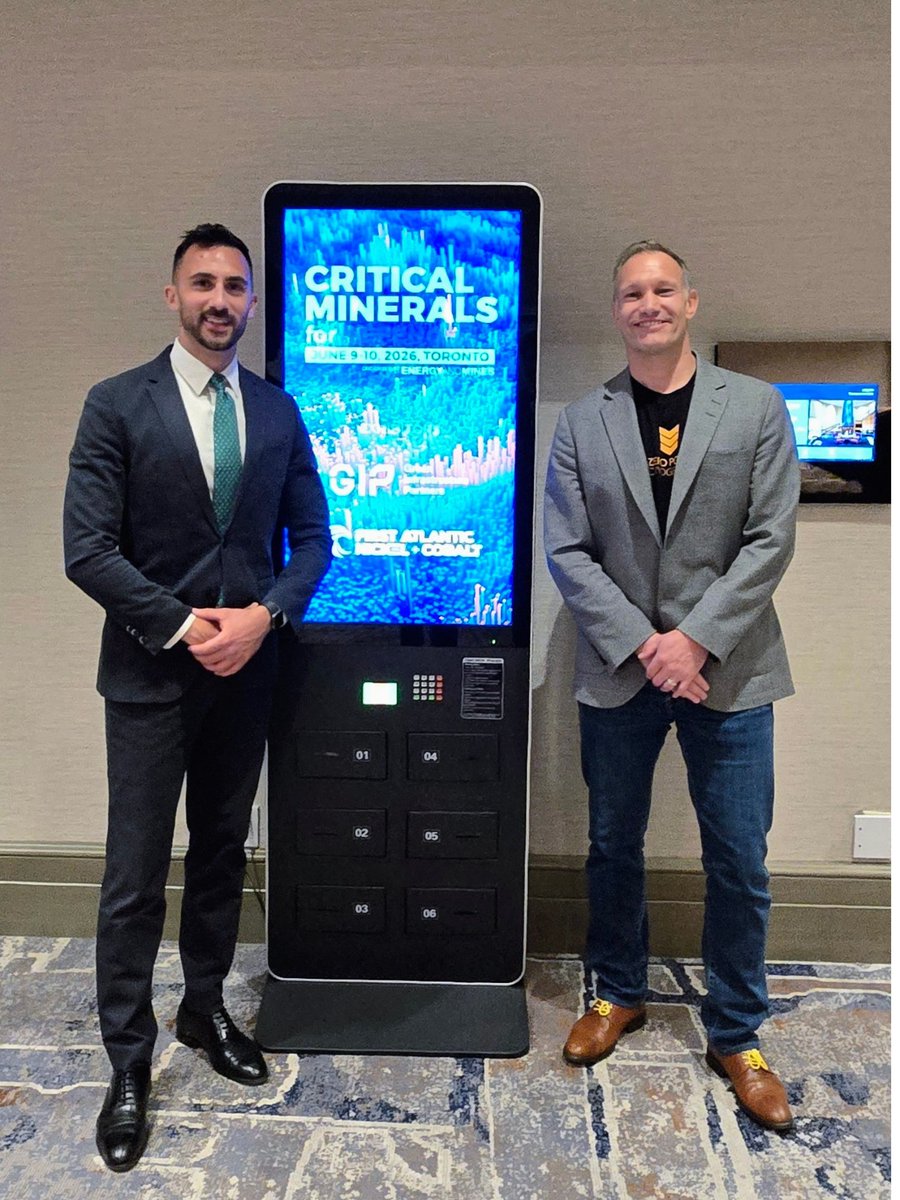
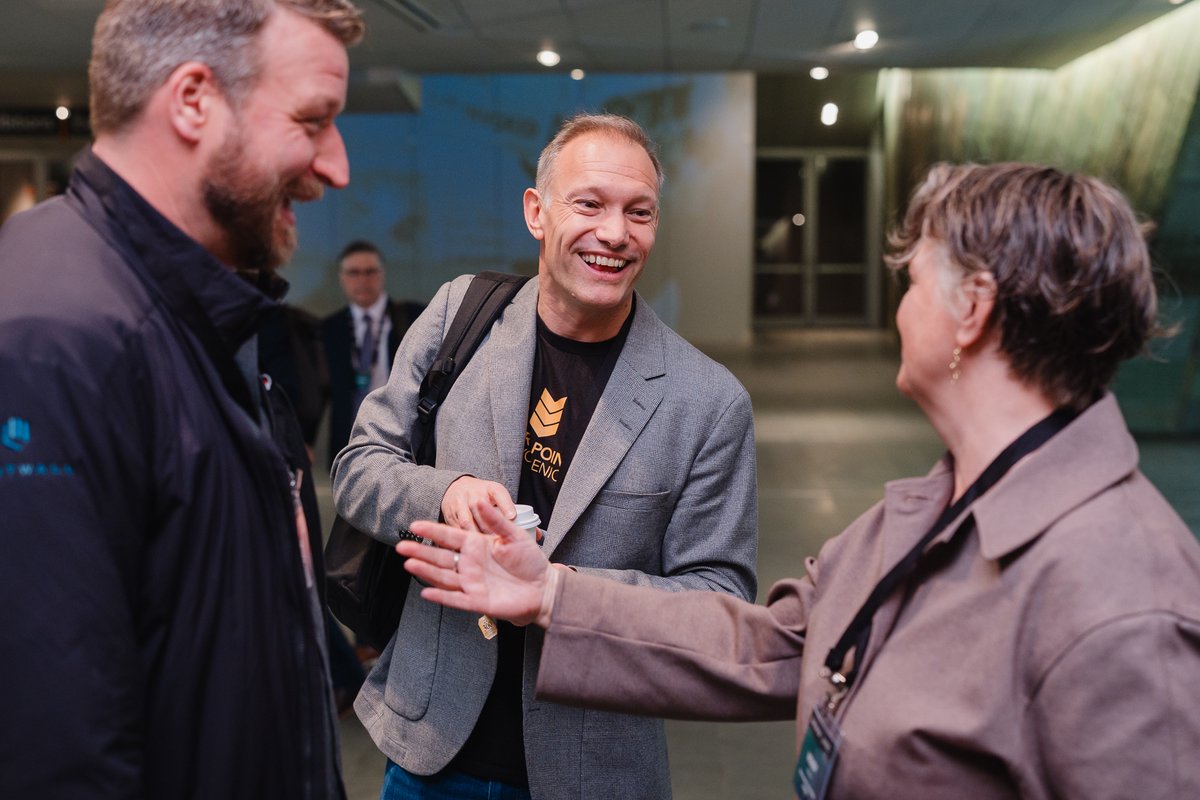
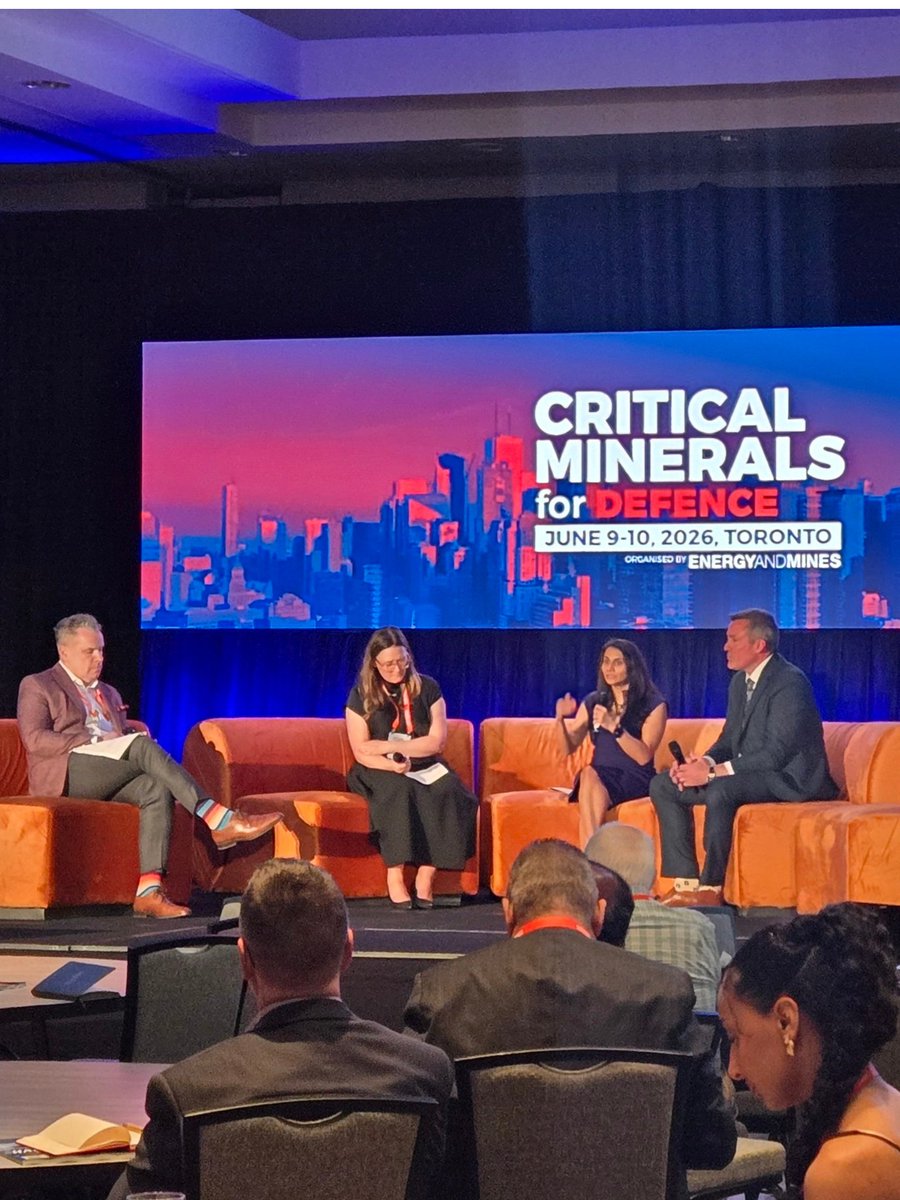
Critical Minerals for Defence Conference🪨
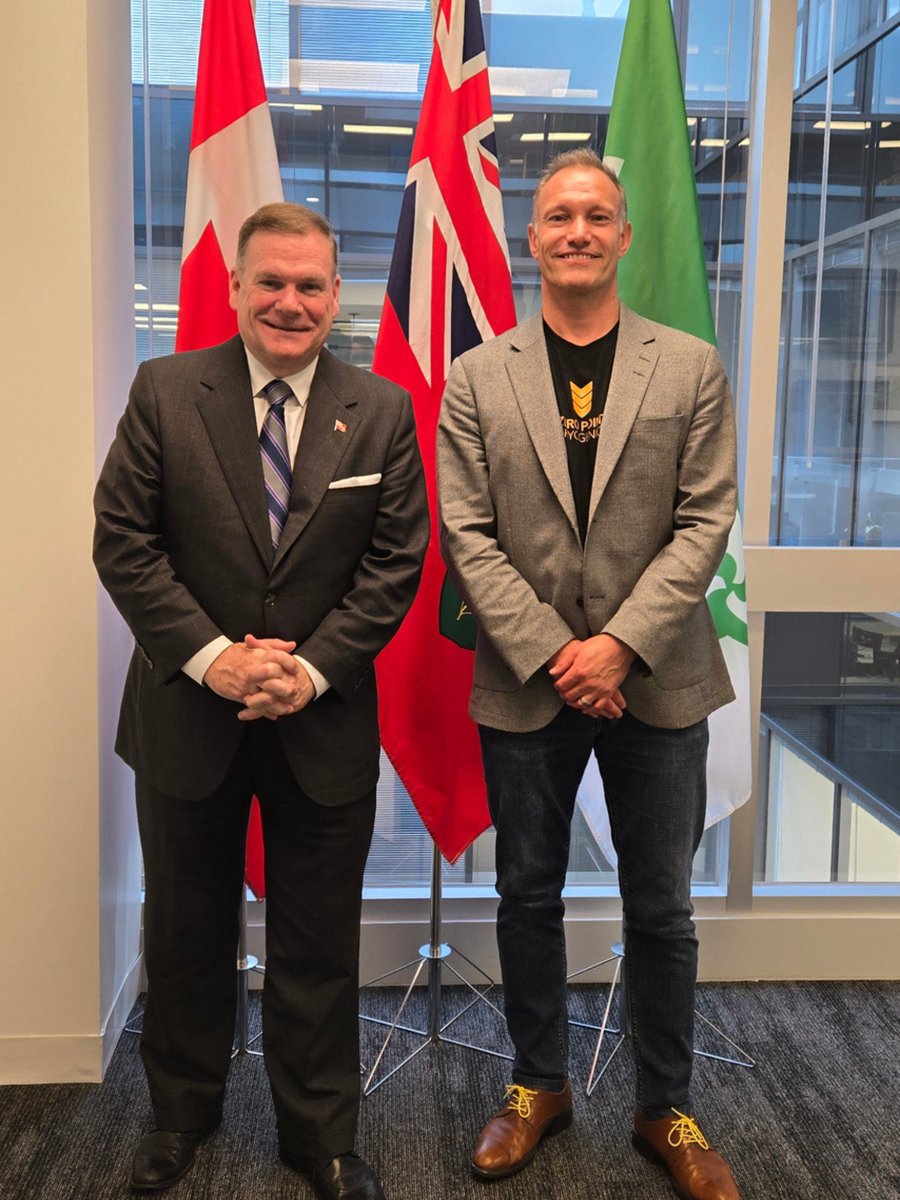
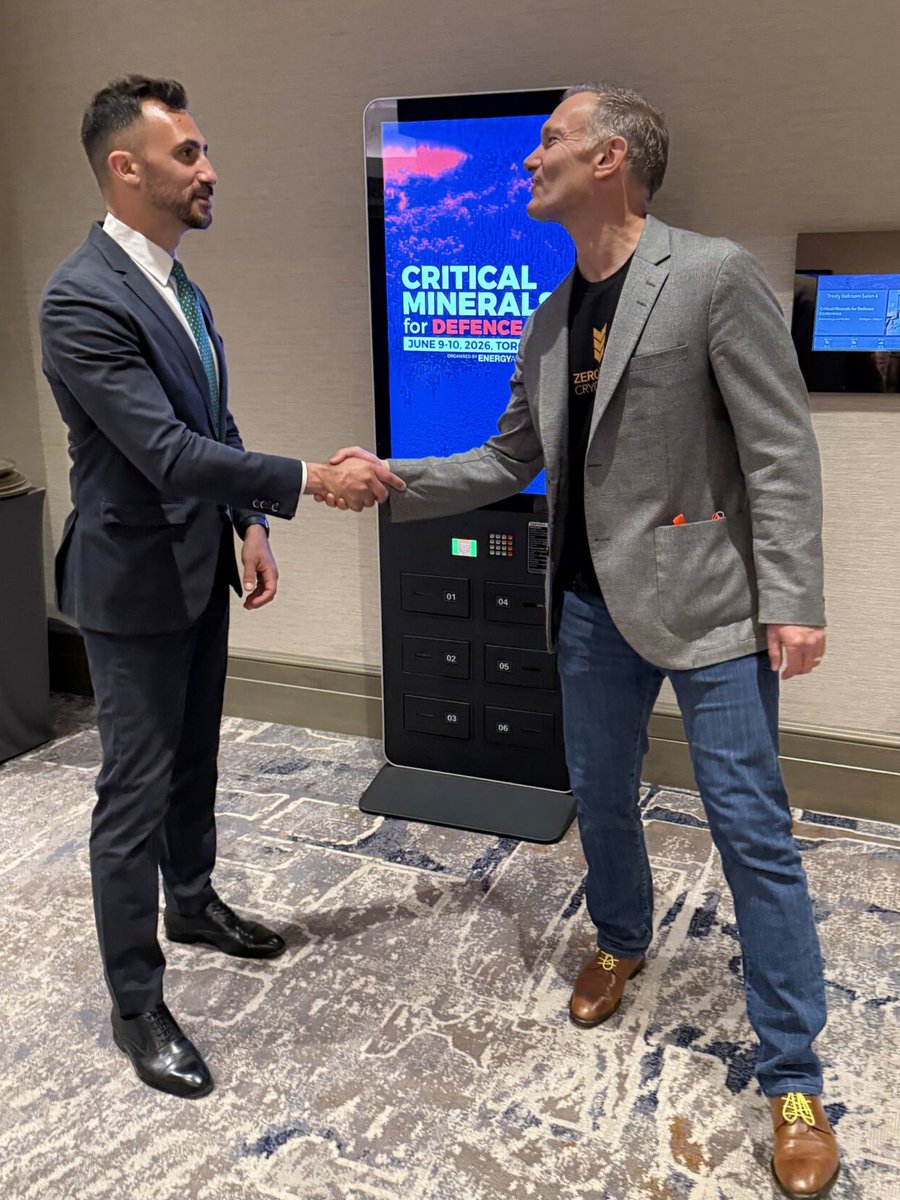
Zero Point Cryogenics' CEO, Chris Cassin, spent this week submerged in conversations on how defence demand is unlocking new opportunities for critical minerals and redefining Canada’s role in allied defence supply chains.
@Sflecce | @ToddJMcCarthy
#CriticalMinerals #Cryogenics #ColderForLonger #CryogenicSystems #ZeroPoint #Dilution
26
Jun 10
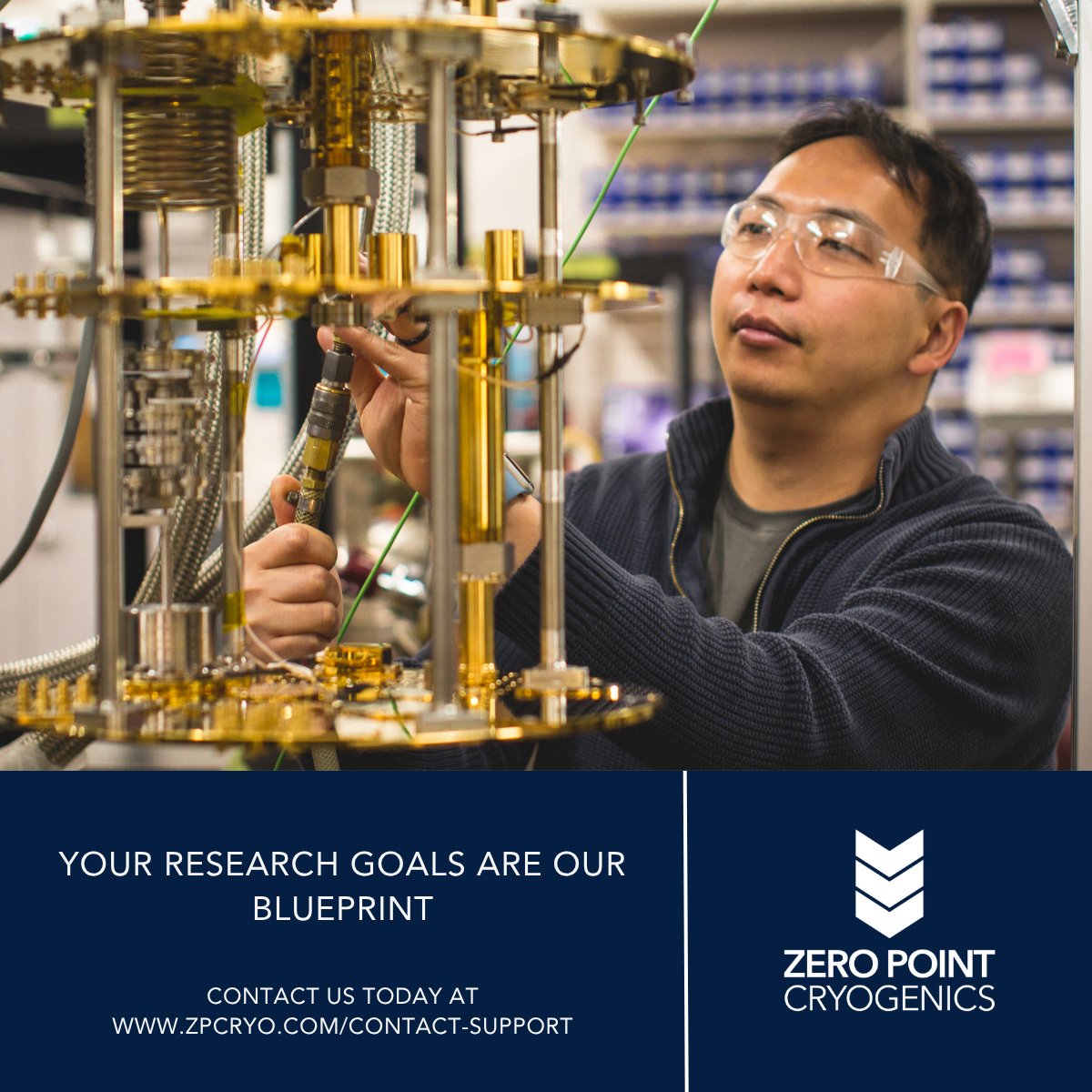
Your Research Goals Are Our Blueprint📝
Our commitment to customization sets us apart. Whether you need complex wiring, advanced optical systems, or an ultra-low-vibration environment, our team makes sure every detail of your build supports your research goals. With Zero Point Cryogenics, you receive a solution that is as unique as your research, ensuring maximum ease of use and reliability for breakthrough performance in quantum technologies.
Contact us today to see how our systems can integrate seamlessly into your lab: zpcryo.com/contact-support/
#Cryogenics #ColderForLonger #CryogenicSystems #ZeroPoint #Dilution
1
16
Zero Point Cryogenics is hiring a Machinist ⚙️
We are looking for a highly skilled, hands-on Machinist who takes pride in precision and craftsmanship. This role is ideal for someone comfortable working in a fabrication and prototype environment who can balance multiple projects while maintaining a high standard of quality. As part of our rapidly growing team in Canada, you’ll join a proud collective of skilled professionals dedicated to solving some of the most complex problems in the field of cryogenics.
Visit our job posting here: ca.indeed.com/job/machinist-…
#Machinist #Hiring #ZPC #ColderForLonger #ZeroPointCryogenics
25
Zero Point Cryogenics at the @canada_quantum DEFSEC forum ⚛︎
Chris Cassin and Aditi Agarwal focused on turning Canada’s quantum strengths into deployed capabilities last week at DEFSEC. ZPC is honored to be a key contributor in Canada’s quantum technology sector and to work with defense, security, and policy leaders to create promising technology for operational quantum systems.
#DEFSEC #QIC #ZPC #QuantumNow #ColderForLonger #CryogenicSystems #ZeroPoint #Dilution
24
May 29
⌛Physics Friday⏳
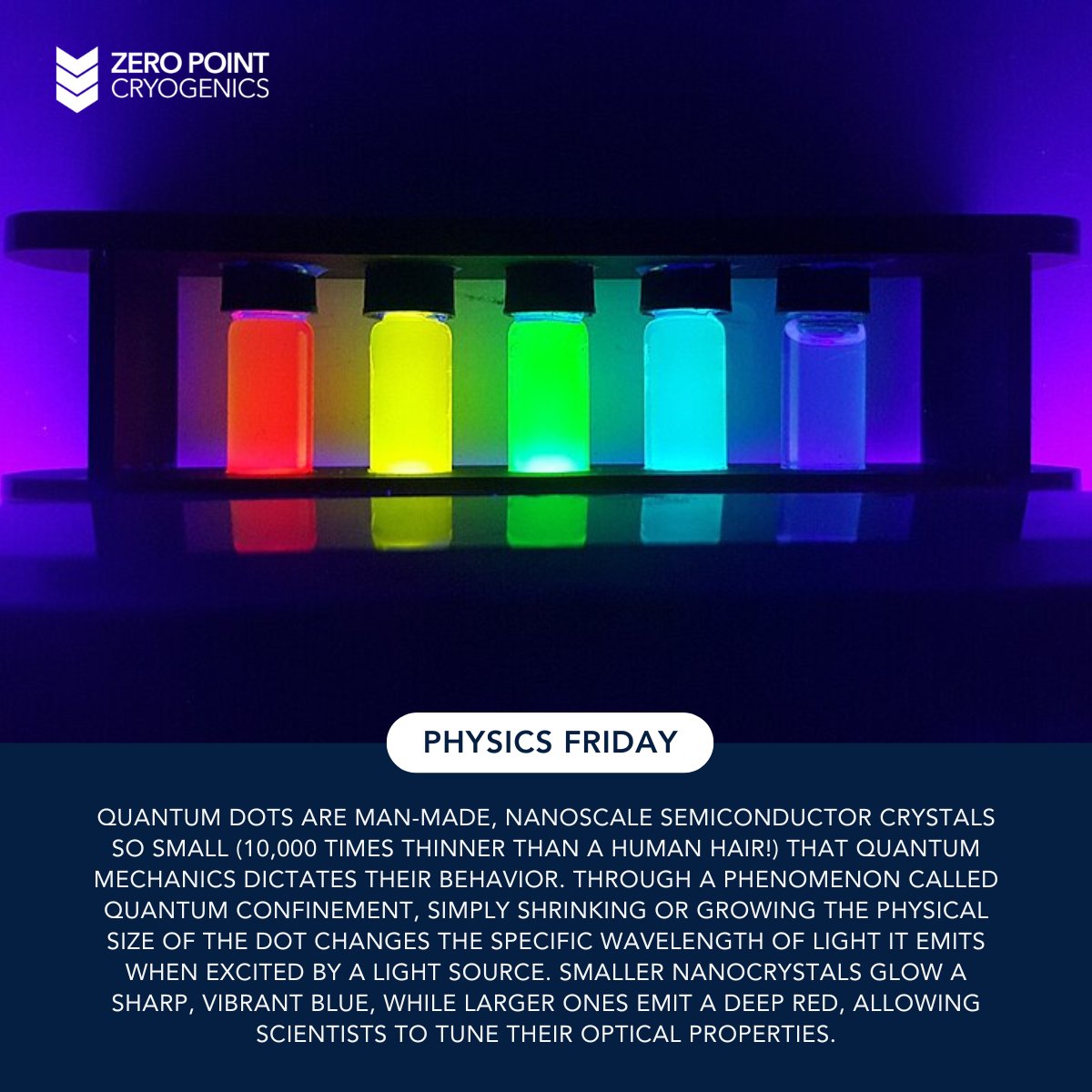
Do you know what quantum dots are?💡
Quantum dots are man-made, nanoscale semiconductor crystals so small (10,000 times thinner than a human hair!) that quantum mechanics dictates their behavior. Through a phenomenon called quantum confinement, simply shrinking or growing the physical size of the dot changes the specific wavelength of light it emits when excited by a light source. Smaller nanocrystals glow a sharp, vibrant blue, while larger ones emit a deep red, allowing scientists to tune their optical properties. This precise control makes them incredibly useful for boosting color accuracy in modern QLED television displays or tracking cancer tumors in medical imaging. There are, however, various types of quantum dots!
Semiconductor quantum dots that rely on cryogenic cooling can generate spin qubits, which are a major focus in quantum computing research. A spin qubit is made when a single electron or a 'hole' (the absence of an electron) is isolated in a quantum dot, and its magnetic orientation (spin state) is used to encode information.
#PhysicsFriday #QuantumDots #ZeroPointCryogenics #Cryogenics #Science
24
May 27
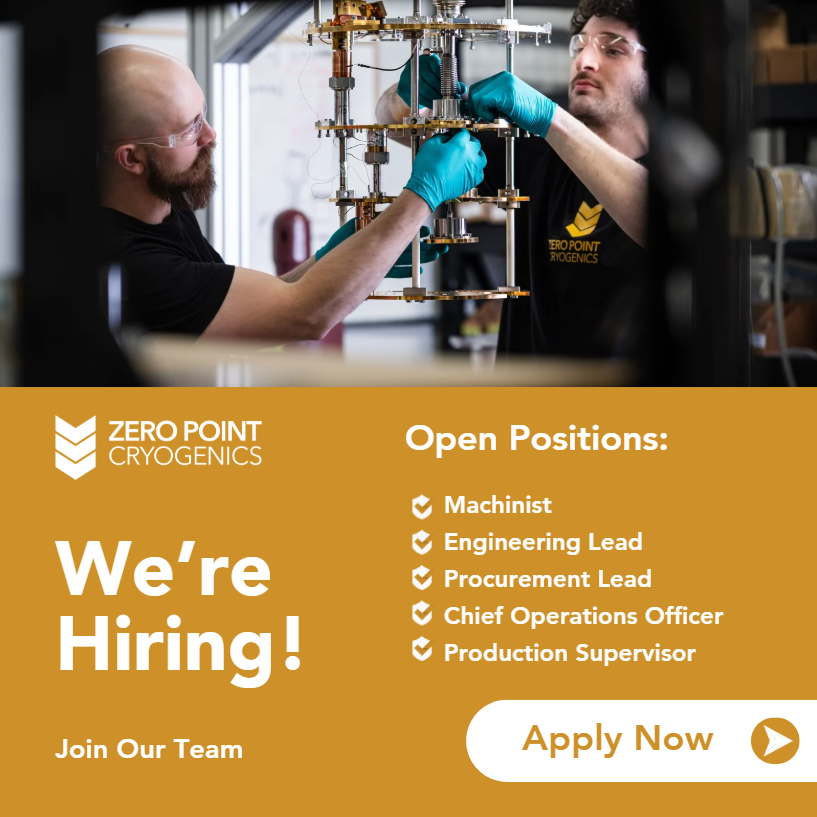
❄️ Zero Point Cryogenics is hiring organization-wide. If you believe you’re a good fit for any of these openings, make sure to apply!
🔧 Engineering Lead: zpcryo.com/current-postings/…
⚙️ Machinist: zpcryo.com/current-postings/…
💻 Procurement Lead: zpcryo.com/current-postings/…
📊 Chief Operations Officer: zpcryo.com/current-postings/…
👷 Production Supervisor: zpcryo.com/current-postings/…
#Hiring #MadeInCanada #Cryogenics #TechJobs #ColderForLonger
1
35
May 26
Zero Point Cryogenics named to The Sovereign Stack🛡️
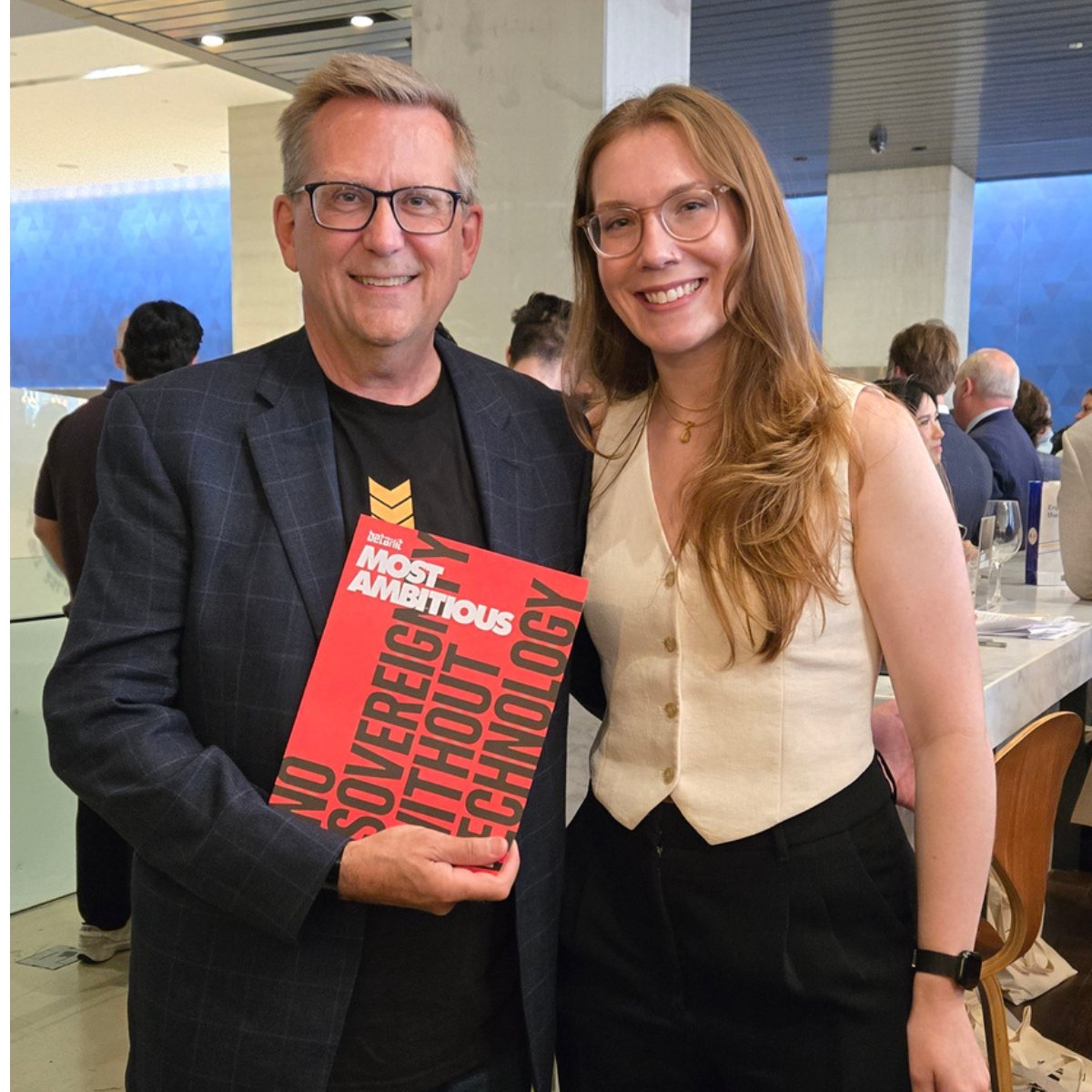
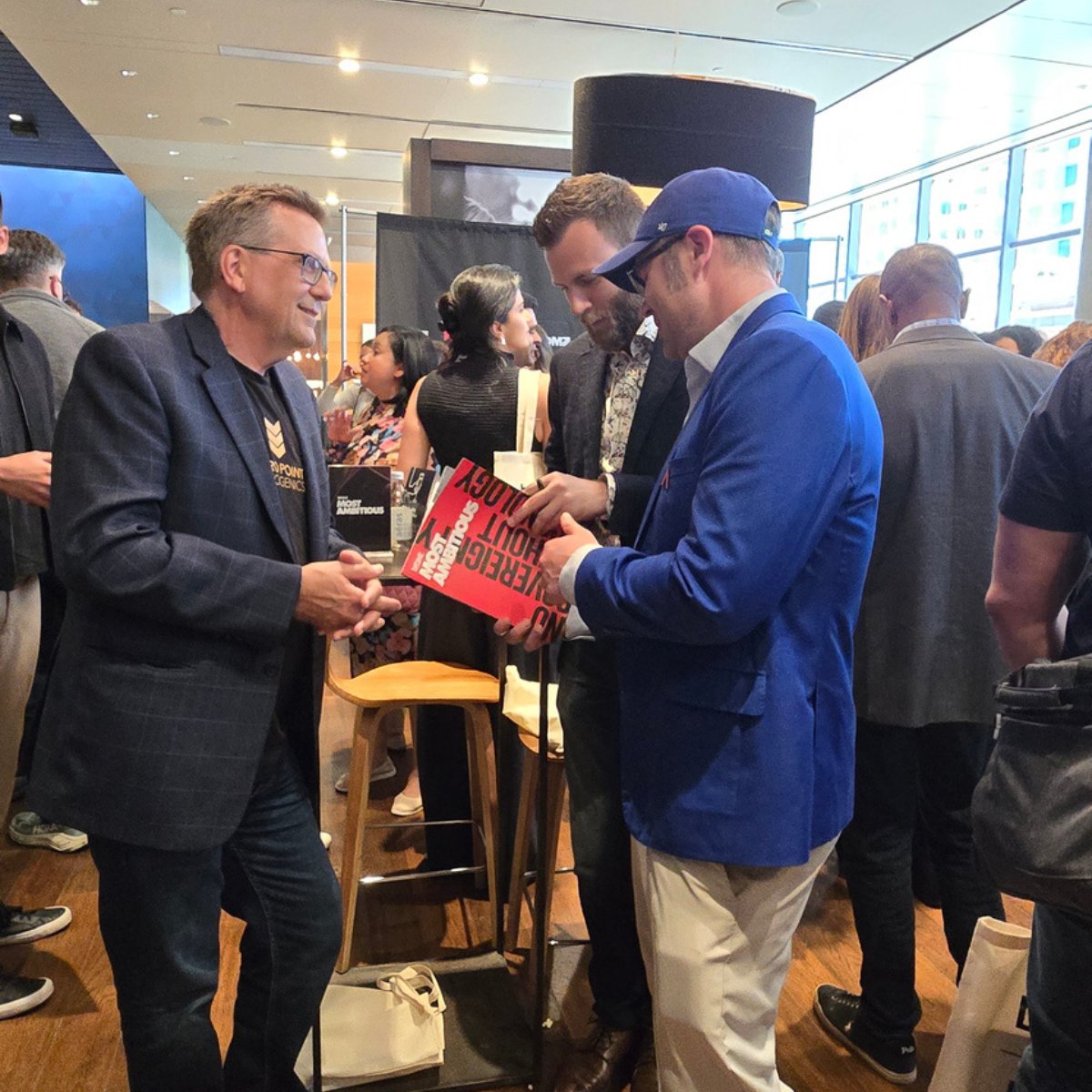
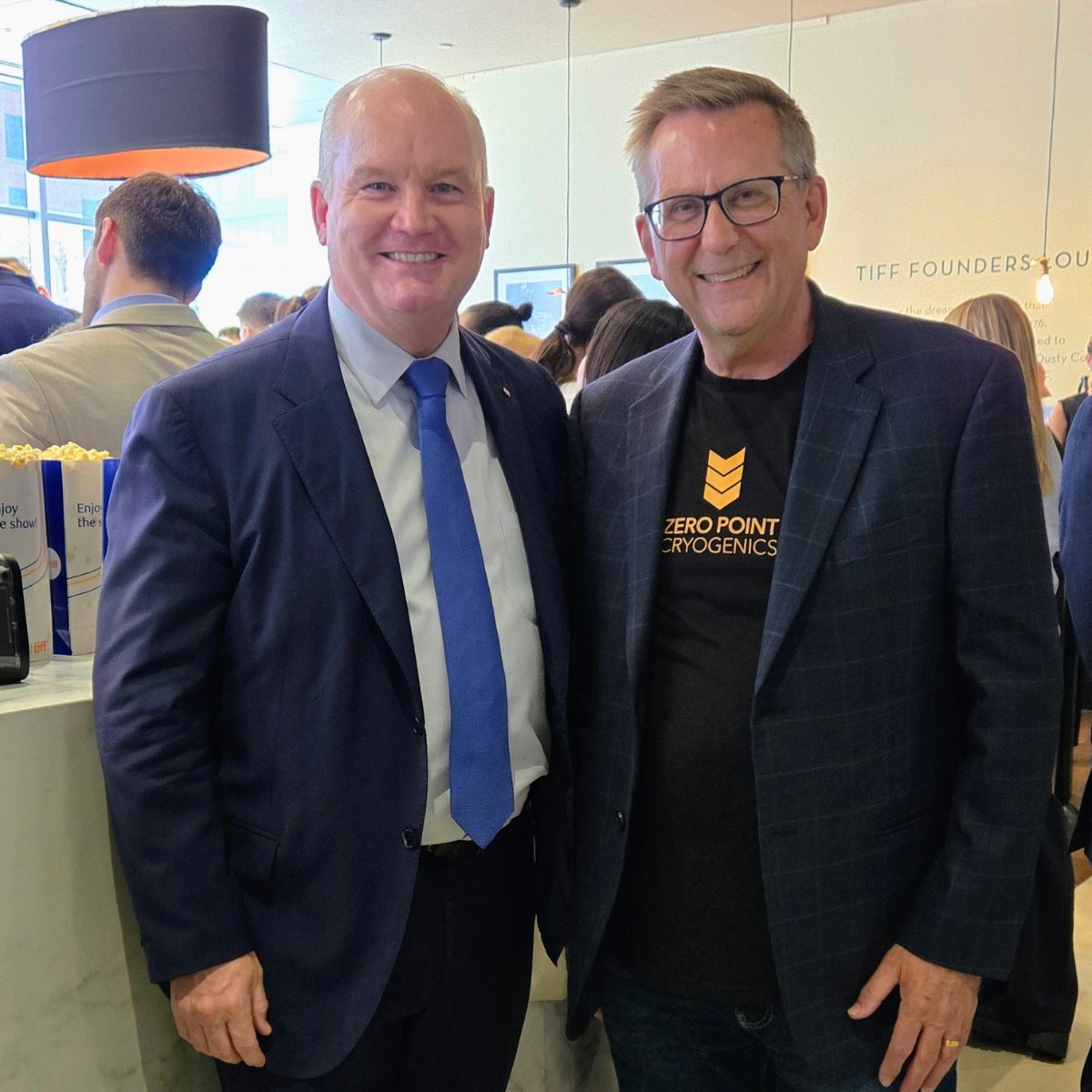
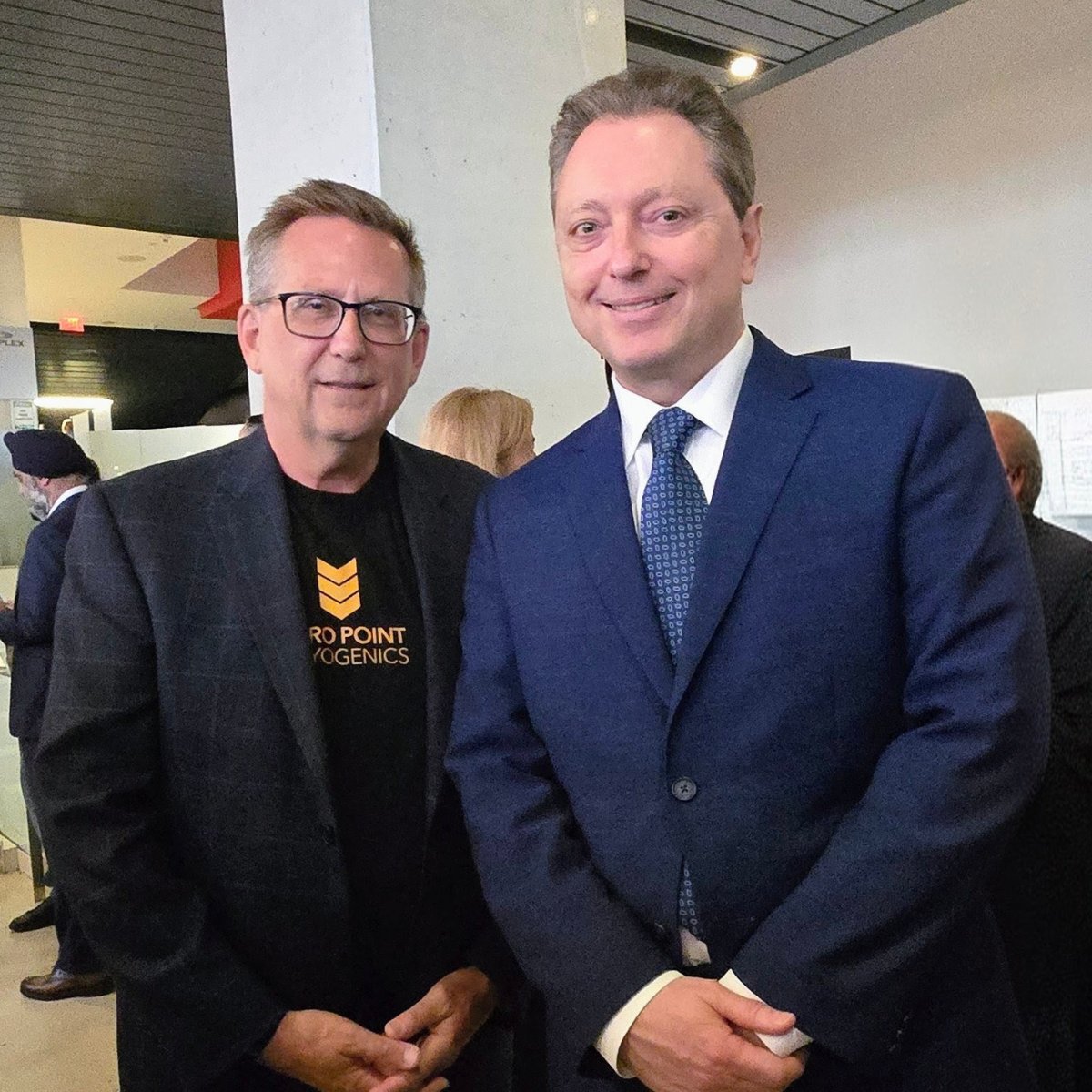
Doug Johnson was thrilled to represent Zero Point Cryogenics at BetaKit's Most Ambitious 2026 event at the TIFF Lightbox to kick off Toronto Tech Week! We are honored to be included in The Sovereign Stack, and we thank @BetaKit for recognizing the critical hardware engines powering quantum technologies and national defense.
CEO Chris Cassin shared: “True quantum sovereignty requires looking at the entire supply chain. Whether a quantum system operates near absolute zero or at room temperature, cryogenic infrastructure is an essential link in the quantum supply chain and in securing Canada’s quantum future."
Read more here! zpcryo.com/highlights/betaki…
Fellow Honouree Kristen Cote with @WyvernSpace | Event sponsor Zach Storms with @Startup_TNT | Erin O'Toole | Stephen Crawford
#BetaKitMostAmbitious #MostAmbitious2026 #ZeroPointCryogenics #CanadianTech #QuantumComputing #ColderForLonger #TorontoTechWeek
1
5
323
May 25
Zero Point Cryogenics Honoured in BetaKit's Most Ambitious 2026!❄️
Zero Point Cryogenics is proud to be named to BetaKit’s Most Ambitious 2026 list, which highlights the visionary builders driving Canadian tech forward.
Zero Point Cryogenics is playing a vital role in securing Canada's technological sovereignty by manufacturing the ultra-low temperature dilution refrigerators essential to the quantum computing ecosystem. Thank you to @BetaKit and our incredible team for helping us innovate and grow.
We have everything we need to build the Canada we want.
Read the full feature here: mostambitious.betakit.com/?u…
#BetaKitMostAmbitious #MostAmbitious2026 #ZeroPointCryogenics #CanadianTech #Cryogenics #Dilution #ColderForLonger
1
3
279
May 22
⌛Physics Friday⏳
Do you know the vacuum comparison between man-made vacuums and outer space?
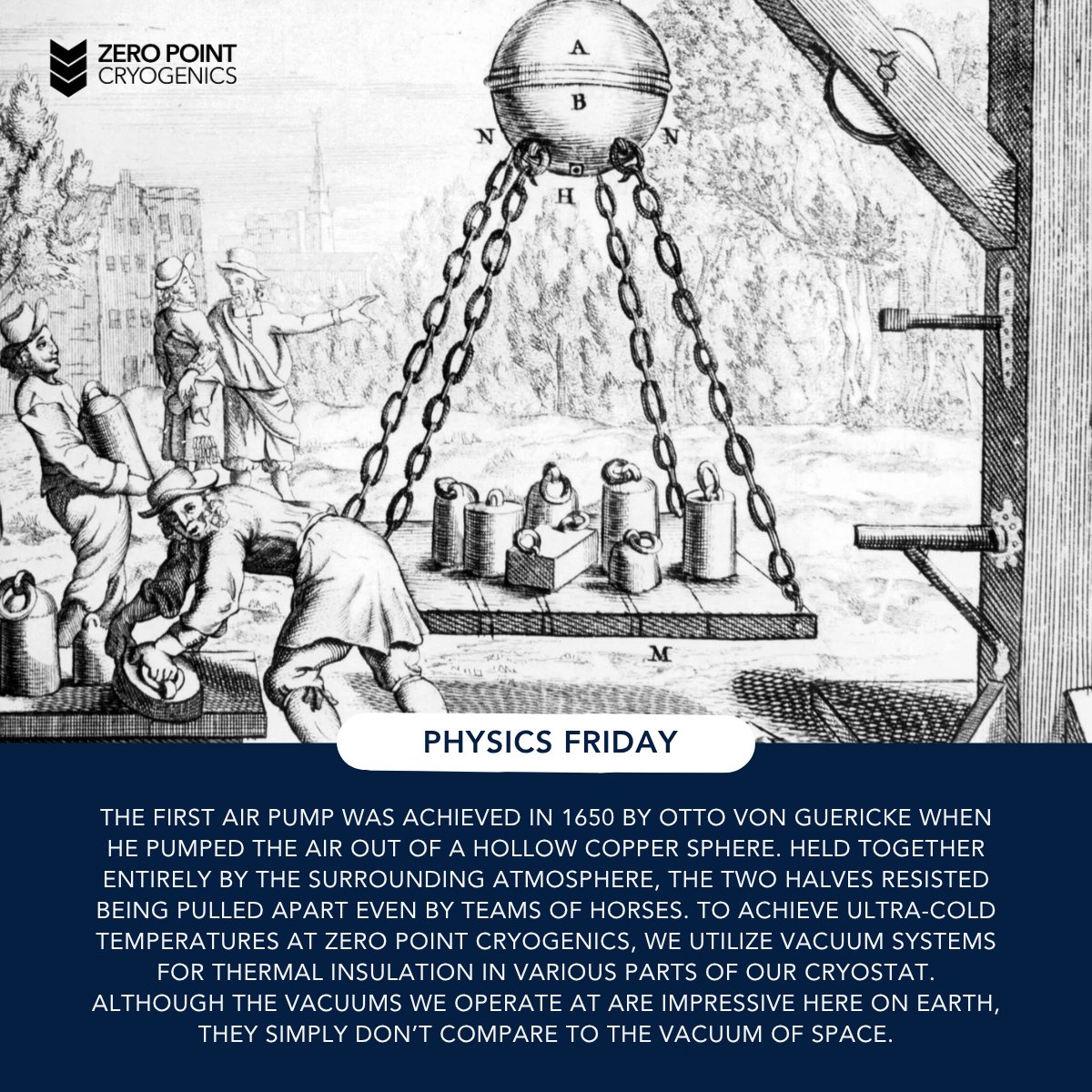
The first air pump was achieved in 1650 by Otto von Guericke when he pumped the air out of a hollow copper sphere. Held together entirely by the surrounding atmosphere, the two halves resisted being pulled apart even by teams of horses. To achieve ultra-cold temperatures at Zero Point Cryogenics, we utilize vacuum systems for thermal insulation in various parts of our cryostat. Although the vacuums we operate at are impressive here on Earth, they simply don’t compare to the vacuum of space:
Atmospheric Pressure: 1E 3 mbar
ZPC Turbomolecular Pumping: 1E-3 mbar
ZPC Cryopumping: 1E-6 mbar
Ultra-High Vacuum (UHV): 1E-11 mbar
Intergalactic Space: 1E-22 mbar
In the intergalactic medium, there is only about 1 atom/cm³. This is 100 billion times emptier than our best man-made vacuums, creating a natural void where an atom could travel for light-years without ever hitting another particle. Compared to the best vacuum in our dilution refrigerators and cryopumps, the effect of trapping gas molecules to cold surfaces falls very short compared to the cosmos' natural vacuum!
#PhysicsFriday #Vacuum #ZeroPointCryogenics #DeepSpace #Cryogenics #Science
18
May 20
Welcome, Zero Point Cryogenics' full-time Chief of Staff: Aditi Agarwal!
You might remember Aditi from her time as an MBA fellow through the Creative Destruction Lab, but we are thrilled to officially welcome her back in her new permanent role as Chief of Staff! She spent over four years working as a corporate lawyer providing counsel to multinational corporations across M&A, private equity, arbitration, insolvency, and regulatory proceedings. When she’s not keeping our operations running smoothly, you can find her mastering a new dance style or planning her next well-deserved beach getaway.
Welcome to the team, Aditi!
#NewHire #ChiefofStaff #ZeroPoint #Cryogenics #ColderForLonger
25
May 15
⌛Physics Friday⏳
Do you know what the coldest naturally occurring place in the universe is?🌌
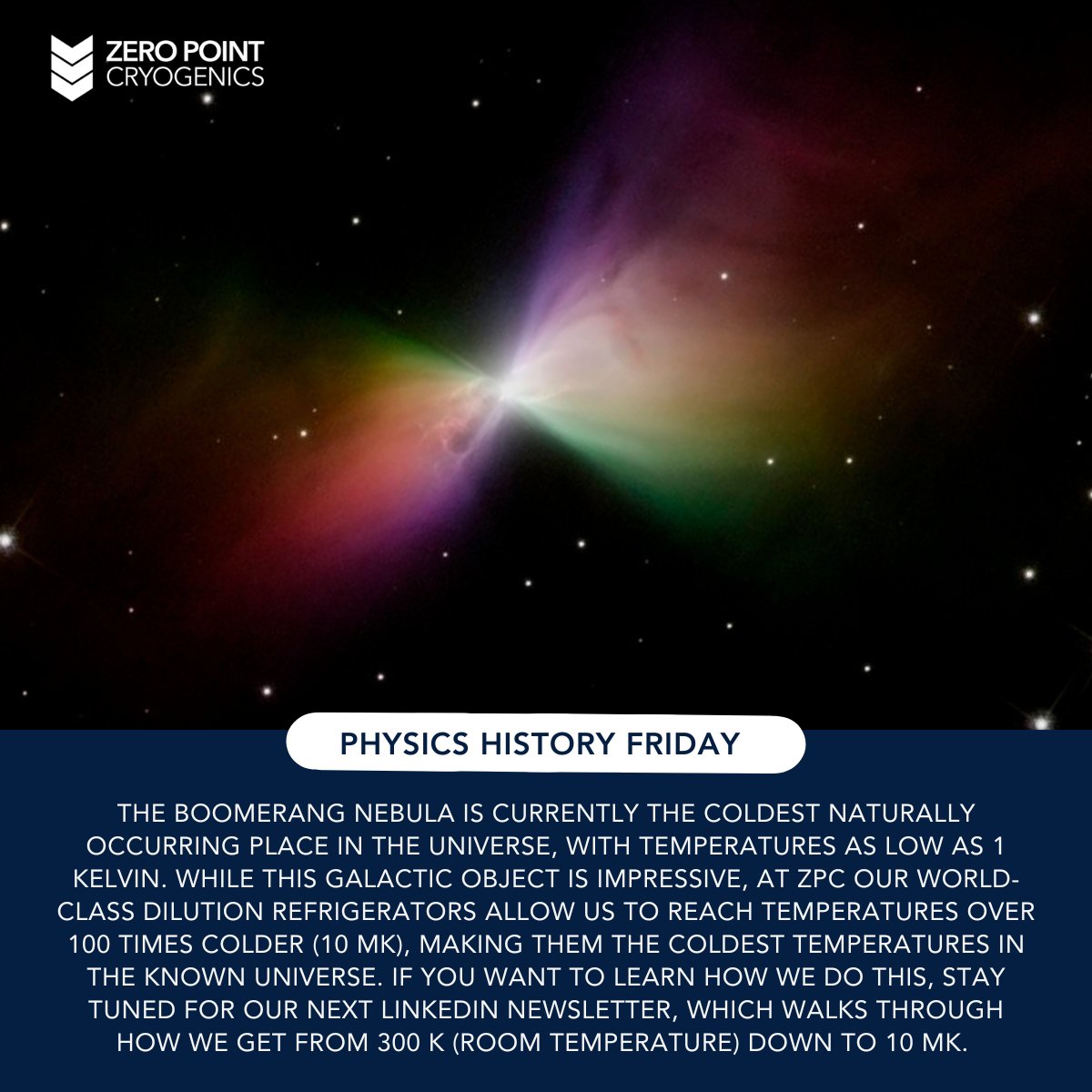
The Boomerang Nebula is the coldest naturally occurring place in the universe, with temperatures as low as 1 Kelvin (-272 degrees Celsius, or -458 degrees Fahrenheit). It reaches this temperature through rapid adiabatic expansion, the Joule-Thomson effect, where gas (from a dying star) rushes outward, and in this case, creates a planetary nebula. The Boomerang Nebula is unique because it's losing mass about 100 times quicker than other similar stars. The reason as to why is still not confirmed, though data from the ALMA radioscope array suggests that it may be a result of a cosmic collision.
The Cosmic Microwave Background (CMB) Radiation is the 2.7 K leftover heat from the Big Bang and is the average temperature of empty space. Typically, the average nebula (10 K to 10,000 K) is cooled by the CMB, however, the Boomerang Nebula's expansion is so powerful that it's actually absorbing the CMB radiation. It is currently the only place in nature that acts as a "heat sink" for the rest of the universe.
While this galactic object is impressive, at ZPC our world-class dilution refrigerators allow us to reach temperatures over 100 times colder (10 mK), making them the coldest temperatures in the known universe. If you want to learn how we do this, stay tuned for our next LinkedIn newsletter, which walks through how we get from 300 K (room temperature) down to 10 mK.
#BoomerangNebula #Cryogenics #Science #PhysicsFriday #ColderforLonger #ZeroPoint
25
May 13
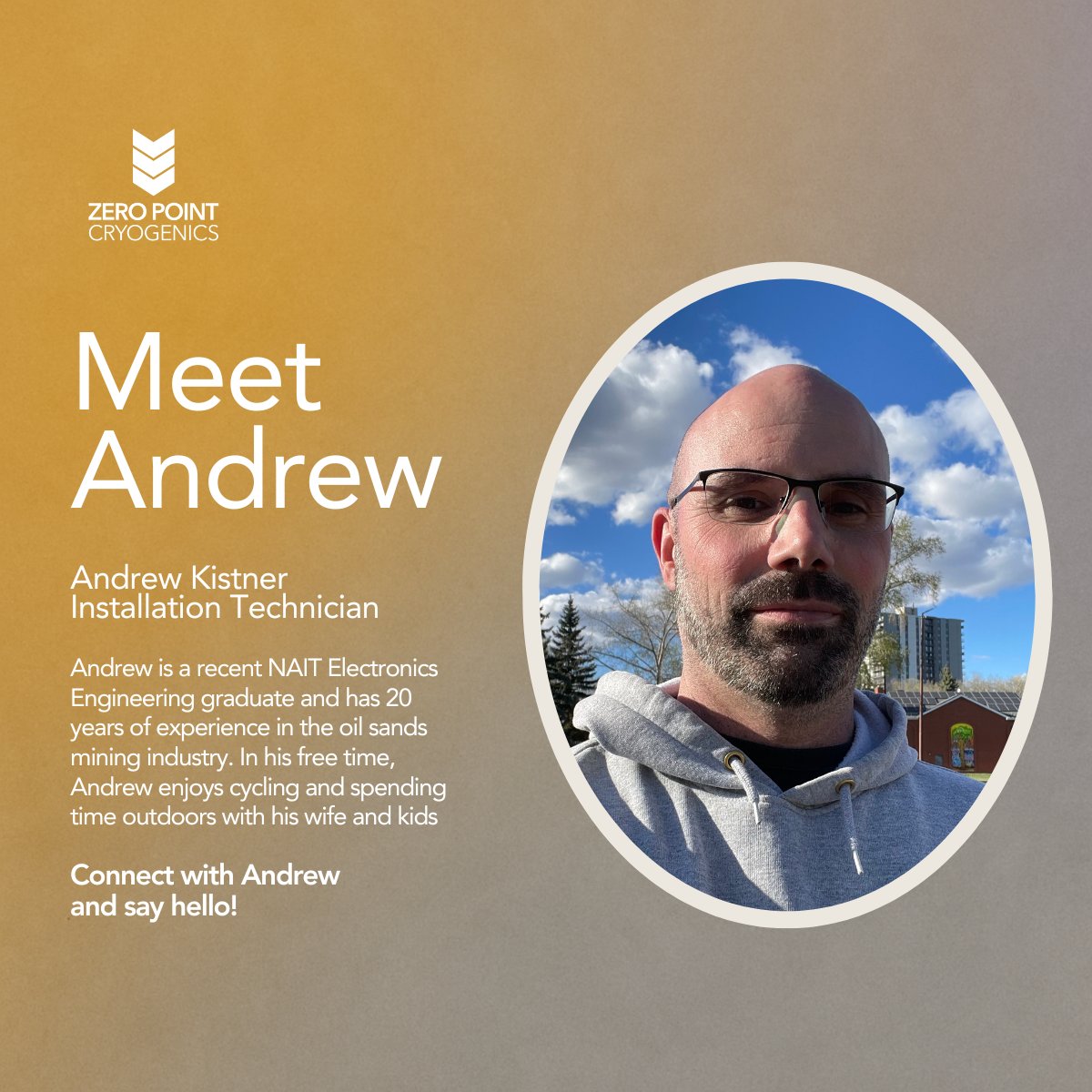
Welcome, Zero Point Cryogenics' full-time Installation Technician: Andrew Kistner!
Andrew is a Journeyman Automotive Technician and a recent NAIT Electronics Engineering graduate. With 20 years of experience in the oil sands mining industry, he specializes in heavy-duty equipment repair and maintenance planning. In his free time, Andrew enjoys cycling and spending time outdoors with his wife and kids.
Welcome to the team, Andrew!
#NewHire #InstallationTechnician #ZeroPoint #Cryogenics #ColderForLonger
1
35
May 11
The Model L - Scattering Cryostat 🔬
It's been three months since we introduced the Model L - Scattering, a beamline cryostat designed specifically for neutron and x-ray experiments. This system utilizes our integrated dilution refrigerator to deliver the stability and atypical geometries required for high-precision materials characterization.
🔗 Read the full post: zpcryo.com/highlights/introd…
#Cryogenics #ZPC #MaterialsScience #CanadianInnovation #ColderForLonger #NeutronBeamline
30
⌛Physics Friday⏳
Do you know about the Ig Nobel Prize?
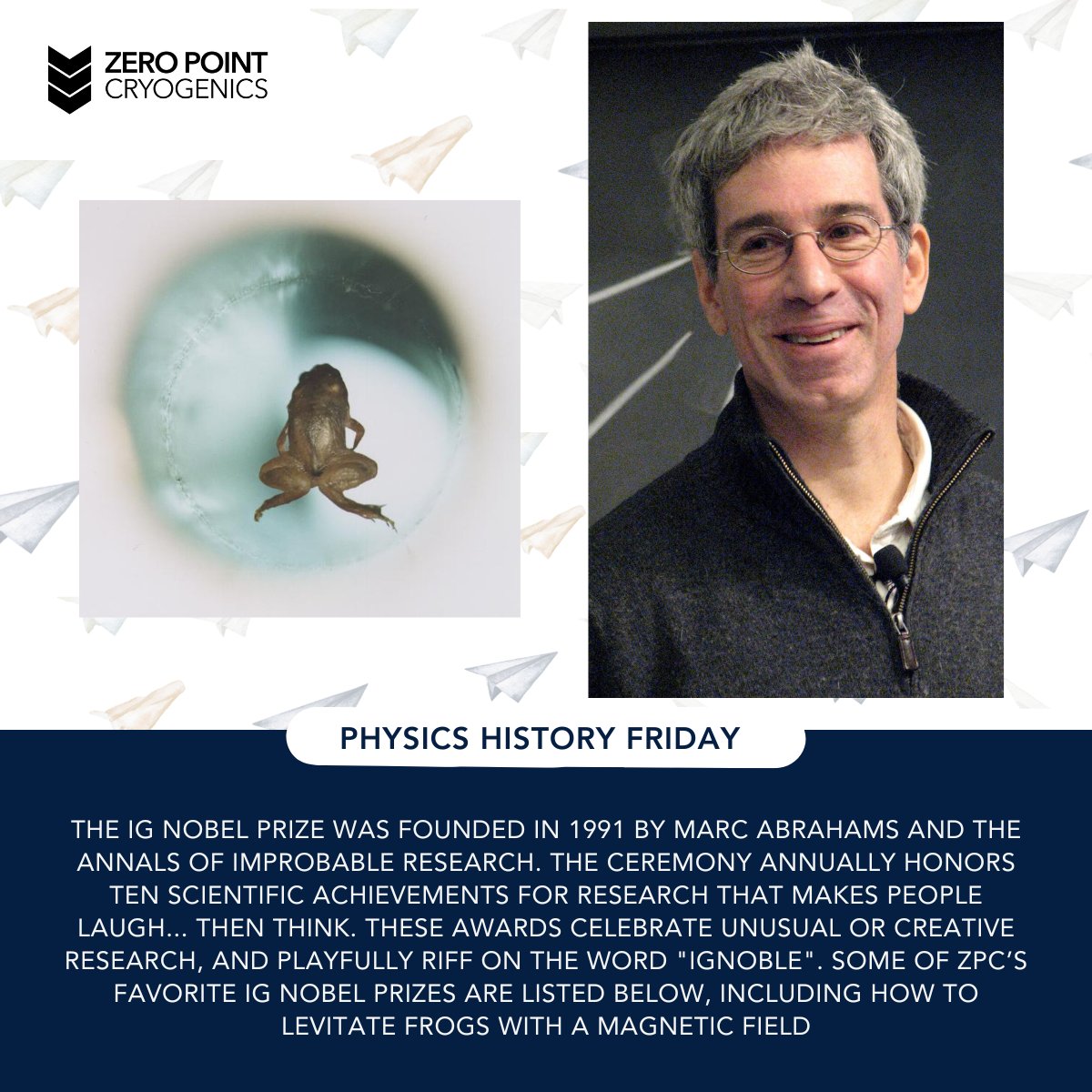
The Ig Nobel Prize was founded in 1991 by Marc Abrahams and the Annals of Improbable Research. The ceremony annually honors ten scientific achievements for research that makes people laugh... then think. These awards celebrate unusual or creative research, and playfully riff on the word "ignoble". Winners are presented their awards by actual Nobel laureates during a chaotic ceremony, initiated by the throwing of paper airplanes, a metaphor for the lighthearted approach to serious science. Recipients receive abstract prizes—such as a 10 Trillion Zimbabwean dollar note. Ultimately, the Ig Nobel Prize proves that even the most imaginative research deserves recognition for bringing serious scientific work to a global audience.
Some of ZPC's favorite Ig Nobel Prizes are listed below:
🐸Levitating frogs with a magnetic field: iopscience.iop.org/article/1…
🍝Phase transitions leading to clumpy pasta sauce: doi.org/10.1063/5.0255841
🥚How to un-boil a boiled egg using shear-stress-mediated refolding of proteins: https: doi.org/10.1002/cbic.2014024…
#Cryogenics #Science #PhysicsFriday #IgNobelPrize #NobelPrize
29
Mental Health Awareness Month at Zero Point Cryogenics 🧠
At ZPC, we’re dedicated to pushing boundaries while staying true to one of our four core values: Enjoy Life. This Mental Health Awareness Month, we’re reminding our community that innovation is only possible when we prioritize our own well-being. Take a moment to breathe, recharge, and stay balanced. 😌
#MentalHealthAwareness #ZeroPointCryogenics #Cryogenics #ColderForLonger
10
⌛Physics Friday⏳
Did you know about the history of the polar and spherical coordinate system?
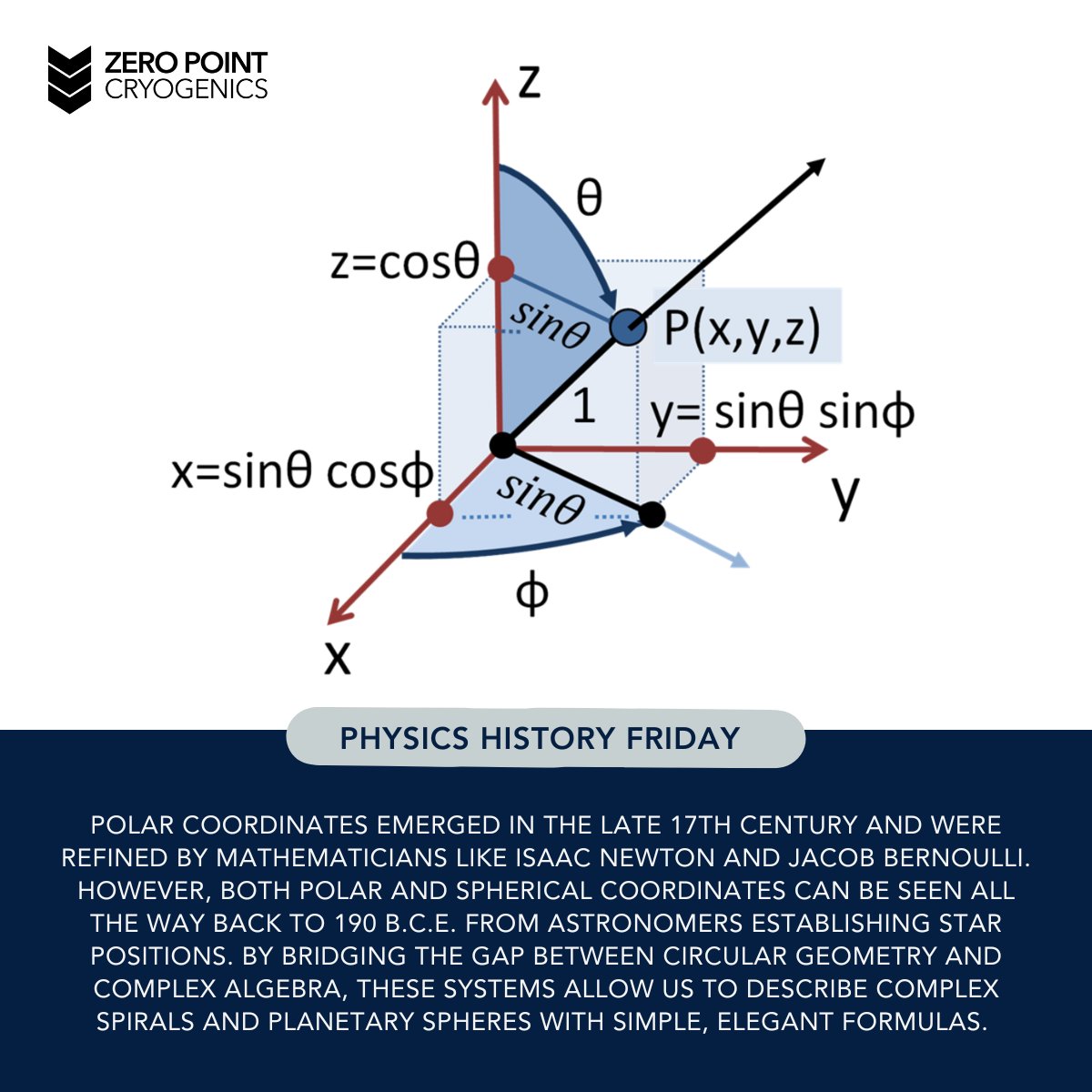
Polar coordinates are used to describe the position of an object on a 2D plane by defining a starting point (the pole, similar to the origin) and a reference direction (the polar axis). Instead of moving in "left-right" or "up-down", you simply rotate to an angle and move outward. Because these coordinates are perfectly suited for "round" or rotational problems, they are used daily in radar and sonar technology, maritime navigation, and tracking the orbits of planets and satellites. When you add a third dimension to account for depth or altitude in a curved space, you transition from 2D polar coordinates into 3D spherical or cylindrical coordinates (depending on the added dimension).
Polar coordinates emerged in the late 17th century and were refined by mathematicians like Isaac Newton and Jacob Bernoulli. However, both polar and spherical coordinates can be seen all the way back to 190 B.C.E. from astronomers establishing star positions. By bridging the gap between circular geometry and complex algebra, these systems allow us to describe complex spirals and planetary spheres with simple, elegant formulas.
#PolarCoordinates #SphericalCoordiantes #CoordinateSystem #Science #PhysicsFriday #ZeroPoint
1
38
Apr 29
ZPC at Northwestern Quantum Week ⚛️
Dr. John P. Davis had a fantastic time at Northwestern Quantum Week, fostering connections between quantum research scientists, industry leaders, and other experts dedicated to quantum innovation.
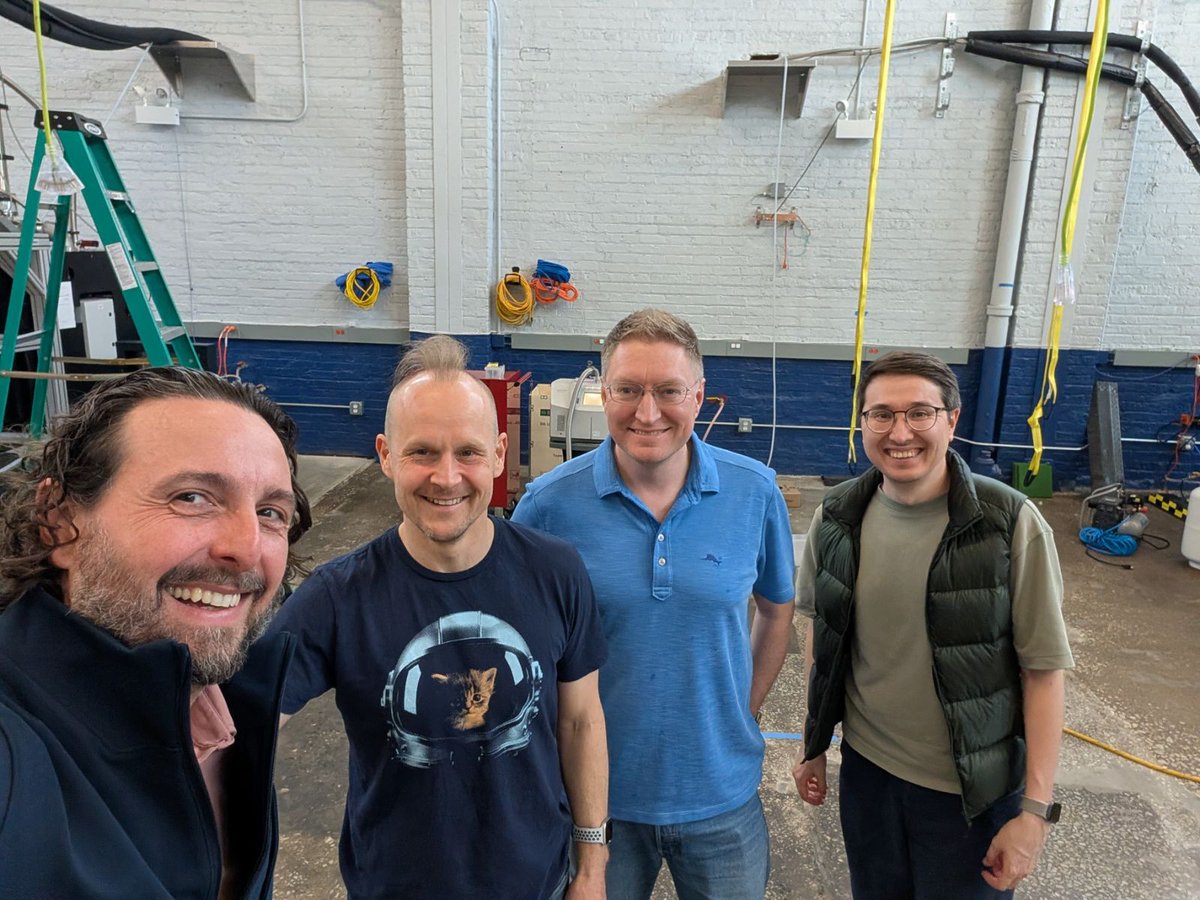
A highlight of the trip was touring the facility at @QCHardware alongside Dr. Johannes Pollanen, Dr. David Rees, and Dr. Niyaz Beysengulov.
#QuantumComputing #Northwestern #NorthwesternQuantumWeek #TechInnovation #ZPC #ColderforLonger
2
4
157
Apr 27
ZPC at the ISIG Quantum Computing Infra Summit 2026! ⚛️
Chris Cassin and David Lang had a fantastic time at the ISIG QC Infra Summit last week! The Plug and Play Center was the perfect hub to connect with so many innovative teams and visionaries.
It’s always inspiring to see the rapid evolution of quantum infrastructure firsthand. We're proud to build the critical cooling systems that will make quantum technology possible worldwide. ❄️
#QuantumComputing #ISIG2026 #TechInnovation #ZPC #Infrastructure
39
Apr 24
⌛Physics Friday⏳
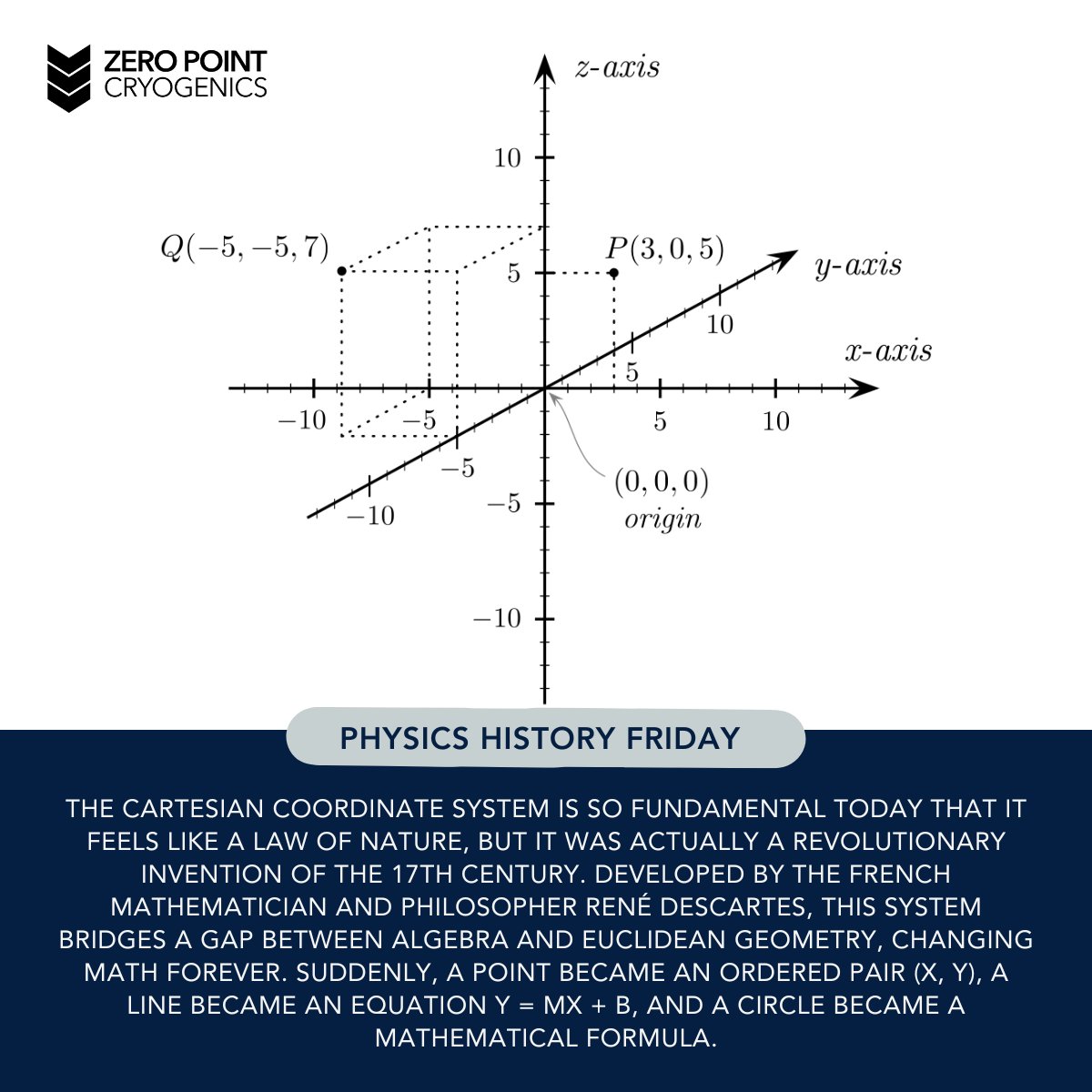
Did you know about the history of the Cartesian coordinate system?
The Cartesian coordinate system is used to describe the position of an object in 2D or 3D space by defining a starting point (the origin) where axes intersect. In 3D space, these lines are defined as the x-axis, y-axis, and z-axis. Because these coordinates are well-suited to "box-shaped" or linear problems, they are used daily in architecture, computer graphics, construction, 3D printing, CNC machining, and more.
This system is so fundamental today that it feels like a law of nature, but it was actually a revolutionary invention of the 17th century. Developed by the French mathematician and philosopher René Descartes, this system bridges a gap between algebra and Euclidean geometry, changing math forever. Suddenly, a point became an ordered pair (x, y), a line became an equation y = mx b, and a circle became a defined formula with an origin point and a radius.
Some more complex scenarios, like curved paths of rocket orbits, require a more compatible coordinate system. Next week, we’ll explore the history and use of polar coordinates.
#Cartesian #CoordinateSystem #Science #PhysicsFriday #ZeroPoint
23
Apr 22
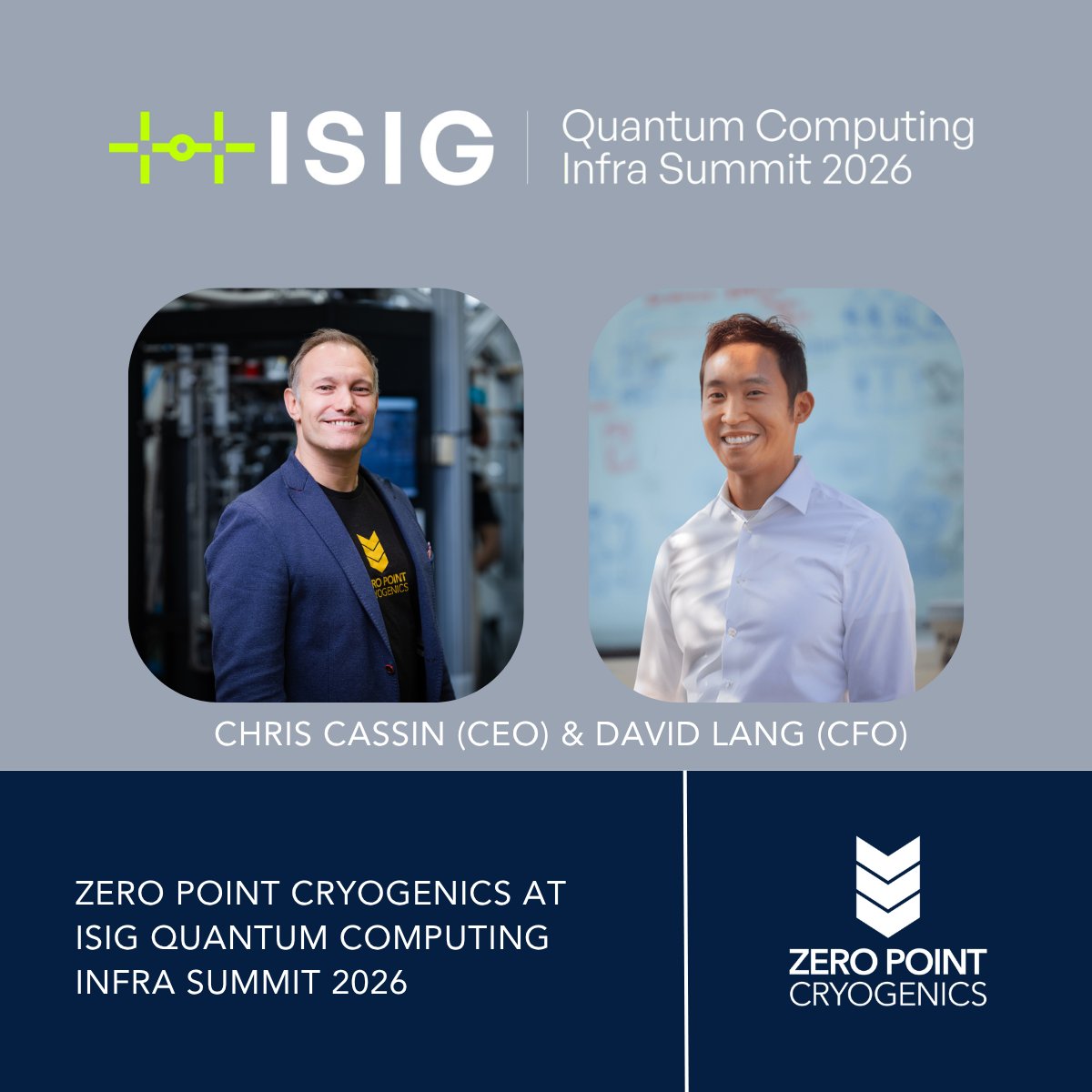
Getting ready for the future of tech at the ISIG Quantum Computing Infra Summit 2026! 🚀
Tomorrow, ZPC will be hosting a table at the ISIG QC Infra Summit in Silicon Valley, and we can’t wait to connect with you in person. Come meet Chris Cassin (CEO) and David Lang (CFO) to chat about the latest infrastructure trends, grab some exclusive insights, and see what we’ve been building. We’ll see you at the summit!
#ISIG #Cryogenics #ZeroPoint #MadeInCanada #Innovation #Dilution #DilFridge
42