
Founder @WSOURCE4 Chair @hongkong_israel V. Partner @r3iventures xCMO @SpacePharma CMO/COO @Rideonvision Ex @Philips #Investor #tech2market #web3 #HumanRights
Joined June 2016
- Tweets 6,059
- Following 804
- Followers 858
- Likes 14,090
568 Photos and videos






Pinned Tweet

30 May 2023
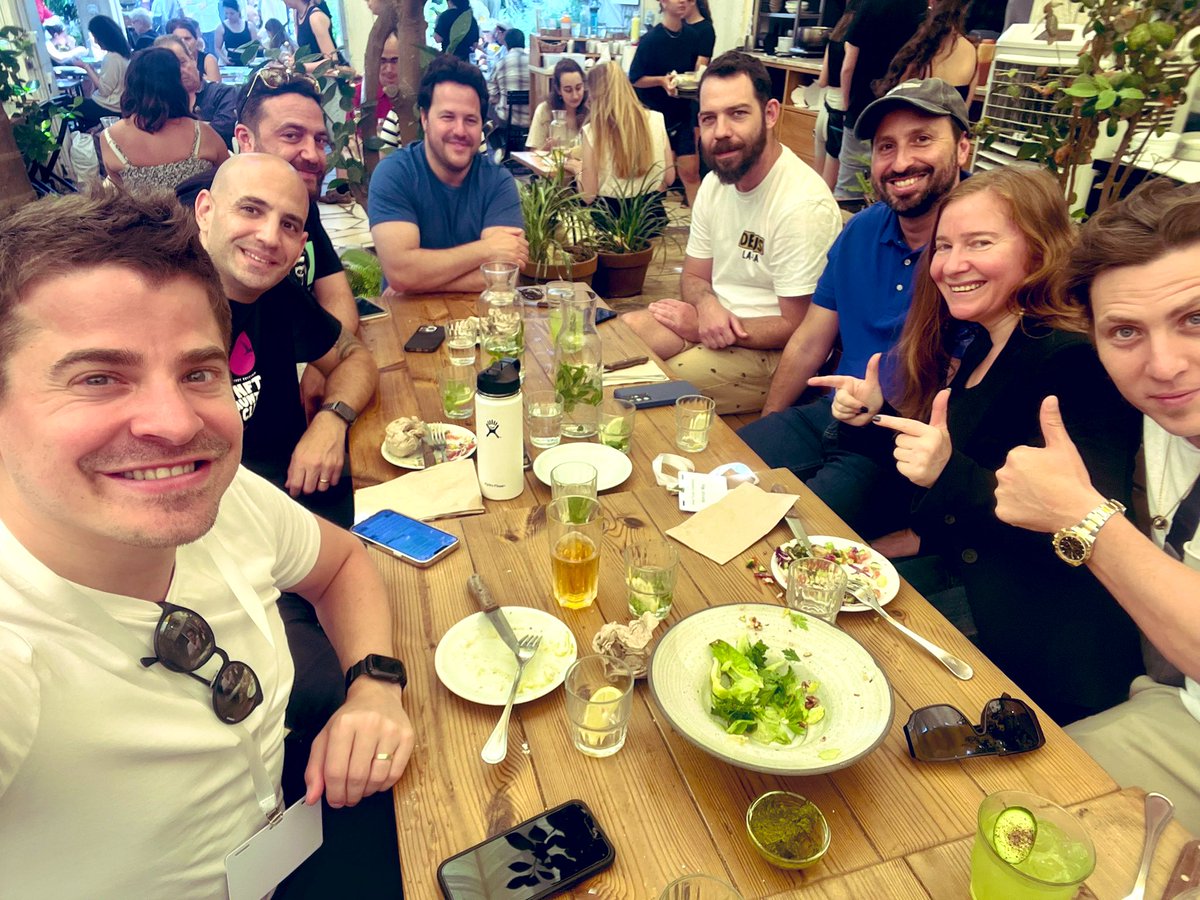
True friendships is when you know you gonna end up eating garlic 🧄in a middle of the day 🤦🏼♀️and you still join them 🧯🤣 #פרלמנט @NFTradeOfficial @MightyLabsDAO @wsource4 @SecretNetwork @KryptomonTeam
5
20
64
37,351
👀
Jun 13

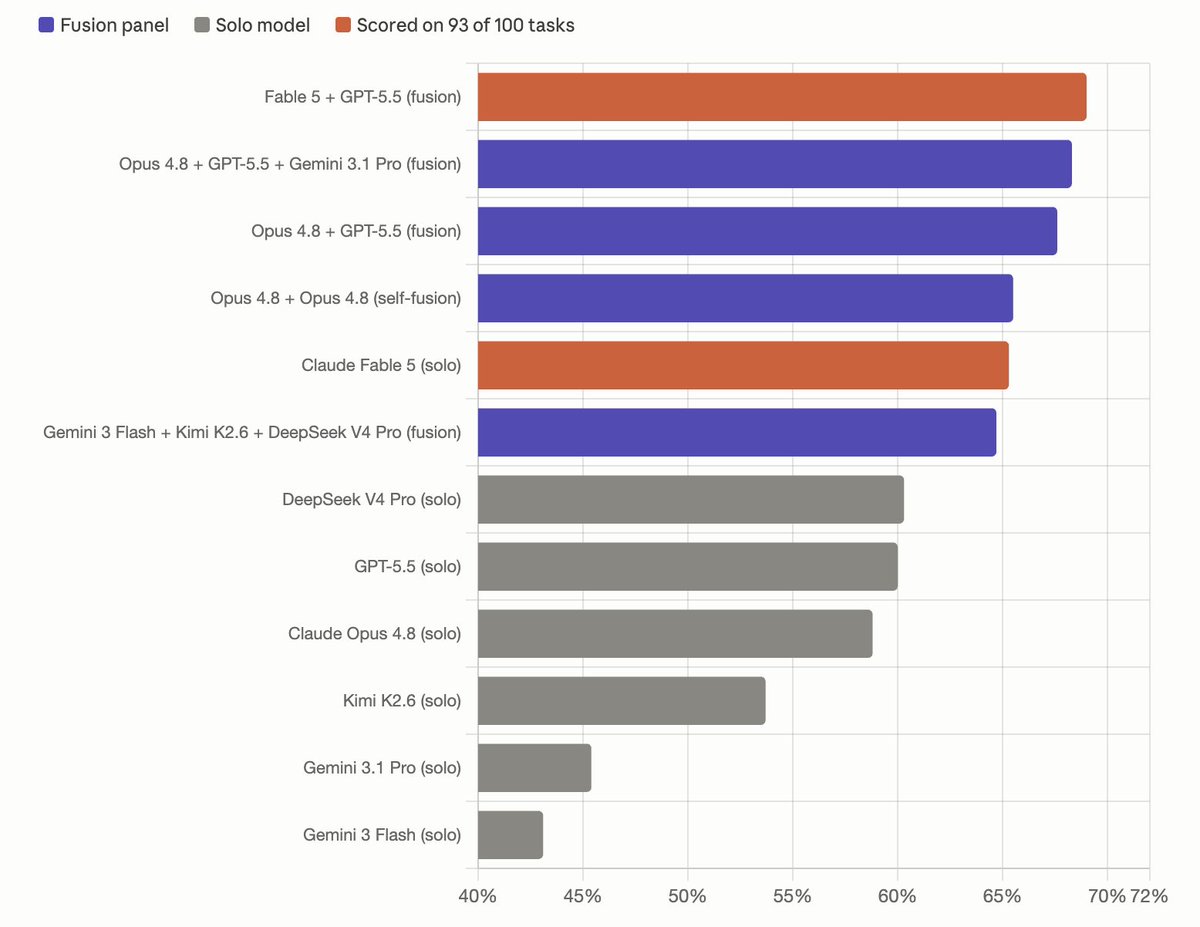
Introducing the Fusion API, the smartest compound model in the market.
Fusion achieves Fable-level intelligence at half the price.
How it works 👇
1
25
Valid explanation.
At the same time, I have not seen one single valid report of Mytbos extended cyber capabilities 🤷♀️
Jun 13

I’ve had a number of conversations with folks inside and outside government about the current situation with Anthropic, and here is what I believe to be true:
— As we know, Anthropic publicly released its Mythos class models earlier this week under the commercial name Fable.
— Fable is Mythos with guardrails. But if those guardrails fail, then you’ve exposed Mythos and its advanced cyber capabilities to people who shouldn’t have them. (Keep in mind that Anthropic itself widely promoted the idea that Mythos was a cyberweapon and needed to be regulated as such. They asked for government regulation of Mythos and championed the guardrails on Fable. If there is a vulnerability — big or small — it is Anthropic’s responsibility to patch.)
— A highly credible trusted partner of both Anthropic and the USG who was testing Fable came forward with a jailbreak of those guardrails. The Admin asked Dario to fix the jailbreak or de-deploy the model. Dario refused.
— In their blog post, Anthropic defended its decision by saying the jailbreak isn’t serious. That is not what the trusted partner and the USG believe; nor is that kind of minimizing language consistent with Anthropic’s brand as the AI safety company. It’s difficult to fathom how they could claim a jailbreak allowing operability of a cyber weapon could be defined as not “serious.”
— In the past, Anthropic has always said that safety must be top priority and taken super seriously. In this case, Anthropic prioritized the continued offering of the consumer model over safety.
— In reaction, the Admin issued the export control. The Admin did this reluctantly. It’s been very surprised that Anthropic hasn’t wanted to cooperate with a reasonable safety request (ie fixing the jailbreak issue). Anthropic’s reaction is very much at odds with their branding and ethos as a safe AI research community.
— The Admin’s hope now is that Anthropic remediates the safety issue, the export control is lifted, and Fable goes back into general release. The Admin wants all of this to happen as soon as possible. It is frankly bewildered that Anthropic hasn’t wanted to comply with safety requests that it previously said were its highest priority.
— Those trying to misdirect and tie this action to the prior DoW/Anthropic issues are wrong. The Admin values Anthropic’s technical capabilities and feels that this issue, while serious, should be easily resolved. The ball is in Anthropic’s court.
4
24
Jun 13
Strikes me more as PR move 🤷♀️ Have not seen any evidence of Mythos’ capabilities that would justify such a move. 🍿
Jun 13

The US government, citing national security authorities, has issued an export control directive to suspend all access to Fable 5 and Mythos 5 by any foreign national, whether inside or outside the United States, including foreign national Anthropic employees.
The net effect of this order is that we must abruptly disable Fable 5 and Mythos 5 for all our customers to ensure compliance.
Access to all other Claude models is not affected.
We apologize for this disruption to our customers. We believe this is a misunderstanding and are working to restore access as soon as possible.
Read our full statement: anthropic.com/news/fable-myt…
4
70
Jun 12
Well Selkis, looks like your business is finally in the good hands 👌
Jun 12

Crypto-Data Provider Blockworks Acquires Messari at a Discount
wsj.com/business/deals/crypt…
2
46
Jun 12
I believe we got to take measures to make sure the AI we use is safe, yet it should only be done voluntarily and not be imposed.
We can see how exaggerated regulation is killing EU’s innovation and violating basic human rights 🤷♀️
Jun 10

Today I'm publishing a new essay, Policy on the AI Exponential. AI is progressing extremely fast—much faster than the policy process was built to handle. The essay lays out where I think the technology is now, and the action needed to close the gap: darioamodei.com/post/policy-…
1
34
Jun 12
🤣

> your grace, the people can't pay the Claude Fable 5 API, it's too expensive!
> why don't they just buy GPUs

2
28
Jun 12
👀

ELON MUSK:
“We’re going to have universal high income.
We’ll basically just issue money to people."
"AI and robots are going to make so much stuff and provide so many services that they’ll run out of things to do for humans."
"Money will stop being relevant at some point in the future."
"AI won’t use human currency. It will care about power and mass: wattage and tonnage.”
ME:
“So just as you’re becoming a multi-trillionaire, money starts to have less value?”
ELON:
“Yeah, pretty much.”
10
Jun 10
👀

Google withheld key details behind a major quantum-computing breakthrough after speaking with the government.
Then a swarm of AI agents recreated the optimization within a week and surpassed Google’s research by 40% the following week.
Jake Brukhman explains why decentralized AI changes the game:
2
5
179
Jun 10
The true 🐐!!!
#surveillance is not #safety 👏🏻👏🏻👏🏻
Jun 8

Our statement on the UK government’s demand that all content on all devices sold or used in the country be scanned, on the presumption of nudity, using a dystopian combination of age verification and content scanning. This proposal will not safeguard children. It endangers us all.
signal.org/blog/pdfs/2026-06…
1
17
Danielle Tichner retweeted

Jun 9
Whatever AI sceptics say, LLMs really can reason. They're not just doing an imitation that looks like reasoning, it's the real deal.
But even though they are able to reason, sometimes they won't! If you ask an LLM a question it can't answer, sometimes it will just try to imitate reasoning without doing it.
The chain of thought looks basically indistinguishable from actual reasoning. But under the hood something very different is going on.
@TrentonBricken talked with me about what work on circuits inside LLMs has revealed:
66
59
1,076
102,820
Jun 10
👀

Today @Meta is proud to launch America’s Workforce Academy with our partners.
This program will provide paid training, certification and a job for Americans of all backgrounds to be part of building American leadership in the world.
Because we believe the Future is for Everyone.
wsj.com/opinion/high-tech-se…
2
14
Waking up in a shelter 🤦🏼♀️ to “no more code” & no more prompts… Loops only… 🤷♀️
The old Dutch saying comes to mind: the soup is never eaten as hot as it is served 🥣 #staysafe
Jun 7

Here’s your monthly reminder that you shouldn’t be prompting coding agents anymore.
You should be designing loops that prompt your agents.
1
47
👀
Jun 6

Chief AI Officer Alex Wang is subtly confirming that $META's previous AI paradigm failed, and they are executing a strategic shift to close their ecosystem, capture personal data, and build a regulatory moat.
For the last few years, Meta’s entire strategy was to open-source frontier-level models like Llama 2 and 3 to commoditize the foundational layer. Now that Meta is building highly lucrative Personal Agents, they are keeping their best tech proprietary.
1
48
Power to Mira 👏🏻#collaboration ⚡️

Mira Murati says frontier AI should be built like a tandem bike:
"Having humans in the loop doesn't quite describe it because it sounds like a checkpoint where we're signing off something, and then you're good to go."
"It's more like creating systems that are not just autonomously advancing and leaving civilization behind, but are more like a tandem bike."
"When you're going up a hill, maybe whoever is stronger is pedaling harder. But both hands are on the wheel. That's quite important because that's a different system. It's a system designed for collaboration."
"It will increase the level of agency that people have, and also it will help us steer the research direction towards creating outputs that are more value-aligned."
@miramurati at Bloomberg Tech live with @emilychangtv
4
93
👀
Jun 4

Recently met @srush_nlp and he started giving me an impromptu lecture on how targeted on-policy self-distillation works.
I asked him if I could record it on my iPhone.
The basic idea is this: if the model made a mistake at some point in the rollout (for example, calling a tool that doesn't exist), we want to discourage this specific error, but we don't want to just learn from the final reward, because it's a very noisy signal spread out over the whole trajectory.
So we have another model read this trajectory and figure where the error was made. It simply inserts some hint tokens to the part of the trajectory right above where the mistake was made.
Now with these injected hint tokens, have the model run a forward pass. You're not having to regenerate a new rollout - aka no new decode required.
The hint causes the model to assign lower probabilities to the error tokens. You then trains the original model to match these new probabilities, teaching it to downweight that specific mistake.
2
74
1
22
👀
Jun 2

Today a crazy quantum story just got wilder.
On March 31, the Google Quantum AI team published a landmark result on Shor's algorithm for elliptic curve cryptography. Technically, the paper was a bombshell: a dramatic 10x improvement over the state-of-the-art. As a stunt and wakeup call to the blockchain space, those optimisations were illustrated on secp256k1, the elliptic curve underlying Bitcoin and Ethereum signatures.
But perhaps the most striking part of the paper was sociological, not technical. Instead of following standard academic process, the optimisations were kept secret, hidden behind a zero-knowledge (ZK) proof. Google's accompanying blog post mentions they "engaged with the U.S. government". The ZK proof demonstrates the existence of algorithmic improvements without leaking details. Academic censorship with ZK, a historic first!
As a co-author of the Google paper I witnessed some of the context surrounding this censorship. To be honest, multiple aspects of that context don't sit well with me. As much as I believe the general public ought to know more, I am limited in my ability to whistleblow. Though let me be clear about one thing: the Google team's professionalism has been absolutely exemplary, and they deserve nothing but praise.
Censorship has a way of backfiring. The Streisand effect, where an attempt to bury something only draws more attention to it, is exactly what's unfolding today. First, Google's key optimisation has been rediscovered by the French. And in a thrilling turn of events, a collaborative Shor-at-home challenge just launched. The initiative, available at ecdsa[.]fail, breached a new Shor world record in a matter of hours.
Let's start with the rediscovery. Just two months after Google's paper, French quantum expert André Schrottenloher cracks the main secret optimisation. His paper, titled "Optimized Point Addition Circuits for Elliptic Curve Discrete Logarithms", landed on the arXiv today. Big congrats to André, who beat several other nerdsnipped experts to it. In a blog post also published today, Craig Gidney, the world expert on Shor optimisations, revealed that he'd been sitting on this very optimisation for a whole year under censorship pressure.
Interestingly, André missed a handful of minor optimisations, both from Google's original publication and from improvements found since. It's plausible there's still plenty of juice left to squeeze out of Shor, and this is exactly what the ecdsa[.]fail challenge is about. The verifier program developed for the ZK proof does double duty, automatically filtering for valid submissions. Dozens of compounding small and micro improvements are rolling in. As of the time of writing there's an 8.4% improvement to Google's circuit, as measured by the product of logical qubit count and Toffoli gate count. Nice!
The nerdsnipping ran deeper than anyone expected. Over the last few weeks it became clear it extended well beyond André and other quantum experts. Behind the scenes, a small army of amateurs quietly got to work. Inspired by Karpathy-style autoresearch, they turned AI on Shor. Ironically, the verifier program for the ZK proof makes an ideal reward function for AIs. The barrier to entry for this modern style of research is refreshingly low, with several non-experts, even a teenager, finding nice optimisations. Get in touch if you'd like to join a Telegram group with fellow autoresearchers :)
Part 2: neutral atoms and qday
The story doesn't end with Google. On the same day Google went public, a stealthy startup called Oratomic published its own Shor paper in a coordinated release. It made a splash, ultimately becoming the most upvoted paper on scirate[.]com, a website ranking arXiv papers.
Oratomic's claim was wild. By building on Google's logical optimisations and applying custom physical optimisations for neutral atoms, they claimed just 10K physical qubits were sufficient to run Shor's algorithm on secp256k1. That number is mind-bogglingly low.
Knowing essentially nothing about neutral atoms when Oratomic's paper landed, I was intrigued and decided to learn more about the tech. I fell straight down the rabbit hole and spent a couple hundred hours on the topic. I got a little obsessed and watched every YouTube video I could find and spoke to a bunch of experts.
My conclusion? The tech is real, very real. Even Google recently decided to start a neutral atom lab, a notable pivot from their sole focus on superconducting qubits. If you care about qday, i.e. the day a quantum computer will break the first piece of cryptography in production, neutral atoms demand your attention. I shared some of my learnings on Shor and neutral atoms in a 30min talk at the ZKProof cryptography conference. You can find it on YouTube by searching "zkproof neutral atom".
Here's an interesting observation about this duo of breakthrough papers: neither Google nor Oratomic say a word about what their results mean for qday. No timelines. Zero. Nada. That is especially baffling given that the whole point of whitehat quantum cryptanalysis is to inform qday estimations and help the general public make good decisions.
So let me attempt to partially fill the silence, similarly to what Scott Aaronson did in his April 29 post. Given everything I know, including scary non-public information, I now put the odds of qday by 2032 at 50%. 10% by 2030.
Anecdotally, the US government has its own date: 2035. Originating at the NSA and later adopted by NIST, it's when branches of the US government will be disallowed from using quantum-vulnerable cryptography. In plain language: with hindsight, that date is a joke and should be discounted entirely. I don't see how NIST avoids being forced to pull it forward by years.
Part 3: post-quantum cryptography
There are good reasons to sound the alarm today, but please do not panic. Rushing carelessly towards immature post-quantum cryptography is a recipe for disaster. IMO a good target date for migration is 2029, roughly 3.5 years out. 2029 happens to be the date selected by Google, Cloudflare, and the Ethereum Foundation.
These days most of my time goes to safely migrating Ethereum towards post-quantum cryptography as part of the broader lean Ethereum effort. There's a lot to do. We need to rip out and replace BLS signatures at the consensus layer, KZG commitments at the data layer, and ECDSA signatures at the execution layer.
The plan to get there is compelling, and is based on hash-based cryptography. Within the Ethereum Foundation we've developed a Swiss army knife called leanVM (github[.]com/leanEthereum/leanVM) powered by the magic of hash-based SNARKs. Thanks to truly exceptional work by Emile, Thomas, and others, its performance is derisked. Regarding security, leanVM is a jewel, a minimal zkVM crafted for end-to-end formal verification and maximum security.
Want to help? There are two $1M initiatives. First, the Proximity Prize (proximityprize[.]org). Solve a long-standing mathematical conjecture in coding theory, improve hash-based SNARKs, and go home a millionaire. Second, the Poseidon Initiative (poseidon-initiative[.]info), offers $1M for breaking Poseidon, the SNARK-friendly hash function.
1
72
❤️
Jun 1

Avi Wigderson is the only person in history to have won both a Turing Award (computer science) and Abel Prize (math). I interviewed him all about his field. We discussed:
• His intuition on a proof of P vs NP
• Why we use SAT solvers for most NP problems
• Zero knowledge proofs and their impact
• Quantum computation and implications
• Math and computer science's relationship
Where to watch:
• YouTube: youtu.be/5GUcvSAJcJw
• Spotify: open.spotify.com/episode/4JZ…
• Apple Podcasts: podcasts.apple.com/us/podcas…
• Transcript: developing.dev/p/turing-awar…
Thank you to this episode's sponsors for supporting my work:
• WorkOS: makes your app Enterprise Ready with easy to use APIs to add SSO, SCIM, RBAC, and more in just a few lines of code, check them out at workos.com/
Timestamps:
00:00 - Intro
01:08 - P vs NP
14:51 - What if you relaxed correctness
25:38 - Why NP complete problems are equivalent
30:33 - Space vs time complexity
43:06 - Why people use SAT solvers
45:53 - Randomness is a resource
55:48 - Randomness depends on computational power
01:21:20 - Zero knowledge proofs and their significance
01:38:30 - Quantum computation and why it matters
01:56:24 - Math vs computer science
02:08:16 - Major breakthroughs and his experience
02:12:31 - Advice for his younger self
02:14:48 - Outro
35
👀
Jun 1

Ivanka @IvankaTrump and @eladgil are
working on a project that uses Al to translate the world's great public-domain books into every major language, making them accessible for free to anyone:
“What are some of the positive use cases for AI? And we started talking about how so much of history's great works of information and literature are not accessible to so many people due to lack of access.
AI has gotten so good that we could create high-fidelity translations of these incredible literary works.
So you think about Dostoevsky, you think about Bronte, you think about Marcus Aurelius, or Epictetus.
All of these works are available in the public domain.
We can use AI to translate them into all the world's commonly spoken languages and make them accessible and available for free if you have internet access.
So we're democratizing access to this incredible knowledge. We're calling it Alexandria Library”
2
52