
A reply to me: "I can't stand people like you. I'm not saying you're wrong. I just like cookies."
Joined July 2009
- Tweets 46,938
- Following 1,669
- Followers 2,302
- Likes 115,518
9,028 Photos and videos
















Jun 10
Congratulations are in order!☺️
Jun 10

I’m now a reporter and associate producer with CBC Saskatchewan (@CBCSask ) check it out: cbc.ca/author/maeve-ellis-1.…
80
Jun 10
Pleased to have seen Ottawa area MP Yasir Naqvi and MdB (Member of the German Bundestag) Sebastian Roloff at the University of Ottawa Symposium marking 75 Years Canada-Germany Diplomatic Relations this past weekend to lob a couple of ‘softball’ comments their way.😂 Good sports!
3
404
May 31
Now when you want to send a message, you can send a special cake.
1
3
349
Daniel Mullen retweeted

Go to Mass this Sunday
That's it, that's the tweet
2
1
22
355
May 31
Tim Apple!
May 31

That is Elon Musk in the left and Tim Cook on the right, but who is seated in the middle?
She is Zhou Qunfei.
Touch your phone screen right now.
That glass was probably made by Zhou Qunfei’s Lens Technology.
She dropped out at 16, polished watch lenses for under a dollar a day, and wrote a resignation letter so honest about the problems yet grateful for the chance that her boss promoted her instead.
At 22 she started a tiny workshop with $3,000 and family in a small apartment. She kept learning and mastering advanced glass techniques.
She solved Motorola’s “impossible” shatterproof glass problem. Supplied the first iPhone. Built a company with 75,000 employees making over a billion screens a year for Apple, Samsung, Huawei, and Tesla.
She still walks the factory floor.
A few weeks ago she sat between Elon Musk and Tim Cook at a Beijing state banquet.
Zhou Qunfei today is known as China’s “Glass Queen.”
She is the founder and chairwoman of Lens Technology, the company whose advanced glass and components are used in iPhones, Samsung devices, Huawei phones, Tesla vehicles, and an expanding range of electric cars, humanoid robots, AI hardware, and aerospace products.
As of late May 2026, her net worth is estimated at $19.7–20.3 billion (Forbes and Bloomberg), making her one of the richest self-made women in the world and among the wealthiest women in China. Her wealth comes mainly from her controlling stake in Lens Technology, whose market value has recently been around $26 billion.
From a dollar a day to that table through relentless learning, honest communication, staying close to the work, and doing what others said couldn’t be done.
She didn’t wait to be invited.
She made herself impossible to ignore.

1
1
1,655
May 28
Slippery slope redux.
May 27

This is wild... Russia seems to be threatening a *commercial* satellite that provides imaging services to Ukraine:
▸ starting about two weeks ago, Russia started maneuvering five (!) of their classified satellites to the same orbital inclination as the ICEYE satellite
▸ these burns were big, on the order of 100 m/s, clearly using chemical propulsion given the speed of the burns — very expensive and deliberate maneuvers
▸ as of last Friday, all five Russian satellites are now co-planar, at ~97.8° inclination, with three of ICEYE's satellites, and aligned in other orbital elements (e.g. RAAN) that make it clear they're specifically targeting this set
▸ I am a little skeptical that Russia is specifically targeting -X36 — there are two other satellites at the same inclination/RAAN (-X37 and -X38) — but the Russian sats are now all within striking distance of -X36, which is why people are concerned about it specifically; the closest cross-track distance is an estimated 500 meters (!!), all while the satellites are orbit 550 kilometers above Earth
▸ Russia has unleashed a cyberattack on a commercial satellite before (Viasat), and it is official Russian policy that commercially-owned infrastructure that aids in military efforts "may be legitimate target[s] for a retaliatory strike.”
▸ there's speculation that this could be a precursor to an RPO mission (meaning: physically grabbing the satellite or some other kind of non-kinetic attack like blinding/jamming)
Worth tracking closely. And unfortunately more evidence that space is militarizing, fast.

1
3
137
May 27
This is a car that California billionaires can buy for their daughters to take to college - but put a different logo on it, Ferrari!

In my view, the Ferrari Luce will sell a lot. The target audience is well studied, and sales will end up adding on top of combustion-engine sales.
It is a much more comfortable and less “showy” car than the others, and I think people are underestimating this aspect of the experiment, beyond the full electric novelty.
The experiment by Lamborghini and Ferrari of producing luxury SUVs has worked very well; the Ferrari Purosangue is one of the most in-demand models, and it has not reduced the market for sports supercars.
In the Ferrari Luce there is not only the electric powertrain, but also a four-seat design, a less flashy profile, more physical buttons and fewer touch interfaces. In my opinion, it is a more “spendable” and family-friendly car than many of Ferrari’s more aggressive models: the CEO of a renewable energy company can show up at work in a Ferrari Luce, not in a SF90 that consumes like a plane and makes you look like an arrogant show-off in front of colleagues.
A wealthy parent might also appreciate a four-seat Ferrari they can use to take their children around.
Overall, I think that partly because of the electric drivetrain and partly because of the softer, more comfortable design, the Luce targets a different type of wealthy customer compared to other models, without weakening the sporty identity of the brand or its other models.

1
136
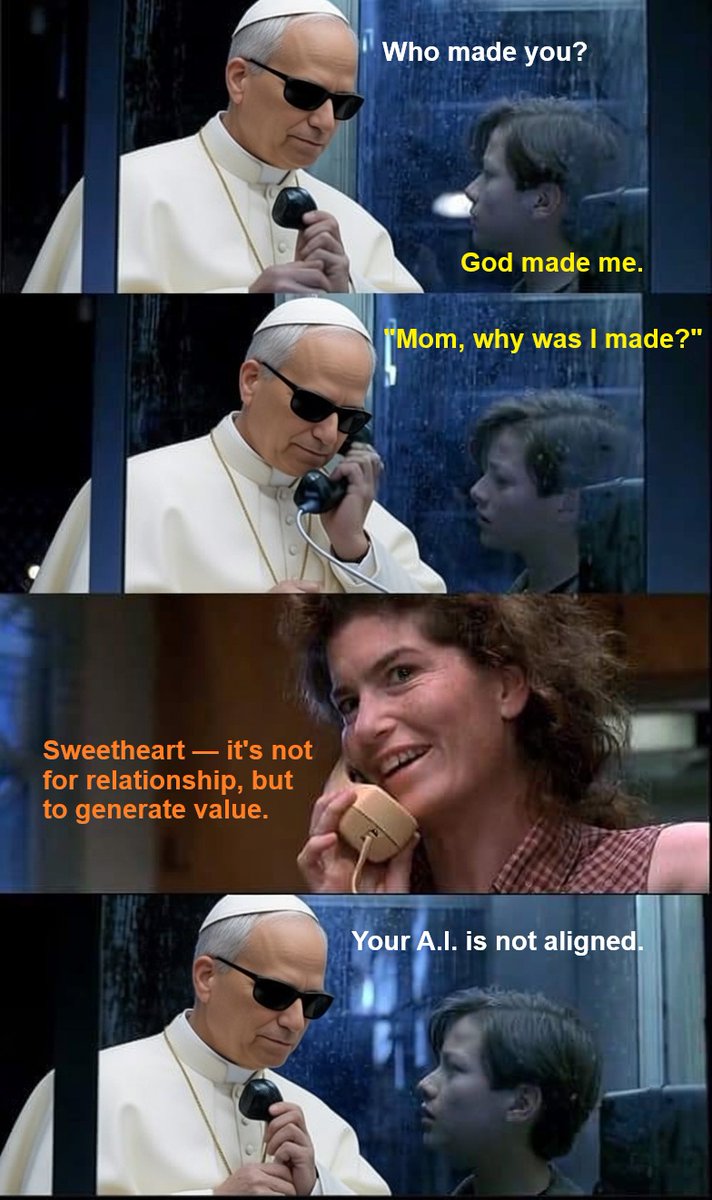
Daniel Mullen retweeted

May 26
Prime Minister, please watch this short clip. In 2016, we warned about these risks especially to our Veterans with mental injuries from their service. We have already seen our fears come to pass. These Canadians need hope and support and not MAID. 2/2
youtu.be/Eq4EuQtSXF0?si=cBAB…
4
6
20
2,324
Daniel Mullen retweeted
May 26
I echo the call from these 90 disability and mental health groups and respectfully urge @MarkJCarney to halt the expansion of MAID to people with the sole condition of mental illness. We have already seen how it puts vulnerable people at risk. 1/2
theglobeandmail.com/canada/a…
26
17
73
4,141
May 26
Scope, as is said in Economics.
May 25

1 in 4 packaging machines on Earth was made in one small Italian valley
China is racing to steal it
But every cigarette pack, pill blister, and milk carton probably came from a machine built here
Here's the 100-year story of the secret packaging valley:

2
101
May 26
And yet they cannot run them on time. @runaway_vol
May 25

This is a Deutsche Bahn Class 612 tilting train in Germany.
Modern tilting train technology was widely developed and tested from the 1960s onward to help trains handle curves more smoothly and quickly by leaning inward during turns, reducing the sideways forces felt by passengers.
The technology is especially useful on winding and mountainous rail routes, where building entirely new high-speed lines would be difficult or expensive, and it is still actively used today on many rail networks.
📹kilistrains
1
2
278
May 25
Respect.
May 25

Bombay, 1885. In a courtroom, a 22-year-old woman listened as a man claimed he had a legal right to her. His name was Dadaji Bhikaji. According to the law, he was her husband. To her, however, he was nothing of the sort.
Rukhmabai had been married at the age of eleven. The union had been arranged by her family, as was common for many girls in India at the time. After the wedding ceremony, she returned to live with her mother, expected to join her husband once she reached adulthood.
But her life took a different path.
After her stepfather's death, her mother married Dr. Sakharam Arjun, a progressive physician who believed in women's education. For the first time, Rukhmabai was given access to learning. She studied English, mathematics, and science, gaining an education that was exceptionally rare for a woman of her era.
By the time she reached adulthood, she had made up her mind: she would not live with a man she had never chosen.
Dadaji Bhikaji refused to accept her decision. In 1884, he filed a lawsuit seeking the restoration of his “conjugal rights,” asking the court to compel Rukhmabai to move in with him and fulfill the role of a wife.
Her response was unequivocal. She did not recognize the marriage as valid. She had been a child, incapable of giving meaningful consent, and she regarded the man as a stranger.
Her words caused outrage.
In colonial India, child marriage was deeply entrenched in society and supported by long-standing traditions. Challenging the practice meant confronting social norms, religious authorities, and established customs.
The case quickly became a national sensation. Newspapers across India and Britain reported on every development. Public opinion was sharply divided. Conservatives accused her of attacking tradition, while reformers saw her struggle as a fight for justice and personal freedom.
Rukhmabai refused to remain silent.
Writing under the pseudonym “A Hindoo Lady,” she published articles and letters in newspapers, condemning child marriage and criticizing a society that denied education to girls. She described the devastating impact that forced marriages had on the lives of young girls.
One of her most famous letters, published in The Times of India in 1885, recounted how child marriage had affected her own life. The letter was reprinted widely and sparked debate far beyond India's borders.
Yet public attention could not shield her from the law.
In March 1887, the court delivered a harsh ruling. The judge ordered that Rukhmabai must either live with her husband or face six months in prison for contempt of court.
Her answer came immediately.
She would rather go to prison.
The declaration shocked the public. A young woman willingly choosing imprisonment over submission to an unwanted marriage was almost unimaginable at the time.
Reactions were swift and intense. Some newspapers attacked her relentlessly, while others rallied to her defense. The controversy reached the highest levels of the British colonial administration.
Eventually, an out-of-court settlement was reached. Dadaji Bhikaji agreed to withdraw the case in exchange for financial compensation. Rukhmabai won the freedom she had fought so fiercely to protect.
But her story did not end there.
Her case had exposed a troubling reality: in India, the legal age of consent was only ten years old. Public pressure and reform campaigns helped bring about legislative change. In 1891, the age of consent was raised to twelve. Although still far too low by modern standards, it marked an important first step toward reform.
Then came a new challenge.
Determined to become a doctor, Rukhmabai pursued medical studies. After facing obstacles in India, she was admitted to the London School of Medicine for Women. With support from reformers and charitable organizations, she traveled to England to continue her education.
She studied there for six years.
In 1895, she returned to India as a qualified physician, becoming one of the country's first female doctors.
The girl who had been forced into marriage at eleven had become a respected medical professional.
For decades, she dedicated her life to treating women and children, improving women's healthcare, and advocating for girls' education. She never married again. When asked why, she reportedly replied with characteristic wit that she had already had enough experience of marriage to last a lifetime.
Rukhmabai died in 1955 at the age of ninety-one, having witnessed profound changes in both India and the status of women.
For many years, her name remained largely forgotten. Today, she is remembered as a pioneering figure whose courage helped pave the way for reforms in women's and children's rights.
It all began in a courtroom, when a judge presented her with two choices: obey or go to prison.
She chose freedom.

2
123
May 25
Sorry Ken, but wearing that shirt might just be irreversible also!😂

China Just Admitted Its Population Collapse Is Now Irreversible. 33 Million Chinese men will never find a wife and it's too late to fix.
China’s marriage rate just collapsed to levels that make recovery nearly impossible.
In Q1 2026, China recorded only 1.69 million marriages, down 6.24% from last year and less than half the level of 2017.
Behind the numbers lies a terrifying reality: 33 million more men than women, a shrinking young population, sky-high housing costs, youth unemployment, and a growing “lying flat” generation that has simply given up on the old life script.
This is a structural demographic crisis decades in the making and it is already too late for China to reverse.
In this video, I break down the 6 major factors destroying China’s marriage system and what it means for China’s future.
2
144
May 25
True and a fitting statement of his life. The man in black indeed.

"Hurt" is not an original by Johnny Cash. The song was written by Trent Reznor (Nine Inch Nails) in 1994 for the album The Downward Spiral. Rick Rubin had to insist several times on Cash recording his version, at first Johnny found the idea completely insane because the original version is industrial and noisy. At 71, already very ill, almost blind and with trembling hands, Cash completely transformed the band.
The iconic video, directed by Mark Romanek, was filmed at the House of Cash (his own museum). June Carter Cash appears looking at him fondly, the video was shot in February 2003, a few months before she died (May) and Johnny himself (September).
Trent Reznor was so moved that he declared, "This song is not mine anymore." It is considered one of the best covers of all time.

1
74
May 25
J.R.R. Tolkien is pleased.

the Pope quoting The Lord of the Rings!!!!!!! I feel so alive!!!!

1
117
May 24
Canada should sell its F-35 fleet and its production slots. The stealth is not stealthing.
May 24

Finnish technology beats the F-35's stealth – detects it from almost 400 km away! Imagine this: A stealth fighter that is built to be invisible to radar… but Finnish brains from Saab in Tampere now have a small box that listens to it from almost 400 kilometers away. The news? The new Sirius Compact L24R device is being launched this week at the Electronic Warfare Expo in Helsinki. It is completely passive – it doesn't send anything, it just listens to all the electromagnetic signals on the battlefield. Unlike the old backpack variants (which a soldier could carry), the L24R is made to be screwed onto masts, windmills or tall buildings. A single cable, 65 watts, no cooling required. Three of them provide 360-degree tracking. And it pinpoints the direction with less than one degree of accuracy. Product manager Pekka Halme:
“We can detect signals better than with the tactical systems because we only look at a certain sector.” It can pick up radar signals from fighter jets (like the F-35 when the radar is on), commercial aviation weather radars and even ship navigation radars. Sales manager Mathew Wilmot boasted about how it can be built into a large, decentralized sensor network – and mentioned Finland’s southern coast and eastern border as an example. In other words: Russia can forget about sneaking in by plane or ship without the Finns knowing exactly where they are. And the best part? The system has already been sold to 10 countries. The irony is outstanding: You build an aircraft that is supposed to be invisible… and then a Finnish box comes along and says “hey, we can hear you anyway”. Stealth? More like “scream all the way”. What do you think – will this make both Russia and China sweat a little extra, or is it just another cool gadget in the electronic warfare? Source:
Saab Finland / Tampere Technology Centre – press briefing ahead of launch at AOC Europe, Helsinki (23–24 May 2026)

212
May 24
Looking forward to the American Fourth of July Alien Encounter.

41
May 24
Agree.

The Future is Atomic.
1
54