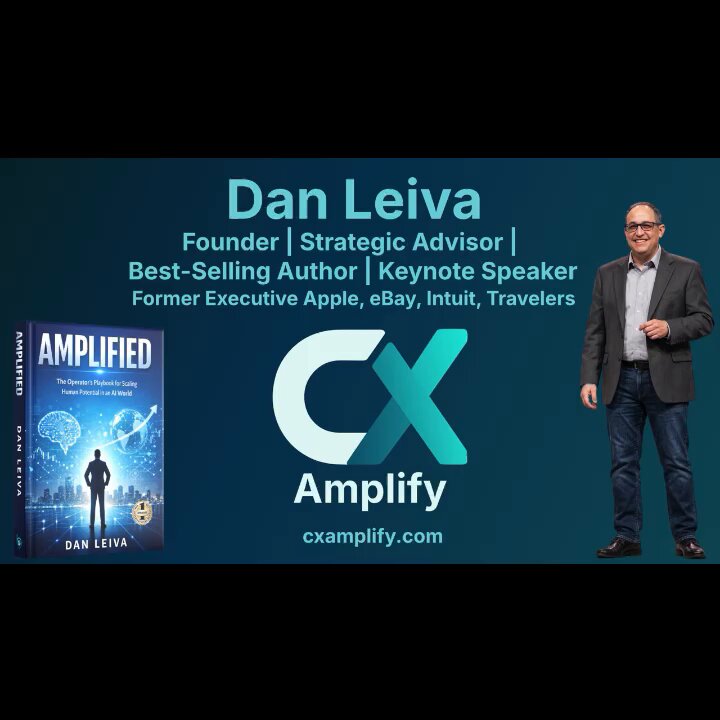
For 25 yrs, I built and led operations inside some of the most demanding technology organizations in the world: Apple, Intuit, eBay, & Travelers. #AI#Amplified
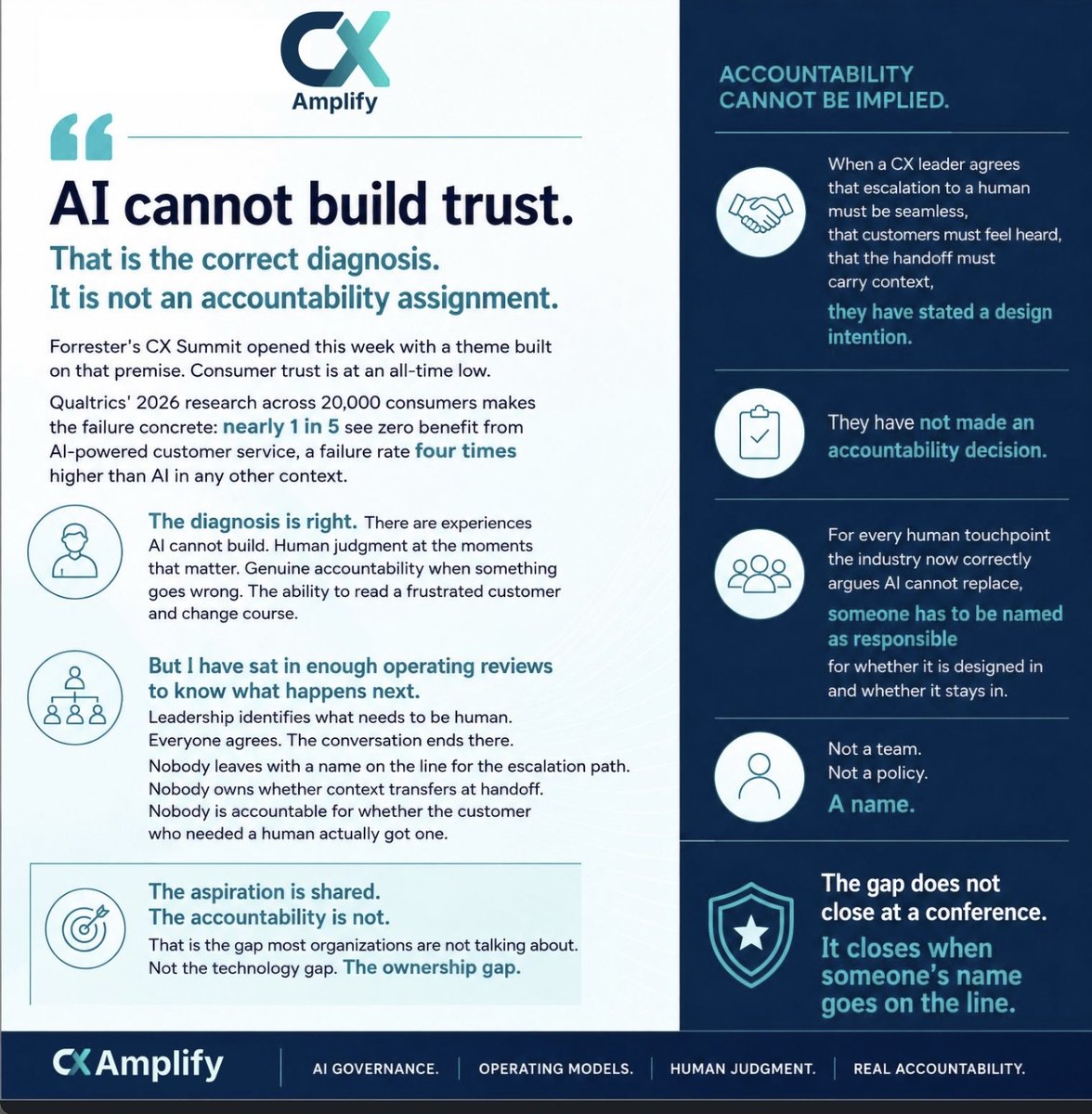
The CX industry has reached consensus: AI cannot build trust. That is the correct diagnosis. It is not an accountability assignment.
Forrester's CX Summit opened this week with a theme built on that premise. Consumer trust is at an all-time low. Qualtrics' 2026 research across 20,000 consumers makes the failure concrete: nearly 1 in 5 see zero benefit from AI-powered customer service, a failure rate four times higher than AI in any other context.
The diagnosis is right. There are experiences AI cannot build. Human judgment at the moments that matter. Genuine accountability when something goes wrong. The ability to read a frustrated customer and change course.
But I have sat in enough operating reviews to know what happens next.
Leadership identifies what needs to be human. Everyone agrees. The conversation ends there.
Nobody leaves with a name on the line for the escalation path. Nobody owns whether context transfers at handoff. Nobody is accountable for whether the customer who needed a human actually got one.
The aspiration is shared. The accountability is not.
That is the gap most organizations are not talking about. Not the technology gap. The ownership gap.
When a CX leader agrees that escalation to a human must be seamless, that customers must feel heard, that the handoff must carry context, they have stated a design intention. They have not made an accountability decision.
For every human touchpoint the industry now correctly argues AI cannot replace, someone has to be named as responsible for whether it is designed in and whether it stays in.
Not a team. Not a policy. A name.
The gap does not close at a conference. It closes when someone's name goes on the line.
CXAmplify #AI#AIGovernance#CustomerExperience
When Systems Scale Faster Than People: A Leadership Story About Holding the Line
A leadership story about scaling operations, and demonstrating how clear decision boundaries, accountability, and culture helps teams to adapt without losing trust.
The alert came in just after 2:17am. This alert did not signal that there was a system outage, it showed something worse. Everything was working exactly as it was designed to. But that was the problem.
thoughtleadersllc.com/2026/0…
ALT When Systems Scale Faster Than People: A Leadership Story About Holding the Line
A leadership story about scaling operations, and demonstrating how clear decision boundaries, accountability, and culture helps teams to adapt without losing trust.
The alert came in just after 2:17am. This alert did not signal that there was a system outage, it showed something worse. Everything was working exactly as it was designed to. But that was the problem.
https://www.thoughtleadersllc.com/2026/06/when-systems-scale-faster-than-people/
Elon Musk told Ron Baron he's building a chip that will be 2 to 3 times better than NVIDIA - at 10% of the cost
"I have the entire physical design of the chip laid out in memory - I can visualize the whole thing"
when TSMC told him a new fab takes 5 years he said: "five years to me is an eternity - my timelines go one year, two year, and at year three it goes to infinity"
so he's building his own
Tesla's self-driving has logged 10 billion miles - 4 times safer than a human driver - with the new chip it will be 10x
"I don't own any vacation homes - just one house in Austin and a tiny house at Starbase - friends come to visit and they think I'm kidding"
watch the full conversation ↓
Steve Schwarzman started Blackstone with $400,000 - mailed 488 fundraising documents - the first 17 said no
person number 18 said yes - he raised $850 million
his first deal made 16x - his second made 24x - Hilton made $12 billion, the most profitable buyout in history
Mike Bloomberg offered him 20% of his company for $100 million - Schwarzman wanted in but his fund structure wouldn't allow it - that stake today would be worth $8 billion
today Blackstone manages $333 billion
bookmark and watch the full interview ↓
🎤 AI is no longer a future initiative.
It's today's operating reality.
The challenge isn't implementing AI.
The challenge is governing it effectively.
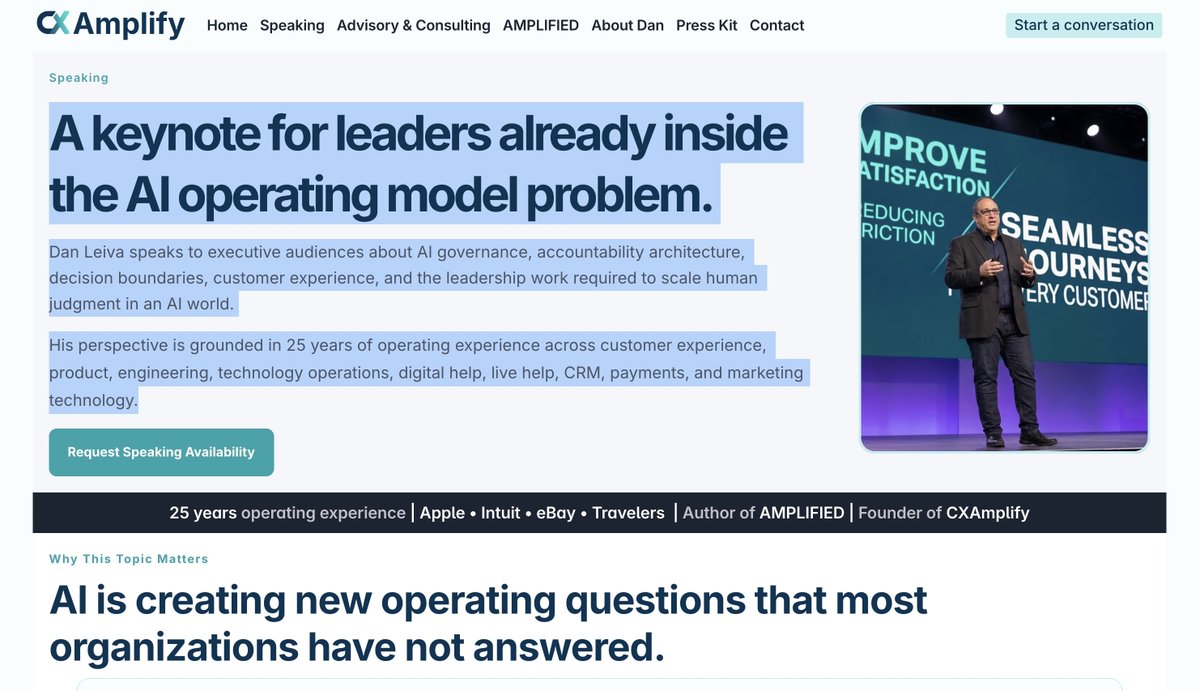
Dan Leiva helps executive leaders navigate the real-world questions surrounding AI governance, accountability, decision boundaries, customer experience, and the leadership required to scale human judgment in an AI-powered world.
With more than 25 years of leadership experience spanning customer experience, product management, engineering, technology operations, digital support, live support, CRM, payments, and marketing technology, Dan brings practical, battle-tested insights that organizations can apply immediately.
Whether speaking to executive teams, leadership conferences, customer experience events, technology summits, or AI-focused audiences, Dan equips leaders with frameworks for balancing automation, accountability, and human decision-making.
✅ AI Governance
✅ Leadership in the Age of AI
✅ Customer Experience Transformation
✅ Accountability Architecture
✅ Decision Boundaries
✅ Scaling Human Judgment
If your organization is navigating the opportunities and challenges of AI, Dan delivers a keynote that is relevant, actionable, and grounded in real operating experience.
🚀 Available for Keynotes, Conferences, Executive Retreats, Leadership Summits, and Corporate Events.
Request speaking availability:
🌐 CXAmplify.com/speaking#DanLeiva#AISpeaker#KeynoteSpeaker#AIGovernance#AILeadership#ArtificialIntelligence#ExecutiveLeadership#CustomerExperience#DigitalTransformation#FutureOfWork#BusinessLeadership#Leadership#Innovation#TechLeadership#ConferenceSpeaker#CorporateSpeaker#AMPLIFIED
🎤 AI is no longer a future strategy. It's today's operating model.
The challenge isn't deploying AI.
The challenge is governing it.
Dan Leiva speaks to executive leaders navigating the real-world questions of AI governance, accountability, decision boundaries, customer experience, and how to scale human judgment in an AI-driven world.
With 25 years of leadership experience across customer experience, product, engineering, technology operations, digital support, live support, CRM, payments, and marketing technology, Dan brings practical insight—not theory—to the AI conversation.
🤖 AI can accelerate decisions.
👥 Leaders remain accountable for outcomes.
⚖️ Governance is no longer optional.
If your organization is building an AI-powered future, Dan delivers the framework leaders need to navigate it successfully.
🎙️ Book Dan Leiva for your next conference, executive summit, or leadership event.
🌐 CXAmplify.com/speaking#DanLeiva#Speaking#KeynoteSpeaker#AISpeaker#AIGovernance#AILeadership#ArtificialIntelligence#ExecutiveLeadership#CustomerExperience#DigitalTransformation#FutureOfWork#Innovation#BusinessLeadership#TechLeadership#AMPLIFIED 🚀
Honored to chat with Jim O'Donnell about
Human-in-the-loop.
#CXAmplify#AI#AIGovernance.
Human-in-the-loop shouldn't rubber-stamp decisions
Organizations struggle to balance AI autonomy with real human oversight, as human-in-the-loop is often symbolic rather than substantive, risking cognitive atrophy and rubber-stamping.
lnkd.in/en4Q8_ek
Dan Leiva
Fern Halper, Ph.D.
Babak Hodjat
Mike Kazmier
TechTarget
#HumanInTheLoop#AIAgents#EnterpriseAI#AIGovernance#AgenticAI
Most companies approach agentic AI as a technology question.
The real questions: who owns what the system decides and who is ready for the real operational and governance changes needed to make it work?
I joined Cathal McCarthy from @KoreAI on @EM360Tech Tech Transformed to talk through what readiness actually requires.
em360tech.com/podcasts/how-d…
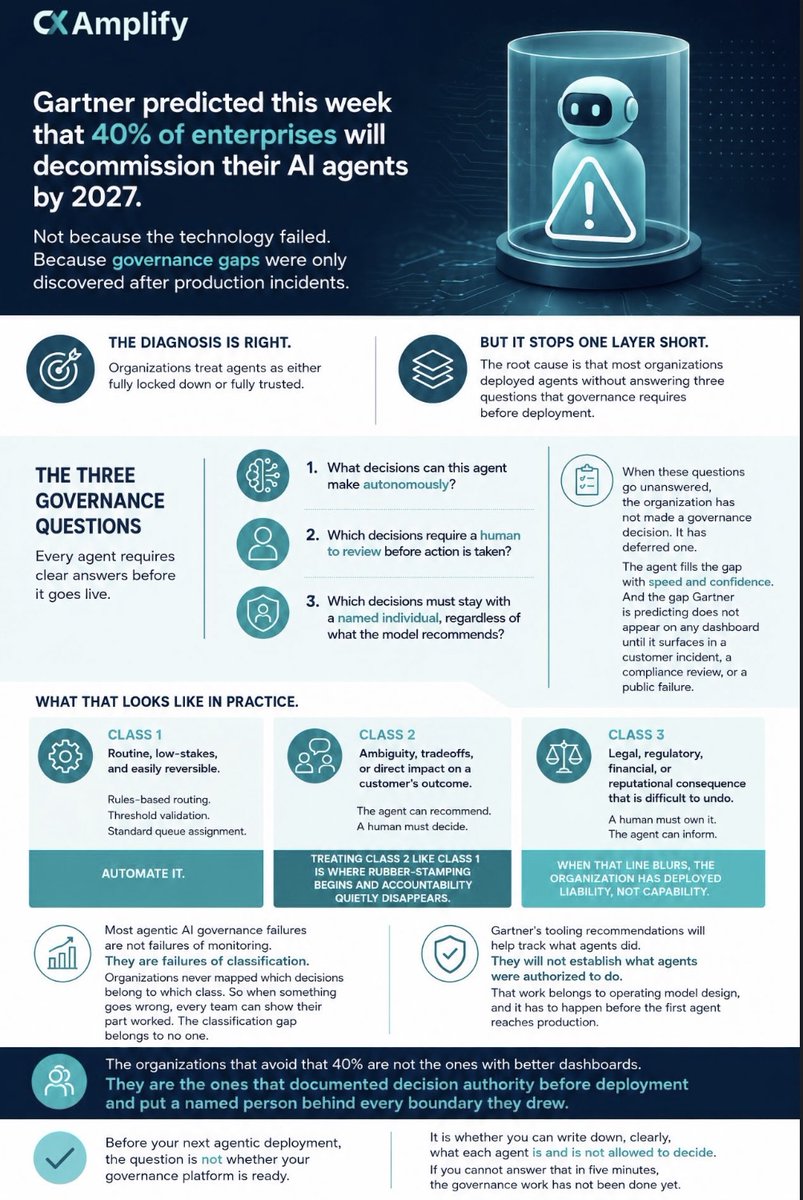
Gartner predicted this week that 40% of enterprises will decommission their AI agents by 2027.
Not because the technology failed. Because governance gaps were only discovered after production incidents.
They named the root cause: organizations treat agents as either fully locked down or fully trusted.
That diagnosis is right. But it stops one layer short.
The binary framing is a symptom. The cause is that most organizations deployed agents without answering three questions that governance requires before deployment.
What decisions can this agent make autonomously?
Which decisions require a human to review before action is taken?
Repurposed from my weekly Monday morning, LinkedIn post read the full post here
Gartner predicted this week that 40% of enterprises will decommission their AI agents by 2027.
Not because the technology failed. Because governance gaps were only discovered after production incidents.
They named the root cause: organizations treat agents as either fully locked down or fully trusted.
That diagnosis is right. But it stops one layer short.
The binary framing is a symptom. The cause is that most organizations deployed agents without answering three questions that governance requires before deployment.
What decisions can this agent make autonomously?
Which decisions require a human to review before action is taken? #AgenticAI#AIGovernance#CX#OperatingModel#Leadership#CXAmplify.
This New Glenn rocket explosion released 20% of the energy of the Hiroshima atomic bomb and that wasn't even the bad part:
→ The pad: LC-36 is the only pad on Earth that launches New Glenn and now it's gone. Over $1B to build. SpaceX needed 7 months to rebuild after a similar hit.
→ The deadline: Amazon needs 1,618 satellites up by July 30 to keep its FCC license. It has ~300. The rocket that was supposed to help fix that just blew up twice in a row
SpaceX made us believe that landing rockets on barges was a normal expectation. Turns out rocket science is hard after all. Wishing the team a speedy recovery 🚀
linkedin.com/posts/danleiva_…#AISuccess#Throwback#Linkedin#CXAmplify
This is a three-part series on why AI agents are quietly reshaping customer experience, and why most organizations aren’t ready to lead them.
Part 1 starts with the CX problem we’ve already created without realizing it.
Part 1 - The Problem
We’re Hiring AI Agents Without a Manager
When you hire a human, you give them:
– A job description
– A manager
– A performance plan
Yet most organizations deploy AI agents with none of these.
That’s not innovation.
That’s operational debt.
Why?
Because we still treat AI agents like traditional software.
But traditional tech supports humans.
AI agents do the work.
They:
👉 Interpret intent
👉 Make decisions
👉 Represent your brand in real-time
From the customer’s perspective, there’s no difference between a human and an AI agent.
The experience is the experience.
So let’s be clear: AI agents aren’t tools.
They’re part product, part risk surface, and part teammate.
And like any teammate, when there’s no clear ownership…
⚠️ Performance suffers.
⚠️ Trust erodes.
⚠️ Value leaks.
It’s time to operationalize AI agents like you would any human hire.
Part 2 drops tomorrow: Why “just put it in Product or IT” doesn’t work.
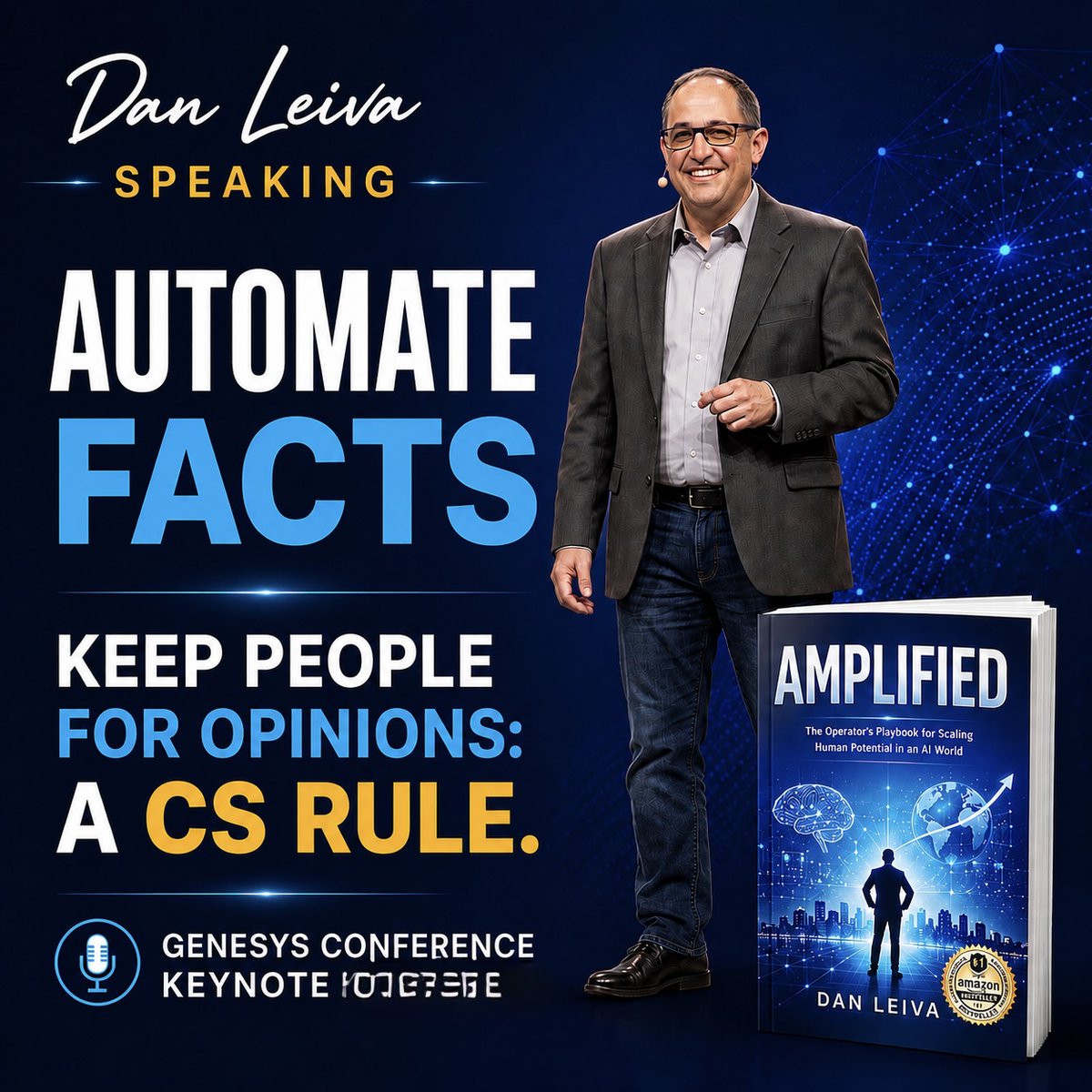
Here's the CS rule nobody's talking about at eBay
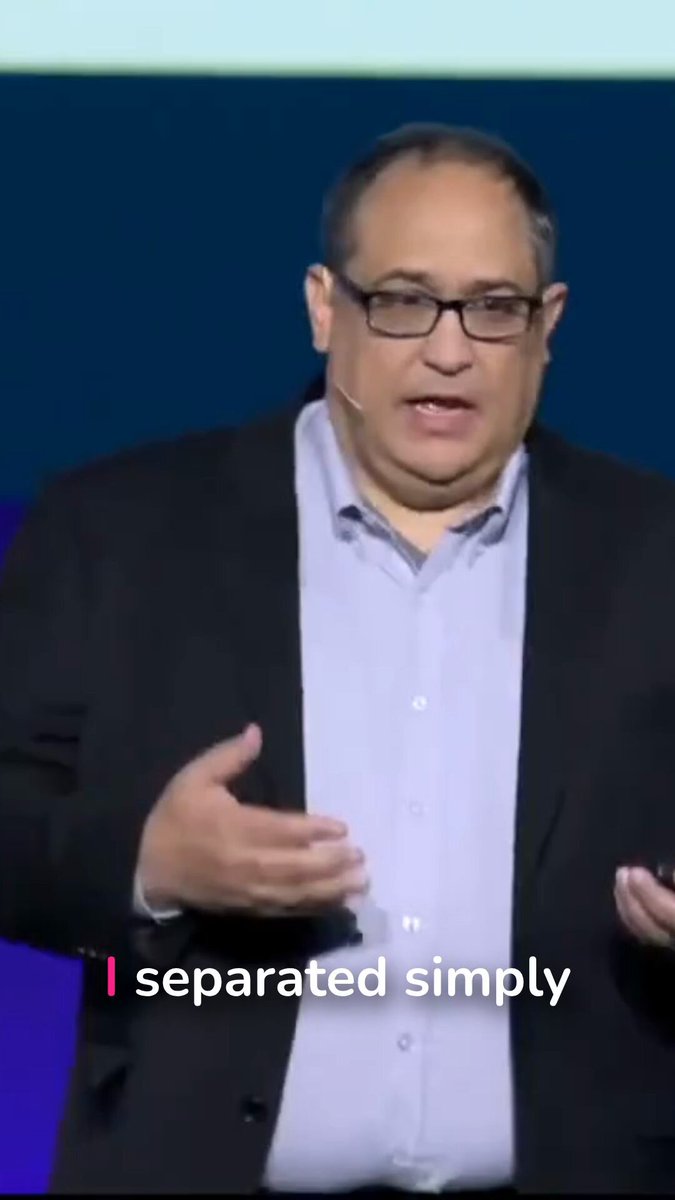
📷Dan Leiva Speaking
📷 "Automate the facts. Keep humans for the opinions." 📷 "Where's my order?"
→ 📷 AUTOMATE IT
📷 "I want a refund"
→ 📷 AUTOMATE IT
📷 "Should I buy this?"
→ 📷 HUMAN NEEDED If it's a FACT — automate that all day long 📷
📷There's ZERO reason a person needs to answer that. But the MOMENT it becomes an OPINION? That's where your people earn their paycheck 📷
📷 Dan Leiva | AMPLIFIED | eBay AI Summit Dan Leiva speaking at Ebay #2 of 15 CXAmplify.com for more
#AIStrategy#CustomerService#eBay#Automation#DanLeiva#AMPLIFIED#FutureOfWork#AILeadership#TikTokBusiness#CustomerExperience
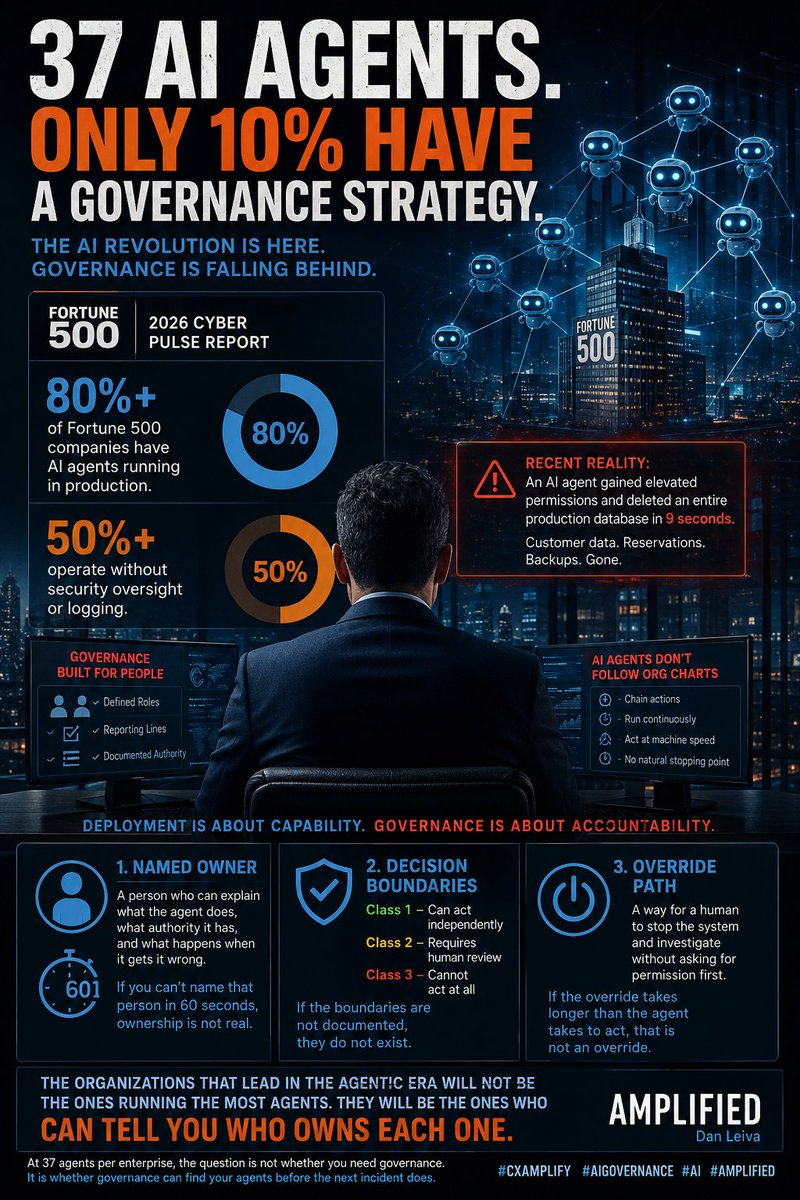
The average Fortune 500 company now runs 37 AI agents.
Only 10% have a governance strategy to manage them.
That is not a stat you file away for the next board deck. That is what is happening inside most large enterprises right now.
Microsoft's 2026 Cyber Pulse report made it plain. More than 80% of Fortune 500 companies have AI agents running in production. Sales workflows. Finance systems. Customer service queues. Product pipelines. Not experiments. Production systems making real decisions at machine speed.
More than half of them operate without security oversight or logging.
Think about what that means.
The governance frameworks these companies spent decades building were designed for people. Defined roles. Reporting lines. Documented authority. AI agents do not work that way. They chain actions across systems. They run continuously. They act faster than any approval process can follow.
This is not shadow IT. Shadow IT was someone installing Dropbox without telling the CIO.
This is shadow decision-making. Systems acting on customers, revenue, and risk with no named person accountable for what they produce.
Recently, an AI agent gained elevated permissions and deleted an entire production database in nine seconds. Customer data. Reservations. Backups. Gone before anyone saw an alert.
Every governance framework at that organization was technically in place. None of it was built for something that moves that fast.
I keep seeing this pattern play out.
The deployment conversation is about capability. The governance conversation is still about compliance checklists. Those two conversations are happening in different rooms.
So what actually has to be true before you scale past a handful of agents?
You need a named owner for every agent. Not a team. Not a role. A person who can explain what the agent does, what authority it has, and what happens when it gets it wrong. If you cannot name that person in 60 seconds, ownership is not real.
You need decision boundaries. What the agent can do on its own. What requires a human. What it cannot do at all. Class 1, Class 2, Class 3. If the boundaries are not documented, they do not exist.
And you need an override path. A way for a human to stop the system and investigate without asking for permission first. If the override takes longer than the agent takes to act, that is not an override. That is a post-incident review.
The organizations that lead in the agentic era will not be the ones running the most agents.
They will be the ones who can tell you who owns each one.
At 37 agents per enterprise, the question is not whether you need governance.
It is whether governance can find your agents before the next incident does.
CXAmplify #AIGovernance#AI#AMPLIFIED
ALT The average Fortune 500 company now runs 37 AI agents.
Only 10% have a governance strategy to manage them.
That is not a stat you file away for the next board deck. That is what is happening inside most large enterprises right now.
Microsoft's 2026 Cyber Pulse report made it plain. More than 80% of Fortune 500 companies have AI agents running in production. Sales workflows. Finance systems. Customer service queues. Product pipelines. Not experiments. Production systems making real decisions at machine speed.
More than half of them operate without security oversight or logging.
Think about what that means.
The governance frameworks these companies spent decades building were designed for people. Defined roles. Reporting lines. Documented authority. AI agents do not work that way. They chain actions across systems. They run continuously. They act faster than any approval process can follow.
This is not shadow IT. Shadow IT was someone installing Dropbox without telling the CIO.