
Inner Architect Media LLC Principal, digital marketing, Blogburst & Plaintiff magazine contributor: plaintiffmagazine.com/author…
Joined June 2007
- Tweets 27,014
- Following 5,133
- Followers 5,334
- Likes 4,596
197 Photos and videos












Jun 4
Every major ai platform has moved on from single-shot RAG. . . "They retrieve, read, then retrieve again. They grade their own first drafts and decide whether to go back for more." #rag #ai
ipullrank.com/agentic-rag
13
Jun 1
Do you dig deeper by going to AI Mode? Are you satisfied with the AIO results or do you go to another engine?
searchengineland.com/users-b…
4
May 26
"Where AI Overviews are shown, users stay longer on Google as they read, revisit, and compare listings carefully." #aioverviews #aio
searchenginejournal.com/goog…
21
dean guadagni retweeted

May 26
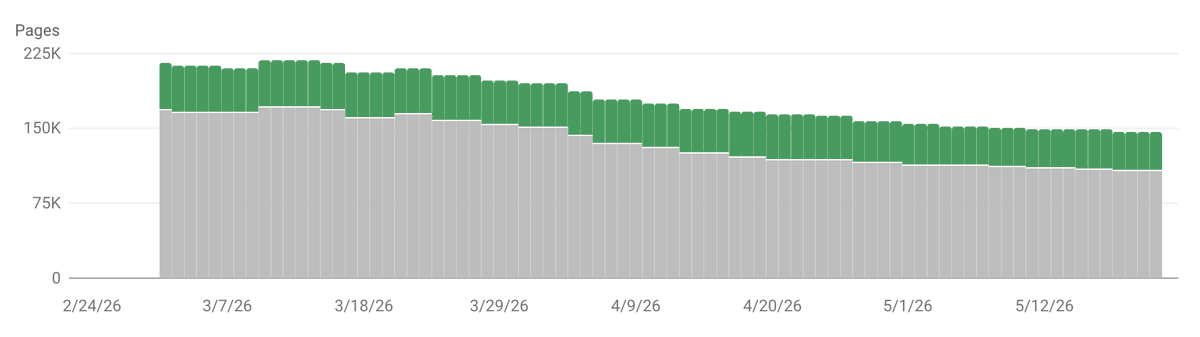
The Google mass deindexing still going on but no real comment from Google on what is up :( old story URL but new chart seroundtable.com/google-sear…
23
44
202
1,038,810
May 18
Adds credence to the idea that sometimes when I write I feel like it's all pouring out of me into my hand and on the "paper" whether digital or real.
May 18

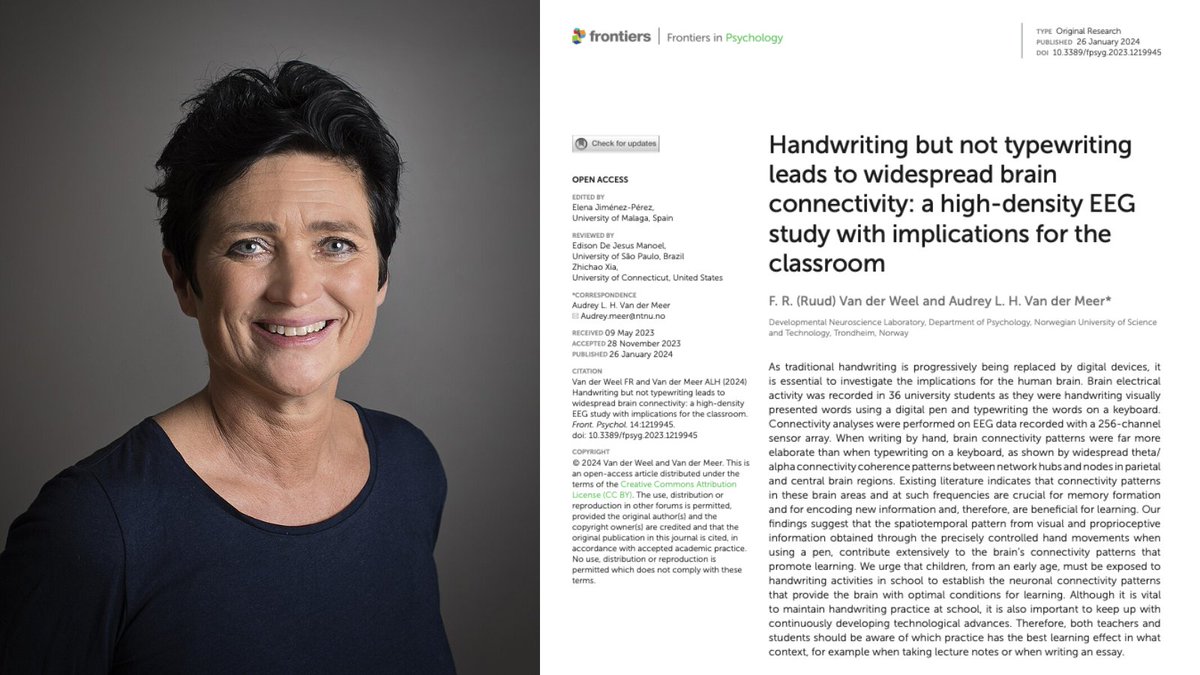
A Norwegian neuroscientist spent 20 years proving that the act of writing by hand changes the human brain in ways typing physically cannot, and almost nobody outside her field has read the paper.
Her name is Audrey van der Meer.
She runs a brain research lab in Trondheim, and the paper that closed the argument was published in 2024 in a journal called Frontiers in Psychology. The finding is brutal enough that it should have changed every classroom on Earth.
The experiment was simple. She recruited 36 university students and put each one in a cap with 256 sensors pressed against their scalp to record brain activity. Words flashed on a screen one at a time.
Sometimes the students wrote the word by hand on a touchscreen using a digital pen, and sometimes they typed the same word on a keyboard. Every neural response was recorded for the full five seconds the word stayed on screen.
Then her team looked at the part of the data most researchers had ignored for years, which is how different parts of the brain were communicating with each other during the task.
When the students wrote by hand, the brain lit up everywhere at once.
The regions responsible for memory, sensory integration, and the encoding of new information were all firing together in a coordinated pattern that spread across the entire cortex. The whole network was awake and connected.
When the same students typed the same word, that pattern collapsed almost completely.
Most of the brain went quiet, and the connections between regions that had been alive seconds earlier were nowhere to be found on the EEG.
Same word, same brain, same person, and two completely different neurological events.
The reason turned out to be something nobody had really paid attention to before her work. Writing by hand is not one motion but a sequence of thousands of tiny micro-movements coordinated with your eyes in real time, where each letter is a different shape that requires the brain to solve a slightly different spatial problem.
Your fingers, wrist, vision, and the parts of your brain that track position in space are all working together to produce one letter, then the next, then the next.
Typing throws all of that away. Every key on a keyboard requires the exact same finger motion regardless of which letter you are pressing, which means the brain has almost nothing to integrate and almost no problem to solve.
Van der Meer said it plainly in her interviews.
Pressing the same key with the same finger over and over does not stimulate the brain in any meaningful way, and she pointed out something that should scare every parent who handed their kid an iPad.
Children who learn to read and write on tablets often cannot tell letters like b and d apart, because they have never physically felt with their bodies what it takes to actually produce those letters on a page.
A decade before her, two researchers at Princeton ran the same fight using a completely different method and ended up at the same answer. Pam Mueller and Daniel Oppenheimer tested 327 students across three experiments, where half took notes on laptops with the internet disabled and half took notes by hand, before testing everyone on what they actually understood from the lectures they had watched.
The handwriting group won by a wide margin on every question that required real understanding rather than surface recall.
The reason was hiding in the transcripts of what the two groups had actually written down.
The laptop students typed almost word for word, capturing more total content but processing almost none of it as they went, while the handwriting students physically could not write fast enough to transcribe a lecture in real time, which forced them to listen carefully, decide what actually mattered, and put it in their own words on the page.
That single act of choosing what to keep was the learning itself, and the keyboard had quietly skipped the choosing and skipped the learning along with it.
Two studies. Two countries. Same answer.
Handwriting makes the brain work. Typing lets it coast.
Every note you have ever typed instead of written went into your brain through a thinner pipe. Every meeting, every book highlight, every idea you captured on your phone instead of on paper was processed at half depth.
You did not forget those things because your memory is bad. You forgot them because typing never woke the part of the brain that would have made them stick.
The fix is the thing your grandmother already knew.
Pick up a pen. Write the thing down. The slower road is the faster one.
17
May 13
I was at this game, 27 years old, and a huge basketball fan. Sleepy was in a zone like no other. He scored 29pts in 12 min many on And 1's to the rack. Magical moment.
May 13

THE SLEEPY FLOYD GAME.
Donovan Mitchell's 39-point second half in Game 4 tied Sleepy Floyd's 39 in this iconic May 10, 1987 performance! 📽️
74
Apr 3
If your work doesn't produce ROI then it will be automated. #ai #jobmarket
searchenginejournal.com/ai-l…
44
Mar 18
"Do not complain about growing old. It is a privilege denied to many." --Mark Twain
61
Mar 17
"Is AI Mode Now Dominated by Google's Self Referencing Links?" Yes and Yes!
seranking.com/blog/google-li…
30
Mar 12
Where are your clicks going? What value does your content have in driving traffic? Here's an answer worth reading. Thank you @hnshah
Mar 11

Everyone says AI is unbundling Google Search.
ChatGPT processes 1.6 billion queries a day. Perplexity grew 340% last year. The narrative writes itself.
But look closer at the numbers and something else is happening.
ChatGPT has 12% of Google's search volume. It sends 190x less traffic to websites.
Google stays intact. The web gets unbundled.
Google saw this coming. They decided to become AI search before anyone else could.
AI Overviews now appear on most informational queries. Organic click-through rates dropped 61% in 18 months. Paid CTR crashed 68%. Zero-click searches for news jumped from 56% to 69%.
Google did this to itself. On purpose.
The logic is simple. If zero-click is inevitable, own it. Make Google the terminal point where queries enter and answers exit, but traffic never leaves.
The numbers tell the advertiser story. Google Search ad spending grew 9% year-over-year in Q1 2025. Click growth was only 4%. That 5% gap is advertisers paying more for fewer clicks.
Google extracts more revenue from less inventory. Short-term, the math works. Long-term, advertisers notice.
Publishers take the hit. They create the content that trains the AI and feeds the summaries. They get nothing back. Traffic gone, attribution meaningless. Just their words, summarized and served to someone who will never visit their site.
Everyone predicted AI would fragment Google's search monopoly. Instead, Google used AI to collapse the open web into a walled garden.
Queries go in, answers come out, and the middle layer disappears.
1
44
Mar 2
There is a ton of important info listed here by Jake. Please go over it carefully if want your brand to show up in AIO etc, social
Mar 2

I've been doing SEO for 10 years and AI search is making me rethink everything I know, here are 10 changes I’m seeing:
1. Search results have always come from our sites. Now AI also pulls from sites like Reddit and YouTube. If you’re not present, you’re not visible in answers.
1
2
340
Feb 26
If you read on thing the rest of this week about SEO make sure it's this really interesting look behind the AI content curtain!
Feb 26

I keep hearing SEOs say "but our AI content is ranking fine."
That's exactly the problem.
Tomek Rudzki from Peec AI just published research that should make every content team pause. They analyzed companies using popular AI content generation tools and found that 36% of the brands in their success stories had massive Google visibility drops.
For one tool, it was even worse. 75% of the showcase clients had significant traffic losses.
The pattern is always the same. Rank, bank and tank.
Publish hundreds of AI articles. Rank quickly. Monetize. Then get hit by a core update or manual action. Abandon domain. Repeat.
Google's March 2024 update deindexed 837 sites overnight. Originality AI confirmed 100% of affected pages had AI-generated content. 20 million monthly visits gone.
But here's the part most people miss.
When Grokipedia lost its Google rankings in early 2026, Peec AI's Malte Landwehr tracked what happened across AI search engines. ChatGPT, AI Mode, and AI Overviews all reduced citations at the exact same time.
One Google penalty now makes you invisible everywhere. LLMs use search engines for grounding. If Google demotes you, ChatGPT stops citing you too.
Now let me be honest here.
I work in industries like casino where rank, bank and tank is a common and accepted tactic. You build a site, extract value, and move on when it gets hit. I'm not going to pretend that doesn't work. In some niches it's simply part of the business model.
But here's what bothers me.
The companies selling AI content generation tools are marketing them to brands building long-term businesses. SaaS companies. Ecommerce brands. B2B companies. And they're not being transparent about what happens next.
Rudzki found that 3 out of 4 major global brands featured on one tool's website had suffered significant visibility losses. These aren't disposable affiliate sites. These are real companies with real reputations.
After 30 years in SEO, I see a clear line:
Rank, bank and tank as a deliberate strategy with eyes wide open? Fine. That's a business decision.
Selling AI content at scale to brands without warning them about the risk? That's irresponsible.
The data backs this up. NP Digital tested 744 articles across 68 websites and found human-written content generates 5.44x more traffic over time. Ahrefs analyzed 600,000 pages across 100,000 keywords and found only 4.6% of top-ranking pages are purely AI-generated. And Lily Ray predicts a huge crackdown on scaled AI content in 2026.
If you're a tool provider or consultant, be honest with your clients. Tell them what the research actually shows. Let them make an informed decision.
Rudzki's advice is simple: before you publish, ask yourself. Would I want to read this? Does it add something you can't get from ChatGPT itself?
If the answer is no, don't hit publish.
Sources:
→ Tomek Rudzki, "The real risk of AI-generated content" (Peec AI, Feb 25 2026): peec.ai/blog/the-real-risk-o…
→ Originality AI, AI content penalty analysis (2024):
→ Neil Patel / NP Digital, "AI vs Human" study, 744 articles, 68 sites (2024)
→ Si Quan Ong & Xibeijia Guan / Ahrefs, 600K page analysis (Jul 2025)
44
dean guadagni retweeted

Feb 17
This stopped me.
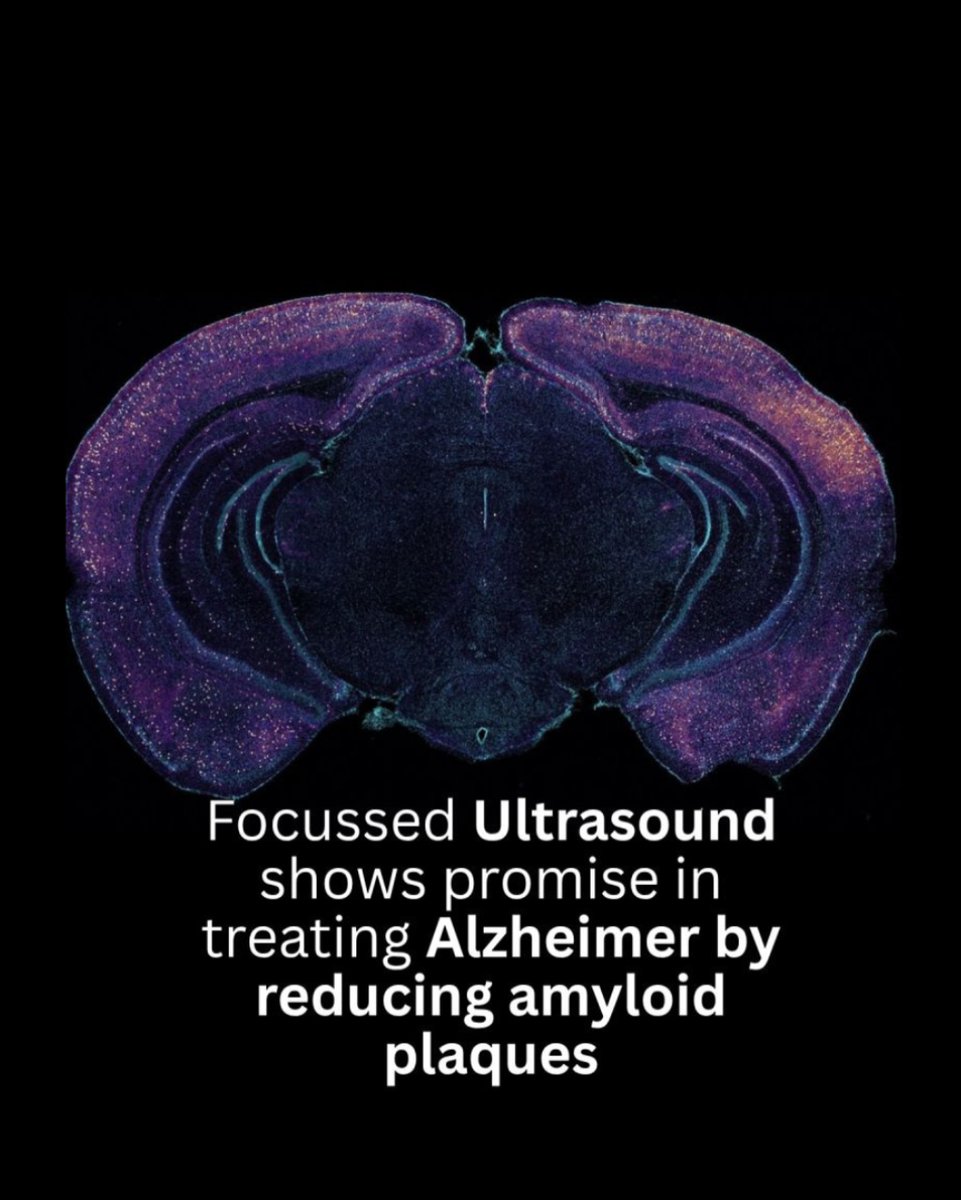
MIT researchers cleared 50% of Alzheimer’s plaques
using 40 Hz sound waves.
No drugs.
No surgery.
Just frequency.
For decades, we tried to fight Alzheimer’s chemically.
Billions spent.
Minimal progress.
Then something different happened.
Expose the brain to 40 Hz gamma waves.
Microglia activate.
Plaques get cleared.
The brain cleans itself.
As someone who has spent years studying automation and systems, this fascinates me.
We are not attacking disease anymore.
We are tuning the system.
Focused ultrasound can:
→ Reduce tremors in one session
→ Open the blood-brain barrier for hours
→ Deliver treatment precisely where needed
Not by cutting.
Not by poisoning.
By orchestrating.
That shift feels bigger than one breakthrough.
It suggests something deeper.
What if the future of medicine is not force…
but frequency?
So here is the question I cannot ignore:
If we can tune biology instead of fighting it, what else have we misunderstood about healing?
#AI #HealthTech #Neuroscience #Innovation #FutureOfMedicine #Technology
927
6,588
22,001
1,108,496
Feb 17
Brick, do you believe Google in this statement? It would make sense to quash an opt out option would it not?
Feb 17

Google said allowing sites to opt out of AI Overviews is a "huge engineering project" seroundtable.com/google-ai-o…
1
3
686
Feb 17
I don't like political commentary but this is about free speech and that I love. Make your own decision but watch this clip.
Feb 17

It’s important that you understand what happened last night.
Last night, Stephen Colbert interviewed Democratic Texas Senate candidate James Talarico, a candidate who, by all accounts, is on track in the polls to flip Texas blue.
In response, Trump’s FCC reportedly threatened CBS if the interview aired.
CBS caved and pulled the segment, citing “financial reasons.”
In modern American history, no president has been more hostile to free speech than Donald Trump.
But censorship always backfires.
Here’s the full segment Trump didn’t want you to see.
33
Feb 17
Thank you Jake and thanks for the perspectives.
Feb 17
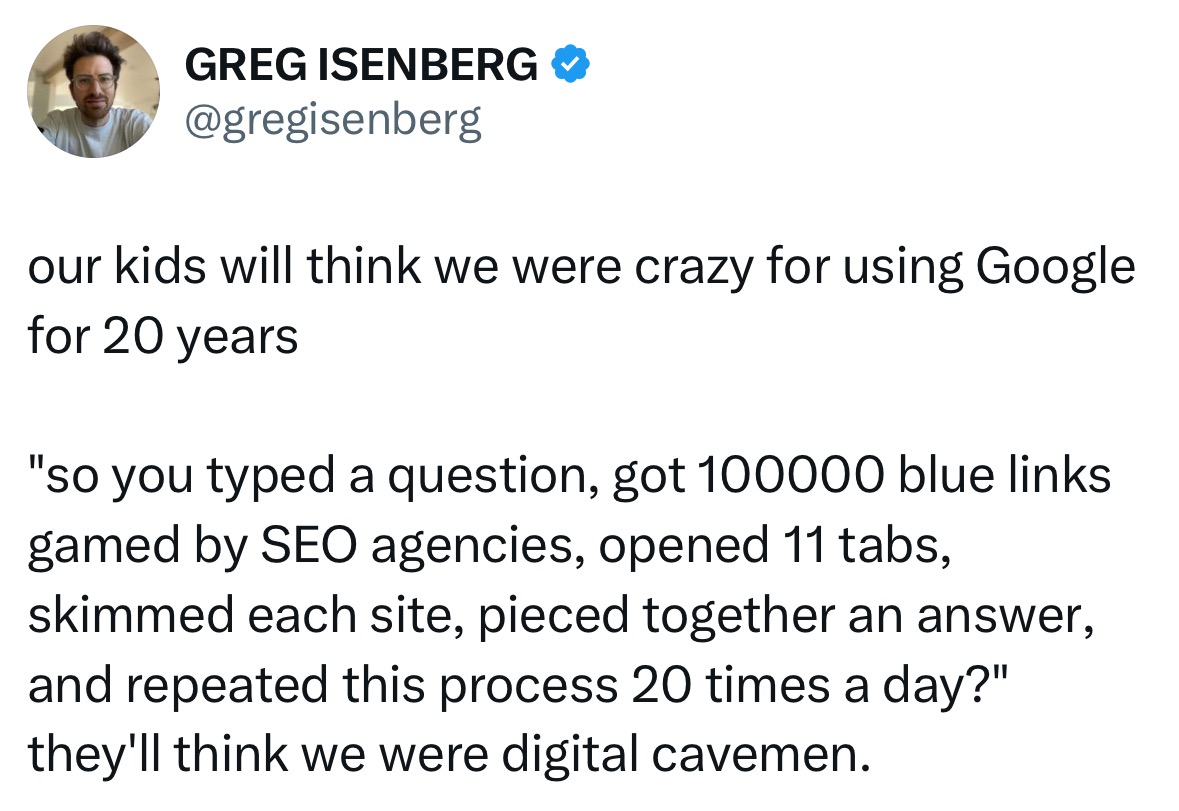
I can’t stop thinking about this Tweet.
ChatGPT now handles over 2.5 billion queries per day and Google is eventually defaulting to "AI Mode."
This is the future of SEO.
6 tips you need to rank in AI platforms:
1. Win brand mentions
- Get your brand mentioned on high-authority websites
- Contribute to industry publications
- Be featured in news outlets
- Engage in forums and community discussions
- Encourage authentic UGC and word-of-mouth mentions
2. Build brand equity
- Monitor online reviews and brand sentiment
- Respond to feedback and address complaints
- Build a consistent, trustworthy public image
- Use tools like Mentions.so to track visibility, sentiment, and competitors
3. Be the source
- Publish authoritative, reference-style content
- Use neutral, factual, data-backed tone
- Avoid excessive personal takes or fluff
- Regularly update key content for accuracy
- Include credible citations and external data sources
4. Embrace passage-level SEO
- Structure content into short, focused paragraphs
- Use clear subheadings for logical segmentation
- Include concise, standalone answers
- Avoid burying insights in long text block
- Add structured data (e.g. schema markup)
- Make each paragraph extractable and cite-ready
5. Cover the conversation
- Use tools like Semrush for question research
- Monitor forums/socials for emerging questions
- Identify and answer sub-questions users ask
- Add relevant FAQs and support content
- Internally link related topic clusters
6. Optimise for crawlability
- Ensure AI crawlers are allowed in robots.txt
- Verify CDN settings aren't blocking crawlers
- Submit up-to-date XML sitemaps in GSC
- Optimise for fast page speed and clean HTML
- Review server logs for GPTBot, BingBot, etc. behaviour
But first, start with an audit:
- Your current visibility across all LLMs
- Prompt and content gaps vs your competitors
- Technical issues preventing AI from citing your site
Use a tool like Mentions.so to find this information.
Don’t regret not starting AI SEO sooner.
20
Feb 17
It's possible within 5 years that #websites begin the slide into obsolescence searchenginejournal.com/goog…
10
Feb 10
The Blazeo The 2026 Speed-to-Lead Benchmark Report. "74% of businesses aren’t responding fast enough to new leads." #responsetimes
lnkd.in/gxvVWuFT
1
1
11
Feb 3
Wow, thank you Jake! Especially "9. Proprietary data becomes your moat. Own original research, customer insights, and first-party data that AI can't regurgitate."
Feb 2
2026 SEO predictions:
(Took me until February to compile this)
1. Publishers lose 30-40% of their traffic. AI Overviews now appear in 44% of queries and are eating up informational clicks.
2. "Position 1" becomes meaningless. Share of SERP is the new metric. You need to appear in AI Overviews, PAA, videos, AND organic results to win.
3. Schema becomes non-negotiable. LLMs optimise for token efficiency. They want to understand your content in the fewest tokens possible. Schema tells them exactly what they need to know.
4. Brand mentions in AI answers replace clicks as the primary KPI. Your content gets consumed in AI summaries, not on your site. If your brand isn't mentioned, you don't exist.
5. Many SEO agencies won't survive 2026. AI automation replaces services, traffic declines kill their results, lack of conversion focus is highlighted, and they can't pivot fast enough.
6. Human expertise crushes 100% AI slop. Nearly half of the web will be AI-generated. Small bloggers with real experience will outrank Forbes and HubSpot because they actually lived it.
7. Keyword tracking tools become less popular. Zero-click searches dominate. Traditional rank tracking becomes almost useless in isolation.
8. Attribution becomes your biggest nightmare. The user journey fragments across LLMs, Google, and other platforms. You need to prove SEO's value through contribution analysis, not last-click attribution.
9. Proprietary data becomes your moat. Own original research, customer insights, and first-party data that AI can't regurgitate.
10. Feeds and structured data become your brand protection. Control what you send to Google and OpenAI directly. It's your biggest defence against AI hallucinations and misrepresentation.
11. Topic clusters completely replace keyword lists. LLMs use vector embeddings, not keyword matching. Create topic hubs where your pages link together.
12. SEO fundamentals still win. Indexation, internal linking, crawl optimizing... remain critical. AI doesn't change the foundation, it adds layers on top (traditional SEO on hard-mode).
13. Content refresh beats new content. Everyone publishes the same AI summaries. Update your best content with fresh insights and real expertise.
14. ROI replaces vanity metrics. Traffic for traffic's sake dies. Companies ask more questions like, "does this convert or just inflate numbers?"
15. SEO doesn't die, it evolves. Call it GEO, AEO, whatever. The fundamentals remain. Fix user problems, earn trust, get visibility, and convert traffic.
16. The fastest wealth creation in SEO comes from spotting what others underestimate. Most people think traditional SEO is dead. They're wrong. That's your edge.
2026 should be wild for search.
What did I miss?
1
28
Jan 30
Spectacular Product! LiquidView digital windows displaying incredible shots of outside for windowless rooms
theliquidview.com/
1
45