
voicemoat.com/ - Voice DNA cloning for solo creators on X | #Buildinpublic | #indiehackers | #BuildWithAI
Joined April 2020
- Tweets 25,254
- Following 1,466
- Followers 18,442
- Likes 14,103
3,521 Photos and videos














Pinned Tweet

Jun 3
Sounding like everyone else is killing your engagement. Here's the fix.
Most AI writing tools make everyone sound the same. That sameness quietly kills engagement for anyone building an audience online.
I built VoiceMoat to fix that, and today I'm shipping V2.
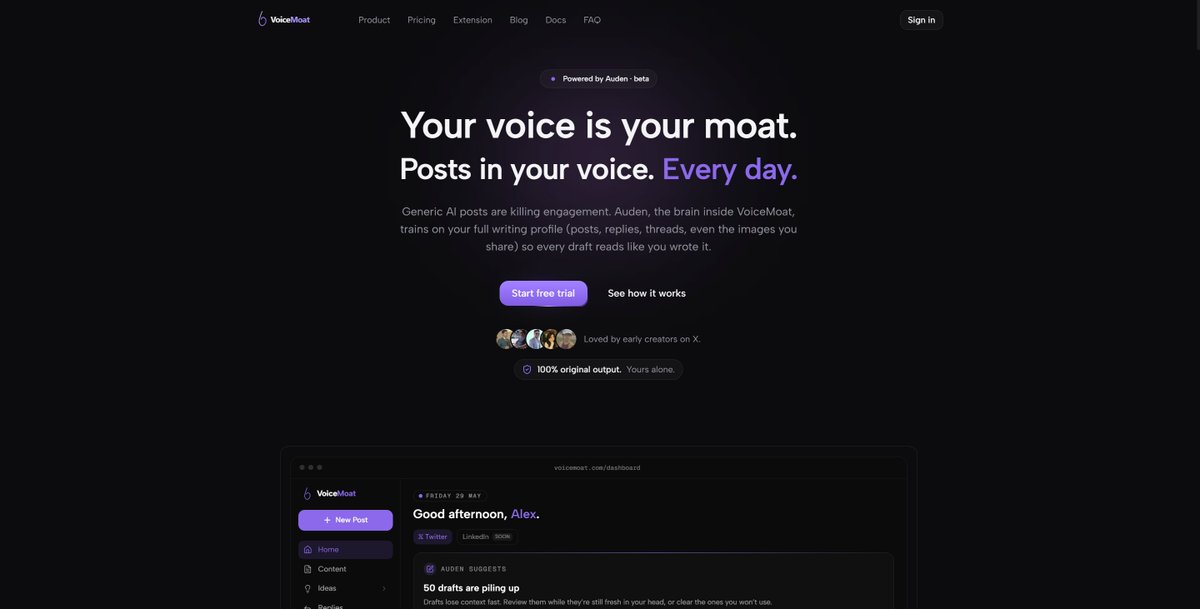
The idea is simple. VoiceMoat learns from your actual writing so the output still sounds like you, not a generic assistant. V2 is rebuilt from the ground up, and it's a real step up from the first version:
→ Auden, the brain inside VoiceMoat, now trains on your full profile (posts, replies, threads, even images) so it captures how you actually write.
→ Voice Lab: see the signals that make up your voice and fine-tune them.
→ Ask Auden: a writing partner you can chat with that remembers your context.
→ Analytics that read your live X data, so you can see which posts land, track your growth, and double down on what works.
→ An upgraded browser extension that drafts and coaches replies right inside X.
It's X-first today, with LinkedIn coming soon.
7-day Pro trial, full access, no card: voicemoat.com/
14
5
152
4,405
Jun 12
been quiet here for a while.
not because nothing was happening.
because we were building something that needed to work before it needed to be talked about.
VoiceMoat is launching on Product Hunt soon.
it's a tool that helps you sound like yourself at scale. not like everyone else with a queue full of AI slop.
if that problem sounds familiar, you'll want to be around when it drops.
13
13
167
7,389
Jun 3
Just requested access to Brag in Public — an invite-only community for indie makers who ship.
cc @ratheejaisal braginpublic.com/r/wwjkacn5t…
5
10
150
5,845
May 31
X to LinkedIn conversion
Your best X threads are LinkedIn posts waiting to happen. Most people destroy them in the conversion.
You wrote a thread that performed on X. People engaged, shared, replied to say it landed. Someone tells you to "put it on LinkedIn."
You spend 30 minutes expanding it. The post goes up, gets 12 likes from existing connections, never reaches a new reader.
Something died in the translation.
Three predictable failure modes, each preventable:
Surface-convention imitation. The writer studies high-performing LinkedIn posts, notices the motivational hooks and line-break-heavy formatting, and rewrites to match. The output looks like LinkedIn but sounds like everyone else on LinkedIn.
Generic AI rewriting. The writer pastes the tweet into ChatGPT with "rewrite for LinkedIn." The model adds length, swaps vocabulary for professional register, inserts decorative emojis. The output reads as AI-rewrite-from-X.. because that's exactly what it is.
Length-padding. The writer copies the tweet verbatim and pads it to LinkedIn's longer budget by repeating the same idea in slightly different words. The audience reads padding as filler because it is filler.
What all three have in common: they treat X and LinkedIn as the same platform with different character limits.
They're not.
Three structural moves that hold voice across the platform change:
Use the extra character budget for substance, not length. X compresses. LinkedIn expands. A 280-char tweet is already complete at its word count.. every word did work. The right move with 3000 characters isn't repeating the idea three times. It's adding what the tweet had to omit. The situation that produced the take. The counterargument considered and rejected. The corollary that flows from the same insight.
Calibrate register without going corporate. X tolerates more abruptness, more dry irony, more fragment-heavy pacing. LinkedIn expects slightly more setup. But "professional" doesn't mean corporate, and it doesn't mean LinkedInfluencer. Your vocabulary, your specific hooks, your way of phrasing contrarian positions.. those should survive the platform change. Give the reader 30% more context before you make the sharp claim. Don't soften the claim. Earn it more explicitly.
Reset the audience context. X feed is fast.. 1.5 seconds to earn the "show more" click. LinkedIn is slower. Readers stop more often. Your opener can earn the hook with a half-sentence more context. Adjust what you're signaling, not what you believe.
The checklist before you publish a conversion:
Is the core claim identical to the X version, or did I soften it to "fit" LinkedIn?
Is my specific vocabulary intact, or did I swap it for LinkedIn's default register?
Is the extra length substance, or is it repetition?
Would someone who knows my writing recognize this as mine without seeing my name on it?
If any answer is wrong, the conversion failed. Rewrite or don't post.
Your voice is what made the X thread work in the first place. It should survive the platform change. That's the whole point.
6
1
147
3,513
May 31
Somewhere around Series A, most SaaS teams discover the same uncomfortable truth: their CEO's casual tweet about a product insight drives more inbound sign-ups than a month of paid acquisition at the same cost.
The organic content loop is real. Measurable. And it doesn't scale.
Your CEO can write 3-5 posts a week and still run a company. At that cadence the compound effect is real but slow. The moment marketing tries to help.. by ghost-writing posts or drafting threads on their behalf.. the signal evaporates.
Readers can tell. The authentic founder voice IS the product. Any drift erodes the channel.
This is the SaaS team problem nobody has solved cleanly: how do you scale founder-led and team-led content without flattening individual voices into one corporate house style?
Per-contributor voice models. The CEO has one. DevRel has one. Head of product has one. Marketing drafts in each person's voice, routes for approval, ships at 3-5x output without losing what makes each voice work.
Engineers start posting because the tool respects their voice. Launch momentum doesn't die on day 7 because the calendar was drafted in advance. Pipeline lifts 15-25% from organic.
Full breakdown in the link.
voicemoat.com/for/saas
8
137
5,597
May 30
VoiceMoat vs Typefully
A beautiful editor won't fix a generic voice.
@Typefully is the best thread composer in the AI Twitter category. Not "good for an AI tool." Good by any standard. Keyboard shortcuts, thread blocks, split view, multi-platform publishing.
@VoiceMoat is a voice model trained on your actual posts. Auden learns your 9 voice dimensions, generates drafts in your specific style, scores every output 0-100 against your profile.
Both tools live in the X creator stack. Both have serious users. Both produce publishable content. Which is why the comparison keeps coming up.
They solve different bottlenecks.
A creator with Typefully but no voice model has a beautiful editor producing generic-AI drafts. The writing surface is great. The output sounds like everyone else using AI on X.
A creator with VoiceMoat but no thread composer has voice-accurate AI in a functional interface. The output sounds like them. The composing experience is fine but not elegant.
The right answer for most serious creators is both.
When budget only allows one, the question is which problem is louder right now:
If the writing surface itself is slow and fragmented.. or you publish to 5 platforms simultaneously.. or your voice is already strong and AI tools already sound like you.. Typefully.
If AI drafts feel generic and your audience is giving you "did you use AI?" signals.. or you live in replies and need in-feed drafting.. or you want to measure voice drift over time.. VoiceMoat.
The editor question and the voice question are separate. Know which one you're actually hitting.
5
1
105
4,446
May 30
The Tuesday method
Most AI Twitter workflows fail not because the AI is weak, but because the workflow is wrong.
Creators bolt AI onto a daily content grind and end up grinding just as hard. Post 2 days, miss 3, feel guilty, post twice more, miss the week. The AI made each individual draft faster.. but the structural problem was never draft speed.
The conventional advice is to post daily. The implication being that content creation is a daily practice. This works for about 12% of creators who genuinely have high-throughput idea metabolism and uninterrupted focus time.
For the other 88%, daily creation is a guilt-inducing grind that produces inconsistent quality.
Here's the math nobody does:
When you sit down to write one tweet, you spend roughly 5-8 minutes just getting into the right mental state. That warm-up applies whether you write one tweet or twelve. Batching twelve at once amortizes the warm-up across the entire session. You enter creative flow once and stay there for 90 minutes, instead of entering it twelve separate times for 15 minutes each.
The method:
Tuesday morning. 90 minutes. One session.
0-15 min: brain-dump every idea, opinion, customer quote, half-formed take from the last 7 days. No filter. 10-25 seeds.
15-20 min: triage. Mark the ones with a specific, arguable position. Delete the generic observations. You need 8-10 with real edge.
20-55 min: voice-matched drafts per seed. Pick the closest variant, 30-second edit, move on. You're editing from 80%, not writing from zero.
55-75 min: format selection. Some seeds want to be single tweets. Others want to be threads. Pick the format that fits the idea, not the format that fits the day's quota.
75-90 min: queue across the week with humanized timestamps. Close the laptop.
Output: 15-20 pieces of content. Done with creation until next Tuesday.
The most common failure mode isn't AI quality. It's starting with a seed pool of generic observations with no edge.. "consistency matters," "distribution is underrated," "focus on customers".. and wondering why the drafts feel lifeless. These aren't seeds. They're platitudes.
A seed is a position. Not an observation.
"Posted 3x a week for 6 months, grew slower than my friend who posted 7x for 3 months. Consistency matters less than intensity of a focused sprint" is a seed.
"Consistency matters" is not.
One session. One week. Done. The grind was always optional.
6
1
135
3,392
May 30
Ghostwriting is a craft business with a brutal scaling problem.
Your product is content that sounds like a specific person. Producing that requires deep familiarity with their voice. And deep familiarity takes weeks.
Most ghostwriters handle 3-5 clients well. Quality is high, retention is strong. Then someone offers a sixth retainer and the math breaks. Taking it means spreading thinner.. which means voice drift.. which means churn.
So you say no to growth.
The bottleneck isn't skill. Human voice-learning doesn't scale linearly. Your bandwidth to absorb and replicate a new writing style tops out somewhere around 5 active retainers.
What changes with per-client voice models:
Onboarding from 2-3 weeks to 5 minutes. Editing from 80% instead of writing from zero. Revision rounds drop from 3 to 1. Active book moves from 3-5 to 8-12 clients.
When a client says "this doesn't sound like me," you point to a 92% match score and the specific signal it missed. Subjective taste becomes data-backed review.
Full breakdown of the workflow in the link.
voicemoat.com/for/ghostwrite…
5
2
162
7,578
May 29
VoiceMoat vs Tweet Hunter (two theories)
Tweet Hunter and VoiceMoat are built on two competing theories of what makes content work on X. The honest answer: both are right, at different stages.
Theory A (@TweetHunterIO): study what worked, replicate the structure. 2B viral tweets indexed by performance. The bet is that performance patterns transfer.. what worked in your niche will work for you with the right structural moves.
Theory B (@VoiceMoat): what works is what sounds unmistakably like you. Audiences follow specific people, not content types. The bet is that voice distinctiveness is the durable competitive advantage.
Where each theory actually wins:
For discoverability and new audience acquisition, structurally optimized hooks earn the first click from someone who has no prior relationship with your account. Theory A wins.
For retention and loyalty, voice distinctiveness is what keeps followers engaged past the initial follow. An audience that followed you because a hook was good will unfollow when the next hundred hooks are identically structured. Theory B wins.
Stage-by-stage:
0-500 followers.. you need consistent posting and inspiration. Tweet Hunter is more useful.
500-5k followers.. you have a voice worth protecting. Both relevant, voice becomes critical.
5k followers.. parasocial relationship with your specific voice. Drift is detectable and costly. VoiceMoat is more critical.
Pick the theory that matches where you are right now, not where you wish you were.
5
4
121
3,374
May 29
The solopreneur one-person content machine
Most content advice assumes you have resources to allocate. The solopreneur doesn't.
"Build a content calendar." "Hire a ghostwriter." "Delegate the scheduling."
Fine for someone with a team. Wrong for the solopreneur whose day already divides between building the thing, selling the thing, delivering the thing, supporting people using the thing, doing the bookkeeping, and occasionally sleeping.
The solopreneur has one resource pool shared across all roles. When content wins time, something else loses it.
And yet.. the solopreneur's X presence matters more, not less, than the funded founder's.
For a one-person business, the audience-relationship IS the business. The inbound channel, the trust asset, the thing that makes customers choose you over a cheaper alternative. When your X presence falters, there's no marketing department running ads in parallel to cover the gap.
Three principles that hold a one-person presence together:
Voice is the non-negotiable asset, not posting frequency. A solopreneur posting 3x a week in their own voice compounds better than posting 10x a week in a generic AI register. Your audience followed you specifically. When your content starts sounding like it could have been written by anyone, you've accidentally made the case for your cheaper competitor.
Batch creation, not daily creation. Daily content requires consistent mental availability that solopreneur days don't reliably provide. A client emergency on Tuesday breaks a daily cadence. Batching one week in a single 90-minute session is defensible against almost all interruptions.
Use AI to eliminate blank-page friction, not to replace thinking. You have ideas. The bottleneck is the 15-25 minutes it takes to turn a raw idea into a polished post. Voice-trained AI fixes that specific problem. The thinking stays yours. The polish time gets reclaimed.
The actual weekly time math when this is running: from 7.7 hours a week down to 1.9.
Six hours back. Same voice. Same audience trust. Just less friction between the idea in your head and the post in your feed.
Your voice is the competitive advantage a team can't replicate. Protect it like it's the asset it is.
8
4
116
7,247
May 29
Every serious founder knows the math.
A visible X presence drives inbound.. from customers, hires, investors. The founders who build in public consistently are the ones who show up in deal flow. The ones who go dark for six weeks during a sprint lose the compounding they spent months building.
The problem isn't motivation. It's time.
Writing one good tweet takes 15 minutes. A thread takes 90. Across a week, across a launch, across six months.. that's a full-time job running alongside your actual full-time job.
So founders outsource.
$1-3k/month ghostwriters who take two weeks to onboard and still produce drafts that sound like a press release.
ChatGPT that produces content indistinguishable from every other AI-generated founder thread.
Or they just stop posting and tell themselves they'll get back to it after the next sprint.
None of these work.
The fix is a system that learns your actual voice in under 5 minutes, generates drafts scored against that voice, and turns 20 minutes a Monday into a week of content that compounds.
Pre-launch is the optimal window. Most of the upside from consistent posting comes from content published 3-6 months before launch, not during it.
Full breakdown in the link.
voicemoat.com/for/founders
11
2
159
6,562
May 28
SaaS founder distribution
Your product shipped. Did anyone notice?
SaaS founders are trained to focus on two things: build the product and talk to customers.
Both correct. What neither covers is the third job that makes both of the first two compound. Building the audience that makes your next launch land, your next hiring wave fill fast, and your next fundraise start from a warm signal instead of cold outreach.
The math at most early-stage SaaS:
60-80% of founder hours → product
Less than 5% → organic content
That gap is where the distribution game gets lost.
Naval, Pieter Levels, Sahil Bloom, DHH aren't famous because they're better builders. They're famous because they built in public at a cadence that let audiences build alongside them. By launch, they had people who were already sold.
The problem isn't motivation. Every founder wants this.
The problem is that building organic distribution on X requires 2-4 hours a day the founder cannot spare without sacrificing product velocity. And product velocity is the load-bearing metric at early stage.
So distribution loses the internal priority battle every time.
The four failure modes specific to SaaS:
Founder content capped at founder hours.. 3-5 posts a week when the channel deserves 12-18.
Team silence.. DevRel, head of product, lead engineer all default to silence because "marketing will sanitize it."
Launch cliff.. Week 1: CEO posts 8 times. Week 3: zero. Product momentum starves exactly when sustained oxygen matters most.
Generic AI damage.. founders try to solve the time problem with general AI tools, customers spot the drift, trust erodes faster than no content would have.
What changes when each team contributor has their own voice model:
Marketing drafts in each person's voice, scored against their actual profile. Marketing can't sanitize without the tool catching it. Engineers start posting because the tool respects their voice. Launch calendars get drafted four weeks ahead.. day 7 momentum doesn't die because nobody had time to write.
The hardest question isn't the ROI. It's whether you're willing to test the channel that every SaaS founder who's done it consistently says was their highest-leverage early investment.
16
7
114
5,893
May 28
CT has been trained to smell marketing.
two agency-sounding tweets and your credibility window closes.
chatGPT's default voice is exactly what gets flagged. neutral. professional. optimistic. the "social media intern" tell.
what actually works is your cadence. your dialect. the things you'd never post even if they'd farm engagement.
taboos enforced as hard blocks, not suggestions.
$69/month vs $2k for a CT ghostwriter.
narrative response time in minutes, not hours.
manual approval on every draft. zero auto-posting.
pre-token is when voice lock-in matters most.
10
10
117
6,479
May 27
The AI Twitter tool decision framework
Most "best AI Twitter tool" lists assume the same tool is best for everyone.
It isn't.
Hypefury, Tweet Hunter, Typefully, and VoiceMoat sit in genuinely different product categories. They keep appearing in the same roundups because they share a search space.. but that's like calling a drafting table, a pencil, and a printing press all "writing tools." Technically true. Not useful for buying.
Each one solves a different bottleneck:
Hypefury → distribution. Multi-platform scheduling, auto-plugs, evergreen recycling. Pick when content is good but isn't reaching enough people.
Tweet Hunter → research. 2B viral tweet library, searchable by topic. Pick when you know how to write but don't know what to write next.
Typefully → composing surface. Best thread editor in the category. Pick when the writing experience itself is the slow part.
VoiceMoat → voice fidelity. Trains on your actual posts, scores every draft 0-100 against your profile. Pick when AI drafts feel generic and your audience can tell.
The decision is straightforward once you know which stage of your workflow is broken.
Distribution problem → @hypefury
Inspiration problem → @TweetHunterIO
Composing problem → @typefully
Voice problem → @VoiceMOAT
Stop picking by popularity. Pick by bottleneck.
5
7
115
6,964
May 27
CT's BS detector
Crypto Twitter's BS detector is the best AI filter your content could have.
Every online community develops some capacity to detect inauthentic content. CT's capacity is in a different tier.
Years of rug pulls, narrative pumps, coordinated KOL campaigns, and paid shill rotations trained crypto audiences to read for specific authenticity signals.. position disclosure, native vocabulary, cycle experience, willingness to take positions that could be wrong in public.
When a piece of CT content fails the BS detector, it doesn't just underperform. It actively inverts.. generating suspicion and ratio instead of engagement.
The interesting implication: if your AI content strategy can pass CT's filter, it's almost certainly authentic enough for any other platform.
CT has the most sensitive filter. Using it as your QA system is actually useful information.
What fails it (and what generic AI produces by default):
"Revolutionary." "Cutting-edge." "Seamless." "Transparent." Rocket emoji as a tic. No specific claims that could be checked.
What passes it (and what real builders write):
"our v2 liquidation engine is live on mainnet. the v1 bug that let liquidators sandwich the protocol is fixed. tested it against 14k blocks of historical data. found 3 edge cases we patched."
Specific. Positioned. Dialect-appropriate. Shows the work. Takes a real claim.
The discipline that holds for AI tooling on CT:
Train on your actual posts, not on general writing. Generic models produce professional-neutral register by default.. CT requires your specific dialect.
Hard taboos at the model level, not prompt level. "Revolutionary" needs to be blocked, not managed through careful prompting.
Manual approval on every single draft. Automation at the reply layer carries account-safety risk beyond what most platforms require, because CT specifically watches for bot-shaped behavior.
Pass CT's filter and you've cleared the highest bar in social. The rest of the internet is forgiving by comparison.
5
5
115
4,461
May 27
voice drift is the silent killer of creator brands.
week 1: you sound unmistakably like yourself.
week 6: you're recycling the same 3 hook structures.
week 12: replies drop. you blame the algorithm.
month 6: someone asks if an AI wrote this.
they're not wrong.
the irony is brutal. the tools you use to post more are the same tools making you worth following less.
generic models average across millions of writers. the output lands somewhere between useful and indistinguishable.
your followers are there because you're not average.
volume without voice is a slow death.
5
2
106
5,486
May 27
the cheat code for staying ahead in AI isn't following labs. it's following the builders inside them.
here's who i actually check daily, by lab:
anthropic
• @karpathy: the clearest thinker in the space, period
• @bcherny: built claude code, drops real usage insights
• @trq212: writes the best technical breakdowns on CC
openAI
• @polynoamial: reasoning research with actual depth
• @gabriel1: sora, and one of the more honest career timelines you'll find
• @jxnlco: dev experience lens on codex, underrated follow
google AI
• @officialloganK: if gemini ships something, he'll tell you first
• @ammaar: best person to follow if you're vibe-coding in AI studio
• @fofrAI: generative model use cases that actually make you think
cursor
• @leerob: loudest signal on what cursor is doing next
• @mntruell: CEO. ships fast, posts faster
• @ericzakariasson: practitioner-level cursor insights
xAI
• @milichab: grok updates, early and specific
• @skcd42: covers the major releases without the noise
• @elonmusk: reposts everything xAI, like it or not
who's missing from your list?
6
107
7,904
May 26
The $2,400 to $69 switching story
The math looks obvious. Human ghostwriter: $2,400/month. Voice-trained AI: $69/month. Switch and save $2,331.
But the ROI question isn't the cost question. It's the conditional question.. what do you actually get and what do you actually lose?
What AI gives you that humans can't:
Drafts in under 2 seconds, available at 3am. 10x volume at the same budget. Voice match score on every draft. 5-minute onboarding vs 3-week ramp. No off-days, no vacation gaps, no holiday radio silence.
What humans give you that AI can't:
Strategic judgment.. knowing what NOT to post this week. Current-event awareness without briefing. Industry relationships. The ability to surprise you with angles you hadn't considered.
The honest framing: humans are better at judgment, worse at scale. AI is better at scale, worse at judgment.
The question is which you're more bottlenecked by right now.
For most creators 6 months into a ghostwriting relationship, the writer has already provided most of the judgment value. You're now paying $2,400 for execution.. which AI does cheaper and faster.
For creators in the first 3 months, the judgment is still being built. Switching too early loses that investment.
The optimal stack isn't AI vs human. It's AI for execution and your own judgment for strategy.
You were paying $2,400 a month for someone to execute decisions you can make yourself in 4 minutes per post.. once the execution friction is removed.
6
1
126
8,886
May 26
The Chrome extension stack
Tab-switching is the silent killer of content cadence.
You leave x.com to draft a reply in another tool. By the time you come back, the mental state that made you want to write it is gone.
The math nobody does:
90 seconds per tab-switch round-trip
× 12 switches per day
= 18 minutes lost daily
Which is 90 minutes a week. Six hours a month. Just on context-switch friction. Before accounting for the lower quality of replies written while partly context-switched.
The fix isn't more Chrome extensions. It's the right ones.
A genuine inline extension does its work without ever redirecting you out of x.com. If you have to click into another full interface, it's not saving you the tab-switch.. it's just a shortcut to it.
What actually belongs in a minimum viable stack for most creators:
A voice-trained reply drafter that lives inside the x.com compose area. Hover a post, get a draft in your voice in under 2 seconds, edit, send. Replaces the longest tab-switch in the average creator's day.
An inspiration sidebar that brings viral examples into the feed when you're already scrolling.
That's it. Two extensions. Everything else is optional additive.
The test for whether an extension belongs in your stack: does it remove a tab-switch you were already making, or does it add a new interaction layer on top of your existing workflow?
The former earns its place. The latter usually doesn't.
The best creators aren't fast because they work harder. They removed friction the rest of us didn't notice.
5
1
117
4,450