
Let's talk DevRel 🥑
Joined September 2022
- Tweets 406
- Following 80
- Followers 737
- Likes 328
59 Photos and videos



Pinned Tweet

1
261
One-line takeaway:
The biggest startups are built not by exploiting people, but by deeply understanding users, solving problems they truly care about, and growing through products people genuinely love.
Jun 14

How to Earn a Billion Dollars: paulgraham.com/earn.html
19
How do you use Claude Code, Codex, Hermes, Openclaw, or any similar agents? What do you use to perform it better? What are the patterns?
What is the execution layer?
1
64
DevRel As Service retweeted

Jun 2
Introducing Devin Desktop.
Manage fleets of local and cloud agents from one surface. Plan, delegate, review, and ship without leaving your editor.
121
163
1,601
3,192,194
THE WINNER OF THE ANTHROPIC HACKATHON JUST OPEN SOURCED HIS ENTIRE AI CODING SETUP FOR FREE. 183 AGENT SKILLS, 48 SUB-AGENTS AND 79 READY-MADE COMMANDS.
He spent 10 months on it, won $15K in API credits, then released the whole stack under MIT license.
2
110
DevRel As Service retweeted

Jun 2
New Hermes Agent Desktop app is AWESOME 🔥
33
28
386
36,362
DevRel As Service retweeted

May 30
Watch me control my computer with just my voice. This is the future of operating systems.
No hands.
GPT-Realtime 2.0 is very, very underrated.
Demo:
932
842
14,145
3,720,847
DevRel As Service retweeted

May 29
Hermes Agent now has Tool Search, so your agent only loads what it needs
160
257
3,372
1,020,271
RT @ghumare64: Almost everyone is building agent harness systems the wrong way.
The default move: pick LangChain or LangGraph or the OpenA…
55
DevRel As Service retweeted

May 15
15
26
295
39,511
DevRel As Service retweeted

May 27
18k ⭐️ on a GitHub repo. Organically.
My friend @ghumare64 is a great example of building in public for the community. The guy is genuinely passionate about what he does and builds open-source projects that get serious traction.
His latest project, agentmemory, a persistent memory layer for AI coding agents based on real-world benchmarks, and hit the number 1 trending spot. Incredible milestone.
Check it out here: github.com/rohitg00/agentmem…
3
5
115
5,372
DevRel As Service retweeted

May 21
Today we reduced headcount by 22%. The business is the strongest it's ever been. So I think it's important to be direct about what I'm seeing and why.
First, I made this decision and I own it. I did it because the way to operate at the highest level of productivity is changing, and to win the future, ClickUp needs to change with it.
Second, this wasn't about cutting costs. Most savings from this change will flow directly back into the people who stay. We'll be introducing million-dollar salary bands. If you create outsized impact using AI, you'll be paid outside of traditional bands.
Most importantly, I have the deepest gratitude for those affected. We're doing this from a position of strength specifically so we can take care of people properly. Everyone affected receives a package aimed at honoring their contributions and easing the transition.
I only see two options: wait for this to play out gradually in the market or be honest about what I'm seeing and act proactively.
THE 100X ORGANIZATION
The primary change is that we're restructuring around what I call 100x org. The goal is 100x output. The roles required to build at the highest level are fundamentally different than they were a year ago.
Incremental improvements to existing systems won't get us there. We need new ones. That means creating enough disruption to rebuild rather than iterate on what's already broken.
The common narrative is that AI makes everyone more productive. It doesn't. Many of the workflows of today, if left unchanged, create bottlenecks in AI systems.
These roles will evolve. But waiting for that to happen naturally means falling behind now.
The 100x org is actually heavily dependent on people - infinitely more than today. This is only possible with 10x people that have embraced and adopted new ways of working.
THE BUILDERS, AGENT MANAGERS, AND FRONT-LINERS
— THE BUILDERS: 10X ENGINEERS
I don't think most companies have internalized what's actually happening with AI in engineering. The common narrative is that AI makes all engineers more productive. That may be true in isolation, but at an organization level - that is the farthest thing from reality.
Here's what we've validated recently at ClickUp: the great engineers, the ones who can orchestrate, architect, and review, are becoming 100x engineers. They're not writing code. They're directing agents that write code. The skill is judgment.
AI makes the best engineers wildly more productive, and everyone else using AI slows these engineers down.
Think about it - the bottlenecks are (1) orchestration - telling AI what to do, and (2) reviewing - what AI did. Everything is leapfrogged and no longer needed.
So who do you want orchestrating and reviewing code?
And how do you want your best engineers to spend their time?
If your best engineers are spending time reviewing other people's code, then this is inherently an inefficient bottleneck. These engineers can review their agent's code much faster than reviewing human code.
The new world is about enabling your 10x engineers to become 100x.
The wrong strategy is to push every engineer to use infinite tokens. Companies doing this are celebrating 500% more pull requests. But customer outcomes don't match the volume of code being generated.
I call this the great reckoning of AI coding, and every company will face this soon if not already.
More code is just another bottleneck to the best engineers, and ultimately to your company's impact as well.
— THE BUILDERS: 10X PRODUCT MANAGERS
Product management and design roles are merging.
Designers that have customer focus, become more like product managers.
And product managers that have intuition for UX become more like designers.
The bottleneck of user research is gone. It takes us just one mention of an agent to kickoff research and analyze results.
The bottleneck of product <> design iteration is also gone. The product builder iterates on their own, along with agents and skills that ensure alignment with quality and strategy.
Also controversial today - I believe that the wrong strategy is to have your PMs shipping code - that just introduces another bottleneck that the best engineers will waste their time on.
To be clear, PMs should be coding but they should do this in a playground to iterate, validate, and scope. That code should not go to production.
Everything outside of managing systems, orchestrating AI, and reviewing output becomes a bottleneck.
That's why the other roles that are critical along with these are the systems managers (to reduce bottlenecks) along with a bottleneck you can't replace - customer meeting time.
— THE SYSTEM MANAGERS
Ironically, the people that automate their jobs with AI will always have a job. They become owners of the AI systems - agent managers. We have many examples of these people at ClickUp.
The underlying systems in which we operate are absolutely critical to get right. I think most companies are delusional to think they can iterate on existing systems and compete in this new world.
You must create enough disruption so that old systems are deprecated entirely. If there's any definition for 'AI native' that's what it is.
— THE FRONT-LINERS
In a world that will become saturated with AI communication, the human touch will matter more than anything to customers.
This is a bottleneck that you shouldn't replace - even when agents are high enough quality to do video meetings.
One-on-one meeting time with customers is something that shouldn't be automated. The systems around the meetings should be - so that front-liners spend nearly 100% of their time with customers.
REWARDING 100X IMPACT
In a world where companies are able to do so much more with less, where does that excess money go?
In our case, much of the savings in this new operating model will flow directly back to those that enabled it.
We must reward people that create productivity accordingly. This aligns incentives on both sides. Plus, in a world where your best people create 100x impact, you can't afford to lose them.
You should aim to retain these employees for decades. The context they have and their ability to efficiently orchestrate and review will be nearly impossible to replace.
Compensation bands of today should be thrown out the door. We're introducing $1 million cash/year salary bands with a path available to nearly everyone in the company if they produce 100x impact by creating or managing AI systems.
THE FUTURE
Nearly every company will make changes like these. The ones that do it proactively will define what comes next.
The future is not fewer people. It's different work, new roles, and better rewards for those who embrace it. We're already seeing entirely new roles emerge, like Agent Managers, that didn't exist a year ago.
ClickUp is positioning to lead this shift, not just internally, but for our customers too. I've never been more certain about where we're headed.
1,651
1,136
7,666
9,129,832

DevRel As Service retweeted

May 19
karpathy pulling up to the office for his first day on the research team

67
717
14,674
883,434
DevRel As Service retweeted

May 19
RAG vs. CAG, clearly explained!
RAG is great, but it has a major problem:
Every query hits the vector DB. Even for static information that hasn't changed in months.
This is expensive, slow, and unnecessary.
Cache-Augmented Generation (CAG) addresses this issue by enabling the model to "remember" static information directly in its key-value (KV) memory.
In fact, you can combine RAG and CAG for the best of both worlds.
Here's how it works:
RAG CAG splits your knowledge into two layers:
↳ Static data (policies, documentation) gets cached once in the model's KV memory
↳ Dynamic data (recent updates, live documents) gets fetched via retrieval
This gives faster inference, lower costs, and less redundancy.
The trick is being selective about what you cache.
Only cache static, high-value knowledge that rarely changes. If you cache everything, you'll hit context limits. Separating "cold" (cacheable) and "hot" (retrievable) data keeps this system reliable.
You can start today. OpenAI and Anthropic already support prompt caching in their APIs.
I have shared my recent article on prompt caching below if you want to dive deeper.
Have you tried CAG in production yet?
Below, I have quoted an article that I wrote on prompt cashing and how Claude Code achieves a 92% cache hit-rate. Give it a read.

52
298
1,486
277,278

There canonical guide to using X with Hermes 👀👀

31
34
654
48,497
DevRel As Service retweeted
May 19
The @xai team has published a full setup guide on how to use the xurl skill, which allows your Hermes Agent to read and write to X on your behalf — posting, searching, pulling bookmarks, managing lists, and more — all through natural language.
181
397
4,554
576,341
DevRel As Service retweeted

May 19
Personal update: I've joined Anthropic. I think the next few years at the frontier of LLMs will be especially formative. I am very excited to join the team here and get back to R&D. I remain deeply passionate about education and plan to resume my work on it in time.
7,988
11,149
150,266
27,584,306

Ok, Hermes Agent just cooked
Their biggest update just dropped and it adds a TON
• Post autonomously to X
• WAY improved memory
• MUCH smarter kanban board
• Tons more
In this video I walk you through all the new features and how to SUPERCHARGE your 24/7 AI employee
70
67
867
57,735
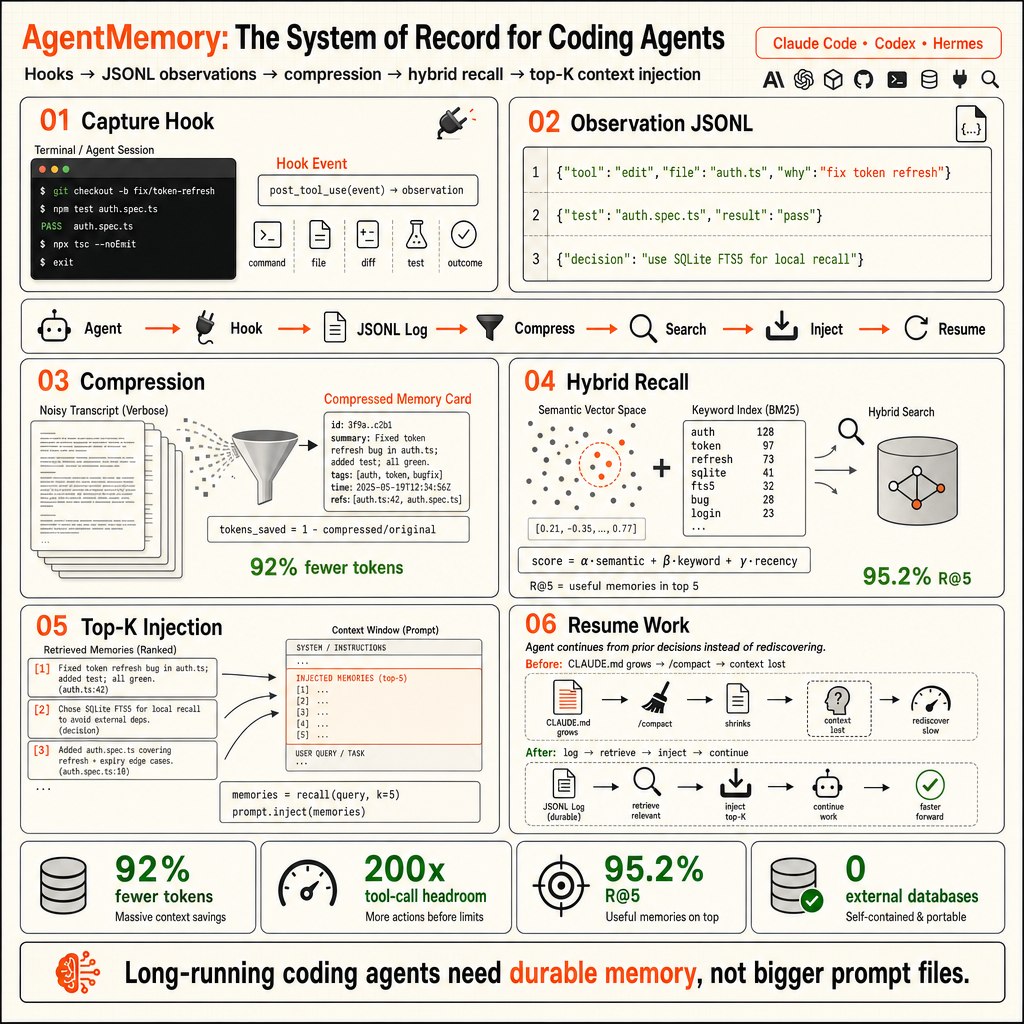
🚨 AI coding agents just got the missing primitive.
It is called AgentMemory, and the idea is simple:
Your coding agent remembers everything.
A persistent memory layer for Claude Code, Cursor, Codex, Gemini CLI, OpenCode, Hermes, OpenClaw, and any agent that speaks MCP or REST
6
6
248