
Bitcoin native assets and scalability technologies. Building @bitlynxoffcial
Joined September 2023
- Tweets 14
- Following 30
- Followers 275
- Likes 194
Photos and videos
Pinned Tweet

16 Oct 2024
Channel solutions extend beyond the Lightning Network! 🔥Shared UTXO & ARK protocol are gaining traction.
Why are they essential?
How do they differ from #LightningNetwork ?
What possibilities do they unlock for #Bitcoin ?
Read our latest article!
👉 medium.com/@discocolabs/the-…
9
17
43
12,546

First, I'd like to thank @1440000bytes for the excellent compilation of covenants. Here I'll briefly outline these covenants and explain the attitudes expressed in the table.
OP_CTV represents the simplest way to make UTXO spending predictable. It inspired ideas about implementing Shared UTXO on Bitcoin and unilateral exit mechanisms, including the controversial congestion control tree. While some consider it insufficiently flexible, I believe it's adequately effective and simple, thus posing minimal potential risk to Bitcoin. Therefore, I lean towards favoring CTV.
Regarding OP_CSFS, I first encountered it while reading about CTV use cases, discovering its potential to combine with CTV for efficient non-interactive payment protocols. I believe it has more interesting use cases, hence my "Acceptable" rating.
OP_PAIRCOMMIT is an interesting example because many script program designs using OP_CAT operate similarly to OP_PAIRCOMMIT: hashing after concatenating elements. However, CAT has been promoted for a long time, and we shouldn't limit ourselves to just this usage in the future.
OP_INTERNALKEY designs have been discussed extensively historically, but we understand they only solve part of the UTXO introspection issue. If we only get one upgrade opportunity every four years, this seems too wasteful.
OP_CAT was originally designed to concatenate two elements but unexpectedly achieved complete UTXO introspection of Bitcoin through the Schnorr trick, making CAT representative of universal covenants. I recommend reviewing @weikengchen's cases like state caboose to understand an alternative implementation of MATT-like concepts.
OP_CCV prompted many to consider implementing native applications on Bitcoin. MATT's forward-thinking approach is admirable, but its design is somewhat rigid. Perhaps we'll develop better solutions in the future.
Compared to CTV's commitment to fixed UTXO fields, OP_TXHASH allows users to choose fields for commitment construction. However, this adds complexity: we must decide which fields can enter the stack and how to represent field selection. I believe introducing TxHash would only bring more controversy and issues. Nevertheless, its design is undeniably cool.
APO's past application in Eltoo actually couldn't bring a better future for Bitcoin, as I've detailed in my article. Those interested can read more at the medium.com/@discocolabs/the-…。
1
3
16
1,748
Discoco Labs retweeted

31 Oct 2024
Seeing the growing interest in payment protocols compatible with the Lightning Network, we wanted to share insights from our work on Arkade, a PoC wallet for the Ark protocol.
A few people were able to try our PWA implementation in the last month. While far from optimized, we think it's useful to create a mental model around the Ark transaction lifecycle ⬇️
5
24
107
23,784
25 Oct 2024
The difference in @bitlynxoffcial approach lies in ARK’s OOR transactions, where we introduce threshold signatures to make VTXO payments more trustless, thus avoiding the additional costs associated with channel liquidity. This approach is similar to the role statechains play in Spark’s design.
The descriptions of the funding tree and unilateral exit feel very familiar, leading me to believe that ARK and Spark are players within the same domain.
As we mentioned in our previous research, Bitcoin’s native scaling solutions will introduce greater collaboration with off-chain operators, which not only lowers costs for end users but also improves their experience.
2
13
1,942
Discoco Labs retweeted
21 Oct 2024
Don't miss our latest blogpost for all highlights from this month's @BitcoinConfEUR, including @Boltzhq's game-changing Ark integration and @tierotiero’s vision for scaling Bitcoin to billions—all while preserving everything that makes Bitcoin, Bitcoin! blog.arklabs.to/ark-labs-at-…
9
11
38
2,803
Discoco Labs retweeted

16 Oct 2024
Bitcoin is both a medium of exchange and a store of value, now and in the future.
It's never a choice between hodling or spending sats; bitcoin's growth lies in doing both.
@roy_breez breaks apart bitcoin’s false dichotomy in his latest post 👇
bitcoinmagazine.com/culture/…
52
119
387
129,204
It’s truly exciting to collaborate with the most pioneering teams in the BTC ecosystem on advancing new scaling solutions!
@ArkLabsHQ is committed to developing innovative technologies like virtual channels, which will undoubtedly inject new vitality into the BTC ecosystem.
16 Oct 2024

Another player enters the Ark arena
Very excited to collaborate with @blapta and his team as we continue to iterate on different designs and optimizations.
Highly recommend checking out his article to get a glimpse of the potential behind this new protocol.
2
2
13
2,562
16 Oct 2024
The potential of the ARK protocol is truly amazing, I believe everyone will love it!🥰
16 Oct 2024
Another player enters the Ark arena
Very excited to collaborate with @blapta and his team as we continue to iterate on different designs and optimizations.
Highly recommend checking out his article to get a glimpse of the potential behind this new protocol.
4
361
7 May 2024
RT @blapta: 这次最Maxi的活动来了! 香港五月十一号 HashKey Capital @HashKey_Capital 和 Discoco Labs @discoco_lab 将一起给大家带来关于Bitcoin Channel的不同的设计与最新的进展。 更有…
2
2
Discoco Labs retweeted

2 May 2024
The first ever Taproot Assets transaction on Lightning 👀
2 May 2024

excited to announce that I’ve just made the first mainnet *asset* keysend payment w/ Taproot Asset channels! ⚡️🥕
below you can see me sending beefbux across nodes instantly
the demo uses a dev version of litd (Lightning Terminal Daemon) that packages lnd tapd ⛓️
⬇️
10
77
320
87,303
Discoco Labs retweeted

2 May 2024
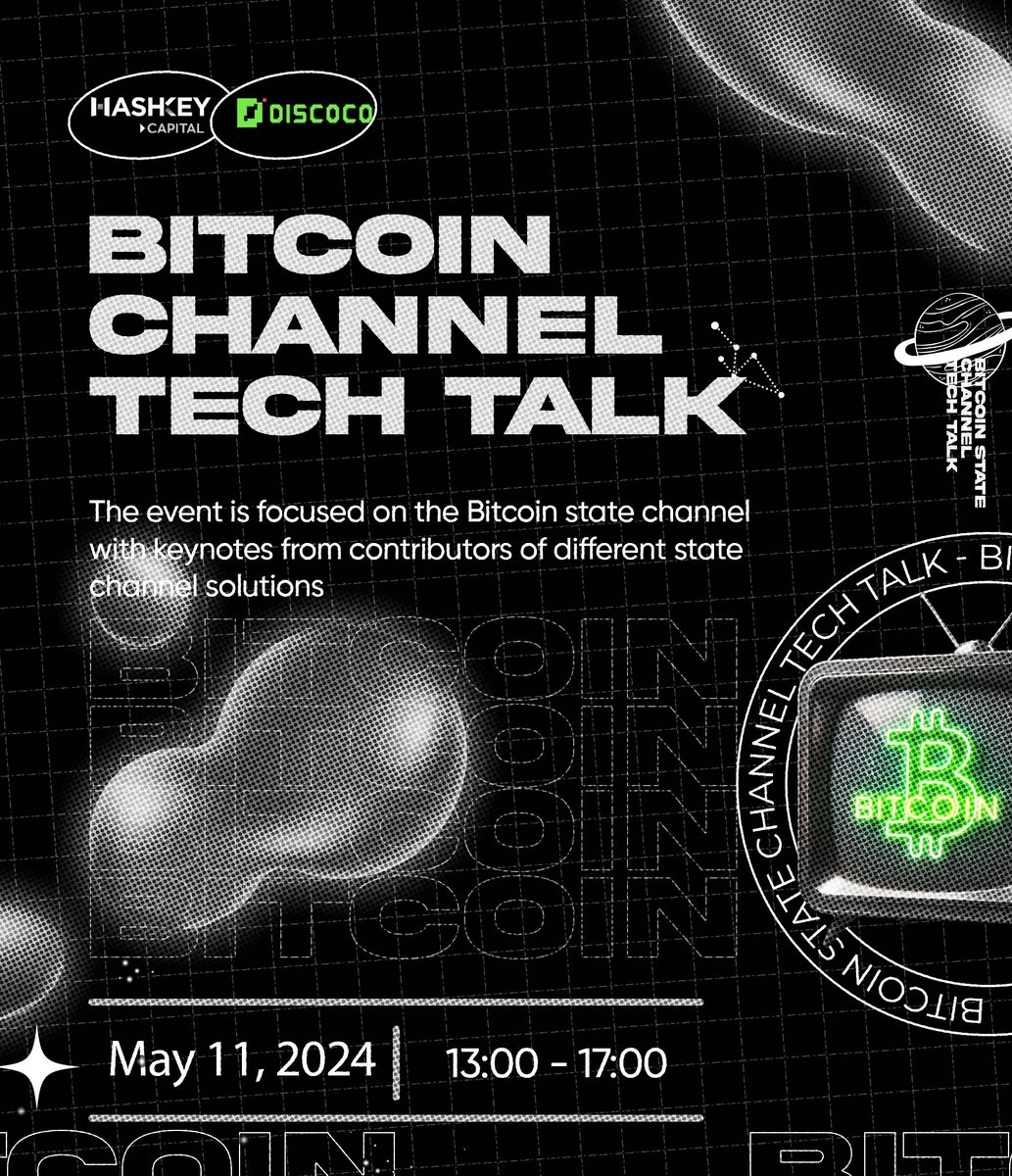
We’re bringing #Bitcoin Channel Tech Talk to Hong Kong!🇭🇰
Bitcoin channels, such as the Lightning Network are crucial for scaling the Bitcoin network; and there are also new designs like DLC channels, Hedgehog enabling faster, cheaper, and more scalable transactions.
Co-hosted by HashKey Capital and @discoco_lab, join experts, developers, and enthusiasts such as our Head of Investment Research, @hu_zhiwei plus @AurtrianAjian @blapta @bonomat @yyforyongyu @starkness @super_testnet & more to explore the latest advancements and networking opportunities!
Register now to secure your spot - lu.ma/bitcoin-channel-tech-t…
4
315
332
15,895
19 Mar 2024
对比特币生态感兴趣的欢迎报名 👏
3 月 25 -29 日一起学习 #Bitcoin
12 Mar 2024

⚡️2024年,加密市场发生巨大变化,比特币生态也吸引了整个Web3行业的关注点。越来越多的开发者关注比特币的发展,与此同时更多的开发者感觉无从下手。#比特币公开课
为帮助更多开发者系统入门比特币生态,@btcstudy 、 @CKB_CN、@discoco_lab、@see_dao、@UpchainDAO、@RebaseCommunity、@OpenBuildxyz 共同组织了为期一周(3月25-29日)的比特币线上公开课!
📌欢迎各位感兴趣 BTC 生态的小伙伴报名:
openbuild.xyz/learn/challeng…

1
1
949
15 Mar 2024
So glad and honored to be selected by @masknetwork 🔥
Great thanks to Mask for your support 🤝
13 Mar 2024

🚀 Mask Network Web3 Social Ecosystem Grant has reached its 3rd round, and we're thrilled to announce the selected grantees! 🎉
Long Thread below 1/10
link.medium.com/jCRHzOQUVHb
578
6 Nov 2023
这是我们在 #BTC 生态研究的第一篇文章,欢迎大家拍砖。 关于 #taprootassets 和 #RGB 的差异,客户端验证和一次性密封的概念解析,BTC未来扩容的方向。
你想知道的,这里都有:
mirror.xyz/0x5CCF44ACd0D19a9…
1
22
58
29,684