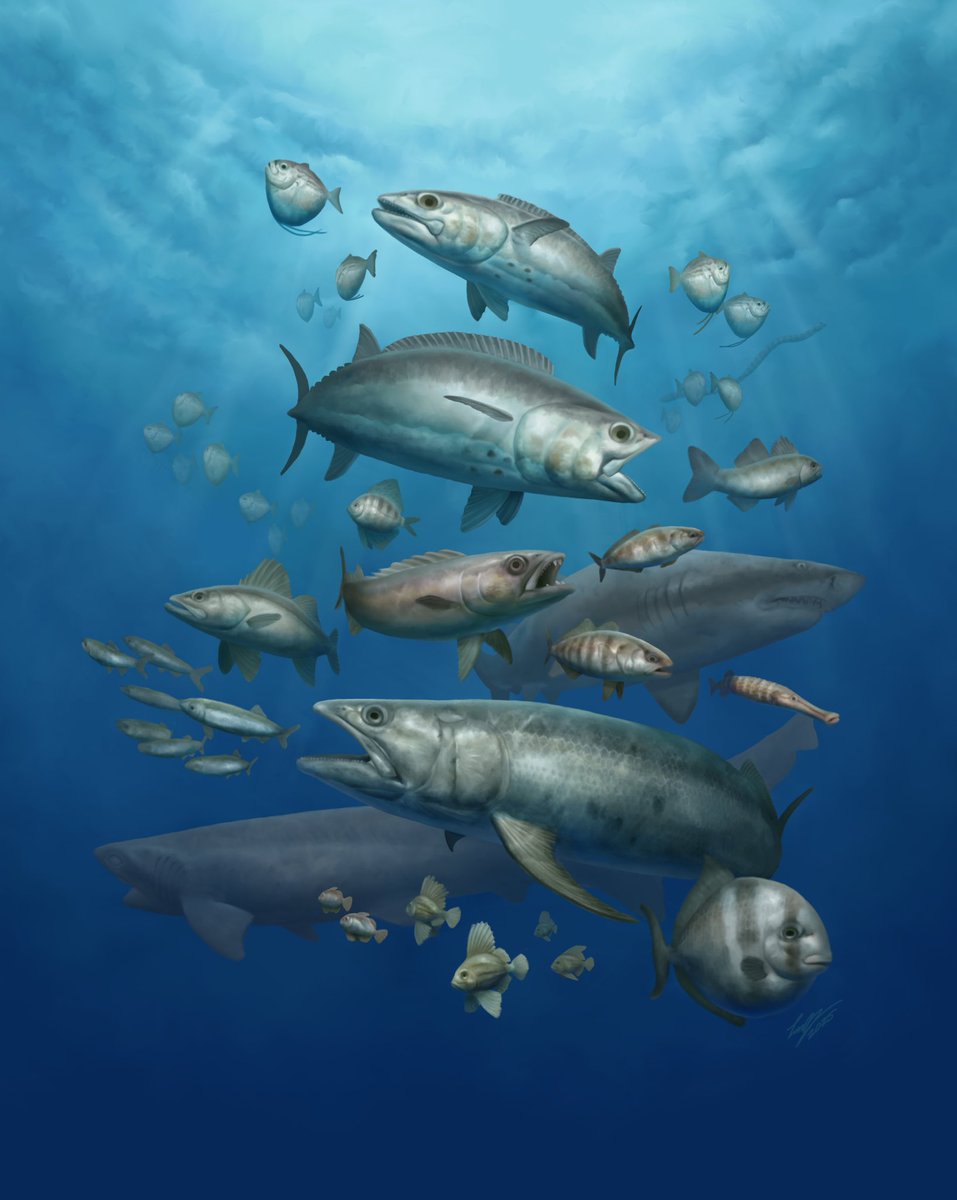
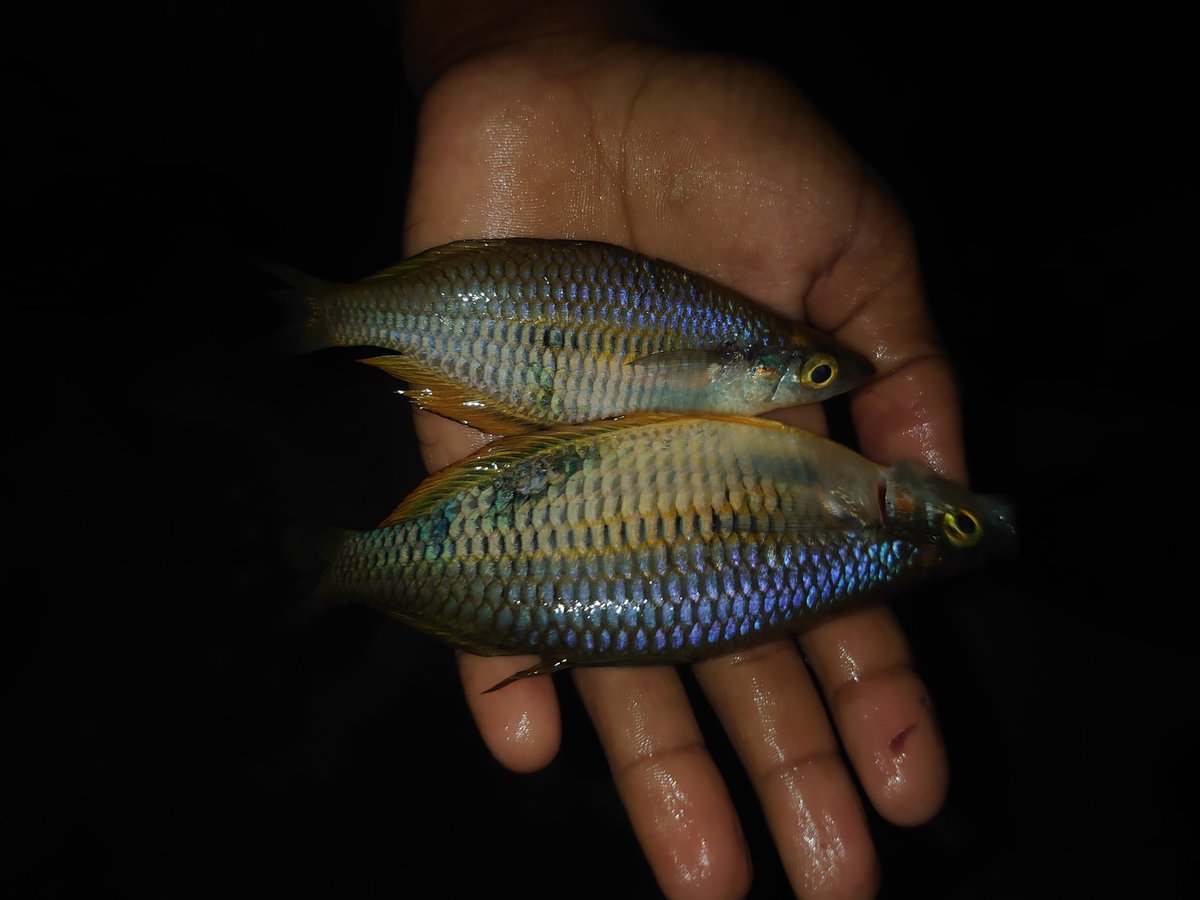
The order Atheriniformes (silversides, rainbowfishes, and blue-eyes) is a globally distributed group of fishes with frequent evolutionary transitions between marine and freshwater ecosystems. However, understanding these transitions has been hampered by poor phylogenetic resolution and limited taxonomic sampling.
Here, researchers produce a phylogenomic dataset of 150 species to resolve interfamilial relationships and reconstruct the group’s biogeographic history. Results suggest more frequent marine-to-freshwater transitions than previously inferred, and uncover habitat transitions where marine ancestors may have gone extinct.
Researchers propose a revised classification that restricts Atherinidae to the genus 𝐴𝑡ℎ𝑒𝑟𝑖𝑛𝑎 and recognises Atherinomoridae and Craterocephalidae as separate families based on their findings.
🔓 (Preprint)
biorxiv.org/content/10.64898…
𝗪𝗵𝗮𝘁 𝗶𝘀 𝗮 𝗣𝗿𝗲𝗽𝗿𝗶𝗻𝘁 𝗣𝘂𝗯𝗹𝗶𝗰𝗮𝘁𝗶𝗼𝗻?
biorxiv.org/content/what-unr…
𝗥𝗲𝘀𝗲𝗮𝗿𝗰𝗵 𝗧𝗶𝘁𝗹𝗲
Phylogenomics, Biogeography, and a New Family-level Classification of Silversides, Rainbowfishes, and Allies (Teleostei: Atheriniformes)
𝗖𝗶𝘁𝗮𝘁𝗶𝗼𝗻
Lily C. Hughes, Victor de Brito, Kyle R. Piller, Seishi Kimura, Peter J. Unmack, Dahiana Arcila, Ricardo Betancur-R., Devin D. Bloom, Guillermo Ortí, Phylogenomics, Biogeography, and a New Family-level Classification of Silversides, Rainbowfishes, and Allies (Teleostei: Atheriniformes), bioRxiv 2026.05.05.722987; doi:
doi.org/10.64898/2026.05.05.…
𝗔𝗯𝘀𝘁𝗿𝗮𝗰𝘁
The order Atheriniformes (silversides, rainbowfishes, and blue-eyes) is a globally distributed group of fishes with frequent evolutionary transitions between marine and freshwater ecosystems. However, understanding the tempo and mode of these transitions has been hampered by poor phylogenetic resolution and limited taxonomic sampling, particularly within the suborder Atherinoidei.
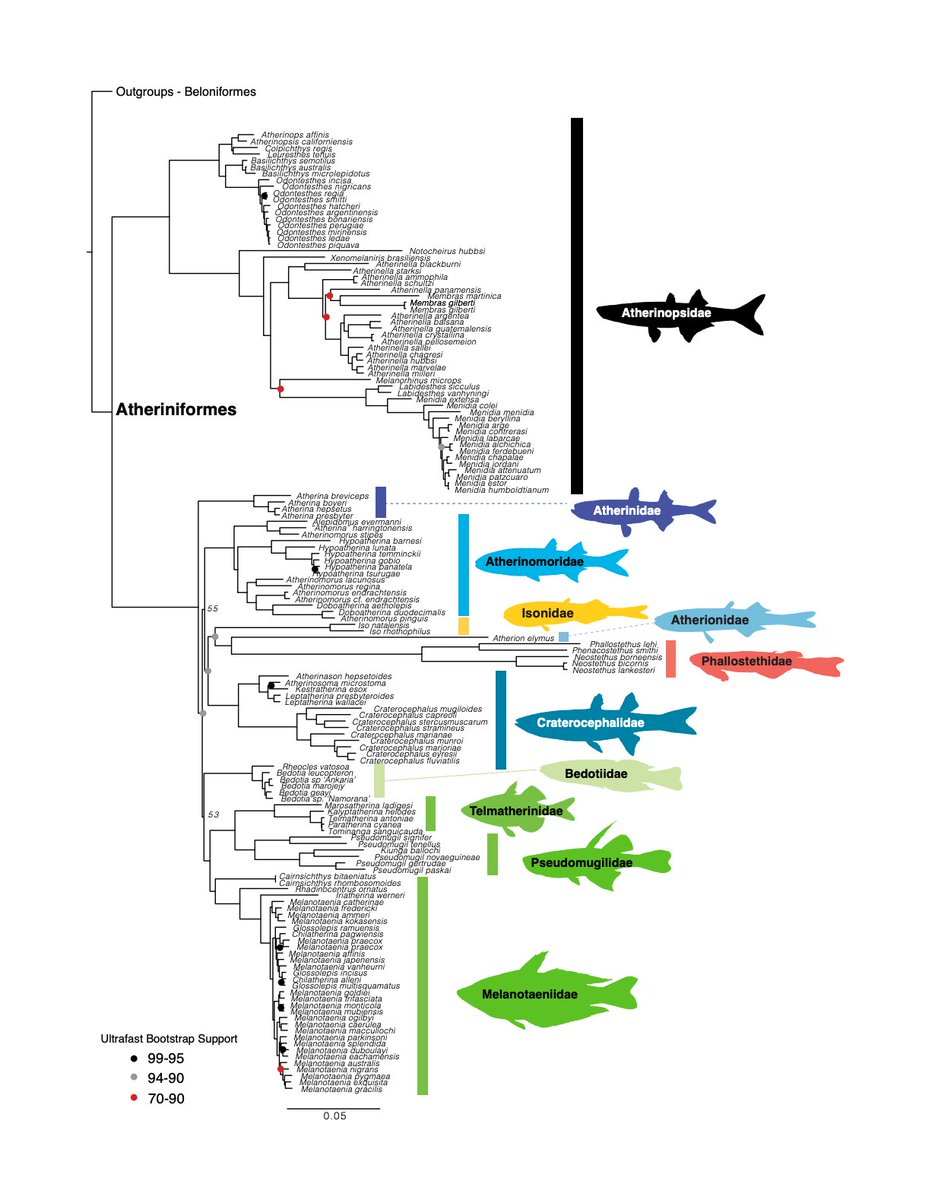
We generated a phylogenomic dataset of 1,100 exon loci for 150 species to resolve interfamilial relationships and reconstruct the group’s biogeographic history. We were also able to incorporate a large number of existing GenBank sequences, producing a phylogeny with 265 species sampled for at least some genetic data (67% of known species diversity). While the New World suborder Atherinopsidae is well-resolved, we found that the family Atherinidae is polyphyletic across all analyses. We propose a revised classification that restricts Atherinidae to the genus 𝐴𝑡ℎ𝑒𝑟𝑖𝑛𝑎 and recognizes Atherinomoridae and Craterocephalidae as separate families.
Our biogeographic inferences using explicit geographic areas suggests more frequent marine-to-freshwater transitions than previously inferred with simplified binary (marine vs. freshwater) coding, and uncover habitat transitions where marine ancestors may have gone extinct.
These results highlight how explicit geographic modeling can uncover marine ancestry erased by extinction, providing a robust phylogenetic framework for future evolutionary studies of Atheriniformes.
𝗣𝗵𝗼𝘁𝗼 𝗖𝗿𝗲𝗱𝗶𝘁
Phylogenomic tree of Atheriniformes based on the concatenated nucleotide G75 matrix analysed in IQ-TREE (Table 1; Analysis 2). Nodes without annotations have 100% ultrafast bootstrap support. The tree was rooted with ten outgroup taxa from Beloniformes, which are not shown in the figure.
© 2026 the Author(s). Published on the bioRxiv Preprint Server. An open-access article, distributed under the terms of the Creative Commons Attribution 4.0 International (CC-BY-4.0) licence.
creativecommons.org/licenses…
#Phylogenomics #Biogeography #Silversides #Rainbowfishes #Ichthyology #Taxonomy #Biodiversity #AquariumHobby #Fishkeeping #Aquarist #TropicalFish #FishTank #Rainbowfish #Atheriniformes #Atherinidae #Atherinopsidae #Atherinomoridae #Craterocephalidae #Atherina #Atherinoidei #Isonidae #Atherionidae #Phallostethidae #Bedotiidae #Telmatherinidae #Pseudomugilidae #Melanotaeniidae