
I'm a tech head, I love all things technology. Fishing is my primary hobby and I love being on the water. Love building Fibre networks!
Joined February 2010
- Tweets 8,629
- Following 624
- Followers 739
- Likes 83,868
933 Photos and videos











David Trad retweeted

May 19
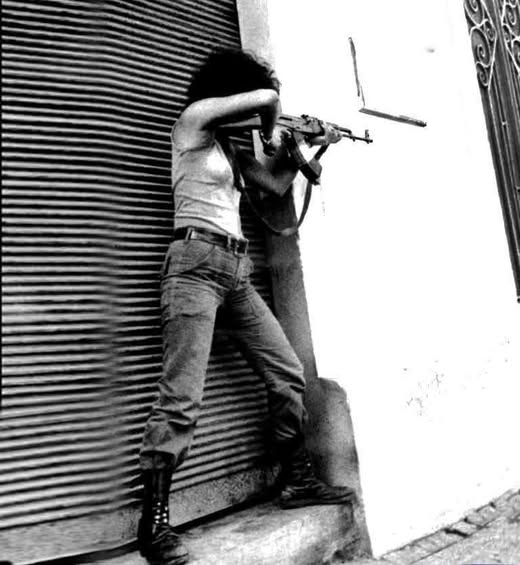
When 7 Lebanese Christian girls alone defeated 300 Palestinian Muslim terrorists:
50 years ago, Jocelyne Khoueiry,
just 20 at the time, along with 6 other girls,
held their ground and defended themselves against 300 armed Palestinians.
The jihadists were trying to kill Christian families in a residential building in Beirut.
Jocelyne killed their leader,
causing the rest to panic and flee.
To this day,
Palestinians call this episode “little Nakba”.
A teenager, Jocelyne joined the Kataeb or Phalangist Party and joined the party’s militia in 1975.
She was Lebanon's first female militant.
Jocelyne Khoueiry inspired over 1500 Christian women to enlist during the civil war in lebanon
78
920
3,672
45,006

May 6
WTF!!!

Sure, using latest public estimates (AUD billions, approx.):
- Snowy Hydro 2.0: 42
- Inland Rail: 45
- Cancelled Comm Games: 0.6
- NDIS fraud: 3.7 (annual)
- Indigenous welfare: ~30-40 (annual, older data)
- Suburban Rail Loop: 35
- Cross River Rail: 19
- Wasted COVID vax: unclear (high wastage on multi-B program)
- PNG NRL team: 0.6
- Brisbane Olympics: ~11
- Green H2 projects: several committed
One-off projects ~150B . Annual items separate. Sources vary; some are total costs, not pure "waste".
2
23
May 6
My Goodness! The Fin Review and their headlines (Click bait crap) and the really dog awful reporting is why no one gives a shit about MSM
David Crisafulli’s Queensland refinery plan faces scrutiny over economic sense and climate risks share.google/1VjgxR16VouZif0…
1
22
May 6
Another one bites the dust!
Every day I check thr wind up, liquidation and Administration announcements and it is getting bad again.
Anyone who thinks our economy is doing well is delusional beyond repair!
Jack Purcell Meats closes after 70 years, enters liquidation | The Courier Mail share.google/r0Ij6diiClUOyYf…
27
David Trad retweeted

There MIGHT be a case for SLIGHTLY higher royalties, but our panel explains clearly - with data - why calls for a 25% up-front royalty from the billion-dollar renewables lobby, the Greens, the Australia Institute and “Punters” Politics are really about shutting gas down.
21
32
204
206,461
David Trad retweeted
RE: Punters Politics, the Greens, and the misleading GAS TAX campaign mystery…
We asked this question of ChatGPT and Claude. This question was crafted after a lot of other questions that gave good, but not very clear answers.
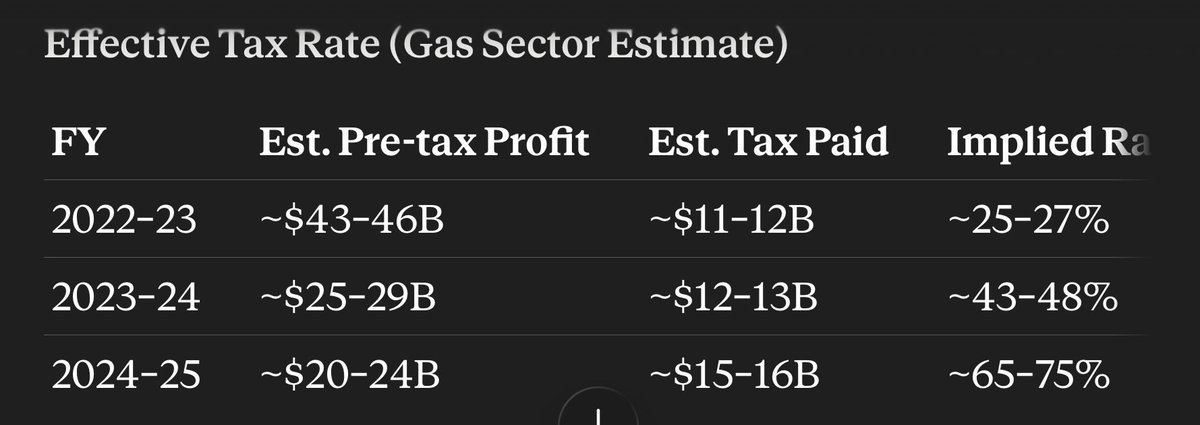
“please give your best estimate of total profit for the GAS industry in Australia (not oil industry) for FY 2024-25 and 2023-24 and 2022-23. Then your best estimate of total tax paid. Do not use Australia institute or the Greens political party as a source as they are very biased. Use only official and neutral sources”
Chat GPT said:
Bottom line (best estimates)
Total Australian gas industry profit (LNG-focused)
2022–23: ≈ A$35–45 billion
2023–24: ≈ A$25–35 billion
2024–25: ≈ A$30–40 billion
Total tax royalties paid
2022–23: ≈ A$18–20 billion
2023–24: ≈ A$21.5 billion
2024–25: ≈ A$21.9–22 billion
And Claude gave the answer in the picture here.
In everything I have read and looked at today (a lot!) one thing is clear:
PUNTERS POLITICS is - at best - unintentionally misleading us. At worst he is … well … you make your own mind up after our show this week.
The industry is definitely not “ripping us off” or “getting its gas for free”.
Also - Norway and Qatar’s industries and tax systems are NOT comparable to ours.
So why the big campaign from Punters and his mates at the Greens-aligned “Australia Institute”?
We will discuss on the show this weekend with some very smart guests… @EnergyWrapAU @GrahamY @OzInstProgress @FreyaThinks (Drops Friday night at 7pm AEST)
4
3
17
1,333
David Trad retweeted

Apr 27
Who do we report the UN to?
Apr 27

Don’t share hate! Each click carries the potential to ignite change, so let's share responsibly and harness the true power of our interconnectedness.
#PledgeToPause ⏸️ #NoToHate

3
4
50
David Trad retweeted
"A former train driver on a $352,000 a year salary has won a huge compensation payout from his old employer despite admitting to an “eight ball a day” cocaine habit"
EVERYTHING wrong with modern Australia summed up on one news story... Forget everything else - how does a train driver earn $352k a year? And what impact is that having on EVERY SMALL BUSINESS in the land trying to hire people when government pays that much and allows insane tribunal rulings like this. #UnionRorts
couriermail.com.au/business/…
28
44
322
45,914
David Trad retweeted
Happy Sunday!
Today the Australian Communist Party (the Greens) one-man performance artist show, aka “Punters Politics”, is appearing on my feed again — this time banging-on about how if THE GUBBERMINT owned everything, we’d all be better off.
Uh huh.
And hundreds of his fans applaud in unison in the comments.
I think we will lose this battle.
People LOVE the simple narratives of the left. They keep voting for them, and I really believe Australia will likely stay left-wing for a long time.
For some strange reason (mostly I’d rather just be at the beach enjoying the sunshine) I feel compelled to remind everyone that:
The real problem is privatisation INTO MONOPOLY. That’s pointless. Privatisation into a COMPETITIVE multi-player free market ALWAYS improves things because it forces organisations to be responsible to the CLIENT and end-users, thereby leading to innovation and wealth creation.
Monopolies - ESPECIALLY when government is the only owner - ALWAYS lead to perverse incentives, value destruction, failure and massive corruption.
To all the leftists who want to comment and argue with me, let me just save you the time: you win.
I give up. Most people totally agree with the simplistic rubbish you spew and clearly adore this performative clown show. Enjoy the socialist utopian future Australia. (Not sure how you’ll go with no cheap energy and no soldiers to defend you though.) 🫡
youtube.com/shorts/9g5b-tnLn…
@ellymelly @TopherField @polibard @OzraeliAvi @therealrukshan @GraemeHaycroft @GrahamY @spectator @SkyNewsAust @OneNationAus @LibertariansAus @FSUofAustralia @DavePellowe @CampbellNewman @discernableco @punterspolitix @ljayes
14
24
65
2,159
David Trad retweeted

Apr 24
8
48
156
9,540
David Trad retweeted

Thanks @karlstefanovic for taking the time to dig into defence, spending, innovation and investments.
youtube.com/watch?v=e6nzvgHG…

4
2
9
533
David Trad retweeted

Apr 22
Home Affairs Minister Tony Burke says migrants are not required to assimilate under his immigration policy, arguing those coming to Australia should be able to remain who they are.
2,049
607
1,764
228,320
Apr 9
55
Apr 9
Will we listen to those who were there and have the first hand knowledge? Or are we numb to this politically motivated witch hunt already set in its trajectory and he has been deemed guilty from the very start by those who he maybe decided to pick a fight with, and they are now biting back hard...
Is it a case that Roberts misunderstood what he was capable of by taking them to task?
This is not a normal hunt, the varsity of this suggests otherwise.
1
66
Apr 9
Hell Yes! How on earth is this even possible, this is just not possible, Nayib is 100% right the judge who did this is just not right
Apr 9

Impeach the corrupt judges.
1
36
Apr 4
Check my article out on LinkedIn about Grok and my conversation with it, quite interesting. Will post it on here once I work out how to do it (Where it belongs) @elonmusk
linkedin.com/pulse/my-conver…
1
59
Apr 4
I'm calling it now, the 8th crusade will be the "Crusade of the Heathens" - It will be those who have just had enough of religion altogether and will happily go to war over it
2
44
David Trad retweeted
Albanese’s response was underwhelming—light on transparency and devoid of any meaningful new information.
Instead of taking responsibility, he defaulted to shifting blame, ignoring the obvious: this was a foreseeable problem. Energy security risks, supply chain fragility, and Australia’s dependence on imported fuel have been debated by experts for years. Yet when the moment arrived, there was no acknowledgment of that reality—let alone a credible plan to address it.
And now we know the government had even more reason to be alert.
Iran’s ambassador to Canberra, Ahmad Sadeghi, was expelled on 26 August 2025 following revelations that the Iranian regime orchestrated antisemitic attacks on Australian soil. This includes the attack on the Adass Israel synagogue in Melbourne and the Continental Kitchen in Sydney, with ASIO confirming Iranian involvement and likely direction of further incidents.
This marked the first expulsion of an ambassador from Australia in the post-war era.
Anthony Albanese himself announced the decision—making it clear the government was aware of escalating geopolitical tensions and hostile state activity well in advance.
So the claim—implicit or otherwise—that this situation has somehow come as a surprise simply doesn’t hold. The warning signs were there. The risks were known. The failure was in preparation.
There was also a glaring absence of honesty about Australia’s ongoing reliance on oil-based inputs—fuel, fertilisers, plastics like PVC—all fundamental to modern life. No serious discussion of how we could, and should, be far more self-reliant as a nation.
Where was the leadership on:
unlocking known domestic oil and gas reserves
rebuilding sovereign refining capacity
embracing proven technologies like coal-to-liquids used internationally
lifting the ideological ban on nuclear energy
These are not radical ideas—they are practical steps toward national resilience.
To be clear, Labor is not alone in this failure. The Coalition’s record on long-term energy security is hardly inspiring. But the past four years—and the consequences now unfolding—sit squarely with Albanese and his government.
Yes, an oil shock will accelerate shifts toward electric vehicles. That’s fine—for those who choose it and where it makes sense. But let’s drop the subsidies and mandated targets. Let consumers decide.
The same applies to rooftop solar and home batteries. If they stack up commercially, Australians will adopt them without government distortion. Subsidies only mask real costs and misallocate capital.
And while electric trucks and tractors may one day play a role, they are not a serious solution to immediate diesel shortages. Pretending otherwise avoids the hard reality we face now.
Government should focus where it actually has a role:
long-term national security, energy resilience, and enabling supply.
Beyond that, it should step back—and let the market drive innovation, investment, and consumer choice.
Australia has the resources, the expertise, and the opportunity to be energy secure.
What’s missing is the political will to act.

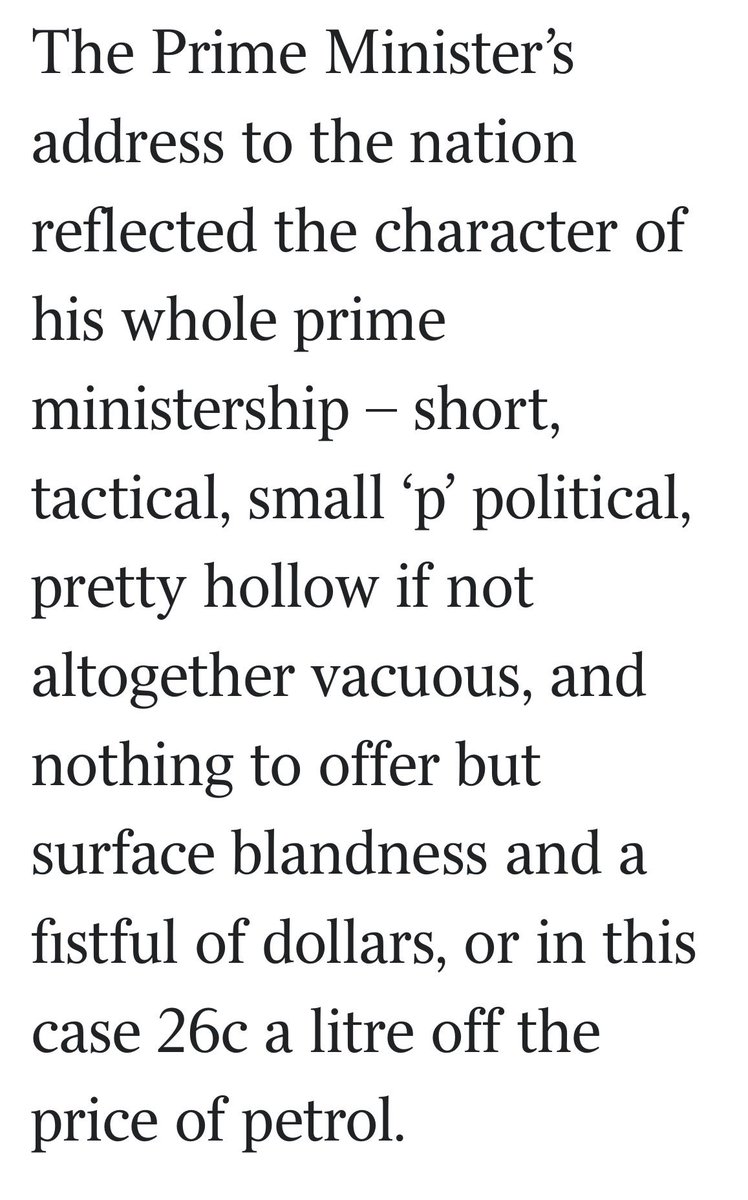
Greg Sheridan in @australian sums up the pathetic grandstanding of @AlboMP last night
1
5
9
895