
America First Conservative 🇺🇸 Lawyer ⚖️
Joined November 2016
- Tweets 22,726
- Following 365
- Followers 335
- Likes 49,215
152 Photos and videos













Professor Plum retweeted

Jun 2
The Nowak case clearly highlights that we need to stop treating racism as an ~infinite evil, not because Nowak was racist (no evidence of this) but because any time you create a social superweapon like accusations of racism are now, it’ll be misused horribly.
What is racism? Ask 10 people and you’ll get 12 opinions. Historically, it meant someone who treats people badly in interpersonal interactions because of their race. Which is just, like, kinda annoying and slightly boorish. It’s not the apocalypse. There are many personal traits that are equally or more annoying.
Now the definition has been ludicrously expanded to include a bunch of things even less objectionable than that, including belief in very plausible scientific claims and policy preferences that were near-universal for almost all of human history.
Racism just isn’t a big deal. We have to take it off its pedestal. If Nowak had said something racist, it would morally change exactly nothing about the horror of what happened to him. He didn’t, but I feel over-focusing on that distracts from the fact that it wouldn’t matter if he had.
Murder is worse than racism. Hell, shoplifting is worse than racism. Enough. Who cares.
1,040
4,711
32,085
14,154,904
Professor Plum retweeted

May 20
The most horrifying thing in this article, out of the dozens of nightmarish details, is that some of these men are selling their children to family members. Imagine that your relative needs help and you offer it only on the condition that they sell their children to you as slaves. And then imagine that they actually do it. Totally unthinkable all around. But this is the “culture” in places like Afghanistan. And it’s why we should have realized and accepted a long time ago that some cultures are just evil. Some people are just barbarians. You lock your door and don’t let them inside, ever, period.
May 18

Selling children to survive: Afghan fathers forced to make impossible choices bbc.in/49UQzLU
Community note
BBC frames Afghan fathers selling daughters as sympathetic. All profiled cases involve girls (e.g. 5-year-old). Selling daughters for marriage is a longstanding cultural practice in parts of Afghanistan. BBC focuses on fathers' distress over outcomes for the girls (rape).
childmarriagedata.org/country-profil…
582
4,198
34,032
1,183,391

Apr 30
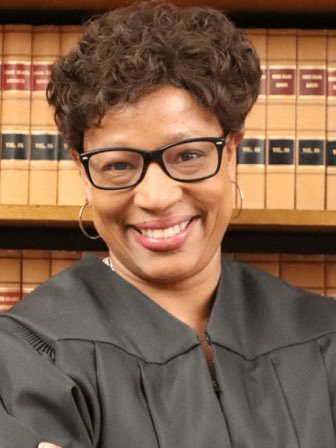
Biden appointed all these activist black women to the bench. Can we do mass impeachments?
Apr 30

NEW: I’m told by federal sources that a Dominican illegal alien with a deportation order & an Interpol Red Notice arrest warrant for murder in his home county was ordered released from ICE custody on Tuesday by Rhode Island federal judge Melissa DuBose (Biden appointee). I’m told that international fugitive Bryan Rafael Gomez was arrested by ICE Boston in Worcester, MA on April 4th, and had been detained in a facility in Rhode Island where he was issued a deportation order on April 28th by an immigration judge.
On Tuesday, I’m told Judge DuBose ordered Gomez be released from ICE custody on the grounds of “continuous unlawful detention”, while ICE argued that Gomez was subject to mandatory detention due to having an international arrest warrant for homicide.
I’m told Gomez was released, is now roaming freely again, and ICE can’t rearrest him due to Judge DuBose’s order. He was caught and released at the southern border by the Biden administration in 2022.

2
912
Professor Plum retweeted
Apr 8
The illegal immigration issue is not difficult or complex or nuanced. If they came here illegally, they need to leave. That's it. End of story.
"But what if they've been here for 10 years???"
They need to leave.
"But what if they haven't committed any other crimes???"
Leave.
"But what if they have a family???"
Leave.
This isn't hard at all. We have laws in this country. You broke the law. You don't belong here. Nothing personal. But get the hell out.
It should not be hard for elected Republicans to articulate this point. If they do have trouble articulating it -- if they take any position on illegal immigration except for this -- they can also go. That's not complicated either.
1,655
11,383
59,770
989,735
Professor Plum retweeted

Apr 7
Pro tip: you don't actually have to study for law exams. On the exam, simply derive the laws from reason and first principles and then apply them to the facts.
101
333
17,679
799,354
Trump should immediately deport every illegal this judge just tried to protect. Make activist judges scared to rule like this.

The Trump administration must restore the legal status of potentially hundreds of thousands of immigrants who came to the United States legally through a Biden-era pathway, a federal judge ruled Tuesday.
abcnews.link/iAn9X3o
3
789
Professor Plum retweeted

Mar 28
“Historians will look back in stupor at 20th and 21st century Americans who believed the magnificent republic they inherited would be enriched by bringing in scores of millions from the failed states of the Third World.”
—Pat Buchanan

88
1,115
6,135
79,782
Professor Plum retweeted

Mar 24
I think Trump should just unilaterally scrap the TSA to be honest.
The White House should announce that given Congress has decided not to fund it, it can't continue to exist. Do a transition period where it gets phased out, and airlines take over airport security once again.
The Dems are basically doing a shakedown right now. If Trump doesn't cave on enforcing our immigration laws (which he was elected to do), then they will continue to make Americans suffer at airports, confident that many will ignorantly blame Republicans. All in service of illegal immigrants over American citizens, because they need illegals to shore up the population of failing blue states.
Don't play into that nonsense. Call their bluff. Just announce TSA is being scrapped. What are they going to do, argue that scrapping an agency would be unconstitutional when THEY ARE REFUSING TO FUND IT? lol
211
737
5,213
98,992
Professor Plum retweeted

Feb 26
Honestly, I'm coming around to the idea that we should just ban dual citizenship, particularly if the Supreme Court decides to arbitrarily rule that birthright citizenship is constitutional. It should work like this:
1) If you're a naturalized U.S. citizen, you must renounce any other citizenships you hold within a year or be automatically denaturalized.
2) If you hold a second citizenship at birth, you must renounce the citizenship after you turn 18 but before you turn 21. Failure to do so will automatically strip you of your U.S. citizenship. (I believe Japan does this.)
3) Accepting a second citizenship causes you to automatically lose your U.S. citizenship.
Carveouts should be added for countries that make it difficult/impossible to renounce citizenship, but these are extremely rare by definition and should be applied on a case-by-case basis. Additionally, in these cases, the dual citizen has to demonstrate that they made a good faith effort to renounce the citizenship AND they are at risk of losing their U.S. citizenship if they are found to be exercising the rights and privileges of the other citizenship.
There are too many countries---India and China being the biggest offenders---trying to use dual citizens to infiltrate and undermine America. Time for them to go.
Feb 26

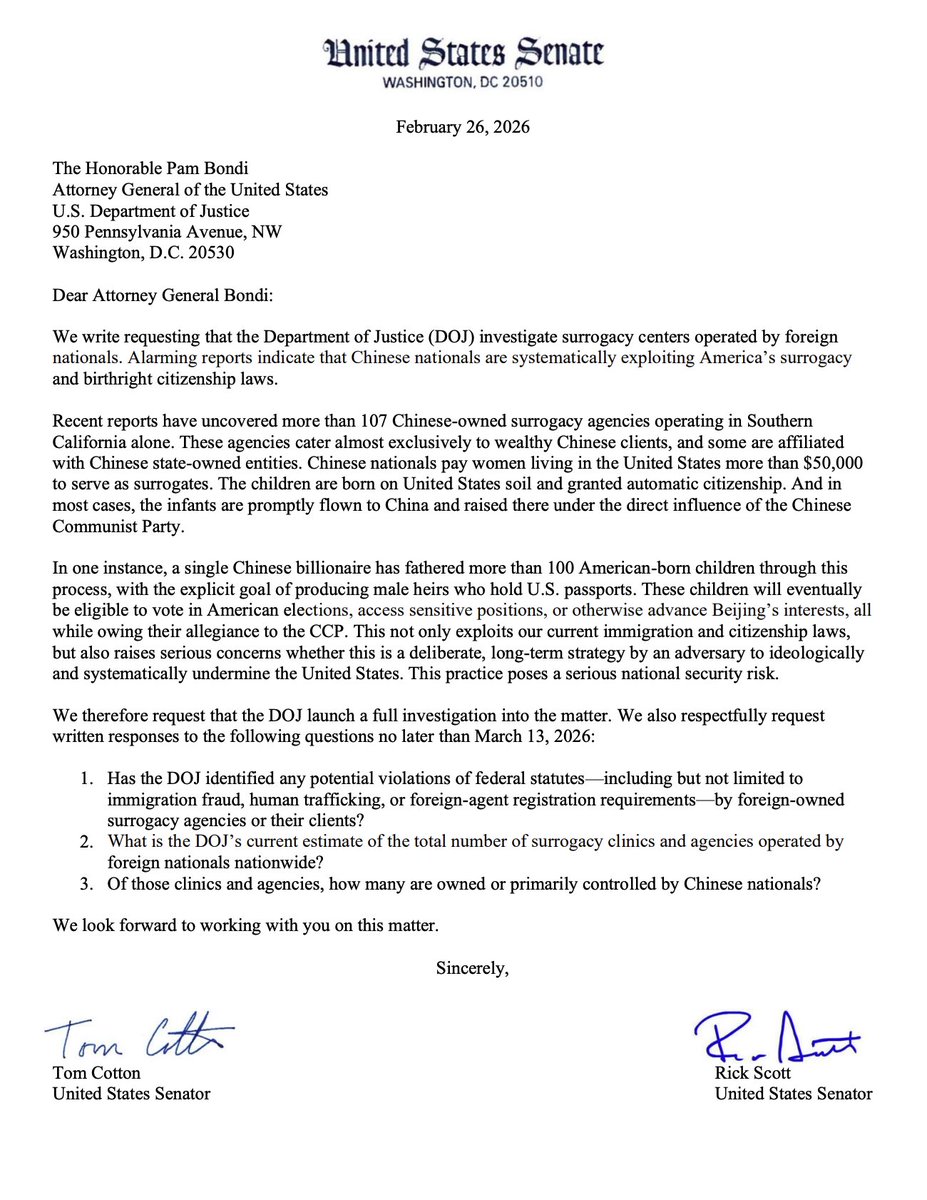
Communist Chinese nationals shouldn’t be taking advantage of our surrogacy and birthright citizenship laws to access U.S. passports.
@SenRickScott and I are urging @TheJusticeDept to investigate.
Community note
Neither India nor China allow dual citizenship. Any Indian citizen who naturalizes as a US citizen has to give up their citizenship same for China.
constitutionofindia.net/articles/artic…
npc.gov.cn/zgrdw/englishn…
166
193
1,514
146,532
Repeal the ADA
Feb 3

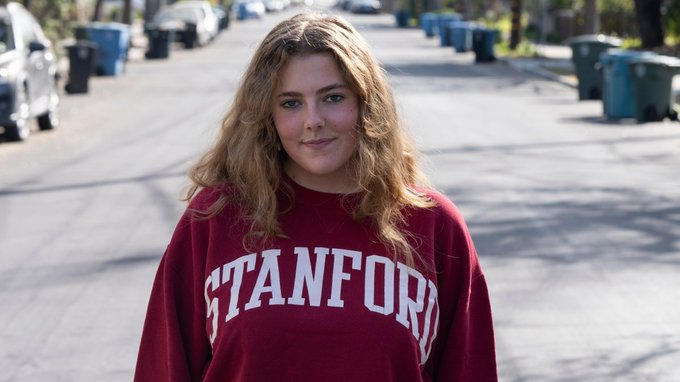
Nearly 40% of Stanford undergraduates claim they’re disabled. I’m one of them | Elsa Johnson, The Times
In 2023, one month into my freshman year at Stanford University, an upperclassman was showing me her dorm room — a prized single in one of the nicest buildings on campus. As she took me around her space, which included a private bathroom, a walk-in shower and a great view of Hoover Tower, she casually mentioned that she had lived in a single all four years she had attended Stanford.
I was surprised. Most people don’t get the privilege of a single room until they reach their senior year.
That’s when my friend gave me a tip: Stanford had granted her “a disability accommodation”.
She, of course, didn’t have a disability. She knew it. I knew it. But she had figured out early what most Stanford students eventually learn: the Office of Accessible Education will give students a single room, extra time on tests and even exemptions from academic requirements if they qualify as “disabled”.
Everyone was doing it. I could do it, too, if I just knew how to ask.
A recent article in The Atlantic reported that an increasing number of students at elite universities were claiming they had disabilities to get benefits or exemptions, which can also include copies of lecture notes, excused absences and access to private testing rooms. Those who suffer from “social anxiety” can even get out of participating in class discussions.
But the most common disability accommodation students ask for — and receive — is the best housing on campus.
At Stanford University in Palo Alto, California, where competition for the best dorm rooms is fierce, this practice is particularly rife. The Atlantic reported that 38 percent of undergraduates at my college were registered as having a disability — that’s 2,850 students out of a class of 7,500 — and 24 per cent of undergrads received academic or housing accommodations in the fall quarter.
At the Ivy League colleges Brown and Harvard, more than 20 per cent of undergrads are registered as disabled. Contrast these numbers with America’s community colleges, where only 3 to 4 per cent of students receive disability accommodations. Bizarrely, the schools that boast the most academically successful students are the ones with the largest number who claim disabilities — disabilities that you’d think would deter academic success.
The truth is, the system is there to be gamed, and most students feel that if you’re not gaming it, you’re putting yourself at a disadvantage.
That’s why I decided to claim my legitimate illness — endometriosis — as a disability at Stanford.
When I arrived on campus two and a half years ago, I would have assumed that special allowances were made for a small number of students who genuinely needed them. But I quickly discovered that wasn’t true. Some diagnoses are real and serious, of course, such as epilepsy, anaphylactic allergies, sleep apnea or severe physical disabilities.
But most students, in my experience, claim less severe ailments, such as ADHD or anxiety. And some “disabilities” are just downright silly. Students claim “night terrors”; others say they “get easily distracted” or they “can’t live with others”. I know a guy who was granted a single room because he needs to wear contacts at night. I’ve heard of a girl who got a single because she was gluten intolerant.
That’s why I felt justified in claiming endometriosis as a disability. It is a painful condition in which cells from the uterus grow outside the womb. I’m often doubled over in agony from the problem, for which there is no known cure, so I decided to ask for a single room in a campus dorm where I could endure those moments in private.
The application process was very easy. I registered my condition on the Stanford Office of Accessible Education website and made an appointment to meet an adviser later that week. The system is staffed largely by empathetic women who want to help students.
As I explained my diagnosis and symptoms over Zoom to one woman, she listened, nodded sympathetically, related my problems to her own life and asked a few basic questions. Within 30 minutes, I was registered as a student with a disability, entitled to more accommodations than I asked for.
In addition to a single housing assignment, I was granted extra absences from class, some late days on assignments and a 15-minute tardiness allowance for all of my classes. I was met with so little scepticism or questioning, I probably didn’t even need a doctor’s note to get these exemptions. Had I been pushier, I am sure I could have received almost any accommodation I asked for.
While I feel entitled to my single room, I would feel guilty about some of the perks I have — except that so many of my fellow students have gamed the system. Take Callie, a recent Stanford grad with ADHD and Asperger’s who agreed to be quoted under a pseudonym. Callie was diagnosed with her conditions in elementary school; in return, Stanford granted her a single room for all four years, plus extra time on tests — and a few more perks.
“In college, I haven’t had that many ‘in real life’ tests as opposed to take-home essays,” Callie told me. “When I did use the extra time, I felt guilty, because I probably didn’t deserve the accommodations, given the fact I got into Stanford and could compete at a high academic level. Extra time on tests — some students even get double time — seems unfair to me.”
But at Stanford, almost no one talks about the system with shame. Rather, we openly discuss, strategise and even joke about it. At a university of savvy optimisers, the feeling is that if you aren’t getting accommodations, you haven’t tried hard enough.
Another student told me that special “accommodations are so prevalent that they effectively only punish the honest”. Academic accommodations, they added, help “students get ahead … which puts a huge proportion of the class on an unfair playing ground”.
The gaming even extends to our meals. Stanford requires most undergraduates living on campus to purchase a meal plan, which costs $7,944 for the 2025-26 academic year. But students can get exempted if they claim a religious dietary restriction that the college kitchens cannot accommodate.
And so, some students I know claim to be devout members of the Jain faith, which rejects any food that may cause harm to all living creatures — including small insects and root vegetables. The students I know who claim to be Jain (but aren’t) spend their meal money at Whole Foods instead and enjoy freshly made salads and other yummy dishes, while the rest of us are stuck with college meals, like burgers made partly from “mushroom mix”.
Administrators seem powerless to reform the system and frankly don’t seem to care. How do you prove someone doesn’t have anxiety? How do you verify they don’t need extra time on a test? How do you challenge a religious dietary claim without risking a discrimination lawsuit?
I often think back to that conversation with my upperclassman friend. She wasn’t proud of gaming the system and she wasn’t ashamed either. She was simply rational. The university had created a set of incentives and she had simply responded to them.
That’s what strikes me most about the accommodation explosion at Stanford and similar schools. The students aren’t exactly cheating and if they are, can you blame them? Stanford has made gaming the system the logical choice. When accommodations mean the difference between a cramped triple and your own room, when extra test time can boost your grade point average, opting out feels like self-sabotage. Who would make their lives harder when the easiest option is just a 30-minute Zoom call away?
thetimes.com/us/news-today/a…
2
939
Foreign born “citizens” should not be allowed to hold federal offices.
This woman was appointed simply because she was nonwhite, female, and gay. Every Biden judge was picked for identity-based reasons. We should impeach for the same reasons.
Feb 3

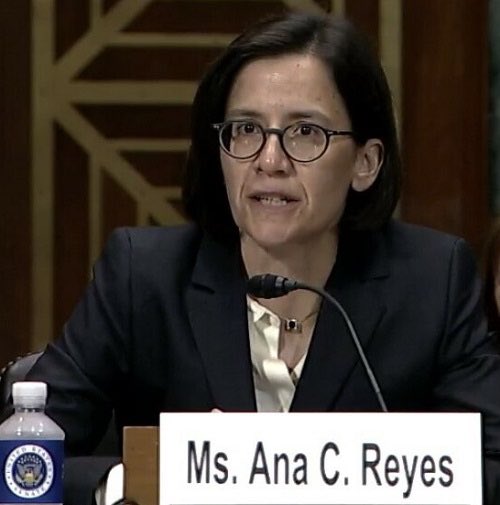
JUST IN: Federal judge Ana Reyes who who was born in Uruguay and was appointed by Biden, just halted Trump’s plan to end temporary protected status for 300,000 Haitians
2
466
Professor Plum retweeted

Jan 24
“Protest culture” is a huge problem. We romanticize protesters. We admire their “passion, “courage,” and “idealism.”
We think that emoting, screaming, inconveniencing, and threatening people with street protests and even riots or disorderly conduct is how we actually persuade people to do what we want — because way too many people forgot or never learned how to reason, how to think, how to argue with credibility and logic as well as passion.
Social media hasn’t exactly helped.
222
170
1,215
147,697
Jan 22
Oscars so black!
Jan 22

‘SINNERS’ has broken history as the MOST-NOMINATED FILM OF ALL TIME at the Oscars with 16 nominations
See the full nominees list: bit.ly/OscarNoms26

1
617

It seems pretty clear to me that what we’ve been told about radicalization for the last 10 years is exactly the opposite of what’s happened in reality.
We’ve been told that men are increasingly radicalized to the right and that this is a bad thing.
What’s actually happened is that women have increasingly radicalized to the left. This doesn’t really get talked about much, but to the extent that it does, it will in every single case be framed as a good thing.
316
1,301
13,617
1,056,172
Professor Plum retweeted

Jan 14

Community note
The government and people of Greenland have repeatedly said they not interested in joining the United States.
bbc.com/news/videos/c7…
npr.org/2025/02/27/nx-…
bbc.com/news/articles/…
aljazeera.com/features/2026/…
cnbc.com/2026/01/12/gre…
bbc.com/news/articles/…
1,694
1,802
30,822
3,388,074
Jan 14
The idea that we CHOSE this woman to become a citizen is astounding. We import people like this and naturalize them, and actual Americans suffer.
Jan 14

We’ve moved the Overton Window so far that we don’t even fully appreciate how bonkers it is that Democrats routinely use this line.
American politicians regularly tell Americans that someone else built their country.
3
258
Professor Plum retweeted

Jan 13
Your grandparents didn’t go half way across the world and fight the Nazi’s to the death, just so a bunch of foreigners who came here after World War II could call you a Nazi for having the same exact world view as your grandparents.
334
2,707
22,653
350,120
Professor Plum retweeted

Jan 13
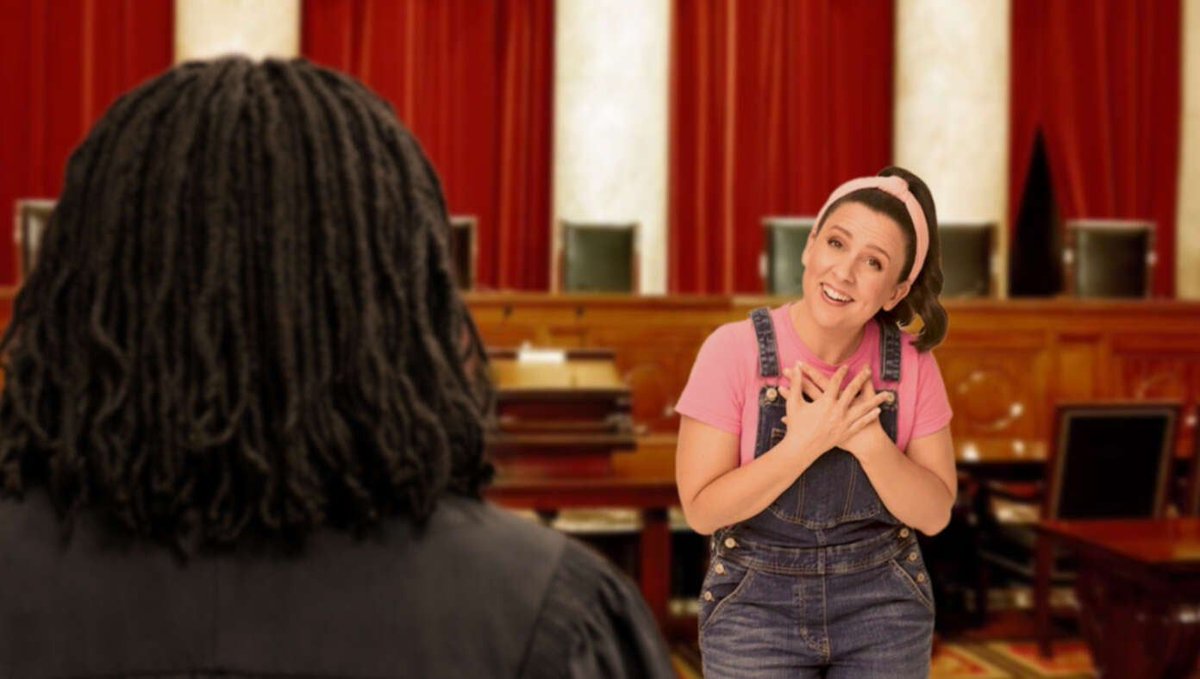
Supreme Court Justices Bring In Ms. Rachel To Explain Cases To Ketanji Brown Jackson buff.ly/yf8kajU
240
2,154
17,634
312,596
Professor Plum retweeted

Jan 12
ICE provided a list of crimes committed by illegals they’ve arrested in Minnesota:
– Strong-arm sodomy
– Child prostitution
– Rape and child fondling
– Homicide
Why are white liberal women trying to protect them?
3,969
12,410
69,048
1,142,956