Visual Information Layer of Technology | TG Channel ➠ t.me/eli5definews | Substack ➠ eli5defi.substack.com | All Posts NFA DYOR
Joined January 2022
- Tweets 47,352
- Following 7,436
- Followers 46,442
- Likes 37,401
9,908 Photos and videos




One of the weird perks of being thoroughly unemployable is drowning in free time, enough to tear through an unreasonable amount of great reading.
This week’s been pure whiplash: the Fable 5 launch, the out-of-nowhere Fable shutdown, the $SPCX IPO, and a geopolitical backdrop that won’t sit still.
And, If you’re struggling to keep up, I’ve got you covered right here ⤵

6
1
15
883
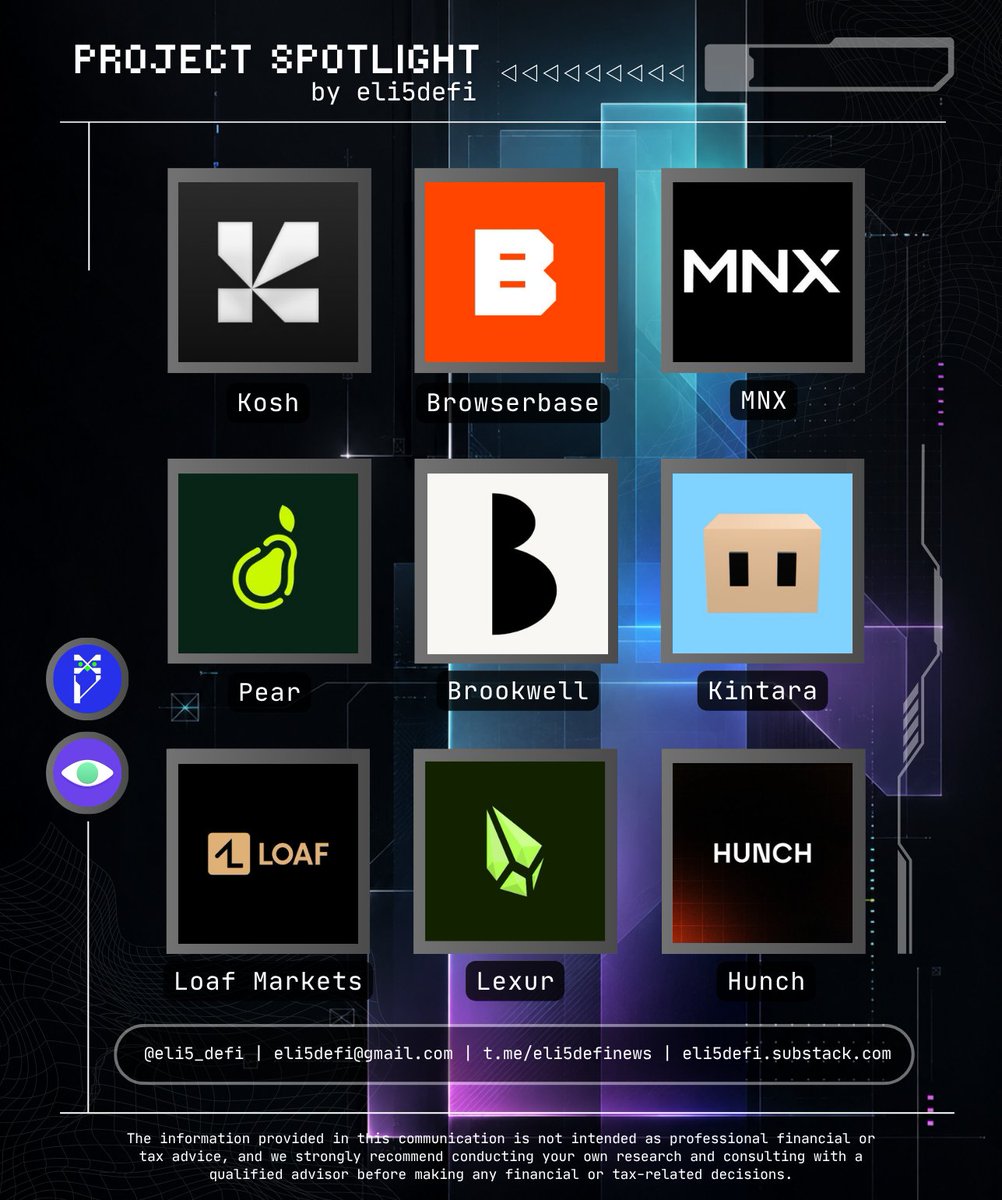
➥ Project Spotlight - Week 24/2026
Here are 9 handpicked projects you'll want to explore.
➢ @koshmoney
➢ @browserbase
➢ @MNX_fi
➢ @tradeonpear
➢ @brookwellapp
➢ @PlayKintara
➢ @Loafmarkets
➢ @Lexur
➢ @tradeonhunch
Powered by @getmoni_io and @_dexuai
Below you will find brief summaries for each.
Let's dive in!
…
— 📌 | Kosh
KOSH is a simple app that gives freelancers and creators in Asia a USD account. You can receive payments from clients around the world, hold your money in stable USD, spend it globally with a card, and earn yield on your balance.
…
— 📌 | Browserbase
Browserbase helps AI agents use the real internet. It gives agents reliable browser access so they can log into websites, click buttons, fill forms, and complete actual tasks online.
…
— 📌 | MNX
MNX is an exchange on @megaeth focused on AI-related things. You can trade assets or prices connected to AI companies like Anthropic, memory stocks, and H100 GPUs. It’s still early but has been teasing trading on big upcoming events like the SpaceX IPO.
…
— 📌 | Pear
Pear is building a social prediction market app. The goal is to let you trade prediction markets from different platforms in one simple account, see what others are trading in a feed, and automatically get the best prices. It focuses on “trading your instincts” in a more social and easy way.
…
— 📌 | Brookwell
Brookwell is an app that lets you earn DeFi yield on your money while still using it to pay everyday bills like rent and expenses. It makes moving between stablecoins and regular cash simple and seamless so your money can work for you without getting stuck in DeFi.
…
— 📌 | Kintara
Kintara is an isometric MMO game where you play to earn. Players can buy, sell, and trade items using the $KINS token, complete quests, and make real money. The game recently showed strong activity with players earning over $18,000 in a single day and rare items selling for around $10,000.
…
— 📌 | Loaf
Loaf is building a platform to trade property RWAs (real estate) on-chain with good liquidity. It’s still in private beta and run by people with traditional finance experience.
…
— 📌 | Lexur
Lexur built by @lexurlabs is building a social trading platform for Solana perpetuals. It adds social features so traders can follow each other, share ideas, and trade perps on Solana in a more community-driven way.
…
— 📌 | Hunch
Hunch is a unified trading terminal for prediction markets. It brings together markets from Polymarket, Kalshi, Hyperliquid and others into one clean interface with better tools and discovery.
18
6
43
4,221
➥ Project Spotlight - Week 24/2026
Here are 9 handpicked projects you'll want to explore.
➢ @koshmoney
➢ @browserbase
➢ @MNX_fi
➢ @tradeonpear
➢ @brookwellapp
➢ @PlayKintara
➢ @Loafmarkets
➢ @Lexur
➢ @tradeonhunch
Powered by @getmoni_io and @_dexuai
Below you will find brief summaries for each.
Let's dive in!
…
— 📌 | Kosh
KOSH is a simple app that gives freelancers and creators in Asia a USD account. You can receive payments from clients around the world, hold your money in stable USD, spend it globally with a card, and earn yield on your balance.
…
— 📌 | Browserbase
Browserbase helps AI agents use the real internet. It gives agents reliable browser access so they can log into websites, click buttons, fill forms, and complete actual tasks online.
…
— 📌 | MNX
MNX is an exchange on @megaeth focused on AI-related things. You can trade assets or prices connected to AI companies like Anthropic, memory stocks, and H100 GPUs. It’s still early but has been teasing trading on big upcoming events like the SpaceX IPO.
…
— 📌 | Pear
Pear is building a social prediction market app. The goal is to let you trade prediction markets from different platforms in one simple account, see what others are trading in a feed, and automatically get the best prices. It focuses on “trading your instincts” in a more social and easy way.
…
— 📌 | Brookwell
Brookwell is an app that lets you earn DeFi yield on your money while still using it to pay everyday bills like rent and expenses. It makes moving between stablecoins and regular cash simple and seamless so your money can work for you without getting stuck in DeFi.
…
— 📌 | Kintara
Kintara is an isometric MMO game where you play to earn. Players can buy, sell, and trade items using the $KINS token, complete quests, and make real money. The game recently showed strong activity with players earning over $18,000 in a single day and rare items selling for around $10,000.
…
— 📌 | Loaf
Loaf is building a platform to trade property RWAs (real estate) on-chain with good liquidity. It’s still in private beta and run by people with traditional finance experience.
…
— 📌 | Lexur
Lexur built by @lexurlabs is building a social trading platform for Solana perpetuals. It adds social features so traders can follow each other, share ideas, and trade perps on Solana in a more community-driven way.
…
— 📌 | Hunch
Hunch is a unified trading terminal for prediction markets. It brings together markets from Polymarket, Kalshi, Hyperliquid and others into one clean interface with better tools and discovery.
18
6
43
4,221
Check out our complete portfolio here:
eli5defi.xyz
➥ Project Spotlight - Week 24/2026
Here are 9 handpicked projects you'll want to explore.
➢ @koshmoney
➢ @browserbase
➢ @MNX_fi
➢ @tradeonpear
➢ @brookwellapp
➢ @PlayKintara
➢ @Loafmarkets
➢ @Lexur
➢ @tradeonhunch
Powered by @getmoni_io and @_dexuai
Below you will find brief summaries for each.
Let's dive in!
…
— 📌 | Kosh
KOSH is a simple app that gives freelancers and creators in Asia a USD account. You can receive payments from clients around the world, hold your money in stable USD, spend it globally with a card, and earn yield on your balance.
…
— 📌 | Browserbase
Browserbase helps AI agents use the real internet. It gives agents reliable browser access so they can log into websites, click buttons, fill forms, and complete actual tasks online.
…
— 📌 | MNX
MNX is an exchange on @megaeth focused on AI-related things. You can trade assets or prices connected to AI companies like Anthropic, memory stocks, and H100 GPUs. It’s still early but has been teasing trading on big upcoming events like the SpaceX IPO.
…
— 📌 | Pear
Pear is building a social prediction market app. The goal is to let you trade prediction markets from different platforms in one simple account, see what others are trading in a feed, and automatically get the best prices. It focuses on “trading your instincts” in a more social and easy way.
…
— 📌 | Brookwell
Brookwell is an app that lets you earn DeFi yield on your money while still using it to pay everyday bills like rent and expenses. It makes moving between stablecoins and regular cash simple and seamless so your money can work for you without getting stuck in DeFi.
…
— 📌 | Kintara
Kintara is an isometric MMO game where you play to earn. Players can buy, sell, and trade items using the $KINS token, complete quests, and make real money. The game recently showed strong activity with players earning over $18,000 in a single day and rare items selling for around $10,000.
…
— 📌 | Loaf
Loaf is building a platform to trade property RWAs (real estate) on-chain with good liquidity. It’s still in private beta and run by people with traditional finance experience.
…
— 📌 | Lexur
Lexur built by @lexurlabs is building a social trading platform for Solana perpetuals. It adds social features so traders can follow each other, share ideas, and trade perps on Solana in a more community-driven way.
…
— 📌 | Hunch
Hunch is a unified trading terminal for prediction markets. It brings together markets from Polymarket, Kalshi, Hyperliquid and others into one clean interface with better tools and discovery.
1
7
504
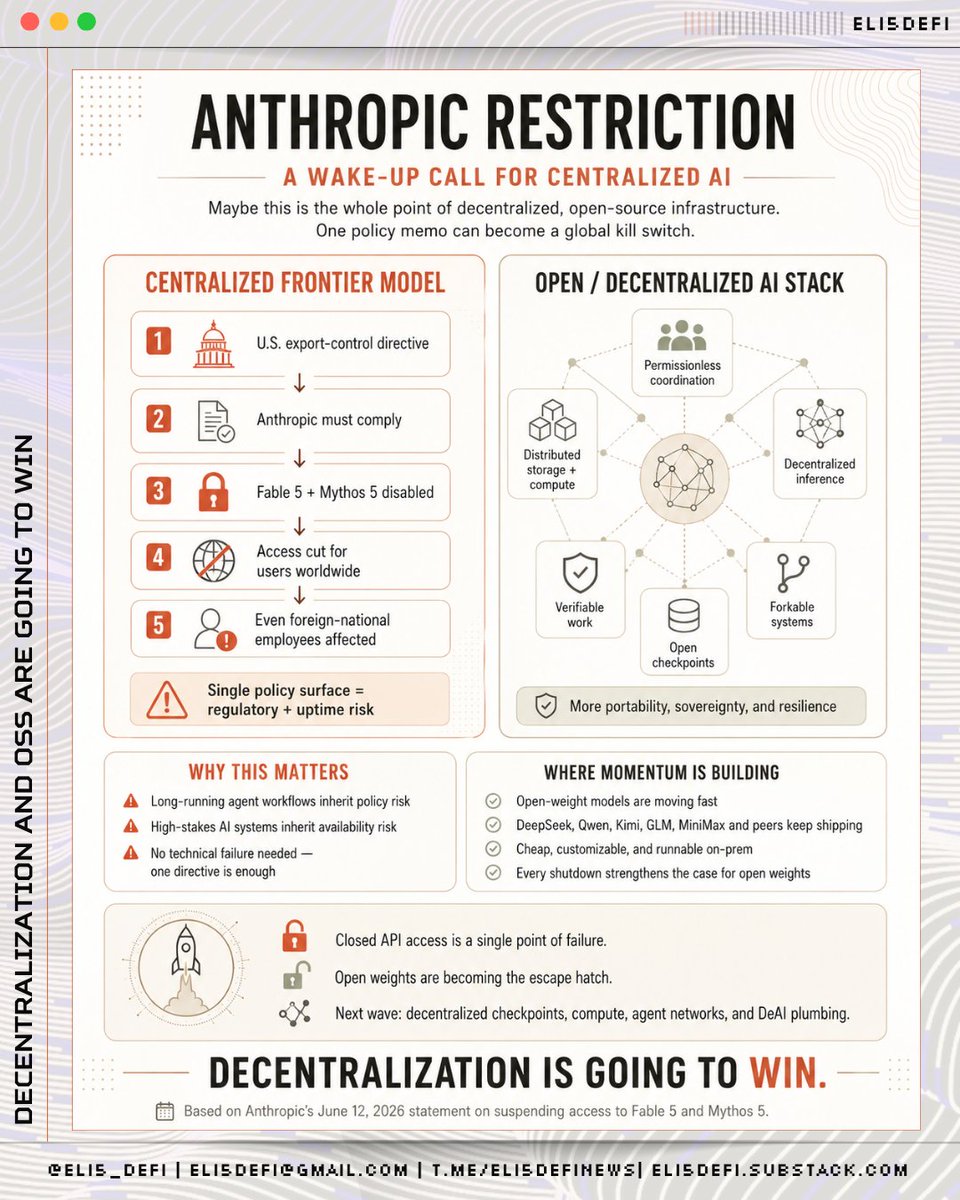
Decentralization and OSS are going to win.
Maybe this is the whole point of decentralized, open-source infrastructure, and maybe it is the alarm clock we have been ignoring.
Anthropic just had to flip the switch globally on Fable 5 and Mythos 5 after a U.S. export-control directive dropped.
One policy memo leads to a worldwide shutdown, for everyone, everywhere, including their own employees outside the U.S.
If you are building long-lived or high-stakes agent pipelines on a centralized frontier model, you are implicitly accepting regulatory risk and uptime risk as part of the stack.
Mock crypto all you want, but it has been quietly stress-testing answers to this exact failure mode for years:
- Permissionless coordination
- Incentivized storage and compute
- Decentralized inference
- Verifiable work, forkable systems
- And more
My bet:
China is not waiting. They are already monetizing momentum.
DeepSeek, Qwen (Alibaba), Kimi, Zhipu/GLM, MiniMax, and peers are pushing open weight models at a blistering pace. They routinely climb to the top of Hugging Face charts and ship into production because they are inexpensive, runnable on prem, and easy to tailor.
Depending on the tracker, they are approaching about 30% of global “useful” AI traffic, often at 4x or more lower cost than comparable US offerings.
And every high profile shutdown or hiccup, with Fable 5 as the latest, reinforces the narrative: closed API access is a single point of failure, while open weights buy sovereignty, portability, and staying power.
Next, the wave is teams shipping and coordinating around decentralized checkpoints, especially across:
- Decentralized compute
- Training networks and frameworks
- Tokenized agents and agent economies
- DeAI plumbing: privacy, storage, data rails, oracles, and more
However, China’s regulatory posture around crypto makes it a long shot for them to dominate permissionless, crypto native stacks (think Bittensor like subnets, tokenized agent layers like Virtuals, or on chain coordination).
But their open weight models are the perfect high octane input for the rest of the world’s decentralized machine.
Again, Decentralization and OSS are going to win.
Jun 13

The US government, citing national security authorities, has issued an export control directive to suspend all access to Fable 5 and Mythos 5 by any foreign national, whether inside or outside the United States, including foreign national Anthropic employees.
The net effect of this order is that we must abruptly disable Fable 5 and Mythos 5 for all our customers to ensure compliance.
Access to all other Claude models is not affected.
We apologize for this disruption to our customers. We believe this is a misunderstanding and are working to restore access as soon as possible.
Read our full statement: anthropic.com/news/fable-myt…
18
1
35
3,588
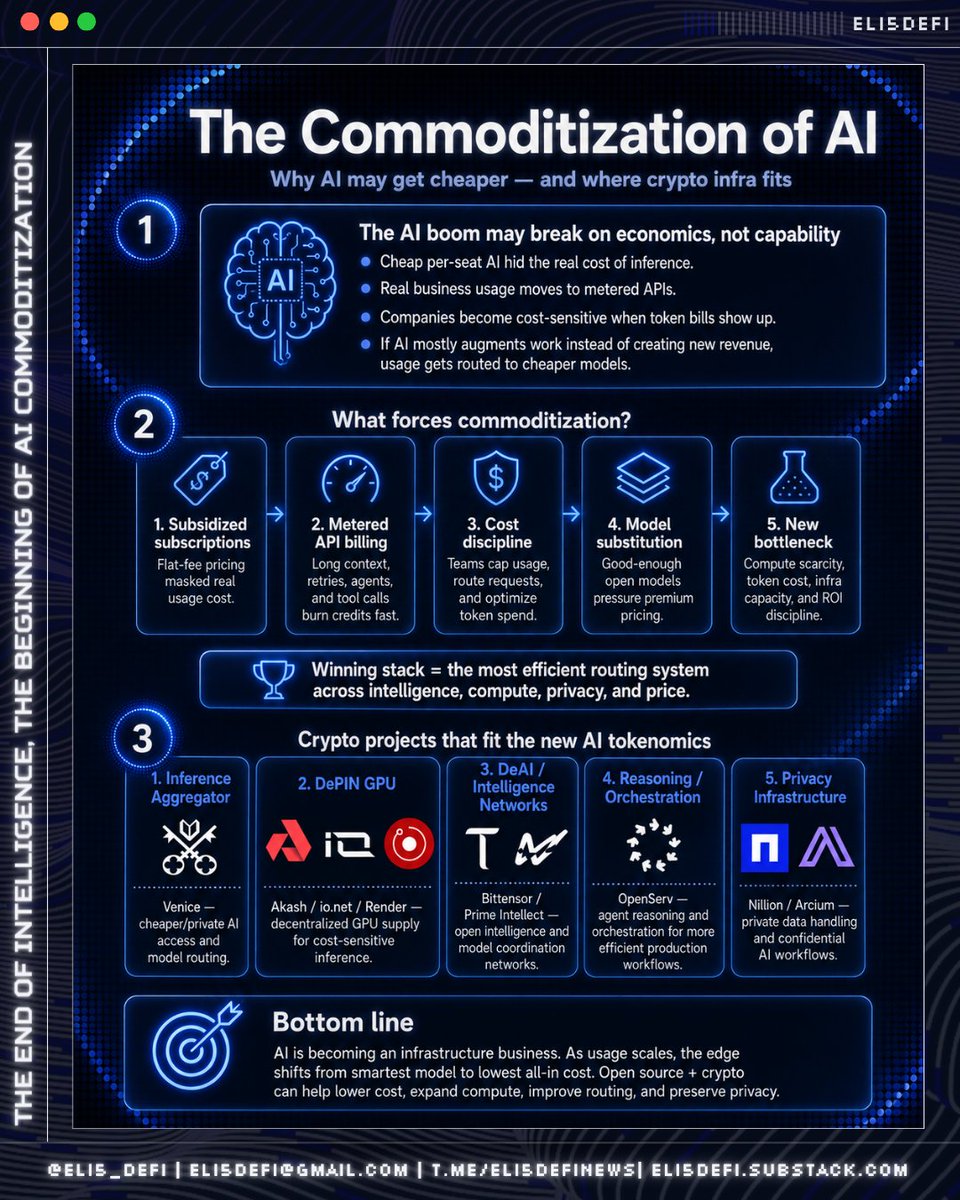
Plus, we’re going to see AI become more commoditized, with intelligence being the second determining factor.
Check out my post here ⤵
I’m with @Shaughnessy119 and @Moshaikh on this.
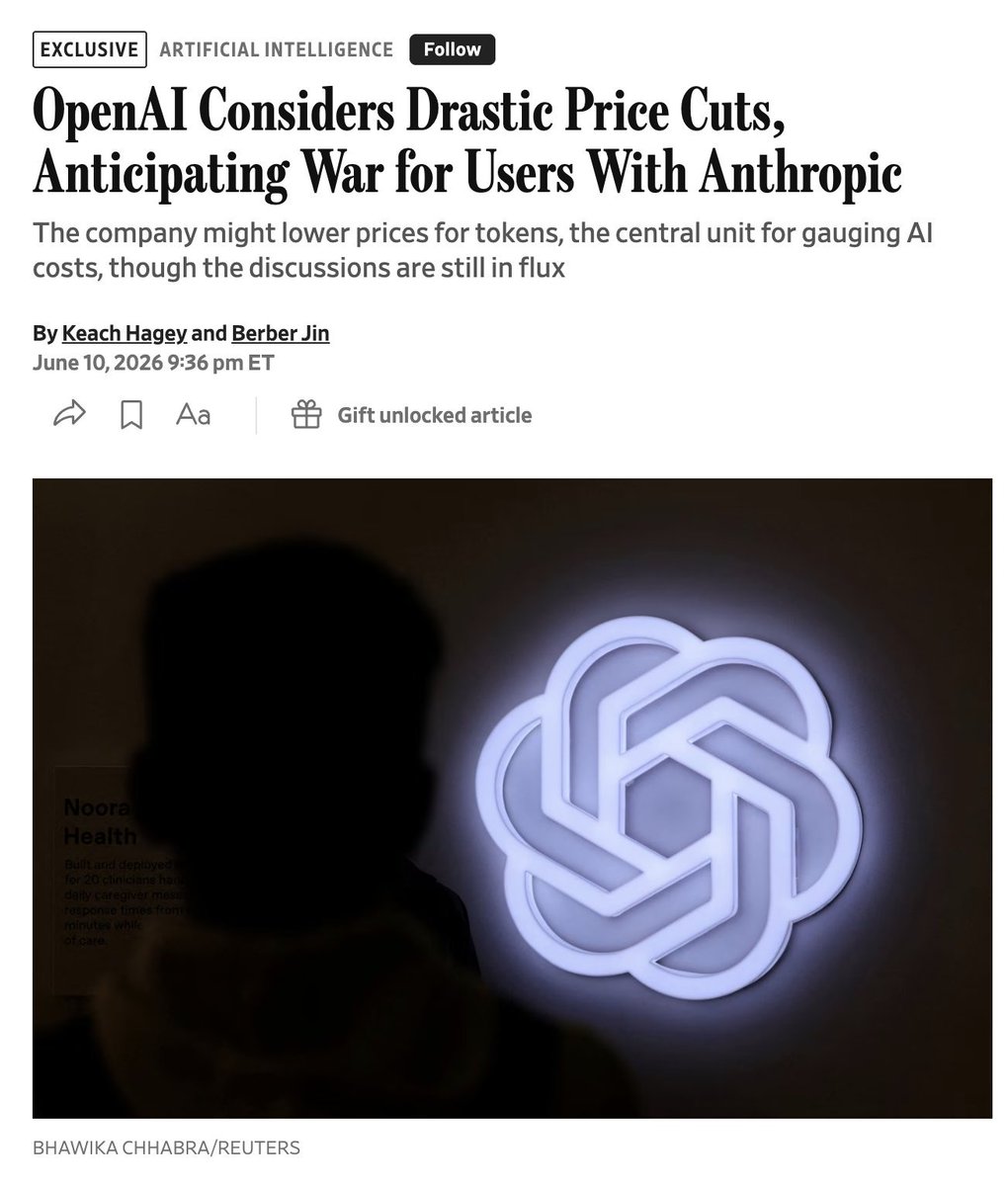
The most obvious way the AI boom breaks isn’t because models stop improving. It’s because the economics of using them at scale become impossible to ignore.
For the past few years, most people have experienced AI through simple per-seat subscriptions: pay a flat monthly fee, get access to a powerful model, and treat usage as basically unlimited.
That pricing model created the illusion that AI is cheap.
But it was never really cheap, it was subsidized. AI may be extremely useful, but it’s often too expensive to serve at the scale the market is pricing in.
If AI creates entirely new revenue streams, new drugs, new companies, new scientific breakthroughs, or massive productivity unlocks, then users will pay premium prices.
In that world, expensive inference is just a cost of production.
But if most AI usage is productivity augmentation rather than new value creation, companies will become brutally cost-sensitive (which already happened with the latest Fable 5 release, and we should expect similar pressure across other AI frontier models).
- Cap usage
- Route requests to cheaper models
- Optimize token spend
- Use frontier intelligence only where it’s truly needed
At the end of the day, an AI company is an infrastructure company. The bottleneck is no longer just model capability; it’s compute scarcity, token cost, infrastructure capacity, and ROI discipline.
Then the winning stack is not just the smartest model. It is the most efficient routing system across intelligence, compute, privacy, and price. That is where open source and infrastructure like crypto become relevant.
Some of the projects that might fit in in this new AI 'tokenomics':
- Inference Aggregators → @AskVenice
- DePIN GPU → @akashnet, @ionet, @rendernetwork
- DeAI / Intelligence Networks → @opentensor, @PrimeIntellect
- Reasoning Layer/ Orchestration → @openservai
- Privacy Infrastructure → @nillion, @Arcium
NFA. DYOR.
1
1,313
Wtf, this is not cool at all.
Jun 13
The US government, citing national security authorities, has issued an export control directive to suspend all access to Fable 5 and Mythos 5 by any foreign national, whether inside or outside the United States, including foreign national Anthropic employees.
The net effect of this order is that we must abruptly disable Fable 5 and Mythos 5 for all our customers to ensure compliance.
Access to all other Claude models is not affected.
We apologize for this disruption to our customers. We believe this is a misunderstanding and are working to restore access as soon as possible.
Read our full statement: anthropic.com/news/fable-myt…
4
12
1,073
Eli5DeFi retweeted

Jun 12
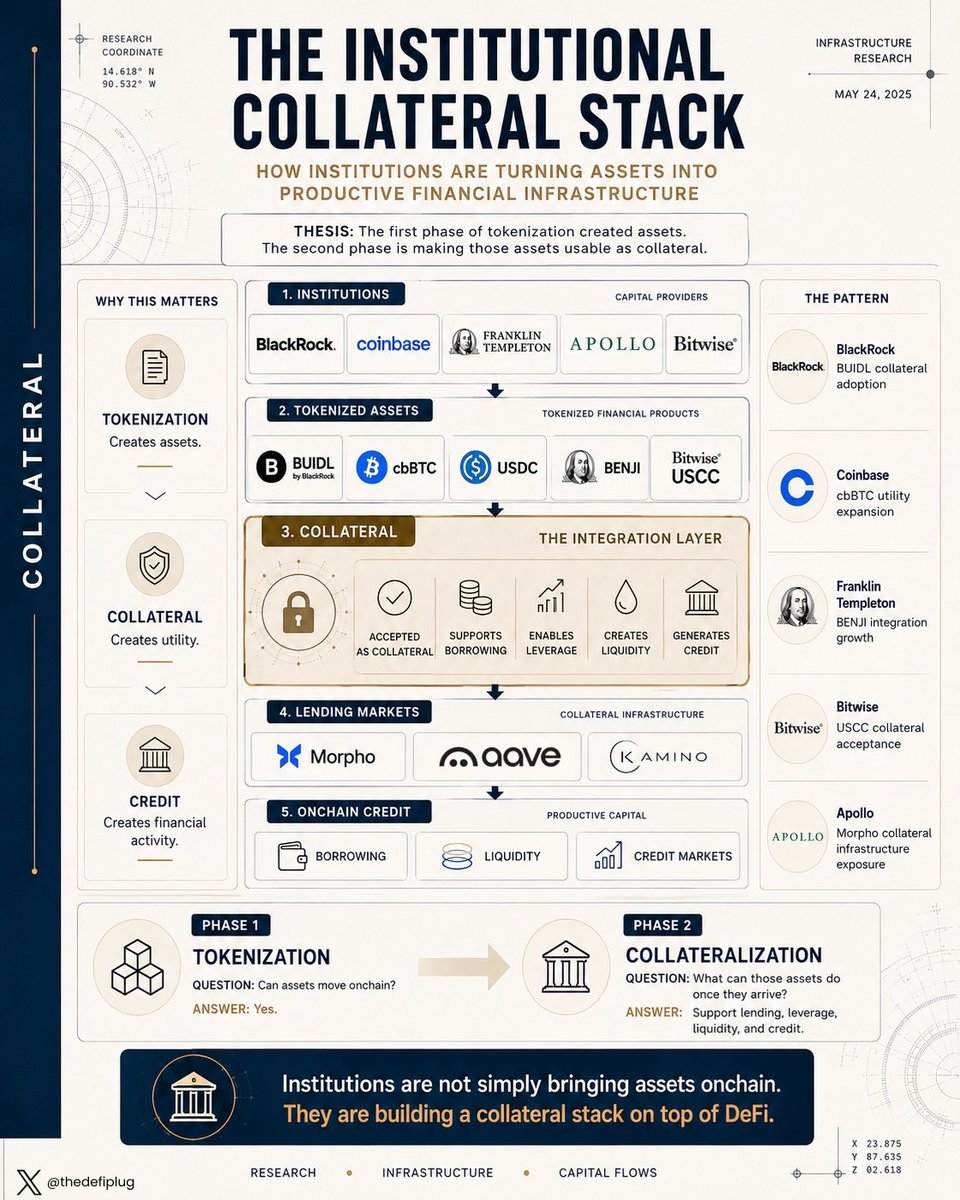
Over the past year, several large institutions have expanded their presence in DeFi.
@BlackRock launched BUIDL. @Coinbase expanded cbBTC and USDC integrations. @FTI_US expanded BENJI’s onchain reach. @apolloglobal and @Morpho announced a strategic partnership that includes up to 90 million MORPHO tokens vesting over 48 months.
At first glance, these look like separate initiatives.
The common thread is easy to miss.
The easiest way to interpret these developments is through adoption.
Institutions are entering DeFi.
The more important question is integration.
How are institutions choosing to participate once they arrive?
A pattern is starting to emerge.
Institutions are not entering DeFi by becoming crypto-native.
They are entering by making their assets usable as collateral.
That distinction matters because financial systems are built around collateral, not assets.
The first phase of tokenization focused on issuance.
Can Treasuries be tokenized?
Can institutional funds exist on public blockchains?
Can private credit move onchain?
The answer is increasingly yes.
The more important question now is:
What can those assets do once they arrive?
Several developments point in the same direction:
➤ Apollo: Strategic partnership with Morpho involving up to 90 million MORPHO tokens over 48 months
➤ BlackRock: BUIDL accepted as collateral across lending venues
➤ Coinbase: Expanding cbBTC and USDC integrations
➤ Franklin Templeton: Expanding BENJI’s utility across public blockchains
➤ Bitwise: USCC fund tokens accepted as collateral across Morpho, Aave, and Kamino
Different firms.
Different products.
Same objective.
Make institutional assets usable inside DeFi.
This is why the Apollo-Morpho relationship stands out.
The market tends to view it as a token investment.
It is better viewed as exposure to collateral infrastructure.
Morpho provides modular lending infrastructure that allows credit markets to be built around specific collateral assets.
The opportunity is not tokenization itself.
The opportunity is collateralized credit.
BlackRock’s BUIDL illustrates the same shift.
The interesting development is not that BUIDL exists.
It is that BUIDL can now secure loans and participate in lending markets.
Once an asset can support borrowing, leverage, and liquidity, it stops behaving like a passive investment product.
It becomes infrastructure.
The same logic applies to cbBTC.
The value is not issuance alone.
The value comes from expanding where Bitcoin can be deployed productively.
The market still underestimates this distinction.
Most tokenization discussions focus on assets.
Financial systems focus on collateral.
An institutional asset sitting in a wallet creates limited value.
An institutional asset that can secure credit and circulate through lending markets becomes significantly more useful.
That is why collateral integrations may ultimately matter more than token issuance.
The first phase of tokenization created assets.
The second phase is turning those assets into productive financial infrastructure.
Viewed through that lens, the Apollo-Morpho relationship is important not because Apollo is simply buying a token.
It is important because it signals institutional interest in the infrastructure layer that makes collateral productive.
The easiest interpretation is that institutions are entering DeFi.
The more useful interpretation is that they are building a collateral stack on top of it.
54
17
95
6,619
You’ve got to have balls of steel to post this (assuming it’s legit).
Going from $80M to scraping by on $500k would snap most people sanity.
I’ve been in a similar spot, on a smaller stack, sure, I watched my portfolio flirt with seven figures back in the OHM/TOMB-forks days.
Problem was, I thought I was invincible., I got greedy and refused to take anything off the table… until my wife smacked me with the obvious: profits aren’t real until you actually exit the position.
So I finally peeled off some gains, and holy hell am I glad I did.
Jun 12

I’ve wanted to tell this story for years. Never had the courage. Here it is.
I turned a presale allocation into $80 million on $OHM. Today I have $500k left.
In 2021, I got a presale allocation in OlympusDAO, then aped heavily myself on top of it. The allocation got me in the door. My own conviction made me go all in. Staked everything. Watched it compound daily. By the peak I was sitting on $80 million.
Then I started spending like the money printed itself.
Private jets to Dubai because commercial felt beneath me. $40k weekends in Monaco. A garage full of cars I drove twice. Watches I never wore. I tipped $5k at dinners just to feel something. Every purchase was a flex for an audience that didn’t care.
The casino was worse. High limit rooms in Vegas and Macau. I’d lose $2 million in a night and laugh it off because the portfolio would make it back by morning. Until it didn’t.
When $OHM unwound, I didn’t sell. I doubled down. Then I leveraged. 5x, then 10x, trying to trade my way back to the peak. Every liquidation felt like a personal insult, so I’d open a bigger position. I wasn’t trading anymore. I was gambling with a different interface.
$80 million became $20 million. $20 million became $4 million. I told myself $4 million was still life changing money. Then I levered that too.
$500k. That’s what’s left.
Here’s what I learned the expensive way:
Unrealized gains are not money. I never had $80 million. I had a number on a screen and the arrogance to believe it was permanent.
Getting in early is a gift. I treated it like a skill. The allocation didn’t make me a genius. It made me lucky. I confused the two for three years.
Lifestyle inflation is a leak you don’t notice until the ship is underwater. The jets and cars didn’t kill me. The identity did. I became someone who needed to spend to feel like a winner.
Leverage doesn’t get you back to even. It gets you to zero faster. Revenge trading is just grief with a chart open.
Nobody at the table in Monaco remembers my name.
I’ve carried this story alone for years. Too embarrassed to say it out loud. But $500k is more than most people will ever hold at once, and I’m done pretending the past didn’t happen. The next decade is about building slow and keeping what I make.
If you’re up big right now, screenshot this. You’ll need it.
9
31
6,096
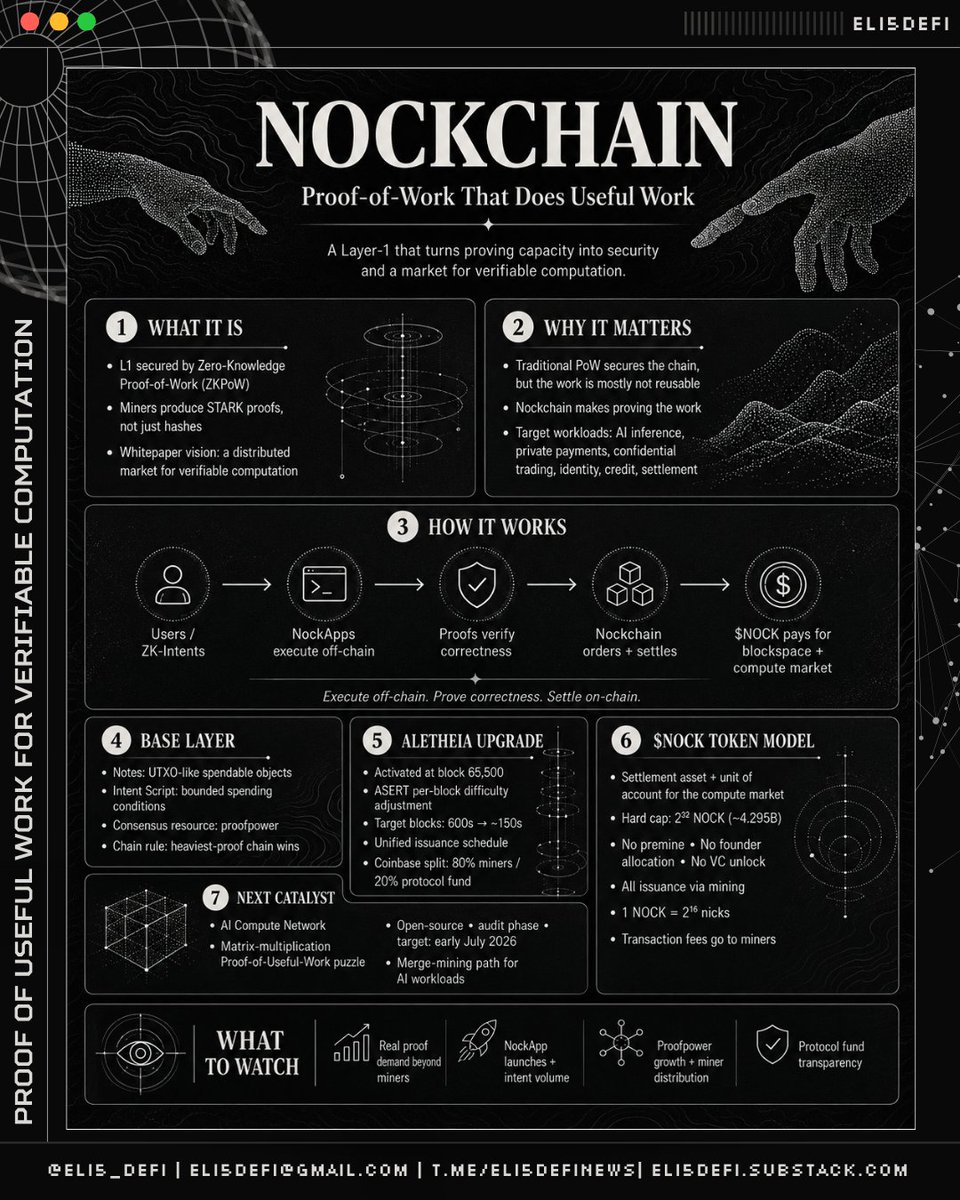
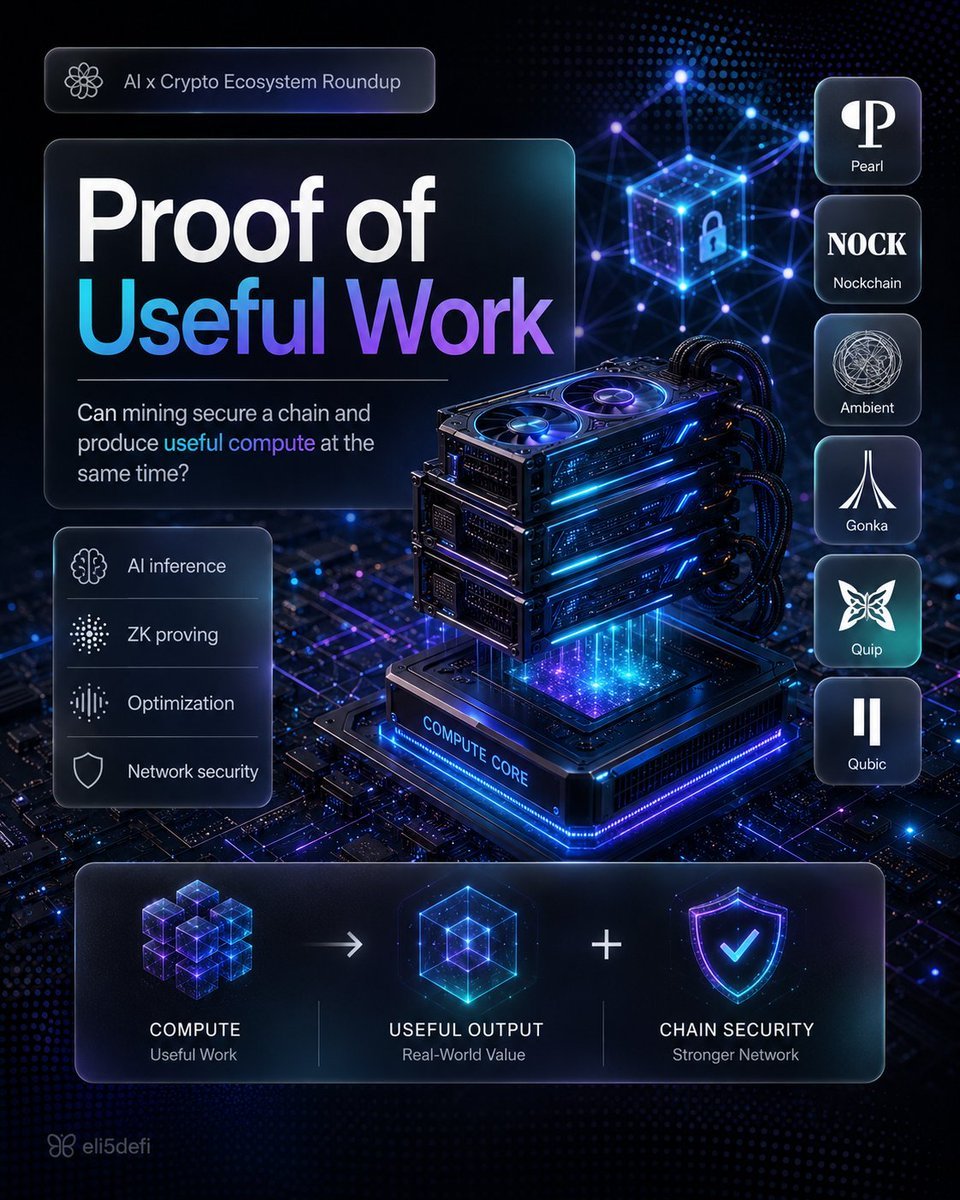
Nockchain is taking on the question most L1s sidestep:
What if Proof-of-Work weren't just a furnace?
What if the effort that secures the ledger also generated real, reusable output?
That's the bet behind @nockchain.
Most chains optimize for higher TPS, more DeFi, or ZK layers. Nockchain flips the premise:
The bottleneck isn't blockspace. It's verifiable computation.
—
➠ WHAT IT IS
Nockchain is a Layer-1 blockchain built around Zero-Knowledge Proof-of-Work (ZKPoW).
Instead of miners hashing random data, they generate zero-knowledge proofs. Their latest whitepaper frames this as a distributed market for verifiable computation:
→ Miners supply proofpower
→ Apps consume proofs
→ The L1 settles truth
The goal: make the work behind security useful for a broader proof market.
—
➠ WHY IT MATTERS
Traditional PoW has one obvious criticism: the energy cost is real, but the work isn't useful outside chain security.
Nockchain's answer: make proving itself the work. Not computation for the sake of computation, but computation that creates verifiable certificates.
Demand for proofs may grow across:
→ AI inference
→ Private payments
→ Sealed-bid auctions
→ Confidential trading
→ Identity and reputation
→ Credit markets
→ Cross-venue settlement
If these workloads need trust-minimized verification, proof generation becomes an economic resource.
—
➠ HOW IT WORKS
Nockchain keeps the base layer minimal.
Apps run off-chain as NockApps, execute their own logic, then settle back to Nockchain through proofs.
The flow:
→ Users submit intents
→ NockApps execute heavy logic off-chain
→ Proofs show the result was valid
→ Nockchain verifies, orders, and settles
Unlike Ethereum, validators don't re-execute smart contract logic. The design is:
→ Execute off-chain
→ Prove correctness
→ Settle on-chain
The chain only needs proof that the steps were valid.
—
➠ BASE LAYER DESIGN
Nockchain uses a UTXO-like model built around Notes.
Instead of account balances, users hold spendable notes containing assets, spending conditions, provenance, and app-specific metadata.
Spending conditions are expressed through Nockchain Intent Script—a smaller, bounded language for:
→ Signature checks
→ Hashlocks
→ Timelocks
→ Burns
→ ZK proof verification
Complex logic is pushed into NockApps, keeping the L1 conservative.
—
➠ PROOFPOWER, NOT HASHPOWER
In Nockchain, the critical resource is proofpower, the network's aggregate capacity to produce valid proofs.
Consensus follows a heaviest-proof chain rule.
The security model is still thermodynamic. An attacker still needs to out-compute the honest network.
But the work is oriented toward proof generation instead of arbitrary hashing.
The shift:
→ $BTC turns energy into hash security
→ Nockchain turns energy into proof security
—
➠ ALETHEIA UPGRADE
Nockchain started minimal with "Dumbnet" (basic UTXO functionality).
The major upgrade: Aletheia, activated at block 65,500.
Aletheia introduced:
→ ASERT per-block difficulty adjustment
→ Faster target blocks (600s → 150s)
→ Unified issuance schedule
→ Deterministic coinbase split
→ Protocol fund for future PoUW development
This made the chain more responsive, predictable, and aligned with the PoUW roadmap.
—
➠ AI COMPUTE NETWORK
The next catalyst: AI Compute Network upgrade.
This introduces a matrix-multiplication Proof-of-Useful-Work puzzle, one of the core operations behind AI training and inference. If this works, Nockchain mining could connect to external AI compute demand.
The vision:
→ Miners produce proofs
→ Applications consume proofs
→ $NOCK becomes the settlement asset
There's also a merge-mining angle, where multiple computation protocols could contribute useful proofs while securing the same chain.
Recent Pearl-related discussion shows both the opportunity and debate around how GPU-based AI compute networks might plug into Nockchain's security model.
—
➠ NOCK TOKEN
NOCK is the native asset, designed as hard-capped programmable sound money and the unit of account for Nockchain's compute market.
Supply cap: 2³² NOCK (~4.295 billion)
→ No premine
→ No founder allocation
→ No VC unlock
→ All issued through mining
Each NOCK is divisible into 2¹⁶ nicks for precision.
Post-Aletheia rewards:
→ 80% to miners
→ 20% to protocol fund (for future PoUW development)
→ Transaction fees go to miners.
—
➠ RISKS
The biggest risk: the compute market is still mostly a thesis.
Visible activity centers around mining, proof generation, and basic settlement. DeFi metrics remain negligible.
Other risks:
→ Useful compute demand may stay theoretical
→ Developer mindshare may stay with EVM and ZK L2s
→ Early emissions may create sell pressure
→ Protocol fund needs transparency
→ AI Compute upgrade execution matters
→ NockApps need product-market fit
Architecture alone isn't enough. The market needs real buyers of proofs.
—
➠ BULL CASE
Nockchain becomes more than another PoW chain.
If the AI Compute Network ships, matrix-multiplication proving gains real demand, and NockApps find use cases, proofpower becomes an economic resource.
Nockchain wouldn't just be securing blockspace. It would be coordinating a market for verifiable off-chain computation.
NOCK becomes the monetary layer around proof supply, settlement, and compute-market demand.
—
➠ BEAR CASE
Useful work stays theoretical.
Mining continues, but external demand for proofs doesn't materialize. Builders prefer EVM chains, ZK rollups, or existing AI compute networks.
Early emissions create sell pressure before the ecosystem has real activity to absorb it.
Nockchain remains technically interesting but economically unproven.
—
➠ THE TAKE
Nockchain is asking a deeper question than most L1s:
Not just "How do we secure a chain?"
But "What should the security work produce?"
If Nockchain is right, Proof-of-Work doesn't have to stay trapped in the security versus wasted energy debate. It can become a market for useful, verifiable computation.
That's the thesis. Now the network has to prove there's real demand behind it.
29
20
120
7,821
Check out other PoUW protocols brief dive of them here ⤵
3
4
1,390
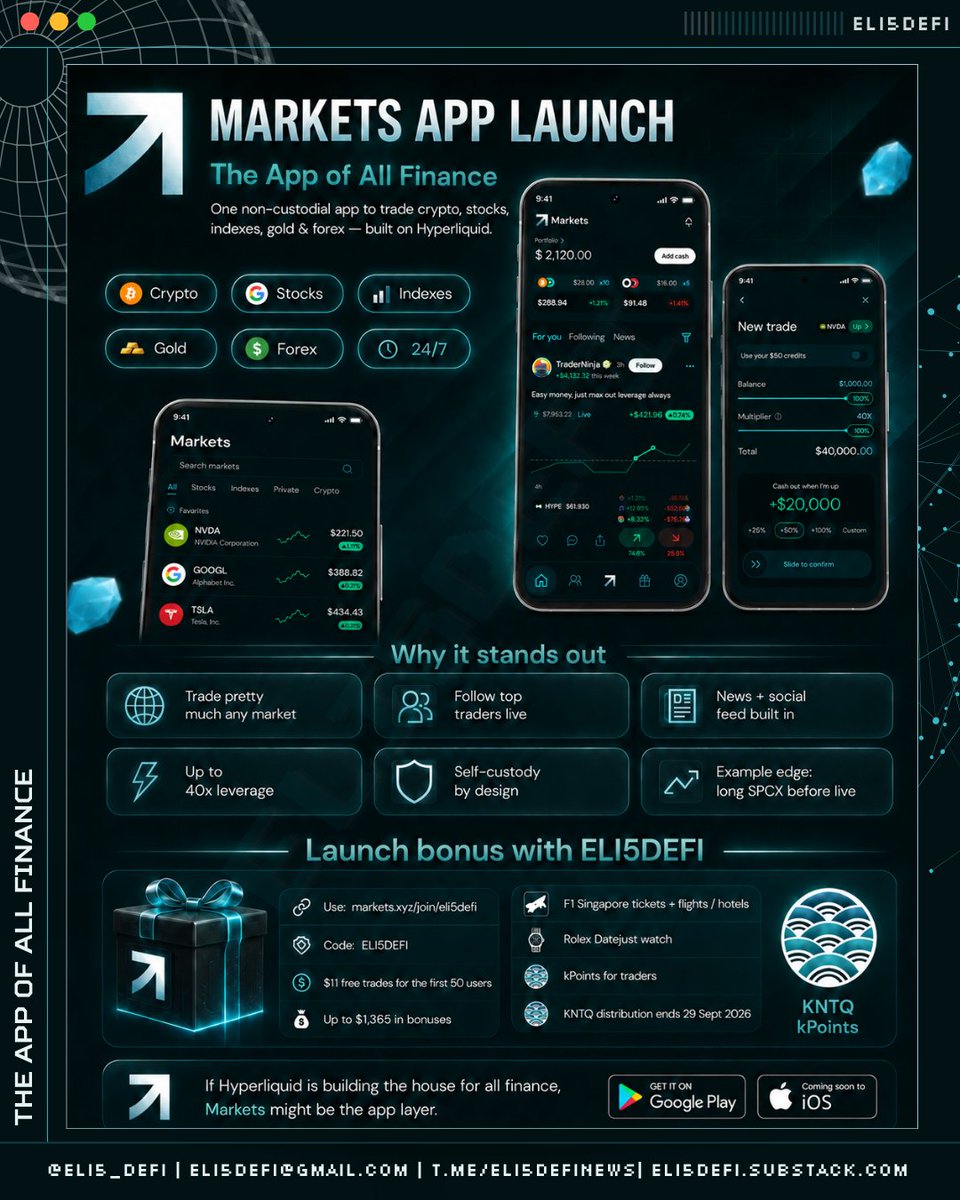
If Hyperliquid is building the house for all finance, then @Markets_xyz might be the App of All Finance.
For example, you could literally long $SPCX before it even went live today, trade pretty much any market, or just tail any sharp trader that pops up on your radar.
Use this ref link → markets.xyz/join/eli5defi (code: ELI5DEFI on Mobile App) if you want $11 in free trades for the first 50 users, plus additional bonuses based on your level in the app:
- Up to $1,365 in bonuses
- F1 Singapore tickets flights/hotels
- A Rolex Datejust watch
- kPoints ( @Kinetiq_xyz / $KNTQ ) for traders (29 Sept 2026 will be stopping distribution)
Hyperliquid.
Jun 11

Money printer goes burrrrr with Markets app.
Now live on both Android and iOS.
Trade, follow, earn 24/7.
Download & copy the best traders in the world. 👇
16
35
3,892
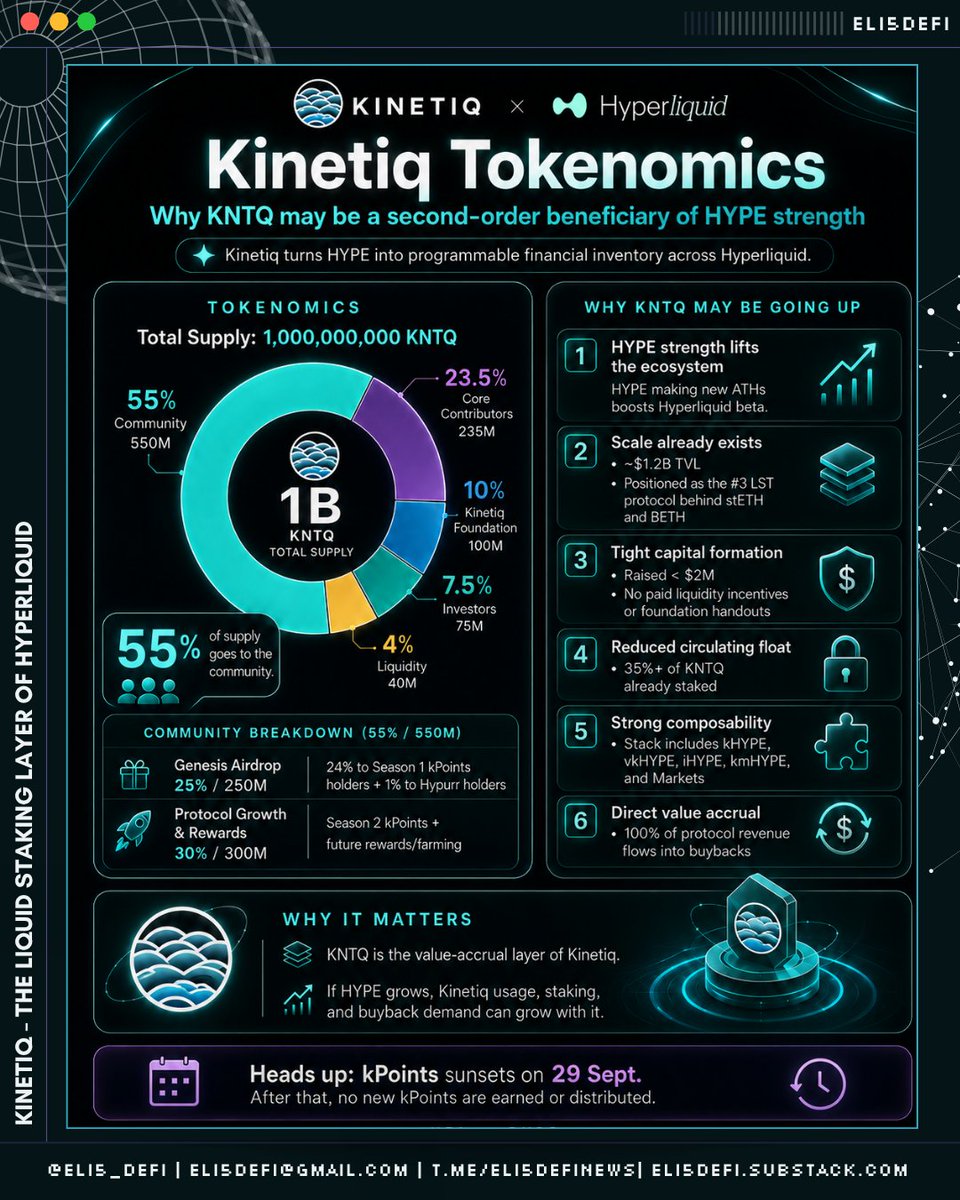
If you want the full rundown, my earlier post breaks down $KNTQ, and why it’s shaping up as one of the biggest LST plays and a major second-order ripple off $HYPE.
kM, $HYPE is casually printing ATHs like it’s on a daily schedule.
My take: the real second-order beneficiary is @Kinetiq_xyz / $KNTQ, and it’s not complicated:
- Total TVL sitting around ~$1.2B
- No.3 LST protocol behind Lido / stETH and Binance / BETH
- Raised < $2M total, with zero paid liquidity incentives or foundation handouts
- 35% of KNTQ already staked
- Strong composability across the Kinetiq stack, e.g. @Markets_xyz (HIP-3 FE)
- 100% of protocol revenue flows into buybacks
- Lean tokenomics with asymmetric upside → 55% to the community (25% genesis airdrop 30% protocol growth S2 rewards)
And heads up: their kPoints program sunsets on 29th September, after that, no new kPoints get earned or distributed.
HyperKinetiqLiquid
NFA DYOR.
2
7
893
I’m starting to suspect the next breakout onchain perp narrative won’t be another new crypto ticker.
It’ll be equities.
Specifically the equity markets that already have real, sustained global tailwinds.
Korea fits that bill.
Korean stocks have been one of the strongest equity themes lately, powered by the AI and semiconductor upcycle.
Samsung and SK Hynix aren’t just “local champions” anymore.
They sit right inside the global AI supply chain.
→ Memory
→ HBM
→ Data center buildout
→ Hyperscaler pull-through
→ AI infrastructure spend
Which is why Korean stock perps landing onchain feels like more than a routine “new market added” post.
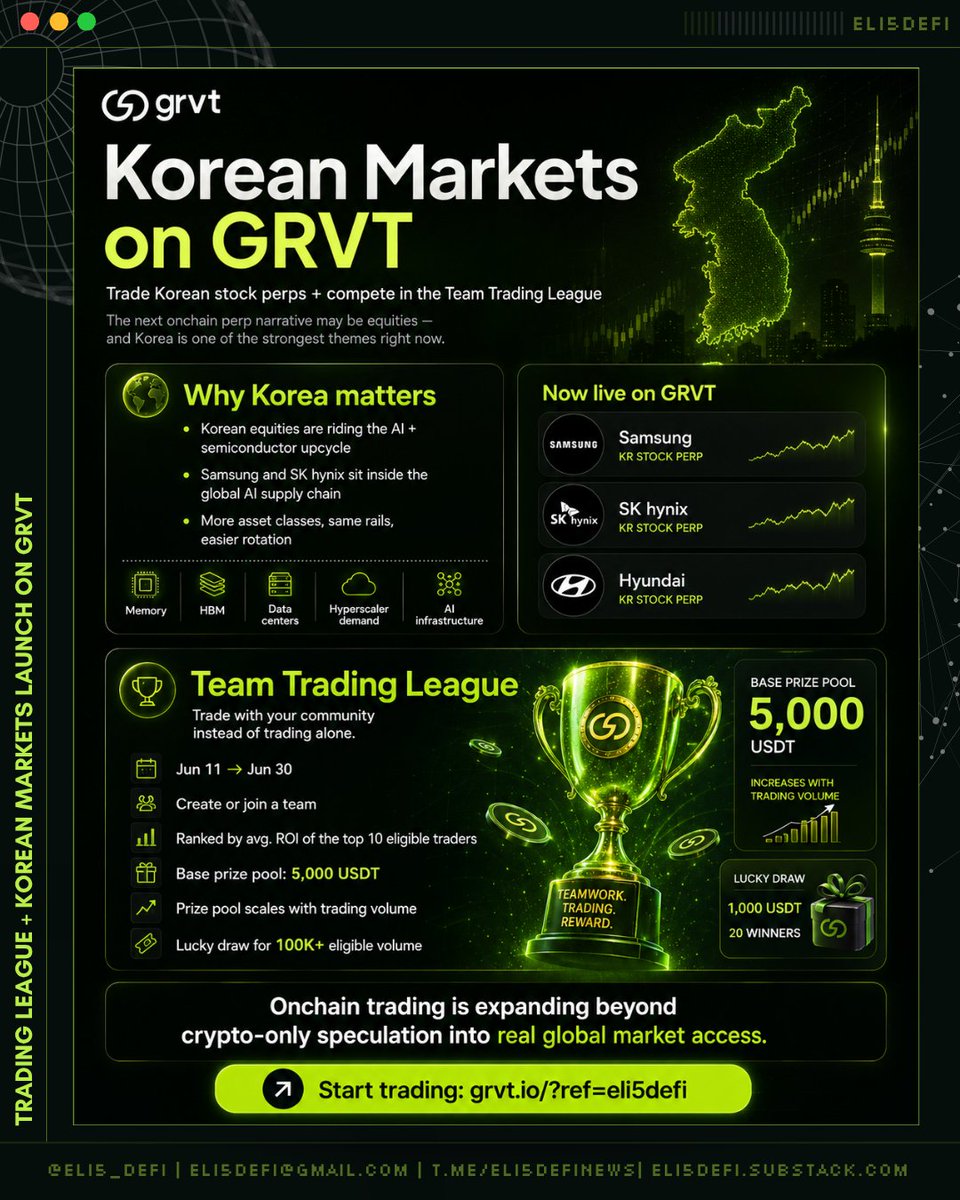
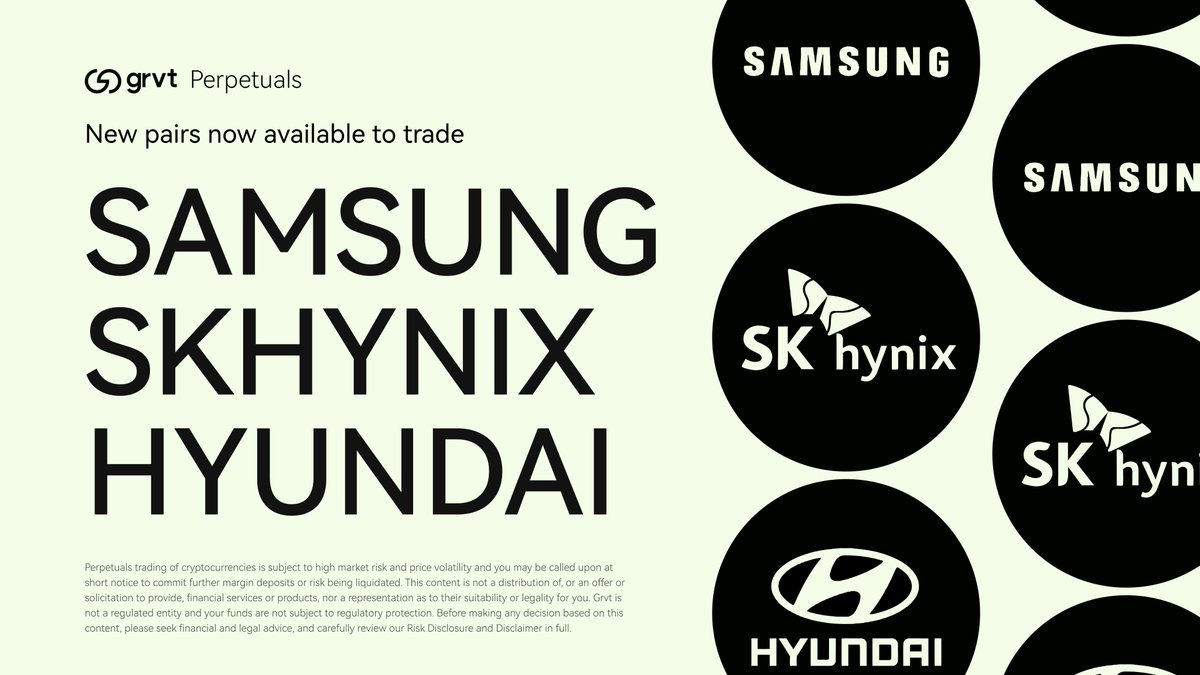
You have seen me posting a lot about GRVT and now via @grvt_io, you can now trade Korean equity perps like Samsung, SK Hynix, and Hyundai right next to crypto and other markets.
To me, that’s the real inflection:
Onchain trading is expanding from crypto-only speculation into genuine global market access. More asset classes, same rails, closer together, easier to rotate between.
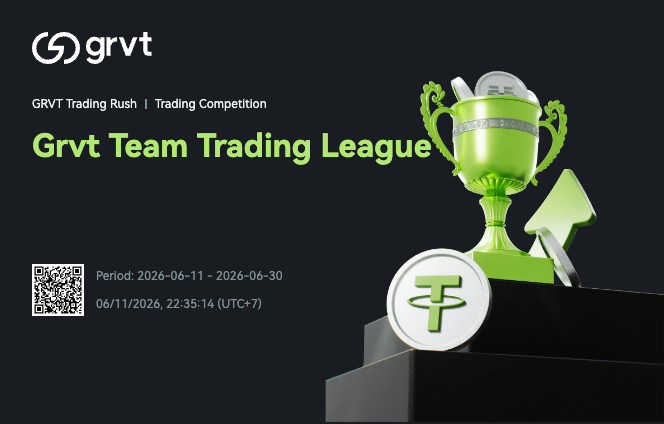
The timing is also notable because GRVT is running its Team Trading League.
Instead of trading in isolation, I can spin up a team, pull in friends, trading circles, or my community, and compete as a unit.
It’s pretty straightforward:
→ Jun 11 to Jun 30
→ create or join a team
→ trade during the competition window
→ team rank = average ROI of the top 10 eligible traders
→ prize pool starts at 5,000 USDT and scales with volume
→ lucky draw for anyone with $100K eligible trading volume
So, why waiting?
Start your trade now and join my team in the post below ⤵

74 real-world assets. 11 sectors. 8 markets. And today, Korea joins the list.
Korea's stock market is having its biggest year in decades, being one of the best performing major equity markets on earth right now.
☆ SAMSUMNG
☆ SK HYNIX
☆ HYUNDAI
These are the companies shaping global tech and manufacturing right now. Don't skip the opportunity.
Long the rally. Short the peak. Live on Grvt: grvt.io/exchange/perpetual/S…
6
19
4,578
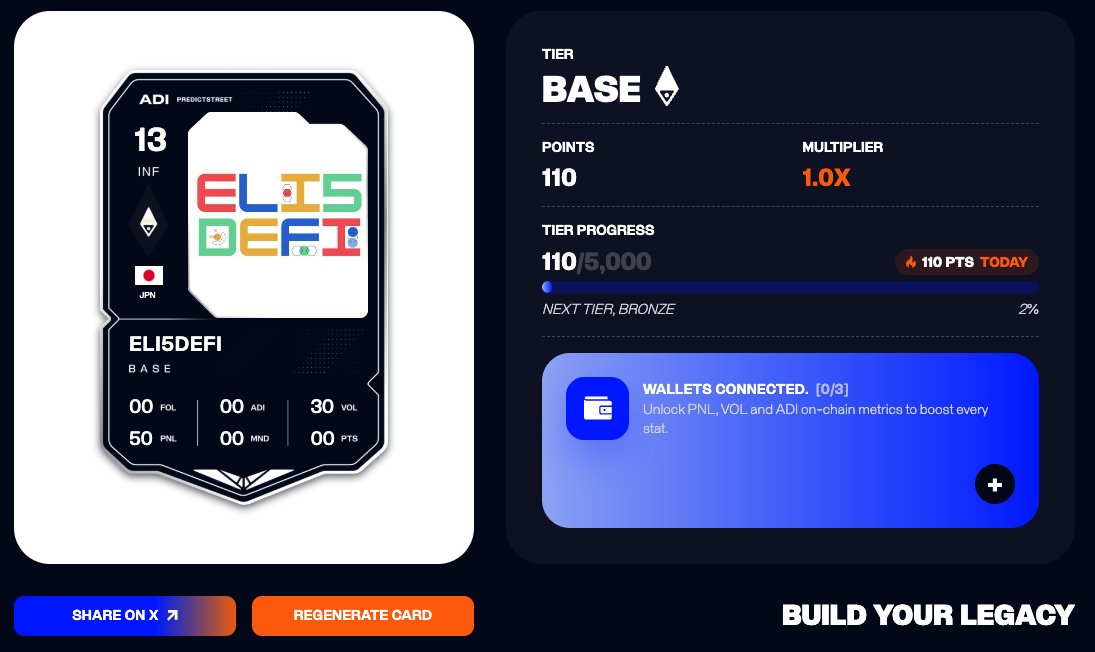
PSA: I’m getting in early on @Predictstreet
I’ll keep it simple: the World Cup is one of the few moments where the entire internet turns into a prediction market.
- Everyone has a team they’re convinced will go far.
- Everyone has a matchup they “already know” the outcome of.
- Everyone has a pre-tournament narrative they won’t shut up about.
And that’s exactly why the ADI Predictstreet momentum makes sense.
Predictstreet is the official on-chain prediction market partner of the FIFA World Cup 2026, built inside the @ADIChain_ ecosystem.
Because instead of firing off hot takes and letting them disappear into the feed, you can actually back your conviction on-chain via Predictstreet and let that activity stack up over time.
Prediction markets shine when they’re attached to massive real-world events where information keeps moving.
The World Cup is basically the perfect environment: attention, emotion, arguments, and a 24/7 storyline engine, from squad lists and injuries to group-stage chaos.
- Every match rewrites the narrative.
- Every upset shifts the market.
- Every late winner flips sentiment instantly.
- Every underdog run creates a fresh angle to price.
That’s why Predictstreet feels like a native layer for World Cup prediction activity. It takes all the tournament noise and turns it into something measurable: participation, progress, and a public track record.
---
➥ How to Participate?
Step one: Claim the ADI Predictstreet SBT Card.
It’s a dynamic Soulbound Token that works as your identity inside the platform. You just need to:
→ Connect your X account
→ Answer 3 quick questions
→ Claim your Predictstreet Card
→ Enter the dashboard
→ Open daily packs
→ Earn points
→ Complete prediction tasks
→ Climb the leaderboard
So, are you positioning yourself for The World Cup already?
Jun 11

THE WORLD CUP™ ‘26 SPRINT IS LIVE.
Claim your Predictstreet Card to enter now: sprint.adipredictstreet.com
Open daily packs, build streaks, & climb the leaderboard to win FIFA World Cup 2026™ tickets.
Finals. Semi-finals. And more.
Here’s how the Sprint works ↓
4
1
15
3,003
1
1
1,023
This is very big for institutional players.
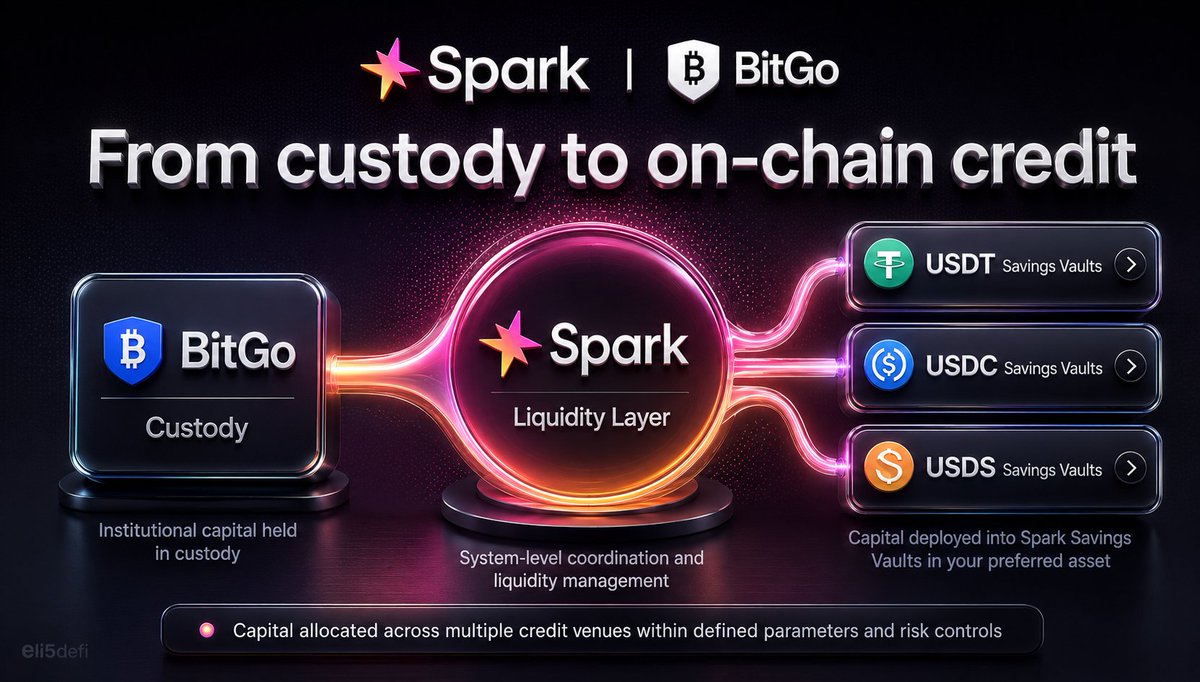
Institutional assets held with BitGo can now tap onchain credit via @Sparkdotfi
Rather than parking funds in a single lending pool, Spark Savings vaults spread capital across several credit venues, guided by preset rules for:
- Liquidity
- Exposure
- Allocation caps
- Utilisation thresholds
- Frictionless capital flow
That’s important because one-pool lending can turn fragile as utilisation spikes and liquidity tightens.
Spark mitigates this by dynamically distributing capital across markets instead of locking it into one.
BitGo custody → Spark Savings vaults → curated, structured access to onchain credit.
Jun 9

Institutional capital held in custody can now now access on-chain credit markets through structured allocation via Spark.
Through BitGo, capital can be deployed into Spark Savings vaults, where it is allocated across multiple credit venues within a single, structured system.
Most on-chain lending requires selecting a single market or pool.
Spark takes a different approach:
Capital is deployed across venues based on predefined liquidity, exposure, and allocation parameters, rather than remaining fixed within one market.
Reducing exposure to high-utilisation conditions where liquidity becomes constrained.
This is a new path for institutional capital into on-chain credit markets.
Spark is now available via @BitGo institutional wallets.
9
21
1,303