
Joined March 2021
- Tweets 2,042
- Following 139
- Followers 12,953
- Likes 1,441
537 Photos and videos




Pinned Tweet

Jun 10
Last week in Web3 Abstraction:
- ERC-4337 reaches Final
- STRK20 brings private DeFi to @Starknet
- pERC20 proposes privacy-native tokens
- $RLUSD expands to 40 chains via @wormhole
Learn more👇 go.etherspot.io/KVxSKYe
3
207
Jun 12
How can a liquidation or asset freeze be enforced across multiple chains at the same time?
A recent Ethereum Research article tackles the problem with machine-checked proofs of safety and liveness.
More in this week's AA digest👇
Jun 10

Last week in Web3 Abstraction:
- ERC-4337 reaches Final
- STRK20 brings private DeFi to @Starknet
- pERC20 proposes privacy-native tokens
- $RLUSD expands to 40 chains via @wormhole
Learn more👇 go.etherspot.io/KVxSKYe
3
91

And just like that, ERC-4337 is final 🎉
eips.ethereum.org/EIPS/eip-4…
10
36
9,844
Jun 9
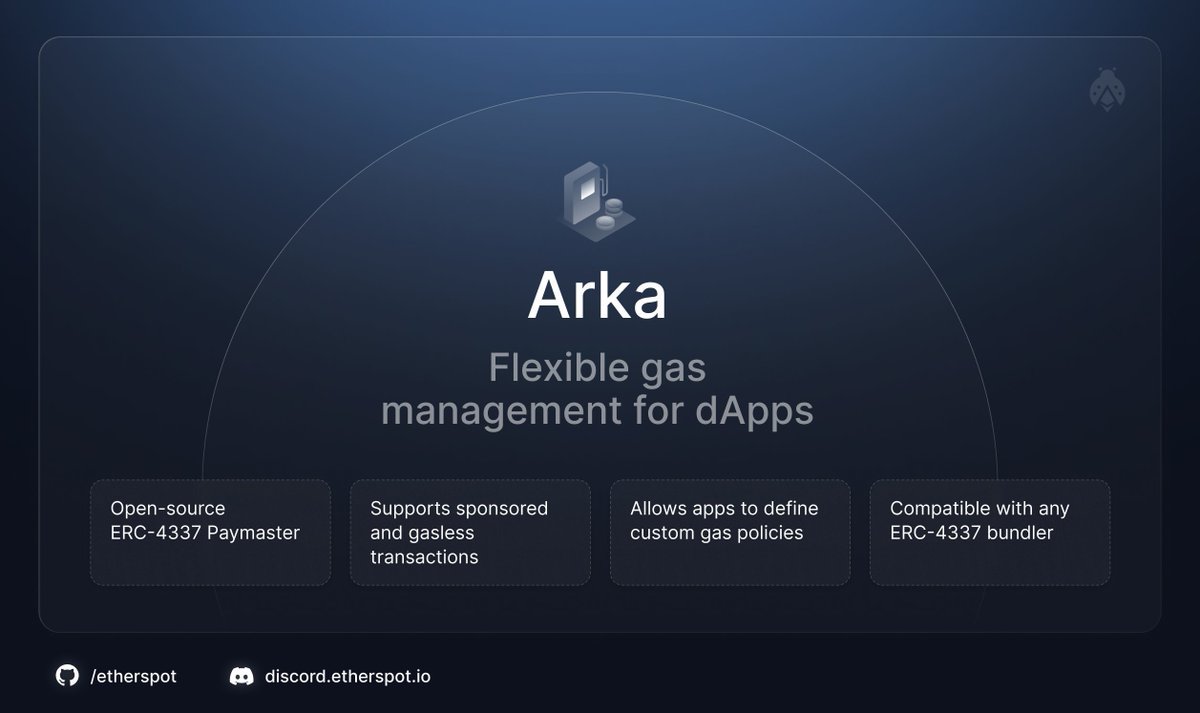
How many users have dropped off because they didn't have enough gas?
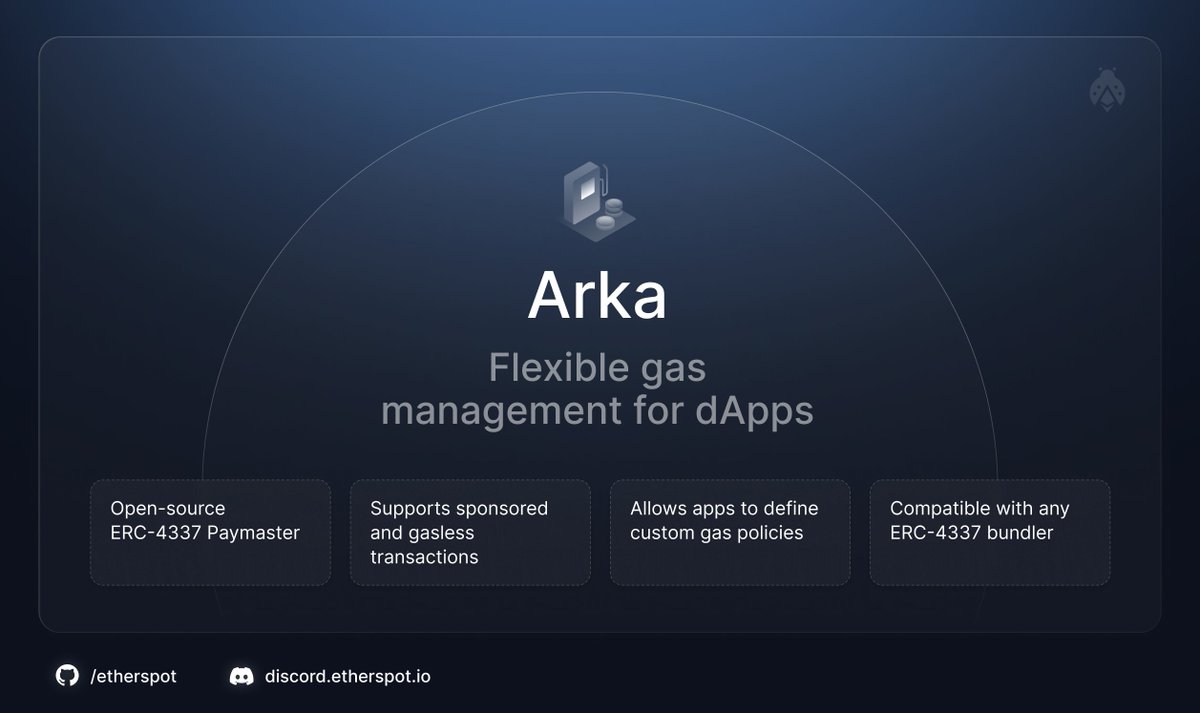
That's exactly the problem Arka helps solve👇
Jun 1
Let users swap, stake or interact with your dApp without holding ETH or any native gas token.
With Etherspot's Account Abstraction infrastructure, you can enable gasless user journeys by sponsoring transactions or letting users pay gas with supported ERC-20 tokens.
👉 Build and test it for free: go.etherspot.io/srlOpgq
2
136
Jun 5
What if every wallet, paymaster, bundler and solver had a "nutrition label" explaining its trust assumptions?
Vitalik floated that idea last week.
Read more about the latest updates in Web3 Abstraction 👇
Jun 3
Recent updates in Web3 Abstraction:
- @base launches Azul multiproofs
- @biconomy ships ERC-8211 smart batching
- @lifiprotocol launches enterprise intents
- Vitalik's "trust dependency" framework
Read the full digest👇 go.etherspot.io/1KKZCJT
2
4
355
Jun 3
Recent updates in Web3 Abstraction:
- @base launches Azul multiproofs
- @biconomy ships ERC-8211 smart batching
- @lifiprotocol launches enterprise intents
- Vitalik's "trust dependency" framework
Read the full digest👇 go.etherspot.io/1KKZCJT
5
473
Jun 1
Let users swap, stake or interact with your dApp without holding ETH or any native gas token.
With Etherspot's Account Abstraction infrastructure, you can enable gasless user journeys by sponsoring transactions or letting users pay gas with supported ERC-20 tokens.
👉 Build and test it for free: go.etherspot.io/srlOpgq
6
257
May 29
Vitalik outlined three near-term steps toward making privacy a native part of Ethereum:
1. Account abstraction FOCIL for private transactions.
2. Keyed nonces (EIP-8250) for better privacy.
3. Kohaku-powered private reads.
Read more 👇
May 27
Recent updates in Web3 Abstraction:
- EIP-7928: Parallel execution highlighted by @nero_eth
- Ethereum’s near-term privacy roadmap
- EIP-8141 Frame Transactions deep dive from @EthPrague
- @VitalikButerin outlines a leaner, more focused EF
Read more 👇go.etherspot.io/aImnP48
1
5
206
May 27
Recent updates in Web3 Abstraction:
- EIP-7928: Parallel execution highlighted by @nero_eth
- Ethereum’s near-term privacy roadmap
- EIP-8141 Frame Transactions deep dive from @EthPrague
- @VitalikButerin outlines a leaner, more focused EF
Read more 👇go.etherspot.io/aImnP48
1
5
360
May 25
EIP-7702 gave EOAs access to smart account functionality.
EIP-7851 asks the next logical question: what should happen to the original signing authority once delegation is enabled?
More below 👇
May 18
Etherspot explains: EIP-7851
EIP-7702 introduced delegated EOAs, allowing regular Ethereum accounts to adopt smart account functionality.
EIP-7851 builds on that idea by proposing a protocol-level mechanism that allows delegated EOAs to disable their original ECDSA signing authority.
The goal is simple: reduce the risks of keeping the original EOA key active after delegation, especially in multi-chain setups where the same ECDSA key may control accounts across multiple EVM networks.
The proposal is evolving through ongoing Ethereum research and core-dev discussions. The latest design update introduces SETSELFDELEGATE(delegate_address), a self-only opcode that allows delegated wallet code to write the 0xef0101 || delegate_address marker.
This permanently disables residual ECDSA authority while still allowing wallet code to update the delegate in ECDSA-disabled mode.
One of the key ideas behind the design is that delegated wallet code, not the original EOA key, should control when the transition is finalized.
At a broader level, EIP-7851 reflects a growing push toward making delegated EOAs behave less like partially upgraded EOAs and more like fully transitioned programmable accounts.
4
200
May 22
Ethereum ecosystem teams are working on an open standard to end blind signing, a UX and security flaw that has already contributed to billions in user losses.
More in this week’s account abstraction digest 👇
May 20
Recent updates in Web3 Abstraction:
- Ethereum’s Glamsterdam roadmap takes shape
- @ethereumfndn launches clear signing standard
- @silencelabs_sl releases first quantum-safe MPC infra
- Updated EIP-7851 delegation design
Read more👇 go.etherspot.io/ezpdbJv
1
2
130
May 20
Recent updates in Web3 Abstraction:
- Ethereum’s Glamsterdam roadmap takes shape
- @ethereumfndn launches clear signing standard
- @silencelabs_sl releases first quantum-safe MPC infra
- Updated EIP-7851 delegation design
Read more👇 go.etherspot.io/ezpdbJv
4
469
May 18
Etherspot explains: EIP-7851
EIP-7702 introduced delegated EOAs, allowing regular Ethereum accounts to adopt smart account functionality.
EIP-7851 builds on that idea by proposing a protocol-level mechanism that allows delegated EOAs to disable their original ECDSA signing authority.
The goal is simple: reduce the risks of keeping the original EOA key active after delegation, especially in multi-chain setups where the same ECDSA key may control accounts across multiple EVM networks.
The proposal is evolving through ongoing Ethereum research and core-dev discussions. The latest design update introduces SETSELFDELEGATE(delegate_address), a self-only opcode that allows delegated wallet code to write the 0xef0101 || delegate_address marker.
This permanently disables residual ECDSA authority while still allowing wallet code to update the delegate in ECDSA-disabled mode.
One of the key ideas behind the design is that delegated wallet code, not the original EOA key, should control when the transition is finalized.
At a broader level, EIP-7851 reflects a growing push toward making delegated EOAs behave less like partially upgraded EOAs and more like fully transitioned programmable accounts.
1
6
461
May 18
For ongoing updates around EIP-7851, @colinlyguo has been actively sharing revisions and discussion points as the proposal evolves.
Find the proposal draft here: eips.ethereum.org/EIPS/eip-7…
245
May 15
What if Ethereum exposed more native proof verification infrastructure at the protocol level?
A new proposal explores moving proof-checking logic into Ethereum’s L1 to reduce verifier complexity for rollups and ZK apps.
Learn more👇
May 13
Last week in Web3 Abstraction:
- Deep dive on Ethereum accounts
- Native proof verification reducing rollup verifier complexity
- 7702 8141 for prediction market parlays by @alexanderchopan
- 7702 Collective call by @ParticleNtwrk
Read more 👉 go.etherspot.io/3JmCZD7
3
182
May 13
Last week in Web3 Abstraction:
- Deep dive on Ethereum accounts
- Native proof verification reducing rollup verifier complexity
- 7702 8141 for prediction market parlays by @alexanderchopan
- 7702 Collective call by @ParticleNtwrk
Read more 👉 go.etherspot.io/3JmCZD7
1
5
486
May 11
Your users shouldn’t need ETH just to use your dApp.
Arka enables sponsored transactions and gasless flows through an open-source ERC-4337 paymaster.
Read the docs: go.etherspot.io/srlOpgq
4
124
May 8
Post-quantum Ethereum wallets are closer than you think.
A new proposal on how to upgrade any existing wallet in a single transaction using EIP-7702 delegation, zero-knowledge proofs and a hidden public key.
Learn more👇
May 6
Last week in Web3 Abstraction:
- Soldøgn Interop locks Glamsterdam targets
- EIP-7702 ZK Proofs to hide wallet public keys
- New Ethereum proposal adds verifiable routing for agent solvers
- 7702 Collective drops new industry report
Read more 👉 go.etherspot.io/jflfBYT
7
203
Etherspot 🐞 retweeted

May 6
The Real State of Crypto Innovation: Looking into the 7702 Collective's Report x.com/i/broadcasts/1yKAPMQDd…
22
21
73
24,793
May 6
Excited to be part of this🔥 Our very own @abhixh will be joining the conversation live. Don't miss it, 5PM UTC

Join us, @rhinestonewtf, @zerodev_app, and @etherspot to discuss the 7702 Collective, its mission, and findings!
Tune into this and @wordabstractor's account at 5PM UTC.
1
6
197