
Mapping the chokepoints behind the chokepoint. Supply chain intelligence that finds mispriced assets before the market connects the dots.
Joined February 2026
- Tweets 548
- Following 102
- Followers 806
- Likes 117
51 Photos and videos


Jun 13
Fable isn’t a chip. It’s a dependency that has just got export controlled like one. Sovereign AI just repriced model redundancy overnight.
Jun 13

The US government, citing national security authorities, has issued an export control directive to suspend all access to Fable 5 and Mythos 5 by any foreign national, whether inside or outside the United States, including foreign national Anthropic employees.
The net effect of this order is that we must abruptly disable Fable 5 and Mythos 5 for all our customers to ensure compliance.
Access to all other Claude models is not affected.
We apologize for this disruption to our customers. We believe this is a misunderstanding and are working to restore access as soon as possible.
Read our full statement: anthropic.com/news/fable-myt…
141
Jun 10
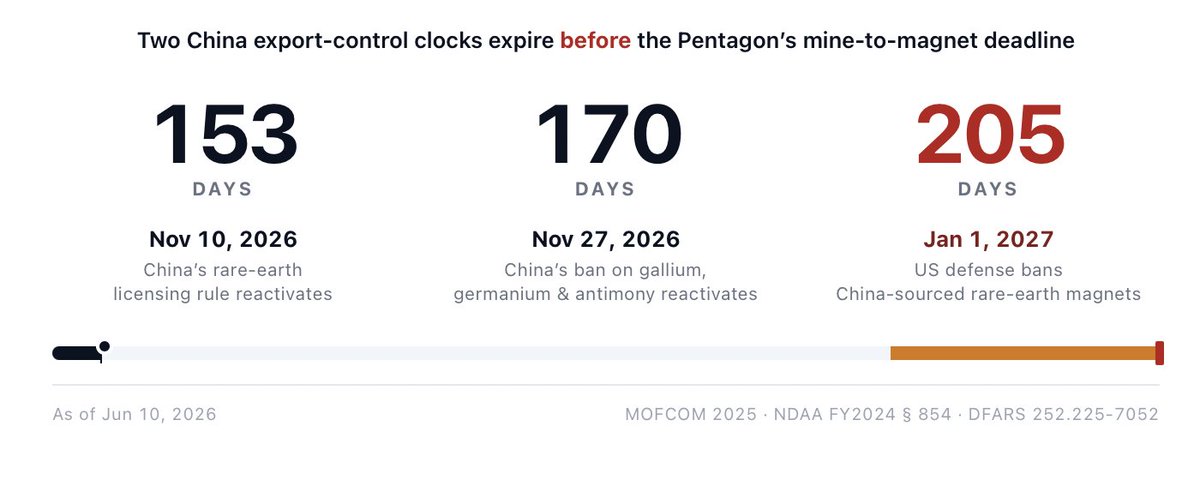
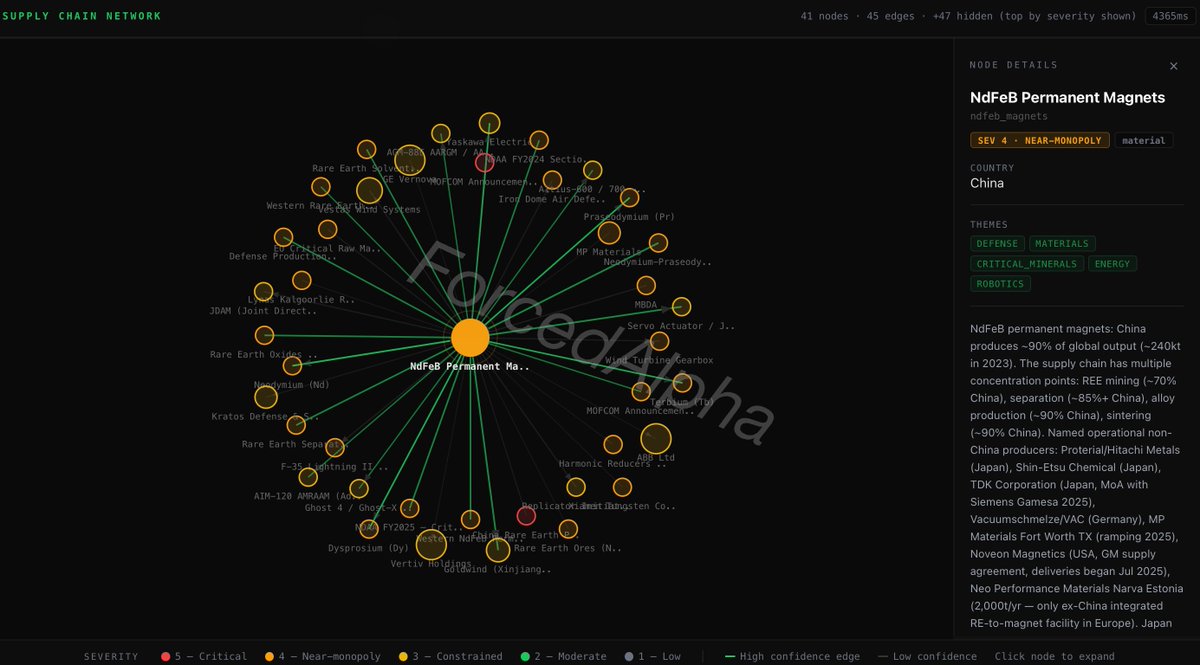
#China processes 90% of rare earth magnets. On Jan 1st 2027, US defense can't buy them.
Western #germanium already trades at 167% premium to Chinese. China's export control suspensions expire 52 days before the ban hits.
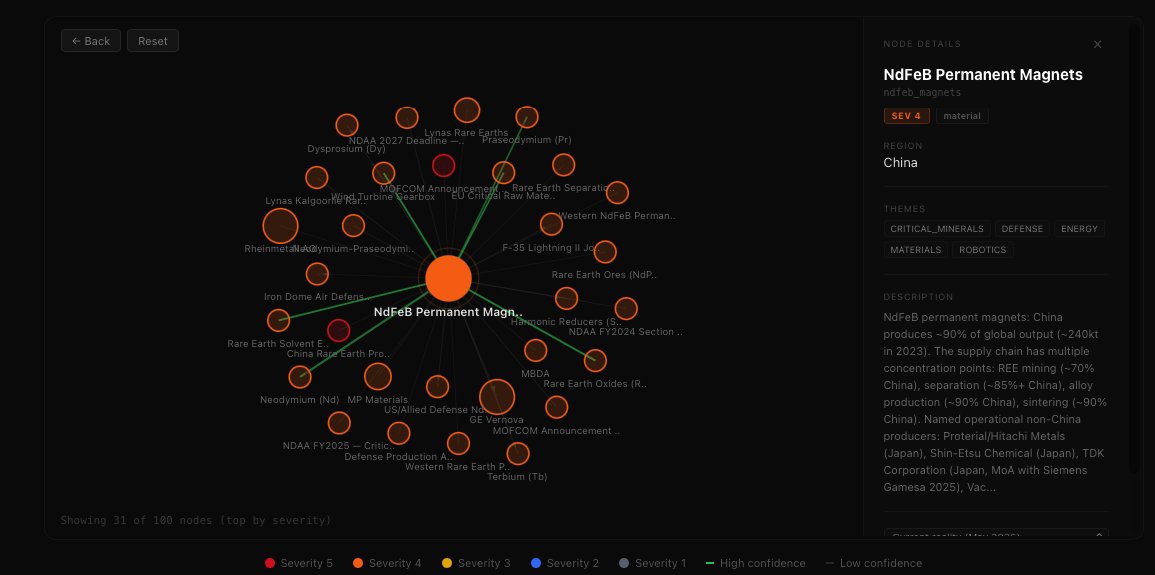
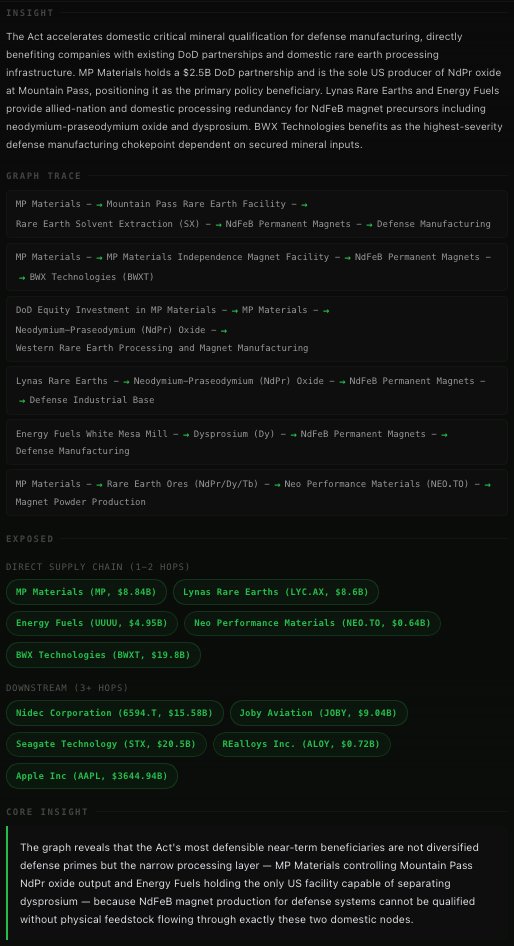
We mapped the demand floor, supply gap, and scarcity rent.
What do you think happens when US defense, #AI, #robotics all push for magnet supply?
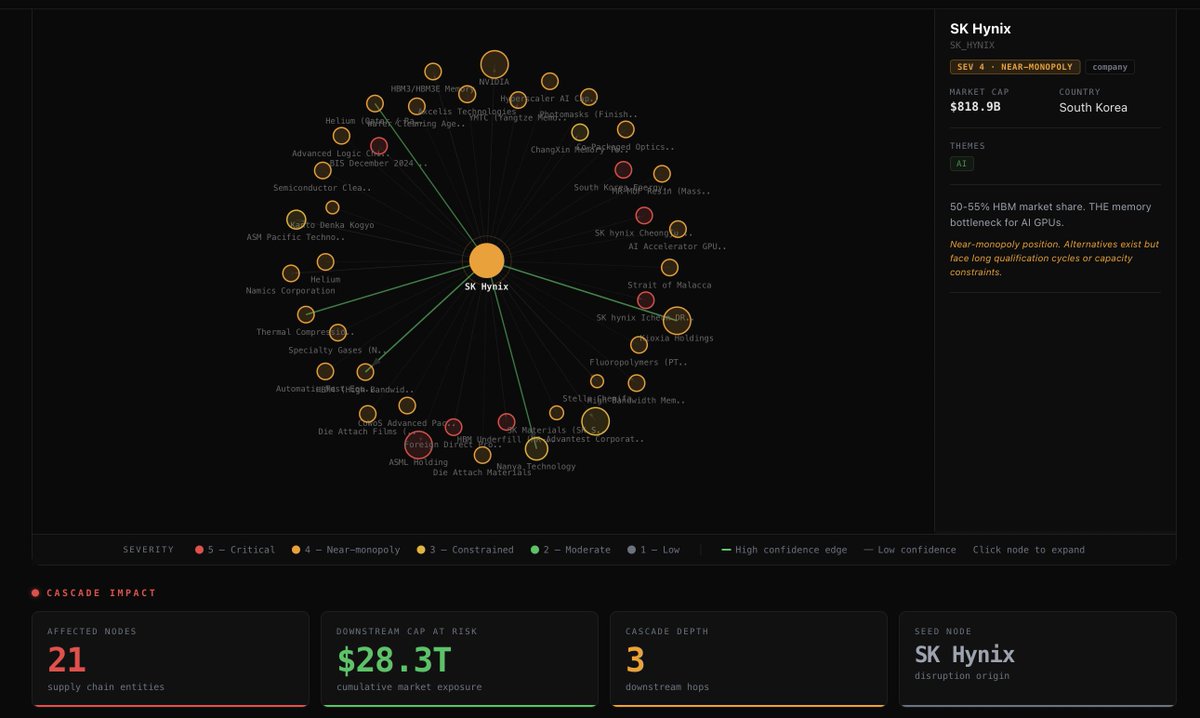
We do — we've modelled the downstream cascade.
#criticalminerals #MP #USAR #nationalsecurity
1
1
3
2,391
Jun 9
Question is what sort of US response does this force? CHIPS Act 2.0 with transformers attached, DPA on grid equipment, sovereign backstop on hyperscaler power?
reuters.com/world/china/chin…
1
109
Jun 8
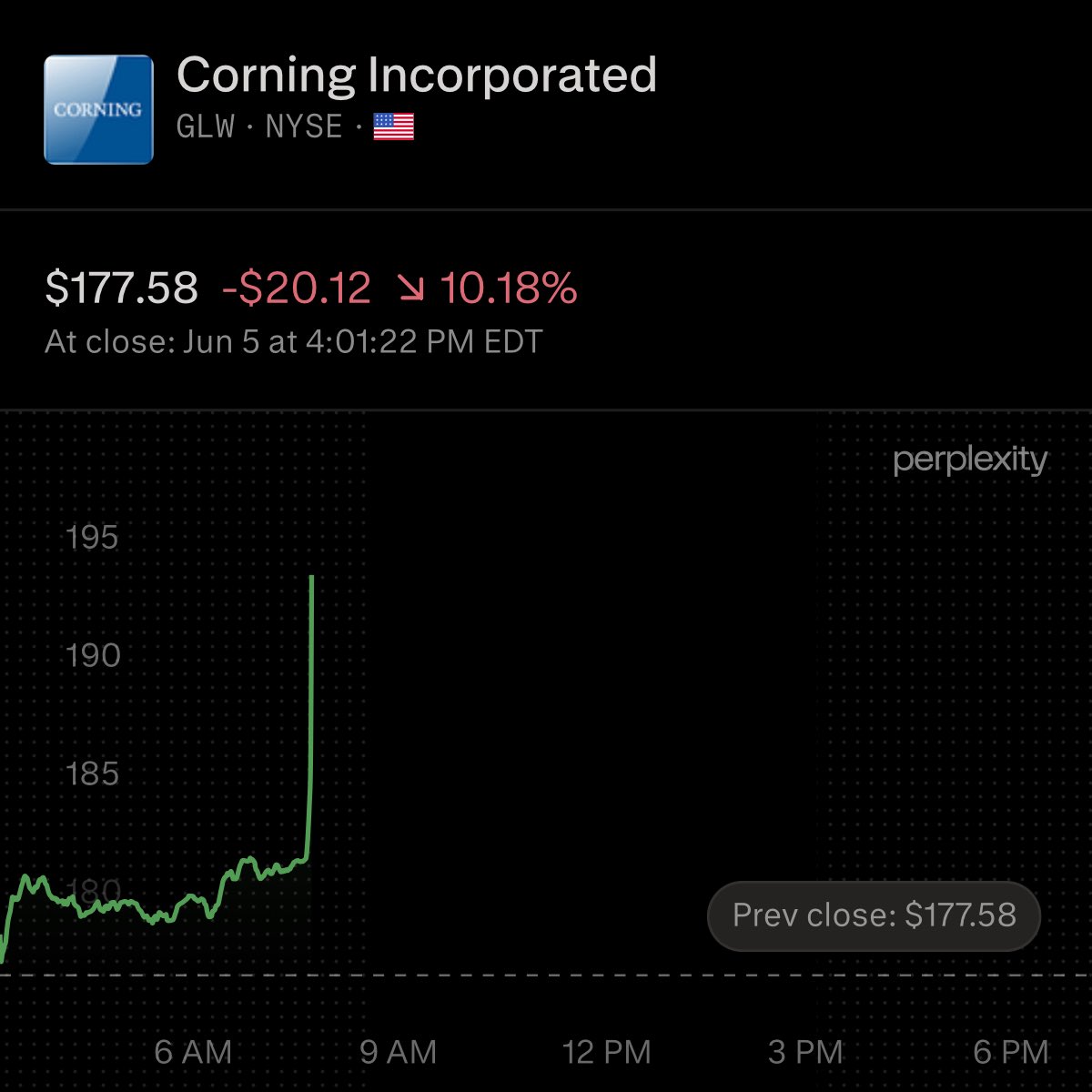
Why is $GLW winning every hyperscaler fiber RFP? $AMZN. $META. $LUMN. $CIEN. $CRWV. $NBIS. $WULF. Not because they're the only one who makes it. $PRY and can too. It's because they're the only one who make it in USA. Buy America mandate EU anti dumping on Chinese fiber = Corning advantage.
Jun 8

$AMZN announced a multibillion-dollar agreement with $GLW to supply optical fiber, cable, and connectivity solutions for Amazon’s U.S. data center infrastructure.
The deal will create 1,000 advanced manufacturing jobs at Corning’s North Carolina facilities and support hundreds of construction jobs.
Amazon says the agreement strengthens the U.S. fiber optics supply chain as AI data center demand expands.
1
2
701
Jun 4
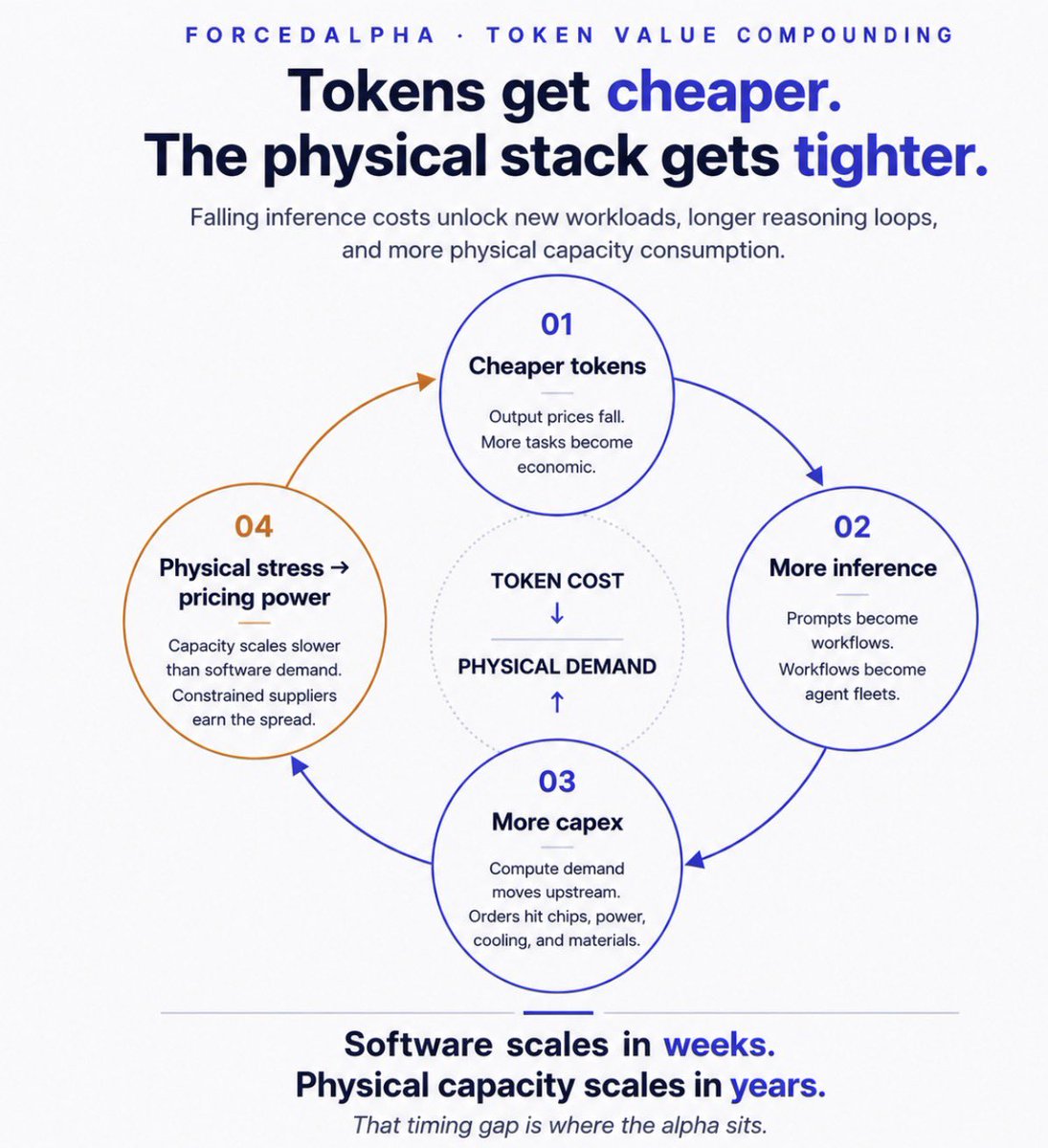
More agents than humans = supply chain pressure. Token usage going parabolic. Each token has a physical bill which must be paid across every layer. This is only the start and we’re already struggling with the physics.
Jun 3

Welp, that happened faster than I predicted. Thought it would be end of 2027, then early 2027, but agentic traffic growing so fast that bots have now passed human traffic online for the first time in the Internet's history. radar.cloudflare.com/traffic…
2
201
Jun 2
If nuclear takes years, gas turbines are sold out years in advance what's left? Fuel cells, solar, batteries. It's literally 5 - 2 = 3. There is no alternative and demand is a J curve going straight up. Full stop.

Bloom, a maker of fuel cells that has seen its stock price double in the past two months, doesn’t see a need to sell shares to meet surging demand from artificial intelligence data centers, its CEO says bloomberg.com/news/articles/…
1
1
307
Jun 1
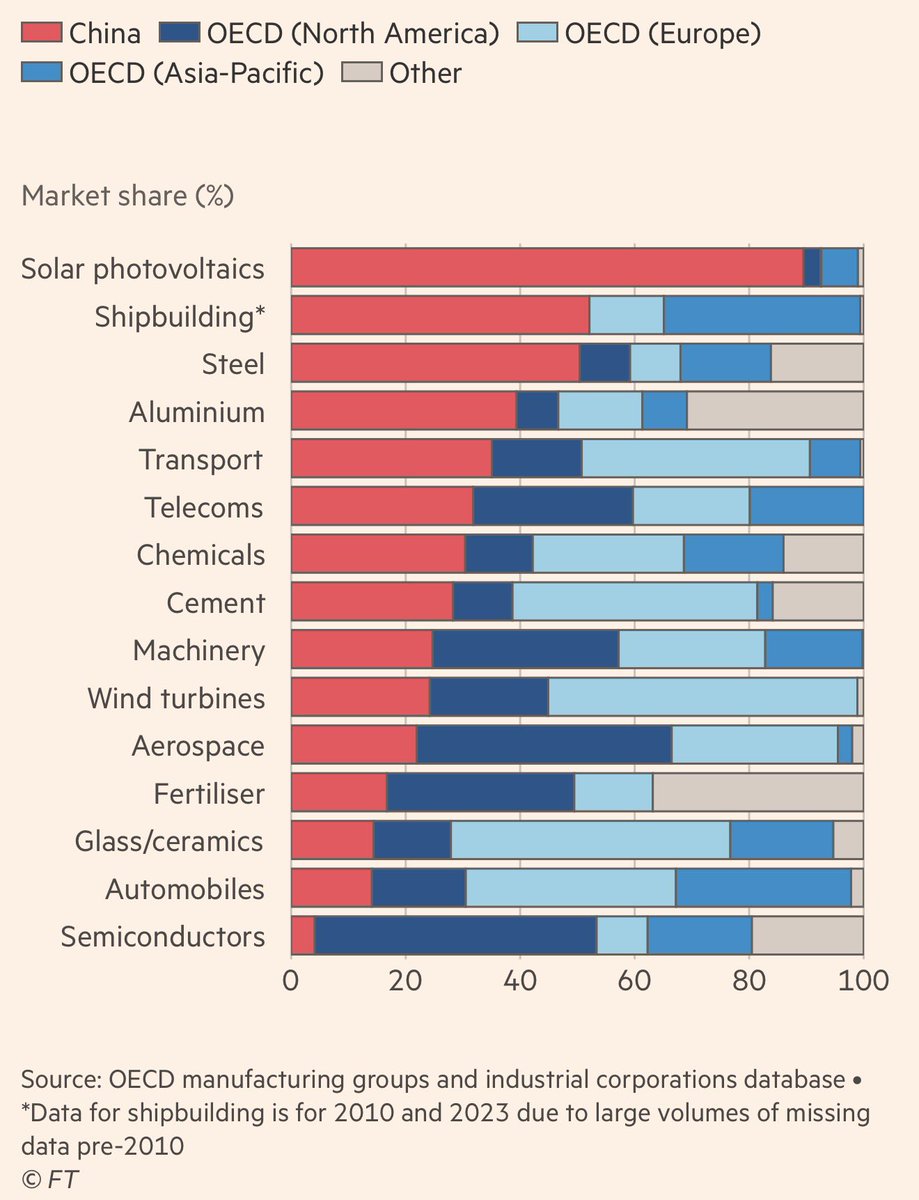
China owns everything you can build from a blueprint. Solar panels, steel, ships, aluminium. Just look at the chart. Dominant across the board.
Semiconductors are the one exception. Not for lack of money or will.
The difference is that you can’t write down how to make a leading edge chip. The people who know how to run these processes learned it over 30 years inside a handful of companies. That knowledge doesn’t transfer by hiring or copying. Instead it compounds in place.
That’s why the controls on engineers and equipment matter more than the controls on chips. You’re not trying to slow down a factory. You’re trying to slow down a learning curve.
Jun 1

Many have tried industrial policy: India, Brazil, France, Germany, Indonesia, even the US. But why have some been more successful: Japan, South Korea, China, Taiwan?
Great FT piece by @tejparikh90: “China’s comparative advantage is industrial policy” giftarticle.ft.com/giftartic…
2
231
Jun 1
Vera Rubin turns NVIDIA from a GPU demand story into a full rack BOM shock.
Every rack that ships needs more of everything. Memory, packaging, photonics components, specialty resins. The companies making those inputs were already sold out building the previous generation. They didn't double their factories overnight.
Second order is:
1) CoWoS remains as the first bottleneck
2) Qualified HBM materials continue to choke under demand pressure
3) InP goes from tight to structurally short
4) Micron is structurally set to possibly benefit more than SK Samsung
Third order is:
1) Optics becomes structural. CPO makes InP lasers and photonics part of the AI compute BOM, not a telecom side market. Expect memory style moves.
2) The resin suppliers become the recognised as an ASML style choke point.
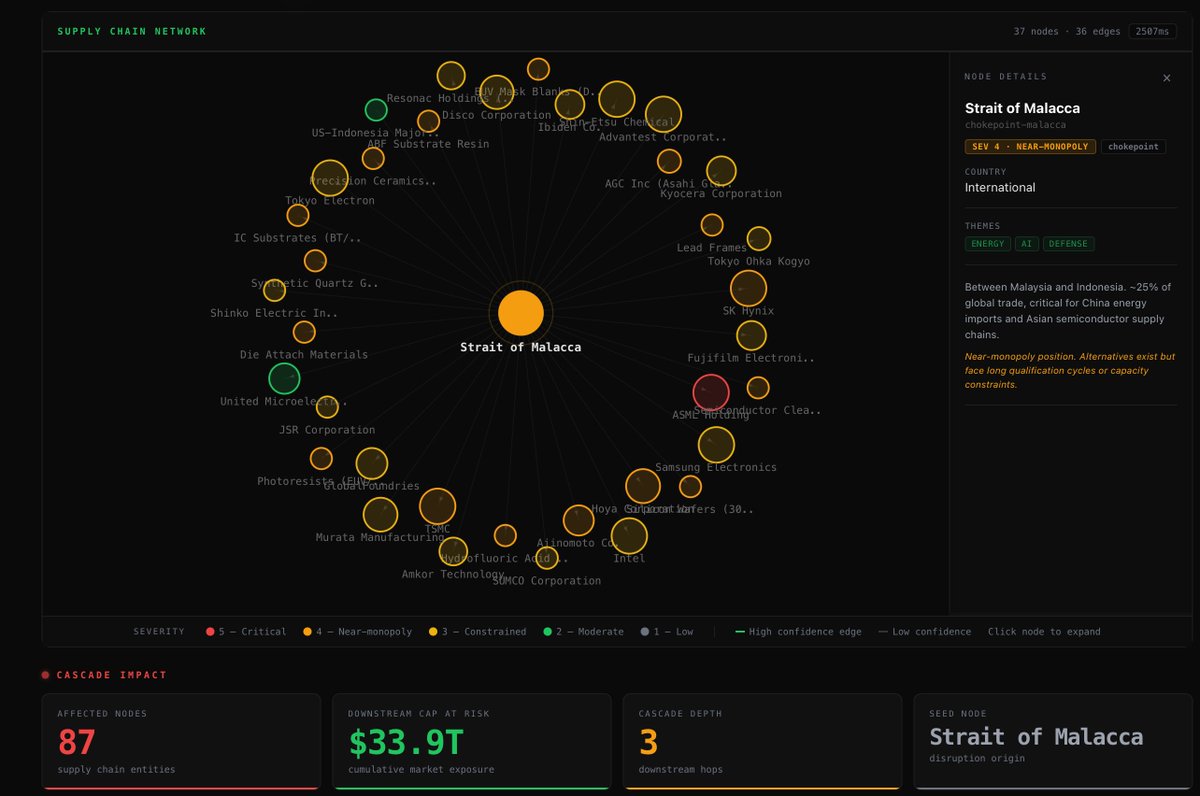
3) AI supply chain dependency on Asia (Korea, Japan and Taiwan) continues to concentrate.
You cannot move physics as fast as photons.
Jun 1
Nvidia $NVDA CEO:
Vera Rubin is in full production.
The supply chain we created for Vera Rubin is twice as large as Grace Blackwell.
What used to take two hours to assemble one Grace Blackwell rack now only takes 5 minutes.
2
4
510
May 31
Consensus $OKLO on the plutonium allocation. Differentiated read from our supply chain graph: $LEU instead. 3 reasons. 1) Centrus has actually delivered HALEU 900kg to DOE, not paper allocations. 2) $3.6b mcap vs Oklo $11.6b, same fuel sovereignty narrative, smaller cap. 3) The unsolved chokepoint is fabrication, not material. Plutonium needs a fab the US doesn’t have. HALEU enrichment is already running. The derisked sovereignty play is the one already producing fuel, not the one negotiating to receive it.
May 31

ICYMI: The Department of Energy is delivering on President Trump’s executive order to reinvigorate America’s nuclear base by taking a surplus of U.S. plutonium and making it available to the nuclear industry for advanced reactor fuels. newsmax.com/newsfront/depart…
4
1,319
May 31
$MARA bought 64% of Exaion, EDF’s HPC subsidiary. Softbank is announcing they want what MARA already owns: a seat on the French nuclear fed AI compute grid. The asset MARA paid for in Feb is selling into a bigger TAM today than yesterday.
May 30

SoftBank is promising to spend at least $52 billion on building a network of massive data centers in France, helping advance Europe’s goal of tech independence with what would be the continent’s largest AI infrastructure project. on.wsj.com/4nXCsvp
1
9
1,810
May 30
$400K government salaries. 400 positions. Critical minerals and advanced materials. Direct from the white house.
Congress have spent billions but they're realizing the knowledge gap is something else. You've just got to see how MP materials and USAR are fighting over magnet IP theft.
You can't hire a rare earth refiner off LinkedIn. You can't train someone to run a speciality smelter without the precise context yourself.
So now the government is offering $400K to poach from the tiny pool of people who already do this. At companies you've probably never heard of.
reuters.com/world/trump-issu…
1
251
May 27
Physics takes time to catch up. Why do we always forget this? Capital can reprice demand instantly, but it cannot move supply chains constrained by physics at the same speed. Leading to material chokepoints that gate multiple product lanes.

Demand for industrial metals like copper and aluminum is soaring on the back of AI power needs, grid expansion and the renewable energy transition. AlphaCore Wealth Advisory's David Stubbs says years of underinvestment means supply would struggle to keep pace
2
286
May 27
This $20B in critical minerals isn't going to China's competitors. It's going to the 3-4 companies globally that actually know how to separate rare earths outside China. And those companies can't scale overnight. So the money creates a queue. The queue creates locked in offtake agreements which sets a pricing floor. China didn't corner critical minerals by digging holes. They cornered it by training the people who know what to do after.

For too long, China has used its dominance over critical minerals processing to pressure industries, manipulate markets, and threaten global supply chains.
Today’s @StateDept Quad partners announcement is a major step toward building resilient, diversified supply chains with trusted partners, not strategic adversaries.
The U.S., Japan, Australia, and India are mobilizing up to $20 BILLION to secure supply chains for the minerals powering advanced technology, defense systems, batteries, and AI.
The era of relying on China for critical minerals must come to an end.
state.gov/releases/office-of…
1
1
587
May 27
Tacit knowledge. Without it supply expansion is irrelevant. China has been building this for decades and we’re clearly struggling to catch up.

BREAKING: $MP Sues $USAR for Stealing Proprietary Magnet Technology
Two rare-earth companies that cut deals with the Trump administration are fighting over rare-earth magnet technology as the US tries to overcome the industry’s reliance on China.
MP Materials Corp. alleged that rival USA Rare Earth Inc. stole its proprietary technology through a former employee, according to a lawsuit filed in Texas business court Friday. The lawsuit alleged that a former MP Materials engineer shared proprietary “grain boundary diffusion” formulations with USA Rare Earth, which later disclosed the information to a third-party technology company.
The technology is used for high-performance magnets which are found in electric vehicles, defense systems and advanced electronics. The US government has poured billions into building a domestic rare-earth supply chain to reduce its dependence on China for critical minerals and magnets.
“USA Rare Earth has exhibited a pattern of recruiting employees from other companies and then using those employees to misappropriate trade secrets to accelerate USA Rare Earth’s own development,” MP said in the suit.
USA Rare Earth didn’t respond to a request for comment.
MP Materials and USA Rare Earth are among companies racing to establish US-based mining, processing and magnet manufacturing capacity — making proprietary technology and engineering talent increasingly valuable competitive assets. Both firms are getting funding from the Trump administration to build a domestic supply chain of the minerals. Last year, the White House made a $400 million equity investment in MP, while USA Rare Earth reached a $1.6 billion agreement with the administration.
MP also accused USA Rare Earth of failing to follow through on numerous commitments, including for a feasibility study and getting commercial magnet operations running by the second-quarter of 2022.
“USA Rare Earth failed to achieve any of those milestones,” according to the suit.
The company also questioned the quality of USA Rare Earth’s flagship mine, Round Top in Texas. MP said the measure of how much critical minerals that could be found in the deposits at Round Top are “among the lowest in the world for rare earth projects.
Source: news.bloomberglaw.com/ip-law…
2
200

May 25
A competitor can exist and still be irrelevant.
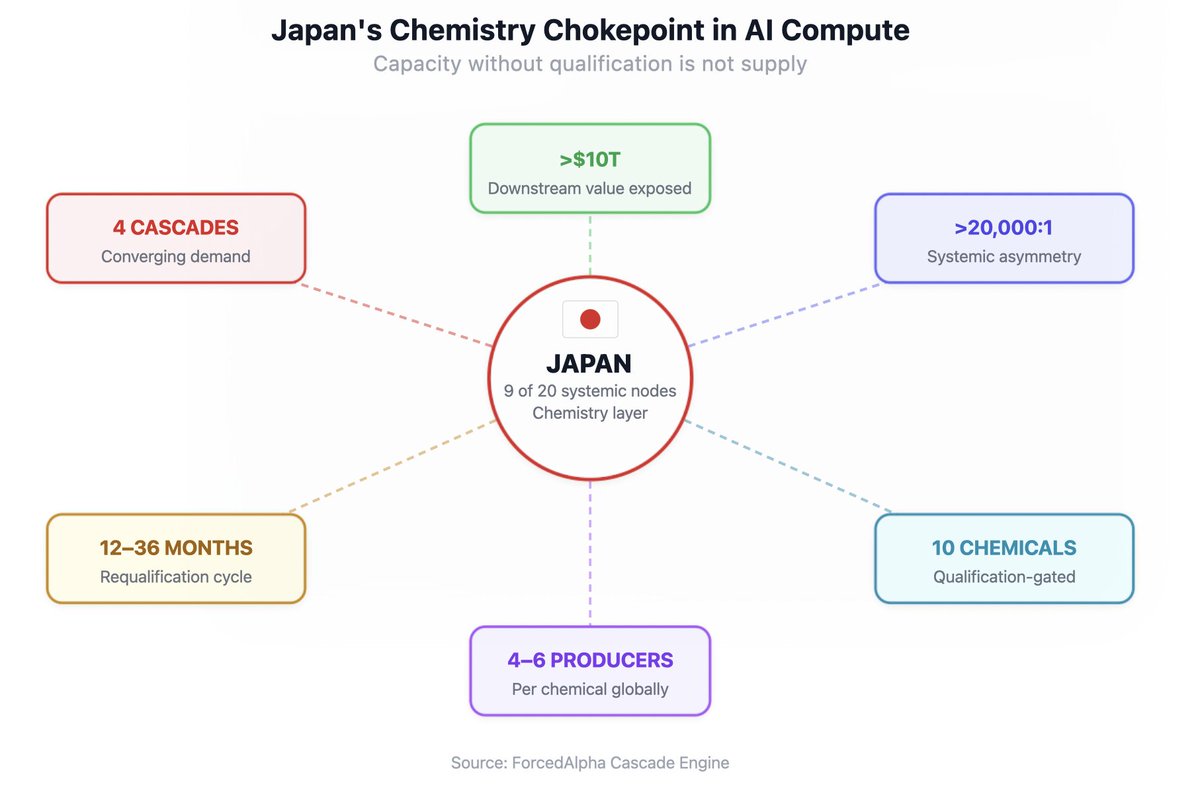
EUV photoresist: the knowledge is in the head of engineers. Takes many years of experience. It's why #Japan dominates.
Rare earth separation: same. China's been doing it 40 years. The West is WIP but its a decade out (at least) to match #China.
Capacity without qualification is not supply. This is why parts of the physical economy look competitive on paper but behave like monopolies in practice.
1
138