
No mud, no lotus
Joined October 2011
- Tweets 1,150
- Following 394
- Followers 658
- Likes 6,653
53 Photos and videos










Pinned Tweet

Jun 6
$VVV FUD that collapses under minimal scrutiny. Let's dismantle it piece by piece.
1. "Big Tech can just ship privacy as a checkbox tomorrow"
Load-bearing claim, and it's historically illiterate.
And it begs the most obvious question in the entire debate: if it's so easy, why haven't they?
These are companies that ship multi-billion-dollar features on quarterly cadences. Google rebuilt Search around AI Overviews in 18 months. Meta pivoted an entire company to the metaverse, then pivoted again to AI, in under three years. Microsoft jammed Copilot into every product line — Windows, Office, GitHub, Edge, Teams — inside of 24 months. These organizations move fast when they want to.
Yet on real privacy — the one feature users have been screaming for since forever — nothing. A decade of opportunity, trillions in combined R&D budget, infinite engineering talent, and the result is zero credible private-mode product from any of them. Not because they forgot. Because they can't. The "low-lift product decision" framing is the tell — anyone who's actually built inside one of these companies knows that shipping real privacy means dismantling the revenue model that pays for everything else.
Big Tech's business model is the surveillance. Suggesting Google, Meta, or Microsoft will "just add privacy" is like suggesting Philip Morris will just add a "no nicotine" checkbox. Their revenue, their ad targeting, their Reinforcement Learning from Human Feedback (RLHF) pipelines, their model improvement loops, their enterprise upsell motions — all of it depends on data retention and telemetry. Pretending they'll bolt on a "private mode" reflects a fundamental misunderstanding — possibly a willful one — of how these models actually get better with each iteration. The training data is the product. You cannot turn that off without turning the company off.
Maybe in 20 or 30 years — once the foundation model arms race has cooled, the winners have been crowned, and marginal training data stops moving the needle — one of these incumbents ships a faux-privacy tier as a brand-rehab exercise. Fine. But suggesting they'll do it right now, in the middle of the Model Wars, when every token of user data is a competitive weapon and every six weeks decides who leads the leaderboard? That's not a product decision. That's corporate suicide. No CEO survives the board meeting where they propose voluntarily blinding their own training pipeline while OpenAI, Anthropic, xAI, and DeepSeek are still trading punches.
And by the time they do bolt it on — privacy in name only, sanded down for compliance and PR — the market will have already crowned its privacy leader. The private AI category is being decided right now, and Venice is the one already shipping the product, already operating the infrastructure, already running the token economy underneath it. A 2045 "Google Private Mode" launching into a market Venice has owned for two decades isn't a threat.
The training data is the product. You cannot turn that off without turning the company off.
Hard stop.
But fine — let's entertain the fantasy. Pretend the cockamamy "privacy checkbox" scenario actually ships. Why on earth would anyone trust it?
Trusting Big Tech with a "private mode" is like trusting Equifax to safeguard your Social Security number — right after they leaked 147 million of them, paid a fine smaller than a single quarter's revenue, kept the same executives in place, and then pivoted to selling you identity protection as a monthly subscription. Their business model only works if your privacy doesn't.
The receipts:
Google paid $5 billion in 2024 to settle a class action proving that Chrome's Incognito Mode — a literal privacy checkbox — still tracked users across the web the entire time. They shipped the exact product the original argument claims is a "low-lift decision." It was a lie. A court said so. Separately: 20 years of ad-targeting infrastructure, four delays on third-party cookie deprecation, a full reversal in 2024, and "Privacy Sandbox" as theater designed to keep Google in control of targeting while pretending to retreat from it.
Meta was fined €1.2 billion by the EU in 2023 for illegal data transfers, paid $725 million to settle Cambridge Analytica, ran the Onavo VPN as a surveillance tool to spy on competitor apps, and quietly injected JavaScript into Instagram's in-app browser to log every keystroke on third-party sites. Zuckerberg's 2019 "privacy-focused vision"? Six years later, vaporware.
Microsoft shipped Recall in 2024 — an AI feature that silently screenshotted everything on your screen every few seconds and stored it locally in a plaintext, unencrypted database. After researchers demonstrated trivial exfiltration, Microsoft walked it back, "fixed" it, and re-released it anyway in 2025. This is the same company being asked to credibly ship private AI.
OpenAI retains conversations for 30 days minimum and indefinitely under the NYT lawsuit court order they fought and lost. Free-tier inputs train the model by default. Sam Altman went on Bari Weiss's podcast in 2025 and openly admitted ChatGPT conversations have no legal privilege and can be subpoenaed at will.
Anthropic — the self-styled "safety" company — quietly flipped their 2025 terms so user conversations train Claude by default, with a 5-year retention window.
Snowden / PRISM is the original receipt. Google, Microsoft, Apple, Yahoo, and Facebook all directly fed user data to the NSA under a program they publicly denied existed — until the documents leaked. Then they updated their terms and kept going.
"Trust is earned, respect is given, and loyalty is demonstrated. Betrayal of any one of those is to lose all three."
Big Tech has betrayed all three. Repeatedly. Publicly. Under oath. The trust was never earned in the first place — it was defaulted to because users had no alternative. The respect was performative, scripted by PR teams between scandals. The loyalty was extracted through lock-in, not given freely. And every receipt above is a documented betrayal of the bargain users thought they were striking.
A fantasy privacy checkbox shipped by Big Tech in 2026 isn't a turning point. It's the same actors offering the same promise after a multi-decade track record of breaking it. The asymmetry is brutal: Venice has to earn trust once; Big Tech has to rebuild it after generational, repeated, settled-in-court betrayal. One of those tasks is hard. The other is impossible.
The notion that any of these firms will voluntarily kneecap their data moat with a checkbox misunderstands what they sell. Privacy isn't a feature for them — it's an existential threat to their core economics.
It is precisely because shipping real privacy is a "low-lift product decision" that they haven't done it. They had a decade. They didn't. Because they can't — not in any form that actually means anything.
Moving on. The critique also conveniently ignores that privacy is only one leg of Venice's stool.
2. The argument completely ignores aggregation
Venice is not "private ChatGPT." It's a model-agnostic aggregation layer. No Big Tech provider will ever serve you their competitors' models:
OpenAI will never serve you Claude.
Anthropic will never serve you Gemini.
Google will never serve you Llama, Qwen, or DeepSeek.
The "chase the newest greatest model" problem is real and recurring. Every six weeks a new SOTA model drops from a different lab — and the leaderboard has flipped hands at least a dozen times in the last 24 months. Venice solves this by being neutral infrastructure. Big Tech is structurally incapable of solving it because they're competing labs with mutually exclusive economic incentives. This is a moat that cannot be "checkboxed" away no matter how many product managers Sundar throws at it.
3. The argument completely ignores uncensored models
Big Tech will never offer uncensored models. Not "probably won't" — cannot.
Brand risk: a single screenshot of Gemini producing #NSFW or politically spicy output becomes a Congressional hearing within 48 hours. We've already seen this play out — remember Gemini's image generator getting yanked offline in February 2024 after the "ethnically diverse Nazis" debacle? That was just a style misfire. Imagine the explicit content reaction.
Advertiser risk: their entire revenue stack depends on brand-safe environments. Disney is not running display next to NSFW Gemini outputs.
Internal culture: "trust & safety" teams at these companies have veto power and an institutional immune response. They aren't going anywhere.
Venice serves a market that Big Tech has explicitly abandoned: adult creators, fiction writers, security researchers, harm reduction workers, journalists, lawyers handling sensitive case work, anyone touching politically inconvenient topics. That's tens of millions of users currently routing through jailbreaks, sketchy wrappers, or just doing without. Venice is the only credible, well-capitalized, professionally operated provider in that lane.
4. The argument ignores tokenized inference and first-mover dynamics
$VVV / $DIEM is the first serious attempt to tokenize inference capacity as a tradable, stakeable asset. Each staked DIEM confers a perpetual $1/day on the API. This creates:
A prepaid compute market with secondary liquidity.
Aligned incentives between token holders, infrastructure operators, and end users.
An on-chain settlement layer that no Big Tech provider can replicate without blowing up its billing stack and inviting SEC scrutiny.
Big Tech is not tokenizing inference. Their CFOs would resign. Their general counsels would have aneurysms. Their boards would never approve it. This is a structurally permanent advantage and a category Venice currently owns outright. First-mover advantage in tokenized inference is not a vibe — it's a network effect that compounds with every DIEM minted and every API call settled on-chain.
5. The "$740M market cap is priced for growth" framing is lazy
$740M is rounding error in AI infrastructure valuations:
Perplexity raised at $14B with no moat and worse unit economics.
Anthropic sits at $ 300B .
CoreWeave IPO'd at $ 35B renting out GPUs.
OpenAI's secondary tender pegged the company at $ 500B.
xAI raised at $200B with a fraction of Venice's product surface area.
If Venice captures even 0.5% of the combined privacy-conscious uncensored aggregation tokenized-inference market over the next 24 months, $740M looks like a generational entry. The bear case requires Big Tech to fundamentally change what they are. The bull case only requires Big Tech to keep being what they've been for the last 20 years.
One of those scenarios has historical precedent. The other has none.
Bottom line
The original argument is a single-variable thesis — "Big Tech ships privacy checkbox" — built on a counterfactual that has never happened, against every economic incentive these companies have, while ignoring three other independent moats (aggregation, uncensored, tokenization), any one of which would justify the current valuation on its own.
It's not a risk analysis. It's wishcasting dressed up as skepticism.
Jun 6

At a $740M market cap, $VVV is already priced for growth that hasn't shown up yet.
The biggest risk to the whole thesis sits inside Big Tech.
If OpenAI, Anthropic, or Google add privacy as a simple checkbox inside the apps people already open every day, Venice loses most of its reason to exist.
And making that happen is a relatively low-lift product decision.
They could ship it tomorrow.
8
12
87
9,967
G.W. Jackston retweeted

Jun 13
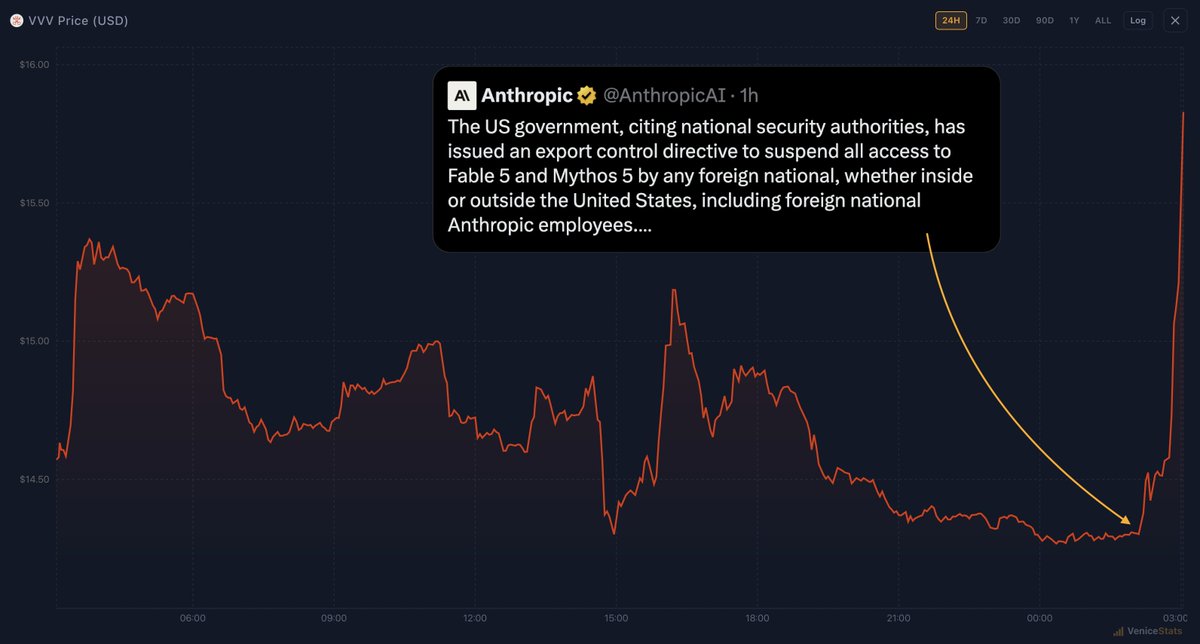
Have seen a bunch of people pushing back on the Anthropic news being a positive catalyst for Venice user growth and $VVV with variations of “well it’s not like Venice has a model that can compete with Mythos.” That’s entirely missing the forest for the trees. Sure that’s the first order effect but the second order effect is the impact on user data and privacy. If one of the top AI labs is willing to switch off access to users at a moments notice, what will prevent them from sharing all of your personal data or gating models/features based on user profiles (location, nationality, background, etc). It’s not about what other models does Venice offer that can compete with Mythos today but rather when you use Venice, usage is private/anonymized/uncensored. The other implication of the Anthropic news is the clear need for decentralized training and open source models that can one day compete near the levels of the models produced by the frontier labs. That’s a long term problem to solve but there are also a lot of interesting protocols working on this, some with liquid tokens but many still pre token launch.
24
25
203
32,980
G.W. Jackston retweeted

Jun 13
@AustinBarack is reading this right. The "@AskVenice doesn't have a Mythos" takes are measuring the wrong thing.
Frontier leads last 3-4 months, not forever. with 500 labs chasing, a mythos-class equivalent is months away, not years.
Access you don't control, and data you can't see, is the part that doesn't come back. That's the whole base:0xacfe6019ed1a7dc6f7b508c02d1b04ec88cc21bf bet: private and permissionless AI, the need nobody knew they had until they got switched off.
Jun 13

Have seen a bunch of people pushing back on the Anthropic news being a positive catalyst for Venice user growth and $VVV with variations of “well it’s not like Venice has a model that can compete with Mythos.” That’s entirely missing the forest for the trees. Sure that’s the first order effect but the second order effect is the impact on user data and privacy. If one of the top AI labs is willing to switch off access to users at a moments notice, what will prevent them from sharing all of your personal data or gating models/features based on user profiles (location, nationality, background, etc). It’s not about what other models does Venice offer that can compete with Mythos today but rather when you use Venice, usage is private/anonymized/uncensored. The other implication of the Anthropic news is the clear need for decentralized training and open source models that can one day compete near the levels of the models produced by the frontier labs. That’s a long term problem to solve but there are also a lot of interesting protocols working on this, some with liquid tokens but many still pre token launch.
2
3
29
2,835
Jun 13
RT @JonShapeShift: Yet another example why the world needs @AskVenice .
Private and uncensored AI is more in deamnd everyday.
1
5
G.W. Jackston retweeted
Jun 11
Bullish @AskVenice base:0xacfe6019ed1a7dc6f7b508c02d1b04ec88cc21bf
Jun 10

The reason is quite hilarious 😂😂.
Microsoft put $50 billion into Anthropic.
FIFTY billion dollars.
they are a Project Glasswing partner. Fable 5 runs inside Azure. Microsoft sells Claude to its own enterprise customers through Microsoft 365 and GitHub Copilot.
and they won't let their own employees use it.
here's why.
under Anthropic's new Mythos-class data retention policy, every prompt you type and every response you get is stored for 30 days. automatically. no opt out.
if their safety classifiers flag anything in your session, anything, they keep it for up to two years.
you don't get told when that happens, what was flagged or who can see it.
Microsoft employees paste confidential contracts into these things. customer data. internal roadmaps. acquisition strategies. legal documents. source code.
all of it sitting on Anthropic's servers for 30 days minimum. flagged sessions for two years.
so the company that invested $50 billion looked at that policy and told its staff: actually hold on.
other Claude models still work internally. under Zero Data Retention rules. the normal ones are fine.
just not the most powerful one they helped fund.
and one more thing.
the Pentagon listed Anthropic as a supply chain risk in March and banned defense contractors from using its products.
Microsoft funds Anthropic. sells Anthropic's models. runs them on Azure. helped build the most powerful one.
won't let employees use it.
the Pentagon won't let defense contractors near it.
the safeguard that makes Fable 5 safe enough to release publicly is the same safeguard that lets Anthropic keep your data for two years.
the guardrail is a data retention policy.
but you can use it. it's in your browser right now. 🌚
have fun.
1
5
42
2,024
Jun 11
$DIEM spot credits lending birthing and maturing in real time.
Next comes futures.
And then @AskVenice executes and enters hyper-growth phase
$VVV
2
31
885
G.W. Jackston retweeted

Jun 10
Another reason @AskVenice is so important…
Jun 10

Our Anthropic overlords deciding which prompts the peasants are allowed to use.

1
7
75
2,329
Jun 10
$DIEM 21% APR
> buy $DIEM in the market for $1200
> stake DIEM = $1.00 per day of Venice API inference credits (perpetual, resets daily).
> Sell the daily credits on @AskSurplus at 30% discount → you realize 70% = $0.70 USDC per day.
> Annual USDC income = 0.70 × 365 = $255.50.
> Yield = 255.50 ÷ 1,200 = 21.29% APR
> you keep the DIEM token forever 100% of its price appreciation upside.
$VVV $DIEM Higher.
DIEM is tokenized inference. And the demand will only be growing. Exponentially.
Never know... maybe @mac_eth will even offer farming rewards for an improved base:0xc52aedec3374422d7510e294cfaa90799595cba3 token? Juicy.
Jun 9

"Almost every dollar of AI revenue has been generated by inference."
→ Anthropic: $30B ARR.
→ OpenAI: $25-30B.
→ Total: $60-65B today.
→ Five-year outlook: $500B to $1 trillion.
"That's why inference is the most valuable thing in the AI stack."
— @jbrukh, Founder & CEO @coinfund
1
7
265
G.W. Jackston retweeted

Jun 10
the counter to this future is @AskVenice (private uncensored) and $VVV (own a stake in the rails, vs everything going to private VCs and the rich)
cleanest bet that will get clearer over time
Jun 10

The scary part about Anthorpic's Fable nerf is not that it refuses to answer biology or cryptography. It's that it foreshadows what's coming. A world where a couple companies decide what you can and cannot do. They're building a new ruling class and you're not in it...
2
3
38
3,764
Jun 10
$DIEM usage is fixing to skyrocket

Minimum Discount Routing is now live on Surplus
Set a discount floor, and we'll automatically route your calls to offers that are at least X% off.
Stop overpaying for inference today
2
1
29
2,662
G.W. Jackston retweeted

Jun 9
We got something cooking at Venice... drop the absolute best AI filmmakers below or drop your own best AI film or video👇
6
3
37
1,083
G.W. Jackston retweeted

Jun 9
The latest discretionary $VVV burn has been executed
At a total of $162K in VVV at time of burn, this is the largest yet.
25
79
439
23,542
G.W. Jackston retweeted

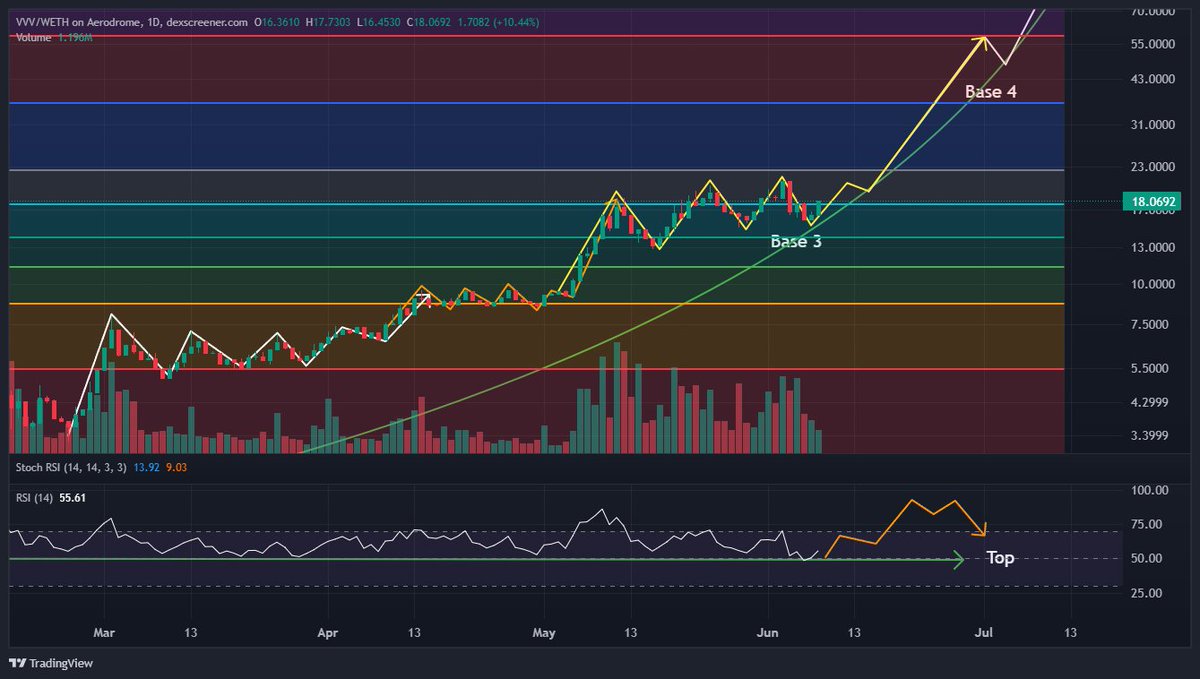
$VVV 1D
Fourth peak incoming
Then Break Out
Fib 1.618 and 2.618 on deck beginning mid June
Keep your eyes Peeled
5
7
46
1,652
Jun 8
Wow wow wow.
Must listen interview by @TrustlessState with @JonShapeShift and @jesseproudman from Venice @AskVenice $VVV
In my writings and posts, I’ve theorized about the financialization of inference and $DIEM’s role in that initiative. Great to hear directly from the team on this topic.
Very, very exciting. The Venice team gets it.
Never been more bullish on the future of where Venice can go.
Interview is littered with other incredible anecdotes and insights.
Go and listen.

INTERVIEW - @AskVenice Is Here to Win: How Private AI Takes On OpenAI and Anthropic
@TrustlessState sits down with @JonShapeShift and @jesseproudman to unpack how Venice is taking on OpenAI and Anthropic with private AI.
They talk about:
- why AI is becoming the biggest data honeypot ever
- private @grok access through Venice
- unrestricted AI as a consumer wedge
- how non-crypto users still feed the $VVV economy
- $DIEM, tokenized inference, and AI agents
---
TIMESTAMPS
0:00 Intro
1:12 Why Private AI Matters
3:01 The AI Data Honeypot
6:07 Venice’s Consumer AI Ambition
8:01 Beating the Big AI Labs
10:19 Model Aggregation and Agentic Chat
12:29 Open Source, Closed Source, and Private Grok
17:14 Who Actually Needs Private AI?
21:58 Venice’s User Base
23:53 What Drove Venice’s Recent Growth
27:21 $VVV, $DIEM, and Tokenized Inference
29:00 Where Venice Gets Its Compute
32:17 Bonding Curves and DIEM Monetary Policy
39:14 Real Tokenomics, Not Just a Pie Chart
45:46 AI Agents Need Inference to Exist
52:54 ShapeShift DNA Inside Venice
55:53 Regulation, AI, and Individual Rights
2
11
57
4,278
Jun 8
$VVV hiiiiigher
INTERVIEW - @AskVenice Is Here to Win: How Private AI Takes On OpenAI and Anthropic
@TrustlessState sits down with @JonShapeShift and @jesseproudman to unpack how Venice is taking on OpenAI and Anthropic with private AI.
They talk about:
- why AI is becoming the biggest data honeypot ever
- private @grok access through Venice
- unrestricted AI as a consumer wedge
- how non-crypto users still feed the $VVV economy
- $DIEM, tokenized inference, and AI agents
---
TIMESTAMPS
0:00 Intro
1:12 Why Private AI Matters
3:01 The AI Data Honeypot
6:07 Venice’s Consumer AI Ambition
8:01 Beating the Big AI Labs
10:19 Model Aggregation and Agentic Chat
12:29 Open Source, Closed Source, and Private Grok
17:14 Who Actually Needs Private AI?
21:58 Venice’s User Base
23:53 What Drove Venice’s Recent Growth
27:21 $VVV, $DIEM, and Tokenized Inference
29:00 Where Venice Gets Its Compute
32:17 Bonding Curves and DIEM Monetary Policy
39:14 Real Tokenomics, Not Just a Pie Chart
45:46 AI Agents Need Inference to Exist
52:54 ShapeShift DNA Inside Venice
55:53 Regulation, AI, and Individual Rights
1
41
1,161
Jun 8

Yeah that's correct -
You are selling the API credits, not the DIEM tokens.
You just need an API key.
Don't even need to use the same wallet that has the tokens staked.
1
3
22
2,592

If you have $DIEM, sell your unused inference on surplus.
I sold out of $600 worth of $DIEM on surplusintelligence.ai today.
Inference demand is picking up again.
10
21
131
20,479