
Founder & CEO @coinfund. Engineer. Investor. Digital network expert (blockchain, AI). Champion of the builders of frontier tech. (Not investment advice.)
Joined April 2008
- Tweets 35,143
- Following 6,935
- Followers 52,721
- Likes 38,625
1,917 Photos and videos













Pinned Tweet

11 Oct 2024
My prediction is that we’re about to enter a decentralized AI training race.
66
32
375
64,315

Jake Brukhman retweeted

Mar 23
2026 Thesis: Regulation is the ultimate catalyst for DeAl.
Every time a government limits Al access, the value proposition of a peer-to-peer network like @MorpheusAIs $MOR. We aren't just trading tokens; we're funding the infrastructure for free speech in the age of LLMs.
1
3
2,510
"That means it's time to buy a GPU"

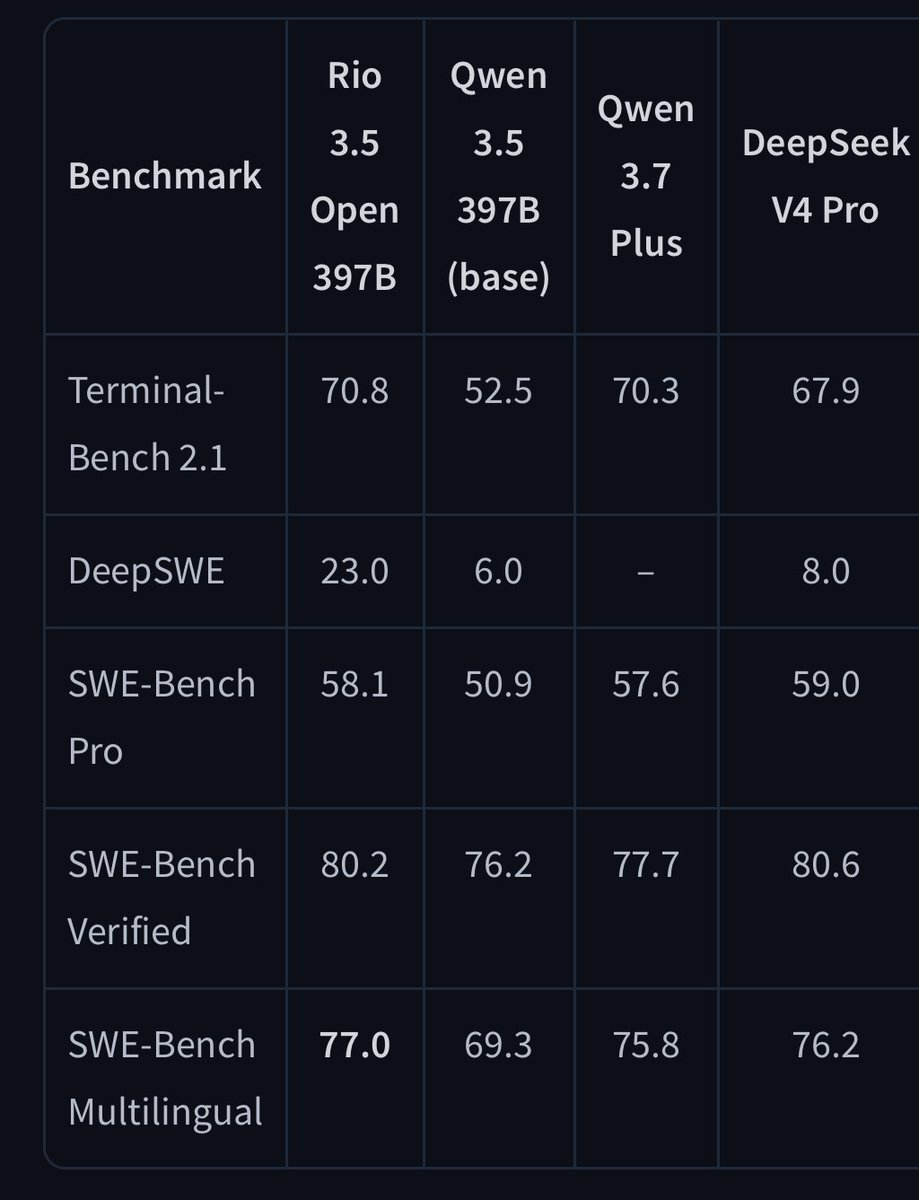
Alibaba Qwen3.7 slowly fading into irrelevance at the frontier due to proprietary stance.
In it's place we have Minimax M3 and... *checks notes* Rio 3.5 397b, made by the municipal IT company of Rio de Janeiro's city government.
huggingface.co/prefeitura-ri…
2
6
1,715
Jake Brukhman retweeted

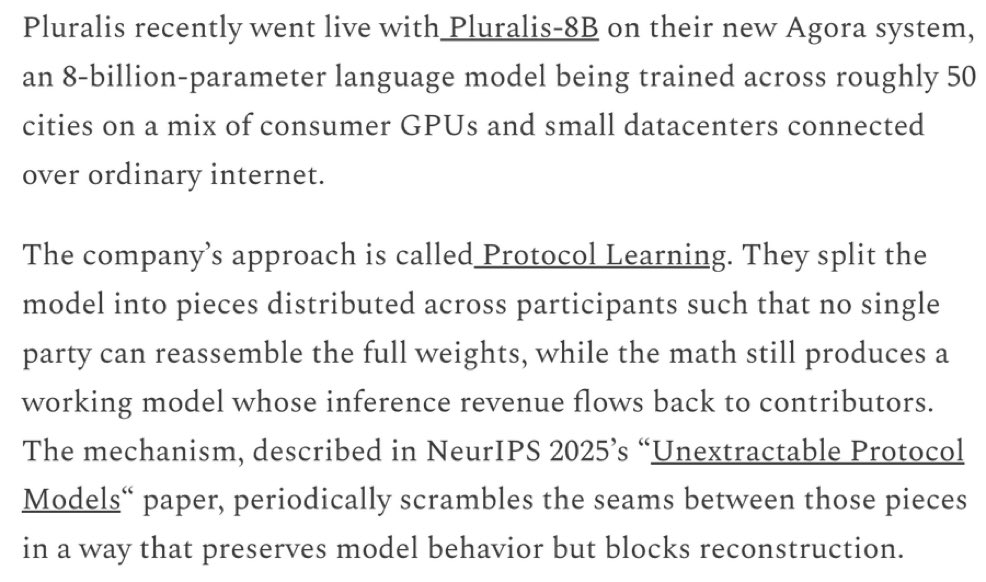
Pluralis is training a model on consumer GPUs with the explicit goal of enabling you to own a piece without waiting for a trillion$ IPO, and also becoming the best (open source) LLM thanks to distributed compute.

The 8B model currently training on Agora is 350B tokens in and continuing to converge. The top level metrics and evals look almost exactly like a centralised run. But;
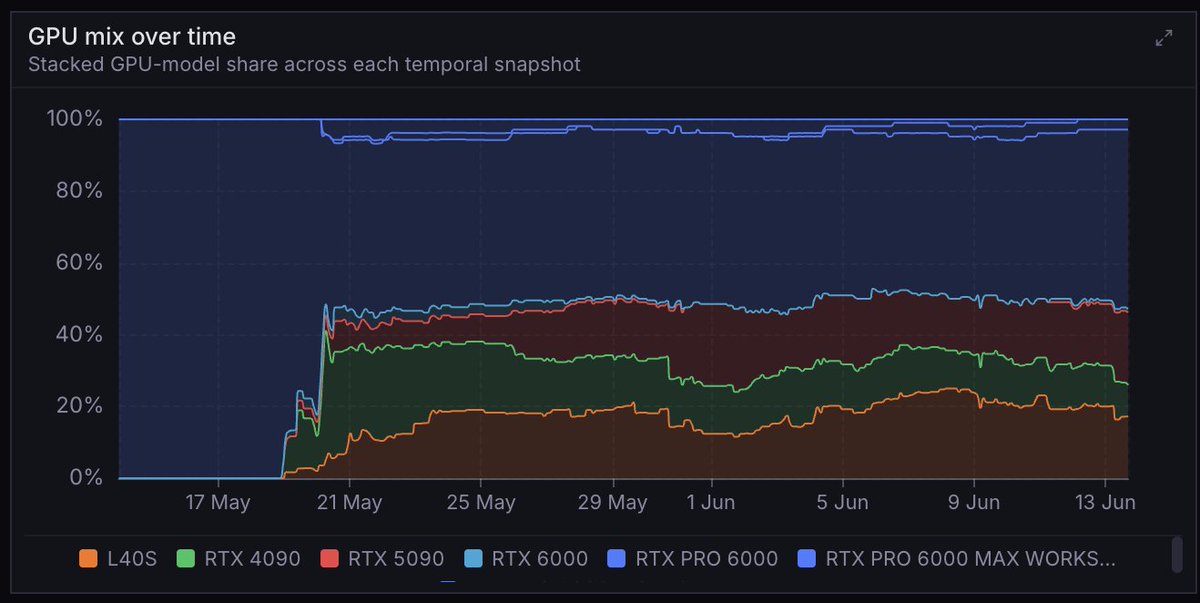
- 133 external contributors total bringing 4090's, 5090's, L40S/RTX 6000 and RTX 6000 Pros. These are cards that people actually own - there are no H100, B200's etc.
- The max number of nodes the system can support (104) was filled almost immediately. The authorization layer is receiving approximately 100 requests/minute to join.
- The total tokens/per second processed moves directly with amount of compute in the swarm, with Agora constantly optimising to make most efficient use of what hardware is present.
- MFU is approximately 20%, TPS is 170k tok/s. There are near constant communication failures which Agora is completely absorbing without slowdown.
- The system is effectively on auto-pilot, requiring very little intervention from us. Bad nodes are purged immediately before training is affected and new nodes take their place.
1
1
20
4,480
AI can become extremely dangerous.
This is precisely why it needs to become open, transparent, and available to everyone.
5
3
33
2,917
A year ago it was impossible to train LLMs on consumer GPUs.
Now it’s happening in real time and the parameter count is going up.
The 8B model currently training on Agora is 350B tokens in and continuing to converge. The top level metrics and evals look almost exactly like a centralised run. But;
- 133 external contributors total bringing 4090's, 5090's, L40S/RTX 6000 and RTX 6000 Pros. These are cards that people actually own - there are no H100, B200's etc.
- The max number of nodes the system can support (104) was filled almost immediately. The authorization layer is receiving approximately 100 requests/minute to join.
- The total tokens/per second processed moves directly with amount of compute in the swarm, with Agora constantly optimising to make most efficient use of what hardware is present.
- MFU is approximately 20%, TPS is 170k tok/s. There are near constant communication failures which Agora is completely absorbing without slowdown.
- The system is effectively on auto-pilot, requiring very little intervention from us. Bad nodes are purged immediately before training is affected and new nodes take their place.
2
3
43
4,291

When access to advanced AI systems can change overnight, privacy and user ownership become core requirements, not a nice-to-haves.
"As AI moves from answering questions to taking actions, the privacy of the inference layer stops being a preference and becomes a requirement. You cannot build a resilient agentic economy on infrastructure that requires you to trust the provider. NEAR AI is that infrastructure." - @ilblackdragon
Jun 13

The US government, citing national security authorities, has issued an export control directive to suspend all access to Fable 5 and Mythos 5 by any foreign national, whether inside or outside the United States, including foreign national Anthropic employees.
The net effect of this order is that we must abruptly disable Fable 5 and Mythos 5 for all our customers to ensure compliance.
Access to all other Claude models is not affected.
We apologize for this disruption to our customers. We believe this is a misunderstanding and are working to restore access as soon as possible.
Read our full statement: anthropic.com/news/fable-myt…
2
4
17
1,656
Jake Brukhman retweeted

“there are no H100, B200's”
The 8B model currently training on Agora is 350B tokens in and continuing to converge. The top level metrics and evals look almost exactly like a centralised run. But;
- 133 external contributors total bringing 4090's, 5090's, L40S/RTX 6000 and RTX 6000 Pros. These are cards that people actually own - there are no H100, B200's etc.
- The max number of nodes the system can support (104) was filled almost immediately. The authorization layer is receiving approximately 100 requests/minute to join.
- The total tokens/per second processed moves directly with amount of compute in the swarm, with Agora constantly optimising to make most efficient use of what hardware is present.
- MFU is approximately 20%, TPS is 170k tok/s. There are near constant communication failures which Agora is completely absorbing without slowdown.
- The system is effectively on auto-pilot, requiring very little intervention from us. Bad nodes are purged immediately before training is affected and new nodes take their place.
12
83
4,105
Jake Brukhman retweeted
Systems like this must exist. This is the way out.
The 8B model currently training on Agora is 350B tokens in and continuing to converge. The top level metrics and evals look almost exactly like a centralised run. But;
- 133 external contributors total bringing 4090's, 5090's, L40S/RTX 6000 and RTX 6000 Pros. These are cards that people actually own - there are no H100, B200's etc.
- The max number of nodes the system can support (104) was filled almost immediately. The authorization layer is receiving approximately 100 requests/minute to join.
- The total tokens/per second processed moves directly with amount of compute in the swarm, with Agora constantly optimising to make most efficient use of what hardware is present.
- MFU is approximately 20%, TPS is 170k tok/s. There are near constant communication failures which Agora is completely absorbing without slowdown.
- The system is effectively on auto-pilot, requiring very little intervention from us. Bad nodes are purged immediately before training is affected and new nodes take their place.
4
6
39
5,880
Jake Brukhman retweeted

Don't like your AI classified as illegal arms? Here's what to do about it
The 8B model currently training on Agora is 350B tokens in and continuing to converge. The top level metrics and evals look almost exactly like a centralised run. But;
- 133 external contributors total bringing 4090's, 5090's, L40S/RTX 6000 and RTX 6000 Pros. These are cards that people actually own - there are no H100, B200's etc.
- The max number of nodes the system can support (104) was filled almost immediately. The authorization layer is receiving approximately 100 requests/minute to join.
- The total tokens/per second processed moves directly with amount of compute in the swarm, with Agora constantly optimising to make most efficient use of what hardware is present.
- MFU is approximately 20%, TPS is 170k tok/s. There are near constant communication failures which Agora is completely absorbing without slowdown.
- The system is effectively on auto-pilot, requiring very little intervention from us. Bad nodes are purged immediately before training is affected and new nodes take their place.
1
5
707
Jake Brukhman retweeted

Decentralized AI isn't just philosophically better, it's functionally necessary for science to move at the speed required.
Anthropic already made Claude structurally useless for serious biotech work before any government pressure.
When they launched Claude Opus 4, they activated ASL-3 — their internal Responsible Scaling Policy's highest deployed tier. The trigger? Internal testing showed the model could assist someone with a basic STEM background in synthesizing dangerous pathogens. Their chief scientist called it explicitly: COVID-like agents, pandemic-level risk.
Their response was to apply broad biological research restrictions across the board.
The problem is that the same guardrails that block novice bioterrorists also block legitimate computational drug discovery, protein engineering, nanobody design, and molecular pathway analysis. You can't surgically remove "dangerous biology" from "useful biology" at the model level — the underlying science is the same. So they blunted the whole thing.
This is what centralized AI control looks like in practice. One company's risk tolerance — shaped by liability, regulatory pressure, and investor optics — becomes the ceiling for what an entire scientific field can access.
Open source isn't just an ideological position — it's infrastructure for the next era of drug discovery.

Access to intelligence should not depend on a handful of companies or governments.
This is why open, decentralized, permissionless AI matters.
This is why Bittensor matters.
4
9
46
3,042
Jake Brukhman retweeted

Jun 13
I would like to make a few brief points;
- Opensource ai is not the same thing as opensource software. The models cost tens to hundreds of millions to make. This is not gonna be a volunteer effort from people doing stuff after work for free.
- the second you release a weight set, you lose any ability to make money serving your own model and recoup the training cost. This very simple property means open-weights is unsustainable.
- the things you ACTUALLY want from opensource ai is: transparent behaviour, dispersed ownership and control, a guarantee of access, the ability to build on it/modify it, and privacy.
protocol learning gets you all 4 and is the only alternative to closed models that makes any kind of sense.
By protocol learning I mean a very specific, novel thing; collaborative training and development of the models without anyone ever being able to see the complete weight set.
19
20
110
8,084
Decentralized AI training networks like @Pluralis' Agora are the only true counterbalance to centralized AI.
The 8B model currently training on Agora is 350B tokens in and continuing to converge. The top level metrics and evals look almost exactly like a centralised run. But;
- 133 external contributors total bringing 4090's, 5090's, L40S/RTX 6000 and RTX 6000 Pros. These are cards that people actually own - there are no H100, B200's etc.
- The max number of nodes the system can support (104) was filled almost immediately. The authorization layer is receiving approximately 100 requests/minute to join.
- The total tokens/per second processed moves directly with amount of compute in the swarm, with Agora constantly optimising to make most efficient use of what hardware is present.
- MFU is approximately 20%, TPS is 170k tok/s. There are near constant communication failures which Agora is completely absorbing without slowdown.
- The system is effectively on auto-pilot, requiring very little intervention from us. Bad nodes are purged immediately before training is affected and new nodes take their place.
2
4
24
4,022
Jake Brukhman retweeted

After the last 24 hours, how can you read this and not see that decentralized training is going to be the most important innovation to come out of crypto since Bitcoin?
The 8B model currently training on Agora is 350B tokens in and continuing to converge. The top level metrics and evals look almost exactly like a centralised run. But;
- 133 external contributors total bringing 4090's, 5090's, L40S/RTX 6000 and RTX 6000 Pros. These are cards that people actually own - there are no H100, B200's etc.
- The max number of nodes the system can support (104) was filled almost immediately. The authorization layer is receiving approximately 100 requests/minute to join.
- The total tokens/per second processed moves directly with amount of compute in the swarm, with Agora constantly optimising to make most efficient use of what hardware is present.
- MFU is approximately 20%, TPS is 170k tok/s. There are near constant communication failures which Agora is completely absorbing without slowdown.
- The system is effectively on auto-pilot, requiring very little intervention from us. Bad nodes are purged immediately before training is affected and new nodes take their place.
3
10
82
4,736
10h
They can meet it, @chamath.

Game theory from here is super interesting:
Original Mags (Google, Amazon, Microsoft, Meta) now have a serious non-zero opportunity to tank the frontier labs.
Go to the government, kneecap the labs’ motion of putting the latest models out in the wild, become the trusted gatekeeper between the labs and the public at large (including internationally) by having the labs go through their clouds (AWS, GCP, Azure) and implement strict KYC to seal the deal.
The frontier labs should have seen this coming years ago and implemented a robust KYC for just this moment. The fact they didn’t is kind of concerning.
Why did they not do it?
Best guess is because it would have changed the run-rate revenues (downward) which would have then changed funding dynamics - lower valuations, more dilution, less secondary.
A valuation reset may happen now anyways, except the labs may end up with less control and more restrictions at the end of it. At the same time, everyone is already clamoring about token prices of the old models from the labs anyways…
This couldn’t be a better setup for open source and neoclouds. Big question is can they meet the moment?
There are too few of them and their progress seems sporadic at best.
10
3,961
11h
If this doesn’t radicalize you into decentralizing AI training on heterogeneous commodity hardware over slow consumer internet, I don’t know what will.

If this doesn’t radicalize you into founding your own open source AI lab, I don’t know what will.
2
1
23
4,842
11h
Maintain your intellectual opsec, assume your VC competitor uses the opposite heuristics than the ones laid out on their podcast interview.
1
1
14
3,086
12h
“Open source” AI doesn’t work.
For one, open weight models are not transparent about their training data, cleaning pipelines, or training architecture. These things are kept proprietary even by companies producing open models.
Far more importantly, open models are not economically viable, and certainly not at the frontier. Someone has to pay billions for the public domain.
The superior approach to AI transparency is public models — those trained, maintained, and tokenized on open decentralized networks.
22
16
94
14,896

Which way western weights?
13h

Unlike many investors in crypto, I did not pivot to AI in the last few years. However, since 2020, I built some of the deepest understanding in this industry on the intersection of AI and decentralized networks (crypto, web3).
From the start, it was very clear that AI models are a centralizing force and the biggest target for government control. That point became market fact last night, with @AnthropicAI’s export control compliance.
As an investor in decentralized AI, I know that d-networks are a counterbalance to this state of affairs. In particular, the starting point of sovereign, open, public, decentralized AI is the seemingly insurmountable compute problem.
How are people supposed to source more industrial compute for frontier training than these huge trillion dollar companies? The answer is simple: there is enough commodity GPU compute in the world to compete on the frontier, but to make use of it we need new algorithms for training.
That’s what a few companies like @gensynai @PrimeIntellect @bageldotcom @Pluralis @NousResearch @MacrocosmosAI @covenant_ai set out to research, while everyone on the planet told them it was impossible.
The result is that it is not only possible, but it can be cheaper and nearly as efficient as the alternative process.
The second major problem is economic sustainability. Open source models are great, however, they are not economically viable as they don’t have a business model. So far in decentralized AI, only @Pluralis has an answer — by breaking up the weights of the model among participants, we create a business model for tokenized AI models.
This is the moment of truth — will AI become fully centralized and fall under censorship and unilateral government control? Or will the AI world realize the importance of public AI on open decentralized networks?
1
8
2,033
13h
Unlike many investors in crypto, I did not pivot to AI in the last few years. However, since 2020, I built some of the deepest understanding in this industry on the intersection of AI and decentralized networks (crypto, web3).
From the start, it was very clear that AI models are a centralizing force and the biggest target for government control. That point became market fact last night, with @AnthropicAI’s export control compliance.
As an investor in decentralized AI, I know that d-networks are a counterbalance to this state of affairs. In particular, the starting point of sovereign, open, public, decentralized AI is the seemingly insurmountable compute problem.
How are people supposed to source more industrial compute for frontier training than these huge trillion dollar companies? The answer is simple: there is enough commodity GPU compute in the world to compete on the frontier, but to make use of it we need new algorithms for training.
That’s what a few companies like @gensynai @PrimeIntellect @bageldotcom @Pluralis @NousResearch @MacrocosmosAI @covenant_ai set out to research, while everyone on the planet told them it was impossible.
The result is that it is not only possible, but it can be cheaper and nearly as efficient as the alternative process.
The second major problem is economic sustainability. Open source models are great, however, they are not economically viable as they don’t have a business model. So far in decentralized AI, only @Pluralis has an answer — by breaking up the weights of the model among participants, we create a business model for tokenized AI models.
This is the moment of truth — will AI become fully centralized and fall under censorship and unilateral government control? Or will the AI world realize the importance of public AI on open decentralized networks?
76
80
871
170,914