
Protection spell
Each one is uniquely designed to protect you from whatever threats you may be facing. Protection spells are just one powerful method you can use to keep yourself safe. There are also amulets, charms, crystals, sigils, wards & much more. DM for more details.
2

The claim that Noah’s Ark was completely dismantled immediately after the Flood is not supported by ancient historical sources.
Jewish historian Flavius Josephus wrote in the 1st century AD that the remains of the Ark were still visible in his day. In Antiquities of the Jews (Book 1, Chapter 3), he states:
“Of this ark, there is a part still remaining in Armenia… and they carry off pieces of the bitumen, which they take away and use chiefly as amulets.”
Josephus also notes that people visited the site and collected pieces of pitch (bitumen) from the Ark as souvenirs or talismans. He was not alone—other ancient writers such as Nicolaus of Damascus likewise reported that remains of the Ark could still be seen.
Whether one agrees with these accounts or not, the idea that the Ark was completely dismantled immediately after the Flood contradicts what multiple ancient historians recorded.
4

Alongise Puttakhun exists a separate set of practices involving spirits and prai. Prai refers to human remains, often from individuals who died suddenly, or violently. Prai amulets require a relationship with the associated spirit and involve offerings beyond Buddhist ritual.
1
7
The Buddhist side of this tradition is known as Puttakhun and derives from Puttasart Wicha. It uses sacred materials such as temple soil, incense ash, old Buddhist amulets, and wahn, plants believed to possess magical properties. Ancient amulets are often ground into powder.
1
1
6

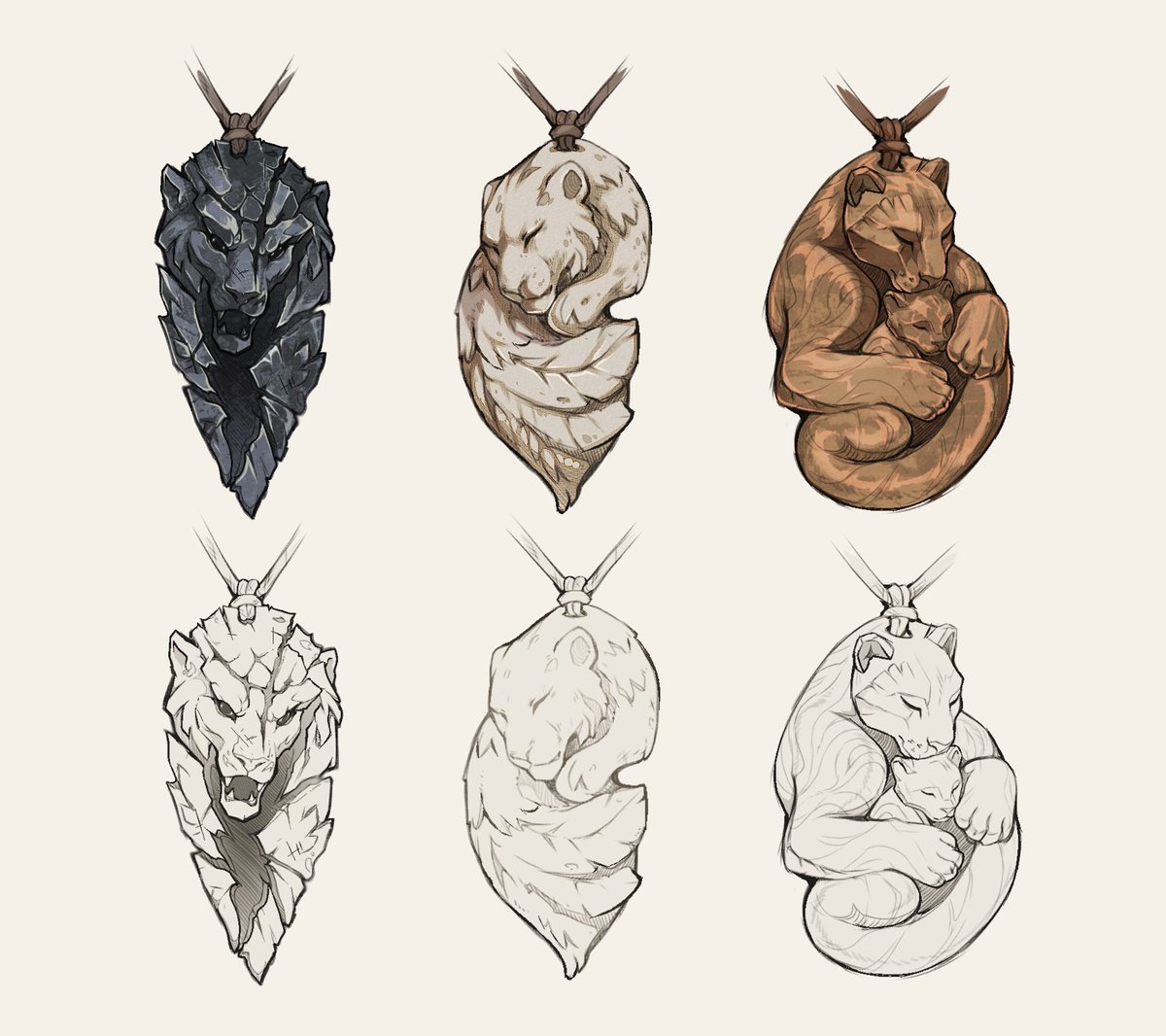
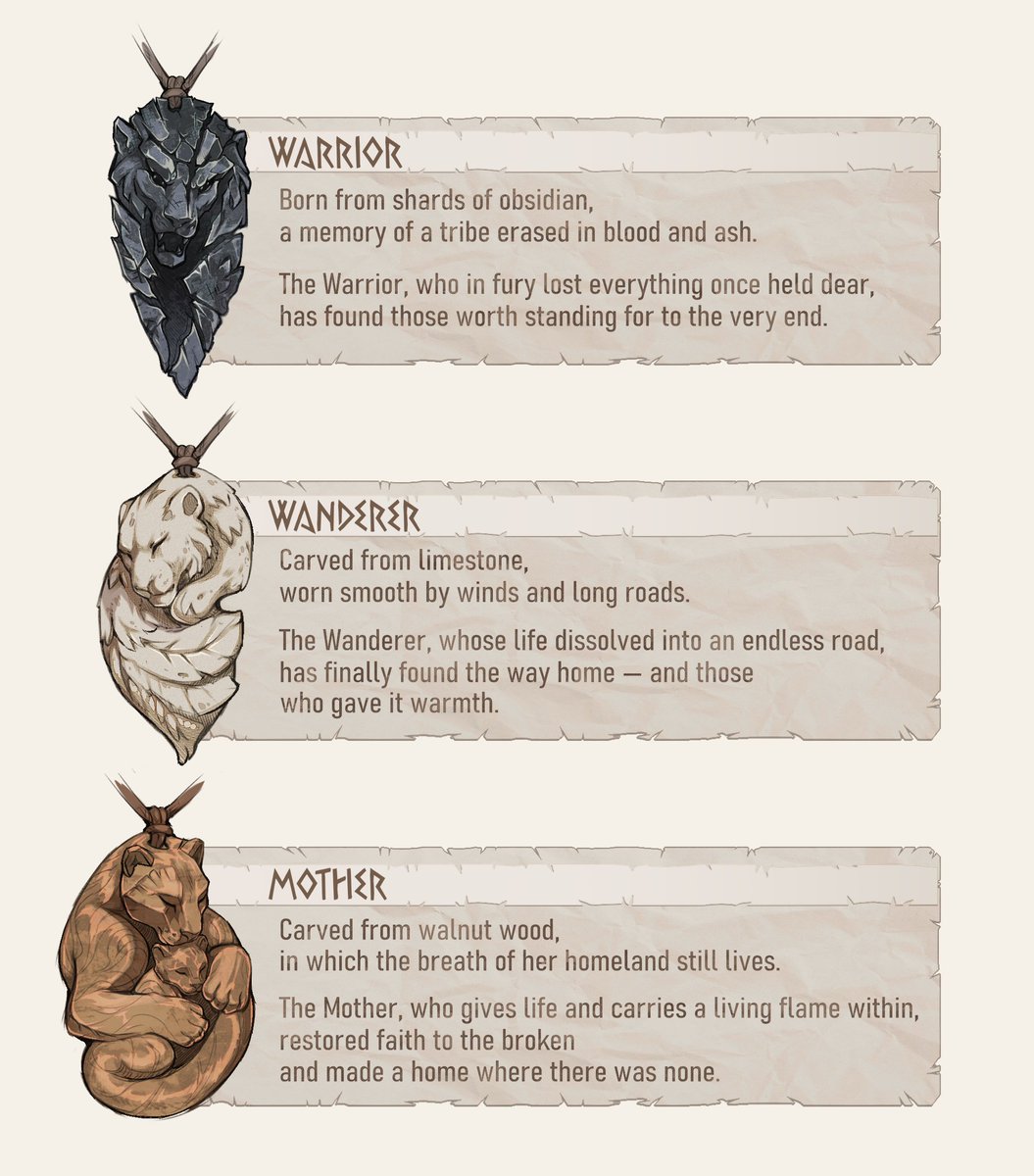

📣 New Podcast! "85-Amulets with the Qur’ān and Fortune Telling" on @Spreaker #aqeedah #hadeeth #islam #salafiyyah #sunnah spreaker.com/episode/85-amul…

📣 New Podcast! "83-Invocations, Incantations, and Amulets" on @Spreaker #aqeedah #hadeeth #islam #salafiyyah #sunnah spreaker.com/episode/83-invo…


It's easy! You just have to add USDT or USDC to Amulets card and start spending anywhere Visa is accepted.
1
7


Fog of War retweeted

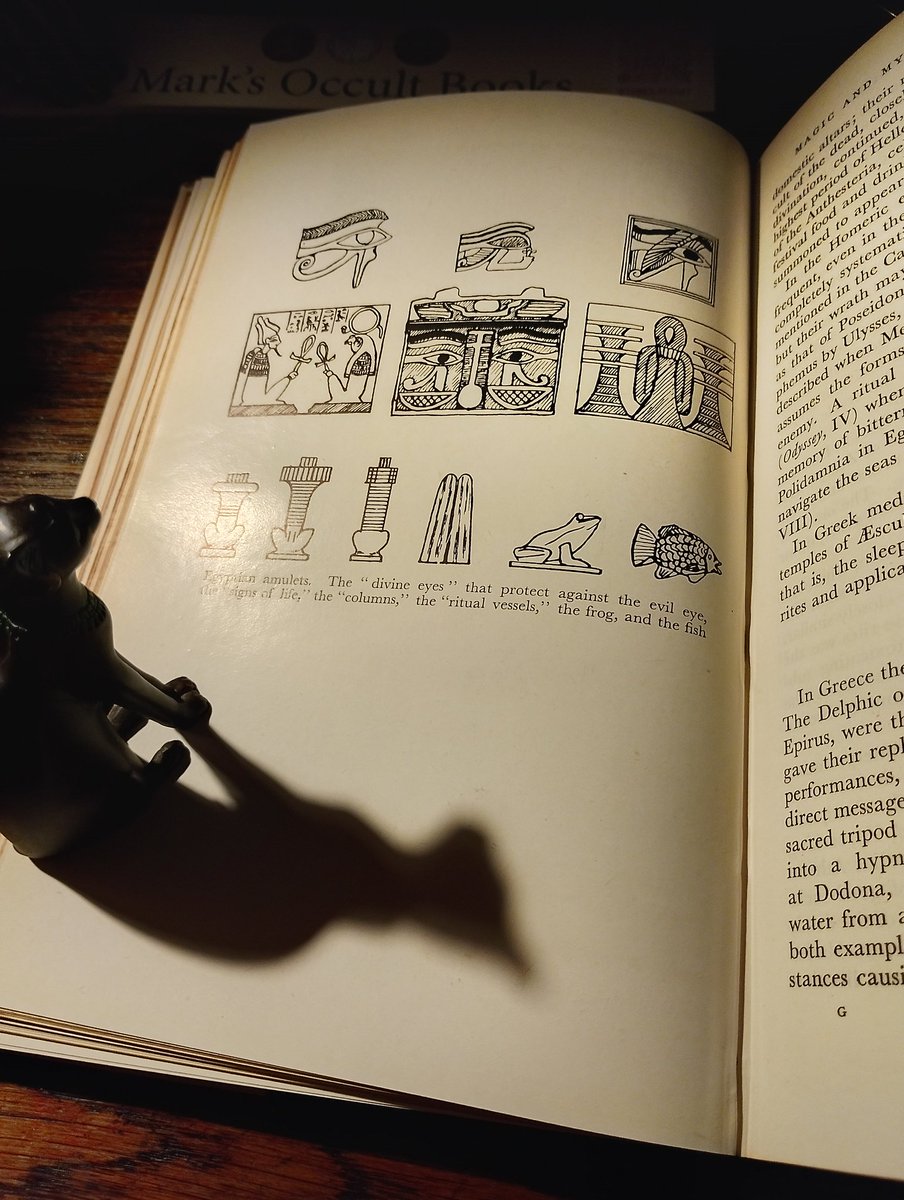
"Egyptian Amulets", as reproduced in Arturo Castiglioni's Adventures of the Mind, Sampson Low, Marston & Co., Ltd. 1949
2
7
182

“ANOANA” is a mesmerizing incantation by the Nordic folk band Heilung. Instead of a traditional language, the lyrics are reconstructed from ancient, golden Roman-era amulets (bracteates). The song serves as a musical spell designed to connect modern listeners with the magic and daily life of the Dark Ages.
The visual storytelling of the track embodies its mystical roots. It explores the themes of faith, community, and the human journey through female-centric shamanic rituals in wild nature.
18

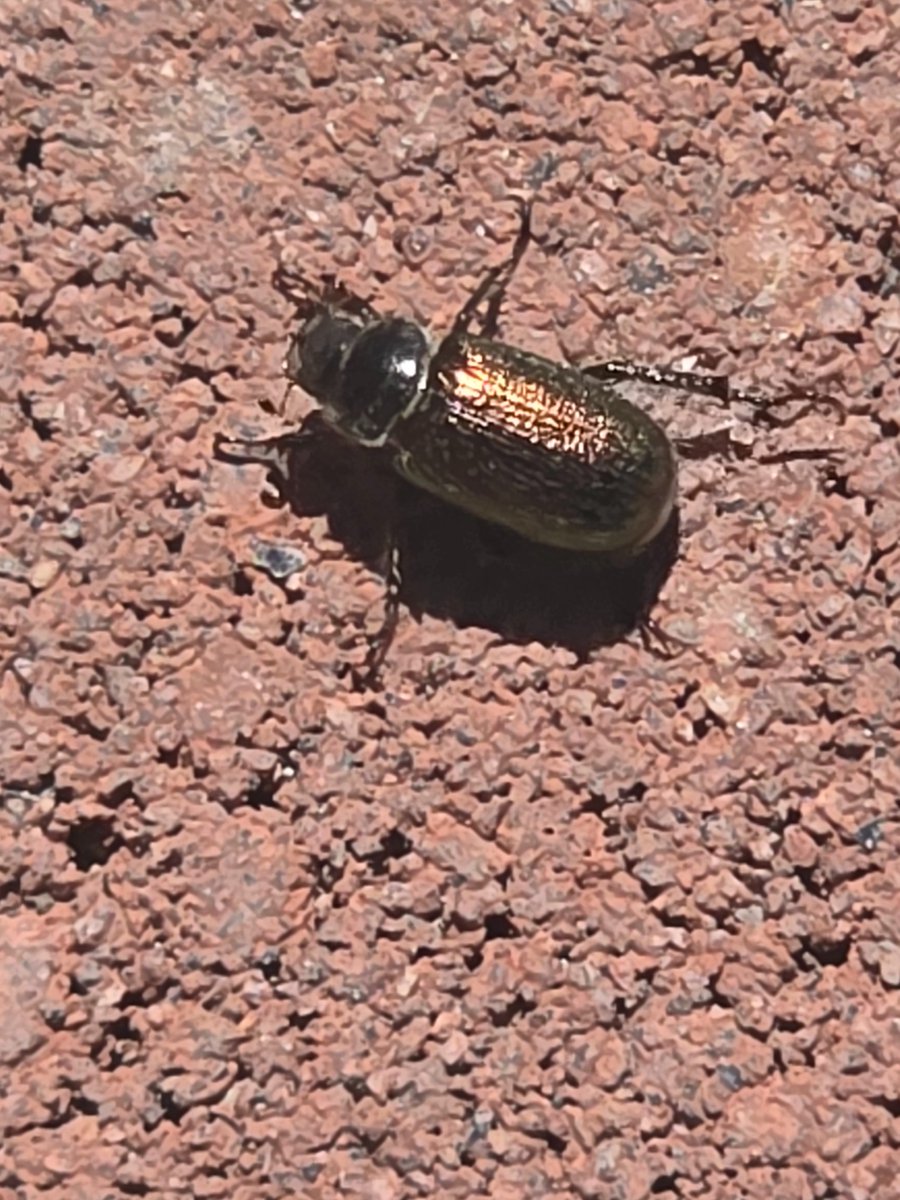
This small dung beetle struck me for its exceptionally coppery sheen.
Looks like *Aphodius erraticus* or *Aphodius fimetarius* (scarab beetles in the Aphodiinae subfamily).
In ancient Egypt, SCARAB BEETLES were deeply revered as symbols of rebirth, regeneration, and the eternal cycle of life.
The god Khepri was depicted as a scarab beetle rolling the sun across the sky, just as these beetles roll their dung balls — a powerful metaphor for creation and renewal. Scarab amulets were worn and buried with the dead for protection in the afterlife.
Some modern spiritual lore also associates scarabs with exceptionally strong vital energy auras and resilience.
They help recycle nutrients back into the soil.
Which do you think it is — erraticus or fimetarius?
13

Trefoil Motif of the Indus Civilization
--------------------------------------------------
"Several scholars have identified the trefoil-ornamented bulls as images of the constellation Taurus (§ 12.1); Willy Hartner (1965:4) speaks in this connection of the horned head of this celestial bull, which is 'dominated by the very bright star Aldebaran [= Rohiṇī] as the bull's eye'." (A. Parpola, Deciphering the Indus Script).
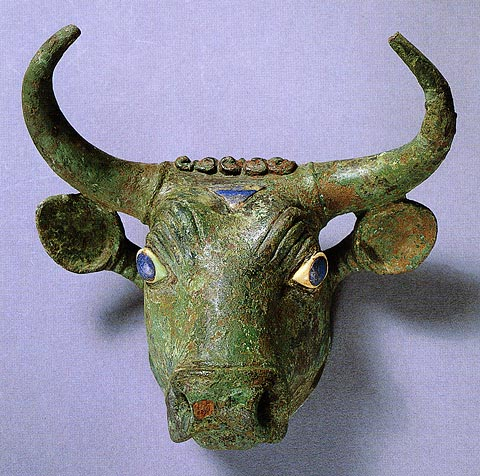
There are several animal statues marked with a triangle on the forehead in Sumerian art. Bulls, antelopes, and Markhor goat bronzes have this feature. I will show some examples. When an animal head was crafted out of valuable copper or bronze, it was usually intended as a sacred object — either an ornament for a holy musical instrument (like the Lyres of Ur) or a temple votive offering. The geometric forehead inlay served as a "sacred brand," distinguishing the animal as a divine, consecrated creature rather than a mundane, wild beast.
Cosmic Symbolism: The downward-pointing triangle is one of humanity's oldest symbols, and in various Near Eastern contexts, it carries celestial meaning. When placed on the head of a bull or caprid, it often symbolized a "star" or "light." In Mesopotamian texts, the constellation Taurus was known as the Bull of Heaven, and major deities were frequently described as possessing a radiant, terrifying divine glow called melammu. The bright, inlaid triangle right on the crown of the head visually anchored this idea of divine, celestial radiance emanating from the animal.
The idea of the sacred triangle comes from Sumeria to the Indus-Vāṉi Civilization (IVC). It can be seen in the Kot Diji phase cow-boat, published by IVC archaeologist Massimo Vidale, and in terracotta jars of the Hakra Ware culture. Furthermore, several zebu statuettes from the Kulli culture and early Harappan sites have the triangle on their foreheads. The ancient Ghaggar-Hakra riverbed has hundreds of Mature Harappan sites (e.g., in the Cholistan Desert). The river name in the Ṛgveda was Sarasvatī, and the Dravidian name for the river is Vāṉi, meaning "sky river" (> Vāṇi = Sarasvatī). The place where the Vāṉi (cf. Vāṉ = sky) river goes into the ground is vavvāṉi (> Bhavāṉipura). For the sky river mythology, see M. Witzel, Sur le chemin du ciel. BEI 2: 213–279, 1984.
en.wikipedia.org/wiki/Sarasv…
en.wikipedia.org/wiki/Hakra_…
Harappans of the IVC converted the triangle motif into a three-dot pattern, representing the traditional Indian fireplace, which consists of three stones serving as a stand on which vessels can be placed above the fire. This three-dot motif can be seen on the forehead of the zebu bulls, and was then geometrically abstracted to a trefoil motif — three fused circles whose outlines are seen prominently on the robe of the Mohenjo-daro Priest-King, bulls, linga stands, bangles, and steatite beads. In the natural world, the trefoil leaves of the Bael/Bilva (Aegle marmelos) tree, which has a Dravidian etymology, were chosen for the trefoil motif. IVC peoples exported the trefoil motif with lapis lazuli of Afghanistan — presumably the blue lapis representing the sky — on "Bull of Heaven" amulets to Sumeria. Like unicorn seals, the Bull of Heaven amulets depict taurine cattle. The Vilva/Bilva tree leaves are associated with the Śiva Lingam in all the Hindu temples of India.
References:
(1) Renate Marian van Dijk-Coombes, Motif of the Bull in the Ancient Near East: An Iconographic Study. MA thesis in Ancient Near Eastern Studies at the University of South Africa, 2011. For the triangular mark in the forehead, see pp. 58-62.
(2) researchgate.net/publication…
Photo Note: Copper bull head lyre ornament recovered from the Royal Cemetery of Ur, Iraq, 2550–2450 BCE. Photographed at the University of Pennsylvania Museum of Archaeology and Anthropology.
5
1
10
484

11h
"More anecdotally, journalistic stories of electron microscopes in Japanese universities with Shinto amulets attached to them, and rocket scientists praying for success at a Shinto shrine near Tokyo, abound."
89

12h
The Amulets leaderboard is live, and $50 goes to whoever tops it each week.
Here is how to climb it, and the mistake that keeps most people stuck:
→ Share your referral link
→ Get those friends to actually spend. A signup that never uses the card does not count
→ Real usage is what moves you up, updated live
→ Lead the cycle, Sunday to Sunday. The winner is paid every Monday.
Your rank is in the app, Rewards tab.

2
8
199

We should trust a failed actor who sells "magic amulets" instead. 🤡
1
19
