
Jun 15
GM and happy Monday 🟦
While most people were offline this weekend, AI kept moving.
New papers.
New models.
New ideas.
Miss a week in AI and you can feel behind.
Time to lock in. 🚀
#AI #Crypto #BaseChain #ARCChain

6
5
40
674

Jun 1
Streak Wars S2·R1 is LIVE on @arc 🔥
→ $200 USDC starter pool
→ 9 on-chain actions on ARC
→ 20 days to climb the leaderboard
Early streaks = top of the board.
zns.bio/quests/arc-s2
#ARC #StreakWars #200USDC #arcchain #zns
50
44
78
2,261
May 15
Gm 🫡
@OpenAI
@xai
@GoogleAI
@AnthropicAI
Billions are being made from AI.
Now imagine when regular people start running the infrastructure too.
Own your AI.
Don’t let it own you.
#ArcChain
5
11
46
1,077

May 13
Public chain technology is now fully mature.
Once the financial giants understand it, what will be the role of us little crypto novices?
Circle ArcChain BlackRock a16z
May 12

Yesterday, I said #Ethereum would be excluded from Wall Street's institutional markets, and many Ethereum supporters were still stubborn.
Today, #Circle released the ArcChain white paper and completed a $222 million token pre-sale with a $3 billion valuation. A16Z led the investment, with BlackRock participating. Frankly, public chain technology is quite mature now. Once those people in the financial world figure it out, there won't be much for us crypto novices to do.😅
1
5
173

May 12
Yesterday, I said #Ethereum would be excluded from Wall Street's institutional markets, and many Ethereum supporters were still stubborn.
Today, #Circle released the ArcChain white paper and completed a $222 million token pre-sale with a $3 billion valuation. A16Z led the investment, with BlackRock participating. Frankly, public chain technology is quite mature now. Once those people in the financial world figure it out, there won't be much for us crypto novices to do.😅
59
58
2,711

$ARC - DISRUPTING THE MULTI BILLIONS INFERENCE INDUSTRY
A thread 🧵
1/8
What if I told you the multi-billion dollar #AIinference market could be CHEAPER, VERIFIABLE and run directly on-chain with #OnChainAI?
Meet Arc Chain — the world’s FIRST Layer 1 built from the ground up for deterministic on-chain AI inference.
Same quality you pay millions for… now available straight from the blockchain.
@ARCreactorAI @VitalikButerin @cdixon @a16z @balajis @delphi_digital @sassal0x @CryptoCobain @Ansem @0xfoobar @EthDevCommunity 🚀🧠
#ArcChain #DeAI
@TheCryptoKazi @KAPOTHEGOAT01 @AltcoinSensei @blockchain_goat @based_elnen
May 5

Running an ARC Node is now stupid simple.
No setups. No configs. No expensive hardware.
If you’ve got a laptop, you’re good.
Full step-by-step downloads below 👇
2
3
5
478


🎉 20 days, 20 NFTs, and finally 1 unlocked app!
Day 21 on @UnitFlowFinance means full access to app.unitflow.finance
I’m swapping, bridging, and farming like never before — every interaction counts toward leveling up and earning rewards
#UnitFlowFinance #ArcChain #NFTs
1
3
9
211
Day 20 journey with @UnitFlowFinance 🚀
Swapping, bridging, minting NFTs, and pushing up the leaderboard on Arc testnet.
Building real on-chain history one interaction at a time 👀
Let’s see what the future brings.
#UnitFlowFinance #ArcChain #Crypto #Testnet #AirdropHunting 🪂
5
2
7
70


Jan 16
No closed doors.
No extraction without contribution.
This is finance designed in public,
tested by the community,
and owned by those who show up early.
Build. Test. Contribute.
@ArcFlowFinance
#ArcChain #DeFi #OpenFinance #Web3
2
16

GN anh em, vừa thử một kèo lạ: gas trả bằng $USDC trên ArcFlow Finance khi thêm Arc Chain vào ví. Trải nghiệm dùng @MetaMask mượt, không phải lo nạp native token trước, cảm giác onboarding gọn hẳn cho người mới và cho mấy thao tác nhanh như swap hay mở BTC perps demo
Cách mình làm:
- Mở MetaMask → Add network → thêm Arc Chain dưới dạng custom, kiểm tra RPC/chain info khớp nguồn chính thức
- Connect Wallet, chọn MetaMask, vào Faucet để nhận $USDC làm gas
- Start testing, mình chạy 1 swap nhỏ rồi vào tab perps thử cặp $BTC/USD demo, slippage giữ chặt và khớp lệnh ổn
Góc nhìn: trả phí bằng stablecoin giảm ma sát đúng nghĩa, nếu cộng thêm các cơ chế subsidize kiểu Open Gas Initiative thì onchain có thể đạt mức “zero‑friction” cho user mới. ArcFlow chọn $USDC làm gas là một hướng thú vị; câu hỏi là liệu mô hình này có thành tiêu chuẩn với L2 mới không
Anh em đã test ArcFlow với MetaMask chưa, thấy gas bằng $USDC có giúp flow nhanh hơn không #MetaMask #DeFi #ArcChain #USDC #BTC
6
14
270

Jan 8
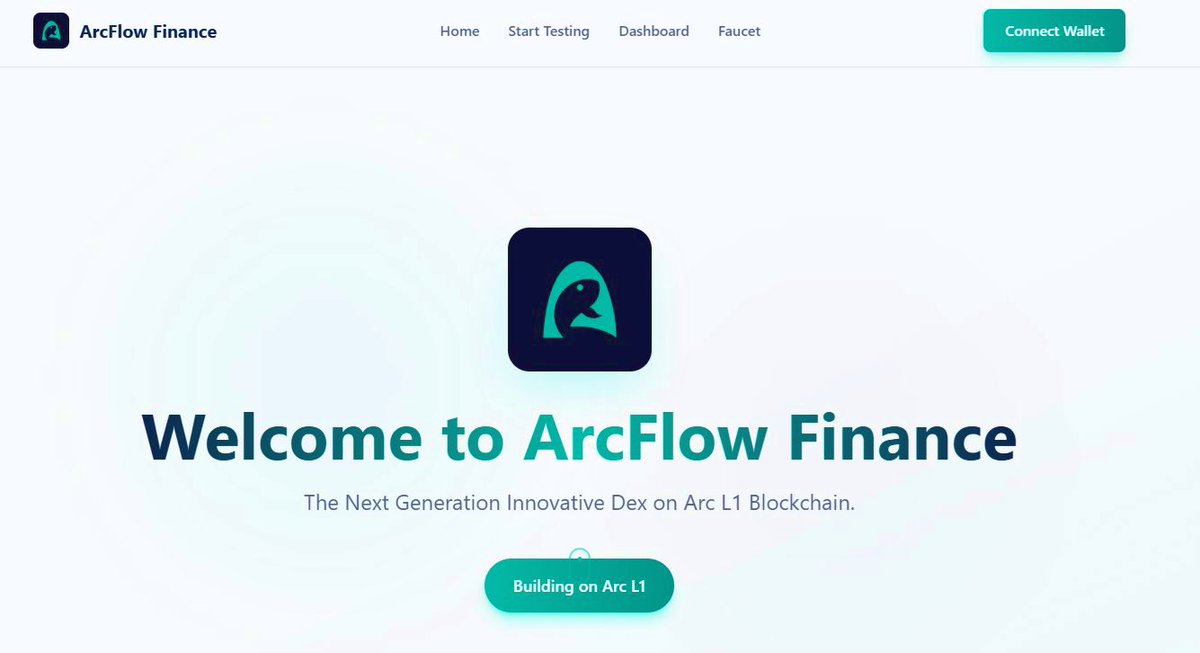
Here are some 👍🏻key strengths of ArcFlow Finance (as of early 2026):
1. Native DEX on Arc L1 (built by Circle): Uses USDC as native gas → stable fees, no volatility, sub-second finality – perfect for real-world DeFi and enterprise use.
2. Seamless support for reflection/tax tokens: Handles liquidity without tax interference – a rare feature that makes it ideal for memecoins and community tokens.
3. Trustless USDC Agents: Enables secure automated trading, deeply integrated with Circle’s ecosystem.
4. Strong community & high engagement: Nearly 167K unique wallets, hundreds of thousands of testnet transactions, evolving NFT ranking system that rewards long-term activity.
5. Multi-chain bridge & liquidity hub:
Frictionless connection for builders, communities, and institutions on Arc’s high-performance chain.
6. Community-driven development: Frequent updates based on tester feedback, fun content, strong anti-scam measures, and a welcoming vibe.
The project is still crushing it in testnet with huge potential ahead if Arc mainnet delivers. Keep swimming! 🐟
Join now: arcflow.finance/
#ArcFlow #ArcChain #DeFi
@ArcFlowFinance
arcflow.finance/
7
5
484
Arc ecosystem builders 👀
@ArcFlowFinance is working on a native DEX liquidity layer for Arc.
Testnet is live, NFTs are being used for engagement, and infra is still forming.
Early ≠ guaranteed.
Worth watching. 👀
#DeFi #ArcChain
1
3
95
Exploring @ArcFlowFinance 👀
A native DEX & liquidity layer being built on the Arc blockchain.
• DEX liquidity pools
• NFT-based reward system
• Testnet activity ongoing
• Focused on Arc ecosystem growth
Still early, but worth watching 👀
#DeFi #Testnet #ArcChain
1
2
29

Want to get ahead on the @arc ecosystem without things getting complicated? 🗓️
Meet ArcFlow Finance. They are building a native DEX (a place to swap tokens) on Arc chain. It’s not live fully yet, but you can get involved today in just a few minutes.
How to fit it into your daily routine: Think of it like a digital check-in. ArcFlow has created a testnet playground where you complete simple tasks to test the network.
1️⃣ The One-Time Pass: Go to their site and mint your main "Pass NFT."
2️⃣ The Daily Habit: Come back once a day, do a quick task, and mint your "Daily Activities NFT."
It’s an easy way to support a new project and build up your on-chain activity history on Arc.
🌱 Start your daily streak here: arcflow.finance
#ArcFlow #DeFi #ArcChain

10
1
11
97

23 Dec 2025
Let's talk about ArcChain. Why did @circle decide to build its own blockchain?
The answer is simple: USDC operates on the Ethereum and Solana network, and the gas fees, MEV, and ecosystem value are all appropriated by third parties. Circle is just a broadcaster.
If we divide the stablecoin ecosystem into three layers: the middle is @USDC itself, the channel is exchanges and traditional financial institutions, and the gateway is public blockchains. Previously, Circle acted solely as a conduit, relying on exchanges like Coinbase (which distributes $900 million annually) as a conduit and public blockchains like Ethereum and Solana as a gateway.
Now, Circle is building its own channel, Arc, which will be Circle's L1 blockchain. It does not position itself as a general-purpose public blockchain, but rather as USDC's native financial infrastructure blockchain. Key design features include: gas payments using @USDC , eliminating the need to purchase native tokens; confirmation in less than a second, suitable for payment scenarios; and an integrated exchange mechanism, allowing direct exchange between stablecoins.
Circle recently launched the @arc Builders Fund, focusing on incentivizing on-chain markets (perpetual DEX, prediction market, AMM), RWA, lending, exchange (combining Circle StableFX and CPN for on-chain forex trading), AI agent economics (enabling AI agents to trade autonomously using @USDC ), energy and computing (IoT devices with their own wallets for automatic payments). With the exception of DEX/AMM, which are casino-like businesses across all blockchains, the rest are extensions of Circle's core payments business. Arc does not aim to become the next Ethereum or Solana, but rather a dedicated channel within the USDC ecosystem.
Circle's current strategy is clear: diversify channels (signing with Binance, partnering with Visa, and more recently collaborating with traditional US financial giants like Intuit) while building its own payment gateways (@arc ). What is the objective? Not just be a stablecoin issuer or an innovative bank with its own user base, but become the global stablecoin settlement layer "the SWIFT of stablecoin networks" aiming to not only take market share from banks, but also from Visa. That's why the Arc has an integrated shift mechanism; @circle aims to create the infrastructure for the on-chain exchange market.
Previously, I said that investing in Circle requires answering three questions:
1⃣ Is there still room for stablecoins to grow tenfold?
2⃣ Will Circle be able to maintain and increase its market share?
3⃣ Will Circle be able to maintain its profitability?
I've always had more confidence in points 1 and 2 than in point 3. After all, 96% of my current income comes from interest, and I'm not sure I'll be able to maintain the same level of profitability if interest rates fall.
Arc's emergence reflects Circle's visionary planning, broader strategic objective and more diversified profit model. Compared to its current profit model, which depends exclusively on interest rates, Circle's revenue structure could undergo a paradigmatic change, obviously for the better, in five years!
@arc
1
3
62

20 Dec 2025
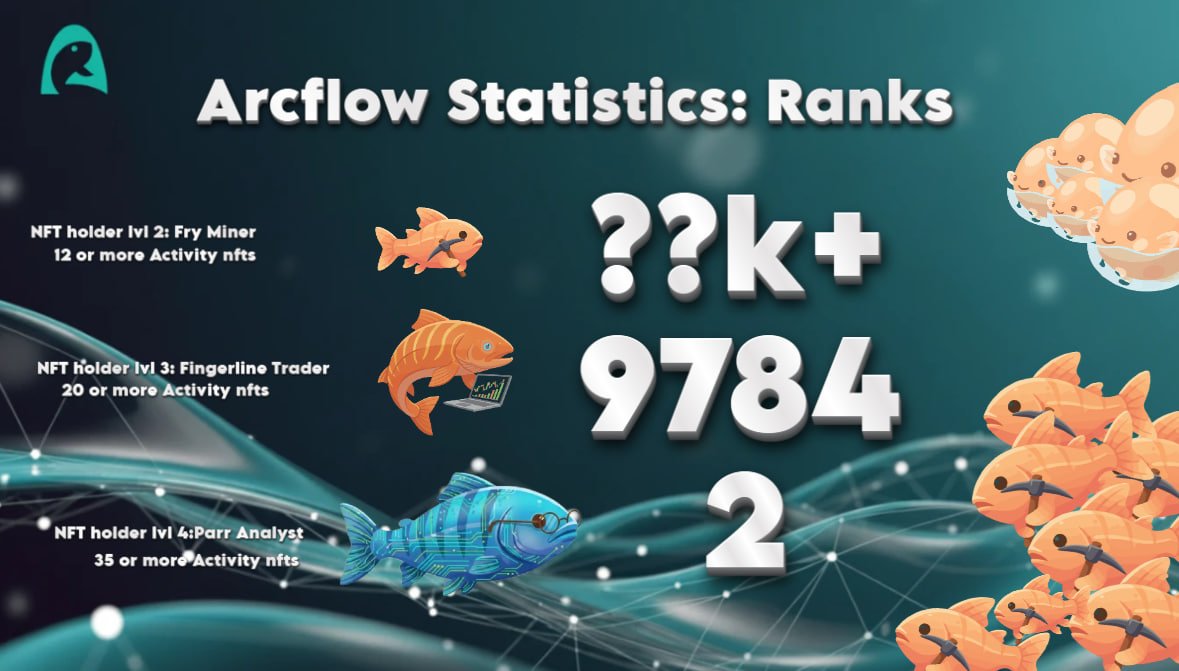
The evolution to Parr Analyst shows Arc is entering a serious phase. With 136 pools and DEX access, it’s time to level up our missions. I’ve hit level 4 with 35 NFTs — ready for what’s next!
@ArcFlowFinance #ArcChain #NFTMission
19 Dec 2025

It’s a great day to be an ArcFlow Fish 🐟
The first Fish have officially started evolving into Parr Analysts!
Nearly 10,000 Fish now have access to our DEX for the first round of testing.
So far, they’ve already opened 136 pools, giving the rest of the fishes plenty options to explore.
Some Fish are even treating this like mainnet already and honestly, we love to see it. 🔥
— ArcFlow Intern.
2
11
17 Dec 2025
Visa announced that US banks can use Circle's USDC for transaction settlement via the Solana blockchain, marking the first full implementation of its stablecoin settlement service in the American banking system. Initial users include Cross River Bank and Lead Bank.
This move benefits from the deregulation implemented during the second term of the Trump administration and will facilitate the launch of ArcChain, a blockchain developed jointly by @Visa and @circle . Visa anticipates that stablecoins will become a fundamental payment channel in the future, with an annualized clearing volume reaching $3.5 billion by the end of November.
@arc

Settlement on @Visa in the US is moving onchain with @USDC!
For the first time, Visa’s US issuer and acquirer partners can settle with Visa in USDC for near-instant, always-on money movement.
investor.visa.com/news/news-…
2
77