
Jun 15

🚨 MAJOR ALERT: The dam just broke in Minnesota and it’s uglier than anyone imagined
SBA Administrator Kelly Loeffler now confirms the alleged $1 billion Somali fraud ring is so massive that the SBA is expanding its investigation across the entire state of Minnesota.
Read her words and feel the rage:
“It appears that this fraud ring is being perpetrated across all types of government assistance meant for families that are hungry, families that need housing, young children that need education. And it’s being exploited.”
They didn’t just steal money
They stole food
They stole housing
They stole aid meant for American families in real need
And Minnesota’s leadership let this metastasize for YEARS.
This is what happens when politicians put “community optics” above law and order.
Burn it down. Expose every player. Recover every dollar.
This is only the beginning.
FOLLOW ME, THE NEXT DROP WILL BE SHOCKING.

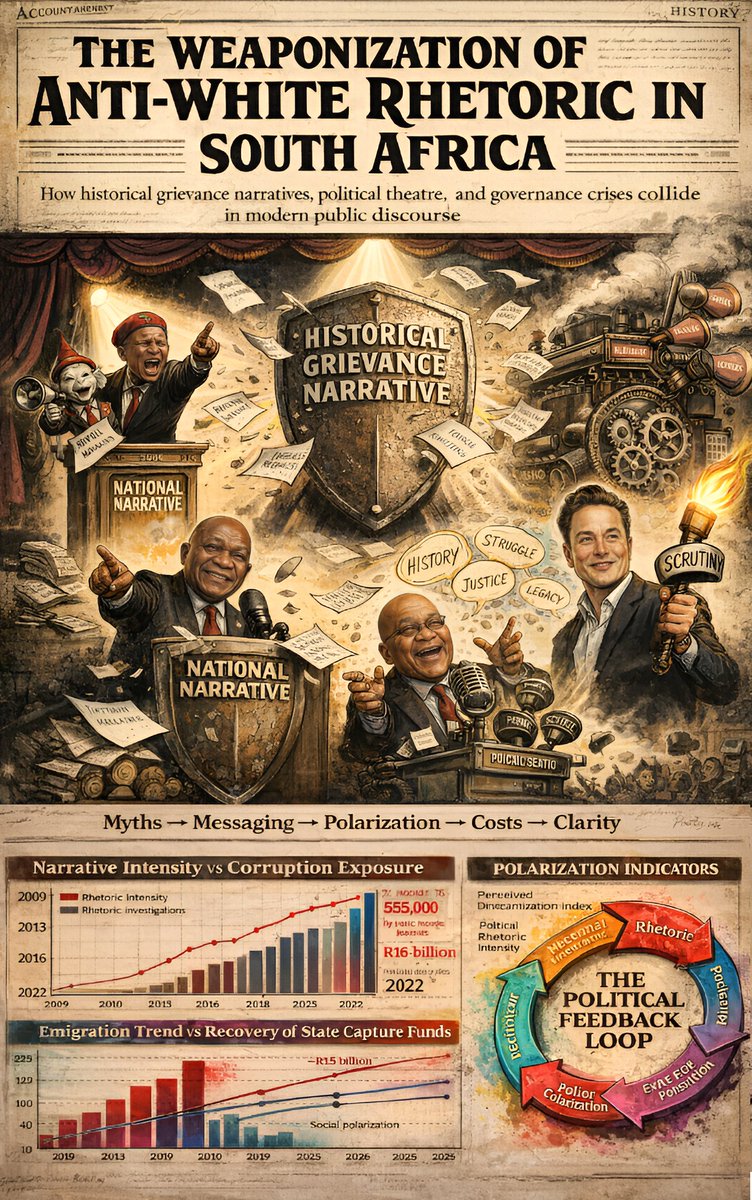
Sjoe! 😳 When Corruption Gets Caught… Suddenly It’s “White Monopoly Capital” Again 🎭💸 ~ When Accountability Meets a Racial Firewall 🔥🧱 ~ Blame the Past, Protect the Present ⏳💼 — Inside South Africa’s Political Feedback Loop of Anti-White Rhetoric Weaponization.
Sjoe, let’s be brutally honest with each other for once. You’re sitting in traffic on the N1, or waiting for a taxi in the rain, or scrolling X at 2 a.m. because sleep won’t come, and you see the same phrase pop up again: “It’s still the whites.” Or “apartheid scars forever.” Or the slightly more polished version: “white monopoly capital.” Sometimes it’s shouted in Parliament, sometimes whispered in WhatsApp groups, sometimes typed in all caps with three crying emojis.
And every time it lands, the conversation stops.
No one asks follow-up questions.
No one says, “Okay, but what about the R1.5 trillion that disappeared during state capture?”
Because the moment you do, you’re suddenly the one defending whiteness, ignoring history, undermining transformation. The shield is up, the conversation is over, and the person holding the shield gets to walk away looking morally superior while the actual question—where did the money go?—hangs in the air like cigarette smoke nobody wants to inhale.
This is not a rant about hurt feelings. This is about pattern recognition. In South Africa today, anti-white rhetoric is being weaponized—not as raw, unfiltered pain from the past, but as a calculated political and elite-protection instrument.
Historical grievances are selectively edited, amplified, and deployed so that any attempt to hold the current powerful to account can be instantly reframed as racial nostalgia for apartheid.
The result is a self-perpetuating loop: legitimate post-1994 redress gets twisted into cadre deployment and elite enrichment → corruption is exposed → the exposure is deflected by invoking “apartheid scars” or “white monopoly capital” → criticism is silenced as racist → the powerful stay in power and the looting continues.
Ordinary citizens of every background pay the price in stalled progress, fractured trust, and a country that keeps promising a better tomorrow while delivering more of the same yesterday.
The evidence forms a network—history, politics, sociology, economics all locking together so tightly that trying to dismiss one piece makes the others fit even more snugly. It is testable: if the rhetoric were truly about justice and healing, we would see corruption shrinking, accountability rising, racial framing fading.
Instead we see the opposite. And that is the story we are telling here—no distractions, no side quests, just the pattern, laid bare.
Questions Stirring:
How does real historical pain become such a perfect, impenetrable alibi?
What kind of person learns to wave the struggle flag so vigorously that no one notices what their other hand is doing in the state coffers?
And why do these questions refuse to behave like polite guests—they’re chained together, because separating yesterday’s injustice from today’s theft is exactly how the loop stays intact. Together they are not polite inquiries. They are an ultimatum: stop hiding behind the past, or admit that the past is no longer the problem—the present is.
Context: The Scar That Became a Get-Out-of-Jail Card
Let’s start with the thing nobody serious disputes. Apartheid was a crime against humanity. For generations Black South Africans were deliberately dispossessed of land, wealth, education, dignity, opportunity. The 1913 Natives Land Act, Group Areas Act, Bantu Education—each brick in a legal wall designed to keep one group poor and another rich.
When that wall came down in 1994, the promise was redress: restitution, affirmative action, Black Economic Empowerment, a Constitution that remains one of the most progressive on Earth. The moral logic was airtight. The majority had been robbed; justice demanded correction.
Fast forward to 2026. The Zondo Commission (2022) placed a number on what many already felt in their gut: R1.5 trillion lost to state capture, cadre deployment, and elite enrichment. Recoveries remain modest—R16 billion tracked through SIU, AFU, SARS by early 2026. Inequality remains among the worst on the planet (Gini ~63.0, last major World Bank measure stable through 2025).
Every time someone asks where the money went, the answer is pre-loaded and ready to deploy: white monopoly capital, apartheid’s eternal shadow, the same villains who supposedly never stopped pulling strings.
Some invocations are sincere. Many are not.
The rhetoric has hardened into reflex: question cadre deployment, you’re defending white privilege; point out elite looting, you’re ignoring historical pain; demand class-based fixes over race-based ones, you’re undermining transformation.
It’s not random. It’s useful. And it works—because who wants to be the person arguing against “apartheid scars”?
It is the oldest political sleight of hand in the book: wrap yourself so tightly in the flag of the struggle that no one can see what your other hand is doing in the till. And when the till is empty, point at the ghost of the previous owner and say, “See? He’s still stealing.”
Questions Stirring:
If redress was the goal, how did it become a permanent excuse for new looting?
Why does every corruption scandal end with someone shouting “white monopoly capital” instead of naming names and opening the books?
And why do these questions feel like they’re holding hands in a circle? Because they are. You can’t answer one without answering them all. The moment you admit the past is being used as camouflage, the entire loop becomes visible—and once visible, it’s very hard to unsee.
That’s why the questions won’t leave you alone. They’re not polite. They’re insistent.
Evidence Network: The Gears That Keep the Machine Spinning
Historical Distortions as Rhetorical Fuel
History is the clay; selective memory shapes it into whatever is needed. Africa portrayed as empty or primitive pre-colonialism—debunked by Mali, Great Zimbabwe, Aksum. Whites painted as the sole inventors of slavery or genocide—ignoring Arab trades, African kingdoms selling captives, Mao’s tens of millions, Stalin’s purges.
In South Africa, this selective lens turns “apartheid legacy” into an all-purpose answer. The Zondo Commission’s R1.5 trillion state-capture figure (2022) is met with “white monopoly capital” as the real culprit. Land-reform debates become racial morality plays instead of accountability exercises about who captured BEE benefits (Southall, 2016). The past isn’t remembered—it’s edited, looped, and weaponized.
It’s like a magician who keeps insisting the audience stare at the left hand while the right one slips the card into his pocket. The audience claps anyway—because questioning the trick makes you the bad guy who doesn’t respect the performance.
Mechanisms That Amplify and Protect
The machine has gears, and they turn with terrifying precision: elite deflection (blame whites instead of naming looters), electoral mobilization (zero-sum racial rallying), outrage amplification (algorithms love a fight), status-threat exploitation (whites framed as perpetual beneficiaries), international echo chambers (Musk’s 2025 X posts on “genocide,” Trump’s February 2025 EO citing “hateful rhetoric” and resettling 1,651 mostly white South Africans by January 2026).
Each gear turns the next. Inflammatory speech (“Kill the Boer” chants, protected but fear-inducing) keeps the base fired up while shielding the top (Presidency statements, 2025).
It’s not chaos. It’s choreography. And the choreographer always takes the biggest cut.
The Nihilistic Loop: Corruption’s Perfect Cloak
Here is the beating heart of the pattern. Legitimate redress → twisted into cadre deployment and elite enrichment → exposed → deflected with “apartheid scars forever” / “white monopoly capital.” Rinse. Repeat. Zondo’s R1.5 trillion estimate (2022) sits mostly unrecovered.
Reforms stall (partial implementation, ongoing debates March 2026). The loop is self-sustaining: the more corruption is revealed, the louder the historical invocation, the safer the powerful feel.
It’s a tragicomic loop-de-loop: wave the struggle flag, vanish another few billion, blame the whites, collect applause. The audience pays for the tickets and the cleanup. And the show never ends because the curtain never falls.
The Asymmetric Toll: What It Actually Costs
The damage is not abstract. White emigration: over 555,000 since 2001, ~94,898 net loss 2021–2026 (Stats SA mid-year 2025). Brain drain bleeds skills and economic potential (IMF ~10% GDP drag estimate). Diplomatic/investment chill follows (Trump EO 2025). Polarization stays locked at Genocide Watch Stage 6 (mid-2025 onward). Ordinary people—Black, white, coloured, Indian—pay in stalled services, lost opportunity, fractured trust.
Rhetoric has no institutional power behind it like historical racism did, but its effects are real and growing. It’s not genocide at stage 6, but stage 9 and exactly when is it appropriate to cry wolf?! It’s slow bleed. And slow bleeds can kill just as surely.
The Path to Objectivity: The Only Exit Ramp
Weaponization thrives on black-and-white framing—“eternal colonizers,” “no benefits ever,” myths ignoring infrastructure legacies or pre-colonial wars. Objectivity means honoring apartheid’s brutality (land dispossession, forced removals) while rejecting essentialism that blames all whites today.
That opens the door to class-focused fixes: transparent Zondo enforcement, equitable redress without elite capture, dialogue over grievance. It’s hard. It’s uncomfortable.
It’s the only way the loop ever breaks.
Questions Stirring:
How do you dismantle a shield forged from real pain without shattering the people who still carry it?
What does accountability look like when the accusation of racism is the first and last line of defense?
Why do these questions feel like they’re pulling in the same direction? Because they are. They’re not separate demands—they’re one demand wearing different clothes: stop hiding behind yesterday so we can fix today.
Synthesis: When the Pieces Lock, the Picture Becomes Undeniable
The evidence converges: myths give moral cover, mechanisms spread it, loops protect it, costs reveal the damage, objectivity is the breaker. It’s functional cynicism—power retention disguised as moral struggle.
Falsifiable: if Zondo recoveries accelerate and racial framing fades, the thesis weakens. Stakes: Stage 6 Genocide Watch "polarization" risks real fracture, but the same evidence shows a way out—class solidarity, transparency, truth over narrative.
Imagine the moment the loop snaps: trillions traced, myths debunked, alliances formed across old lines.
Objections: Meeting the Pushback Head-On
This dismisses apartheid’s legacy. Valid—wounds are real (UN reports, 2024). But the pattern shows rhetoric shielding new looting, not old victims (Zondo, 2022).
It’s white grievance dressed up. Fair fear—power imbalances linger. But emigration numbers, brain drain, polarization metrics show costs that cross racial lines.
Objectivity whitewashes colonial harm. Limits acknowledged. But debunking myths while honoring restitution (Constitutional land clauses) strengthens equity, not weakens it (Afrobarometer support for non-racial approaches).
Conclusion: The Rainbow We Still Owe Each Other
The evidence network proves it: anti-white rhetoric is being weaponized to shield corruption and division in South Africa—but the same evidence shows it can be dismantled through unflinching objectivity and class-focused reform.
Sjoe, we’ve stared at the pattern long enough. Demand full Zondo enforcement. Build cross-racial coalitions around shared economic survival. Replace deflection with dialogue. The past doesn’t have to be a prison sentence. It can be a map.
What if we stopped using the rainbow as camouflage and started living inside it?
#RainbowNationDrama 🌈🎭
#FollowTheMoney 💸🕵️
#PoliticalMagicTrick 🎩✨
#AccountabilityPlease 🧾⚖️
#StopTheDeflection 🚫🪞
#HistoryIsNotAShield 🛡️📜
#WhereDidTheMoneyGo 💰❓
#ZondoSaidWhat 🧾🔥
#CorruptionCircus 🤡💸
#RaceCardReloaded 🃏📢
#TruthOverTribalism 🧠🤝
#SouthAfricaDebates 🇿🇦💬
#StopTheLooting 🚨💼
#PowerGames 🎭🏛️
#RainbowRealityCheck 🌈😬
#FactsOverFeelings 📊💥
#SjoeMoment 😱
#PoliticalGymnastics 🤸♂️🏛️
#NarrativeVsReality 🎭📉
#AccountabilityMatters ⚖️🧾
#DemocracyWatch 👀🗳️
#FixTheSystem 🔧🇿🇦
Reference:
Afrobarometer. (2026). Public opinion on racial rhetoric in South Africa. Afrobarometer Dispatch No. 612.
BBC. (2025). AfriForum lobbying and international responses. BBC News Africa.
Brookings Institution. (2025). Algorithmic amplification of polarization. Brookings Tech Stream.
Genocide Watch. (2025). Country report: South Africa. Genocide Watch.
IMF. (2025). South Africa economic outlook. International Monetary Fund.
IRR. (2025). Perceptions of discrimination survey. Institute of Race Relations.
Manning, P. (1990). Slavery and African life. Cambridge University Press.
Presidency.gov.za. (2025). Statement on genocide narrative. The Presidency of South Africa.
South African History Online. (2024). Apartheid dispossession. SAHO.
Southall, R. (2016). The new black middle class in South Africa. Jacana Media.
Stats SA. (2025). Mid-year population estimates. Statistics South Africa.
UN. (2024). Report on racism legacies. United Nations Human Rights Council.
US State Department. (2025). Fact sheet on EO 14204. U.S. Department of State.
USCIS. (2026). Refugee resettlement data. U.S. Citizenship and Immigration Services.
White House. (2025). Executive Order 14204. The White House.
World Bank. (2025). Inequality in South Africa. World Bank Group.
Young, I. F., & Sullivan, D. (2016). Competitive victimhood. Personality and Social Psychology Bulletin, 42(1), 24-38.
Zondo Commission. (2022). State capture report (Vol. 1). Judicial Commission of Inquiry into State Capture.
2
4
5,060

6 Dec 2025
Ethanol blending was sold like some magic trick that would cut fuel prices and make India energy independent. What actually happened? Prices stayed the same, mileage dropped, engines started coughing, and ordinary people ended up paying more while pretending they’re benefiting from a “green revolution”.
And the funniest part? Every time the blend increased, the price didn’t go down. It went up. Meanwhile the narrative stayed the same: “Future me sasta hoga”. Future kab aayega? 2030? 2050? Mars landing ke baad?
People are already reporting injector failures, rubber seal damage, start-up issues in cold weather, and reduced engine life. But there’s no accountability because the blame always gets thrown back on users, mechanics, or “bad quality fuel”.
Let’s be honest. If something really saved money, improved performance, and reduced pollution, people wouldn’t need speeches or forceful policy mandates. They’d adopt it voluntarily.
Right now, it just feels like one more experiment done on citizens while companies and policymakers clap from the VIP box.
Nobody is saving money here. Nobody is benefiting except the ones pushing the product.
The common man is just expected to smile, pay the bill, and believe the next promise.🤐
#PetrolPriceReality #EthanolMyth #AccountabilityPlease
2
1
18
1,198

18 Nov 2025
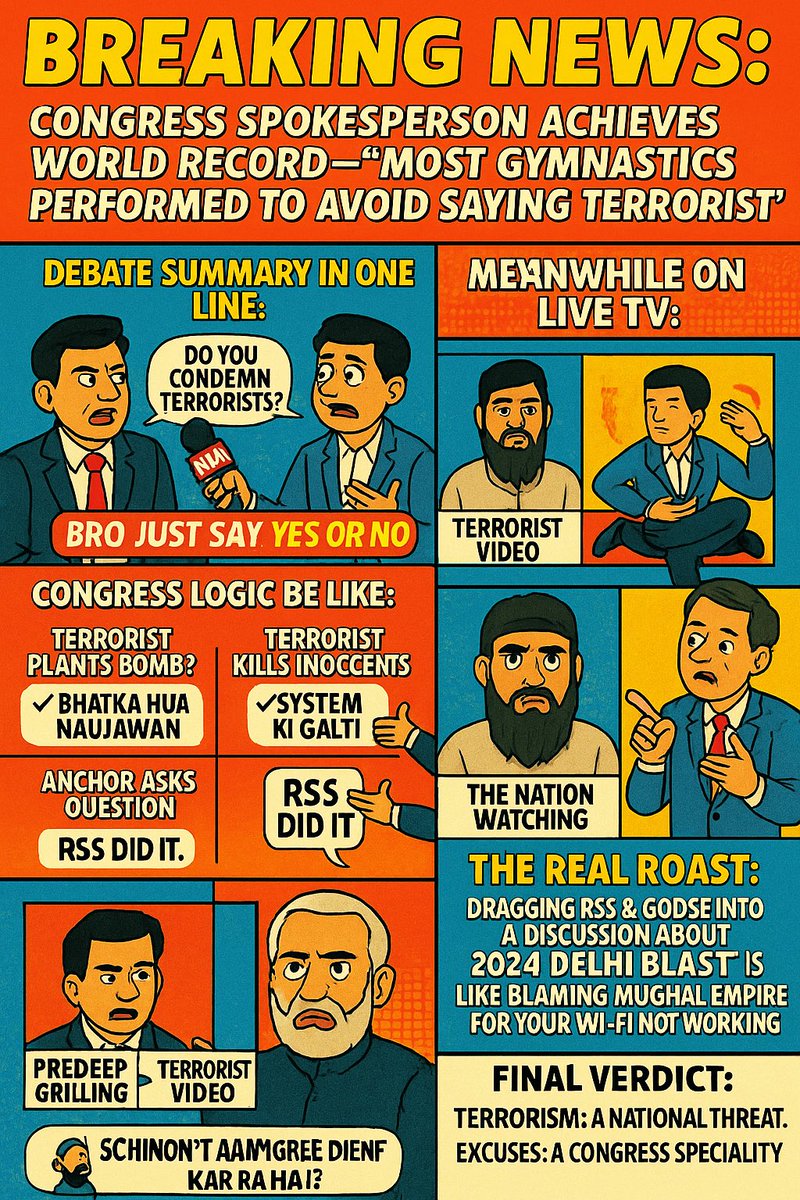
🚨 BREAKING NEWS: Congress Spokesperson Achieves World Record — “Most Gymnastics Performed to Avoid Saying the Word Terrorist” 🤸♂️💀
🎤 DEBATE SUMMARY IN ONE LINE:
Pradeep Bhandari: “Do you condemn terrorists?”
Congress spokesperson: “RSS… Godse… climate change… childhood trauma… unemployment… planets not aligned…”
Nation: BRO JUST SAY YES OR NO 😭🔥
😂 CONGRESS LOGIC BE LIKE:
Terrorist plants bomb? → “Bhatka hua naujawan.”
Terrorist kills innocents? → “System ki galti.”
Terrorist releases radicalisation video? → “Poverty! Oppression! Astrology!”
Anchor asks straight question? → “RSS did it.” 🤡
🔥 MEANWHILE ON LIVE TV:
Pradeep Bhandari: “Please condemn the Delhi Blast terrorists.”
Congress Spokesperson:
🔄 Loading excuses…
🔄 Downloading distraction…
🔄 Installing Godse reference…
❌ Common sense not found.
🤦♂️ THE NATION WATCHING:
Even the terrorist in the video looked confused like:
“Yeh banda mujhe defend kar raha hai ya mujhe bhi jail bhej dega?”
💥 THE REAL ROAST:
Dragging RSS & Godse into a discussion about a 2025 Delhi blast
is like blaming Mughal Empire for your WiFi not working.
PURE MENTAL ATHLETICS. 🤯😂
📺 NDTV SCREEN:
Left box — Pradeep grilling.
Center — Terrorist video.
Right box — Congress spokesperson doing yoga-level intellectual stretching.
🇮🇳 FINAL VERDICT:
Terrorism: a national threat.
Excuses: a Congress specialty.
Accountability: “Sorry, kaun si dish hoti hai?” 🍽️😂
#CongressExposed
#TerrorismCondemnKaro
#NationWantsAnAnswer
#DelhiBlastDebate
#SayTheWordTerrorist
#StopTheDeflection
#PradeepBhandari
#CongressGymnastics
#PoliticalYoga
#IndiaAgainstTerror
#AccountabilityPlease
#NoMoreExcuses
2
5
138

29 Oct 2025
“मोदी राज में सिस्टम इतना पारदर्शी है कि सब कुछ दिखता है — पर कार्रवाई कभी नहीं होती! 😏
- सरकार बनने पर भ्रष्टाचार नामक दीमक जो बिहार को निगल रहा उसे खत्म करेंगे
#TransparentDrama #AccountabilityPlease”
3
3
3
181

25 Oct 2025
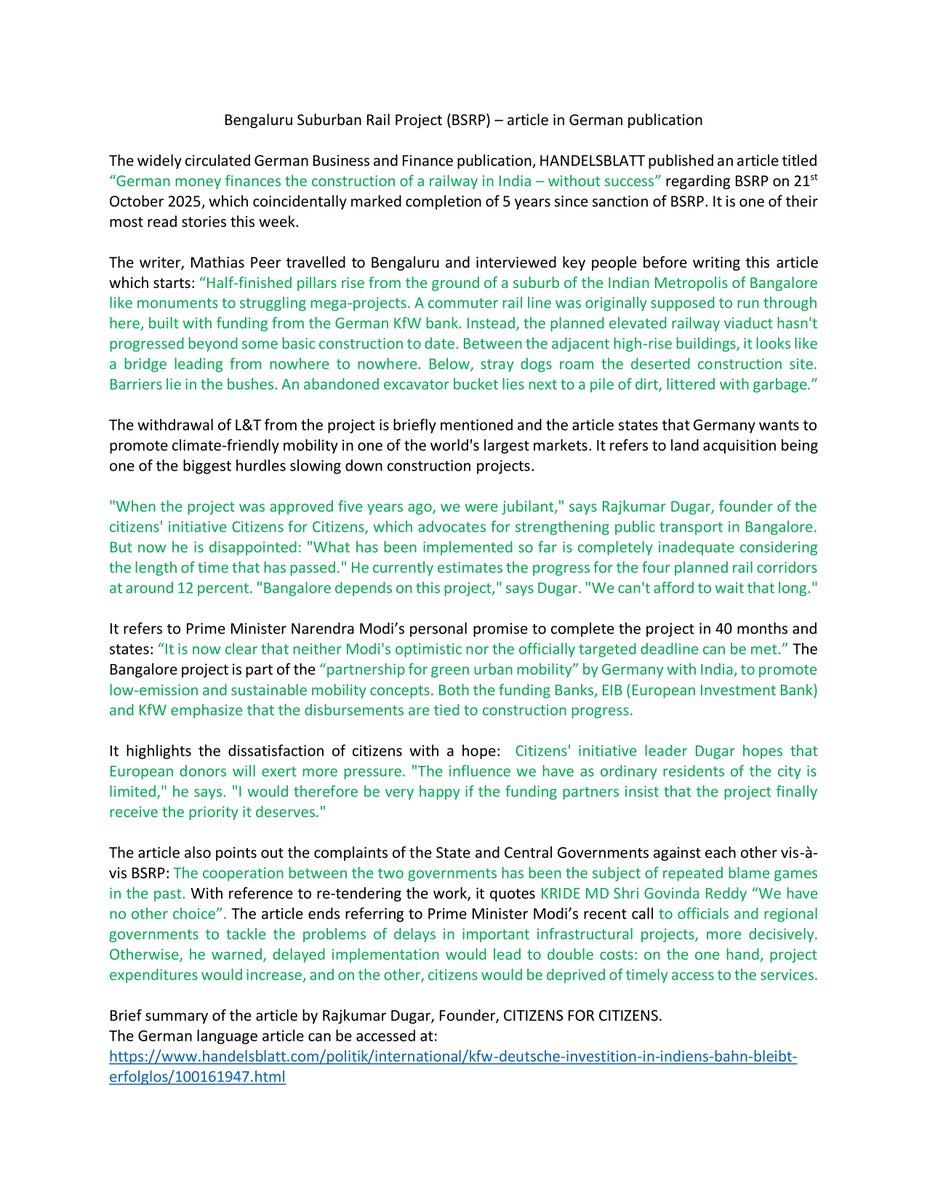
Amazing, isn’t it? A journalist flies in all the way from Germany’s top business daily – @handelsblatt to study the #BengaluruSuburbanRailProject, while our own elected reps and ministers can’t find the time to even take a local train ride.
🔷️When Europe sees potential, we see paperwork.
🔷️When foreign media tracks progress, our leaders track photo-ops.
Maybe #Bengaluru needs a #Schengen visa stamp before our ministers start noticing its infrastructure.
#BSRP #BrandBengaluru #GovernanceIrony #SuburbanRailNow #LowHangingFruit #AccountabilityPlease
25 Oct 2025

Top Business Publication of Germany
"HANDELSBLATT"
sends journalist to Bluru to check out on
#BengaluruSuburbanRailProject
while our ElectedReps &ConcernedMinisters hav no time for LOW-HANGING FRUIT,#BSRP
Article in German at: shorturl.at/mTk1C
English SUMMARY attached
1
2
3
350
17 Oct 2025
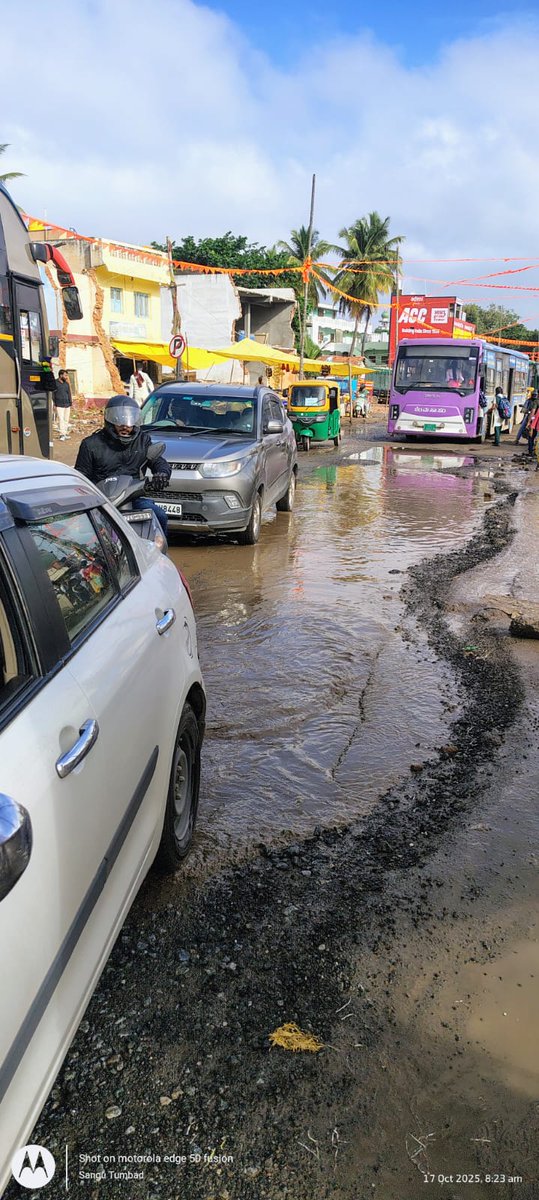
So this is what “world-class infrastructure” looks like- roads doubling up as storm drains while Citizens crawl through muck. Every year, the same stretch floods, and every year the authorities discover it like it’s breaking news 🚨 @ICCCBengaluru, is this negligence a feature or a policy? Taxpayers didn’t sign up for a swamp commute 🥲
@GBA_office @GBAChiefComm @DKShivakumar @siddaramaiah @ChristinMP_
@vinodblru @NammaBengaluroo
@naveenmzs
#Bengaluru #Varthur #Gunjur #DrainFailure #UrbanFlooding #AccountabilityPlease #InfrastructureApathy #TaxMoneyWhere #CitizenRights #HoldThemResponsible
17 Oct 2025

🚨 Traffic Advisory: Slow moving traffic due to the drain water on road, Varthur - Gunjur.
@ICCCBengaluru Kindly look into it immediately.
Friday 17.10.2025
🔻Emergency call 112
4
6
39
2,726
12 Oct 2025
If #Bengaluru contributes billions in GDP, why is it treated like a side project instead of a global city in the making?
It doesn’t take miracles, just political will, a ring-fenced budget, and time-bound execution. A billion dollars invested strategically could transform mobility, drainage, roads, and public infrastructure. Cities across the world have done it with less.
What’s missing isn’t money or expertise- it’s urgency and intent.
@siddaramaiah @DKShivakumar @PriyankKharge The world-class narrative can’t be built on potholes, patchwork and postponements. Vision needs bonding with budget, not just speeches.
Bengaluru doesn’t need excuses. It needs execution @kiranshaw @TVMohandasPai @ChristinMP_ @vinodblru @NammaBengaluroo
#AccountabilityPlease #BengaluruDeservesBetter
12 Oct 2025

I also am puzzled about why the political leadership is not showing the political urgency to fix our city and make it world class. It doesn’t take more than a focus in terms of budgetary allocation n execution. A billion dollars needs to be ring-fenced to do this @siddaramaiah @DKShivakumar @PriyankKharge
3
22
89
3,441
10 Oct 2025
🚨 15 minutes of rain and #Hosa Road turns into Hosa Lake.
Every year the script is the same- potholes, flooding, excuses, and zero accountability.
But sure, let’s keep selling ‘#BrandBengaluru’ while Citizens swim to work in our @NammaBengaluroo
If roads can’t survive drizzle, what exactly are crores of taxpayers’ money funding- infrastructure or annual disaster rehearsals?
BBMP, BMRCL, MLA, corporators, smart city planners- everyone has a ribbon to cut, but no road to fix.”
@ChristinMP_
@arivuexpress
@vinodblru
@TVMohandasPai
@kiranshaw
@prasannavishy
@Suchithkidiyoor
@0RRCA
@BPACofficial
@TOIBengaluru
@BangaloreMirror
@tv9kannada
@rishitaakhanna
#BengaluruRains #AccountabilityPlease #PotholeCapital #TaxMoneyDrowned #BrandOrBlunderBengaluru
28 Sep 2025

Dear @siddaramaiah @DKShivakumar,
Welcome to #HosaRoad our Namma #BrandBengaluru- India’s first government-sponsored off-road adventure park!🙏
No need for #Coorg treks or #Ladakh bike trips- one ride on this primary road connecting #ElectronicCity to #Bellandur and you’ll unlock all seven Chakras ♻️⚕️ #Bengaluru
Drainage work was started, then stopped by your own cadres.
Now we have swamps when it rains, craters when it’s dry, and traffic jams 24/7- truly a multi-season experience.
Three years of suffering. CITIZENS still counting.
HELP MAADI. COME TO HOSA ROAD- Hope your convoy can survive it. 🚜🕳️
@GBA_office
@GBAChiefComm
@ChristinMP_ @naveenmzs @TOIBengaluru @BangaloreMirror @htTweets @nabilajamal_ @tv9kannada @TimesAlgebraIND
#BekuRoadAllaResort #TaxPaidAdventure #NammaSufferings
3
5
18
1,367

8 Oct 2025
So much for “green innovation”!
Our policymakers pushed E20 petrol without ensuring that the infrastructure on the ground could actually handle it.
Now, vehicles in high-humidity and coastal regions are literally breaking down because the so-called “eco fuel” is absorbing moisture and damaging engines.
Instead of experimenting on citizens’ cars, maybe the government should have first ensured fuel stations had upgraded storage and distribution systems.
Once again, half-baked policy … full-blown problem.
@nitin_gadkari … the man who should be fixing India’s crumbling infrastructure is too busy shooting reels and doing PR stunts.
If you care so much about business, maybe step down and focus on your family’s companies instead of pretending to serve the public.
#E20 #PolicyDisaster #AccountabilityPlease
1
4
3,057

21 Aug 2025
Hey @AGNeronha
, any updates on 'I'm an AG!' Flanagan's employment? Or is she still on a 'paid vacation' from reality? #AccountabilityPlease
5
235

1 Aug 2025
10 days, no action on my complaint. [PCI Irfan] makes excuses like “I’m at the masjid.” @RailwaySeva keeps forwarding to @drm_dli , but DRM is silent. Are complaints just for show? Will Indian Railways take real action or protect irresponsible staff? #AccountabilityPlease
3
3
64

24 Jul 2025
🚨Elizabeth Warren acting like she’s about to solve the Social Security disaster by meeting with Frank Bisignano? Please 🤣This is the same woman who’s been cozying up to Wall Street for years, taking millions in donations while pretending to fight the system❗️ Remember how she flipped on big banks after getting paid? Or how she’s been silent while her party rubber stamped corrupt bailout after bailout? Americans deserve answers , not more political theater from someone who’s part of the swamp she claims to hate. If Warren actually cared about fixing things, she’d stop playing sides and start cleaning house but corruption pays better than results, doesn’t it? 😏
#SocialSecurityMess #WarrenHypocrisy #WallStreetPuppet #CorruptionExposed #PoliticalTheater #EpicFail #NoMoreExcuses #BrokenPromises #WakeUpAmerica #AccountabilityPlease #SwampCreature
3
130

22 Jul 2025
📢 Respected @cbawankule ji— Your Attention is Urgently Needed!
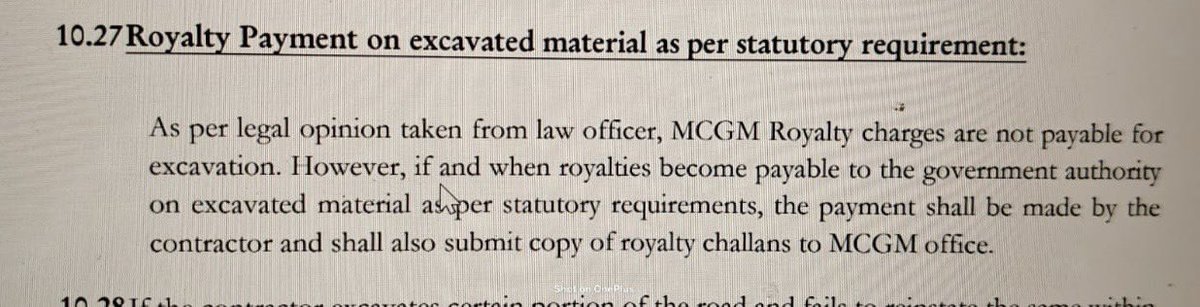
@mybmc Contractors Evading Royalty Payments — Clause 10.27 is the Loophole
A shocking clause (10.27) in @mybmcInfra roadwork tenders allows contractors to skip royalty payments on excavated material unless someone arbitrarily decides it’s required.
Clause says: “Royalty not payable… unless it becomes payable as per statutory requirement.”
Sir, how is this acceptable?
As per Revenue Department rules:
📌 If excavated soil is reused on-site, royalty may not apply.
📌 But if any soil is removed off-site, dumped or sold, royalty must be prepaid with a proper permit.
Yet in project after project:
❌ No royalty challans.
❌ No permits.
❌ No enforcement.
And the State Government loses crores, while contractors save lakhs — and some officers allegedly benefit quietly.
We request your immediate intervention to:
✅ Review how BMC is bypassing royalty enforcement
✅ Direct audit of all excavation works & royalty compliance
✅ Make challan submission mandatory & publicly available
✅ Plug this clause in all future tenders
Public resources deserve protection, not discretion. Mumbai’s revenue must not be sacrificed at the altar of contractor convenience.
@Dev_Fadnavis @CMOMaharashtra @INCMaharashtra @INCMumbai @INCHarshsapkal @VarshaEGaikwad
#RoyaltyScam #RevenueLoss #Clause1027 #BMCUnderLens #PublicFundsMatter #MaharashtraRevenue #TransparencyNow #AccountabilityPlease
1
3
9
287

7 Jul 2025
Breaking News: In Maharashtra's Nanded, a man tears apart a month-old road with bare hands...
And now, sources say the government might register an FIR against him ... for damaging public property! 😅
क्योंकि सड़क बनी हो कच्ची ईंटों से या जनता के टैक्स के पैसों से ...
गुनाह तो जनता का है...
जो इतनी हिम्मत कर ली कि भ्रष्टाचार की सड़क पर उंगलियां डाल दीं!
#YeThikKarKeDikhao #TaxpayerJustice #InfrastructureFail #AccountabilityPlease

Man Tears Apart Month-Old Road By Hand In Maharashtra's Nanded
ndtv.com/india-news/man-tear…
1
63

28 May 2025
I’m still waiting for the truth to come out about J6 !!! #AccountabilityPlease
24 Aug 2022

2
20

18 May 2025
THIS IS A DISGRACE!
And they call PRESIDENT TRUMP A DICTATOR.
#AccountabilityPlease
23
4
844
18 May 2025
Yes! This Behavior CANNOT STAND @FBIDirectorKash
Please Takeover the Case!
Remember Butler, PA The @SecretService Dropped the Ball and PRESIDENT TRUMP WAS ALMOST ASSASSINATED!
#AccountabilityPlease
17 May 2025

I'm calling on @FBIDirectorKash Patel and @FBIDDBongino to supersede the Secret Service and take over the Investigation of James Comey
The Secret Service interviewed him and didn't charge, this can not go unchecked
Who's with me ⚖️ Arrest James Comey
2
11