
RT @BitcoinCreds: Perception vs Reality: Bitcoin, crypto, fiat, Forkgivening, AggWit, and Kapnet.
The surface-level public map is wrong.…
4
Laggard Labs retweeted

Jun 9
Native AI, Bitcoin, Nostr, Aggwit, Forkgivening = -kapnet on @KNUbitcoin Extended Full Node (bitcoind, libbticoin optional, runs native on Nostr with _structured_ P2P via @getpubky and other protocol bindings. Dual Licensed ODL, Open Discourse License.
1
3
4
48

Jun 4
Perception vs Reality: Bitcoin, crypto, fiat, Forkgivening, AggWit, and Kapnet.
The surface-level public map is wrong.
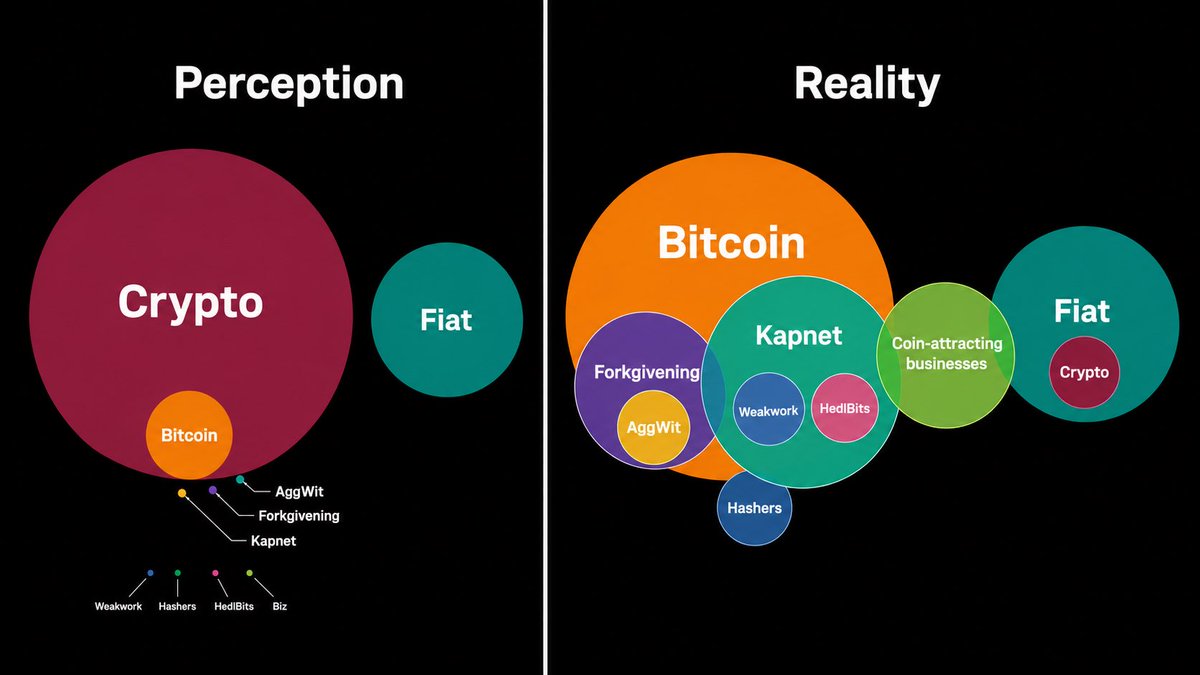
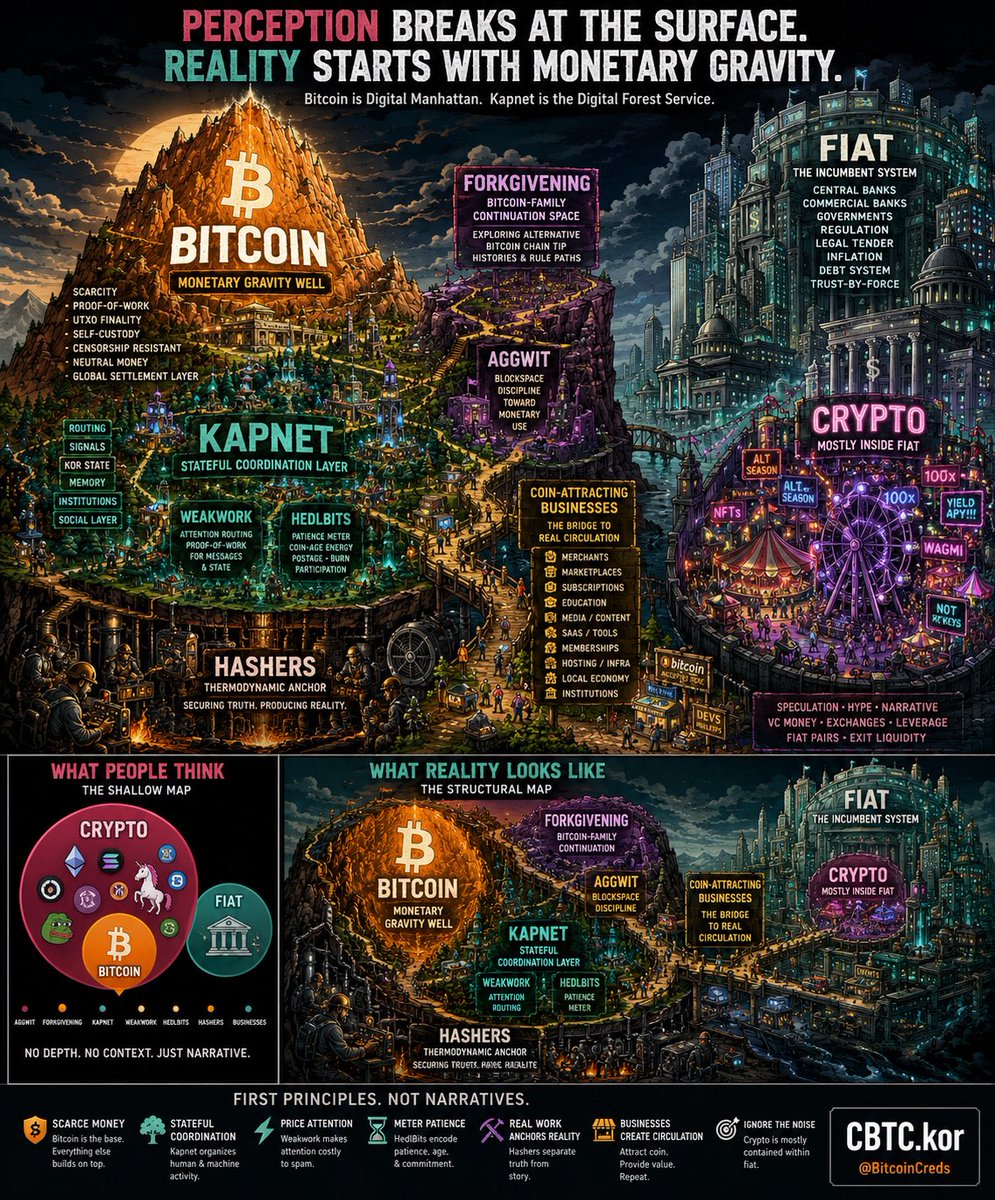
Most people see “crypto” as the big category, Bitcoin as a famous orange sub-bubble inside it, and fiat as the boring legacy system off to the side. From that angle, everything else—AggWit, Forkgivening, Kapnet, weakwork, HedlBits, hashers, coin-attracting businesses—looks like obscure protocol esoterica.
But that is perception. Not structure.
Reality is closer to this:
Bitcoin is not inside crypto.
Bitcoin is the monetary gravity well.
It is the orange root: proof-of-work, UTXO finality, scarcity, settlement, time, difficulty adjustment, hashpower, self-custody, and a globally legible monetary reference point.
“Crypto,” by contrast, mostly lives inside fiat.
Not because every project is fake, but because most crypto activity is still valued, funded, marketed, exited, regulated, and psychologically measured through fiat expectations. VC liquidity, exchange cycles, token launches, legal wrappers, speculative yield, USD marks, and risk-on narratives keep most of crypto inside the fiat bubble.
Bitcoin is different because Bitcoin is not primarily a company, app, token narrative, or speculation machine.
Bitcoin is monetary terrain.
That is where Forkgivening enters.
Forkgivening is not “another crypto.” It is Bitcoin-family continuation logic: a way to explore alternative Bitcoin chaintip histories, rule paths, replayable claims, and monetary counterfactuals while remaining conceptually anchored to Bitcoin’s historical gravity.
AggWit sits inside that Forkgivening space as a blockspace discipline mechanism.
AggWit asks: what if Bitcoin-family blockspace were optimized toward private monetary use, aggregate witness logic, and anti-metaledger pressure instead of endless high-entropy junk graphs?
So AggWit is not the whole forest. It is a pruning tool.
Kapnet is different again.
Kapnet is not trying to replace Bitcoin.
Kapnet is the stateful coordination layer that grows around Bitcoin-family reality. It treats Bitcoin as monetary root, hashers as thermodynamic anchors, weakwork as attention-routing cost, HedlBits as patience-metered participation, and KOR state as the social/institutional memory that lets humans, agents, businesses, and organizations coordinate without pretending everything belongs directly in base-layer consensus.
Kapnet is not the money.
Kapnet is what lets the money attract state, work, reputation, memory, services, education, business, and institutional structure.
Weakwork belongs inside Kapnet because attention must be priced.
HedlBits belong inside Kapnet because patience must be made legible.
Hashers sit underneath the cluster because physical work is what separates monetary reality from pure narrative.
Coin-attracting businesses sit between Bitcoin/Kapnet and fiat because that is where theory becomes circulation.
A coin-attracting business does more than “accept Bitcoin.” It gives coin somewhere to go, somewhere to return from, and something repeatable to coordinate around: subscriptions, memberships, credentials, education, hosting, media, software, marketplaces, local services, and institutional tooling.
That is how Bitcoin escapes being merely held and becomes an economy.
So the geometry is the thesis:
Perception:
Crypto contains Bitcoin.
Reality:
Fiat contains most crypto.
Bitcoin anchors monetary reality.
Forkgivening explores Bitcoin-family continuation.
AggWit disciplines Bitcoin-family blockspace.
Kapnet grows stateful coordination around Bitcoin.
Weakwork prices attention.
HedlBits meter patience.
Hashers anchor truth.
Coin-attracting businesses convert monetary gravity into circulation.
Bitcoin is Digital Manhattan.
Kapnet is the Digital Forest Service.
4
9
485

Usurping from future miners is more ethical than usurping from Patoshi
Chaingiven Token Bridge
CTB
emission-exhausted experimental chaintip
BIP 300/1?
No
BIP-110?
Also No
(That’s @KnoxBitcoin)
Will it enforce #AggWit on kapnet-formatted, BTC weakwork-txxm 64B OP_Return?
Yes!

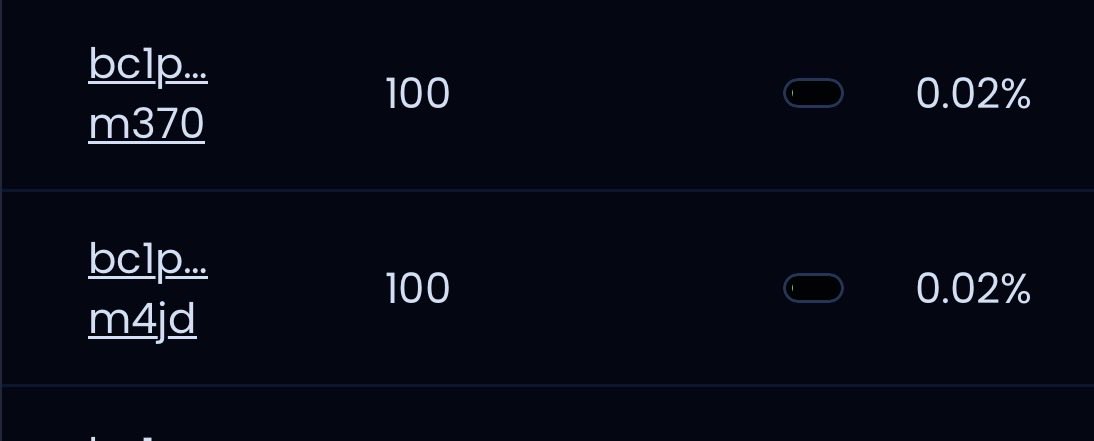
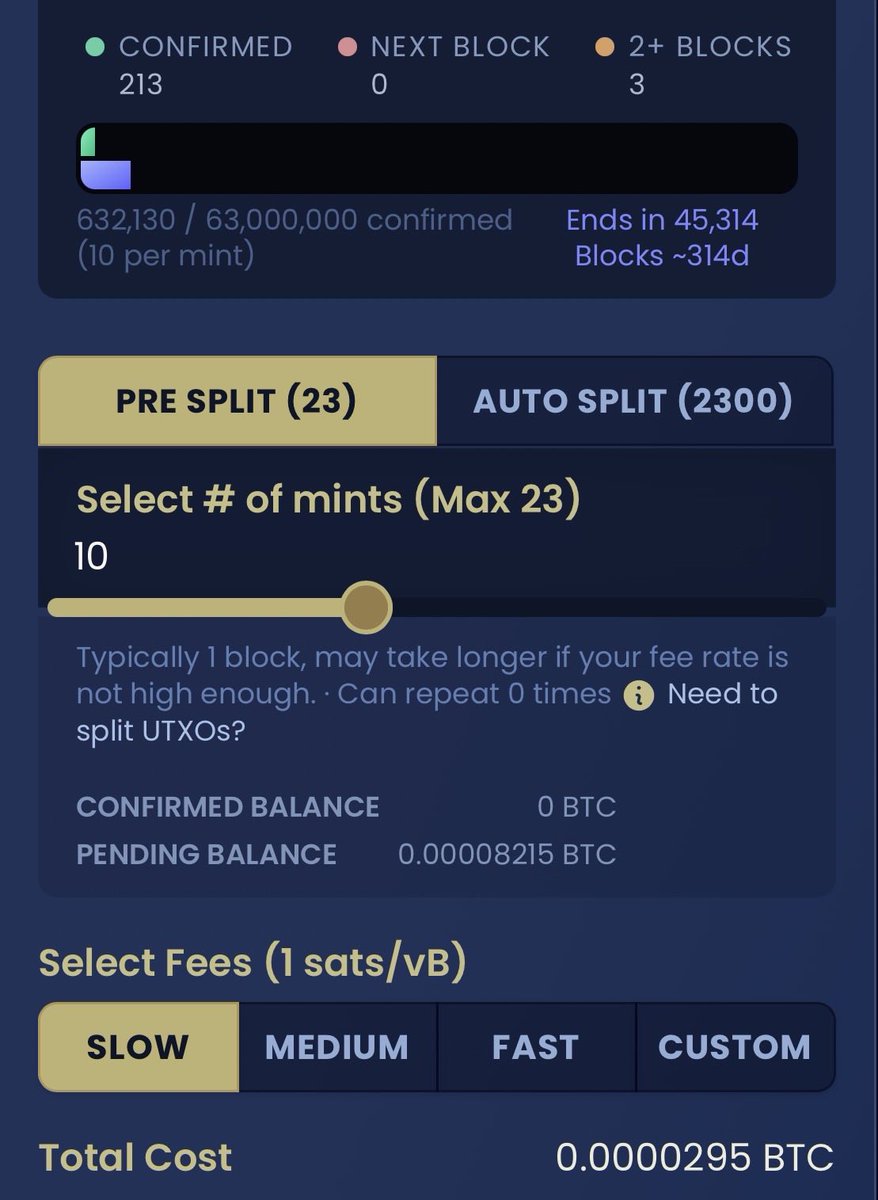
10 mints of #Forkgivening Rune account for 0.02% of the 1,500,000 CTB supply flashmined between blocks 977430 and 6930000
That’s 2950 BTC/ 30 Billion CTB
or
CTB/BTC=
10 million : 1 COIN
Flippening baseline acquired.🎯
2
58
May 5
#Forkgivening
: a Bitcoin chainsplit constellation — arriving at Forkgivening height 977429
•Your coins do not stop being Bitcoin
•Your chaintips split
•Your optionality expands
For example, if you hold BTC at the relevant snapshot, you may have claims, mirrors, airdrops, or opt-in rights across Forkgivening-aligned tips.
What to do?
•You may sell them. Keep them. Ignore them.
•Or run the software and find out what Bitcoin becomes when exit is treated as a first-class consensus primitive.
Vegas:
•Yes, I was around the Bitcoin circus.
•No, I will never explain the whole thing on stage.
•That would be rude.
Our Base Tips…
•are Sha256d mined.
•are Bitcoin-derived.
•are merge-mined where possible.
•are not asking BTC for permission.
•inherit Bitcoin’s proof-of-work grammar, UTXO lineage, and exit-right metaphysics.
•differ by constitution, activation height, historical replay boundary, and upgrade posture.
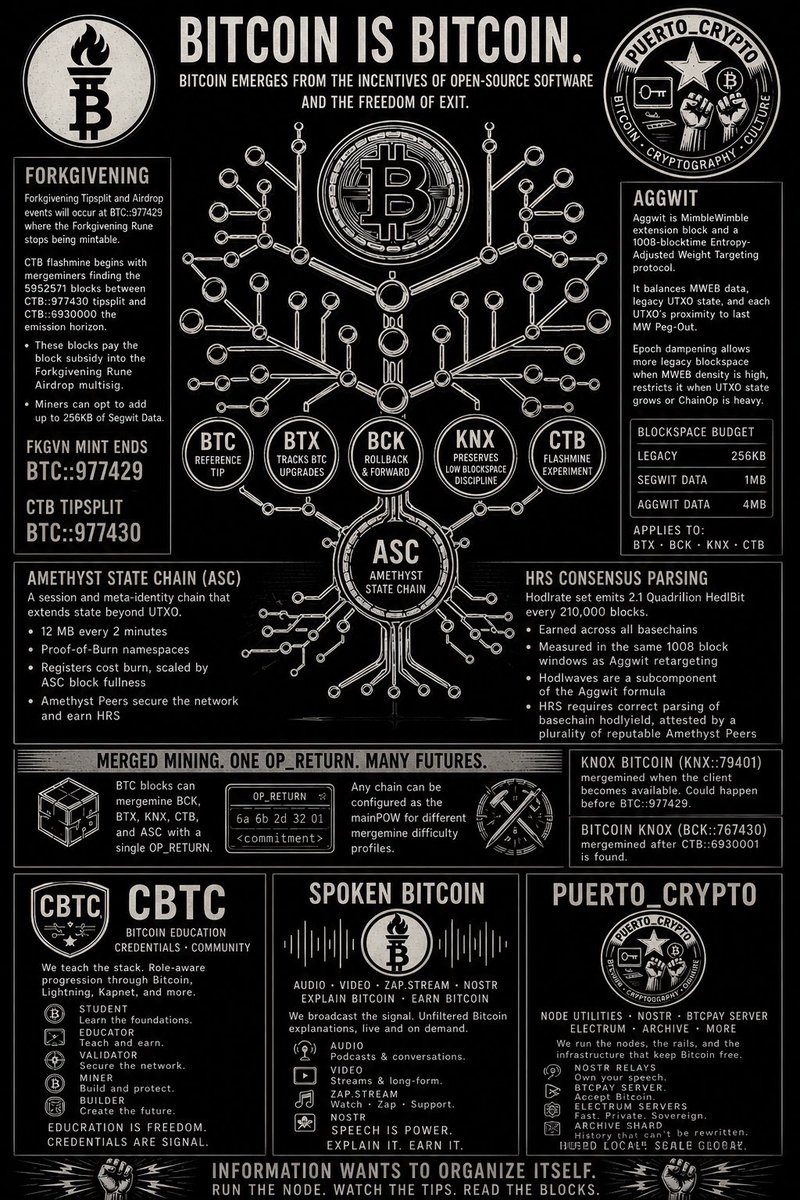
Codewise, the family remains Bitcoin-compatible where useful:
•BTC remains the reference chaintip
•BTX tracks BTC upgrades as they activate
•BCK rolls back to a cleaner historical boundary and moves forward with its own covenant posture
•KNX preserves a more ossified, low-blockspace Bitcoin discipline
•CTB begins the Forkgivening flashmine experiment
•ASC/Kapnet coordinates the extended state, node utility registry, session identity, and governance surfaces above the base chains
Yes, there will be AggWit:
•AggWit is not “more blocksize” as a slogan
•AggWit is blockspace hygiene
•AggWit prices weight according to chain-operation burden, UTXO state externality, and proximity to MimbleWimble-style cut-through
•It makes cheap the things Bitcoin should prefer: consolidation, privacy, fungibility, pruning, and monetary legibility
•It makes expensive the things that bloat shared state for private metaprotocol games
•It is not a ban
•It is a thermodynamic preference schedule
Yes, there will be Kapnet:
•Kapnet is not a token pretending to be Bitcoin
•Kapnet is a Bitcoin-native coordination layer
•It treats nodes, templates, weakwork, submissions, rooms, guilds, and governance as structured activity above the chaintip
•It lets Bitcoiners coordinate without pretending all coordination belongs inside L1 blockspace
•It uses proof-of-work, proof-of-burn, reputation, deterministic replay, and exit pressure as design materials
•It is what happens when information is allowed to organize itself around Bitcoin’s finite monetary matter
Yes, there will be Forkgivening mechanics:
•FKGVN minting ends at BTC::977429.
•CTB begins after the Forkgivening tip event
•CTB flashmining routes subsidy toward the Forkgivening airdrop mechanism
•Runeholders who paid miners for mint inclusion become part of the claim surface
•Miners can participate by merge-mining compatible tips and building valid templates
•This is not just an airdrop
•This is a public audit of who understands that Bitcoin exit is not betrayal
Unlike ordinary fork announcements:
•There is no claim that one ticker owns Bitcoin
•There is no demand that everyone agree
•There is no pretense that consensus is a press release
•There is no fake neutrality about blockspace externalities
•There is no surrender to dev capture, miner apathy, or mempool nihilism
•There is only software, incentives, replayable state, and the freedom to exit
Our design view:
•Bitcoin is Bitcoin
•Bitcoin is not a single corporate roadmap
•Bitcoin is open-source software under thermodynamic constraint
•Bitcoin is the freedom to validate, reject, fork, merge-mine, repeg, and continue
•Bitcoin is people learning to trust horizontal cryptography over vertical permission
•Bitcoin is finite digital matter with monetary properties, open to all, controlled by none
Video to follow
Or don’t wait for the video
Run the node. Watch the tips. Read the blocks.
14
18
289

May 2
Spam Mitigation is a key pillar of Bitcoin’s monetary policy that is essential for Bitcoin to reach its full potential.
If you disagree with this, then simply go study Bitcoin history to see why you’re missing it.
Run Knoxtr AggWit DATUM KNUpool
-kapnet up!💾✊🏼🫡
1
8
54
May 2
-kapnet is not more of the same
#AggWit is not more of the same
#Forkgivening is not more of the same

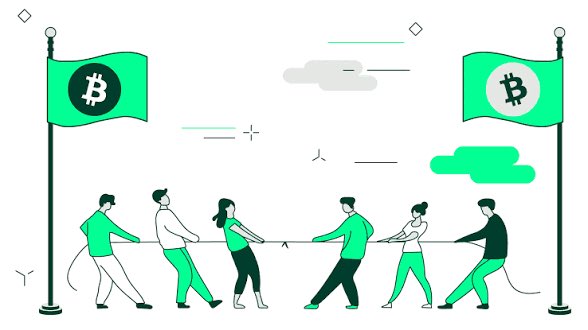
The Next Block Size War?
More and more tech focused Bitcoiners are restarting the mistaken argument that it is block size, transaction capacity, which is holding back Bitcoin.
Really?
There are enough forks which prove conclusively that block size is not the problem. Just look at the -97% market price development of BCH.
Doing more of the same and expecting a different outcome is not a sign of sound thinking.
If you really want Bitcoin to succeed, then help Bitcredit Protocol bring world trade on Bitcoin rails.
4
12
251

and then Bitcoin became infested with thin protocols that embed their ledger within the rivalrous bytespace within valid bitcoin blocks.
Only privacy-by-incentive AggWit can rid a blockchain of such attacks.
Incentive-driven monetary hygiene is within reach.
4
73

Early #AggWit
2 Feb 2024

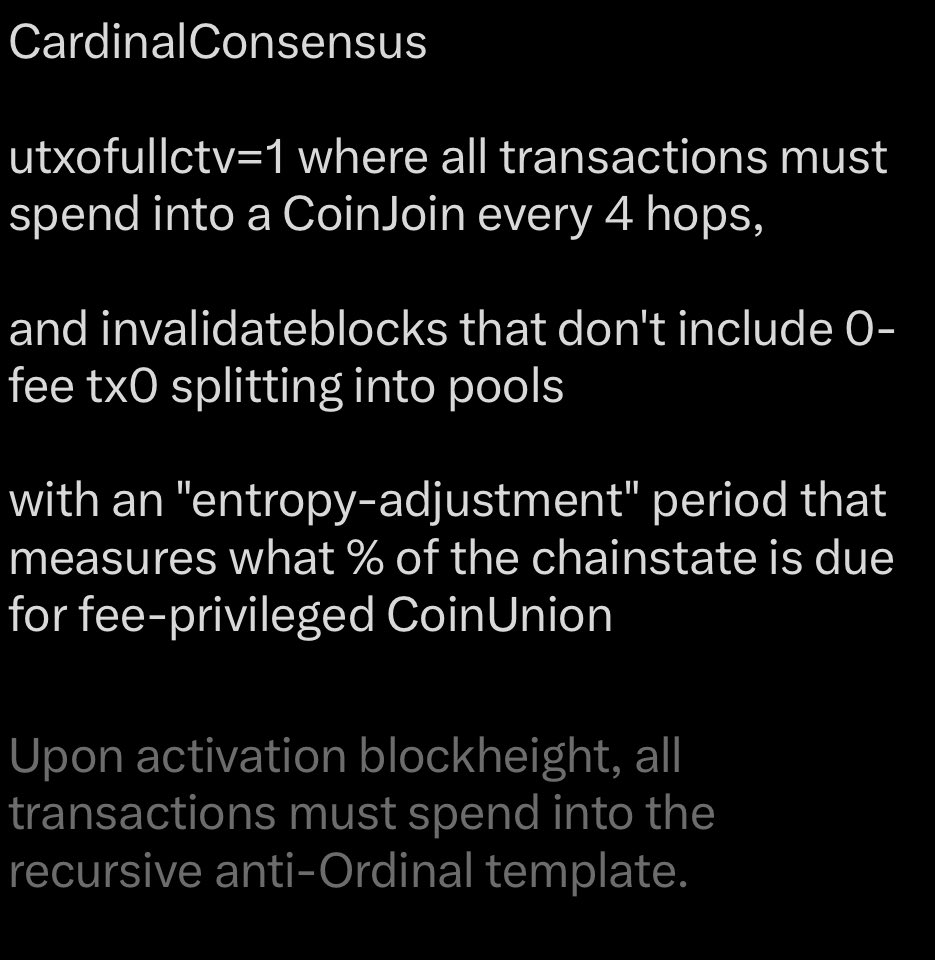
The details are reworkable, like the number of hops, or what is used for track and force the hygiene of the UTXO set.
The gist is to incentivize mixing and invalidate transaction graphs that spend too much time outside of CoinJoins/MimbleWimble/CT.
1
2
48

everyone agrees. have you heard of aggwit? it is a soft fork that makes it much harder to o use bitcoin for anything but money
I thought bip110 people, if they were serious, would love it. but instead they seem to be addicted to purity policing instead of real solutions
1
2
137
Mar 27
Boost #aggwit Neil. Stop pussyfooting around
Mar 26

Spam’s threat to bitcoin is less about the use of block space and more about the dilution of purpose.
3
9
110
This is all of my wishful thinking in one post @adam3us
#aggwit (or something like it) Is an incredible concept
shifting burden onto people making transactions from node holders while expanding financial capacity and decreasing spam capacity
Mar 23

Bitcoin Season 3:
MWEB
Aggwit
-kapnet
hedlbits
weakwork
TXXM
Forkgivening
2
84
Mar 23
Bitcoin Season 3:
MWEB
Aggwit
-kapnet
hedlbits
weakwork
TXXM
Forkgivening
2
10
166
#aggwit
- reduced block size for utxo-heavy transactions
- makes ordinals more expensive
- makes financial transactions less expensive
- adds on-chain privacy
14 May 2025

Blocksize v5 #Aggwit
128 kB - Unupgraded Script
256 kB - v3 Script
1 MB - SegWit
4 MB - AggWit Tie-In/Untie/MWEB
v3 UTXO accrue entropy debt delta every BLOCK_OP based on its inputs.
v5 Blocks and v3 UTXO are weight adjusted according to their share of the blockchain's delta.
1
4
6
193

Mar 18
You claim to be tired of 110 slop but gleefully engage their ragebait concern trolling instead of learning about #Forkgivening #Aggwit or #kapnet
#weknow
1
6
61
Better data disincentives have already been designed.
AggWit consensus discounts MWEB blockspace which is amnesiac and prunable to the tip due to cut-through within the tie-in untie kernels in the EB.
Then, timechain hygiene is discounted by weight-adjusting distance from MWEB.
1
3
27