
May 22
The Applied Knowledge Graph as the Runtime Layer for Agentic AI
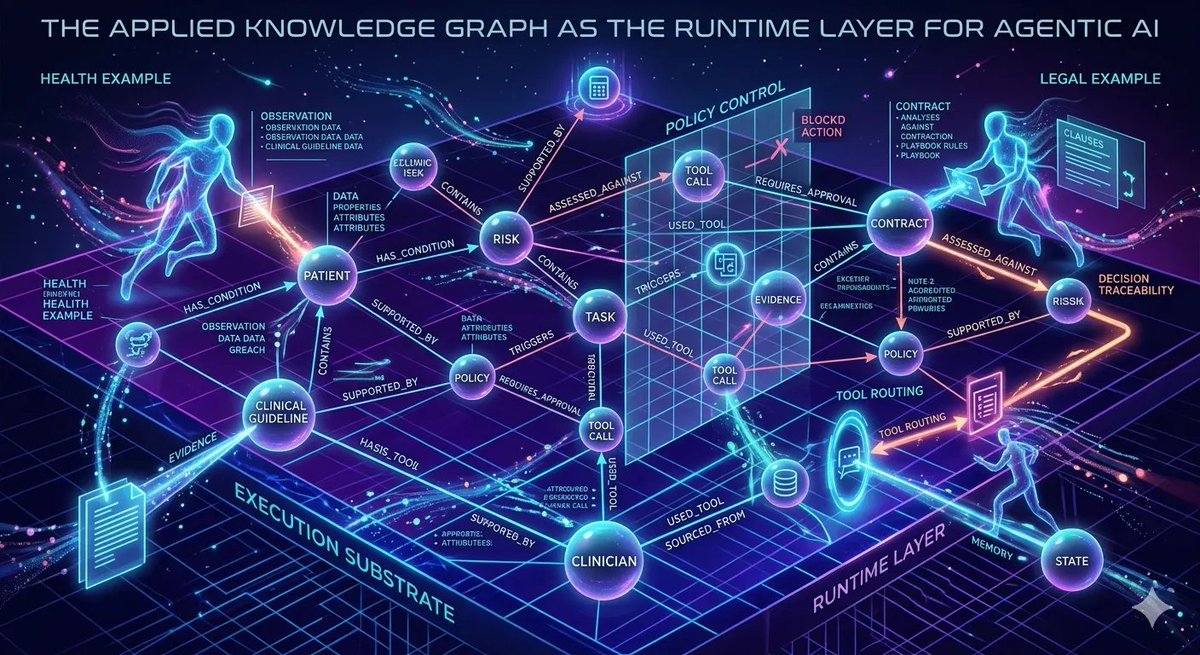
Applied Knowledge Graphs transform how agents act in professional workflows. Unlike traditional KGs that describe a domain, an AKG connects knowledge directly to work. It's the operating layer agents need: holding explicit state, structuring memory, grounding decisions in evidence, routing tools intelligently, making policy operational, and recording every decision with full traceability.
The shift matters. An AKG captures not just Patient, Condition, Medication, but also AgentRun, ToolCall, PolicyCheck, and Decision. It's the foundation for health systems where an agent supports clinical pathways with accountability, and legal workflows where contract reviews are connected to playbook rules, deal context, and precedent.
Why Labelled Property Graphs? They're flexible enough for evolving domains, expressive enough for rich relationships with attributes on both nodes and edges, fast enough for operational traversal, and practical enough for agent workflows. LPGs are also schema-optional, which means they grow incrementally as new tasks, entities, and relationships become important. This is critical for applied AI where the model rarely starts perfect.
The practical benefits compound. Agents work with structured context instead of relying only on prompt text. State becomes explicit and queryable, so clinicians can see why a task was created without reading transcripts. Grounding improves because outputs and actions link to evidence, source versions, policy rules, and tool results. Tool use becomes governable instead of invisible. Memory becomes selective and connected rather than a flat summary. Governance and traceability turn from audit challenges into system design.
GraphRAG was a step forward for retrieval. Agentic GraphRAG goes further. The AKG answers deeper questions: What is the task state? What does the agent already know? Which evidence applies? Which tools are allowed? Which policies are required? It helps before generation by selecting context, during action by guiding tools and policies, and after by recording evidence and outcomes.
The stronger next move isn't treating KGs as static knowledge repositories. It's operationalizing them as runtime layers for agents that need context, evidence, control, and accountability. RDF remains important for interoperability and formal reasoning.
But a knowledge graph doesn't have to be RDF-only. LPGs provide a strong foundation for applied systems, and hybrid approaches can combine LPG performance with RDF interoperability where needed.
For health, legal, and professional domains: the challenge isn't fluent output anymore. It's whether agents can act with context, evidence, control, and traceability. That's the AKG.
By Sergey Vasiliev
sergeyvasiliev.substack.com/…
#AppliedKnowledgeGraph #AgenticAI #GraphDatabase #KnowledgeGraph #RuntimeArchitecture
--
Connected Data London 2026 | 11–12 November | Leonardo Royal Hotel London Tower Bridge
🎤 Share your work with the world's most passionate data community. The Call for Submissions is open. connected-data.london/2026-c…
🎟 Tickets on sale now. Early bird discounts up to 30%. 2026.connected-data.london
📺 Sponsorship opportunities available. Contact info@connected-data.london for details.
#KnowledgeGraph #GraphRAG #Ontology #Graph #AI #DataScience #GraphDB #SemTech
4
13
602