

3 Sep 2025
This will be my 25th Black Friday as an operator.
My first one was running a computer accessories business from my college dorm room. After running and turning around over a dozen of 8 & 9-figure brands, I still see the same patterns every year.
TLDR: The brands that crush it start have already started prepping.
3 things you should be doing this week:
1. Build your audience pools NOW.
When BFCM hits, CPMs explode.
Start building your retargeting audiences today:
- Add the PostPilot pixel to capture site visitors for direct mail retargeting of anonymous non-converters later
- Expand your email capture with stronger CTAs/aggressive lead magnets
- Build your Facebook/Google audiences while traffic is cheap
These pools become goldmines when everyone else is fighting over more expensive cold traffic.
2. Understand your purchase latency
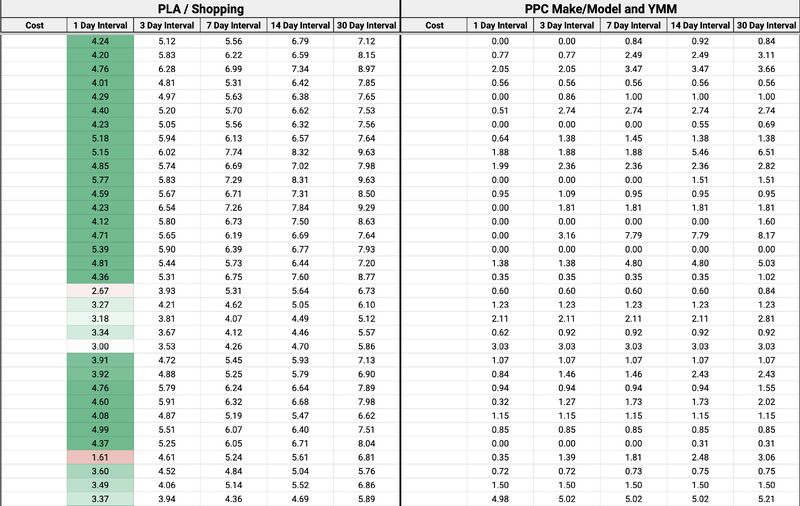
At AutoAnything, I built a script that took attribution snapshots at 1, 3, 7, 14, and 30-day intervals. Game changer.
Not only could we tell what ads were showing promise much sooner (and conversely what to kill), we could see exactly when customers started browsing vs. when they actually bought. During BFCM, that window compressed from weeks/months to days/hours.
Knowing this let us time our ad spend with better precision, ramping well before peak conversion periods while traffic was cheaper.
3. Don't wait to validate cohorts and channels
The biggest BFCM mistake? Using it as a testing ground.
I see it every year: "Let's try TikTok/direct mail/billboards/you name it on Black Friday!"
Dead wrong.
Testing implies small budgets. By the time you get meaningful data, BFCM is over and you've potentially left millions on the table because you couldn't scale.
Test everything NOW. Validate what converts. Then go big on the winners when November hits.
BFCM isn't won in November. It's won in September.
1
2
6
1,218

20 Jun 2025
Our team took KarmaLoop from losing $10M annually to profitable in under 90 days using three revenue multipliers:
1. Customer acquisition
2. Average order value
3. Purchase frequency
Here's the math magic: Improve each by just 30% and you more than double revenue (1.3 x 1.3 x 1.3 = 220% growth).
Most marketers obsess over acquisition while ignoring the goldmine sitting in their existing customer base.
Wrong move.
I've used this framework across multiple turnarounds: AutoAnything, Overtone, Morris 4x4.
Same playbook, same results.
The beauty? You don't need to knock any single metric out of the park. Modest improvements across all three create exponential growth.
DM me "three multipliers" for the full playbook.
2
1
5
641
10 Jun 2025
Most e-commerce brands attack growth completely bass-ackwards.
They obsess over acquisition while their retention and conversion are broken. It's like trying to fill a bucket with massive holes in the bottom.
Instead think back to front:
𝐒𝐭𝐞𝐩 𝟏: 𝐅𝐢𝐱 𝐑𝐞𝐭𝐞𝐧𝐭𝐢𝐨𝐧 𝐅𝐢𝐫𝐬𝐭 You've already paid to acquire these customers. The lifetime value optimization is pure profit waiting to be unlocked.
When we rebuilt AutoAnything and Karmaloop and oVertone and Morris4x4, we discovered that improving retention by just 5% was worth more than doubling our ad spend. Take that to the bank if you aren’t doing it.
𝐒𝐭𝐞𝐩 𝟐: 𝐎𝐩𝐭𝐢𝐦𝐢𝐳𝐞 𝐂𝐨𝐧𝐯𝐞𝐫𝐬𝐢𝐨𝐧 You're already paying for traffic. Before sending more, make sure what you have converts properly.
Warby Parker obsessed over their try-at-home experience before scaling their acquisition machine – smart move that paid massive dividends.
𝐒𝐭𝐞𝐩 𝟑: 𝐒𝐜𝐚𝐥𝐞 𝐀𝐜𝐪𝐮𝐢𝐬𝐢𝐭𝐢𝐨𝐧 Last Only after you've built a retention engine and conversion machine should you pour gasoline on the fire with more traffic. Otherwise, you're just buying expensive one-time customers.
The math is brutal: If your retention sucks and your site doesn't convert, every acquisition dollar is subsidizing your competitors who will win those customers on their second purchase.
I've watched countless brands raise massive rounds, blow it all on Facebook ads, then wonder why their unit economics imploded.
Dollar Shave Club got this sequence right and they perfected the subscription experience before going viral. Casper got it wrong, they prioritized growth over retention/AOV/unit economics and paid the price.
The uncomfortable truth? Most "growth problems" are actually retention and conversion problems in disguise.
Fix the foundation before building the skyscraper.
What's your current marketing priority order? Are you attacking growth in the right sequence?
3
2
349
13 May 2025
Founder milestone: At roughly 100 employees, you realize you can't physically drag your company up the mountain anymore.
Even if you have quads like @mepstein311.
This hit me like a brick at AutoAnything. One morning I walked in and realized I didn't know half the people in our all-hands meeting.
The terrifying truth? Your company is now running on culture whether you've built one intentionally or not.
Here's what nobody tells you: The larger your company grows, the smaller your direct influence becomes. The math is brutal – you simply run out of hours to personally shape outcomes.
There’s only so much you can bearhug.
I've watched brilliant founders fail spectacularly at this inflection point. They created organizations entirely dependent on their heroics, only to discover they can't be everywhere at once.
The solution isn't working harder. It's shifting from dragging to directing.
Look at Strava – when they hit this threshold, they doubled down on their "it's not just work" culture to preserve their unique advantage. The result? They retained their product magic even as they scaled past 300 employees.
Or consider the opposite – Away's well-documented struggles after they crossed this threshold without a sustainable culture beyond their founder's direct supervision.
When we hit this point, we obsessively focused on one core value: extreme ownership. The mantra was simple: "If you see something wrong, you fix it – whether it's in your department or not."
This wasn't some feel-good poster in the break room. It was a survival mechanism.
We built ridiculous rituals around it – handing out "Own It" trophies, highlighting stories of cross-functional problem-solving, and most importantly, modeling it ourselves by publicly admitting when we messed up.
The return was extraordinary. Problems got solved without executive attention. Innovation emerged from unexpected corners. Politics decreased dramatically.
The uncomfortable reality for control-freak founders (Epstein included): Your company will eventually outgrow your ability to micromanage it. The only question is whether you've built a culture that will carry it forward or one that will collapse without your constant intervention.
Where are you on this journey? Have you hit the 100-person threshold where culture becomes your only scalable leadership lever?
1
2
317
5 May 2025
Forget what the financial news is telling you about consumer behavior during trade wars. The data I'm seeing tells a completely different story.
When tariffs hit, conventional wisdom says consumers pull back. But looking across hundreds of e-commerce stores, we're seeing the exact opposite:
• Consumer demand up 12% year-over-year
• Revenue accelerating throughout the month
• Overall order volume climbing steadily
This isn't price inflation driving revenue numbers. It's literal panic buying.
Will it drop off in a month? Probably. But for now, we’re seeing a surge.
I've seen this movie before. During the 2018-2019 tariff war, we watched a similar pattern at AutoAnything. Customers weren't price-sensitive – they were availability-sensitive.
They'd rather pay 10% more now than risk products becoming unavailable or 30% more expensive later.
This creates a fascinating short-term opportunity and long-term trap for merchants:
The opportunity: Pull forward 3-6 months of demand with smart messaging around availability and price stability.
The trap: Misinterpreting this temporary surge as sustainable growth and making inventory bets that lead to brutal oversupply when demand normalizes.
The smartest brands I work with are capitalizing on the surge while hedging against the inevitable cool-down.
Warby Parker brilliantly navigated the last tariff cycle by frontloading specific high-demand SKUs while keeping overall inventory lean.
If you're seeing this demand surge in your business, treat it like a temporary gift. Use the cash flow to build resilience, not to expand fixed costs.
The brands that will thrive aren't necessarily those capturing today's panic buying, but those preparing for what comes after it evaporates.
Is anyone else seeing this pattern in their data? Or is your business experiencing something different in this climate?
As always: comment below and tag my business partner from 25 years ago, Sina Djafari.
1
3
251
1 May 2025
One of my favorite things I used to tell my original business partner, @sinadjafari, at our ecom business in 2001?
. . . that the Chinese word for crisis (危机) combines "danger" with "opportunity.”
After having run businesses through THREE (count ‘em) recessions . . . I can confirm this ancient wisdom is 100% accurate.
Let’s call it the “Sina Djafari” Rule: When most companies are paralyzed by fear, those who act decisively win.
I learned this lesson the expensive way at AutoAnything during the global recession and trade war. While competitors retreated to "safe harbor," we:
• Accelerated our private label development
• Acquired top-tier talent (suddenly available on the market)
• Expanded into B2B channels we'd been "too busy" to explore during boom times
• Invested in technology upgrades we'd perpetually back-burnered
Result? We emerged from the downturn dramatically stronger than we entered it.
This isn't isolated to my experience. Look at the patterns across multiple recessions:
• Airbnb and Uber were both founded during the 2008 financial crisis
• Warby Parker launched during a recession and captured enormous market share with a low-cost value prop
• Amazon grew 28% during the 2001 and 2008 crashes while competitors imploded
My advice for today's turbulent climate? Create your "Sina Djafari List" immediately – those strategic initiatives you've been postponing because "the timing isn't right" or "we need to focus on the core business."
The timing is PERFECT right now, precisely because it seems terrible.
When markets stabilize, the window for these asymmetric opportunities closes. Everyone gets brave at the same time, talent becomes scarce again, and your competitors wake up from their defensive posture.
The market doesn't reward timidity. It rewards calculated courage when courage is scarce.
What bold move have you been postponing that deserves to be fast-tracked right now? What's stopping you?
Please—comment about it below, and tag Sina Djafari where you can
1
2
235
30 Apr 2025
You know how many successful A/B tests we ran at struggling 9-figure 50-100M visitor websites like @Karmaloop and AutoAnything?
Zero. They took too long.
Testing is fine for incremental progress. For big moves at declining shops, it's all about urgency. Analysis paralysis slows everything down.
7
21
2,112
25 Apr 2025
The most profitable growth hack in e-commerce has always been hiding in plain sight, powering brands like Bonobos since day one.
They didn't call it "Whales and Minnows" out loud (though apparently they did behind closed doors), but this concept was the backbone of every scalable DTC brand I've built, bought or advised.
The math is brutally simple: Your VIP customers are worth 4-6x more than your average customers.
Let that sink in. Not 20% more. Not double. FOUR TO SIX TIMES more valuable.
When @mepstein311 and I were rebuilding the marketing engine at AutoAnything, we discovered that 8% of our customers generated 42% of our revenue.
The concentration was even more extreme when we looked at profit contribution.
This isn't a fluffy "customer loyalty" talking point.
It's the difference between running a profitable enterprise and burning cash on a conveyor belt of one-time buyers.
Bonobos cracked this code early. Craig Elbert (then VP of Marketing) put it on my radar.
They built their entire business model around fit – creating an inherent stickiness that traditional retailers couldn't match. Once you found pants that actually fit your body, why would you roll the dice at J.Crew again?
Here's where most brands get it catastrophically wrong:
• They give equal marketing attention to whales and minnows
• They create loyalty programs that reward transactions, not customers
• They focus CAC calculations on initial purchase, not lifetime value
• They put retention marketing on autopilot while obsessing over acquisition
The reality? You should be spending disproportionate resources identifying, nurturing, and retaining your whales.
When I look at the balance sheets of struggling DTC brands, I almost always find the same issue: they're acquiring 100 new minnows when they should be simplifying and gunning for 10 new whales.
The playbook is straightforward:
1. Identify behavioral signals that predict whale potential
2. Create VIP-only experiences that drive emotional connection
3. Build product assortments that encourage repeat purchasing
4. Develop communication cadences specific to high-value customers
Forget the conventional wisdom about universal loyalty programs. Bonobos built a $310M brand without one because they understood something more fundamental: create a product experience that naturally generates whales, then double down on those customers.
What's your whale-to-minnow ratio? And more importantly, does your marketing budget allocation match it?
BTW John Hutchison, fmr CEO Bonobos, and I go DEEP on this strategy on our recent Nerd Marketing Podcast - link in the comments.
2
1
5
350
17 Apr 2025
Every DTC brand hitting $10M is using financial tools that were designed for businesses that don't look remotely like theirs.
It's like Formula 1 drivers using navigation apps built for station wagons.
I watched this problem play out when I was running AutoAnything. When your business sells through 8 different channels (each with different margin structures), runs flash sales that spike inventory demands, and needs to forecast through the chaos of Black Friday/Holiday planning—Excel becomes the financial equivalent of bringing a butter knife to a gunfight.
This new platform IRIS appears to be built by people who actually lived this nightmare. Their founder was CFO at Mad Rabbit (that tattoo aftercare brand), so he's intimately familiar with the spreadsheet apocalypse that finance leaders face in omnichannel retail.
What caught my attention is the vision beyond just better financial planning. The end game appears to be training AI on aggregated financial patterns across enough brands to eventually automate the fractional CFO role itself.
Imagine typing "build my 2025 budget" and having a complete model generated instantly.
The financial stack in e-commerce has been painfully neglected. While marketing teams get shiny new toys every quarter, finance teams are still saddling up to ride Excel.
Think about it: ShipBob solved fulfillment. PostPilot solved direct mail. Klaviyo solved email. But finance? Still using blunt instruments designed for different industries.
Question for my network: What's your current e-commerce finance stack look like? Are you still living in spreadsheet hell or have you found something that actually works?
#Ecommerce #FinancialPlanning #DTCBrands #RetailTech #StartupLife
2
229
11 Apr 2025
Your Business Isn't Just Having a Bad Quarter – It's in Turnaround Mode. Act Accordingly.
When I led the turnaround of AutoAnything, the first thing I did was throw the "growth at all costs" playbook in the shredder.
The brutal reality: Most e-commerce brands right now aren't just having a tough quarter – they're in de facto turnaround mode without admitting it.
Ever noticed how a failing company's P&L resembles a game of Jenga? You keep pulling pieces hoping the tower stays upright. But here's what I've learned after multiple eight-figure exits: restructuring requires a surgeon's precision, not desperate cost-cutting.
Step 1: Create your strategic vs. non-strategic expense buckets immediately.
Strategic expenses directly drive revenue:
• Performance marketing that maintains profitable CAC
• Merchandising/product development
• Sales team compensation
• Customer retention programs
Non-strategic expenses keep the lights on but don't directly generate sales:
• Most of your tech stack
• HR
• Accounting/bookkeeping
• Office space
• That expensive 3PL with the fancy dashboard
When Outdoor Voices hit the wall, they slashed across both buckets indiscriminately. Result? They cut muscle along with fat and crippled their ability to recover.
Step 2: Ruthlessly optimize non-strategic expenses
This is your AI moment. I'm watching brands save $300K annually by implementing:
• Intercom AI for customer service (66% ticket reduction)
• Platforms like Ramp for spend management (12-15% immediate savings)
• ChatGPT ClickUp for project management (eliminating $120K roles)
Casper did this brilliantly in their turnaround – they outsourced entire departments that weren't core to selling mattresses.
Step 3: Protect what drives revenue
The biggest mistake in turnarounds? Cutting the marketing team that's still delivering profitable acquisition. When MVMT Watches struggled, they protected their digital marketing capabilities while streamlining everything else.
Remember: You can't cost-cut your way to growth, but you absolutely can cost-cut your way to survival – which buys you time to rebuild.
What's the most effective cost rationalization you've seen in today's market? Are you treating your business like it's in turnaround mode, or still clinging to 2021's growth handbook?
#BusinessTurnaround #EcommerceStrategy #ProfitabilityFirst #OperationalEfficiency
1
2
324
26 Mar 2025
6. How to keep growing a $100M business when all channels are tapped
Lesson: I learned to love growth through acquisitions. Identify competitors you could run with your existing team and stack. Network to their boards and pitch them on the increased profitability that would come from a combination. At AutoAnything, we acquired Morris4x4, LeonardAccessories, and Wheelwell all with little to no cash up front.
1
5
882
26 Mar 2025
The 80% Problem: How Top Brands Use the “Email Echo” to Win Back Dead Customers
I discovered a shocking pattern after buying 3 x 8 -figure brands: on average, 80% of your customer list is functionally DEAD to your email marketing.
Yet these are people who already know and trust your brand enough to have purchased before.
Want to know how the smartest brands are recapturing this massive revenue opportunity? Enter the "Email Echo" strategy...
When we acquired AutoAnything and Karmaloop, we'd get excited seeing millions of past customers in the database. Then reality would hit: barely 20% had opened an email in the last 90 days.
The other 80%? Completely unreachable through our highest-ROI digital channel.
They had never subscribed. Or unsubscribed. Or weren’t opening.
So we developed a simple solution: take whatever is working in email and "echo" it through direct mail.
Here's how brands are killing it with this approach:
• Taylor Stitch ran automated postcard sequences to customers who hadn't opened emails in 6 months, generating 10X ROI and millions in incremental revenue that would have been left on the table.
• The Beard Struggle sends win-back postcards to email non-openers after 90 days of inactivity and consistently sees 6-10X ROI, with even 18-month lapsed customers coming back.
• &Collar went even simpler - they sent handwritten-style thank you cards (no discount!) to VIPs who weren't engaging with email. Result? Over $200K in revenue at 15X ROI.
The beauty is you don't need new creative or strategy - simply echo what's already working in your email program through a different channel that cuts through the noise.
Question for the comments: What percentage of your customer list hasn't engaged with your emails in the last 90 days? The number might shock you...
#DirectMail #CustomerRetention #EmailMarketing #ROI #DirectResponse
1
1
4
332
18 Mar 2025
Top 5 things I’ve done to turn around several 9-figure eCommerce brands:
1️⃣ Move from a custom IT stack to off-the-shelf
At AutoAnything and Karmaloop, custom server racks meant that some Chris Farley dude could unplug a cord and shut down the website, losing millions in revenue. Maintenance costs were over $5 million a year. Moving off legacy infrastructure saved us money and time to focus on what matters.
6
7
567
6 Feb 2025
No surprise: most DTC and Shopify brands leave money on the table every day.
Their store is a leaky bucket.
One big hole? Underoptimized AOV. Here’s how to fix it:
First some context—
Amazon credits over 35% of its revenue to increases in average order value (AOV).
Imagine: a 35% bump in your revenue from traffic and customers you already have.
THAT's the power of focusing on AOV.
And yet most e-commerce retailers completely ignore AOV.
They treat AOV like an output of their money machine, not an input to it.
Why? I don't really know. Maybe driving traffic is sexier than trying to get people to buy more.
But by neglecting AOV, you are mos' def leaving money on the table.
Remember the Amazon statistic. Imagine if I told you that you too could be 30% bigger overnight if you engaged in some upselling? If you had a nice order bump like McDonald's (you want fries with that)?
Let's take an example. AutoAnything—the brand we acquired out of AutoZone
Let's say the AOV is $300.
If we wanted to increase that AOV, we could think about what some of our top customers might value.
At AutoAnything, lots of customers buy suspensions.
We could, for example, offer a Suspension Install Advisory Service for $2,000. Customers who buy this service would receive a series of scheduled Skype calls with our techs.
On these calls we would get to know the client and his or her vehicle. We'd walk the customer through an install—live.
(It’s stuff our customer support team does anyway over the phone.)
Here's all we would have to do:
1. Spend a few hours putting up a new product page for the new service.
2. Present that page to all customers at checkout.
Done. In a day, we have formulated a great way to increase AOV.
Let's call this a Premium Service Upsell (PSU). Premium because it is high-priced, and service because it is not a physical product. I love Premium Service Upsells because they give most brands a very quick way to generate additional AOV dollars from an existing product lineup.
Does every customer have to take this offer? Of course not. Most will pass on it.
But some will bite. And we doesn't need many to bite on such a high-priced order bump to increase her AOV by 30%.
Here's the math: if only 4.5% of my customers add on the new $2,000 offer, we have increased our AOV 30%:
4.5% x $2,000 = $90 (which is basically a 30% bump on the original $300 AOV).
The beauty of these kinds of offers is that they compound. If we stacked on more PSUs, that AOV would keep going up.
You can see how increasing AOV 30% within a year is doable.
AOV. Optimize yours.
Comment 🚀 and I’ll flip you a podcast I did on how to max your AOV.
3
8
1,523
28 Jan 2025
You can plan an effective growth strategy in about two hours per quarter.
But most CMOs take weeks.
I'll explain...
First, focus. It is vital for you to focus on only one or two tactics at any one time.
How do you know which ones?
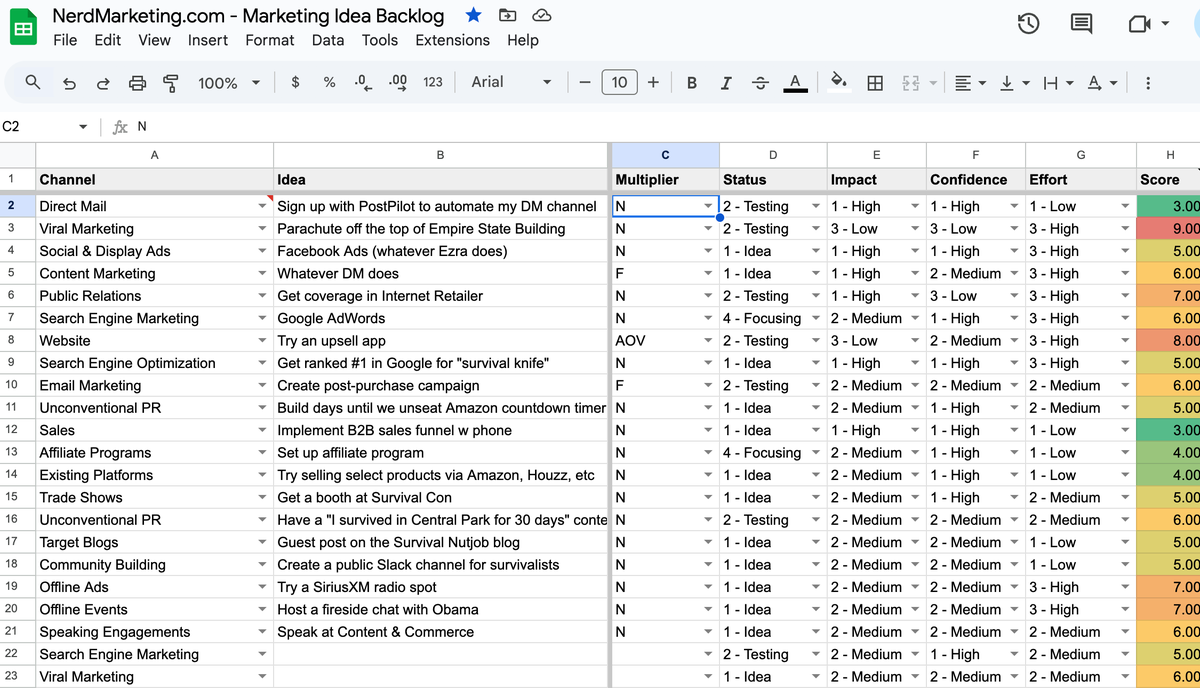
Well, a growth hacker named Sean Ellis (perhaps the original growth hacker?) has a great approach for ranking your marketing ideas.
He grades each potential idea, 1-5, by three criteria:
1️⃣ Expected impact (I). How likely is the idea to impact the top line?
2️⃣ Confidence (C). How confident are we that this idea will work?
3️⃣ Effort required (E). How much time and effort will we need to execute on this idea?
He calls this grade the ICE score.
He then ranks all his ideas by their ICE scores. Indeed, he isn't alone in scoring ideas like this. Nemo Chu (Kissmetrics), Josh Pigford (Bare Metrics), and others recommend roughly the same approach.
I used an ICE-style system at DesignPublic.com to go from $0 to $1 million in our first year.
Fifteen years later I used the same system to take Karmaloop from losing $500K/month to profitable. In under 10 months.
And five years after that, I used it at AutoAnything to double the top line over a couple years.
I recommend you use an ICE-style score to organize all the marketing ideas at your company too. Here's how:
1️⃣ Brainstorm all the marketing ideas you have; tack them to a wall using Post-it notes (1 hour)
2️⃣ Group these notes by the Three Multipliers I talk about all the time: AOV, F, or C
3️⃣ Have each team member score each idea from 1 (worst) to 5 (best) across the ICE criteria. Then create a ICE average score for each idea. (1 hour)
Now, you don't just start with the 555's—the best-ranking ideas.
Want to short-cut the process? There's a better approach...
You should start with the highest ranking idea that is also grouped under AOV or F.
By focusing on AOV or F first, you are working on your current business. Your current customers. Before you worry about acquiring more of them.
In other words, maximize first then multiply.
Why?
Simple. Every dollar you spend on AOV or F does double duty.
• First, it increases the retention and AOV of customers you have already acquired.
• Second, when you do turn to acquisition, the retention and AOV of all new customers that you acquire will be higher.
Why run Meta campaigns at a 200% ROI when you run the same ones at a 500% ROI?
If you want a nifty spreadsheet I built to help you along this process, drop a 🚀 and I’ll send it to you.
Or just follow me where I post these tactics daily.
3
10
989
23 Jan 2025
Most DTC turnovers that I’ve taken over look at discounts totally wrong.
More often than not they are shooting themselves in the foot when they employ discounts.
Here’s the brutal math of pricing strategy that most brands never embrace:
The raw truth: A 20% discount isn't just 20% off your revenue. For a brand with 50% gross margin, you're SLASHING profits by 40%.
They are a straight hit to margin.
So use them smartly. Here’s my playbook:
1️⃣ Customer Segmentation is King
Treat different customers differently.
Many customers arrive on your site, ready to buy, and immediately see a 20% off splash page.
Of course they take it. But they would have bought anyway at full margin.
How do you know who these are?
Try exit-intent popups or promos like “enter to win” vs. a straight-up discount.
(At Karmaloop this generated 100s of thousands in short term margin).
2️⃣ Build a Discount Ladder
• 10% for recent customers
• Sliding scale up to 30% for inactive buyers
You’ll sync the offer with the likelihood of purchase.
3️⃣ Consider alternatives to the flat-out discount. Get creative with higher-margin incentives:
• Gift with purchase
• Store credit
• Exclusive product drops
• Tiered spend incentives
• Free shipping upgrades
These all worked at Karmaloop, oVertone, and AutoAnything. Start here before you spray and pray.
Follow me for more turnaround ideas like these.
2
1
3
564
9 Dec 2024
You know the number one thing you can market this month?
It’s the products that create your best customers.
At AutoAnything, we had customers who started out with a suspension. They went on to purchase over $15K of product the subsequent year.
Whales.
On the other end, we had customers who started out with a $5 spark plug.
They went on to purchase . . . nothing.
Minnows.
Well, guess what?
Which products do you want to market over the holiday? Plugs or suspensions? Plugs convert really well, right? So plugs??
Nope.
You have to take CLV into consideration as a merchandiser and as a marketer. It’s not just about conversion rates.
Optimizing around a $15K customer in our December marketing meant a killer Q1 of the subsequent year.
You should do the same.
Hopefully it gives you a lot of lifetime value in Santa's bag under the tree.
4
5
471
12 Nov 2024
Ten years ago, I generated ~$5M in revenue over the four days between Black Friday and Cyber Monday.
High-fives all around!
Only later in December did I realize we *lost* money over that time period.
D’OH!
Here's the mistake I made and how you can avoid it:
1. Realize that we (brands media) have trained our customers to shop during BFCM.
It's when we do the most marketing.
It's when we offer the biggest deals / discounts.
It's really no surprise that these 96 hours generate the most revenue each year.
2. The key insight: this is just *reallocated* demand.
Customers hold off on (full-margin) Q3 and Q4 purchases so that they can spend on (discounted) purchases over BFCM.
Are you starting to see the problem? We are cannibalizing ourselves.
3. The icing on the cake? During BFCM, CACs skyrocket.
At my last brand (AutoAnything), Amazon, Walmart, and AutoZone all entered the paid ad markets during Cyber Week, which would drive up CACs by 4-5x.
What was once a profitable LTV:CAC went negative overnight.
Recap:
Customers want to buy on discount. And you pay more to acquire them.
Revenue comes, but it's low/no margin.
It's the Woody Allen joke: "This food is terrible and in such small portions"
What's a DTC marketer to do? Three strategies:
1. Be smart on your discounts
It's true: non-discount promotions exist. Some favs:
→ Free gift with purchase
→ Discounting only the highest margin skus
→ Expedited shipping
If you discount, know how deep you can go. Be sure to consider ALL marketing and service costs.
2. Spend EARLY on paid prospecting ads
What was your latency of {ad click} to {conversion} for 2021?
For most brands, the *brand new* customers that buy over BFCM clicked an ad in early Nov.
So only spend up until then.
Cap your prospecting during BFCW and instead...
3. Lean into your owned audiences over BFCM
Don't take on Amazon on paid. Trust me.
Target your owned audiences (using email, SMS, direct mail) instead.
You will hold down your marketing costs.
That's it.
3 factors that make this a dangerous time for DTC 3 strategies to combat them.
PRO TIP: Only direct mail allows you to target ALL your previous buyers.
It's been my BFCM stalwart for 20 years. Caps your CAC casts the widest possible net.
DM me and I’ll show you how to use it.
3
1
8
1,016
22 Jul 2024
The Big 4 flows that @klaviyo highlighted in its 2024 Benchmark report are the most important things you can be working on as a marketer. By Big 4, I mean:
-Welcome
-Post-purchase
-Abandoned cart
-Browse abandonment
These are the email tactics I’ve been writing about and using at all of my brands for the last [ahem] years, and they remain important enough that Klaviyo continues to highlight their efficacy.
Really, the subtext is:
-You’ve gotta be using these.
-If you’re not already, start yesterday.
If you are already, make ‘em better.
Because. . .
They are >fundamental< to email programs improving them is crazy-high-ROI marketing work.
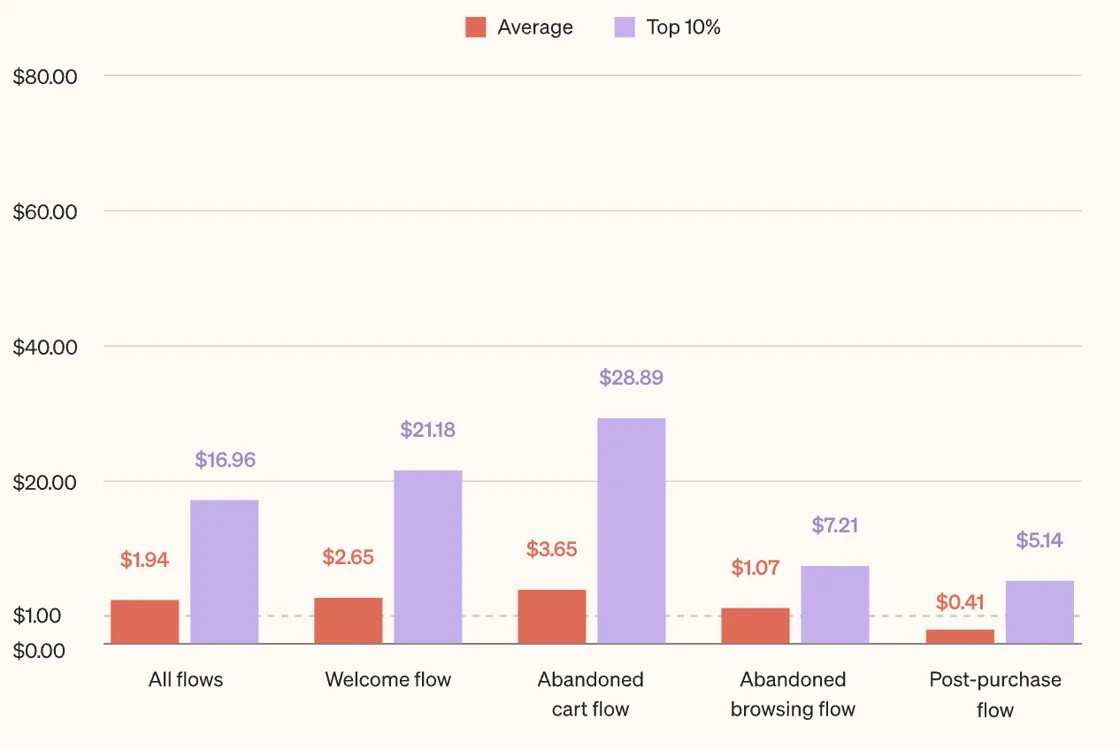
Revenue per recipient (RPR) gets silly high when you’re looking at the Top 10% vs. the average (see attached graph).
The best abandoned cart flows are ~692% higher than the average.
Looking at this, you have to ask yourself whether you’re driving the most value with your time.
If you’re around avg RPR, and a few months of work on abandoned welcome)can double RPR, that’s where your hours should go.
That’s potentially tens/hundreds of thousands/millions per month of extra revenue you can get from your flows.
This work turns solid brands into great brands and great brands into household names.
It’s what I obsessed over for 20yrs, starting back in the early 2000s at my first brand, Design Public.
It’s why I first launched Nerd Marketing. A great email program was, is, and will remain key to being a great brand.
And driving even more value from email (with direct mail) has been one of our missions at @getpostpilot.
I wish I could have used direct mail to extend what I was doing with email over my whole brandside career, but PostPilot didn’t exist until my last 2 turnarounds, AutoAnything and oVertone.
(You better believe we were combining email flows PostPilot-powered direct mail at both brands, though.)
3 High-ROI Email Direct Mail Moves:
1️⃣ Add a postcard at the end of your welcome flows and post-purchase flows. Or go further and create a postcard flow at the end of those email flows.
2️⃣ Same idea with abandoned cart: add a postcard(s) to the end of your abandoned cart flow.
3️⃣ Go a step beyond email’s browse abandonment capabilities and use direct mail for anonymous retargeting with our popular feature, SiteMatchTM. And, as @mepstein311 likes to say, “lower your Meta taxes” in the process.
These tactics will take mere minutes of your time and add thousands ($) to your flows.
We have brands driving ~$500k (at 8 ROI) just from adding a postcard to the welcome flow.
LMK if you want to see similar results.
3
3
32
8,729