Sjoe! From Rainbow to Red Line 🌈➡️🧨 Why the Western Cape Is Packing Its Bags ~ Bloody Streets & Broken Promises 🩸📜 The Case for a Cape Breakaway ~ A Federation on Life Support 🚑⚠️ Why the Western Cape Is Eyeing the Exit.
Sjoe! Imagine a country where the promise of unity feels like chasing a rainbow after a storm that never ends—beautiful in theory, but always slipping away. In South Africa, that rainbow is fading fast, especially in the Western Cape, where whispers of independence are turning into a roar.
Sjoe, the shock of it all: a province once hailed as the jewel of the nation now eyeing the exit door, not because of whimsy, but because the cracks in the foundation are too wide to ignore.
This isn't a tale of rebellion; it's a chronicle of survival. As crime spirals, trust crumbles, and resources vanish into national black holes, the question looms: When—not if—will the Western Cape break free?
Drawing from a web of evidence spanning polls, statistics, historical accords, and global shifts, this piece unravels how systemic failures are pushing Balkanization from fantasy to foregone conclusion. Buckle up, dear reader; we're diving into the absurd drama of a nation at odds with itself, where bureaucracy dances with chaos, and hope peeks through the irony.
Stirring Questions:
What hidden forces are accelerating this shift from unity to fragmentation?
If the "Rainbow Nation" was meant to bind us, why does it feel like it's unraveling thread by thread?
How can a single province's grievances echo the nation's deeper woes?
In a world of redrawn borders, is South Africa's map next on the table?
These questions together are vital because they force us to confront the illusion of post-apartheid harmony, highlighting how unaddressed divides could redefine our future, urging proactive dialogue before inevitability sets in.
The Fractured Foundation: Understanding the Push for Autonomy
Picture this: You're in the Western Cape, a land of rolling vineyards and bustling ports, but also shadowed by gunfire that echoes like a grim symphony. Sjoe, the irony— a place that could be paradise, yet plagued by a national government that treats local pleas like unwanted junk mail.
The core issue? A centralized system that's failing spectacularly, where Pretoria holds the reins on everything from policing to purse strings, leaving provinces like beggars at their own feast.
Common views paint this as mere political squabbling: the ANC guarding its power, the DA pushing for efficiency. But dig deeper, and it's a comedy of errors—cadre deployment stuffing institutions with loyalists over experts, porous borders inviting chaos like an open-house party gone wrong.
Historical echoes abound: The 1994 Accord on Afrikaner Self-Determination promised negotiations for autonomy, yet three decades later, it's gathering dust. Section 235 of the Constitution nods to self-determination for cultural communities, but without action, it's just pretty words.
Enter the Western Cape, governed by the DA since 2009, boasting cleaner audits and innovative programs, yet handcuffed by national vetoes. Sjoe, the exhaustion of it all—residents aren't dreaming of secession for fun; they're reacting to a system where unity feels like a bad joke, one where the punchline is persistent inequality and unheeded cries for change.
This context sets the stage for why Balkanization isn't a radical plot but a rational response, blending frustration with a dash of hope that going solo could rewrite the script.
Stirring Questions:
How has the unfulfilled promise of 1994 shaped today's autonomy demands?
If centralization was meant to foster equality, why does it breed resentment in thriving regions?
What role do everyday frustrations, like denied devolution, play in fueling larger separatist sentiments?
Could this provincial push signal a broader reevaluation of South Africa's federal structure?
Collectively, these questions matter because they bridge past ideals with present realities, compelling us to examine if clinging to outdated unity models risks greater division, and why addressing them now could preserve the nation's fabric.
Weaving the Web of Evidence: A Cumulative Network
The Bloody Impasse: When Governance Fails and Crime Reigns
Sjoe, let's start with the grim reality that hits like a cold Cape wind—persistent national policing failures that turn streets into battlegrounds. Imagine your neighborhood where a routine animal clinic visit ends in tragedy: On January 7, 2026, in Ravensmead, a 25-year-old man was fatally shot and a 12-year-old boy wounded while waiting for pet care at an AACL mobile unit (Nova News, 2026).
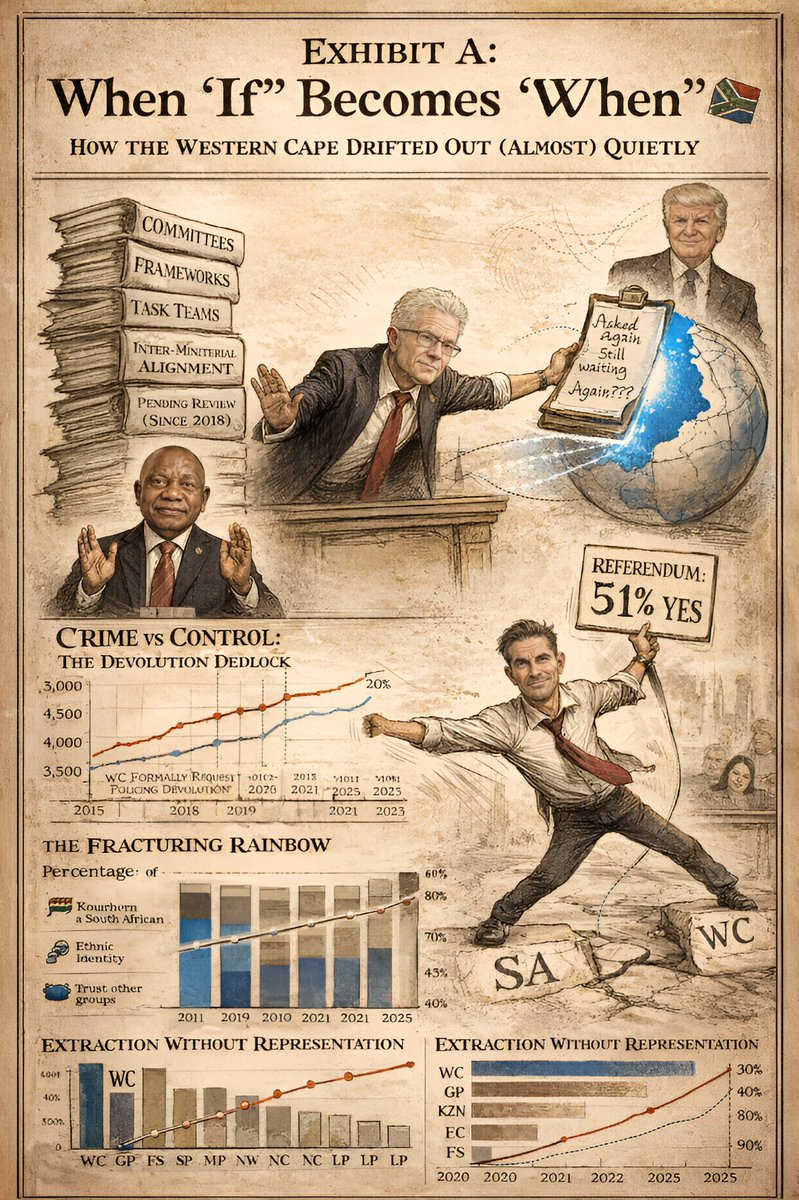
This isn't isolated; the Western Cape logged 1,160 murders in Q2 2025/2026, a 15.3% spike, despite comprising just 11% of the population yet 23% of national cases (Eyewitness News, 2025). The ANC's repeated denials of devolution since 2019 mock provincial pleas, ignoring successes like the LEAP program, which slashed murders by up to 56% in hotspots (Western Cape Government, 2025).
Cadre deployment and porous borders fuel this farce, smuggling guns and drugs that arm gangs, creating an unbreakable cycle of violence. Sjoe, the absurdity: a government that promises safety but delivers sabotage theories.
This impasse erodes faith in unity, linking to ethnic rifts where "outsiders" become scapegoats, making autonomy not a choice but a lifeline for survival.
Fractured Rainbows: The Erosion of Trust and Identity
Building on that security void, the social fabric unravels like a poorly knit sweater. The Afrobarometer report of January 6, 2026, reveals 26% of South Africans prioritizing ethnicity over nationality—the highest among 33 African countries surveyed—down from 70% national preference in 2011 (Afrobarometer, 2026).
Trust in other ethnic groups? A measly 31%, with 44% sensing government discrimination, skyrocketing to 75% among Coloureds, the Western Cape's majority. Sjoe, the tragic comedy of the "Rainbow Nation"—once a vibrant motto from the /Xam language meaning "diverse people unite," now a faded postcard haunted by apartheid's ghosts.
Historical forced removals to Bantustans and ongoing racialized laws (145 pieces, 122 post-1994) deepen divisions, intersecting with crime where migrants are scapegoated amid porous borders. Tolerance for different-ethnic neighbors stands at 80%, but down 13 points since 2018, fragmenting coalitions.
This psychological schism accelerates self-determination, tying back to governance failures: when national policies exacerbate rifts rather than heal, regional identity becomes a shield, making Balkanization a protective "when."
Political Pivot: Elections as Catalysts for Change
Now, the plot thickens with political theater worthy of a soap opera. The DA's role in the Government of National Unity (GNU) post-2024 elections is a reluctant waltz, limiting autonomy pushes to keep the coalition afloat, yet alienating its Western Cape base demanding devolution amid rising crime.
A potential Gauteng loss in 2026—key for national clout, with mixed predictions as of January 11, 2026—could force a retreat to regional strongholds (conversation analysis, 2026).
Past unrest from 2021-2023 boosted independence polls, showing setbacks amplify localism; pro-independence outfits like the Referendum Party add pressure for alliances. Sjoe, the irony: the DA's "golden ticket" in Gauteng slips away, turning national ambitions into a deadline for endorsement of a 2027 private referendum.
This pivot links to economic woes, where fiscal extraction fuels grievances, and ethnic divides, where marginalized voters demand action, creating timed momentum that shifts Balkanization from passive dream to active inevitability.
Fiscal and Global Tides: Survival Economics Meet International Winds
Finally, the material undercurrents surge forward. The Western Cape's economic prowess—12.1% of population but 89% of national net job growth (360,347 jobs from Q1 2020-Q1 2025)—contrasts sharply with national sluggishness, yet it funnels resources to inefficiencies like state-owned enterprise crises and a debt-to-GDP ratio climbing to 77.9% by end-2025 (Trading Economics, 2026; Western Cape Government, 2025).
Sjoe, the colonial echo: "extraction without representation," where provincial strengths in tourism and agriculture subsidize national black holes, intensified by crime's drag on welfare. Polls show 51% favoring a referendum, 43% independence, highest among Coloureds at 60% (Cape Independence Advocacy Group, 2025).
Globally, Israel's December 26, 2025, recognition of Somaliland challenges border sanctity, echoing U.S. Afrikaner asylum programs and legitimizing ethnic claims (The New York Times, 2025). This external blueprint reduces barriers, self-reinforcing as support hits 40-50%.
Governance voids, identity erosion, political pivots—making Balkanization an economic and diplomatic "when."
Stirring Questions:
How do interconnected failures in policing, identity, politics, and economics create a perfect storm for separation?
If evidence from diverse fields converges on inevitability, why persist with a flawed federation?
What untapped alliances could hasten or halt this momentum?
In a global era of redrawn maps, how might Western Cape's path influence Africa's multi-ethnic states?
These questions are crucial together as they reveal how isolated issues form a unified threat to national coherence, demanding we weigh reform against rupture for South Africa's future.
Uniting the Threads: The Inescapable Logic
Sjoe, as this web tightens—from bloody streets where clinics become crime scenes, to fractured identities mocking the rainbow dream, political dances teetering on electoral edges, and fiscal drains meeting global nods—the picture clarifies.
The evidence network weaves science (social psychology via Afrobarometer), economics (debt and job data), history (1994 Accord), and politics into one truth: Balkanization's "when" is forged in irreconcilable realities. It's falsifiable—national reforms could pivot it back—but stakes are high: a divided nation risks chaos.
Picture the Western Cape as a lifeboat—devolution denied, trust evaporated, votes swinging, resources reclaimed, precedents inspiring—autonomy not as destruction, but rebirth.
Stirring Questions:
What reforms could falsify this evidence and restore unity?
If the evidence is so interwoven, why the delay in addressing root causes?
How might citizen action influence the "when"?
Could this model apply to other provinces, reshaping South Africa entirely?
Together, these questions underscore the evidence's strength, emphasizing why interrogating them fosters resilience, turning potential crisis into opportunity for equitable evolution.
Addressing the Skeptics: Common Counterpoints Refuted
"Independence would shatter national unity, a sacred post-apartheid vow." Fair point; empathy for those clinging to Mandela's vision. Yet, evidence shows unity's already fracturing: Afrobarometer's 31% trust signals pre-existing divides, not caused by secession talk (Afrobarometer, 2026).
Economic doomsayers warn of isolation, but the Western Cape's self-sufficiency—89% national job growth—counters this, with separation potentially retaining revenues for local reinvestment (Western Cape Government, 2025).
Fears of precedent-setting chaos ignore global models like Somaliland's stable path, recognized amid similar multi-ethnic tensions (The New York Times, 2025).
Sjoe, the real absurdity: pretending all's well while stats scream otherwise. These objections, while heartfelt, crumble under facts, revealing denial as the true risk.
A Call to Reckoning: Charting the Future
Sjoe, we've traversed the bloody impasses, fractured rainbows, political pivots, fiscal fiascos, and global echoes—each thread tightening the noose on a faltering federation. The claim stands: Western Cape independence is becoming inevitable, a rational response to systemic rot exposing the "Rainbow Nation" as mirage.
Dear reader, imagine your role in this unfolding drama—will you watch the storm or steer the ship? Demand devolution now, before the "when" arrives unbidden. Sjoe, the wry hope: perhaps in separation lies the seed for reborn unity elsewhere. The evidence network proves Western Cape independence is becoming inevitable with undeniable evidence.
#SjoeNews 😮🗞️
#SjoeMoment 🤯
#CapeExit 🚪🌊
#FromIfToWhen ⏳🔥
#RainbowNationNoMore 🌈💔
#WesternCapeRising 🏔️⬆️
#BalkanisationVibes 🧨🗺️
#PretoriaProblems 🏛️🙄
#AutonomyNow ✊📜
#CrimeChaosCommittees 🔫🔥📑
#FiscalFiasco 💸🤡
#DevolutionDenied 🚫⚖️
#MapRedrawEnergy 🗺️✍️
#ThisIsNotFine 🔥🐶
#SjoeThatEscalated 😬💥
#SurvivalNotSecession 🛟🇿🇦
#WhenNotIf ⏰⚠️
#BrokenRainbow 🌈🧵
#FederalFail 🚑📉
#SjoeSA 😮🇿🇦
References
Afrobarometer. (2026). South Africans embrace ethnic identity, distrust other ethnic groups (Dispatch No. AD1102).
afrobarometer.org/publicatio…
Cape Independence Advocacy Group. (2025). Cape independence polling results for 2025.
capeindependence.org/post/ca…
Eyewitness News. (2025, December 17). Cape Town remains epicentre of violent crime in WC, reveal Q2 statistics.
ewn.co.za/2025/12/17/cape-to…
Nova News. (2026, January 8). Man killed, child injured in random shooting at animal clinic in Cape Town.
novanews.co.za/man-killed-ch…
The New York Times. (2025, December 26). Israel becomes the first nation to recognize Somaliland.
nytimes.com/2025/12/26/world…
Trading Economics. (2026). South Africa government debt to GDP.
tradingeconomics.com/south-a…
Western Cape Government. (2025). Provincial economic review and outlook.
westerncape.gov.za/treasury/…
 Daily Romania