
14 May 2025
Automating AI Discovery for Biomedicine Through Knowledge Graphs And LLM Agents
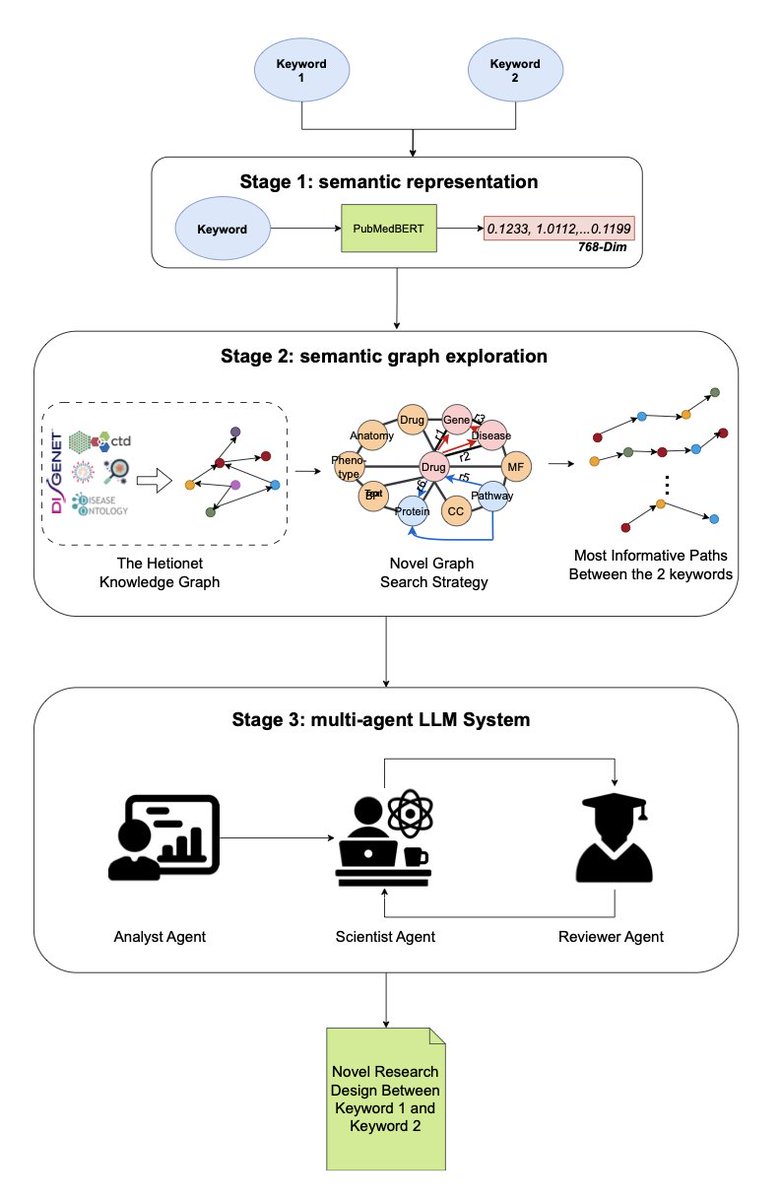
1.This paper introduces a novel framework that combines semantic knowledge graph traversal with a multi-agent LLM system to automatically generate computational research proposals in biomedicine.
2.At the core of the framework is a three-stage pipeline: semantic embedding using PubMedBERT, guided graph search to find biologically meaningful paths between entity pairs, and iterative research design by specialized LLM agents.
3.The system begins by embedding biomedical entities and their relationships from Hetionet using PubMedBERT, ensuring domain-specific semantic representations.
4.A bidirectional beam search algorithm, enhanced with semantic waypoints, is used to discover non-obvious but biologically plausible paths between entities in the knowledge graph, bypassing the pitfalls of hub-dominated traversal in large biomedical graphs.
5.Once a path is found, a three-agent LLM system—comprising Analyst, Scientist, and Reviewer roles—collaborates iteratively to propose, critique, and refine a full research plan grounded in the discovered graph.
6.The Analyst Agent defines and contextualizes each graph node and relationship; the Scientist Agent formulates an AI-based research design; and the Reviewer Agent critiques it on scientific rigor, feasibility, clarity, and novelty.
7.Each proposal goes through multiple refinement rounds, mimicking academic peer review, and is scored on four dimensions: Relevance, Feasibility, Significance, and Verifiability, using a stringent, evidence-based scoring protocol.
8.Across ten biomedical entity pairs—e.g., "Leptin signaling pathway → Rheumatoid arthritis" or "Mitochondrial protein complex → Parkinson’s disease"—the system generated novel AI tasks with scores as high as 8.75/10, reflecting biological plausibility and scientific rigor.
9.For example, in the leptin–arthritis case, the system proposed a hybrid GraphSAGE and RNN-LSTM model to assess risk via AKT1 and Cyclosporine—backed by detailed data, architecture, and validation plans.
10.All AI designs are stored with full iteration history, feedback, evaluation scores, and implementation details, allowing post-hoc analysis and reproducibility.
11.A web-based tool, Intelliscope, provides public access to this system, offering end-to-end automated biomedical research design via a user-friendly dashboard.
12.This framework addresses the problem of literature overload in biomedicine, using structured knowledge and LLMs to generate grounded, innovative research hypotheses that might otherwise be missed.
📜Paper: biorxiv.org/content/10.1101/…
#AI4Science #BiomedicalKnowledgeGraphs #LLMAgents #AutomatedResearch #ComputationalBiology #Bioinformatics #GraphSearch #ScientificDiscovery #AutoML #KnowledgeRepresentation
7
25
1,893
14 May 2025
Automating AI Discovery for Biomedicine Through Knowledge Graphs And LLM Agents
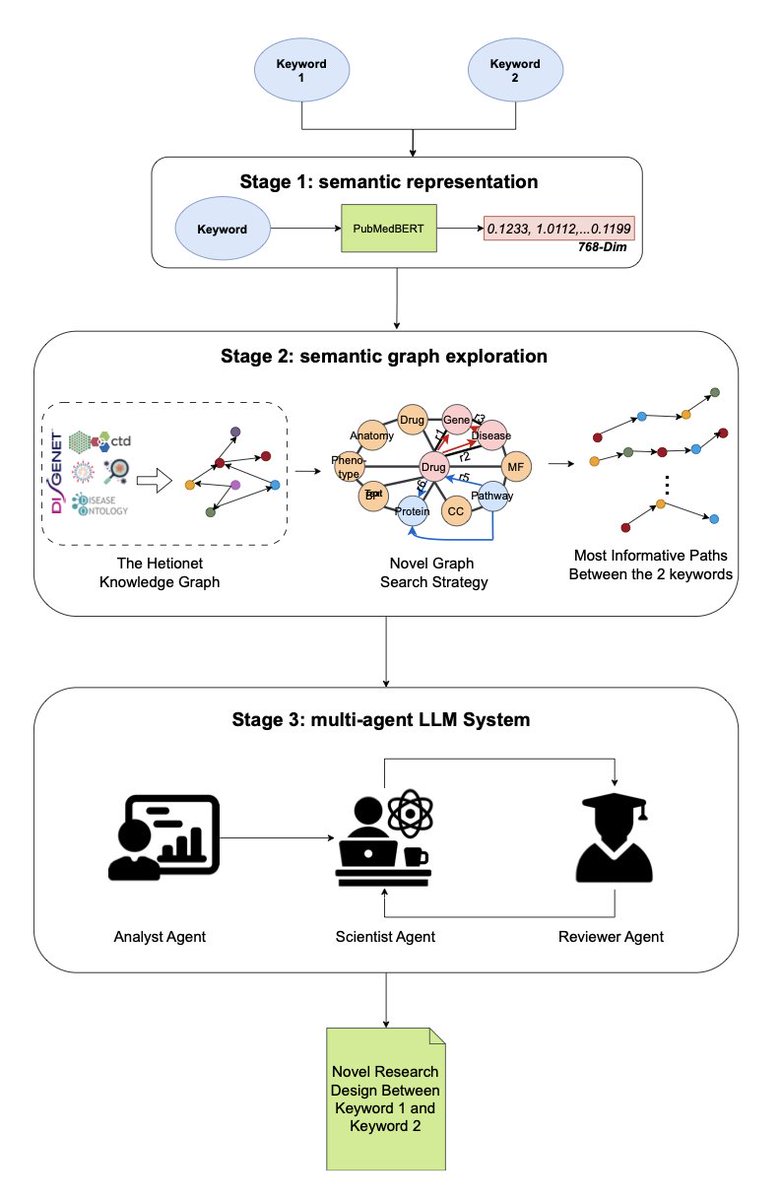
1.This paper introduces a novel framework that combines semantic knowledge graph traversal with a multi-agent LLM system to automatically generate computational research proposals in biomedicine.
2.At the core of the framework is a three-stage pipeline: semantic embedding using PubMedBERT, guided graph search to find biologically meaningful paths between entity pairs, and iterative research design by specialized LLM agents.
3.The system begins by embedding biomedical entities and their relationships from Hetionet using PubMedBERT, ensuring domain-specific semantic representations.
4.A bidirectional beam search algorithm, enhanced with semantic waypoints, is used to discover non-obvious but biologically plausible paths between entities in the knowledge graph, bypassing the pitfalls of hub-dominated traversal in large biomedical graphs.
5.Once a path is found, a three-agent LLM system—comprising Analyst, Scientist, and Reviewer roles—collaborates iteratively to propose, critique, and refine a full research plan grounded in the discovered graph.
6.The Analyst Agent defines and contextualizes each graph node and relationship; the Scientist Agent formulates an AI-based research design; and the Reviewer Agent critiques it on scientific rigor, feasibility, clarity, and novelty.
7.Each proposal goes through multiple refinement rounds, mimicking academic peer review, and is scored on four dimensions: Relevance, Feasibility, Significance, and Verifiability, using a stringent, evidence-based scoring protocol.
8.Across ten biomedical entity pairs—e.g., "Leptin signaling pathway → Rheumatoid arthritis" or "Mitochondrial protein complex → Parkinson’s disease"—the system generated novel AI tasks with scores as high as 8.75/10, reflecting biological plausibility and scientific rigor.
9.For example, in the leptin–arthritis case, the system proposed a hybrid GraphSAGE and RNN-LSTM model to assess risk via AKT1 and Cyclosporine—backed by detailed data, architecture, and validation plans.
10.All AI designs are stored with full iteration history, feedback, evaluation scores, and implementation details, allowing post-hoc analysis and reproducibility.
11.A web-based tool, Intelliscope, provides public access to this system, offering end-to-end automated biomedical research design via a user-friendly dashboard.
12.This framework addresses the problem of literature overload in biomedicine, using structured knowledge and LLMs to generate grounded, innovative research hypotheses that might otherwise be missed.
📜Paper: biorxiv.org/content/10.1101/…
#AI4Science #BiomedicalKnowledgeGraphs #LLMAgents #AutomatedResearch #ComputationalBiology #Bioinformatics #GraphSearch #ScientificDiscovery #AutoML #KnowledgeRepresentation
648

25 Aug 2024
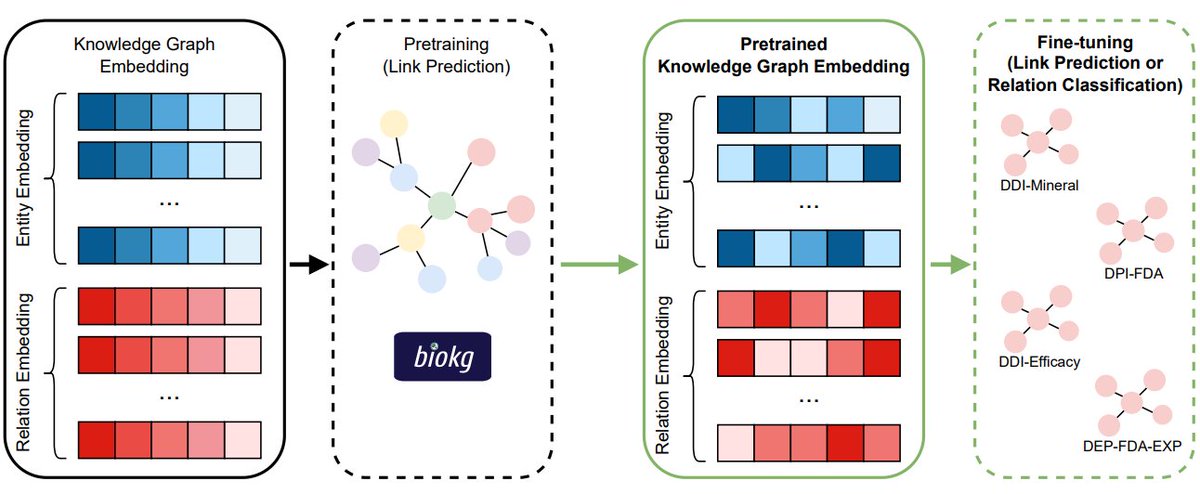
Knowledge Graph Embeddings in the Biomedical Domain: Are They Useful? A Look at Link Prediction, Rule Learning, and Downstream Polypharmacy Tasks. #KnowledgeGraphs #BiomedicalData #BiomedicalKnowledgeGraphs @BioinfoAdv
academic.oup.com/bioinformat…
266