
May 11
Merci pour cette publication qui nous rappelle l'essentiel. Les entreprises ont longtemps décrypté nos personnalités à travers nos achats et nos publications — pratique qui s'inscrit dans la continuité du GraphSearch de Facebook, lancé en 2013, et dont certaines dictatures se sont servies pour traquer des opposants politiques ou des individus en raison de leur orientation sexuelle. Sont venus ensuite les algorithmes, puis les chatbots.
Il est désormais légitime que l'intelligence artificielle apprenne à nous connaître, car elle s'impose comme un véritable collaborateur, parfois même comme un confident. La véritable question est celle de la propriété des données. Dans mes interventions, je plaide pour une IA locale, garante de la protection de notre intimité numérique.
1
22

29 Sep 2025
GraphSearch: An Agentic Deep Searching Workflow for Graph Retrieval-Augmented Generation
Proposes an agentic deep searching framework that addresses shallow retrieval in Graph RAG through dual-channel retrieval.
📝arxiv.org/abs/2509.22009
👨🏽💻github.com/DataArcTech/Graph…
4
18
1,137

8 Aug 2025
Exciting news! 🎉 @moorcheh_ai has surpassed 3000 SDK downloads in @github, a milestone driven by both #developers and #AiAgent
Our #OpenSource community tier built for a powerful #VectorSearch, #HybridSearch and #GraphSearch helping the community build more accurate #RAG & #Ai

1
2
4
108

14 May 2025
Automating AI Discovery for Biomedicine Through Knowledge Graphs And LLM Agents
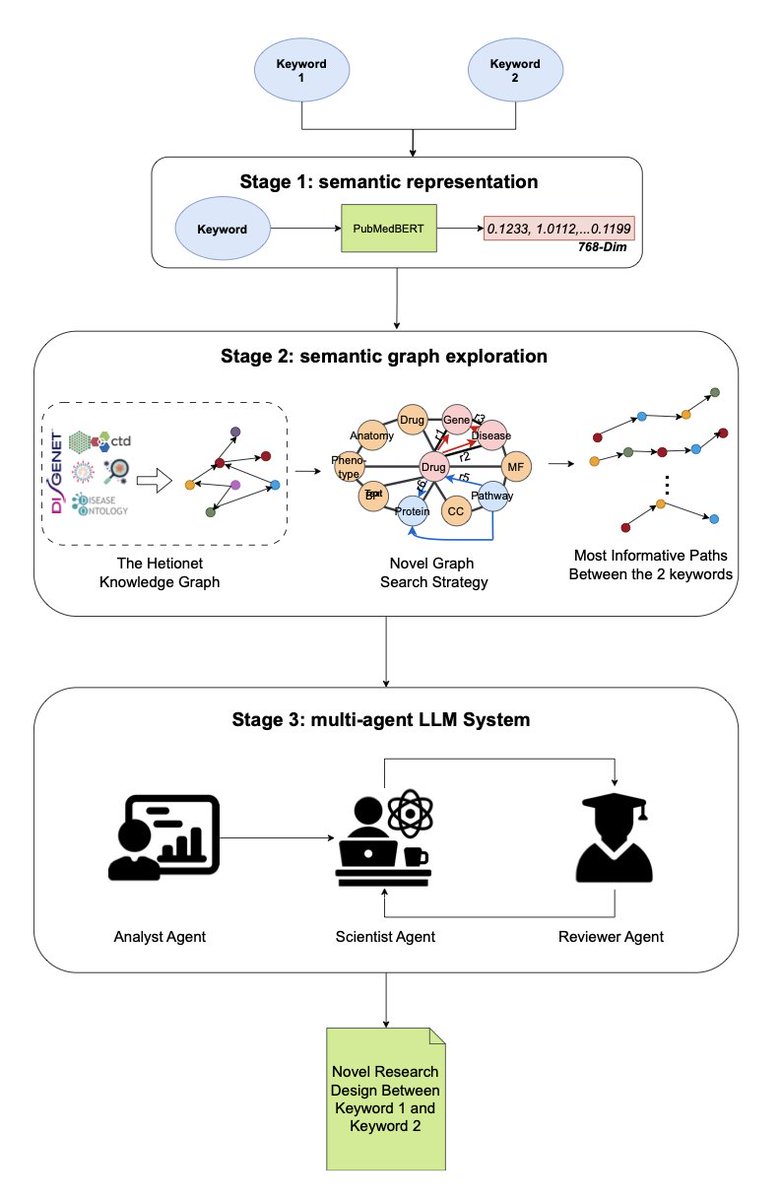
1.This paper introduces a novel framework that combines semantic knowledge graph traversal with a multi-agent LLM system to automatically generate computational research proposals in biomedicine.
2.At the core of the framework is a three-stage pipeline: semantic embedding using PubMedBERT, guided graph search to find biologically meaningful paths between entity pairs, and iterative research design by specialized LLM agents.
3.The system begins by embedding biomedical entities and their relationships from Hetionet using PubMedBERT, ensuring domain-specific semantic representations.
4.A bidirectional beam search algorithm, enhanced with semantic waypoints, is used to discover non-obvious but biologically plausible paths between entities in the knowledge graph, bypassing the pitfalls of hub-dominated traversal in large biomedical graphs.
5.Once a path is found, a three-agent LLM system—comprising Analyst, Scientist, and Reviewer roles—collaborates iteratively to propose, critique, and refine a full research plan grounded in the discovered graph.
6.The Analyst Agent defines and contextualizes each graph node and relationship; the Scientist Agent formulates an AI-based research design; and the Reviewer Agent critiques it on scientific rigor, feasibility, clarity, and novelty.
7.Each proposal goes through multiple refinement rounds, mimicking academic peer review, and is scored on four dimensions: Relevance, Feasibility, Significance, and Verifiability, using a stringent, evidence-based scoring protocol.
8.Across ten biomedical entity pairs—e.g., "Leptin signaling pathway → Rheumatoid arthritis" or "Mitochondrial protein complex → Parkinson’s disease"—the system generated novel AI tasks with scores as high as 8.75/10, reflecting biological plausibility and scientific rigor.
9.For example, in the leptin–arthritis case, the system proposed a hybrid GraphSAGE and RNN-LSTM model to assess risk via AKT1 and Cyclosporine—backed by detailed data, architecture, and validation plans.
10.All AI designs are stored with full iteration history, feedback, evaluation scores, and implementation details, allowing post-hoc analysis and reproducibility.
11.A web-based tool, Intelliscope, provides public access to this system, offering end-to-end automated biomedical research design via a user-friendly dashboard.
12.This framework addresses the problem of literature overload in biomedicine, using structured knowledge and LLMs to generate grounded, innovative research hypotheses that might otherwise be missed.
📜Paper: biorxiv.org/content/10.1101/…
#AI4Science #BiomedicalKnowledgeGraphs #LLMAgents #AutomatedResearch #ComputationalBiology #Bioinformatics #GraphSearch #ScientificDiscovery #AutoML #KnowledgeRepresentation
7
25
1,893
14 May 2025
Automating AI Discovery for Biomedicine Through Knowledge Graphs And LLM Agents
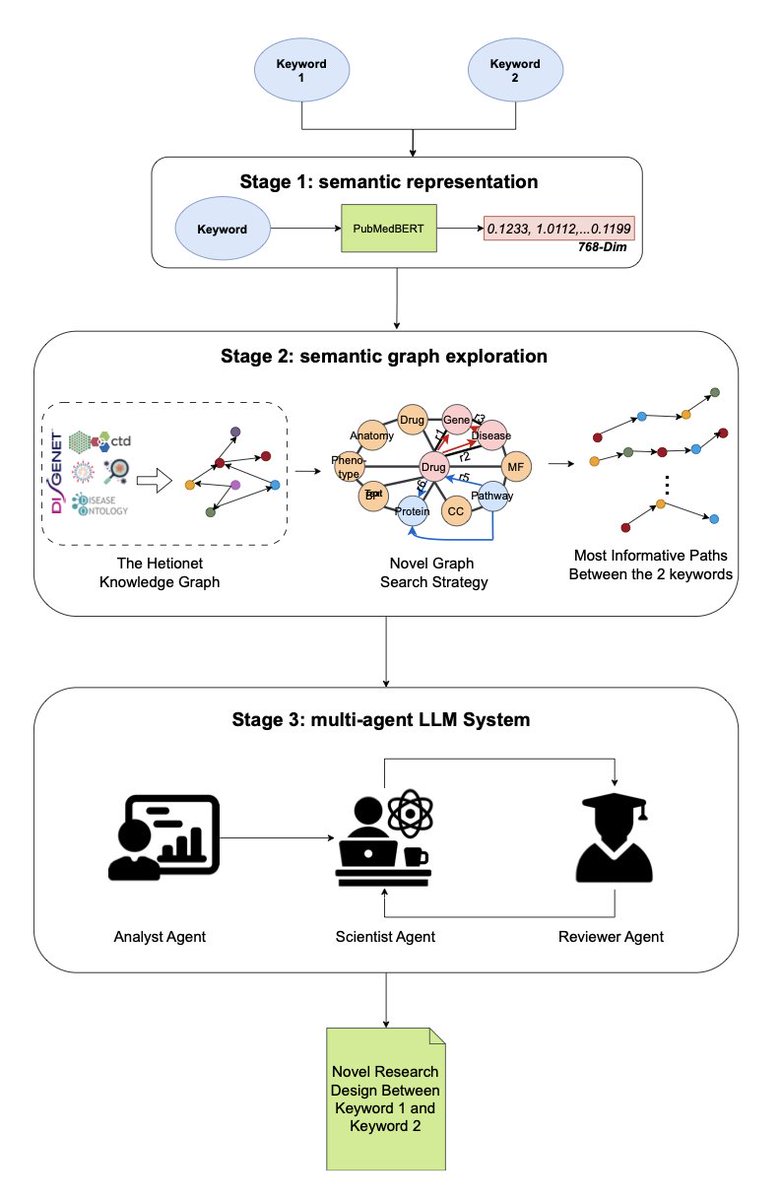
1.This paper introduces a novel framework that combines semantic knowledge graph traversal with a multi-agent LLM system to automatically generate computational research proposals in biomedicine.
2.At the core of the framework is a three-stage pipeline: semantic embedding using PubMedBERT, guided graph search to find biologically meaningful paths between entity pairs, and iterative research design by specialized LLM agents.
3.The system begins by embedding biomedical entities and their relationships from Hetionet using PubMedBERT, ensuring domain-specific semantic representations.
4.A bidirectional beam search algorithm, enhanced with semantic waypoints, is used to discover non-obvious but biologically plausible paths between entities in the knowledge graph, bypassing the pitfalls of hub-dominated traversal in large biomedical graphs.
5.Once a path is found, a three-agent LLM system—comprising Analyst, Scientist, and Reviewer roles—collaborates iteratively to propose, critique, and refine a full research plan grounded in the discovered graph.
6.The Analyst Agent defines and contextualizes each graph node and relationship; the Scientist Agent formulates an AI-based research design; and the Reviewer Agent critiques it on scientific rigor, feasibility, clarity, and novelty.
7.Each proposal goes through multiple refinement rounds, mimicking academic peer review, and is scored on four dimensions: Relevance, Feasibility, Significance, and Verifiability, using a stringent, evidence-based scoring protocol.
8.Across ten biomedical entity pairs—e.g., "Leptin signaling pathway → Rheumatoid arthritis" or "Mitochondrial protein complex → Parkinson’s disease"—the system generated novel AI tasks with scores as high as 8.75/10, reflecting biological plausibility and scientific rigor.
9.For example, in the leptin–arthritis case, the system proposed a hybrid GraphSAGE and RNN-LSTM model to assess risk via AKT1 and Cyclosporine—backed by detailed data, architecture, and validation plans.
10.All AI designs are stored with full iteration history, feedback, evaluation scores, and implementation details, allowing post-hoc analysis and reproducibility.
11.A web-based tool, Intelliscope, provides public access to this system, offering end-to-end automated biomedical research design via a user-friendly dashboard.
12.This framework addresses the problem of literature overload in biomedicine, using structured knowledge and LLMs to generate grounded, innovative research hypotheses that might otherwise be missed.
📜Paper: biorxiv.org/content/10.1101/…
#AI4Science #BiomedicalKnowledgeGraphs #LLMAgents #AutomatedResearch #ComputationalBiology #Bioinformatics #GraphSearch #ScientificDiscovery #AutoML #KnowledgeRepresentation
648

30 Sep 2024
🥈Runner-Up Prizes:
Best Use of Subgraph 🔍 goes to GraphSearch Tools, a tool that helps users quickly query the world of blockchain data with the help of The Graph.
Best Substreams Implementation 🪄 goes to ZKML VaultX, a ZKML-powered trustless ML prediction agents solution.
2
1
14
4,104

11 Sep 2024
📣Deal of the Day📣 Sep 11
SAVE 45% TODAY ONLY!
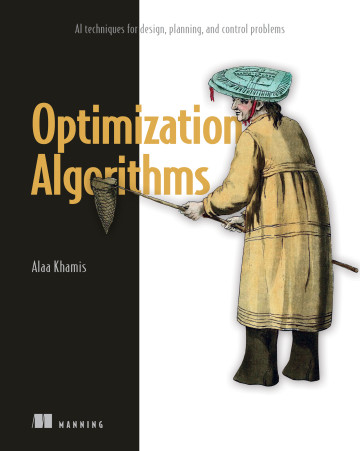
Optimization Algorithms & selected titles: mng.bz/WrEx @AlaaKha30787995 #search #optimization #algorithms #graphsearch
Now in print! Solve design, planning, and control problems using modern #AI techniques.
8
785
12 Mar 2024
🖥️ Watch 🖥️ Optimization Algorithms - First Chapter Summary: loom.ly/x5wnQsg
A sneak peek at the book by Alaa Khamis 📖 Optimization Algorithms 📖 @AlaaKha30787995 #search #optimization #algorithms #graphsearch #AI
SAVE 40% on this book with code: watchkhamis40

5
836

5 Jan 2024
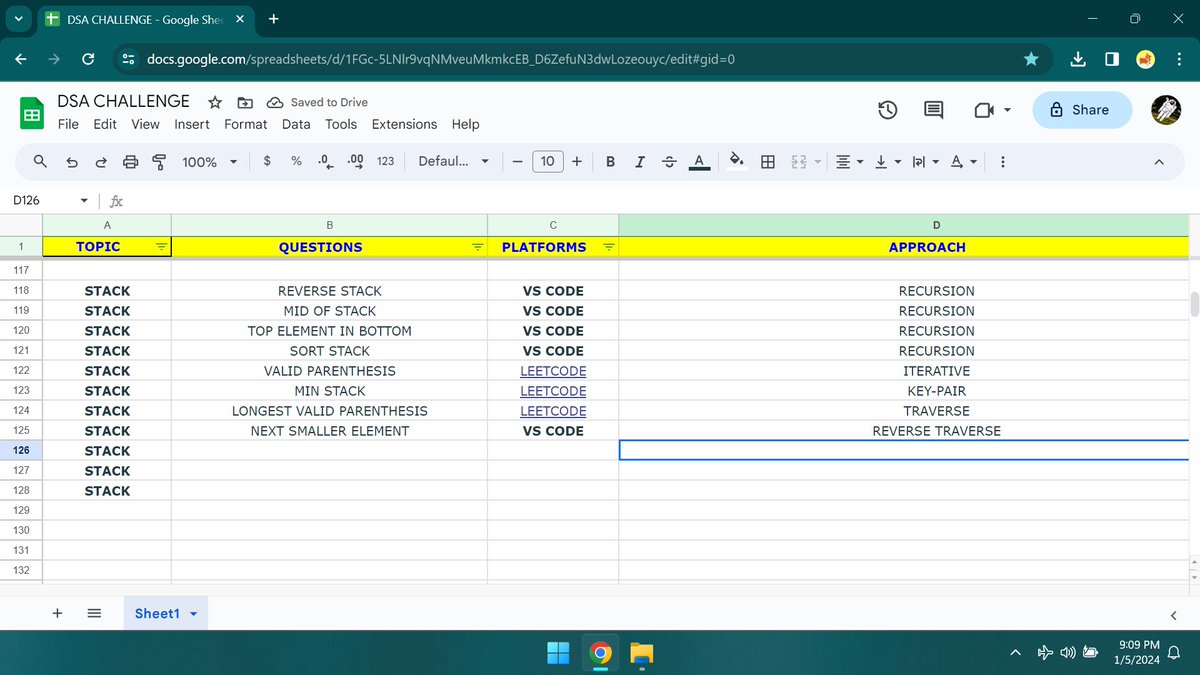
Day 19 of #100daysofcode ! - 5 JANUARY 2024
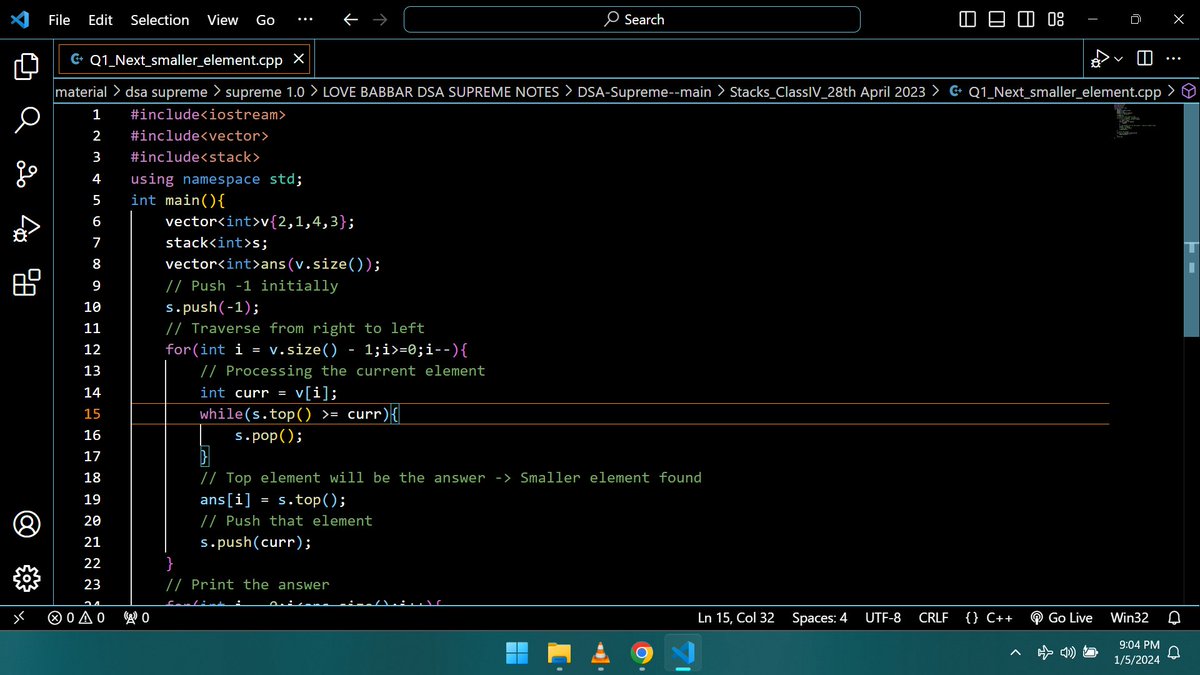
The questions i solved today are :-
1}NEXT SMALLEST NUMBER
#graphsearch #dynamicprogramming #backtracking #bitmanipulation #recursion #sorting #trees #hashing #greedyalgorithms #divideandconquer #stringmanipulation #combinatorics
3
21

8 Sep 2023
Six faves from the #MCN2023 program in chrono order, 2/6:
LUX: Cross-Collection Discovery at Yale
#MuseTech #MuseumData #LinkedOpenData #LinkedData #GraphSearch #Search @Yale
mcn2023.sched.com/event/1RYO…
2
89

6 Aug 2021
Fully funded #Postdoctoral position available for excellent candidates #KnowledgeGraph #graphsearch #graphmining #machinlearnig in a very exciting project with a strong industrial partner @csaudk.
linkedin.com/jobs/view/26757…
Deadline: Oct 1st
Contact me if you are interested!
1
3
7

8 Jun 2021
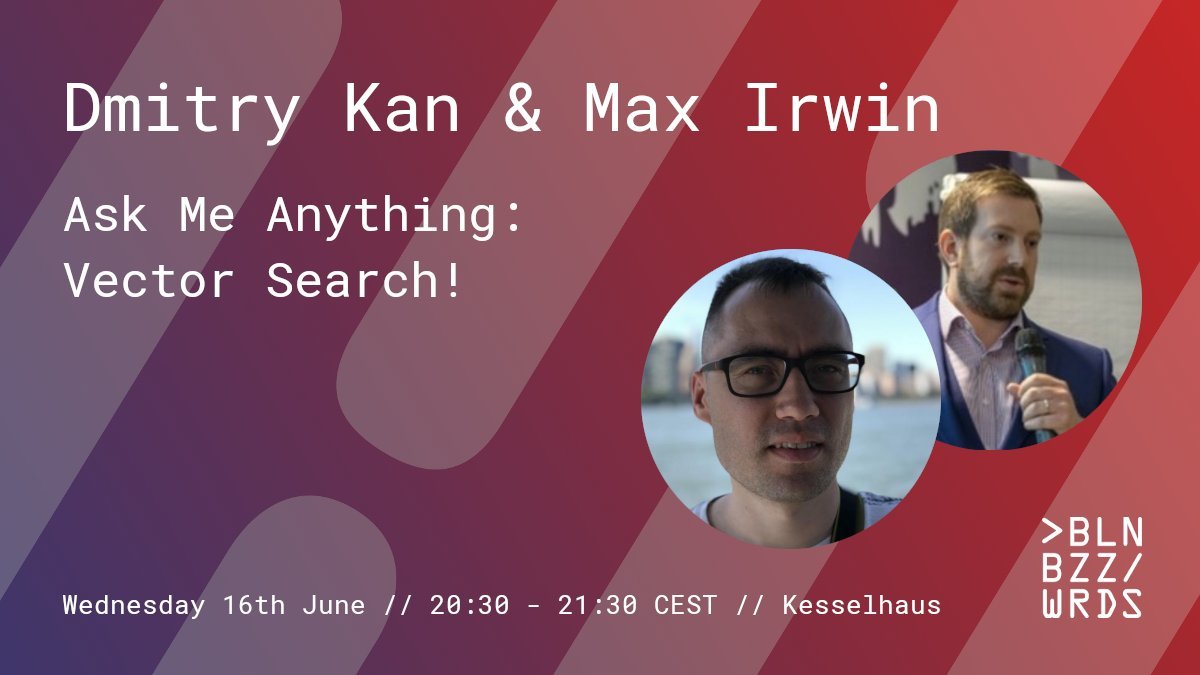
Please use this link forms.gle/eNd5EBxzrHEsGiEw5 to ask your specific question on #vectorsearch #densesearch #nearestneighbors #graphsearch for the Ask Me Anything: Vector Search session at .@berlinbuzzwords next week -- looking forward to a thoughtful discussion.
2
6

6 Jun 2021
Great pleasure to work with such a motivated and dedicated PhD studente on #graphsearch and #visualanalytics @CoDiSLabGraz @tugraz @tugraz_csbme in collaboration with @CERN
1 Jun 2021

Face of the month: Aleksandar (@aleksbobic ) His research focuses on #InformationRetrieval, #NetworkAnalysis and #DataVisualisation. He aims to enhance IR processes using Network Analysis approaches.
@tugraz @tugraz_csbme @CoDiSLabGraz

4

1 Oct 2020
1 Oct 2020
Face of the month: André @arattinger His research focuses on semantic information retrieval for multidimensional publication and patent graphs and is conducted in association with a web-based graph retrieval project developed @CERN #research #graphs #CoDiSLabGraz #semanticsearch

7

[From the best of the blog archives:]
Graph Databases for Beginners: Graph Search Algorithm Basics
by @JoyChao
Read now: r.neo4j.com/38CmT5H
#GraphSearch #GraphSearchAlgorithms #DijkstraAlgorithm
2
5

12 Jun 2020
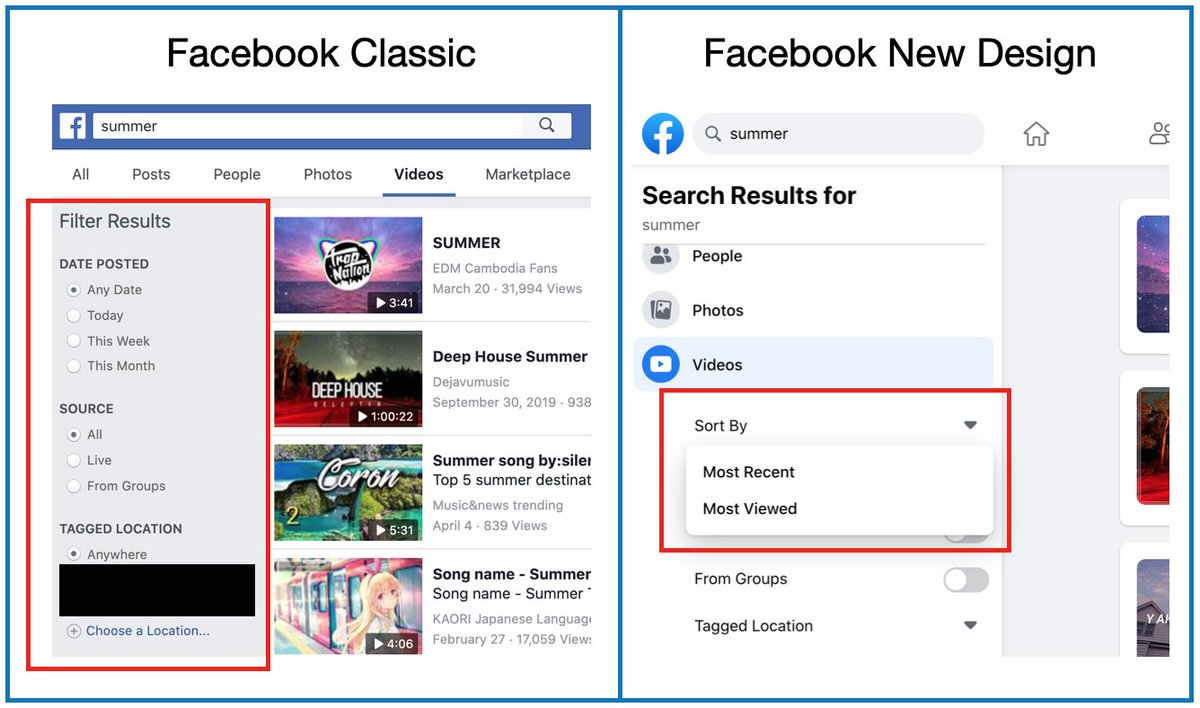
dutch_osintguy: RT technisette: Discovered today that in the new #Facebook design you have an extra option to filter your video search results. You can sort your results by 'Most Recent' and 'Most Viewed' #osint #osintcurious #graphsearch #facebookgraphs…
1
2

12 Jun 2020
#Thread on #Facebook Classic VS New Design
I'll be adding the differences I find between the FB Classic and the FB New design to this thread:
#osint #sourcing #osintcurious #graphsearch #facebooksearch
11 Jun 2020

Discovered today that in the new #Facebook design you have an extra option to filter your video search results. You can sort your results by 'Most Recent' and 'Most Viewed' #osint #osintcurious #graphsearch #facebookgraphsearch
1
45
84
11 Jun 2020
Discovered today that in the new #Facebook design you have an extra option to filter your video search results. You can sort your results by 'Most Recent' and 'Most Viewed' #osint #osintcurious #graphsearch #facebookgraphsearch
3
26
35

13 May 2020
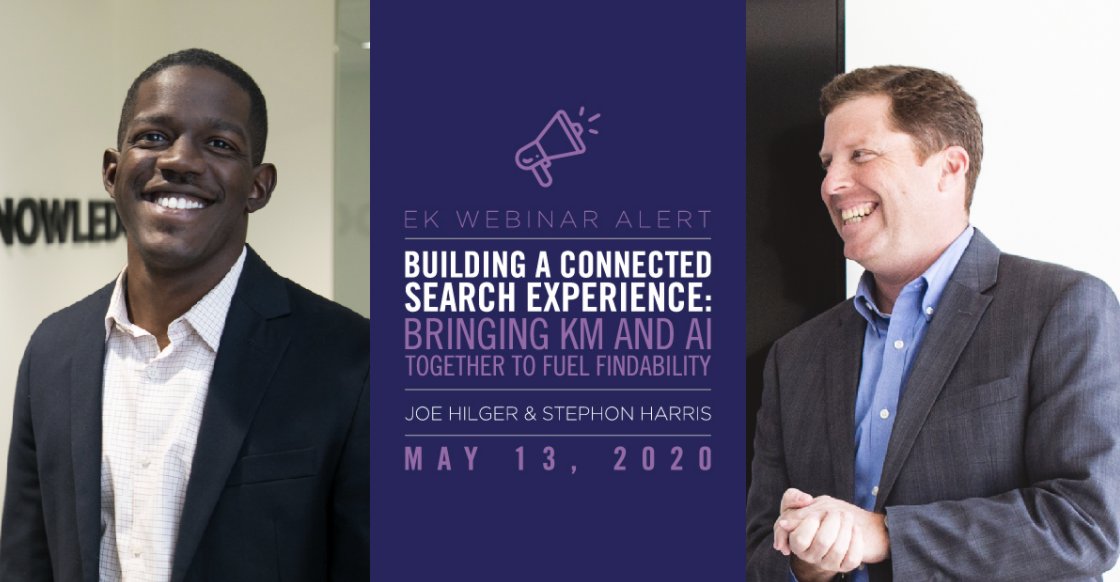
Today is the day! Join EK's search experts @_Stepharr and @jhilgerbc to discuss advanced search and findability - sign up at the link - - - -ow.ly/1YTJ50yZ4HO
#knowledgemanagement #graphsearch #enterprisesearch
6
2
4