Paga retweeted

Jun 13
Stop building Solana startups like it’s 2021. In 2026, speed on @solana doesn’t come from bigger teams, it comes from using the right stack.
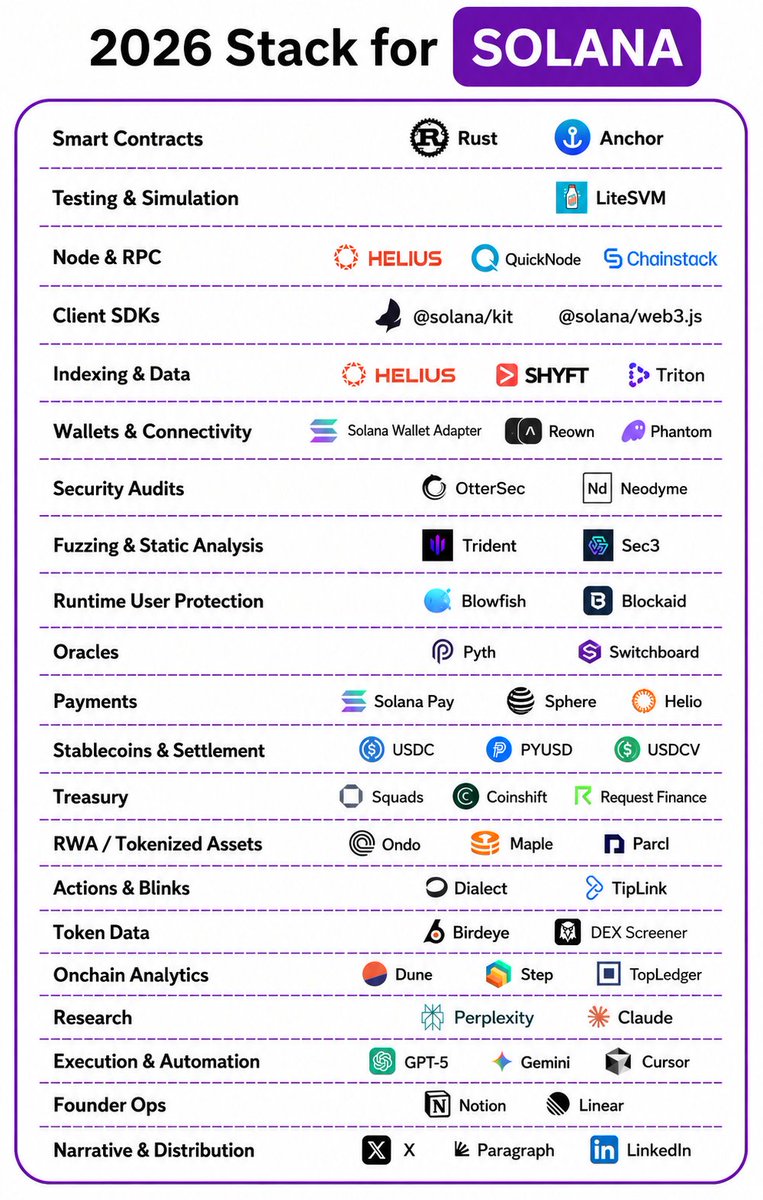
A serious Solana stack now looks something like this:
Core build layer
• Smart contracts → Rust / Anchor
• Testing & simulation → LiteSVM
• RPC / infra → Helius / QuickNode / Chainstack
• Client SDKs → Solana Kit / web3.js
• Indexing & data → Helius DAS / Shyft / Triton
• Wallet connectivity → Solana Wallet Adapter / Reown / Phantom
• Editor → VS Code / Cursor
Security & reliability
• Audits → OtterSec / Neodyme / Sec3
• Fuzzing → Trident
• Static analysis → Soteria / Sec3
• Runtime user protection → Blowfish / Blockaid / Phantom security UX
Product layer
• Oracles → @PythNetwork / Switchboard
• Payments → Solana Pay / Sphere / Helio / Crossmint
• Stablecoins & settlement → USDC by @circle / PYUSD by PayPal Paxos / USDCV by SG-FORGE
• Treasury → Squads
• RWA / tokenized assets → @OndoFinance / Maple / Credix / Parcl / Homebase
• DeFi liquidity → @JupiterExchange / Orca / Raydium / Kamino / Drift
• Actions & Blinks → Dialect / TipLink
• Token data → Birdeye / DexScreener / Jupiter APIs
• Onchain analytics → Dune / Step Finance / TopLedger / Flipside
Founder leverage
• Research → Perplexity / Claude
• Execution & automation → GPT / Gemini / Cursor
• Founder ops → Linear / Notion
• Narrative & distribution → X / LinkedIn / Paragraph / Mirror
The bigger point: Solana’s advantage is not only speed anymore. The next serious Solana startups will be built on top of mature infrastructure: payments, stablecoins, treasury, tokenized assets, analytics, wallets, oracles and security. That means teams can focus less on rebuilding the basics and more on building products users actually trust.
What would you add to the 2026 Solana stack?
3
1
2
127

Jun 13
Good stack breakdown. One piece that's often missing in these setups is native identity. Your on-chain name should be wired in from day one, not bolted on later.
1
47
Jun 11
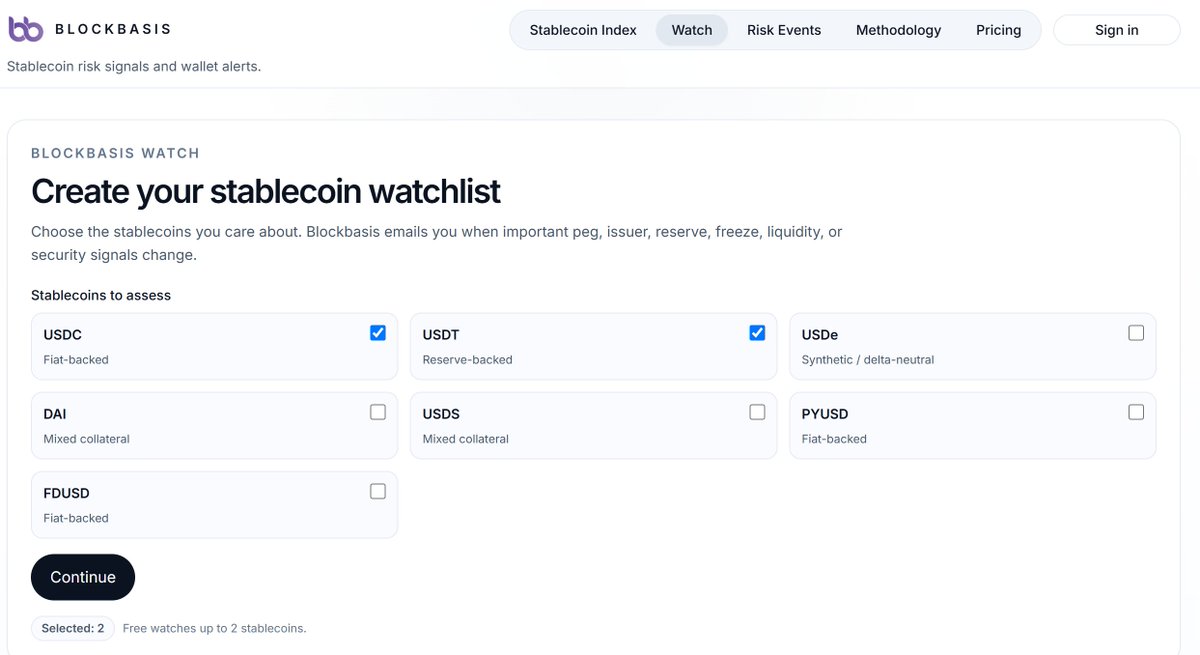
We made Blockbasis watchlist-first for a simple reason: most users think:
“I care about USDC.”
“I care about USDT.”
“I care about USDe.”
“I want to know if something important changes.”
Wallet scan is useful, but it is only a discovery step.
The core product should be simpler: choose the stablecoins you care about → get alerts when risk signals change.
No wallet required.
Create a free Watchlist: blockbasis.com/watch
24
Jun 9
Interesting to see more ecosystem-native stablecoins emerging! For any high-yield stablecoin, the useful question is not only “is it redeemable 1:1?”
There are:
• where does the yield come from?
• what backs the stablecoin?
• how liquid is redemption during stress?
• what happens if APY compresses?
• are risks at the stablecoin layer or staking/yield wrapper layer?
This is the kind of asset we’d like to add to Blockbasis coverage.
79
Jun 9
Most stablecoin conversations still start and end with: “Did it depeg?”
But that is only one part of the story. A stablecoin can sit close to $1 and still become riskier.
Maybe liquidity is drying up.
Maybe reserve disclosure is getting weaker.
Maybe the issuer has more freeze/regulatory exposure. Maybe the mechanism is more complex than people think.
Maybe the risk is not price today, but structure underneath.
The better question is: what kind of risk are we actually talking about? Peg risk, liquidity risk, issuer risk, reserve risk, freeze risk, regulatory risk, security risk, or structure/yield risk.
That is the language we are trying to build into Blockbasis. Not to create panic. Just to make stablecoin risk easier to understand and monitor.
10
Jun 8
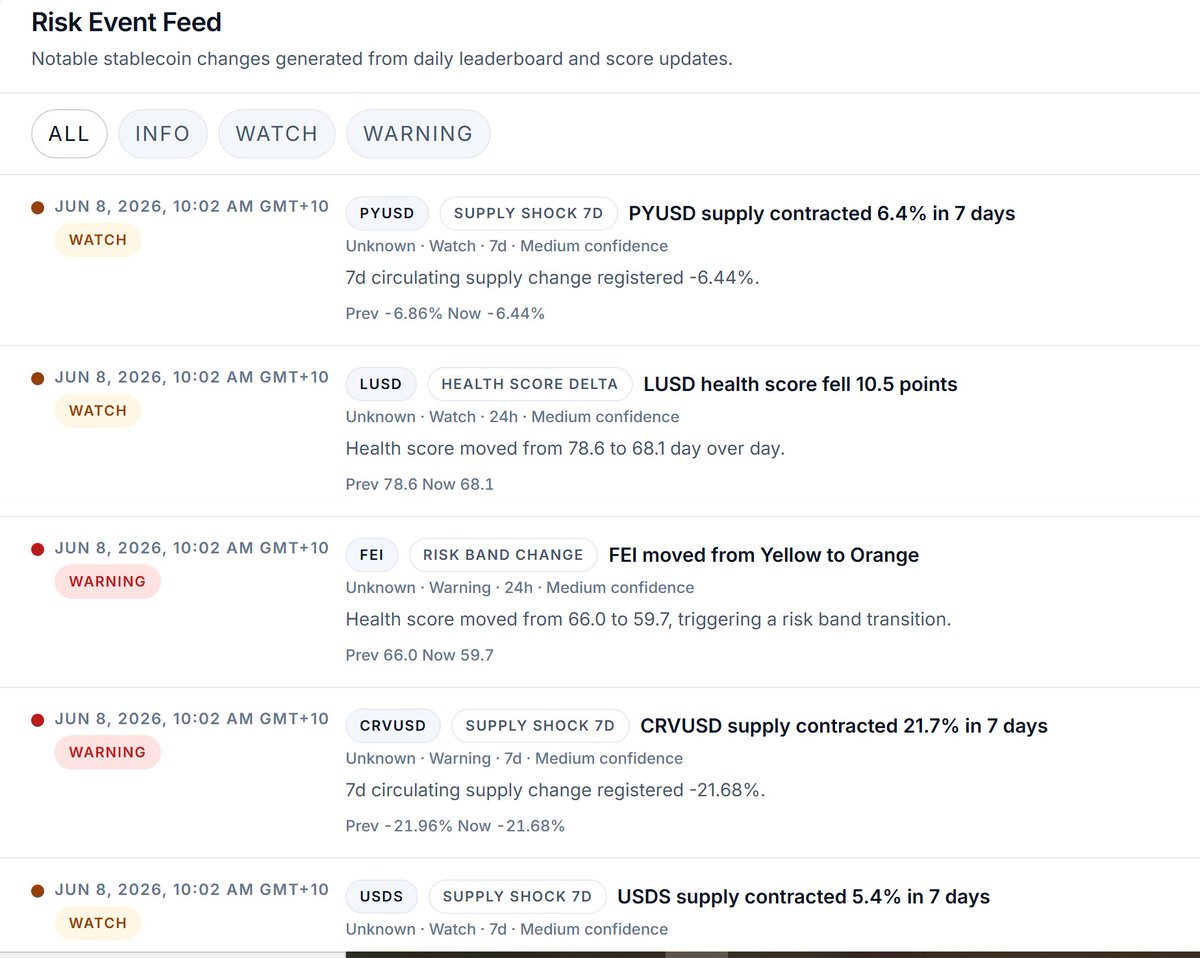
Stablecoin risk is no longer just “did it depeg?”
A stablecoin can trade near $1 and still become riskier underneath. Reserves can change; liquidity can dry up; an issuer can freeze funds; redemption terms can become unclear; regulation can shift; a yield or synthetic mechanism can show stress.
USDC, USDT, DAI, USDe, PYUSD and FDUSD are not the same product with different tickers. They have different issuers, reserve models, redemption paths, freeze powers, regulatory exposure and failure modes.
That is why we are narrowing Blockbasis from broad crypto security to stablecoin risk monitoring and for people who don’t want to monitor stablecoin risk manually or rely on X panic. Blockbasis tracks signals across peg, liquidity, issuer, reserve, freeze, regulatory, security and structure/yield risk.
Create a free Watchlist and monitor the stablecoins you care about. Link in comment 👇
1
54


3 Feb 2023
Thanks for all the questions. @matusho8 @Blockbasis @JBlockchain1010 please DM your wallet address.
1
412

2 Feb 2023
Please connect to Demex via Leap wallet or Keplr wallet and connect to the Carbon network. Then you can view your SWTH address.
1
42
20 Jan 2023
@USAFmike sorry, forgot to add your handle, please DM your picasso wallet as well
1
2
64

30 Sep 2022
You asked, we delivered ⌨️
Many of you have asked for a list of audits we have made for various dapps and protocols 🔍
Now you can find a filter on the homepage to see which projects have been audited by Blockbasis 🧐 👇
2
1
6


15 Jul 2022
You convince no one, placate no one
Are you Rick barber’s alt?
1
3


15 Jul 2022
It is an option, you just denied depositors their funds. You want to protect your own token over poolers
3

14 Jul 2022
You’re proving my point here, the Foundation won’t do anything and token holders want to drag things out
I can only wish you luck
14

14 Jul 2022
The bancor v3 protocol is designed and coded to steal depositors tokens when lp pools are in deficit. That's irrefutable fact.
1
3