
Decompiling Smart Contracts with a Large Language Model - arxiv.org/pdf/2506.19624
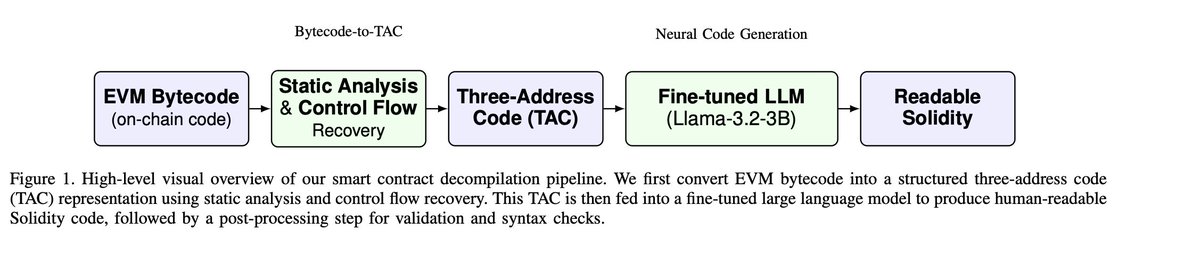
The widespread lack of broad source code verification on blockchain explorers such as Etherscan, where despite 78, 047, 845 smart contracts deployed on Ethereum (as of May 26, 2025), a mere 767, 520 (< 1 %) are open source, presents a severe impediment to blockchain security.
This opacity necessitates the automated semantic analysis of on-chain smart contract bytecode, a fundamental research challenge with direct implications for identifying vulnerabilities and understanding malicious behavior. Adversarial actors deliberately exploit this lack of transparency by deploying closedsource contracts, particularly in MEV and DeFi exploitation, thereby concealing their malicious logic and leaving security researchers with only inscrutable low-level bytecode.
Prevailing decompilers struggle to reverse bytecode in a readable manner, often yielding convoluted code that critically hampers vulnerability analysis and thwarts efforts to dissect contract functionalities for security auditing.
Authors: Isaac David, Liyi Zhou, Dawn Song, @HatforceSec, @KaihuaQIN
#SmartContractDecompilation #LLMDecompilation #BytecodeAnalysis #BlockchainSecurity #SmartContractSecurity #DeFiRisks #MEVExploitation #ClosedSourceContracts #OnChainAnalysis #ContractReverseEngineering #AI4Blockchain #LLMSecurity #CodeTransparency #EthereumSecurity #AIReverseEngineering #SemanticAnalysis #SecurityAuditing #ContractBytecode #LLMDeFi #SmartContractAudit
1
6
174

8 Nov 2018
A very strong differentiator in the #Blockchain market is the #BytecodeAnalysis, identified internally as Grammar development, which revolutionises the way #SmartContracts are tested and audited in a complex automated testing environment. ➡️ dev.modex.tech #Developers
4
3

#Modex Unified Developer Environment bit.ly/2Nay8qL #developers #UDE #Solidity #IDE #bytecodeanalysis #blockexplorer #oracles #blockchain #smartcontracts

11
11
#Modex Unified Developer Environment bit.ly/2Nay8qL #developers #UDE #Solidity #IDE #bytecodeanalysis #blockexplorer #oracles #blockchain #smartcontracts

11
12
#Modex Unified Developer Environment bit.ly/2Nay8qL #developers #UDE #Solidity #IDE #bytecodeanalysis #blockexplorer #oracles #blockchain #smartcontracts

11
11
#Modex Unified Developer Environment bit.ly/2Nay8qL #developers #UDE #Solidity #IDE #bytecodeanalysis #blockexplorer #oracles #blockchain #smartcontracts

11
12
#Modex Unified Developer Environment bit.ly/2Nay8qL #developers #UDE #Solidity #IDE #bytecodeanalysis #blockexplorer #oracles #blockchain #smartcontracts

8
11
#Modex Unified Developer Environment bit.ly/2Nay8qL #developers #UDE #Solidity #IDE #bytecodeanalysis #blockexplorer #oracles #blockchain #smartcontracts

11
11
#Modex Unified Developer Environment bit.ly/2Nay8qL #developers #UDE #Solidity #IDE #bytecodeanalysis #blockexplorer #oracles #blockchain #smartcontracts

11
11
#Modex Unified Developer Environment bit.ly/2Nay8qL #developers #UDE #Solidity #IDE #bytecodeanalysis #blockexplorer #oracles #blockchain #smartcontracts

11
11
#Modex Unified Developer Environment bit.ly/2Nay8qL #developers #UDE #Solidity #IDE #bytecodeanalysis #blockexplorer #oracles #blockchain #smartcontracts

10
10
29 Jun 2018
We present the Modex Unified Developer Environment! ➡️ blog.modex.tech/modex-unifie…
#Modex #developers #UDE #Solidity #IDE #bytecodeanalysis #blockexplorer #oracles #blockchain #smartcontracts
34
25