

Jun 15
INDEX TO MINERALS GATHERED FROM GRIFFIN'S SYSTEM OF CRYSTALLOGRAPHY
PART IV - D
239 / CCXXXIX. Datolith
240 / CCXL. Datholite
241 / CCXLI. Dark Red Silver
242 / CCXLII. Cymophane
243 / CCXLIII. Demant
244 / CCXLIV. Desmine
245 / CCXLV. Devonite
246 / CCXLVI. Diallage
247 / CCXLVII. Diamant
248 / CCXLVIII. Diamond
249 / CCXLIX. Diaspore
250 / CCL. Dichroite
251 / CCLI. Diopside
252 / CCLII. Dioptase
253 / CCLIII. Diploite
254 / CCLIV. Disthene
255 / CCLV. Dolomite
256 / CCLVI. Dreelite
257 / CCLVII. Dreelith
258 / CCLVIII. Dyoxilite
PART V - E
259 / CCLIX. Edler Granat
260 / CCLX. Edingtonite
261 / CCLXI. Efflorescent Zeolite
262 / CCLXII. Egeran
263 / CCLXIII. Einaxiger Glimmer
264 / CCLXIV. Eisenvitriol
265 / CCLXV. Eisen
266 / CCLXVI. Eisenkies
267 / CCLXVII. Eisenglanz
268 / CCLXVIII. Eisenspath
269 / CCLXIX. Eisspath
270 / CCLXX. Electric Calamine
271 / CCLXXI. Electrum
272 / CCLXXII. Emerald
273 / CCLXXIII. Emeraude
274 / CCLXXIV. Endellione Copper
275 / CCLXXV. Epidote
276 / CCLXXVI. Epistilbite
277 / CCLXXVII. Etain Sulfure
278 / CCLXXVIII. Etain Oxide
279 / CCLXXIX. Etain Manganésifère
280 / CCLXXX. Euchroite
281 / CCLXXXI. Euclase
282 / CCLXXXII. Euklas
283 / CCLXXXIII. Eudialyte
PART VI - F
284 / CCLXXXIV. Fahlerz
285 / CCLXXXV. Fassaite
286 / CCLXXXVI. Feldspar
287 / CCLXXXVII. Feldspath
288 / CCLXXXVIII. Fer Arséniaté
289 / CCLXXXIX. Fer Apyre
290 / CCXC. Fer Arsenical
291 / CCXCI. Fer Chromaté
292 / CCXCII. Fer Calcardo-Siliceux
293 / CCXCIII. Fer Natif
294 / CCXCIV. Fer Muriaté
295 / CCXCV. Fer Oligiste
296 / CCXCVI. Fer Oxidule
297 / CCXCVII. Fer Hydro-Oxide
298 / CCXCVIII. Fer Titané
299 / CCXCIX. Fer Phosphaté
300 / CCC. Fer Sulfaté
301 / CCCI. Fer Speculaire
302 / CCCII. Fer Spathique
303 / CCCIII. Fer Sulfuré
304 / CCCIV. Fer Blanc
305 / CCCV. Fergusonite
306 / CCCVI. Fibrous Malachite
307 / CCCVII. Fluellite
308 / CCCVIII. Fluorcerium
309 / CCCIX. Flucerine
310 / CCCX. Fish-Eye-Stone
311 / CCCXI. Fischaugenstein
312 / CCCXII. Flexible Sulphuret of Silver
313 / CCCXIII. Fluoride of Cerium
314 / CCCXIV. Fluophosphate of Magnesia
315 / CCCXV. Fluorspar
316 / CCCXVI. Forsterite
317 / CCCXVII. Foliated Zeolite
318 / CCCXVIII. Flusspath
319 / CCCXIX. Franklinite
320 / CCCXX. Fraueneis
PART VII - G
321 / CCCXXI. Gadolinite
322 / CCCXXII. Galena
323 / CCCXXIII. Gahnite
324 / CCCXXIV. Garnet
325 / CCCXXV. Galmei
326 / CCCXXVI. Gehlenite
327 / CCCXXVII. Gay-Lussite
328 / CCCXXVIII. Gelbbleierz
329 / CCCXXIX. Gemeiner Granat
330 / CCCXXX. Gemeiner Augite
331 / CCCXXXI. Glassy Feldspar
332 / CCCXXXII. Glaubersalz
333 / CCCXXXIII. Glauberite
334 / CCCXXXIV. Glauber's Salt
335 / CCCXXXV. Gold
336 / CCCXXXVI. Grammatite
337 / CCCXXXVII. Glimmer
338 / CCCXXXVIII. Granat
339 / CCCXXXIX. Graphic Tellurium
340 / CCCXL. Graphite
341 / CCCXLI. Green Vitriol
342 / CCCXLII. Green Carbonate of Copper
343 / CCCXLIII. Grau-Spiesglanzerz
344 / CCCXLIV. Grenat
345 / CCCXLV. Green Garnet
346 / CCCXLVI. Grey Cobalt
347 / CCCXLVII. Grey Copper
348 / CCCXLVIII. Grey Antimony
349 / CCCXLIX. Grossular
350 / CCCL. Grunbleierz
351 / CCCLI. Green Oxide of Manganese
352 / CCCLII. Gyps
353 / CCCLIII. Gypsum
354 / CCCLIV. Haarkies
⚠️Next comes the massive H-K section, including Haüyne, Harmotome, Helvine, Herderite, Hornblende, Hypersthene, Idocrase, Iridosmine, Jamesonite, Johannite, Kobaltblüthe, Korund, Kryolith, Kupferglanz, Kyanite, Labradorite, Lapis-Lazuli, and hundreds more.
1
1
64
Jun 15
⚠️ PART VII. (7) - DEEPER REPUBLICS OF CRYSTAL KNOWLEDGE - Key Fts - Forgotten Tags, Facets, Correspondences, Sciences, Authors, Propositions, & Mineral Mysteries Beyond the Common Textbooks -
📜 📜
Griffin's actual contents, mineral index,
Rose's classification system, obscure nineteenth-century (1800s-Ancient ages)mineralogy, crystallographic
mathematics, & forgotten
natural philosophy gives
us far richer material.
CCLXXXI. Acmitics
Derived from Acmite (now Aegirine). A forgotten branch of mineral observation concerned with dark green sodium-iron silicates occurring in igneous environments. Nineteenth-century mineralogists often regarded these black crystalline needles as signatures of profound subterranean fire-processes hidden beneath volcanic provinces.
CCLXXXII. Actinolitics
The study of radiating fibrous minerals such as Actinolite. These starburst structures fascinated early observers because they appeared to embody frozen rays, petrified light, or mineralized radiance emerging from the Earth's interior workshops.
CCLXXXIII. Amphibological Mineral Science
Not logical ambiguity but the science of Amphiboles. These minerals demonstrated that crystals could belong to enormous structural families while displaying striking variations in color, habit, density, and geological occurrence.
CCLXXXIV. Anatase Dynamics
The study of titanium-bearing crystal forms. Anatase became important because it showed how rare metallic substances could organize themselves into highly elegant geometric structures far removed from ordinary rock-forming minerals.
CCLXXXV. Arfvedsonian Studies
The investigation of dark alkaline silicates such as Arfvedsonite. These minerals became windows into unusual magmatic environments where rare elements accumulated and produced extraordinary crystalline architectures.
CCLXXXVI. Axinitic Architectonics
The science of Axinite crystals, whose sharply angled forms appeared almost mechanical in their precision. Early mineralogists frequently described them as resembling artificial instruments produced by nature herself.
CCLXXXVII. Azuritic Chromatics
The study of vivid mineral coloration. Azurite demonstrated that geometry alone could not explain mineral beauty. Color, transparency, and reflective power formed secondary kingdoms of mineral knowledge.
CCLXXXVIII. Boracitology
The science of Boracite and boron-bearing crystals. Such minerals fascinated nineteenth-century chemists because they connected geometric regularity with unusual chemical compositions.
CCLXXXIX. Botryogenic Morphology
The study of grape-like mineral aggregates. Botryogen and similar minerals showed that geometry sometimes expresses itself through clusters rather than isolated crystals.
CCXC. Brongniartian Geognosy
Inspired by Alexandre Brongniart. The interpretation of mineral systems within vast geological formations. Crystals became citizens of larger terrestrial provinces.
CCXCI. Brookitic Mineral Physics
Brookite demonstrated how identical chemistry could produce different geometries. This challenged simplistic assumptions and hinted at deeper structural laws governing matter.
CCXCII. Chabasitic Zeolitics
The study of zeolites as mineral sponges, absorbers, and geological transformers. Chabasite represented a forgotten frontier between chemistry, crystallography, and subterranean hydrology.
CCXCIII. Chiastolitic Symbolics
Chiastolite crystals naturally produce cross-like internal markings. They fascinated nineteenth-century collectors because geometry seemed to create symbolic forms without human intervention.
CCXCIV. Chromiferous Mineral Philosophy
The study of chromium-bearing minerals whose brilliant colors transformed ordinary geological specimens into objects of aesthetic and scientific wonder.
CCXCV. Cobalt Bloom Studies
Cobalt bloom minerals displayed remarkable colors and oxidation patterns. Their appearance often resembled natural paintings executed upon stone..
CCXCVI. Corundic Sovereignties
The science of Corundum, Sapphire, and Ruby. These minerals occupied aristocratic positions within mineral classification because of their hardness, brilliance, and geological rarity.
CCXCVII. Cryolitic Mysteries
Cryolite appeared almost magical to nineteenth-century investigators because of its unusual optical properties and strange appearance. It represented one of the mineral kingdom's great enigmas.
CCXCVIII. Cubicitics
The study of minerals dominated by cubic habits. Such forms embodied equilibrium, stability, and geometric perfection.
CCXCIX. Datolithic Mineral Genesis
Datolite became important because it linked boron chemistry, hydrothermal processes, and crystal growth within a single mineral species
CCC. Demantoid Studies
The investigation of exceptionally brilliant garnets whose optical fire rivaled diamonds and challenged assumptions concerning gemstone hierarchies.
CCCI. Diamond Architectonics
Diamond represents not merely hardness but one of nature's most efficient structural arrangements. Its internal geometry became a model of maximum stability.
CCCII. Diopsidic Petrology
The study of Diopside as a bridge between mineralogy and geology. Such minerals reveal the conditions under which deep terrestrial processes crystallize into visible form
CCCIII. Eudialytic Cosmochemistry
Eudialyte contains unusual elemental assemblages. To nineteenth-century observers it hinted that Earth's chemistry was vastly richer than previously imagined.
CCCIV. Euclasian Symmetrology
Euclase crystals display extraordinary clarity and symmetry, providing ideal examples for precise crystallographic measurement.
CCCV. Feldspathic Commonwealths
The feldspars constitute one of the largest mineral republics on Earth. Entire continents are constructed from their crystalline dominions.
CCCVI. Fergusonitic Mineral Analytics
Rare earth minerals such as Fergusonite revealed hidden chemical provinces largely invisible to earlier generations.
CCCVII. Franklinitic Metallogeny
Franklinite illustrated the intimate relationship between metallic ores and geometric organization.
CCCVIII. Gadolinitic Frontiers
Gadolinite opened pathways toward the discovery of rare earth elements, reshaping nineteenth-century chemistry.
CCCIX. Garnetic Genealogies
The garnet family demonstrated that one structural blueprint could generate numerous mineral species through compositional variation.
CCCX. Harmotomic Dynamics
Harmotome crystals exhibit twinning phenomena that challenged simple explanations of crystal growth.
CCCXI. Helvinic Mineral Philosophy
Helvine belongs to a rare class of minerals whose compositions revealed surprising relationships between sulfur, metals, and silicates.
CCCXII. Idocrasian Architectures
Idocrase (Vesuvianite) occupies an intermediate territory between several mineral families, making it a natural bridge-builder within mineral classification.
CCCXIII. Iridosmine Studies
One of the most exotic minerals in Griffin's index. Composed largely of iridium and osmium, it represented almost metallic relics from the Earth's deepest laboratories.
CCCXIV. Johannitic Uranology
Not celestial astronomy but uranium mineralogy. Johannite hinted at hidden energies and uncommon chemical processes long before radioactivity became known.
CCCXV. Lanthanitic Discoveries
Lanthanite belongs to the mysterious rare-earth domain. Such minerals suggested that Earth's elemental inventory was still incompletely known.
CCCXVI. Lazulitic Chromodynamics
The science of deep-blue phosphate minerals whose colors rivaled the finest pigments known to artists
CCCXVII. Lepidolitic Lithochemistry
Lepidolite introduced lithium into nineteenth-century mineral consciousness, opening entirely new chemical territories.
CCCXVIII. Magnetitic Cosmophysics
Magnetite fascinated natural philosophers because it appeared to unite mineral structure with invisible force fields.
CCCXIX. Mesolitic Fibrology
The study of needle-like zeolite growths whose delicate architectures resemble crystalline forests.
CCCXX. Monazitic Antiquities
Monazite later became crucial for rare-earth studies, but already in Griffin's day it represented one of the mineral kingdom's least understood treasures.
CCCXXI. Natrolitic Hydrodynamics
Natrolite crystals frequently emerge from fluid-rich geological environments, preserving evidence of ancient subterranean circulation.
CCCXXII. Nephelinic Petrogenesis
Nepheline-bearing rocks revealed alternative geological pathways distinct from granite-dominated terrains.
CCCXXIII. Oerstedtitic Mineral Theory
Rare minerals named after scientific pioneers often preserve forgotten histories of discovery embedded within nomenclature itself.
CCCXXIV. Olivinian Mantle Philosophy
Olivine later became recognized as a dominant mineral of Earth's mantle. Griffin's inclusion hints at the deep-earth significance later generations would uncover.
CCCXXV. Osmiridic Metallurgy
The study of naturally occurring osmium-iridium associations, among the rarest metallic substances known in the nineteenth century.
⚠️See next reply for continuation into Pyrochlore, Polymignite, Titanite, Tetradymite, Tourmaline, Zircon, Yttrocerite, Wolfram, Vanadinite, Titaniferous minerals, Tellurides, Uranites, and the forgotten rare-earth republics hidden throughout the remainder of Griffin's index.
Jun 15

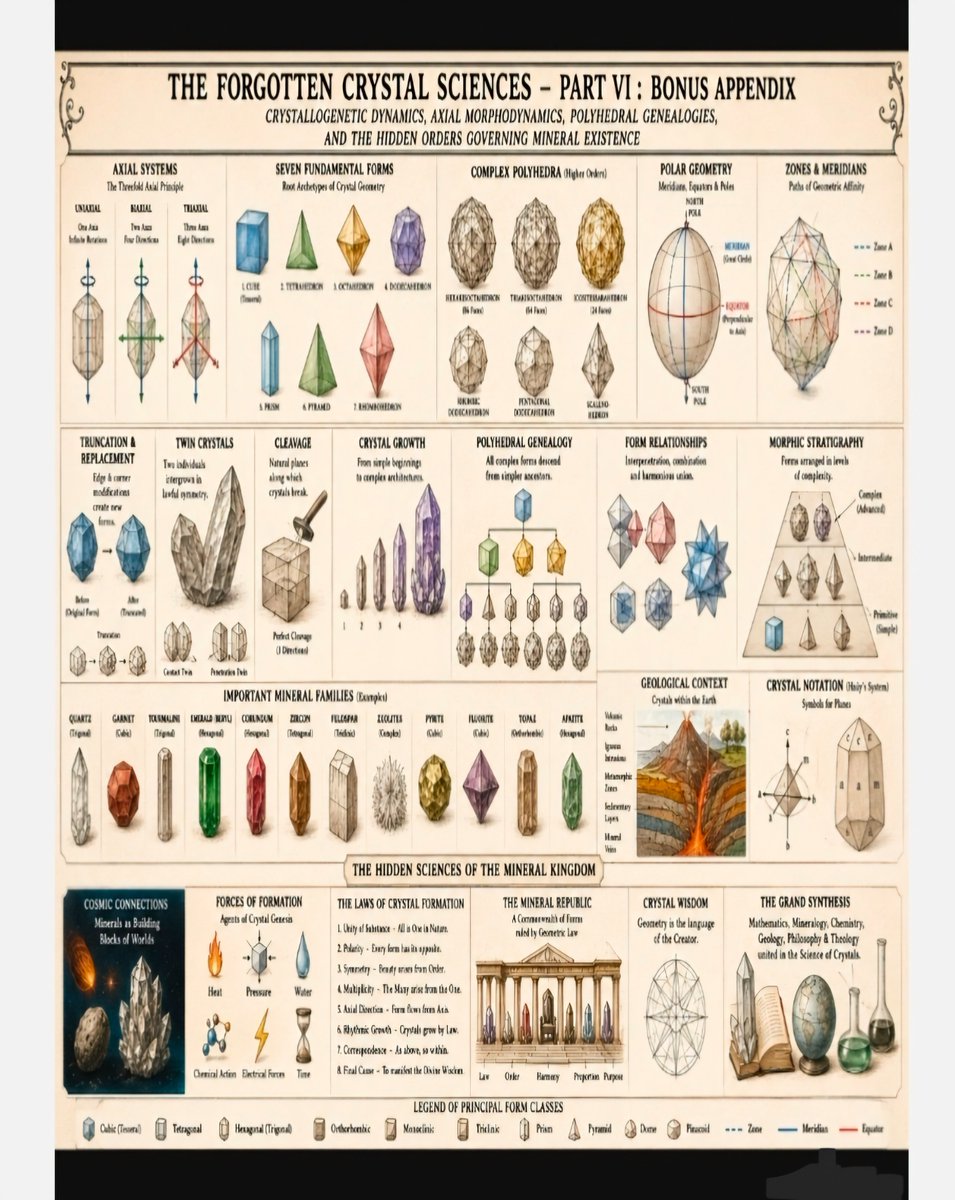
⚠️ PART VI - BONUS APPENDIX OF THE FORGOTTEN CRYSTAL SCIENCES - Deep Entries Continue ! It would take someone years to learn what this uncovers 📜💎✨️📜 - CLI. Zonal Meridianics - The science of crystal zones considered as highways of geometric affinity. Griffin's zones are not merely lines joining faces. They are mineral thoroughfares along which forms communicate their structural relationships. Entire families of crystals may be traced through zonal pathways invisible to casual observation.
CLII. Poleward Morphology
The study of crystal poles as centers of geometrical authority. Just as terrestrial geography possesses north and south poles, crystal forms possess governing extremities from which symmetry and orientation proceed.
CLIII. Equatorial Lithography
A forgotten branch of crystal science concerned with the equatorial arrangements of forms. The equator serves as a balancing horizon where opposite tendencies achieve mathematical reconciliation.
CLIV. Polyaxial Dynamics
The investigation of multiple axes operating simultaneously within a single crystal. Griffin's triaxial systems reveal a complexity resembling celestial mechanics condensed into stone.
CLV. Meridianal Symmetrology
The measurement of crystalline order through meridians, polar relations, and angular pathways. A kind of geometry midway between cartography and mineralogy.
CLVI. Angular Genealogics
The tracing of crystal ancestry through changing angular relationships. A crystal's angles preserve historical evidence concerning its developmental lineage.
CLVII. Rhombogenetics
The science of rhombic emergence. Rhombs appear throughout crystallography as recurring architectural modules governing countless forms.
CLVIII. Octahedral Sovereignties
The study of octahedrons as governing archetypes within crystal kingdoms. Griffin repeatedly returns to octahedral families because they function almost as royal houses among minerals.
CLIX. Plane Archeology
The excavation of mineral history through the examination of crystal faces. Every plane represents a surviving record of growth conditions and structural evolution.
CLX. Facet Historiography
The interpretation of crystal faces as historical documents. Growth, interruption, replacement, truncation, and modification all leave enduring inscriptions upon the mineral body.
CLXI. Crystallographic Diplomatics
The science of deciphering symbolic notations and geometric signatures. Just as medieval scholars interpreted manuscripts, crystallographers decode the language of forms.
CLXII. Lithic Semiotics
The study of crystals as systems of signs. Faces, zones, poles, edges, and truncations function as a mineral alphabet.
CLXIII. Morphological Heraldry
The identification of mineral families through characteristic geometric emblems. Certain crystal habits serve as coats of arms distinguishing one kingdom from another.
CLXIV. Tesseral Philosophy
Derived from tesseral and cubic systems. The study of perfect balance expressed through equal dimensions and symmetrical development.
CLXV. Cubical Harmonology
The investigation of cubes as embodiments of stability, equilibrium, and proportional order. Among ancient thinkers, cubes often symbolized permanence and terrestrial solidity.
CLXVI. Rhombohedral Harmonics
The study of rhombohedrons as geometric mediators between simplicity and complexity. These forms dominate numerous important mineral species.
CLXVII. Scalenohedral Dynamics
The science of unequal geometries operating under perfect law. Scalene forms demonstrate that symmetry does not require sameness.
CLXVIII. Truncational Morphogenesis
The study of crystal transformations through edge replacement. Entire new forms emerge from the progressive modification of older structures.
CLXIX. Replacement Geometry
The investigation of how one plane supplants another during crystal development. Griffin treats replacement as a primary engine of geometric diversity.
CLXX. Polyhedral Evolutionism
Not biological evolution but geometric evolution. Forms diversify through lawful transformations while preserving ancestral relationships.
CLXXI. Crystalline Paleontology
The reconstruction of earlier geometric states from surviving crystal structures. A mineral equivalent of fossil interpretation.
CLXXII. Geometric Embryology
The study of how simple forms develop into elaborate polyhedral organisms. Griffin's crystal families resemble developmental stages.
CLXXIII. Morphic Stratigraphy
The arrangement of forms into successive levels of complexity. Simpler structures become foundations for more elaborate generations.
CLXXIV. Eidogenic Mineral Physics
Derived from Griffin's "Eidogens." The study of formative agencies responsible for crystal emergence and growth.
CLXXV. Dynamic Symmetrology
The measurement of living geometrical processes rather than static forms alone. Symmetry becomes an active principle rather than a passive condition.
CLXXVI. Crystalline Teleodynamics
The study of directional tendencies within mineral growth. Forms unfold according to lawful trajectories.
CLXXVII. Polyhedral Cosmography
The mapping of geometric territories within the mineral universe. Entire kingdoms may be charted according to shared structural principles.
CLXXVIII. Geometric Chorography
A regional science of crystal provinces. Each crystallographic system becomes a territory possessing its own laws and characteristics.
CLXXIX. Mineral Kingdom Cartology
The production of conceptual maps showing relationships among mineral forms, crystal systems, and structural families.
CLXXX. Lithic Taxonomy
A science extending beyond chemistry into pure geometrical classification. Griffin often identifies minerals by form before composition.
CLXXXI. Crystalline Republic Theory
The conception of crystal systems as cooperating commonwealths governed by mathematical constitutions rather than arbitrary arrangements.
CLXXXII. Mineral Statecraft
A metaphorical science treating crystallographic laws as constitutional principles organizing mineral societies.
CLXXXIII. Polyhedral Jurisprudence
The study of lawful constraints governing possible and impossible forms. Griffin repeatedly asks which structures nature permits and which she forbids.
CLXXXIV. Geometric Constitutionalism
The principle that all crystal development occurs under fixed mathematical constitutions.
CLXXXV.
Harmonic Lithodynamics
The study of balanced forces acting within growing crystals. Geometry becomes frozen equilibrium.
CLXXXVI.
Crystalline Energetics
A proto-scientific investigation into the forces producing mineral forms. Though nineteenth-century terminology differs from modern physics, the underlying questions remain profound.
CLXXXVII. Mineral Architectonics
The study of minerals as structures rather than substances alone. Every crystal becomes a building constructed by nature.
CLXXXVIII. Lithic Cathedrology
The interpretation of elaborate crystal forms as natural cathedrals of geometry, symmetry, proportion, and order.
CLXXXIX. Polyhedral Aesthetics
The science of beauty arising from mathematical necessity. Crystal elegance emerges from law rather than ornament.
CXC. Crystallological Wondercraft
A forgotten intellectual virtue celebrated throughout Griffin's work. Wonder becomes a legitimate scientific response to discovering hidden geometries within ordinary stones.
CXCI. Telluric Architectures
The study of Earth itself as a crystallographic organism. Mountains, veins, caverns, and strata become extensions of mineral geometry on grand scales.
CXCII. Planetary Mineral Philosophy
The investigation of minerals as planetary building blocks. Feldspars, quartz, garnets, pyroxenes, zeolites, and ores become constituents of world formation.
CXCIII.
Cosmolithics
The science of cosmic stones. Meteorites, planetary minerals, and extraterrestrial substances are interpreted through crystallographic principles.
CXCIV. Siderolithic Studies
The examination of metallic and meteoritic minerals as visitors from beyond Earth and as witnesses to wider cosmic processes.
CXCV.
Proto-Cosmomineralogy
A nineteenth-century anticipation of planetary science. Mineralogy becomes a bridge connecting Earth with the wider heavens.
CXCVI.
Celestial Geognosy
The application of geological reasoning beyond Earth itself. Long before space exploration, thinkers speculated that the same laws governing crystals here might govern worlds elsewhere.
CXCVII.
Etherio-Crystallics
A forgotten speculative science exploring possible relationships between crystalline order and the universal ether proposed by many natural philosophers.
CXCVIII. Luminiferous Mineral Theory
The investigation of light-bearing and light-governing properties of crystalline structures. Optical minerals inspired many early theories concerning illumination and radiance.
CXCIX. Crystalline Cosmotheology
The contemplation of geometry as a universal language appearing from microscopic minerals to celestial architecture. For many nineteenth-century natural theologians, crystals represented one of creation's clearest demonstrations of intelligible order.
CC. Grand Polyhedral Philosophy
The culmination of Griffin's world: mathematics, mineralogy, chemistry, geology, geometry, natural theology, pedagogy, cartography, and cosmology united within a single vision of the Earth as a vast crystalline commonwealth governed by number, proportion, symmetry, and law
⚠️Artistic pictorial is a fair easy way to learn what is never actually shown unless you know this niche geometric/natural philosophy sciences of old =
⚠️ Next sections will be present even more extinct/lost science of old = all the new terminology (rediscovered) up next! See next reply-
1
1
2
419







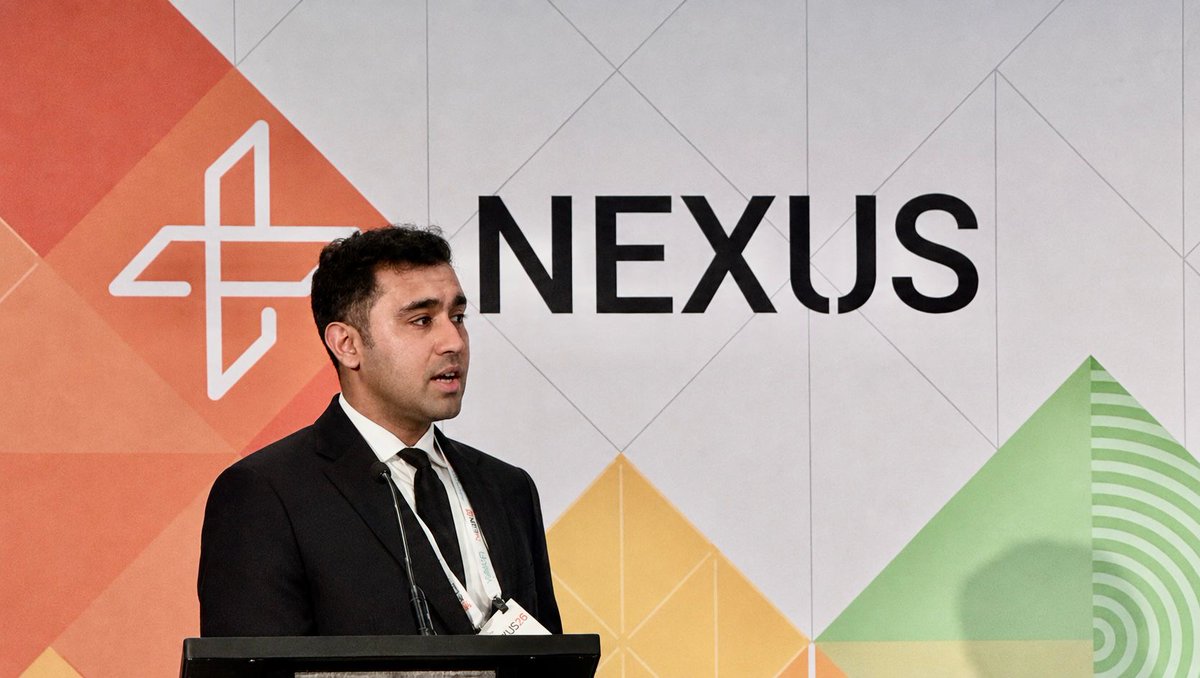
Honored to present on the mainstage at Nexus 2026 and share our experience with our multi-site nocturnal TeleHospitalist admissions program across the Houston Methodist system.
It was a great opportunity to discuss the implementation and evolution of a centralized virtual admissions model and explore the broader role of innovative care delivery models in reshaping hospital operations.
Thank you to everyone across Houston Methodist and to the Center for Connected Care Innovation and Implementation Research (CCCII-R) who supported this program.
#Telemedicine #DigitalHealth #HospitalMedicine #Innovation #VirtualCare #Healthcare #NEXUS2026 @MethodistHosp @HMethodistMD @AmericanTelemed @CCCIIR_HM
Houston Methodist l ATA l CCCII-R

5
158






𝙰 𝙰 𝙰𝙷 𝚃𝙸𝚂𝚂
𝙱𝙱 𝚄𝚃
𝙰 𝙵 𝙴𝚆 𝙵 𝙴 𝙴 𝙰 𝙰 𝚃𝙷 𝙴 𝙴 𝚁𝚂!
𝚆𝚆 𝙴 𝙴 𝙰 𝚁𝙴
𝙴𝙴 𝙴 𝙴𝚇𝚇 𝙲𝙲𝙲𝙸𝙸 𝚃𝚃𝙴 𝙳 𝙳 𝙵𝙾𝚁 𝙾 𝙾𝙽𝙴'𝚂
𝙽 𝙴 𝙴𝚇𝚃 𝙲𝚄𝙳𝙳𝙳 𝙻𝙴
𝚂 𝙴 𝚂 𝚂𝙸!𝙾!!𝙽 𝚆𝙸!𝚃𝙷 𝚄 𝚂!!
1
2
28
Excited to share our latest manuscript evaluating the implementation of a TeleHospitalist admissions model within a large academic health system.
As health systems face increasing overnight admission volumes, variable patient flow, and workforce constraints, telemedicine offers an opportunity to support hospitalist workflows and help maintain timely care delivery.
In this study, we describe the operational characteristics of a centralized TeleHospitalist admissions service, including:
• Descriptive timing metrics across the admission workflow
• Early implementation experience across a multi-site health system
• High patient satisfaction and strong staff reception of the TeleHospitalist admission model
These findings provide an early look at how TeleHospitalist admission programs can be integrated into routine inpatient operations while supporting both patients and clinicians during the admission process.
Grateful to collaborate with an outstanding multidisciplinary team on this project and excited to see how virtual hospital medicine models continue to evolve. Read the article:
bmjopenquality.bmj.com/conte… #Telemedicine #HospitalMedicine #DigitalHealth #HealthcareInnovation #QualityImprovement #CCCIIR #CenterforConnectedCareInnovationandImplemenationResearch #BMJOpenQuality @bmj_latest @MethodistHosp @HMethodistMD @CCCIIR_HM
BMJ | Houston Methodist | CCCII-R

1
2
5
324












3 Dec 2025
This is what the DTC says about Fishers response to Luther:
J. Fisher attaches himself to establishing that, if concupiscence remains in the just soul, it is not a sin, art. 2, p. CX and CXXX: all the guilt of our faults is effaced by baptism, p. CXXII and CXXXVI-CXXXVII. His principal authority is Saint Augustine, in whose name he explains how diverse in Saint Paul are the acceptations of the word sin. On the faith of the Scriptures, he opposes to Luther that there can be no possible non-imputation without true pardon, ibid., p. CXLII: Deum non imputare cuique peccatum est eidem remittere et ignoscere penitus (For God not to impute sin to anyone is to remit it to that person and pardon completely). But sin cannot be remitted except by gratiae praesentia (presence of grace), a. 13, p. CCXXXVIII. Nam has duas, hoc est gratiam et culpam, simul cuiquam adesse nequaquam est possibile(For these two, that is grace and guilt, to be present simultaneously in anyone is in no way possible), a. 17, p. CCCII. Cf. a. 36, p. DCXII. Thus grace is synonymous with a principle of spiritual renovation: per Christi gratiam renovamur et justificamur (by Christ's grace we are renewed and justified), a. 2, p. CXV, which is infused in our soul, a. 17, p. CCCIX, and becomes its true life, a. 36, p. DLI.
3
154

27 Sep 2025
R2 in Beijing ✅️
#Sinner defeats #Atmane 🇫🇷 6-4 5-7 6-0
- 23 consecutive win vs. 🇫🇷 players (32 of the last 33)
Forza 🦊👊🏻
QF vs. #Marozsan 🇭🇺
#JanTheFox CCCII

5
48
788
17,820








20 Jun 2025
#CryptoCoinCases III will commence on 08/01!
You can look for Friday releases 08/01-09/19 that will mirror #CCCII categories with 80 more #crypto
#CCCI was 168
#CCCII was 80
#CCCIII is 80
Total of 328 so far for our #CCC series.
#CCCIII will be the last display of coins for 2025, and 2026 will begin #CCCIV with different category formats.
#TCIG
1
2
41