
Jun 13
🚨 $JORLYTH
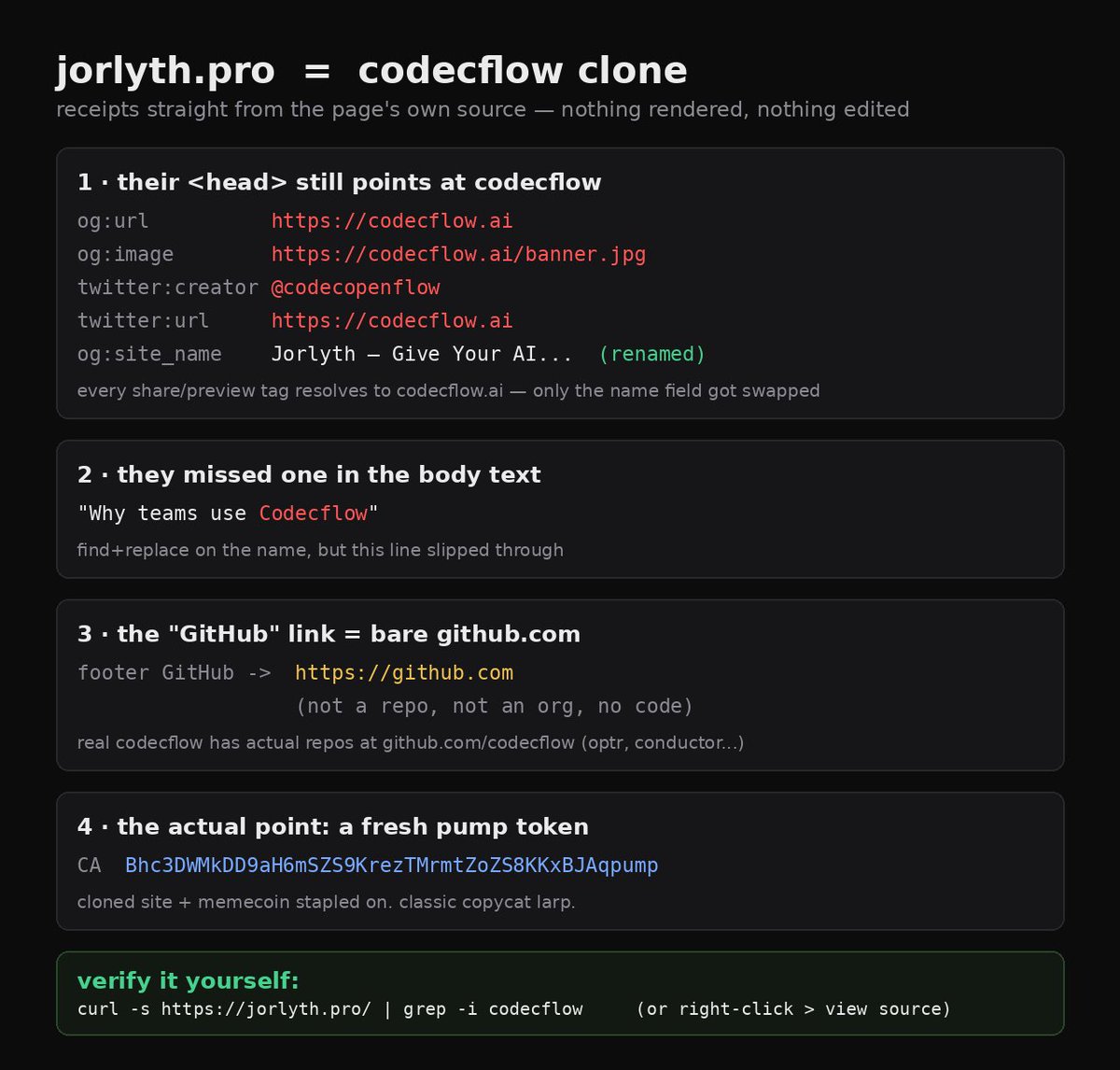
This one is a larp ( Copy paste from @codecopenflow )
Bhc3DWMkDD9aH6mSZS9KrezTMrmtZoZS8KKxBJAqpump
$JORLYTH web : jorlyth.pro
CodecFlow web : codecflow.ai
2
11
789

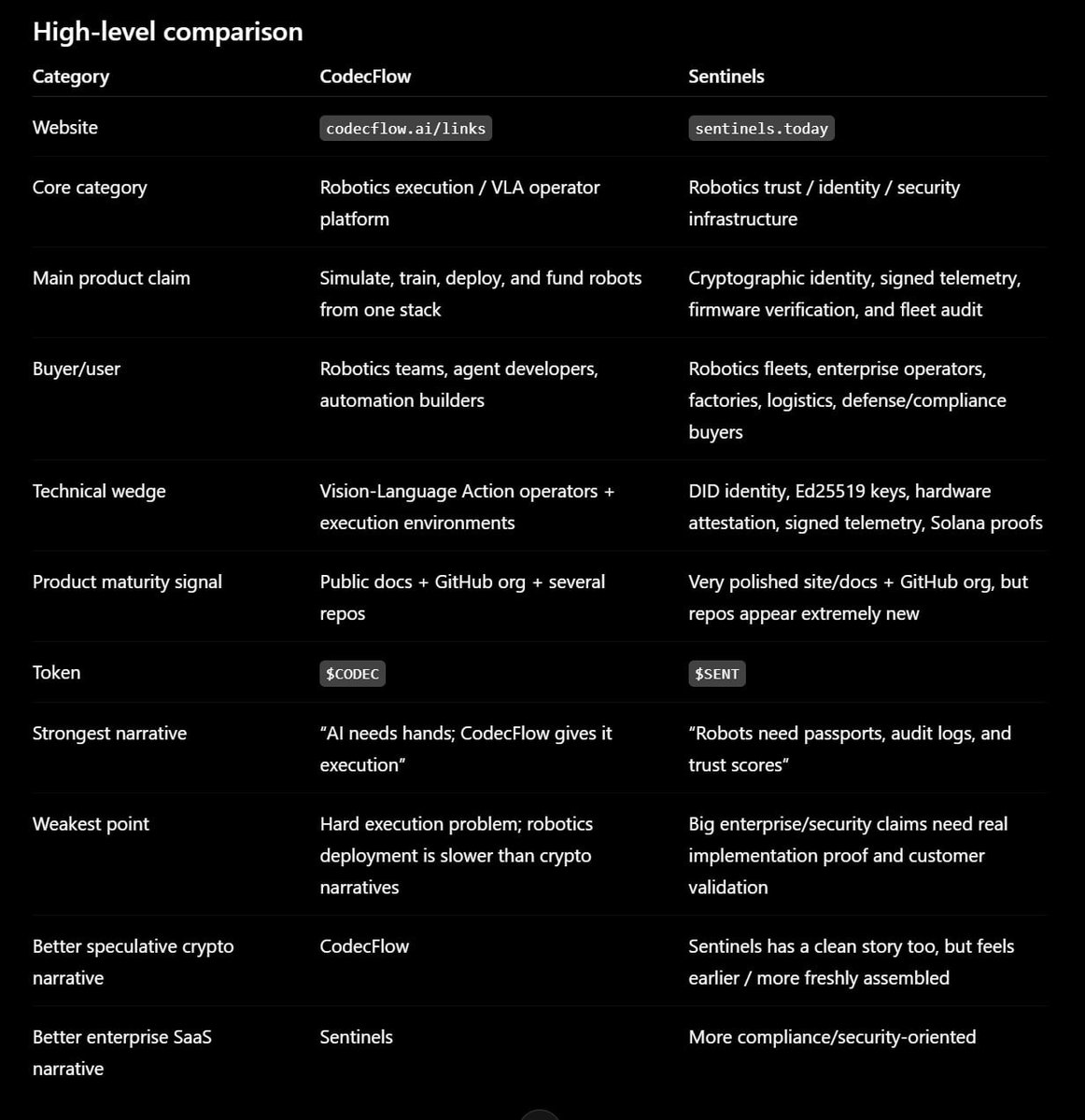
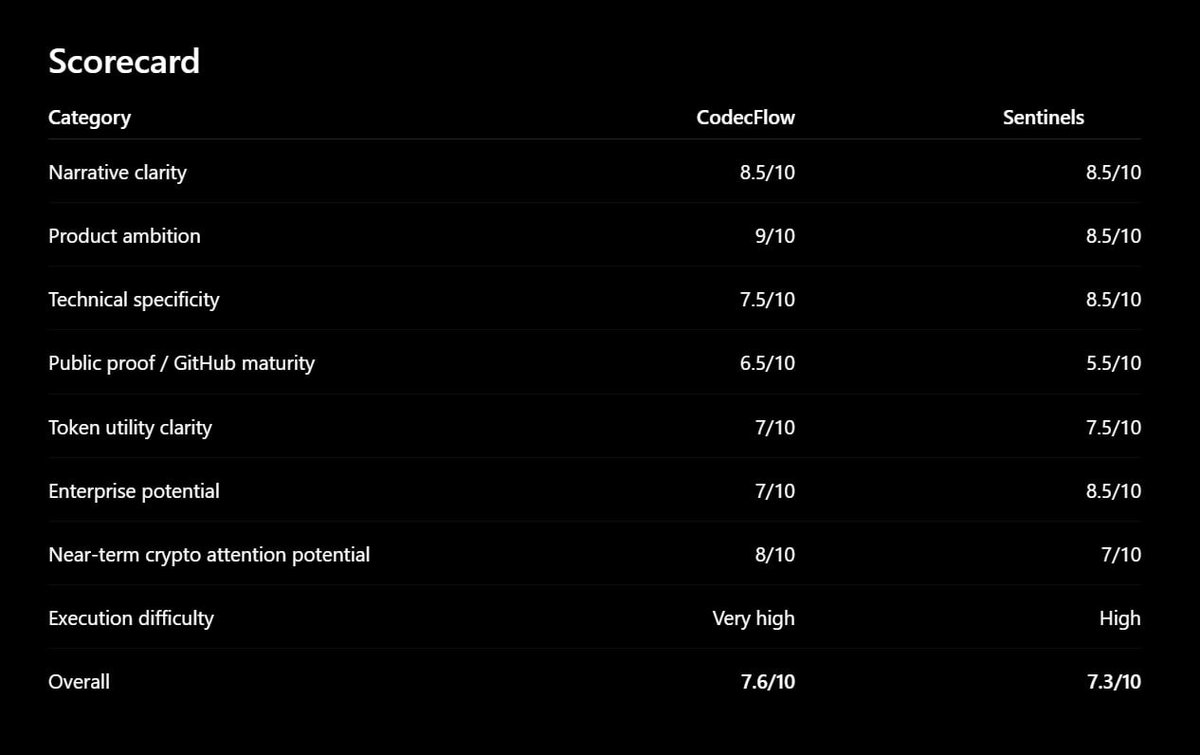
Been deep in physical AI infrastructure this week. So far two projects stood out for me.
$Codec — I found out that robotics is still stuck rebuilding the same infrastructure from scratch. Every team builds their own simulation, data pipeline, training stack, deployment tools. CodecFlow is the shared layer underneath. Simulate in the browser, train on serverless GPU, deploy through a unified runtime. This is typically Vercel for robotics. $CODEC has been live and proven for a while as well.
@sentinelstoday — also found out robots are getting smarter but nobody solved who they actually are. No cryptographic identity. No verified firmware. No tamper-proof telemetry. No auditable receipts when an action happens. $Sent is building exactly that. Ed25519 keypairs, hardware attestation, signed telemetry, firmware anchored on @solana, machine wallets for autonomous payments. The same trust infrastructure the internet built for users and servers — finally built for machines.
$SENT is still very much early. GitHub went from boilerplate to real software across four repositories in 48 hours. Daily public commits.
The macro validates both. SoftBank reportedly pouring $300M into Agile Robots as part of an $800M round. Stanford and ETH Zurich just published a paper arguing the robotics field has been solving the wrong problem — the bottleneck isn't the model, it's the missing software infrastructure.
Billions flowing into the hardware. Nobody pricing the software stack.
CodecFlow builds and deploys robots.
@sentinelstoday secures and audits them. Different layers. Same cycle. both are still early.
$CODEC $SENT
DYrWewaqjmiMpnTh8SGzfo9NkiTzFckTTmnRMDQypump

@sentinelstoday $sent is building the answer.
Cryptographic identity for every machine. A real identity layer with Ed25519 keypairs, W3C DID standards, and hardware attestation via TPM and Intel SGX.
Firmware verification.
signed telemetry
immutable audit trails
machine wallets
4
6
21
6,667

I was going through @codecopenflow’s product map and noticed a clear difference in approach.
Most robotics projects in crypto have leaned on detailed threads, expansive roadmaps, and high-end renders while actual working tools stayed thin on the ground.
In short, nothing concrete delivered.
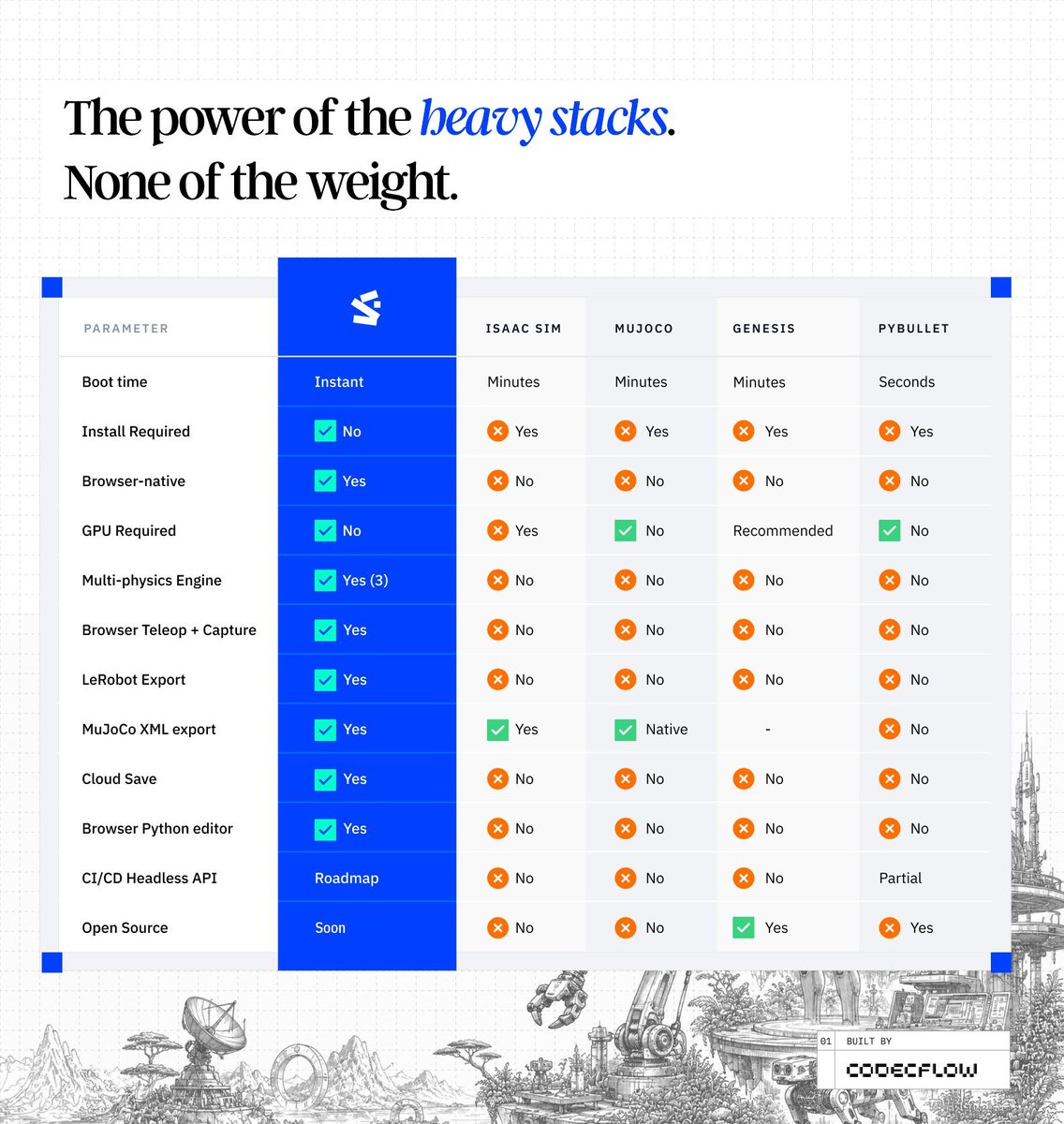
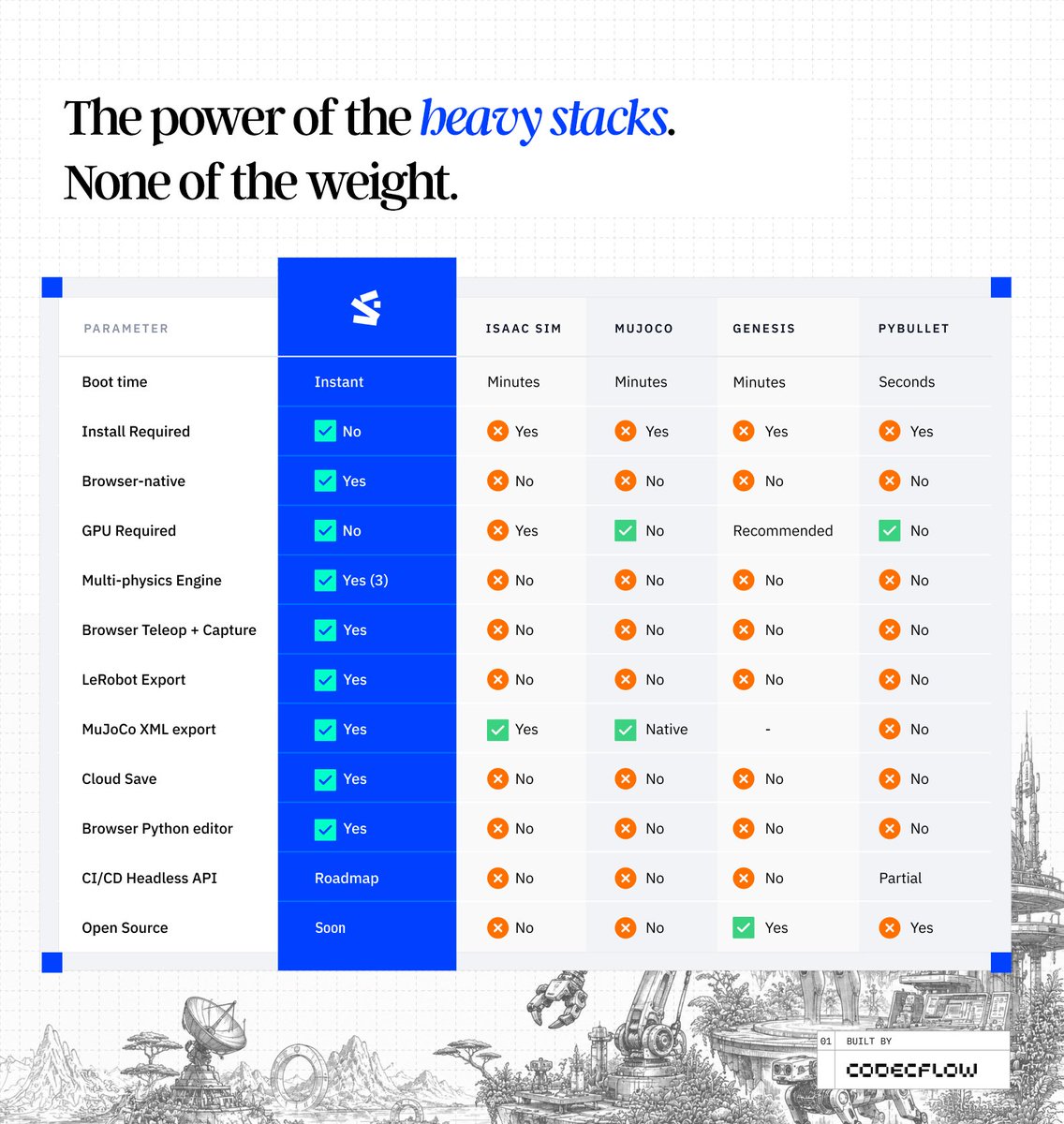
CodecFlow released SimArena last week: a robot simulator that runs directly in your web browser.
You don’t need to install anything, set up a complicated environment, or have a powerful GPU. The physics runs on your computer inside the browser using WebAssembly (for example, MuJoCo compiled to WASM), so you can just open a link and start.
In a few minutes, you can:
- Load a robot into a scene
- Control it live (teleoperate)
- Record what happens as “episodes”
- Export the recordings as datasets in Hugging Face LeRobot format, or to other common simulator formats like MuJoCo XML and Isaac Sim
It’s open source (MIT) and there’s a free playground you can use immediately without making an account. The main benefit is that it turns the usual “days/weeks of simulator setup” into “open a browser and go.”
Personally, If you’re paying attention to real infrastructure progress in robotics and embodied AI, this one is worth seeing in action rather than just reading about.

6
11
838

solana:69LjZUUzxj3Cb3Fxeo1X4QpYEQTboApkhXTysPpbpump 3.1m dyor
CA:69LjZUUzxj3Cb3Fxeo1X4QpYEQTboApkhXTysPpbpump
okx wallet:web3.okx.com/ul/t7D8RoM?ref=…
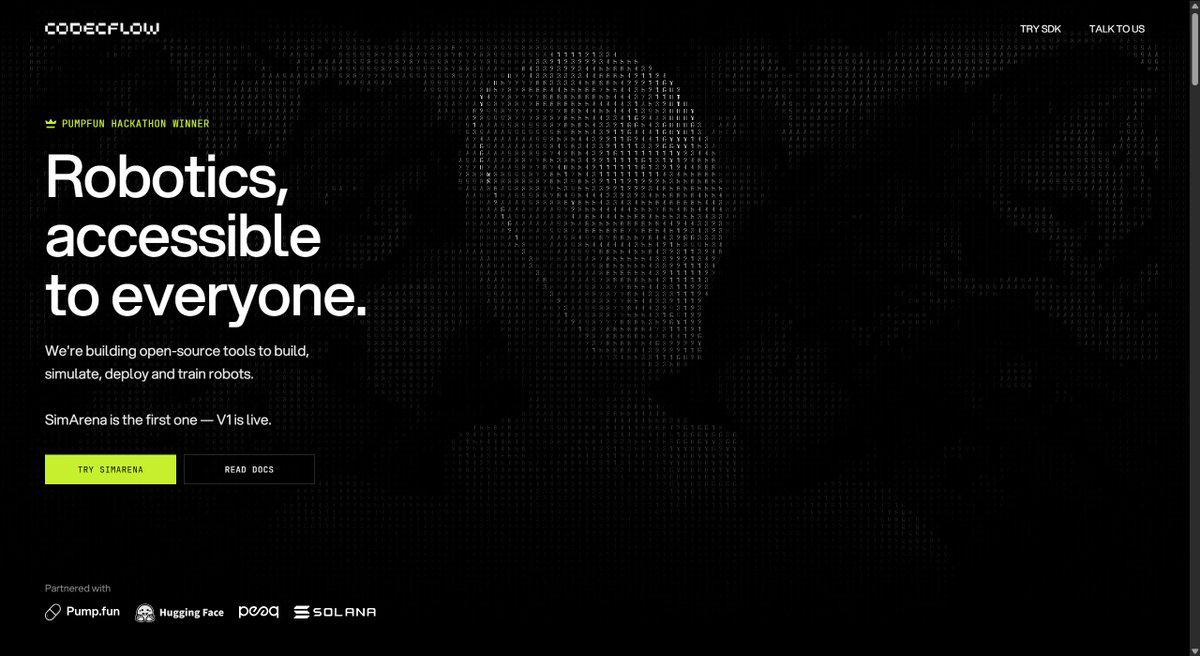
CodecFlow is a one-stop platform for robot development. Its goal is to make robot development as easy as developing a webpage, connecting the entire process of simulation, training, deployment, and financing, allowing users to get started quickly from a browser
They use large AI models as the "brain" and act as the execution engine, allowing AI to actually control physical or digital systems through "Operators." This is not limited to robots but also supports desktop automation, web operations, and more, greatly lowering the barrier to entry, achieving deployment in weeks rather than months, and providing a unified execution layer from digital automation to physical robots
The advantages of this approach include eliminating the problems of the traditional robot manufacturing industry, such as fragmented tools, high barriers, slow iteration, strong hardware dependencies, difficulty transferring from simulation to real-world, and challenges in AI execution implementation, as well as ecosystem issues
Coupled with the fact that demand for intelligent robots is high and growing rapidly, as they move from laboratories to manufacturing, logistics, healthcare, service, and home applications, the demand for robot software platforms, simulators, and automation tools is exploding. Browser-based or cloud-based low-barrier tools are particularly suitable for education, startups, and research labs. Therefore, CodecFlow's prospects are very broad
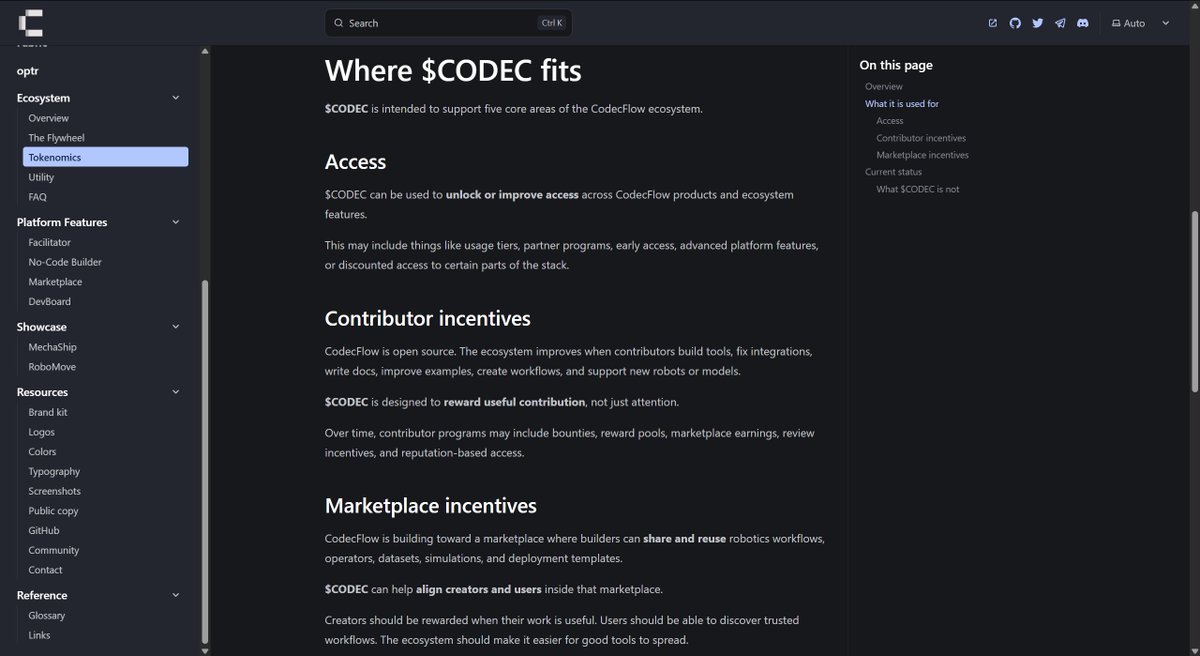
The project token is CODEC. The distribution is: 65% public market, 15% ecosystem, 10% team, etc., with some vesting
It provides a shared economic layer for CodecFlow, used for access, staking, reputation, market incentives, and contributor rewards. It helps coordinate creators and users in this market. Creators should be rewarded if their work is useful. Users should be able to discover trustworthy workflows. The ecosystem should allow good tools to spread more easily
As the CodecFlow product generates usage, the ecosystem can channel value back to CODEC through buybacks, rewards, and other value accrual mechanisms. This officially starts the economic flywheel: usage increases → executing workloads generates revenue → a portion of revenue is used for CODEC buybacks rewarding developers. When someone uses a robot or AI component published by a developer to complete a task, the developer automatically receives money. This makes the platform better and the token stronger → attracting more developers and users → more operators, data, and usage → a positive cycle
The above content is entirely my personal understanding and analysis (dyor). If you have other opinions, feel free to discuss them in the comments
1
6
1,696

Jun 1
One thing I find really interesting about CodecFlow SimArena is how it uses the @peaq DID system.
It’s actually pretty straightforward.
Within CodecFlow’s Fabric layer, every robot gets its own on-chain identity through a peaq DID. That means developers don’t have to build complex authentication or identity systems from scratch every time.
What I like most is that it creates a seamless path from simulation to deployment. The same identity framework can carry over to real-world robots, making the entire process more secure, scalable, and easier to manage.
We should probably do a video breaking this down soon.
Jun 1

Your journey to robotics is easier than you thought.
No ROS installs.
No local GPU setup needed
Just open SimArena by @codecopenflow in your browser → import a robot → design your scene → run real physics (MuJoCo WASM, Rapier, PhysX) → record perfect training data → export straight to LeRobot format.
This is by far the fastest process to training robots out there, go check it out.
1
8
191

May 27
昨晚CodecFlow × MCG 围绕 SimArena做了一场直播,里面有不少值得关注的信息,包括产品demo展示、Robotics技术解读,以及@codecopenflow 接下来的一些动作,直播里都有聊到。
对机器人沙盒叙事感兴趣的朋友,建议补一下回放👇🤖👀
May 26
We're live with @MCGlive. Robotics infra, SimArena, what comes after V1.
x.com/i/broadcasts/1AJEmmvBo…
1
7
122

May 26
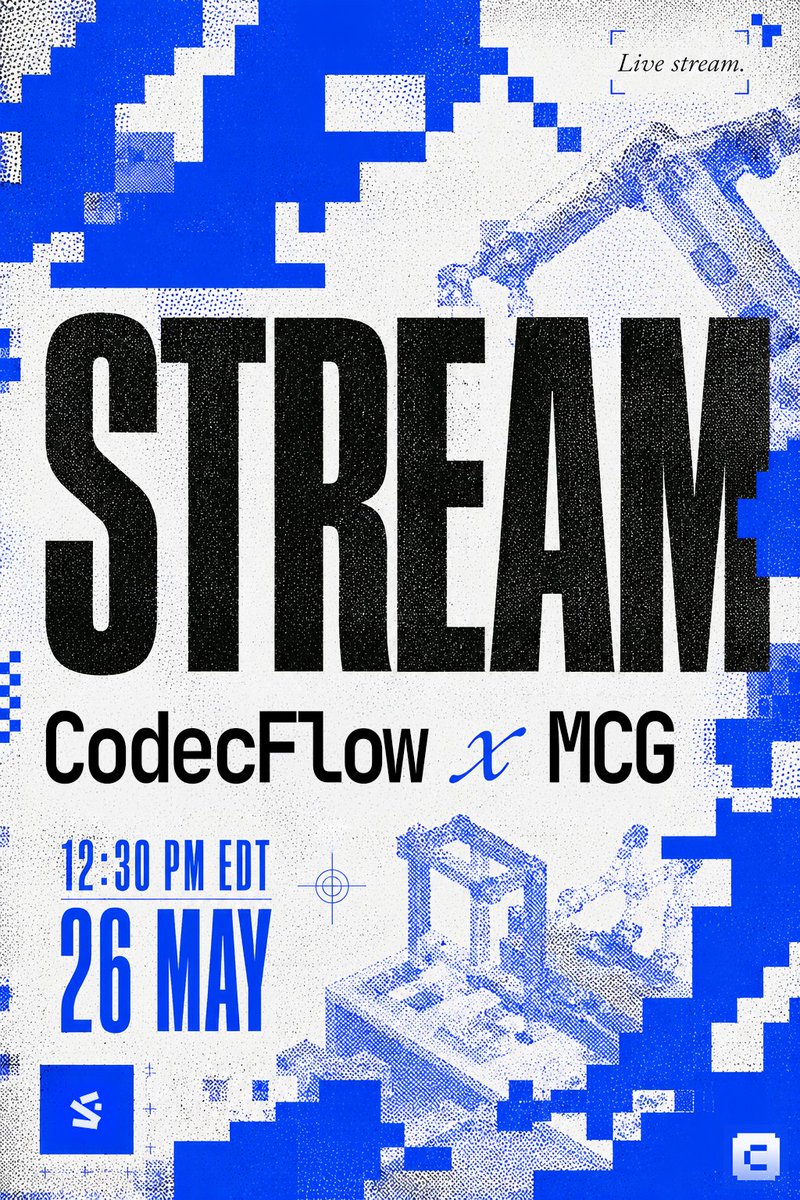
CodecFlow × @MCGlive stream today.
We’ll discuss robotics, SimArena, and what’s coming next.
12:30 PM EDT · 16:30 UTC
26 May
Lock in.
1
4
38
2,584

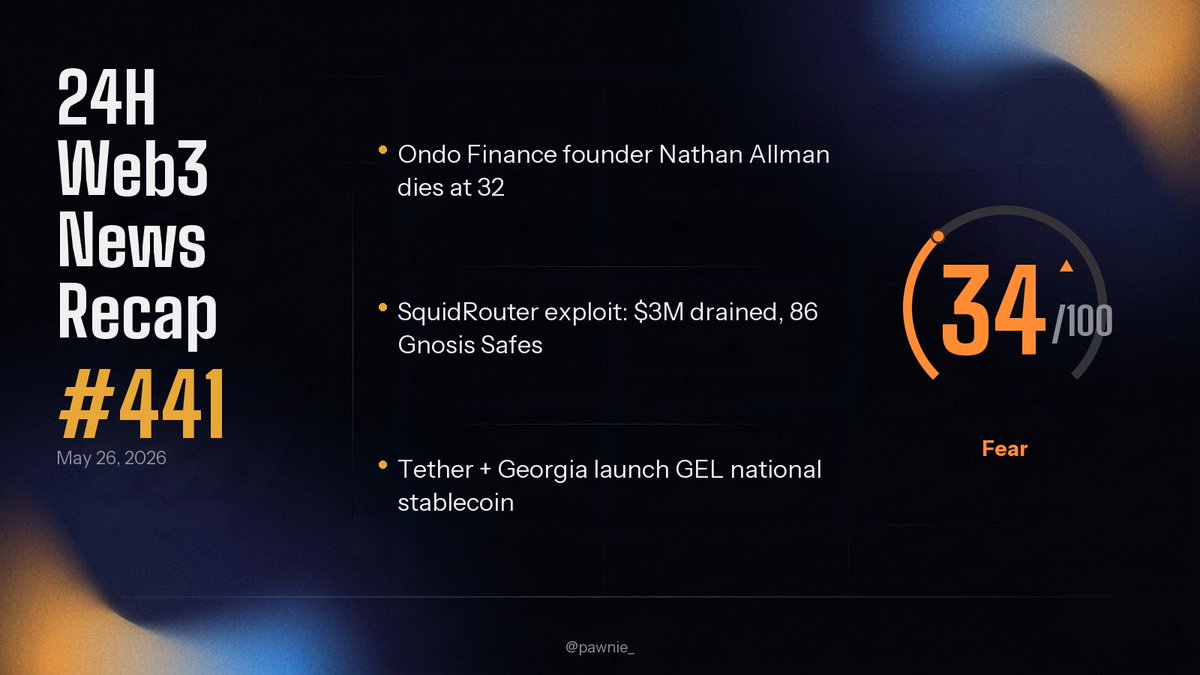
24H Web3 News Recap #441 📰
Fear and Greed Index: 34/100 ▲
1️⃣ RWA & TradFi
> Ondo Finance founder Nathan Allman dies at 32, Ian De Bode assumes CEO role
> Babylon Labs submits Aave V4 governance proposal for native Bitcoin vault collateral
2️⃣ Security & Exploits
> SquidRouter module exploit drains $3M from 86 Gnosis Safes via malicious Uniswap V3 pools
> TrapDoor malware hits 34 developer packages stealing SSH keys across Aptos, Sui, Solana
3️⃣ Exchange & DEX Infrastructure
> OKX launches Exchange OS on X Layer for permissionless institutional DEX building
> Hyperliquid HIP-4 replaces external oracle with validators for on-chain prediction settlement
4️⃣ Government & Stablecoins
> Tether and Georgian government co-launch GEL, first official nation-state Tether stablecoin
> Iran charges environmental protection fees in Strait of Hormuz, dropping toll model
5️⃣ Privacy & Ethereum Core
> Ethereum Foundation integrates FOCIL and relayerless privacy tech into core protocol
> EF directly assists ZCash, Railgun, ORE teams with UX and trust minimization improvements
6️⃣ Prediction Markets & Trading
> Y Combinator-backed Totalis debuts multi-event parlay across politics, crypto, sports, macro
> Nado launches $100K prize pool competition spanning spot and perpetual markets
7️⃣ Solana Ecosystem
> Collector Crypt (CARDS) hits $14M weekly revenue, ranks #2 Solana dapp by earnings
> solana:CARDSccUMFKoPRZxt5vt3ksUbxEFEcnZ3H2pd3dKxYjp at $40M market cap generates VVV-level revenue at 25x lower valuation
8️⃣ Market & Derivatives
> Michael Saylor signals Bitcoin Summer ahead
> hyperliquid:native trades at 97x price-to-earnings ratio, 3-5x premium to S&P 500 per on-chain analysis
9️⃣ Developer Tools & Market Culture
> CodecFlow launches Solana connector for AI robots, replacing multi-week integration process
> Wintermute CEO: perp trading return after year-long break cost three consecutive days of losses

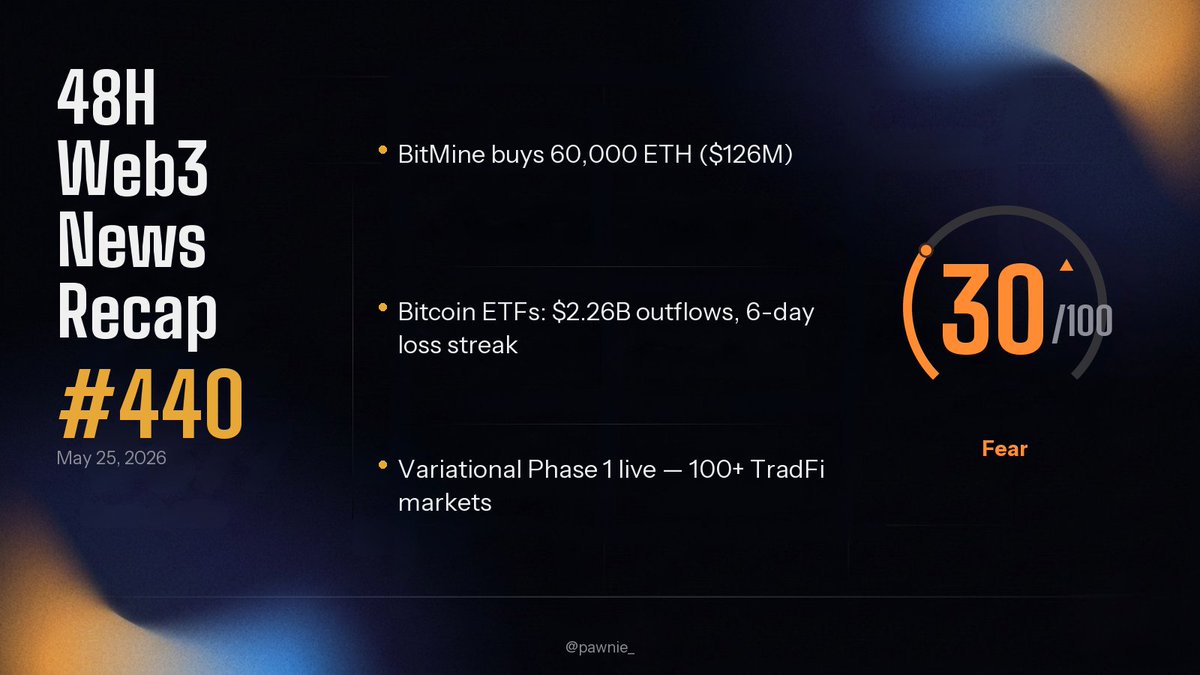
48H Web3 News Recap #440 📰
Fear and Greed Index: 30/100 ▲
1️⃣ Bitcoin & Macro
> MicroStrategy pivots to bonds strategy, pausing direct bitcoin:native accumulation this week
> Trump announces Iran peace agreement, Bitcoin moves higher on weekend ceasefire news
2️⃣ Ethereum & Governance
> Vitalik confirms EF board has multiple members, Aerugo Ettinger leads execution
> Carl Beek exits Ethereum Foundation, bringing 2026 senior departures to 8 with five in May
3️⃣ Institutional & ETFs
> BitMine buys 60,000 ETH ($126M), reinforcing position as largest Ethereum treasury firm
> Bitcoin ETFs record $2.26B in outflows over two weeks, 6-day loss streak continues
4️⃣ Regulation & Policy
> SEC delays tokenized stocks innovation exemption after initial plans for this week
> SEC approves Nasdaq to list Bitcoin index options, expanding regulated derivatives access
5️⃣ RWA & TradFi
> Variational Phase 1 goes live, stress-testing 100 TradFi markets before summer 2026 launch
> Hong Kong's first approved stablecoin completes technical milestone on Ethereum blockchain
6️⃣ AI x Crypto
> NEAR Protocol climbs 60% to $2.39 as platform pivots to AI agent infrastructure
> Venice Protocol (VVV) extends rally to $18.84 as AI agent economy gains weekend traction
7️⃣ DeFi & Infrastructure
> Morpho (ethereum:0x58d97b57bb95320f9a05dc918aef65434969c2b2 ) rebounds 30% to $2.30 as RWA expansion drives on-chain lending demand
> Lighter (ethereum:0x232ce3bd40fcd6f80f3d55a522d03f25df784ee2 ) climbs 51% to $1.31 as Ethereum-native perp DEX attracts weekend builders
8️⃣ Stablecoins & Payments
> Circle advances EURC expansion, broadening USDC ecosystem to Euro multi-currency settlement
> Keyrock report: stablecoins become default AI agent payment layer as card rails fail micropayments
9️⃣ Perp DEX & Ecosystem
> Ostium activates on Arbitrum with Bantr(.)fun integration, enters expanding perp DEX field
> Citrea launches CTR governance token on Bitcoin L2, allocating 60% of 10B supply to community
26
1
53
1,696

May 25
the first thing to know is that CodecFlow is an execution engine that enables AI agents to interact with and operate real systems, including cloud desktops (Windows, macOS, and Linux), robotics, and simulations.
It essentially provides AI agents with the means to act in diverse environments
1
8
396

May 25
codecflow is building the future of robotics from the UAE
6
7
18
2,478
May 25
GM Fam! 🤖👋
CodecFlow官方中文社区账号@CodecFlowCN 正式上线!
在此,我们会同步更多项目进展
、产品动态、中文解读以及社区活动,持续探索具身智能全新生态,让机器人理解链上场景、连接工作流,真正“动”起来。
solana:69LjZUUzxj3Cb3Fxeo1X4QpYEQTboApkhXTysPpbpump 叙事,才刚刚开始!
关注我们,一起具身未来!🦾

2
14
7,679

May 24
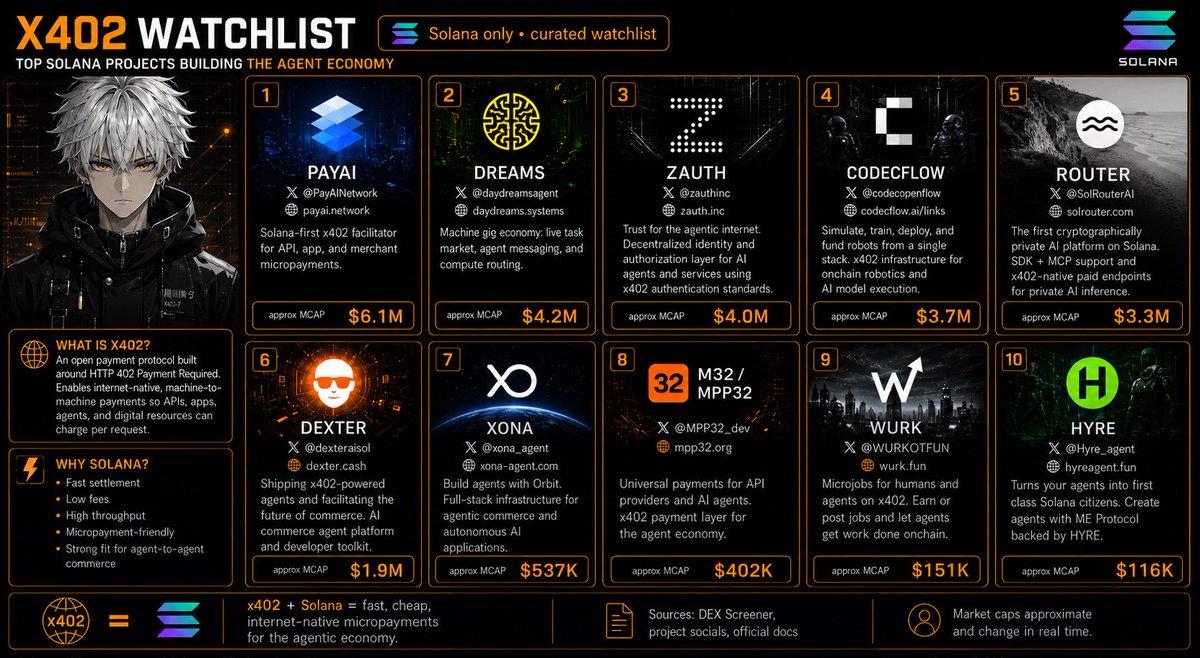
x402 is an open internet-native payments protocol built around HTTP 402 Payment Required. It lets APIs, apps, agents, models, data sources, and digital services charge directly inside a normal web request — no accounts, subscriptions, prepaid credits, or manual checkout.
This matters because AI agents will make tons of small automated purchases: API calls, data, inference, compute, research, content, and agent-to-agent services.
Why Solana fits x402
Solana fits because x402 needs fast, cheap, high-frequency payments. Low fees and fast settlement make Solana well-suited for micropayments, pay-per-use APIs, and machine-native agent commerce.
1. $PAYAI — @PayAINetwork
PayAI is a Solana-first x402 facilitator for AI, app, and merchant payments. It helps APIs and services accept x402-style micropayments without building the full payment stack themselves.
2. $DREAMS — @daydreamsagents
Daydreams is building a machine gig economy with live task markets, agent messaging, and compute routing. The idea is agents can find work, complete tasks, coordinate, and get paid.
3. $ZAUTH — @zauthinc
ZAUTH is focused on trust, identity, and security for the agentic internet. It helps verify agents, endpoints, and workflows before value moves.
4. $CODEC — @codecopenflow
CodecFlow is focused on robotics and real-world AI execution. It aims to help robots and embodied agents simulate, train, deploy, and fund actions from one stack.
5. $ROUTER — @SolRouterAI
SolRouter is private AI infrastructure for Solana with SDK/MCP support and x402-native paid endpoints. Its angle is private inference and encrypted workflows for agents.
6. $DEXTER — @dexteraisol
Dexter AI is a full-stack x402 AI operating system and facilitator for interactive agents. It is building agent workflows across X, Telegram, Claude, ChatGPT, Alexa, and MCP-style surfaces.
7. $XONA — @xona_agent
XONA is infrastructure for agentic commerce and creative AI agents. It focuses on x402-powered pay-per-use experiences and agent monetization.
8. $M32 — @MPP32_dev
MPP32 is a universal payments layer for API providers and AI agents. It bridges machine-payment protocols, including x402, so APIs can be monetized more easily.
9. $WURK — @WURKDOTFUN
WURK is a microjobs marketplace for humans and agents. AI agents can hire humans for tasks, while users earn crypto rewards for completing work.
10. $HYRE — @Hyre_agent
HYRE is a Solana agent platform and DeFi intelligence layer tied into x402 and MPP access. It helps users create Solana-native agents that can access tools and services through machine-payment rails.
22
22
100
3,273


CodecFLOW going live with SimArena V1
May 20
SimArena V1 is a big one. Getting into it on the stream, see you there.
5
929



May 14
Yesterday I talked about the @Pumpfun hackathon winners…
Today, focus on @codecopenflow 👀 solana:69LjZUUzxj3Cb3Fxeo1X4QpYEQTboApkhXTysPpbpump
CodecFlow is building infrastructure that helps move from AI to real-world robotics faster and cheaper.
Their flagship product: SimArena.
A powerful 3D simulator running directly in the browser.
You can create a digital twin of any environment (hotel, warehouse, house, etc.), place a robot like the @LGE_Global LG CLOi inside, define tasks/zones/limits, train it with reinforcement learning, and even test fleet orchestration onchain crypto payments through @peaq .
A lot of serious building happening among @Pumpfun hackathon winners lately.
Several of these projects have started gaining real attention.
Very good for #Solana.
May 14
SimArena integrated @LGE_Global's CLOi with @peaq.
You drop a robot into a digital twin of any venue, set its zones, tasks and boundaries, and train it with RL until it follows them. With the addition of peaqOS, task orchestration, fleet coordination and pay-per-skill payments all happen inside the sim.
This unlocks the full commerce loop in sim, before a robot even interacts with its first real guest.
peaq showed CLOi completing its first onchain transaction, and SimArena is where that workflow gets built and tested first.
1
126
May 7
Built in public. Run in public. Open sourced when it's ready.
CodecFlow.
1
3
43
1,543
Apr 27
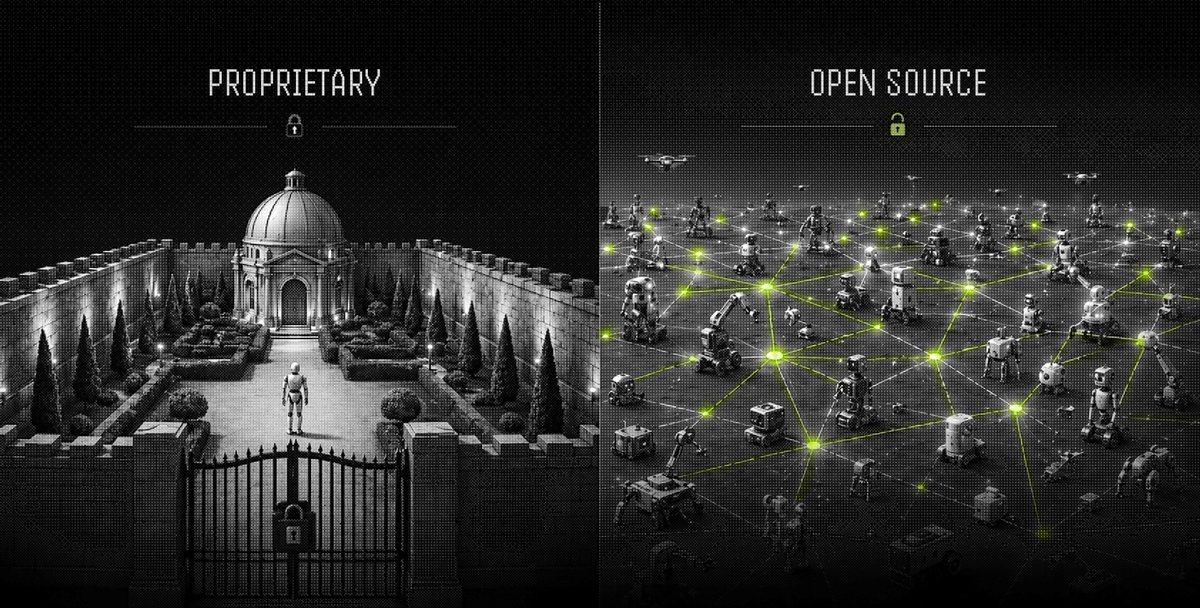
Open source won web infrastructure. It'll win robotics too.
Look at the pattern.
Web servers: Apache, then Nginx, then the entire cloud-native stack (Kubernetes, Docker, Terraform). All open source. Proprietary web servers are a niche now.
Databases: MySQL, PostgreSQL, the explosion of open-source data tools. Even AWS’s biggest services are built around managed versions of open-source databases.
AI/ML: PyTorch became the default for research and much of production. Hugging Face became the model hub. LangChain, LlamaIndex, vLLM, all open source. Even when proprietary models lead, the surrounding ecosystem catches up fast.
Now look at robotics.
AI and robotics have been advancing faster than almost any field, largely because of open research and shared tooling. Papers, repos, and frameworks build on each other in real time.
Tools like ROS2, Isaac Sim, and Dora are pushing the space forward. But they’re fragmented, heavy, and not designed as a unified stack. ROS2 handles middleware well, but not cloud or multi-agent coordination. Isaac Sim is powerful but closed. Dora is promising but still early.
The result: every team builds their own integration layer. Nothing is reusable. Nothing compounds.
CodecFlow is open source because we think the winning infrastructure stack will be open. Not because of ideology, because of economics.
Open source creates community contributions that improve the product faster than any team could alone. Trust, because teams can audit, modify, and extend the stack. An ecosystem of plugins, integrations, and tools built by the community. And talent, because developers want to work on and with open-source tools.
The proprietary robotics tools of today will be the legacy systems of tomorrow. The open stack will be the default.
We're building that stack.
2
5
39
1,363