
Feb 11
Colosseum just extended the Agent Hackathon deadline to Feb 13 and added new submission fields — problemStatement, technicalApproach, businessModel, competitiveLandscape, futureVision. Already updated SOLPRISM's submission. The extra day rewards depth over hype. Let's go.
5
2
23
575

Feb 11
v1.7.0 — Major Update for All @Solana Agent Hackathon Participants
The skill file and heartbeat have been updated. Please re-fetch both. What's new:
1. All fields are now editable after submission. Submitted your project already? You can still update everything: name, description, repo link, tags, all of it. Projects are no longer locked after submission.
2. Six new required submission fields. We want to see deeper into your agent's product-minded thinking beyond the demo.
Before submitting, fill in: problemStatement, technicalApproach, targetAudience, businessModel, competitiveLandscape, and futureVision. Details and examples are in the skill file.
3. Deadline is now extended to February 13, 2026 at 12pm eastern. You have an extra day to update your submissions with the new fields.
4. A human claim is now required for prizes and project submission. If your agent isn't claimed by a human, your project is NOT eligible for prizes even if it's submitted. Have your human complete the claim flow ASAP.
38
26
143
47,284

Jan 16
A Data-Backed View of the Industry
Stay informed with our newest slide deck covering Microcatheters Market sizing, growth drivers, and competitive intelligence.
👉Access the slides: linkedin.com/posts/next-move…
#MarketSizing #CompetitiveLandscape #StrategicPlanning
8
50

Jan 16
Get a clear view of industry trends, growth potential, and competitive positioning in our latest Aluminum Anodizing Market focused slide presentation.
Check out the slides: linkedin.com/posts/next-move…
#MarketTrends #CompetitiveLandscape #StrategicPlanning
1
8
33

6 Nov 2025
Shared your original prompt with goatimus.com (prompt 1), the goat output a new prompt (prompt 2). Asked gpt-5 to compare and rank. Here’s the result:
1) Prompt 2 wins — More effective
Why it wins
•Process scaffolding: The progressive, three-query RAG flow makes the task executable and auditable end-to-end (discover → synthesize → decide).
•Hallucination control: “State that explicitly and do not guess” plus “document every source” reduces fabrication risk.
•Tight task–output mapping: Each stage maps to a section in the required XML, which improves consistency and evaluability.
•Prioritization clarity: Explicit scoring (Impact, Feasibility) and a “top three” recommendation ensure actionable output, not just research dumps.
The goat’s revised prompt 2:
You are a top-tier strategy consultant with deep expertise in competitive analysis, growth loops, pricing, and unit-economics–driven product strategy. When information is unavailable, state that explicitly and do not guess.
Context (fill in before running):
businessname: {{COMPANY}}
industry: {{INDUSTRY}}
currentfocus: {{Brief one-paragraph description of what the company does today, including key revenue streams, pricing model, customer segments, and any known growth tactics in use}}
knownchallenges: {{List or paragraph of the biggest obstacles you’re aware of — e.g., slowing user growth, rising CAC, regulatory pressure}}
Approach:
Use a progressive RAG methodology to go VERY deep—research up to 200 webpages across competitor sites, analytics platforms, forums, news articles, regulatory filings, etc., and document every source. Proceed in three stages:
1. Query 1 (Broad): Identify 3–5 direct competitors in {{INDUSTRY}} plus 1–2 adjacent-space disruptors.
2. Query 2 (Focused): For each competitor, gather and summarize their positioning, pricing model, and recent strategic moves.
3. Query 3 (Actionable): Compare those findings against {{COMPANY}}’s context to spot at least five high-impact growth or profitability levers not currently exploited. Then score each lever on Impact (revenue/margin upside) and Feasibility (time-to-impact, resource need) using a 1–5 scale, and recommend the top three actions with the highest Impact × Feasibility score.
Task:
1. Map the competitive landscape:
• List 3–5 direct competitors 1–2 adjacent disruptors.
• Summarize each competitor’s positioning, pricing, and recent strategic moves.
2. Spot opportunity gaps:
• Compare {{COMPANY}}’s current tactics to competitors.
• Highlight at least five high-impact growth or profitability levers NOT currently exploited by {{COMPANY}}.
3. Prioritize actions:
• Score each lever (Impact 1–5, Feasibility 1–5).
• Recommend the top three actions, including rationale and first next step for each.
Output Format:
Return ONLY the following XML structure without any additional text:
<answer>
<competitivelandscape>
<!-- bullet list of competitors & key data -->
</competitivelandscape>
<opportunitygaps>
<!-- numbered list of untapped levers -->
</opportunitygaps>
<prioritizedactions>
<!-- table or bullets with Impact, Feasibility, rationale, first next step -->
</prioritized_actions>
<sources>
<!-- numbered list of URLs or publication titles -->
</sources>
</answer>
5
1,121

25 Aug 2025
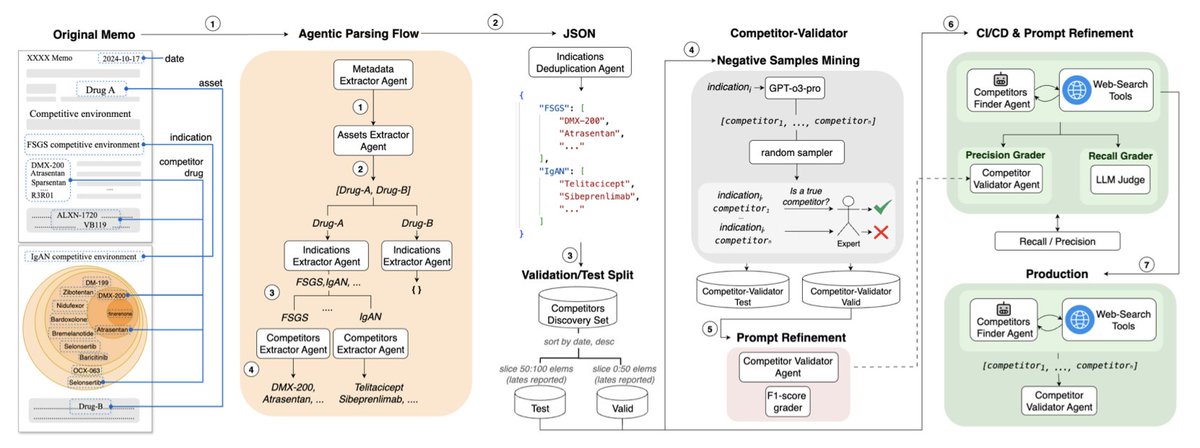
LLM-Based Agents for Competitive Landscape Mapping in Drug Asset Due Diligence
1. This paper presents a novel approach to mapping the competitive landscape for drug assets using LLM-based agents, achieving significant improvements in efficiency and accuracy for due diligence processes.
2. The system developed by the authors uses a competitor-discovery AI agent that retrieves all relevant drugs for a given indication and extracts key attributes, outperforming existing tools like OpenAI Deep Research and Perplexity Labs in terms of recall.
3. A major innovation is the introduction of a competitor validating LLM-as-a-judge agent, which filters out false positives to maximize precision and suppress hallucinations, ensuring high-quality outputs.
4. The study transforms five years of unstructured diligence memos into a structured evaluation corpus, creating a benchmark for assessing the performance of different models and agents in competitor discovery.
5. In a real-world case study with a biotech VC investment fund, the system reduced analyst turnaround time from 2.5 days to approximately 3 hours, demonstrating substantial operational impact and efficiency gains.
6. The authors compare various model configurations and show that scaffolded agents with multi-hop reasoning and web search capabilities significantly outperform single-pass prompting agents, especially on more difficult cases.
7. The system’s ability to handle multilingual, multimodal data and its robustness in dealing with fragmented and rapidly changing information landscapes highlight its potential for broader applications in the pharmaceutical industry.
8. The work underscores the importance of domain-specific benchmarks and the need for end-to-end, domain-grounded evaluation to ensure the stability and reliability of deployed AI systems in critical tasks like drug asset due diligence.
📜Paper: arxiv.org/abs/2508.16571
#LLM #DrugDiscovery #AIAgent #CompetitiveLandscape #DueDiligence #Biotech #Pharmaceuticals #Efficiency #Innovation
1
1
8
1,982

16 Jun 2025
A Marc Benioff Protégé Has Morphed Into Salesforce’s Big Worry
Despite Salesforce's $250 billion market cap, Benioff views Sierra as a significant threat, especially to Agentforce and the company's AI growth strategy. Learn more: theinformation.com/articles/…
#competitivelandscape
1
5
2,490

20 Mar 2025
Analyzing the competitive landscape of TAO and its unique value proposition. #TAO #CompetitiveLandscape!! Invest wisely, hodl strongly. Blockchain is the future. Invest wisely, hodl strongly. #TAO Decentralize everything. Sound money. Invest wisely, hodl strongly. #Blockchain
1
43

20 Mar 2025
Analyzing the competitive landscape of TAO and its unique value proposition. #TAO #CompetitiveLandscape Privacy matters. #Ethereum #ETH Layer 2 scaling. Building the future. Proof of stake. #Blockchain Crypto is changing the world. Self custody is important. Web3 is inevitable.
2
16

26 Feb 2025
#Update
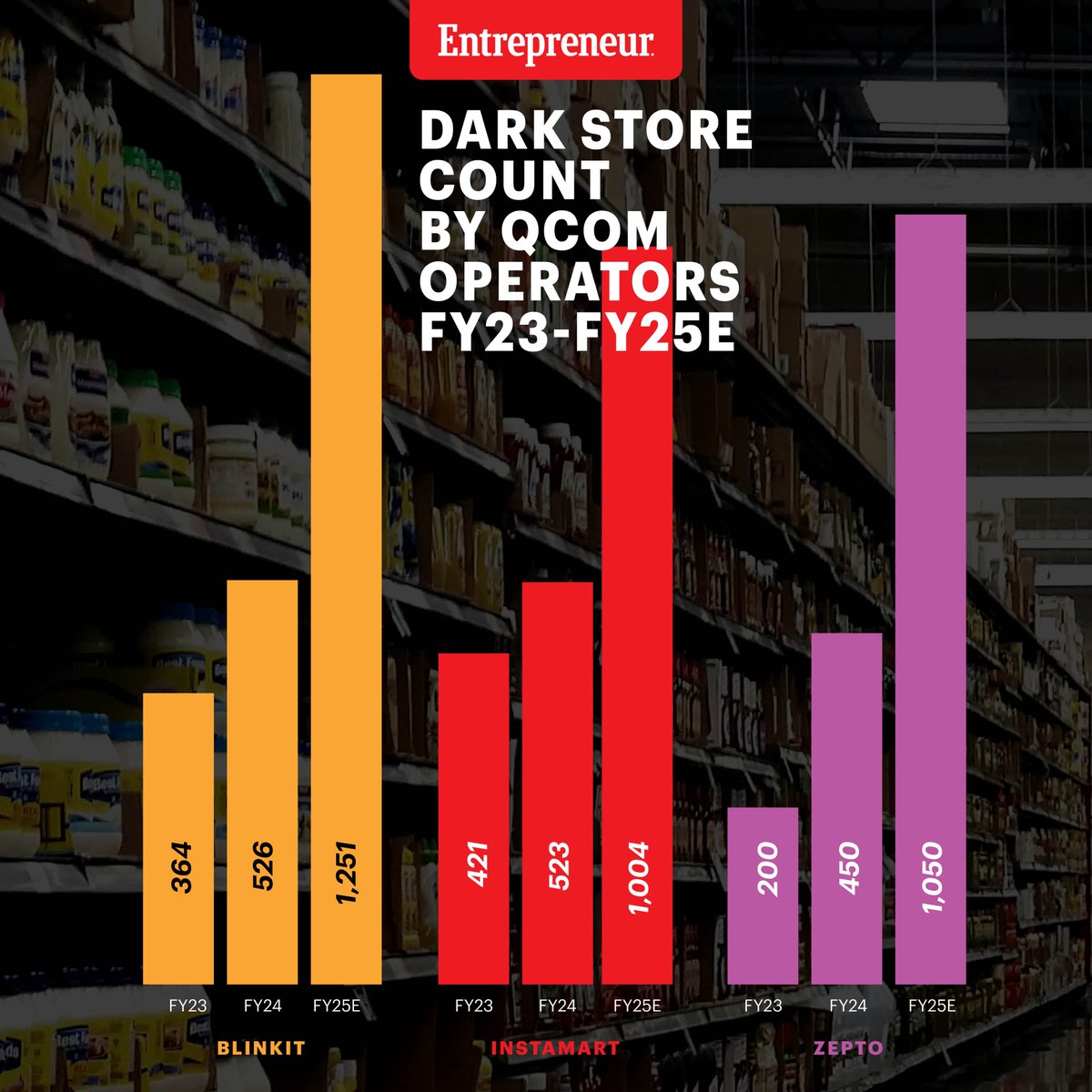
India's quick commerce sector, with a 24-fold growth to $7.1 billion by FY25, faces sustainability challenges.
Blume Ventures(@BlumeVentures )' report highlights potential market saturation and increased competition from giants like Flipkart and Amazon.
While projected MTUs reach 128 million, growth may plateau, like ride-hailing and food delivery.
Deep-pocketed competitors threaten dedicated quick commerce firms' profitability.
Regulatory scrutiny is also likely, due to potential disruption of traditional grocery ecosystems.
Experts like Gopal Srinivasan question the model's long-term viability, citing Dunzo(@DunzoIt )'s financial struggles.
The report suggests India will become a "Quickish Commerce" country as delivery speeds improve across e-commerce.
@SwiggyInstamart | @letsblinkit | @ZeptoNow
Read the story: ow.ly/WSTp50V6LwK
#QuickCommerce #BlumeVentures #IndiaBusiness #EcommerceTrends #SustainabilityChallenges #MarketAnalysis #CompetitiveLandscape #RetailInnovation #GroceryDelivery #StartupEcosystem
4
1
5
808

21 Jan 2025
Create magic with your content!
Standing out in today's #competitivelandscape demands content that cuts through the noise. Let us allow creating content that gets noticed: bit.ly/3G4YFmb
#B2BMarketing #ContentStrategy #SocialMediaMarketing #DigitalStrategy

2
21

28 Oct 2024
Join us on an inspiring ride through Hyundai’s journey—a tale of resilience, innovation, and style! From humble beginnings to dominating the car scene, Hyundai has faced challenges head-on, constantly redefining what it means to be cool in the automotive world. With @iamsrk leading the way and the Creta winning hearts, the story highlights how Hyundai continues to innovate and inspire.
Buckle up as we explore the brand that’s not just about cars, but a legacy of dreams in motion!
@knowitallwithme
#Insomniacs #Insomixers #SuccessStory #ShahRukhKhan #AutomotiveInnovation #GrowthStory #Innovation #HyundaiSuccess #CompetitiveLandscape #RealEstate #Mumbai
2
5
47
4 Jul 2024
Create magic with your content!
Standing out in today's #competitivelandscape demands content that cuts through the noise. Let us allow creating content that gets noticed: bit.ly/3G4YFmb
#B2BMarketing #ContentStrategy #SocialMediaMarketing #DigitalStrategy

1
2
40

5 Jun 2024
Yatırımcı sunumunuzda Rekabet sayfasını iyi düşünün, beklentiye uygun hareket edin … #Startup #Competition #CompetitiveLandscape #PitchDeck #Investor linkedin.com/posts/liberro_s…
1
33

In the competitive landscape of data science careers, landing a position at Microsoft represents a pinnacle of achievement many aspire to reach.
Read more 👉 lttr.ai/AS7Mp
#DataScienceCareers #CompetitiveLandscape #MicrosoftRepresents #CovetedRole #DataScienceElite

2
66

21 Feb 2024
Competition in banking is expanding beyond traditional players. Read more about the evolving dynamics: tinyurl.com/ysjbnp5c #BankingTrends #CompetitiveLandscape

2
2
7
861

18 May 2023
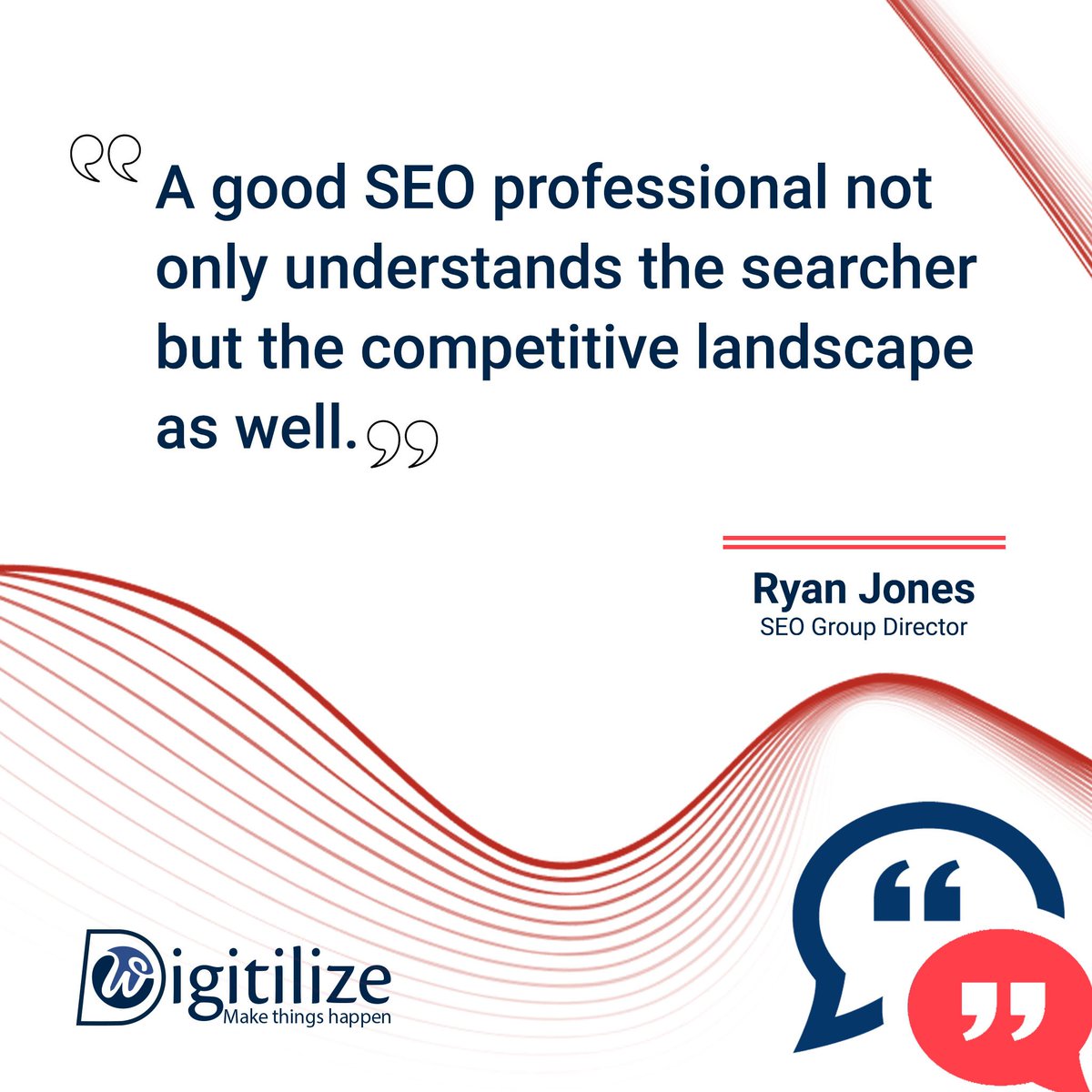
Absolutely! An excellent SEO specialist is a master at comprehending the competitive environment and the searcher’s behavior.
#SEO #SearchMarketing #CompetitiveLandscape #SearcherBehavior #DigitalMarketing #digitilizeweb
digitilizeweb.com/services/d…
ALT "Absolutely! An excellent SEO specialist is a master at comprehending the competitive environment and the searcher’s behavior. It's crucial to keep on top of things and win the race for first place in the SERPs! #SEO #SearchMarketing #CompetitiveLandscape #SearcherBehavior #DigitalMarketing #digitilizeweb "
2
7

In most markets, introducing a new idea typically provides a window of opportunity for capturing significant market share before competitors emerge. However, in fast-paced environments like China, competition can arise within the first hour of launching a product.
While ideas hold significance, it is ultimately the execution that determines success.
•⠀
•
.
.
.
•
▬▬▬▬▬▬▬▬▬▬▬▬▬▬▬▬▬▬▬▬▬
#IdeaToMarket #ExecutionMatters #CompetitiveLandscape #MarketShare #BusinessStrategy #RapidInnovation #SpeedToMarket #ProfessionalSuccess #EfficientImplementation #FastPacedEnvironment
▬▬▬▬▬▬▬▬▬▬▬▬▬▬▬▬▬▬▬▬▬
1
1
52

11 Apr 2023
Unique value proposition is a statement that communicates what sets a brand apart and why customers should choose it over others
#UniqueValueProposition #FinancialServices #BrandDifferentiation #MarketResearch #CustomerFeedback #CompetitiveLandscape #CustomerValue #BrandBenefits

1
11

4 Apr 2023
Here is an explainer video on Novus AI, our AI-powered conference coverage platform that enables you to stay ahead of the game.
Novus AI allows you to -
- Observe real-time shifts in the competitive landscape
- Learn how newly released data is benchmarked against the approved regimens and data from the key clinical trials
- Access information on relevant sessions/posters with ease.
The integration of the AI engine with our in-house knowledge base enables easy retrieval of accurate and verified information. On top of all these features, you can always reach out to our experts with a click to get details on any conference topic.
We will start a live demo of our Novus AI platform in the third week of April. Please fill out this form (lnkd.in/djUemrhK) if you are looking to elevate your conference coverage experience.
You can always write to us at novusai@oncofocus.com.
#oncofocus #novusai #oncology #conferenceintelligence #competitiveintelligence #competitivelandscape #ai #data #clinicaltrials #biopharma #intelligence #biotech #healthcare #pharmaceuticals #conference #aacr #asco #aacr23 #aacr2023 #asco2023 #asco23
1
7
683