
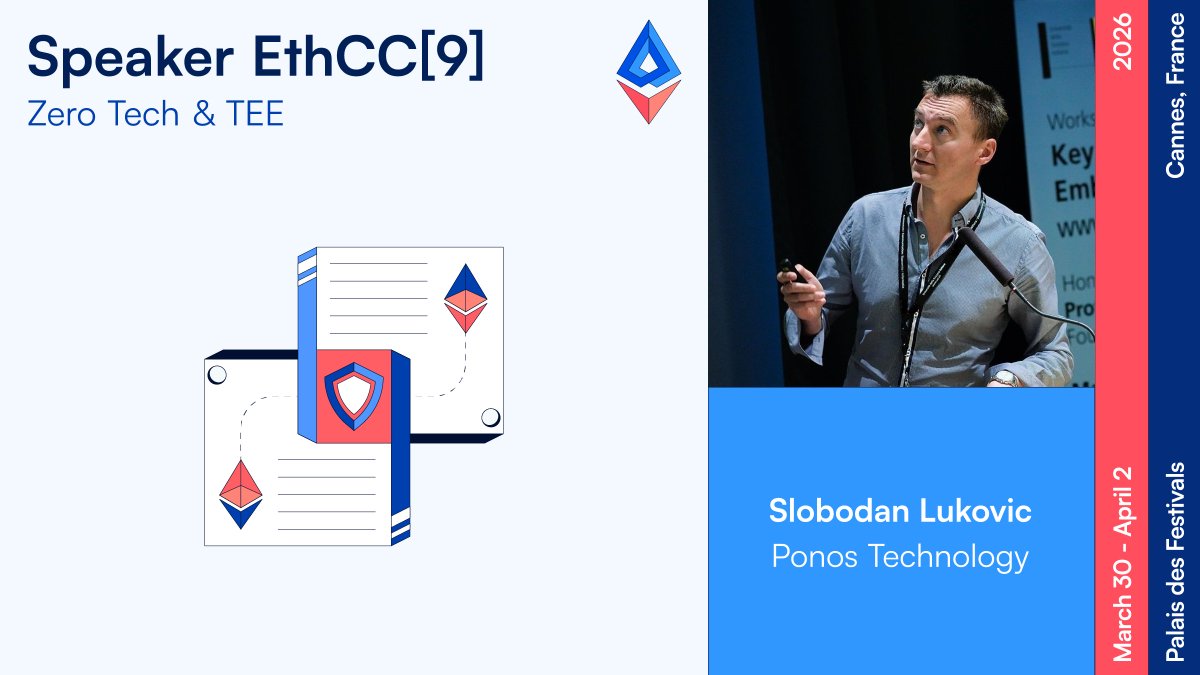
"CryptoCPU: A Solution for Ethereum's Cost-Effective, Post-Quantum-Secure ZK Future" with Slobodan Lukovic (@lukovics) at the Zero Tech & TEE track.
Building quantum-resistant infrastructure today means Ethereum can scale securely tomorrow, no matter what computing threats emerge.
1
6
166

22 Nov 2025
📃 CryptoCPU: Making Zero-Knowledge Proofs Fast, Cost-Disruptive, and Scalable
Zero-knowledge (ZK) proofs are expanding across use cases such as scalability, interoperability, verifiable off-chain computation, privacy, and cross-chain security, making ZK a natural architectural fit for next-generation blockchains. At the same time, Ethereum’s anticipated evolution toward RISC-V at the execution layer and ZK-based transformation of consensus will demand highly efficient compute structures to reduce operational expenses, cut proving latency, and unlock massive scaling while improving privacy, security, and decentralization. CryptoCPU addresses exactly these emerging needs.
🔗 👉 Learn more — full article: ponos.technology/blog/crypto…
#ZeroKnowledge #ZKProofs #BlockchainInfrastructure #Scalability

4
5
560

18 Nov 2025
Privacy is emerging as a crucial layer on top of execution and consensus, unlocking entirely new blockchain use cases. But to make this future efficient, fast, secure, and affordable, we need innovations like CryptoCPU.
18 Nov 2025

📃 Tech Deep Dive: CryptoCPU – Powering FHE & ZKPs for Confidential Computing
Verifiable and confidential computation is no longer a futuristic concept — it's here, and it's advancing rapidly. These technologies are beginning to solve some of the key barriers preventing large enterprises and FinTech companies from embracing public blockchain infrastructure at scale. They might also enable many use cases in traditional industries such as privacy-preserving cloud computing and machine learning. At the core of this transformation are two powerful technologies: Fully Homomorphic Encryption (FHE) and Zero-Knowledge Proofs (ZKPs).
🔗 Read the full article here: ponos.technology/blog/tech-d…
@PonosTechnology
#FHE #ZeroKnowledge #ZK #ConfidentialComputing #Blockchain #Crypto #Privacy #HomomorphicEncryption #Web3 #Hardware

4
5
528
18 Nov 2025
📃 Tech Deep Dive: CryptoCPU – Powering FHE & ZKPs for Confidential Computing
Verifiable and confidential computation is no longer a futuristic concept — it's here, and it's advancing rapidly. These technologies are beginning to solve some of the key barriers preventing large enterprises and FinTech companies from embracing public blockchain infrastructure at scale. They might also enable many use cases in traditional industries such as privacy-preserving cloud computing and machine learning. At the core of this transformation are two powerful technologies: Fully Homomorphic Encryption (FHE) and Zero-Knowledge Proofs (ZKPs).
🔗 Read the full article here: ponos.technology/blog/tech-d…
@PonosTechnology
#FHE #ZeroKnowledge #ZK #ConfidentialComputing #Blockchain #Crypto #Privacy #HomomorphicEncryption #Web3 #Hardware
5
6
888
2 Oct 2025
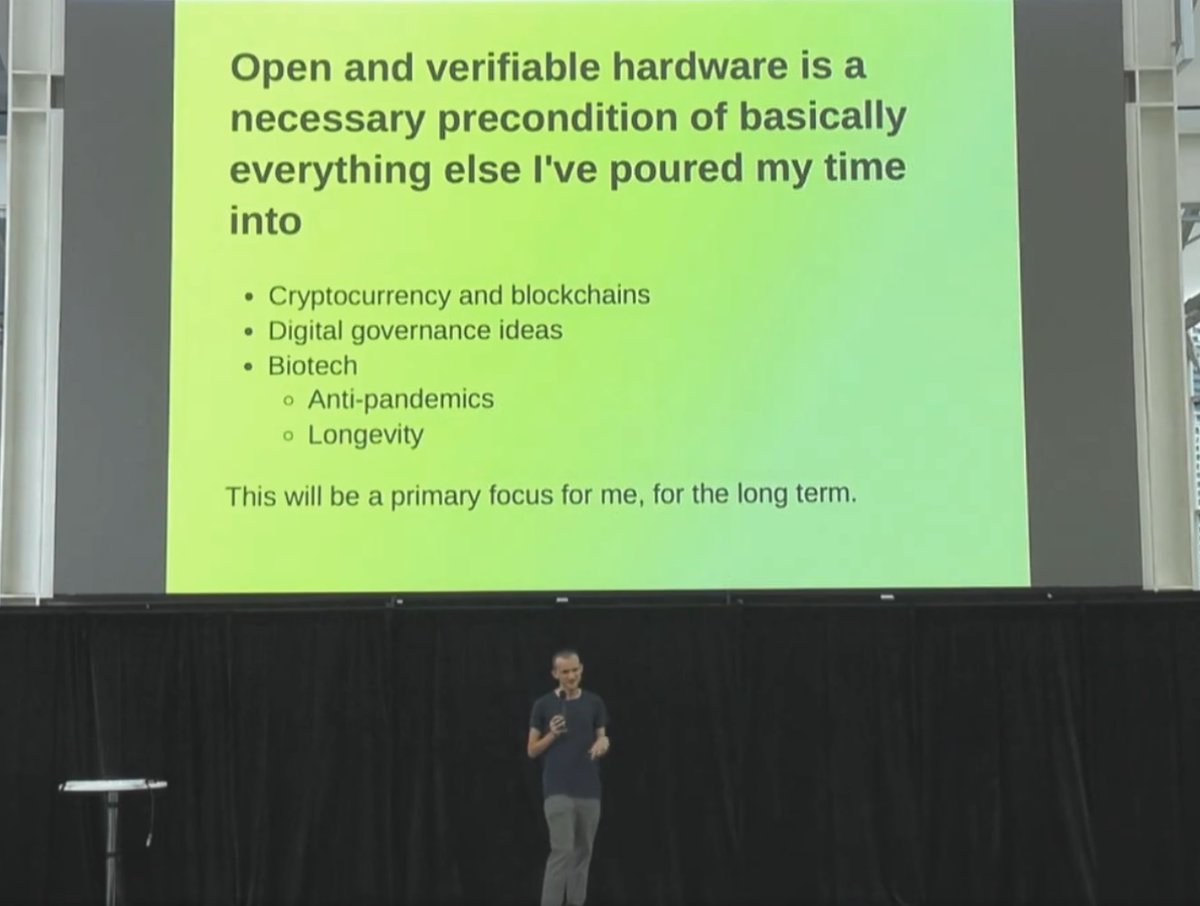
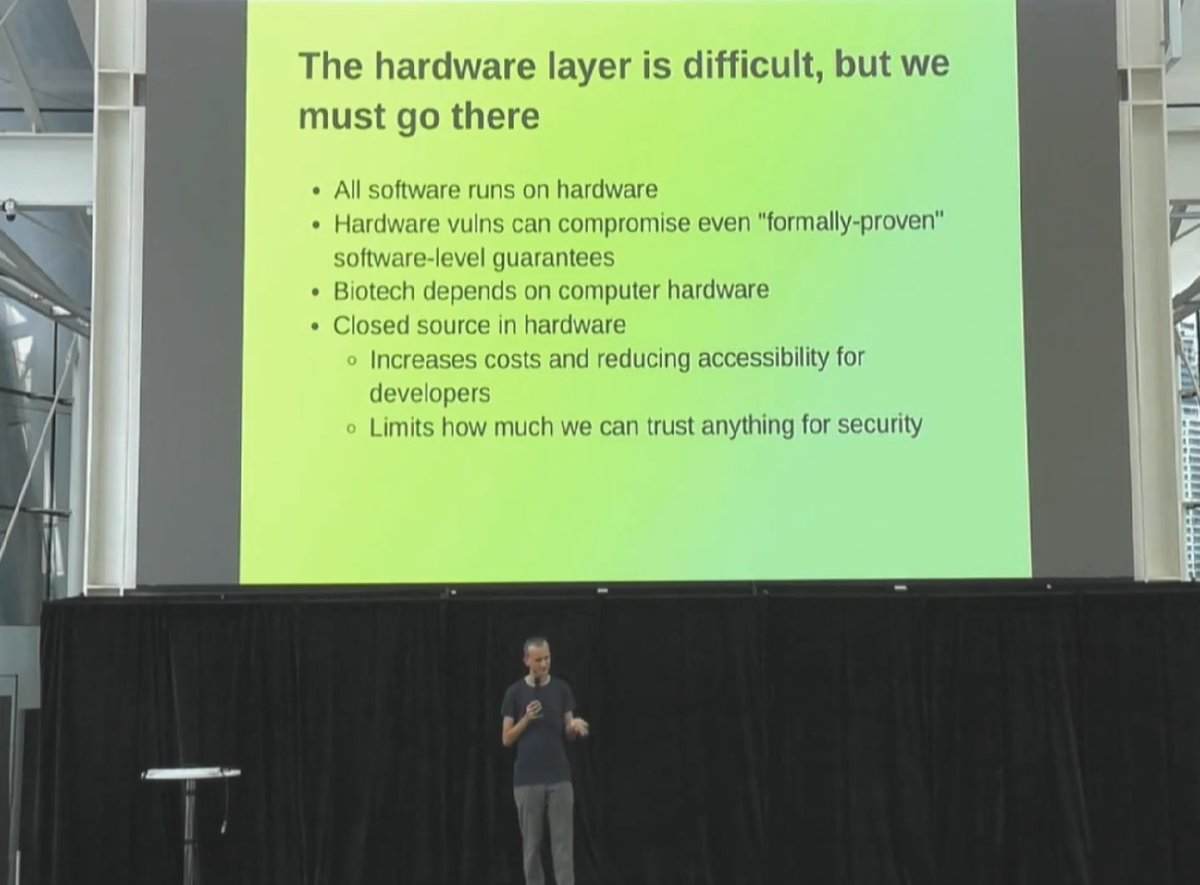
At @ethereum_sg 2025 @VitalikButerin says his long-term focus is on open and verifiable hardware, calling it a necessary precondition for everything else he’s been working on.
“The hardware layer is difficult, but we must go there…”
The shift toward hardware is underway — solutions like @PonosTechnology’s CryptoCPU are bringing fast, affordable, and seamless validation and proving to life.
👉 Learn more about CryptoCPU: ponos.technology/blog/crypto…
@PonosTechnology
1
2
273
23 Sep 2025
📃 Scaling Stablecoins with Confidentiality: How CryptoCPU Unlocks Enterprise Adoption through ZKP FHE
Rapid growth of tokenization, prediction markets, and DeFi creates enterprise use cases that need blockchain solutions which are confidential, fast, and secure. Stablecoins enable programmable global money, but adoption is slowed by trust, compliance, and security concerns. Solving this unlocks new business models through a confidential transactions layer. Advanced cryptography—Zero-Knowledge Proofs (ZKPs) and Fully Homomorphic Encryption (FHE)—holds the key. We design CryptoCPU to remove computational obstacles, making them cheap, fast, and ready for scale.
🔗 Discover how: ponos.technology/blog/scalin…
@PonosTechnology #Blockchain #Stablecoins #ZKP #FHE #CryptoCPU #Innovation
4
5
353
26 Aug 2025
In the recent @eth_proofs Call #4, @stmilosh, CTO & Co-founder at @PonosTechnology, introduced the Ponos CryptoCPU.
🔗Listen to the full recording: youtube.com/watch?v=rJiEV7jJ…

26 Aug 2025

Milos Stanisavljevic of @PonosTechnology introduced the Ponos crypto CPU:
🔹 A specialized RISC-V processor for ZK workloads
🔹 4x vector cores 8x scalar cores modular arithmetic co-processors
🔹 Designed for proving execution: trace gen, NTT, ECDSA, modular exponentiation
🔹 Target: 16-core cards priced ~$1,200 proving Ethereum blocks in real-time
🔹 100× better energy efficiency vs. current GPU/CPU setups
🔹 ASIC planned for 2026
2
12
1,150
11 Jun 2025
We've seen huge progress with SP1/Hypercube (x.com/SuccinctLabs/status/19…) and the shift toward the @SuccinctLabs prover network — perfectly aligning with @PonosTechnology strategy. Our estimates show we can replace a 200 GPU cluster with just 4 CryptoCPU cards (each with 4 CryptoCPU chips), reducing initial investment by 50x and operating costs (mainly energy consumption) by 200x. Unlike GPUs, which require massive parallelization and still plateau early, CryptoCPU's lower intrinsic latency enables proving close to 100% of Ethereum blocks in under 12s with far fewer resources.
More about CryptoCPU: 🔗👇
ponos.technology/blog/crypto…

1
7
397
5 Jun 2025
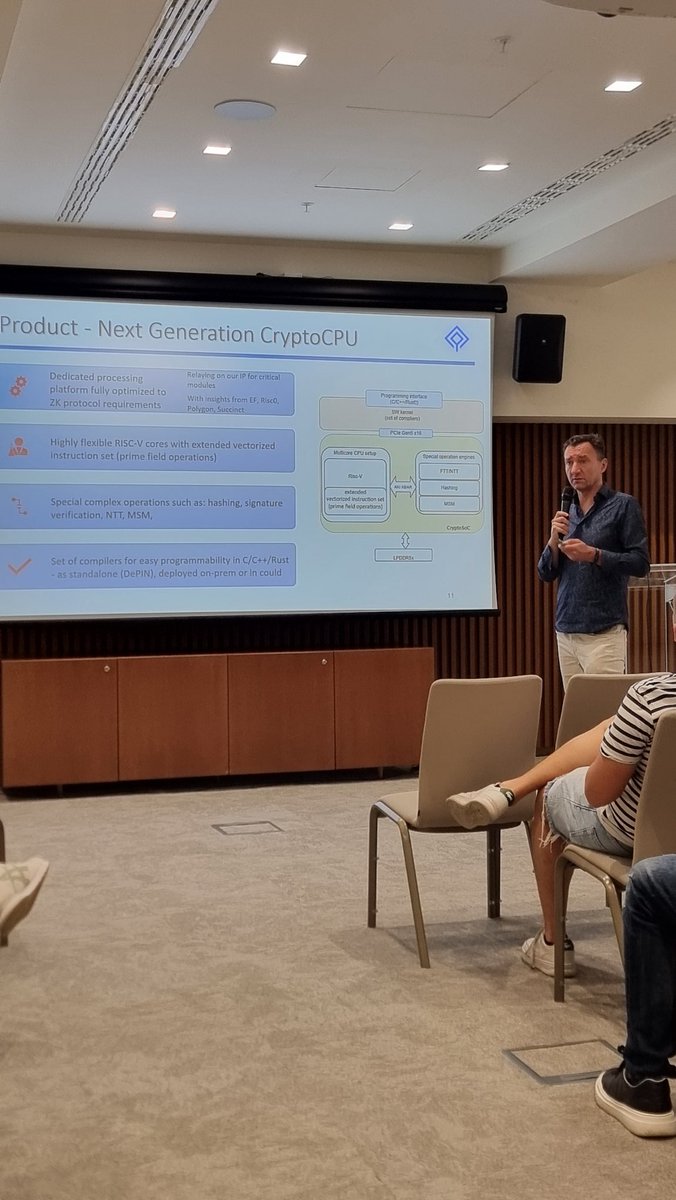
Honored to speak at #ZKdayBelgrade and showcase our CryptoCPU — powering the next generation of ZK-based blockchains. Exciting times ahead for #zkTech! ⚙️ #Web3 #Blockchain
3
8
210
5 Jun 2025
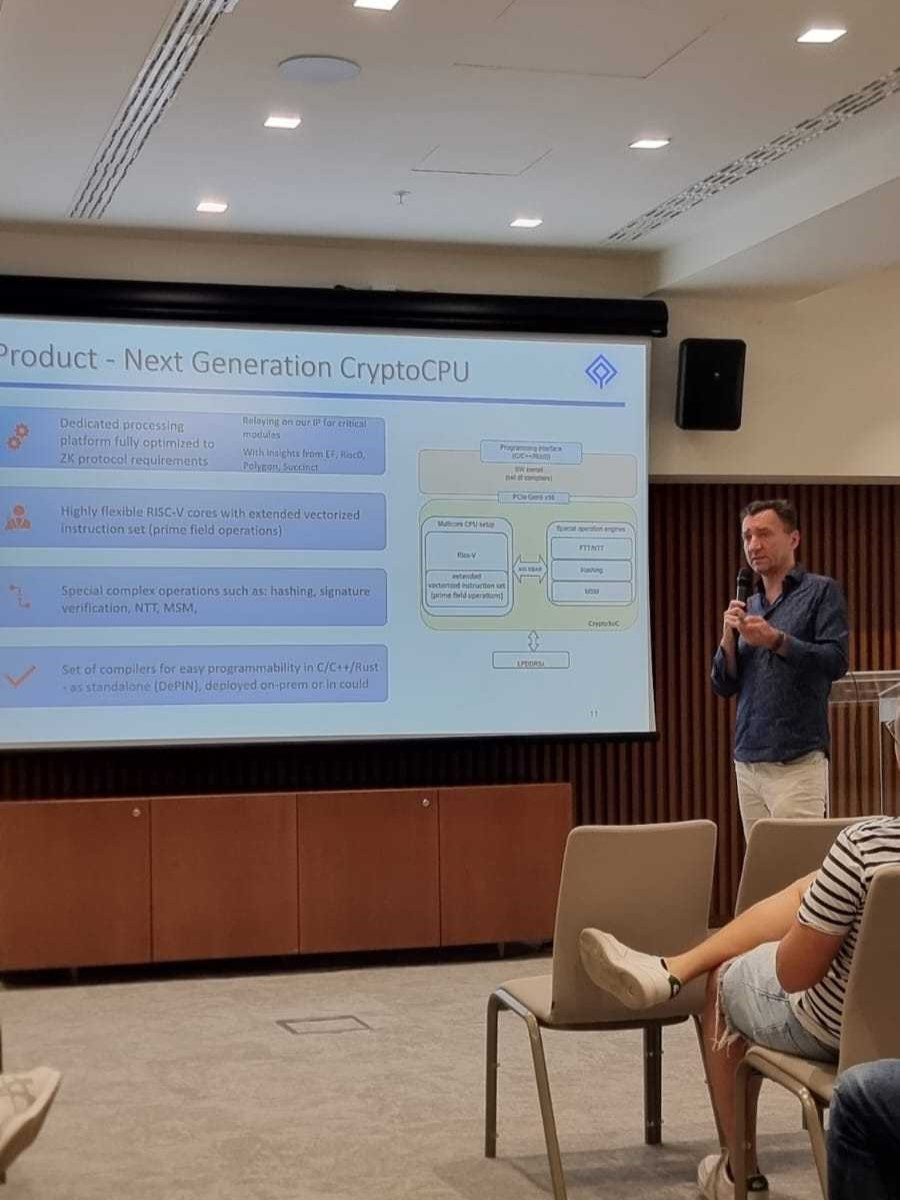
.@lukovics, CEO of @PonosTechnology, introduced the Next Generation CryptoCPU in his talk "ZK Commoditization: Powering the Next Evolution of Blockchain" at ZK Belgrade, an @ethbelgrade side event.
Explore the full details: 🔗 👇
ponos.technology/blog/crypto…
1
6
536
29 May 2025
🚀 Introducing CryptoCPU – a high-performance computing platform purpose-built to supercharge blockchain validation and zero-knowledge (ZK) proving (end-to-end):
Built with custom RISC-V vector extensions and specialized co-processors, CryptoCPU accelerates critical cryptographic operations providing:
✅ Exceptional throughput
✅ Ultra-low latency
✅ Power efficiency
✅ Seamless integration & scalability
Designed for flexible deployment across diverse systems, CryptoCPU is powering the next generation of blockchain infrastructure.
#ZKProofs #Blockchain #RISCVCores #CryptoCPU #HighPerformanceComputing #Web3 #ZeroKnowledge #CryptoInfrastructure
Explore the full details: 🔗 👇
ponos.technology/blog/crypto…

2
5
7
2,037

29 May 2025
🚀 Meet CryptoCPU — a high-performance platform built to accelerate end-to-end ZK proving & blockchain validation.
With custom RISC-V vector extensions & co-processors, it delivers top-tier throughput, low latency, & power efficiency.
ponos.technology/blog/crypto…
#ZKProofs #RISCV
4
5
333
28 May 2025
🚀 Meet CryptoCPU — a high-performance platform built to accelerate end-to-end ZK proving & blockchain validation.
With custom RISC-V vector extensions & co-processors, it delivers top-tier throughput, low latency, & power efficiency.
ponos.technology/blog/crypto…
#ZKProofs #RISCV
6
8
547
8 May 2025
CryptoCPU is a flexible RISC-V-based platform that slashes latency and cost for tasks like validation ZK proving, and witness generation—powering the next-gen of scalable, efficient blockchains
8 May 2025
A common misconception about ASIC-based platforms is that they are fixed, single-function computing devices that cannot be reprogrammed or adapted for various tasks without a complete redesign. While this is true for ASICs designed with very narrow, specific instructions—such as SHA-256 hashing for Bitcoin mining—these devices typically have minimal firmware and simple communication interfaces, focusing exclusively on a single dedicated task.
Now, imagine extending an ASIC’s capabilities to support more complex workloads, like Google Cloud Tensor Processing Units (TPUs). These devices remain ASICs at their core but are managed by low-level firmware and enhanced with a custom-built, domain-specific compiler stack. This allows them to efficiently handle a wide range of AI model computations rather than being limited to a single function. Taking this concept further, consider integrating a full CPU into an ASIC chip along with specialized extensions for specific operations. In this case, rather than completely redesigning the firmware, we would only need to optimize mainstream compilers to support these extensions. The result? A powerful, programmable device that can be used as a server card or a standalone unit, capable of running high-level programming languages while benefiting from native, dedicated instruction sets.
This approach enables significantly faster execution than traditional computing architectures—similar to how ARM-based Snapdragon processors optimize performance in mobile devices. In our case, we extend the well-established RISC-V processor, leveraging its robust tooling and strong community support. This allows compatibility with mainstream programming languages while incorporating dedicated hardware support for major cryptographic operations, such as signature verification, hashing, and NTT/FFT computations. The outcome is an unprecedented reduction in computation time and cost for key blockchain operations.
3
8
248


10 Apr 2021
I notice a lot of runners from the sub pennies up to about the penny mark...then a period of consolidation.
For VRA i think once it breaks 5 cents, 25 comes quick. Then 50. Its under 4 billion in circulation. This thing might go CHZ
1
2

