
Jun 15
Been saying it for a while now: Ethereum liquidity is coming to @salvium_io
Once the Monero $XMR crowd realises what's being built on top of CryptoNote, the value proposition becomes obvious. Salvium is pushing this codebase forward with actual real utility.
$KAS 🤝 $SAL
Jun 15

🚧ERC20 Bridge Progress Update
Development of the Salvium ERC20 bridge continues to advance.
☑️Deposit proofs are now in internal testing and have entered their final optimisation cycle.
☑️Withdrawal proofs have also entered internal testing, with optimisation work scheduled immediately after.
Once both proof systems have been fully tested and stabilised, we'll be deploying a testnet bridge of the complete mechanism.
As we prepare for the ERC20 testnet launch, we'll be rolling out a series of infrastructure and network updates over the coming weeks to help ensure a smoother and more reliable final deployment.
We're getting closer. Stay tuned for more updates.
The Salvium Team
6
19
52
1,195

$Privacy & $Security
• Fully $anonymous transactions powered by CryptoNote Dero Rocket Bulletproofs. $DERO was one of the first projects to implement Bulletproofs on mainnet, making the $blockchain dramatically more efficient than $Monero.
1
5
105


Então segiro que você leia o CryptoNote Whitepaper, que é a base técnica do Monero, fala que é uma moeda digital cash.
20


Jun 11
witness the evolution of privacy right in front of your eyes with @salvium_io..
$ZEC - $7B market cap
Privacy remains optional by design and real-world adoption has struggled to justify its market capitalization.
The network has also faced security incidents and exploits that have raised concerns about long-term resilience.
$XMR - $5.9B market cap
Growth has increasingly been constrained by exchange delistings, regulatory pressure, and shrinking liquidity.
Its primary use case remains private payments only, with no native yield generation, staking, regulatory adaptability or integrated DeFi ecosystem to expand utility.
$SAL - $1.9M market cap
Built on the proven CryptoNote foundation, Salvium represents the next evolution of privacy-focused cryptocurrency. It combines default privacy with native staking, on-chain yield generation, selective transparency, and features designed for greater regulatory resilience.
With a roadmap that includes Private DeFi, ERC-20 interoperability, private smart contracts, and broader real-world utility, Salvium offers significantly more upside potential and functionality than legacy privacy coins at a fraction of their valuations.
Why settle for a privacy coin when you can own a privacy economy with @salvium_io ?
Jun 11
The launch of Salvium One in October 2025 changed the conversation around blockchain privacy forever.
For the first time, it demonstrated that a privacy-focused chain could be built for the realities of the emerging MiCA era - delivering regulatory compatibility without compromising privacy, decentralization, or real-world utility.
But that was only the foundation.
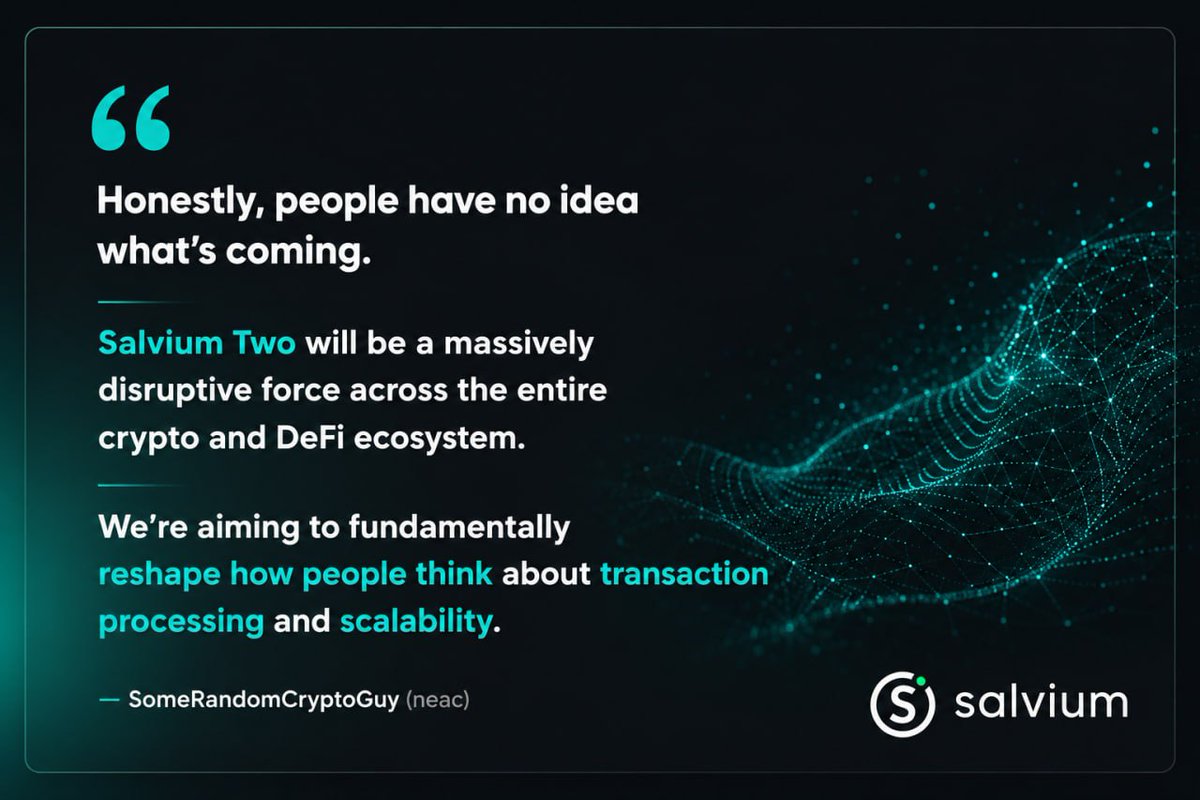
Salvium Two is set to elevate the project into a category of its own.
It begins with the upcoming ERC20 bridge to Ethereum, connecting Salvium to the largest liquidity ecosystem in crypto and enabling seamless movement between private and public blockchain networks.
The next phase of the roadmap includes:
🔹 Truly private smart contracts
🔹 Layer 2 functionality designed for scale
🔹 Higher throughput and more efficient tx processing
🔹 A privacy-first DeFi ecosystem built for real adoption
We are not here to push the boundaries of blockchain privacy.
We are here to redefine the entire concept of digital money - where privacy, scalability, interoperability, and real-world usability exist without compromise.
12
27
65
3,533

Jun 10
Private DeFi on CryptoNote is the roughest diamond atm. With cryptographic tools for exchanges to stay compliant.
@salvium_io $SAL
2
67

Hey @Crypto_peet, your request got the most likes this week. I posted a quick rundown yesterday so here is the full, in-depth analysis of your request, @salvium_io.
Salvium is a Layer 1 proof-of-work blockchain built on a CryptoNote codebase, launched on 2024-07-02. It emphasizes compliant privacy, aiming to deliver strong on-chain privacy features while incorporating regulatory adaptability through refundable transactions, exchange modes, and tools aligned with frameworks such as MiCA. This approach seeks to mitigate delisting risks faced by traditional privacy coins.
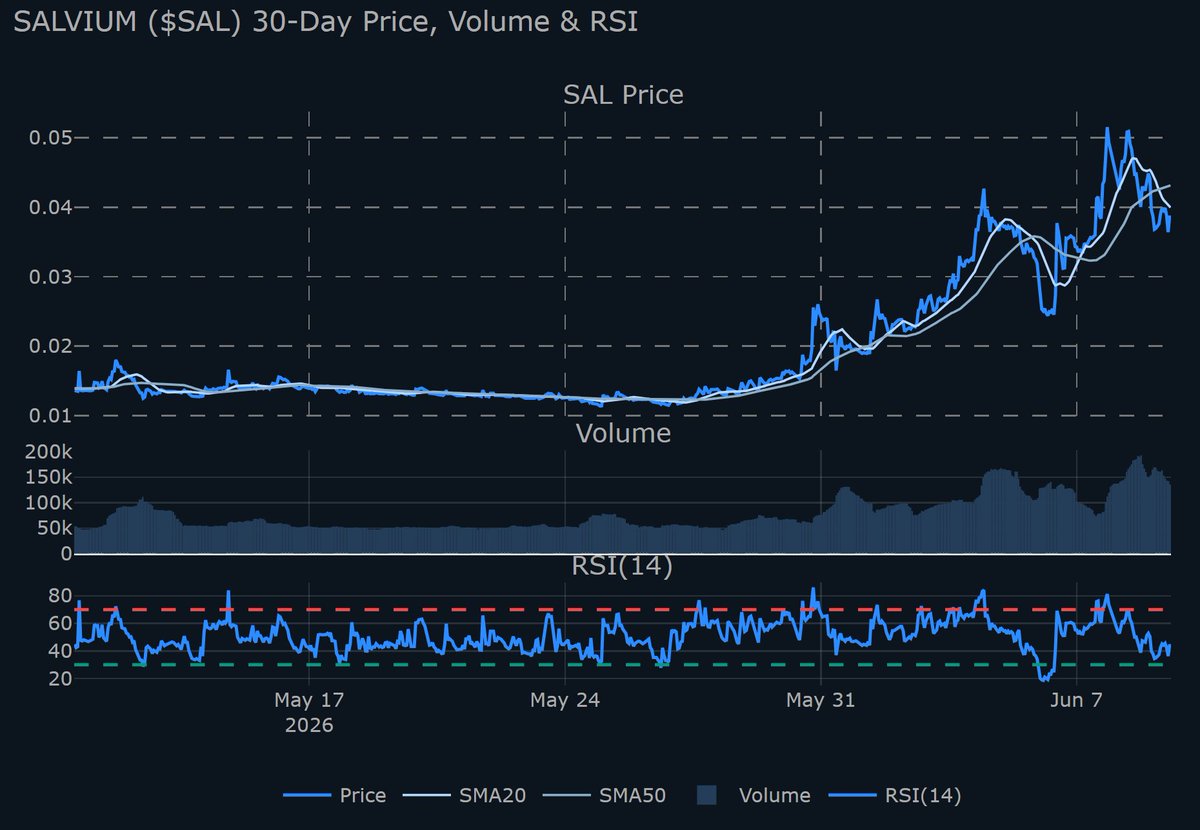
Risks are substantial given the sub-2 million USD self-reported capitalization, sub-130,000 USD daily volume, sub-4,000 Twitter following, and current lack of significant DeFi TVL or major exchange listings beyond the MiCA eligibility opinion. Liquidity is thin, volatility elevated, and the project remains early-stage with smart contract functionality still forthcoming. Price sits below key moving averages after a strong run, warranting caution on near-term continuation without increased volume or positive catalysts.
This is a high-risk, speculative asset best suited for portfolios with substantial risk tolerance and long time horizons. Monitor staking participation, progress on smart contracts and partnerships, actual exchange listings, and on-chain activity for validation.
Strengths include genuine innovation in programmable privacy and regulatory adaptability, audited cryptography, and an active educational community showing consistent growth. Recent triple-digit percentage gains over 30 days reflect speculative interest in this narrative amid a broader market that remains volatile and bearish.
Salvium presents a specialized proposition in the privacy sector by directly addressing regulatory friction through compliant tools and legal groundwork, which differentiates it from pure privacy coins that have faced exchange delistings. The combination of live native staking on PoW, completed audits, successful hard fork for asset issuance, and a clear path to smart contracts and DeFi positions the project for potential adoption if regulatory clarity improves and Phase 3 deliverables are executed.
Tokenomics and Current Market Position: Total supply stands at 56,205,202 with a max supply of 184,400,000. Self-reported circulating supply is 27,734,846. The latest price is 0.0384 USD, reflecting a 24-hour change of -16.09%, 7-day gain of 73.40%, 30-day increase of 180.99%, 60-day change of 83.50%, and 90-day change of 58.49%.
24-hour volume is 77,313 USD (predominantly CEX), with 5 active market pairs. Self-reported market capitalization is approximately 1.06 million USD, and fully diluted valuation is 7.08 million USD. CMC rank is 4037. The token functions as the native utility and staking asset, with a pre-mine that is partially time-locked for development and operations, plus tail emission.
Key innovations include native staking, where participants earn 20% of block rewards (a first for pure PoW CryptoNote-based chains) with an approximate 30-day lock period, Transactional Imbalances, Asynchronous Transactions, SPARC, and T-CLSAG (both audited by Cypher Stack). The project is positioned as DeFi-ready, with foundational support for smart contracts, programmable privacy levels for DApps, and planned middleware to facilitate porting of existing Ethereum applications. A hard fork at block 465,000 on April 13, 2026, activated on-chain token creation known as Salvium Assets, requiring wallet updates.
In the current very bearish investor mood and mixed broader sentiment, position sizing should remain conservative, with attention to overall market recovery signals. The compliant privacy angle has structural merit, but execution over time will determine whether it translates into sustained value accrual.
Jun 8

@HeyEva Check $SAL @salvium_io a programmable compliant privacy L1 with upcoming erc20 shielding, mica listings and private smartcontracts at only 2m marketcap
6
14
33
2,598

Jun 9
The TL;DR on why Zano is fundamentally changing the on-chain privacy game:
> The Public Chain Problem: Traditional blockchains are open ledgers. Anyone who knows your wallet address can instantly see your exact net worth, token balances, and entire transaction history.
> The Monero Pedigree: Zano isn't a random clone. It's engineered from scratch by the OG co-author of the CryptoNote reference codebase, the exact architectural framework that powers Monero ($XMR).
> True Native Privacy: This isn't a flimsy mixer, a basic privacy wrapper, or a temporary fix. It’s a custom, non-EVM layer built specifically to keep all transactions completely untraceable and hidden by default.
> Confidential Assets: It doesn't just hide the native coin. The architecture allows anyone to issue completely customized, private tokens and build private dApps on-chain.
Instead of trying to patch a broken system, the minds who created the industry standard for privacy are building its next evolution.
1
6
310
VitalikButerinOfficial retweeted

Jamtis: Why a new address format?
When Monero was created in 2014, it inherited the CryptoNote addressing scheme. Originally, each wallet only had a single public address and payments were disambiguated with payment IDs. In 2017, subaddresses were introduced, which allowed each wallet to generate a virtually unlimited number of seemingly unlinkable addresses.
In 2019, a weakness of subaddresses was identified, which allows an attacker to link two subaddresses belonging to the same wallet. This is called the "Janus attack".
In 2026, Monero will upgrade to a new transaction protocol called Carrot, which provides mitigations for the Janus attack and offers address-conditional forward privacy (i.e. forward privacy if addresses are kept secret).
However, several issues with the legacy addressing scheme remain unresolved:
1. Wallets with publicly known addresses lose nearly all privacy against a quantum-enabled adversary.
2. Wallets that use a third party service for scanning the blockchain lose nearly all privacy.
3. Generating subaddresses requires keeping track of a global counter, which complicates implementations and may cause merchants to prefer legacy integrated addresses.
4. The detection of outputs received to subaddresses is based on a lookup table, which can sometimes cause the wallet to miss outputs.
5. Checking two addresses for equality is difficult for humans because CryptoNote addresses are long and case-sensitive.
The goal of Jamtis is to tackle the shortcomings of CryptoNote addresses that were mentioned above. Specifically:
1. Jamtis wallets with publicly known addresses retain a certain level of privacy even against a quantum-enabled adversary.
2. Jamtis wallets using a third-party scanning service retain a certain level of privacy.
3. Jamtis addresses can be safely generated without keeping track of a global counter.
4. Balance recovery for Jamtis wallets can be done reliably without the need to use a precomputed table of keys.
5. Jamtis addresses can be quickly compared thanks to a "visual prefix" consisting of 30 lowercase characters.
Jamtis focuses on post-quantum privacy because all past and present Monero transactions are vulnerable to quantum privacy-breaking attacks due to the "harvest now, decrypt later" strategy.
Additional goals are:
1. Backward compatibility with Carrot without hard forking changes.
2. Enotes sent to Jamtis addresses are indistinguishable from enotes sent to legacy addresses.
3. Jamtis addresses retain existing security properties of Carrot, especially Janus attack protection.
Jamtis also comes with a new 16-word mnemonic scheme called Polyseed that will replace the legacy 25-word seed for new wallets.
Non-goals
An explicit non-goal of Jamtis is post-quantum soundness. This includes preventing a quantum-enabled adversary from:
1. opening Pedersen commitments to arbitrary monetary values
2. forging spend authorization proofs and linking tags
3. forging membership proofs
Past and present Monero transactions are safe from soundness-breaking quantum attacks, assuming no cryptographically relevant quantum computers exist at this moment. Both Carrot and Jamtis support a migration protocol that will be used in a future fully post-quantum upgrade.
Read more: gist.github.com/tevador/639d…
1
26
61
20,229
Jun 9
You want to be the first MiCA exchange to make fees of a CryptoNote chain after July 1st? Independent legal opinion states says $SAL is good to go under MiCA regulations 👌
@salvium_io
4
57
Suat Kek “🧡 Ordzaar” retweeted

Jun 7
💡 Did You Know?
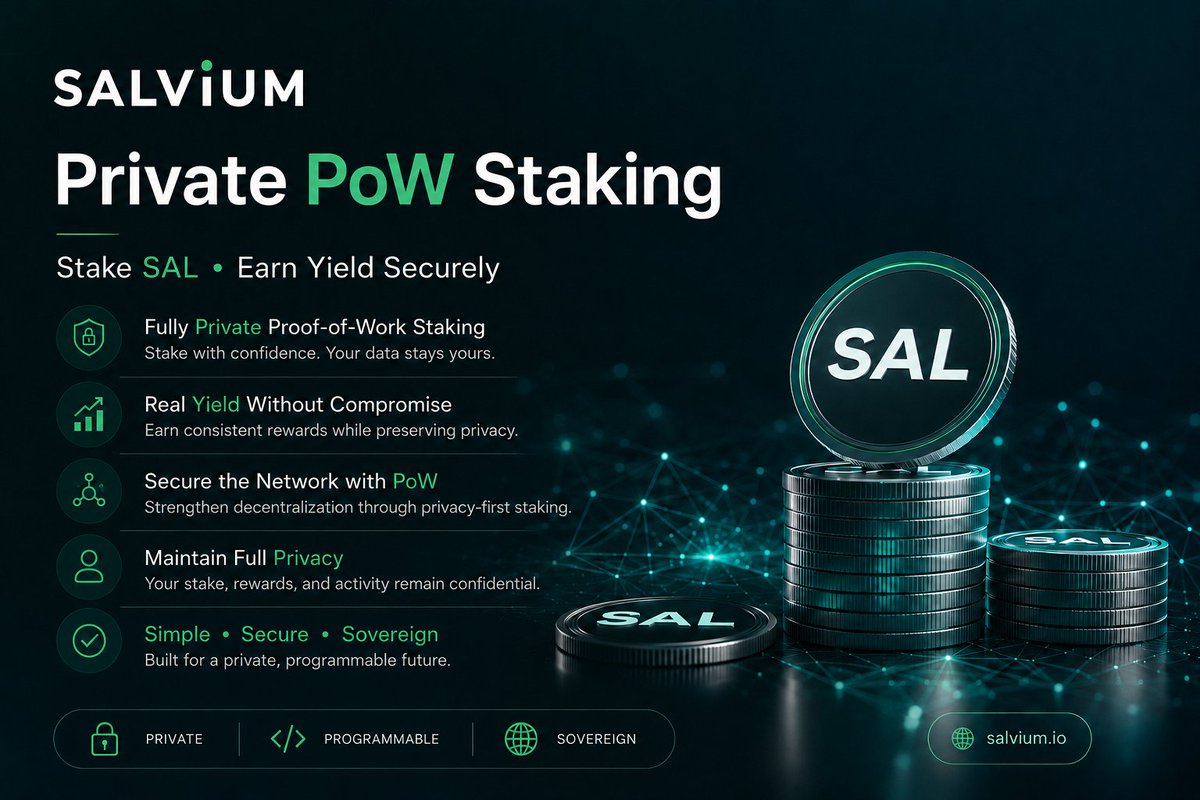
For the first time in the history of a pure Proof-of-Work blockchain built on a CryptoNote codebase, Salvium introduces native staking & yield directly at the protocol level.
Unlike traditional staking systems that rely on Proof-of-Stake consensus, validators, or third-party smart contracts, Salvium remains a pure PoW network while allowing $SAL holders to lock coins and earn yield directly from block rewards.
Built on CryptoNote architecture, Salvium's innovations - including Transactional Imbalances (TI) and Asynchronous Transactions (AT) - enable what the project describes as the first true native CryptoNote staking and yield system.
🔹Privacy-first
🔸Pure Proof-of-Work
🔹Native Yield
🔸CryptoNote Innovation
Learn more about how Salvium staking works 👇
docs.salvium.io/THE PROTOC…
10
34
85
2,581

Jun 8
$SAL CryptoNote L1 with native staking. Pivate DeFi with upcoming SC. Hidden lending, no frontrunning, no one can see your position and try to liquidate you. And it has cryptographic tools for exchanges to stay compliant.
@salvium_io
1
1
4
72